Introduction
The psychological response of rescue workers under stressful situations, called “critical incident stress (CIS),” has been measured on a long-term basis in Europe and the United States.Reference Fullerton, McCarroll, Ursano and Wright 1 Some firefighters who are exposed to CIS are troubled by the symptoms of posttraumatic stress disorder (PTSD).Reference Mitchell and Dyregrov 2 , Reference Bryant and Harvey 3 The day-to-day work of firefighters involves many duties, including extinguishing fires, rescue work, and emergency transportation. They also protect the lives, physical health, and property of individuals from disasters. It is reported that firefighters often experience feelings that may trigger traumatic stress during the course of their work, including feelings of helplessness, guilt, misery, fear, irritation, regret, sadness, and self-hate.Reference McFarlane and Raphael 4 , Reference Pfefferbaum, North, Bunch, Wilson, Tucker and Schorr 5 In Japan, firefighters are engaged in firefighting and rescue operations. Beginning in the 1980s, an interest developed in the stress disorders of high-risk populations exposed to emotional trauma during rescue work.Reference Robinson, Sigman and Wilson 6 Firefighters, emergency workers, and police are among those in these high-risk populations; relevant stress studies have been conducted primarily in Europe, the United States, and Australia. Several surveys of firefighters exist that describe their experiences with specific accident or disaster events, including one study that investigated the prevalence of mental health problems in firefighters exposed to a bushfire in Australia.Reference McFarlane 7 Reports show that firefighters have a higher prevalence of PTSD symptoms than does the general population, because of exposure to CIS in their day-to-day jobs and the duties specifically related to particular events.Reference Bryant and Harvey 3 , Reference Wagner, Heinrichs and Ehlert 8
The Great East Japan Earthquake, which occurred off the coast of Japan on March 11, 2011, was one of the strongest earthquakes recorded in Japan. As a result of the earthquake, a tsunami (“tidal wave”) was created that devastated large portions of coastal Japan. Particularly hard hit were the areas of Iwate, Miyagi and Fukushima prefectures.Reference Yanagawa, Miyawaki and Shimada 9 In response to this event, firefighters of the Fire Department of Akita City were dispatched to the affected communities (Yamada Town and Miyako City in Iwate prefecture and Minamisanriku Town in Miyagi prefecture). They worked to support these communities from the time of the earthquake onwards. The Akita City Fire Department requested that the Akita Prefectural Mental Health & Welfare Center conduct a mental health check on the dispatched firefighters to assess levels of CIS. This study reports the results of this mental health assessment.
Methods
Data were collected from 118 male Akita City firefighters who participated in the Great East Japan Earthquake (Higashi Nihon Dai-Shinsai) rescue effort from March 11 through March 31, 2011. Primary checks (shortly after return from the rescue effort), secondary checks (approximately two weeks after return from the rescue effort), and tertiary checks (approximately one month after return from the rescue effort) were performed. Each check consisted of one or more of the following elements:
-
(1) self-administered questionnaires (comprising questions about demographics, physical complaints and medical history, and the Impact of Event Scale Revised [IES-R]);
-
(2) interview by a public health nurse or a clinical psychologist;
-
(3) interview by a psychiatrist; and
-
(4) provision of information on CIS and PTSD.
A cut-off point of 24/25 for screening was set for determining presence (caseness) of PTSD. Therefore, participants who scored ≥25 points on the IES-R were defined as the PTSD high-risk group and those with a score of <25 points were designated as the PTSD low-risk group.Reference Asukai, Kato and Kawamura 10 Statistical analysis on the IES-R was performed using SPSS version 11.0J for Windows (SPSS, Tokyo, Japan).
Results
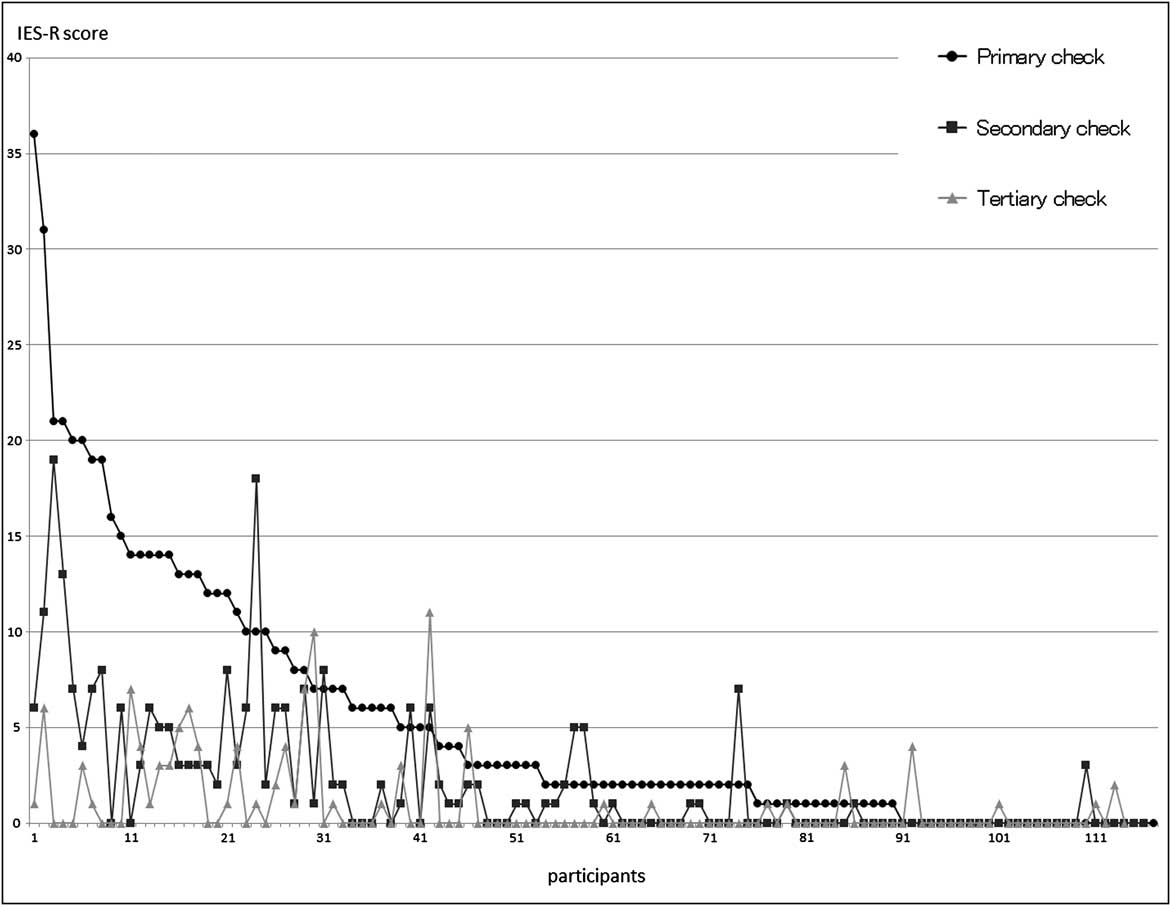
With regard to the questionnaires to assess physical complaints and medical history, no participant had any particular problem with his health. Participants of the primary check (n = 117) had IES-R scores in the range of 0-36 points, with a mean score of 5.22 (SD = 6.75), and only two participants scored ≥25 points. Participants of the secondary check (n = 116) had scores ranging from 0-19 points with a mean score 2.06 (SD = 3.48). Participants of the tertiary check (n = 114) had scores ranging from 0-11 points, with a mean score of 0.96 (SD = 2.07) (Figure 1). Interviews were conducted with 117 participants in the primary check and 116 participants in the secondary check. In the tertiary check of the 114 participants, 61 were interviewed and the remaining 53 participants only completed self-administered questionnaires. Participants were advised to consult the Akita Prefectural Mental Health & Welfare Center as desired for follow-up, although no participant was judged to need a prompt medical consultation as a result of these checks.
Distribution of the Impact of Event Scale Revised (IES-R) Scores of the Participating Firefighters in the Primary, Secondary, and Tertiary Assessments

Discussion
Previous research has investigated traumatic stress in firefighters.Reference McFarlane 7 , Reference Hytten and Hasle 11 With regard to CIS, one report has described the longitudinal course of posttraumatic morbidity in firefighters who were exposed to a bushfire disaster.Reference McFarlane 7 , Reference McFarlane, Clayer and Bookless 12 There are also reports of surveys conducted in non-professional firefighters who participated in a hotel fire rescue operation;Reference Hytten and Hasle 11 in rescue workers, firefighters and others who participated in the rescue effort after the ferry Estonia sank off the coast of Finland;Reference Nurmi 13 and in members of the New York City Fire Department who responded to the World Trade Center site on September 11, 2001.Reference Spadafora 14 In the US, it is said that firefighters are engaged in one of the most stressful jobs.Reference Hildebrand 15 A questionnaire survey assessing the prevalence of PTSD in 402 professional firefighters in Germany estimated that the current prevalence rate of PTSD symptoms among professional firefighters engaged in their day-to-day jobs is 18.2%.Reference Wagner, Heinrichs and Ehlert 8 In addition, firefighters have stated potentially stressful incidents may negatively affect their physical health.Reference Polakoff 16 For example, a report of data obtained from Los Angeles City Firefighters showed that firefighters are highly likely to develop ischemic heart disease (as shown by abnormal ECG findings) as a result of job-related stress.Reference Barnard, Gardner, Diaco and Kattus 17
In this study, no participants had a particular problem with physical health. Moreover, it has been reported that posttraumatic stress is associated with recent critical incidentsReference Bryant and Harvey 18 and that firefighters who have been exposed to such incidents have a higher IES score. In this study, only two of the 117 participants (1.7%) met the criteria of high-risk PTSD when a cut-off point of 24/25 on the IES-R was applied. Furthermore, both participants scored ≥25 points on the IES-R during the primary check (shortly after return from the rescue effort). Previous studies that used a questionnaire survey similar to that used in the present study reported high-risk for PTSD including Wagner et al (1998)Reference Wagner, Heinrichs and Ehlert 8 who reported a prevalence rate of 18.2% in Germany using the PTSD Symptom Scale; Al-Naser et al (1999)Reference Al-Naser and Everly 19 who reported a prevalence of 18.5% using IES; and Bennett et al (2004)Reference Bennett, Williams, Page, Hood and Woollard 20 who reported a prevalence rate of 22% in the United Kingdom using a posttraumatic diagnostic scale. Contrary to expectations, the patterns of posttraumatic stress for participants in the present study were less common than was observed in previous studies. In fact, study participants were in good mental health.
Limitations
More study is required to determine if the reported findings adequately and clearly reflect the mental health of the study participants. It has been stated that PTSD is associated with substantial health service use. However, patients with PTSD are more likely to receive treatment in non-mental health clinics.Reference Eaton, Sigal and Weinfeld 21 - Reference Calhoun, Bosworth, Grambow, Dudley and Beckham 23 It is possible that firefighters are suffering from a cultural environment that may prevail in a fire station, and that they cannot show their feelings openly, which could result in a skewed or misleading IES-R score. In this study, the information provided by the firefighters was made available to the managers of the fire department and the firefighters may have felt uneasy with information given possibly resulting in a negative influence on their careers. In the present study, the request for the mental health assessments and interviews came from the fire department management, indicating that this department had an understanding of the need for mental health care. This understanding may have led to a positive result in the present study. Although conducting mental health assessment by self-reported questionnaires is a useful method for CIS assessment, a weakness of this method may be bias when participants are resistant to psychiatric consultation. Therefore, it is desirable to use interviews in addition to the self-administered questionnaires assessments.
Conclusion
Contrary to expectations, the patterns of posttraumatic stress morbidity were less common in the present study than has been observed in previous studies. The firefighters who participated in the present study were in good mental health. However, more study is required to ascertain whether these findings would adequately and clearly reflect the state of mental health of similar study participants.
Abbreviations
- CIS:
-
critical incident stress
- IES-R:
-
Impact of Event Scale- Revised, Japanese Version
- PTSD:
-
posttraumatic stress disorder