More than 50 years ago, the term “modernization” emerged in the social sciences to describe the transition from traditional structures to more advanced systems. According to the original literature, modernization originates in the economic realm (Rostow Reference Rostow1960), bringing about fundamental changes in politics (Lipset Reference Lipset1959; Huntington Reference Huntington1968) and society (Deutsch Reference Deutsch1961; Eisenstadt Reference Eisenstadt1964), and subsequently affecting culture (Gellner Reference Gellner1983). However, despite its important position in human life, its role as a driver of change has largely been neglected in political science. In particular, the link between modernization and the onset of civil conflict has been understudied. While the influence of economic development on conflict has been examined broadly within the international relations literature, surprisingly few studies have focused specifically on societal changes brought about by economic modernization.Footnote 1 Our aim is to provide further specification of this relationship, arguing that it is not simple economic growth that deters civil conflict, but development driven by industry-based economic modernization.
To understand how the transition to modernity affects conflict, we construct an index of modernization using principal component analysis (PCA), and extract two dimensions (economic structure and level of materialism) that describe an “arc of modernization.” We demonstrate that modernization affects states differently, depending on the level of economic development and the degree of materialism. The first stages of modernization are associated with a greater probability of rebellion, because of rising levels of materialism and lower levels of state capacity. In the long run, however, the shift to a modern, industry-based social structure has a stabilizing effect on both politics (by increasing state capacity) and society (by enhancing satisfaction and discouraging rebellion). For rebels, the shift toward industrialization increases the cost of recruiting, by broadening time horizons and reducing potential gains (resources in industry-led economies are not easily lootable). For governments, a greater ability to extract resources through taxation enhances three dimensions of state capacity: military (societal penetration), economic (welfare provision), and institutional (rule of law), though the latter is conditional on elites’ decisions to allow greater access to the political system (North, Wallis and Weingast Reference North, Wallis and Weingast2009, 149).
This paper proceeds as follows. We begin by reviewing the literature on civil war onset, highlighting its division into two main categories: material (greed and inequality, and administrative and military capacity) and immaterial (grievance and institutional capacity). Next, we outline our model, showing how modernization can affect the causes of intrastate disputes. In doing so, we argue that structural shifts can have impacts on both rebels’ and rulers’ considerations. The next two sections are devoted to empirical analysis, and the conclusion draws implications from our findings and suggests paths for future research.
Causes of Rebellion
Recent studies of intrastate conflict have explained disputes by looking only at rebels or rulers, emphasizing either why rebels decide to fight or how the state can deter rebellion.Footnote 2 From the rebel perspective comes a group of explanations relying on grievance-based or “justice-seeking” arguments (de Soysa Reference de Soysa2002, 397). They claim that insurgencies emerge because of ethnic or political hatred (Horowitz Reference Horowitz1985; Sambanis Reference Sambanis2001), political exclusion of ethnic minorities (Cederman, Gleditsch and Hug Reference Cederman, Gleditsch and Hug2013; Denny and Walter Reference Denny and Walter2014), or lack of participation in the political system (Krain and Myers Reference Krain and Myers1997; Reynal-Querol Reference Reynal-Querol2005). While these arguments do not wholly neglect the opportunity cost of rebellion, they hold that material benefits from fighting are a secondary concern, relative to ideology and other immaterial factors.
A second group of arguments asserts that civil wars are motivated by inequality, relative deprivation, or rebel greed. Most prominent are classic inequality arguments, in which rapid economic development produces a gap between aspirations and expectations (Davies Reference Davies1962). This is relative deprivation (the difference between what one perceives one is entitled to have and what one actually has), which can prompt turmoil among citizens (Gurr Reference Gurr1970), even in the absence of ethnic and cultural cleavages (Bartusevičius Reference Bartusevičius2014). However, other scholars point to the role of group (horizontal) inequality as well (Stewart Reference Stewart2002; Østby Reference Østby2008; Cederman and Gleditsch Reference Cederman and Gleditsch2009).
On the other side, building on the seminal work of Collier and Hoeffler (Reference Collier and Hoeffler1998), scholars examine the opportunity cost of rebellion positing that taking part in an insurgency depends on the expectation of reward from violent political action (de Soysa and Fjelde Reference de Soysa and Fjelde2010). Within this framework, rebellion is considered a job like any other (Fearon Reference Fearon2008). These arguments are “profit-seeking” approaches: potential rebels join insurgencies only when the expected payoff from rebellion outweighs the status quo payoff (Taydas, Peksen and James Reference Taydas, Peksen and James2010). Accordingly, these studies take into consideration factors such as the country’s level of economic development (Fearon and Laitin Reference Fearon and Laitin2003; Jakobsen, de Soysa and Jakobsen Reference Jakobsen, de Soysa and Jakobsen2013) and growth, and the presence of (lootable) natural resources (Collier and Hoeffler Reference Collier and Hoeffler2004; Boix Reference Boix2008).
From the perspective of the government, the literature on state capacity similarly stresses both political and economic factors. States with strong institutions or economies should be especially well suited to resisting rebellion (Buhaug Reference Buhaug2006). According to the institutional capacity argument, civil disputes can be prevented through the strengthening of good governance, democracy, and the rule of law. Indeed, in such systems, minorities have greater representation and demands can be addressed peacefully. But regime type may be related to civil war through an inverted U-shaped curve (Klopp and Zuern Reference Klopp and Zuern2007): democratizing regimes in the middle range of the democracy–autocracy index (anocracies) are more likely to experience civil conflicts than are either true democracies or autocracies (Fearon and Laitin Reference Fearon and Laitin2003; Gleditsch, Hegre and Strand Reference Gleditsch, Hegre and Strand2009). Similarly, Cederman, Gleditsch and Hug (Reference Cederman, Gleditsch and Hug2013) show that, while elections themselves are not dangerous, post-electoral violence may arise in the first two competitive elections after a non-democratic period. Thus, democracy can reduce the risk of conflict, but only when the conditions for stability are present.
For this reason, some authors argue that the peace-inducing effect of democracy may be contingent on development (Hegre, Gissinger and Gleditsch Reference Hegre, Gissinger and Gleditsch2003), and that the democratic civil peace is stronger for developed countries (Hegre et al. Reference Hegre, Ellingsen, Gates and Gleditsch2001; Gleditsch, Hegre and Strand Reference Gleditsch, Hegre and Strand2009) than for developing states. States that are economically and militarily powerful can deter (or repress) possible insurgencies, or provide material welfare and well-being to the population, making rebellion a less-attractive option. By contrast, weak states are poor at counterinsurgency and can provide neither security nor welfare to their own citizens. A weak state may even provide opportunities to generate “rebellion-specific capital,” further increasing the payoff from insurgency (de Soysa and Fjelde Reference de Soysa and Fjelde2010, 295).
Moreover, state weakness can be produced by globalization, which can reshape subnational group identities (Rosenau Reference Rosenau2003), affecting state capacity (Ferguson and Mansbach Reference Ferguson and Mansbach2004) and fueling violence (Devetak and Hughes Reference Devetak and Hughes2007). Recent works in this field have found that, although the economic and social aspects of globalization may reduce the likelihood of civil war (Barbieri and Reuveny Reference Barbieri and Reuveny2005; Flaten and de Soysa Reference Flaten and de Soysa2012), economic openness may generate redistributive struggle (Bussmann and Schneider Reference Bussmann and Schneider2007), especially if the change is sudden (Nieman Reference Nieman2011).Footnote 3 From this point of view, globalization may be seen as a repackaged version of the modernization paradigm (Mason Reference Mason2003), insofar as it affects a country’s economic structure, bringing about social and cultural change. We argue, however, that modernization supercedes globalization for two reasons. First, it necessarily implies a shift to an industry-based mode of production, while globalization relates primarily to international trade levels and flows.Footnote 4 Second, and more importantly, globalization generally implies the adoption of free-market orientations (Amoroso Reference Amoroso1998), while we do not differentiate between liberal and state-driven origins of modernization.
Ultimately, the causes of civil unrest are complex and multifaceted. Fjelde and de Soysa (Reference Fjelde and de Soysa2009), for example, find at least three different routes through which a strong government may discourage rebellion: coercion, cooptation, and cooperation. They argue further that civil peace may actually be co-produced by these factors. In addition, there may be overlap between these causes. Economic and political development, for example, may be mutually constitutive processes (Thies and Sobek Reference Thies and Sobek2010). Similarly, greed, opportunity cost, and state capacity arguments can all be linked (e.g., a strong state raises the opportunity cost for rebellion). Recent scholars have recognized this complexity: the literature focusing on the “oil curse” (that primary commodity exports can encourage civil war onset) relies on both the greed and opportunity cost mechanisms to account for civil conflict (Ross Reference Ross2012), though the relationship between oil wealth and political violence remains controversial (Thies Reference Thies2010). We argue that, although this is a step in the right direction, the focus on primary commodity exports is too narrow, and dispute onset can be understood more readily by looking at the overall structure of society and the economy.
Modernization and Civil Conflicts
The recent literature on the causes of civil conflict suggests that, while there is a general consensus that low levels of per capita income or growth are especially likely to be associated with civil unrest (Blattman and Miguel Reference Blattman and Miguel2010), and that lootable resources are connected to conflict onset, the more general relationship between economics and conflict remains unclear (Ross Reference Ross2004). While a thorough specification of how modernization might affect intrastate disputes remains absent, one of the main contributions of recent works in the study of political violence is that economic structure may matter for explaining the occurrence of civil conflict (e.g., de Soysa and Fjelde Reference de Soysa and Fjelde2010). Since the onset of the Industrial Revolution, nearly every state has initiated the process of modernization (Inglehart Reference Inglehart1997, 18), which has made peace profitable (Gat Reference Gat2013). Furthermore, as noted by modernization scholars (e.g., Lerner Reference Lerner1958; Lipset Reference Lipset1959), modern societies share common features, including high levels of industrialization, urbanization, and education. It is difficult to explain exactly how the components of modernization interact, as the transition to modernity is neither linear nor deterministic (Moore Reference Moore1966); however, it is possible to consider how socio-economic change brought about by the process affects both the state (by increasing fiscal revenues) and the society (through job creation and enhanced material opportunities). Importantly, modernization tends to be an irreversible process: once industrialized, countries will not return to their agricultural roots, but will eventually shift to focus on services instead (Bell Reference Bell1973). Similarly, once urbanized, citizens remain in cities, and education levels tend to increase and then level off. The cultural changes from the process come about later, making their role somewhat more difficult to assess (Inglehart Reference Inglehart1977). However, some modernization scholars (Schumpeter Reference Schumpeter1955 [1919]; Gellner Reference Gellner1983) have stressed that, following industrialization, individuals tend to attribute more value to material goods, and to physical security, well-being, and prosperity. This is consistent with Maslow’s (Reference Maslow1943) hierarchy of needs: after the shift, people satisfy material needs that emerged during the pre-industrial phase (Inglehart’s (Reference Inglehart1997) Scarcity Hypothesis). It is this value system, which gives priority to the satisfaction of material needs, that Inglehart calls materialism.
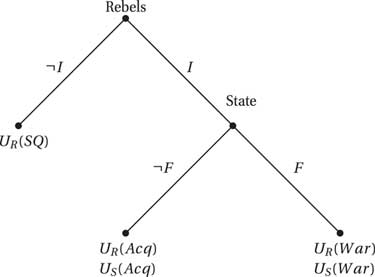
Thus, the transition to industrialization affects the state and society simultaneously: the state increases its capacity through the expansion of tax revenue, while individuals gain interest in maximizing material gains (Inglehart Reference Inglehart1997; Blokland Reference Blokland2008). This has important implications for dispute onset. Earlier studies explained civil conflicts by looking at rebels or rulers, emphasizing state capacity or opportunity costs for rebellion, but not both. However, recent scholarship has stressed that the two dimensions may be interrelated. What is needed is a theory (and empirical model) that can account for societal structure, addressing its effects on rebels and rulers simultaneously. This requires incorporating the deterrent effect of state capacity into rebels’ calculations, and assuming opportunity cost for rebellion to be a function of both state capacity and potential rebel considerations. In other words, the interaction should be strategic, as depicted in Figure 1. An insurgency emerges when a rebel group challenges the government. The government can respond by resisting the rebellion or giving in. A sufficiently strong government reduces the rebels’ expected payoff for insurgency, effectively deterring the rebellion. If the rebel group is powerful enough (i.e., able to mount a significant military challenge), the government will be unable to deter the rebellion. In this case, insurgency will occur, and the final result will depend on each side’s relative military power. Decisions depend on the two sides’ expected payoffs from each action.
A simple rebellion game

Potential rebels seek gains from rebellion. Expected utility is a function of the valuation of the status quo, relative to the future under successful rebellion, and the probability of rebellion success. Modernization affects these calculations in three ways. First, by bringing new jobs, industrialization increases the payoff from the status quo, making rebellion less attractive and hindering recruiting. Individuals with secure occupations and salaries will not abandon them to join a rebellion (unless they expect to gain more from fighting). Second, industrialization affects time horizons. Modern, profit-seeking economies are driven by continuous investment, with the potential to lead to sustained growth. This can be contrasted with pre-modern, agrarian societies, which are characterized by subsistence economies and lower prospects for growth. In modern countries, then, individuals expect future gains under the status quo, and they will be concerned about the lasting consequences of domestic unrest for human and physical capital (Blattman and Miguel Reference Blattman and Miguel2010). This decreases incentives for rebellion to an even greater degree, as citizens living in modern states see prospects for enhanced living standards around the corner. Finally, potential rebels have greater incentive to capture rent-seeking economies than profit-seeking economies. While resource-rich states can use non-tax revenues to buy consensus from the population, making rebellion less likely (Morrison Reference Morrison2009), if resources are concentrated in a limited portion of the state territory and easily lootable, rebels have increased incentives to challenge the government, in order to take power in those regions. In industrial economies, resources are not easily lootable, and extraction is made more difficult because it requires taking over and doing, rather than simply selling commodities. After conquest, rebel groups must run the industrial sector efficiently, reducing immediate benefits from victory. For these reasons, we expect a shift to modernization to be associated with a direct reduction in rebel utility for war.
Hypothesis 1: As a state modernizes, the utility from the status quo for potential rebel groups will increase.
Rebel considerations are not the only factors that affect opportunity costs for rebellion. A modern (i.e., militarily, economically, and institutionally capable) government can deter even highly-motivated and well-organized rebels. In this case, the distinction between profit- and rent-seeking economies (Brawley Reference Brawley1993) is crucial, as a key component of state capacity is the government’s ability to extract resources from society via taxation. Within rent-seeking states, rulers exploit existing resources to enrich themselves without increasing general productivity (increasing only their own slice of the pie); in profit-seeking economies, by contrast, resource exploitation results in an increase in productive efficiency (rulers increase their share by enlarging the entire pie). At the military level, increased fiscal revenues have an immediate effect on military strength, as providing internal and external security is usually the first concern when a government acquires additional resources. Militarily powerful states are able to provide domestic order and to make credible threats to fight back, if necessary. Advanced economies, by definition, have more assets to protect than developing economies. Thus, they tend to give greater priority to securing those assets. In addition, modern economies need infrastructure to sustain the exchange of goods and services, and to manage increasing rates of urbanization (a phenomenon generally associated with industrialization). This can generate a positive externality for the state: rebels exploit rough terrain and sanctuaries in the countryside to organize their movements; if a government invests in public infrastructure and city planning, this increases the state’s ability to penetrate society (Fearon and Laitin Reference Fearon and Laitin2003; Fearon Reference Fearon2008).Footnote 5 Finally, industrial infrastructure often has dual-use: it can be refitted for military purposes, benefiting the state in a conflict. During World War II, for example, the major automobile manufacturers were responsible for 33 percent of US machine guns, 80 percent of US tanks and tank parts, and half of all aircraft engines (Gropman Reference Gropman1996). At the economic level, taxes and other fiscal revenues increase the ability of the state to provide welfare services (e.g., health care, housing, unemployment benefits). This improves satisfaction with the status quo, increasing the opportunity cost for rebellion. Finally, as political development theorists (e.g., Deutsch Reference Deutsch1961; Eisenstadt Reference Eisenstadt1964; Huntington Reference Huntington1968) have stressed, modernizing states are usually faced with the problem of setting new institutions to manage the new socio-economic environment. This means channeling rising demands through the political system, dealing with social mobilization, and coping with pressure on existing resources. If successful, a consolidated democracy or open-access system (North, Wallis and Weingast Reference North, Wallis and Weingast2009) is likely to emerge. On the other hand, failures to meet public demands may lead to revolutions and political decay (as occurred with the Shah’s regime in Iran).Footnote 6 However, even in the absence of institutional capacity, economic modernization should at least increase state military and economic capacity. This should be associated with an increase in the state’s utility for war, which will have a deterrent effect on rebel groups.
Hypothesis 2: As a state modernizes, the utility from war for the state will increase.
Ultimately, these two hypotheses suggest that modernity should reduce the risk of conflict: it makes fighting less attractive to rebels and more attractive to the state, deterring rebellion. However, modernization is not smooth or instantaneous (North, Wallis and Weingast Reference North, Wallis and Weingast2009, 27). Most importantly, as in any radical transition, the socio-economic change brought about by modernization is often followed by a cultural change. This is why—when especially rapid or rocky—the process of modernization may experience breakdowns (Eisenstadt Reference Eisenstadt1964), such as revolutions or civil wars. We argue that the problems affecting the earliest stages of modernization may be due to rising levels of materialism. That is, conflict follows from the growing tendency toward the pursuit of material interests (acquisition and possession of goods).
Growing materialism is clearly linked with the problems affecting the transition to modernity: first, early stages of modernization may lead to rising material inequality (Lipset Reference Lipset1994), as benefits from growth—in the form of savings—tend to be concentrated among upper-income, urban groups (Kuznets Reference Kuznets1955). This can lead to the recognition of relative deprivation among lower-income groups (Gurr Reference Gurr1970). Second, once basic material needs are satisfied, individuals will seek more, proceeding through Maslow’s (Reference Maslow1943) hierarchy. In turn, rising demands may lead to social mobilization. If the government is unable to address them (Deutsch Reference Deutsch1961; Huntington Reference Huntington1968), they can lead to widespread violence, insurgencies, or revolutions. Thus, as the socio-economic structure shifts from an agrarian to an industrial mode of production, there is an initial increase in materialist orientations, followed, along with a rise in education levels, by a return to more immaterial (or post-material), value-based system of beliefs. This is what we refer to as the “arc of modernization.” We argue that the materialist dimension belonging to this arc is positively associated with the probability of civil conflict, with an initial increase in the likelihood of conflicts during the early stages, soon followed by a decrease in the level of violence as modernity takes root and materialism declines.
Hypothesis 3: Early stages of modernization will be related to a higher probability of civil conflict, while later stages will be associated with a lower probability of conflict.
Data and Methods
We examine our hypotheses using civil conflict data from the UCDP/PRIO Armed Conflict Dataset (Gleditsch et al. Reference Gleditsch, Wallensteen, Eriksson, Sollenberg and Strand2002), which contains information on conflicts between 1946 and 2001. Our dependent variable is a binary measure of conflict onset. For a given country-year, it takes a value of 1 if a new civil conflict begins in that year, and a value of 0 otherwise.Footnote 7 Because we are concerned specifically with dispute onset, multi-year conflicts are coded as 0 in all subsequent years.
Our primary concept of interest is the degree to which a state has modernized. Unfortunately, there is no single measure of “modernization,” as it is a process, rather than an attribute of a state. As such, it is difficult to measure. However, it is composed of at least three (measurable) components: industrialization (more generally, economic structure), urbanization, and education.Footnote 8 As measures of each of these values exist, it is possible to construct an index that captures modernization for various countries in our data set.
We begin by collecting data about the relevant measures above. Economic structure—the percentage of gross domestic product (GDP) accounted for by the industrial, agricultural, and service sectors—and urbanization (the percentage of the population living in urban areas) data come from the World Bank (2013). We operationalize education by looking specifically at female schooling, as this concept taps into both education and gender equality (see, e.g., Inglehart and Norris Reference Inglehart and Norris2003),Footnote 9 making it an excellent indicator of a modern society. We draw our data from Barro and Lee’s (Reference Barro and Lee2013) data set on educational attainment, using the percentage of females, aged 25 years and older, who have attained at least some secondary education. While the education data are relatively complete in terms of geographic coverage over the 1950–2010 time period, they are only available at five-year intervals. Because our other variables are measured annually, we interpolate the values between data points.Footnote 10
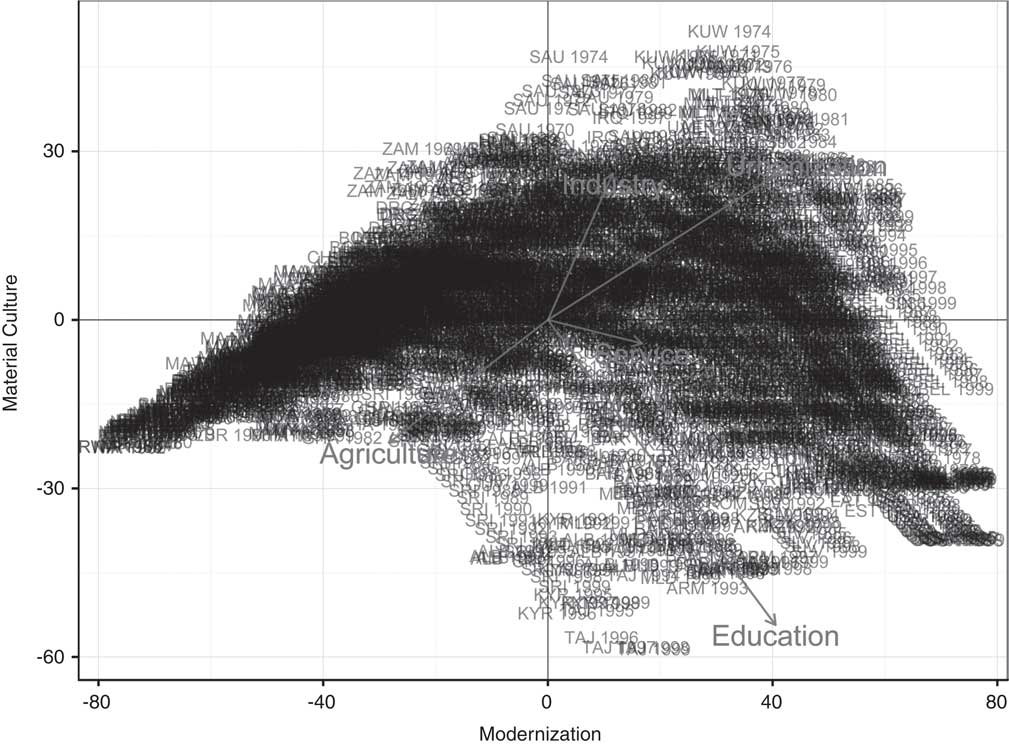
With these variables in hand, we construct an index of modernization using PCA. Figure 2 plots countries along two dimensions, using the five indicators discussed above. The first two components explain 71.6 and 14.3 percent of the variance, respectively. Moreover, they appear to tap clear and relevant latent variables. The first dimension (the x-axis) corresponds to the level of economic modernization. States with high scores on this dimension have stronger industrial and service sectors and higher levels of urbanization and education. The second component (the y-axis) seems to represent the degree of materialism that develops alongside the economic structure. Agrarian societies tend to have immaterial cultures, emphasizing rituals and superstition rather than science; with the shift to an industry-based economy, the level of materialism increases, as individuals begin paying greater attention to their material needs; finally, “after people have attained material security, and because they have attained material security” (Inglehart Reference Inglehart1997, 35) we observe decreasing levels of materialism, and a post-materialist value shift. Countries that score high on both dimensions have modernized, but have not yet made this shift. These would be the most materialistic of countries. By contrast, those that are modernized, but score low on the second dimension tend to be highly developed, post-materialist societies. Thus, both dimensions represent important aspects of a state’s development.Footnote 11
Biplot of principal components

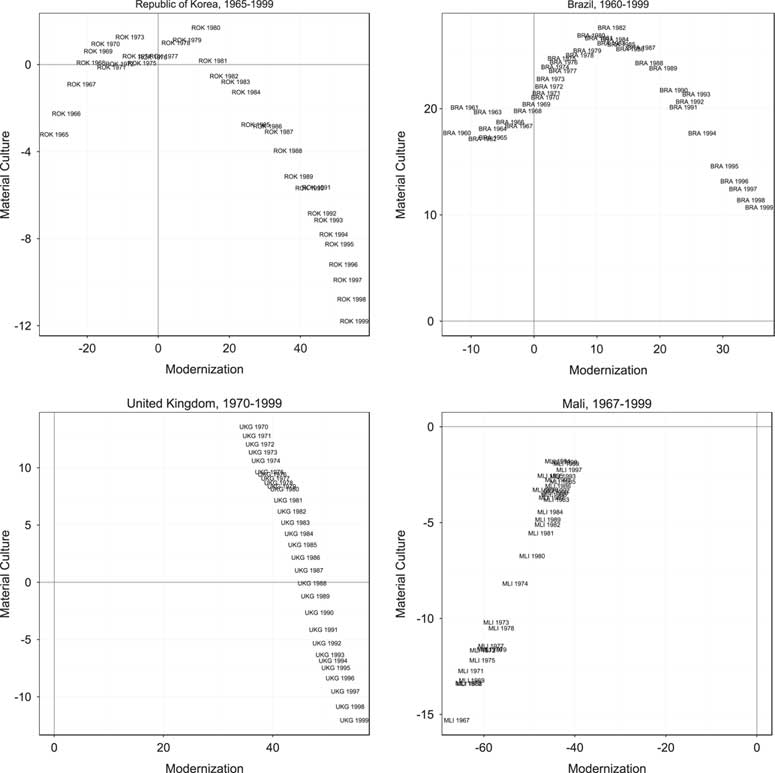
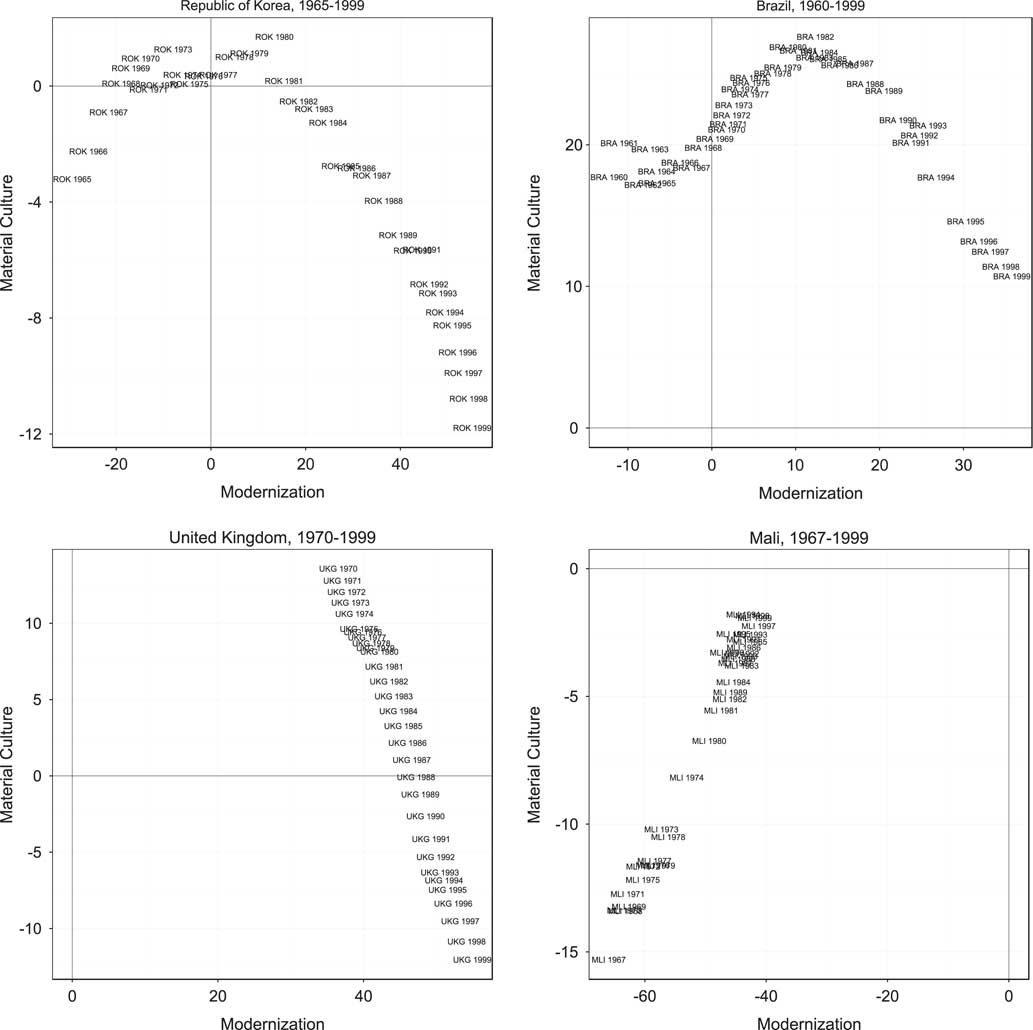
Moreover, there seems to be an important relationship between these two dimensions. The points in Figure 2 describe an arc. We argue that this arc is related to the process of modernization. As states modernize, they initially become more materialistic. At some point, they reach Inglehart’s shift, and begin to fall along the materialism dimension while continuing to advance on the modernization dimension. Thus, pre- and post-modern states should generally be associated with lower levels of materialism, while modernizing countries will exhibit higher levels. An example of this relationship is illustrated in Figure 3, for several countries, at various stages of modernization. The figures in the top row depict plots for the Republic of Korea and Brazil, respectively. Both of these states experienced a significant portion of their modernization process within the years covered by our data set. Korea modernized from the mid-1960s through the late 1970s, while its level of materialism also increased. With the onset of the 1980s, however, the country’s level of materialism began a precipitous decline. Brazil, which employed import-substitution industrialization in the early- and mid-20th century, is typical of many Latin American countries. It eventually liberalized in the 1970s and 1980s. Similar arcs (with different peaks) can be found in Chile, Colombia, and Mexico. The Brazilian and Korean cases are emblematic of the process that we describe, as their arc can be traced through our data. The states on the bottom row, by contrast, either had already entered the post-materialist shift (United Kingdom) before our data set beginning, or had yet to modernize fully (Mali) by its end. In our initial model, we account for the effects of both economic modernization and materialism .
Principal component values for selected countries
As our dependent variable is dichotomous, a logit or probit model might seem appropriate. Indeed, such models are common within the extant literature on intrastate disputes (e.g., Fearon and Laitin Reference Fearon and Laitin2003; Fearon Reference Fearon2005; Jakobsen, de Soysa and Jakobsen Reference Jakobsen, de Soysa and Jakobsen2013; Koubi and Böhmelt Reference Koubi and Böhmelt2014). However, our hypotheses—and many theories related to civil war—do not simply state that the likelihood of civil conflict should fall (or rise) as a particular factor rises. Rather, they posit specific mechanisms through which this change should occur. If the opportunity cost argument is correct (Hypothesis 1), then rebel groups should be less likely to attempt to initiate civil conflict as a state modernizes. If the state capacity argument is correct (Hypothesis 2), then states should be more likely to fight challengers as the economic and social structure becomes more modern. This deters the rebels from initiating conflict in the first place. A simple setup for the theoretical interaction between the state and a rebel group was depicted in Figure 1.
However, in conventional binomial models, all of these effects are aggregated into a single estimation. Cross-cutting, complementary, and deterrent effects are hopelessly entangled together, making more nuanced testing impossible. What is needed instead is a statistical analysis that corresponds directly to this game, allowing us to recover parameters corresponding to the value that rebels place on the status quo versus state acquiescence or civil war, as well as the value that the state places on acquiescing versus going to war. Such an analysis could conceivably be accomplished with a strategic model (Signorino Reference Signorino1999), which could test all of our hypotheses simultaneously. In Signorino’s method, covariates enter into the model through players’ utilities. The analysis recovers parameters for each regressor, in each of the contexts in which it appears. This allows us to differentiate, for example, between the effect of modernization on the government’s decision to go to war and its effect on the rebel group’s decision to initiate conflict. In addition, the model assumes that the decisions at the two stages of the game are linked: the expected decision of the government will influence the rebels’ choice. Thus, not only does it tell us the effect of modernization on the rebel’s decision to initiate, but it does so given the group’s expectation about the government’s likely response. Thus, strategic models are especially useful when deterrence is involved, as they capture the dynamics of the strategic interaction well (Signorino and Tarar Reference Signorino and Tarar2006).
Unfortunately, our data are not sufficient for the use of a conventional strategic model. Although we observe whether conflict occurs, we are unable to determine whether peace is maintained in both sides because the rebels opt not to challenge the government, or because the government acquiesces to rebel demands. Thus, our dependent variable is only partially observed. For this reason, we adopt Nieman’s (Reference Nieman2015) extension of Signorino’s model (the strategic probit with partial observability (SPPO)), which allows for estimation in just such a situation. The SPPO relaxes the data constraints of the Signorino model, such that the analyst must provide only the variables that make up the utility for each outcome, and a single dependent variable (in this case, whether conflict occurs). The two non-events (acquiescence and non-initiation) are combined into the zeros. The model identifies the different types of non-events by making use of the observed portion of the utility. This is similar to the methodology behind the split-population model (see Xiang Reference Xiang2010). Because SPPO uses less information than the traditional strategic model, it has greater variance; however, estimates are consistent in situations that can be characterized by strategic interaction, even if there are not sufficient data to implement Signorino’s estimator.
As Nieman (Reference Nieman2015) points out, civil war fits especially well with the strategic model. From a theoretical standpoint, the rebel group’s decision to initiate conflict is driven, at least in part, by its assessment of the likelihood that the state gives in. Empirically, he compares the strategic model to Fearon and Laitin’s (Reference Fearon and Laitin2003) logit model of civil war onset, demonstrating that the SPPO is a superior estimator when applied to civil conflict, and that statistical analyses should incorporate the strategic process. Given these desirable properties, along with the method’s ability to test our hypotheses directly, we adopt the SPPO as our estimator of choice for this analysis.Footnote 12
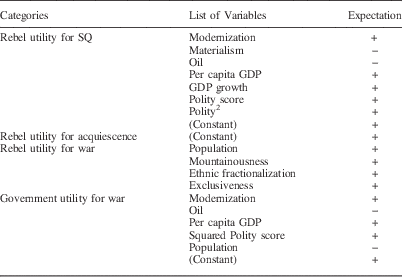
Estimation of the strategic model requires specification of utilities for each of the actors at each outcome node. We specify the utilities in the following way. For the rebels, we expect the value of the status quo to be enhanced by five factors: the level of modernization in the country, per capita GDP and GDP growth (The Maddison-Project 2013), the Polity score of the country (Marshall and Jaggers Reference Marshall and Jaggers2002), and the square of that score (associated with the degree of anocracy) (see Hegre et al. Reference Hegre, Ellingsen, Gates and Gleditsch2001).Footnote 13 Rebel utility for the status quo will be diminished by oil production, as oil-producing states tend to be heavily dependent upon lootable resources that reduce rebel status quo utility, relative to either fighting or acquiescence, and by materialism, which leaves potential rebels hungry for additional gains. The rebel utility for war is based on factors that enhance rebel war-fighting capabilities—including (logged) population size and the (logged) degree of mountainousness within the state—and factors that increase the pool of potential recruits—including ethnic fractionalization and the level of minority group exclusion (operationalized as the ratio of excluded to included groups), which taps the degree to which resources are distributed equally within the state (a key factor in grievance-based civil conflict) (Koubi and Böhmelt Reference Koubi and Böhmelt2014).Footnote 14 Finally, government utility for war is affected by three factors expected to strengthen capacity—modernization, per capita GDP, and institutional strength (operationalized as the square of the Polity score)—and two factors that reduce it—oil production, as oil exporters tend to be weaker states (see Fearon and Laitin Reference Fearon and Laitin2003), and logged population. A summary of the variables included in each utility function, including hypothesized effects, is depicted in Table 1.Footnote 15 In order to minimize endogeneity concerns, we lag all time-variant measures by one year.
Specification of Utilities

Note: GDP=gross domestic product.
Analysis
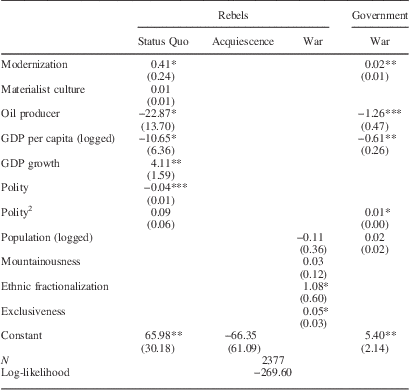
Table 2 provides the results from estimation of the SPPO model.Footnote 16 Columns 1 through 3 are the effects of variables on the rebels’ utilities (status quo, acquiescence, and war, respectively), while column 4 provides the effects of variables on the government’s utility for war. A positive effect indicates that a variable increases the player’s utility for that outcome, while a negative sign suggests that the variable decreases the player’s utility. Given this configuration, variables that are positively associated with conflict onset will be those that are negatively associated with rebel utility for the status quo, positively associated with rebel utility for war, or negatively associated with government utility for war (variables with a positive effect on government utility for war may also have a deterrent effect).
Strategic Probit Analysis of Modernization and Dispute Onset

Note: Standard errors in parentheses. Decade dummies not shown.
GDP=gross domestic product.
*p<0.10, **p<0.05, ***p<0.01. All tests are two-tailed tests.
In examining our results, the effect of modernization is apparent: it has both a pacifying and a deterrent effect. The benefits that come from economic modernization make rebels happier, increasing their satisfaction with the status quo. This reduces the probability that the rebels make demands of the state, ultimately decreasing the probability of conflict. At the same time, modernization strengthens the state, making it less likely to acquiesce to rebel demands. While this increases the probability of war, conditional on rebel demands, it has the effect of deterring weak or unresolved rebels from attacking. As expected, modernization has cross-cutting effects, which would not be discernible under a less sophisticated model. Our findings with respect to modernization are consistent with Hypotheses 1 and 2. Materialism, meanwhile, also appears to increase rebel utility for the status quo, but the effect is small and non-significant (p=0.415), suggesting that materialism alone does not affect incentives to rebel.
Some of the effects for our control variables run counter to our expectations: specifically, rebels are less satisfied in democratic and wealthier states. This is unexpected, given that these factors would both be expected to enhance quality of life, making the status quo more attractive. With respect to the former, one possibility is that citizens in more-democratic states may simply have higher expectations than those in non-democracies (see Rose Reference Rose1969; Di Palma Reference Di Palma1990), leading to greater dissatisfaction with what is actually a better situation. In addition, many democracies that experience civil conflict are actually young, unconsolidated democracies. This seems plausible, given that the coefficient on the square of the Polity score is positive, though the estimate does not attain statistical significance. It is also initially surprising that high per capita GDP is related to lower satisfaction with the status quo, as this is an indicator of higher quality of life. However, it also means that there are greater gains to be reaped from conflict. In addition, we see a strong positive effect for GDP growth, which may be a better proxy for expected quality of life, and a strong negative effect for oil production. Thus, if there is more pie to be captured, rebels may be more likely to revolt, but if that pie is growing, they will think twice.
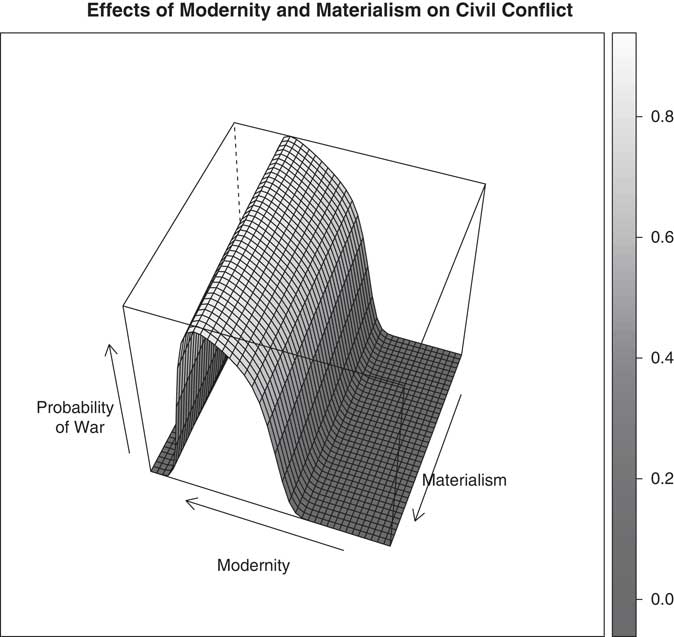
Returning to the effect of our variable of interest, the results in Table 2 suggest a somewhat complex relationship between modernization and conflict onset. The government’s increased utility from war may deter rebels from challenging, but if they do opt to rebel, governments are more likely to fight. Thus, it is important to examine the relationship in greater detail. In addition, given the potential temporal relationship between modernization and materialism—depicted in Figures 2 and 3—we believe that it is important to look at the effect of modernization across several different values of materialism. Therefore, we turn to a graphical analysis of the simultaneous effects of modernization and materialism on dispute onset.
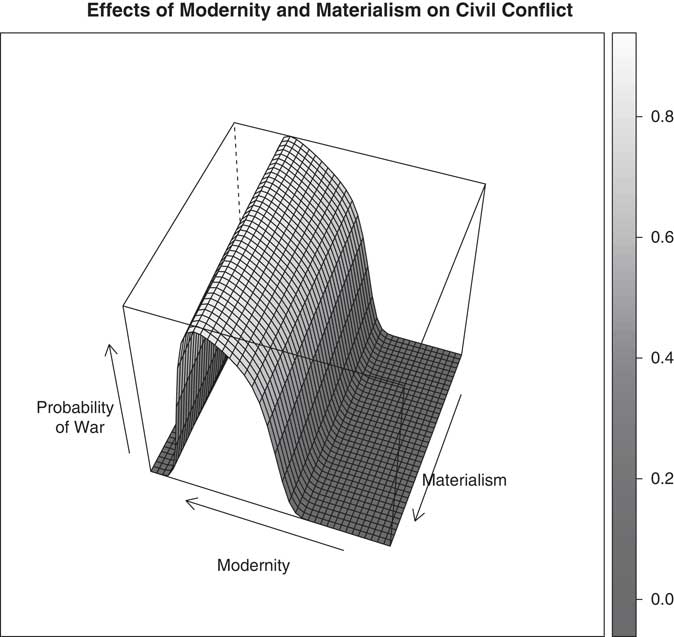
Figure 4 depicts the predicted probability of conflict onset, as modernization and materialism vary from their respective minima to maxima.Footnote 17 The results suggest a non-monotonic relationship between modernization and dispute occurrence. At low levels of economic modernization, there is virtually no risk of civil conflict. As the state develops, onset likelihood rises, given the government’s increased willingness to fight. This finding is consistent with Eisenstadt’s (Reference Eisenstadt1964) “breakdowns of modernization” hypothesis. As modernization continues, the effect dissipates, and the probability of fighting drops back to near-zero levels. This is a result of the shift in quality of life and rebel satisfaction with the status quo. At higher levels of modernization, potential rebels have no desire to fight, especially given the state’s power. As expected from the results in Table 2, there is no obvious effect from materialism. These results are consonant with the theorized effects of the arc of modernization, and provide support for Hypothesis 3.
Modernity, materialism, and the probability of civil conflict
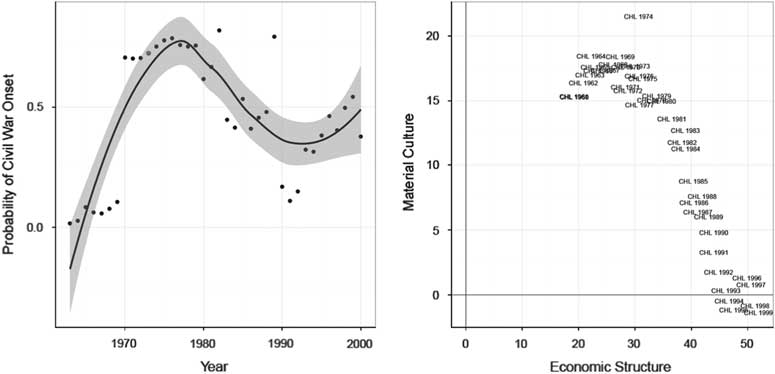
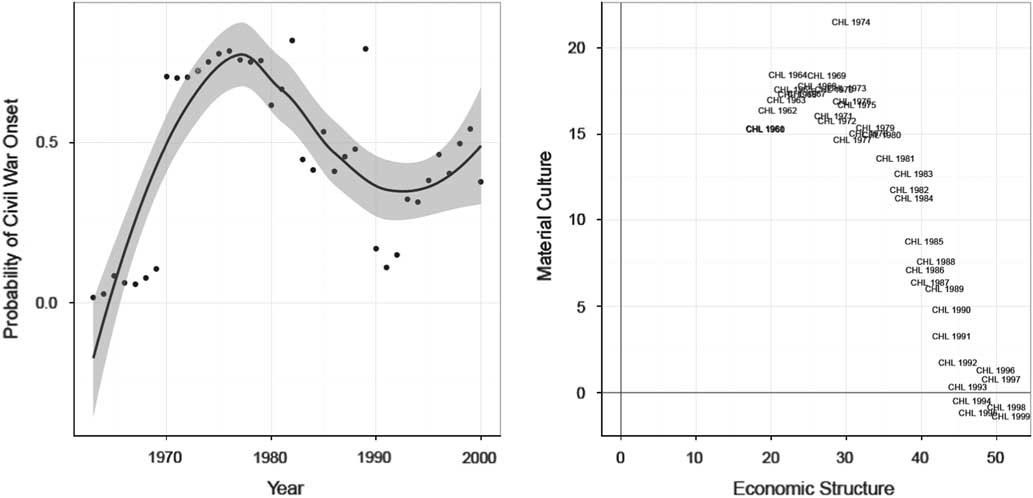
We also find it instructive to apply our results to real cases in the data. We start by looking at the case of Chile, which, like the two countries in the top half of Figure 3, traced its arc through our data. Figure 5 shows the results when applied to Chile between 1960 and 2000, as well as its levels of modernization and materialism. The points in the left panel display estimated probabilities for civil conflict in the actual data. We also plot the smoothed [LO]cally [E]stimated [S]catterplott [S]moothing (LOESS) curve that best fits these data, with the associated 95 percent confidence interval to better illustrate the pattern of the estimates. The single civil conflict that Chile experienced during this time (Pinochet’s coup d’état) is marked with a starburst. The pattern of predictions for Chile roughly follows an inverted U shape between 1960 and 1990, peaking in the mid-1970s. Notably, the coup takes place around the cluster of points during which we would expect conflict to be most likely. From the late 1970s through the early 1990s, this probability declines, picking back up again in the mid-to-late 1990s. This occurs approximately concurrently with the sudden (and unexpected) rise in materialism in the late 1990s.
Estimated probability of conflict and principal component analysis, Chile, 1960–1999
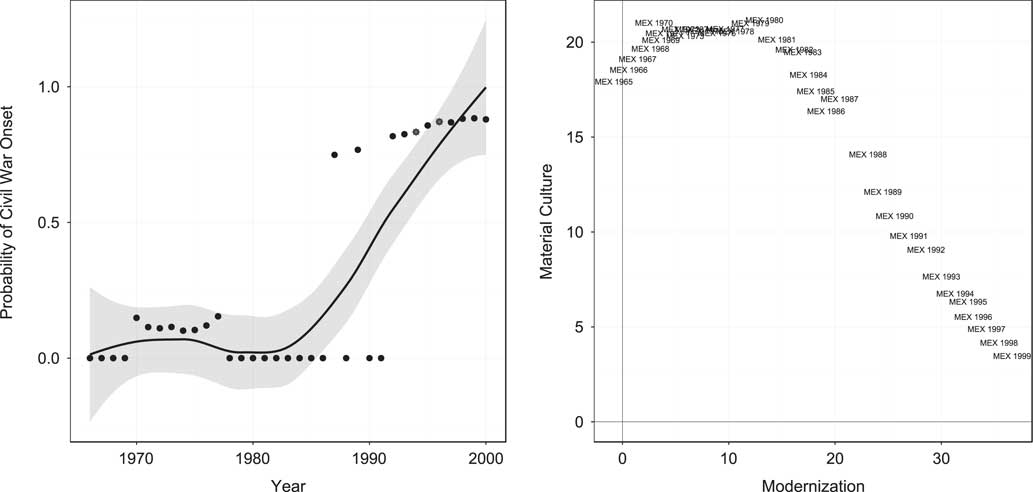
Finally, we examine Mexico, which saw multiple civil conflicts over the course of our data. The left panel of Figure 6 shows the predicted probabilities of conflict from 1966 through 2000. The two starbursts correspond to the failed 1994 uprising by the Ejército Zapatista de Liberación Nacional (EZLN) and the 1996 clashes between the Mexican Army and the Ejército Popular Revolucionario (EPR), respectively. As before, the situation in Mexico is described by a non-monotonic relationship between modernization levels and the probability of conflict. The inverted U-shaped curve does appear in the predicted probability for Mexico, taking place during the first decade depicted in the plot. The relationship is consistent with our expectations, though its peak remains relatively low (at a probability of just over 0.1). It is difficult to see, as its effect is swamped by what occurs in Mexico in the 1990s. From the mid-1980s onward, there is a sharp rise in the probability of conflict. It is in this era that we see the emergence of the EZLN and the EPR. This change is actually unrelated to modernization, and is due primarily to the changing political landscape in Mexico in the late 1980s and early 1990s, as the country transitioned from semi-autocratic one-party rule to a more robust democratic system. Indeed, Mexico in the early-to-mid 1990s was relatively anocratic, with a Polity score of 0 from 1989 to 1994. Its score rose to 3 in 1995 and to 6 in 1998, but remained short of the standard threshold for democracy (a score of 7) until the turn of the century. Although modernization alone does not explain the recent conflicts in Mexico, it is encouraging to see that our model is fairly effective at predicting when conflict is likely to occur within the country.
Estimated probability of conflict in Mexico, 1966–2000

Overall, our results provide robust support for our theory. The findings presented in Table 2 demonstrate the effect of modernization on the incentives of governments and rebel groups alike, and shed light on the theoretical mechanisms underpinning our results. We find that modernization increases both state capacity and rebel utility for the status quo. Finally, the non-monotonic relationship between modernity and civil conflict depicted across various figures—for both real and hypothetical configurations of variables—is consistent with the patterns that we note in Hypothesis 3 and Figure 2, as modernization—like democratization—tends to be accompanied by an initial, rocky period, before bringing about its benefits.
Conclusion
This paper proposed an update to the decades-old theoretical framework of modernization, applying it to civil conflict, and accounting for decisions by both governments and rebel groups. We posited that a shift away from an agricultural economy to a more modern way of life could increase rebel satisfaction, while simultaneously enhancing state capacity. Importantly, we made no claims about the source of the economic shift. We expect no difference between liberal states that experience bottom-up modernization and autocracies like China, where these changes are wholly state-driven. Thus, our theory fits a wide range of cases. The theory highlights a novel aspect of the relationship between economics, society, and civil disorder, which explains much about modern revolutions, and is complementary to the literature on the resource curse (e.g., Ross Reference Ross2012). Moreover, as modernization is virtually irreversible, it has the potential to be more effective and longer lasting than more mutable factors, such as regime type or simple economic growth.
To examine our hypotheses, we employed the SPPO model, which allowed us to tease out the direct effects of various factors on the two relevant actors. The analysis demonstrated that, although the health of the economy (in terms of per capita GDP growth) plays an important role in preventing intrastate disputes, modernization is also vital. In particular, agrarian states tend to be most prone to revolutionary conflict. Industrialization (and the subsequent growth of a service economy) makes war an unattractive option for rebels, even when accounting for economic growth. This is likely because the shifting economic structure affords greater opportunity to citizens, and increases the likelihood of sustained growth over time. For governments, modernization increases the attractiveness of war by raising the state’s likelihood of victory.
Despite the fact that agriculture—an important component of pre-modernism—accounts for an extremely small portion of global GDP today (3.1 percent in 2011), a number of countries maintain pre-modern, agricultural economies. Indeed, among the states that the UN classifies as the least-developed countries, agriculture makes up, on average, around 30 percent of GDP. As of 2012, agriculture accounted for >40 percent of GDP in five of these states. Perhaps unsurprisingly, it is this group of states that has accounted for the majority of civil conflicts since 1995. Our theory suggests that the strife in these countries may be due as much to economic and social structure as it is to performance. A move away from an agricultural economy and the associated societal infrastructure may be helpful in these countries.
Our results have demonstrated both the importance and the usefulness of modernization. The development of a strong industrial or service sector, a commitment to education, and the process of urbanization have the potential to enhance living standards for would-be rebels and to strengthen the state. However, we suspect that the relationship may be more complex. An interesting path for future research would be to focus on the dynamics of modernization, and its relationship to globalization more broadly. Our initial findings point to the possibility that temporal factors may be at play with respect to the process of modernization. As the process of economic modernization progresses, we see an initial increase, followed by a gradual decline in the incidence of intrastate disputes. This may reveal a cultural change brought about by the shift to a post-modern, highly-advanced, and (usually) more-democratic stage of development. However, we are unable to test whether there is a broader relationship between stability and the time since a state modernized directly. While we examine the degree to which a state has modernized, it is equally important to know when the state reached modernity. This should be a fruitful avenue for subsequent research.
Another possibility, not considered here, is the existence of a “virtuous circle” between modernization and political liberalism. The opportunity costs that arise from economic advancement may make repression less necessary for the state, increasing quality of life, and decreasing the incentive to rebel. We surmise that modernization may have effects not only in the immediate future, but indirect effects in later years as well. The state would benefit from such a situation, as it is able to extract more resources over time, and to focus its energies on growth, rather than deterring rebellion; the population benefits both materially, from rising living standards, and immaterially, from the enhanced freedoms that it enjoys. Civil conflict becomes neither necessary nor desirable for either group, allowing both sides to gain as they travel through the arc of modernization.