Introduction
Previous studies have shown that 67–75% (Hosia-Randell et al., Reference Hosia-Randell and Pitkala2005; Pitkala et al., Reference Pitkala2015) of the nursing home patients were prescribed at least one type of psychotropic drugs on a regular basis. Studies done in Scandinavian countries found that antidepressants were prescribed to 39–45% (Johnell and Fastbom, Reference Johnell and Fastbom2012; Pitkala et al., Reference Pitkala2015) of the nursing home residents, followed by antipsychotics 25–43% (Hosia-Randell et al., Reference Hosia-Randell and Pitkala2005; Selbaek and Engedal, Reference Selbeak, Kirkevold and Engedal2007; Pitkala et al., Reference Pitkala2015), anxiolytics by 16–41% (Hosia-Randell et al., Reference Hosia-Randell and Pitkala2005; Selbaek and Engedal, Reference Selbaek2014; Pitkala et al., Reference Pitkala2015), sedatives by 11–34% (Hosia-Randell et al., Reference Hosia-Randell and Pitkala2005; Johnell and Fastbom et al., Reference Johnell and Fastbom2012; Selbaek and Engedal, Reference Selbaek2014; Pitkala et al., Reference Pitkala2015), and anti-dementia drugs by 7–14% (Hosia-Randell et al., Reference Hosia-Randell and Pitkala2005; Selbaek and Engedal, Reference Selbaek2014; Pitkala et al., Reference Pitkala2015).
Psychotropic drugs are often used for the treatment of neuropsychiatric symptoms (NPS), such as depression, psychosis, and agitation. NPS are very common in patients with dementia and about 90% of the patients experience one or more NPS during the course of the disease (Wetzels et al., Reference Wetzels2010). However, the evidence for the effectiveness of antipsychotics on these symptoms is uncertain and the risk of serious adverse events is considerable. Therefore, a discrepancy between the uncertain effect and considerable risk and the high prevalence of use can be seen. In particular, the use of antipsychotic drugs for the treatment of agitation and psychosis has received attention. Studies reported an increased risk of cerebrovascular adverse events (Mittal et al., Reference Mittal2011) and mortality (Schneider et al., Reference Schneider, Dagerman and Insel2005) in patients prescribed antipsychotic drugs. Therefore, the European Medicines Agency and national drug agencies in the United Kingdom, Italy, Spain, France, and other countries published warnings about the increased risk of mortality associated with antipsychotics starting from the year 2004 (Gallini et al., Reference Gallini2014). In theory, the warnings from the different drug agencies as well as the recommendations from clinical practice guidelines should have led to a reduction of psychotropic drug use over the last decade.
Most studies report a reduction in the use of antipsychotic drugs after the publication of warnings and treatment recommendations. However, there are also conflicting results. Two large registry-based studies in the US demonstrated a significant decrease in the use of antipsychotic drugs among outpatients with dementia (Dorsey et al., Reference Dorsey2010; Kales et al., Reference Kales2011). In the UK, a study of hospital inpatients found a highly significant decrease in the use of first generation antipsychotics from 2006 to 2011 (Thomas et al., Reference Thomas2013). A few studies have looked at the possible changes in prescription patterns over time in nursing homes. A study in Denmark used a Danish registry for investigating time trends in the use of antipsychotics in dementia care (Nørgaard et al., Reference Nørgaard2015). They found a decrease in use of antipsychotic, anxiolytic, and hypnotic/sedative drugs. However, the use of antidepressants increased from 43.3% in 2000 to 53.8% in 2012. These results were in line with the results of a study done in Finland (Pitkala et al., Reference Pitkala2015). Additionally, a recent paper analyzed trends in psychotropic drug prescribing in Norwegian nursing homes from 1997 to 2009 by a secondary data analysis of six cross-sectional studies (Ruths et al., Reference Ruths2013). They found an increase of prescribing psychotropic drugs and especially of antidepressants from 32% to 51%.
The reasons for the change are not clear. There are no studies on change in psychotropic drug use that have been able to adjust for important patient characteristics. This is important in order to decide whether a putative change in psychotropic drug use is due to change in clinical practice or merely a change at the disease or symptom level.
The aim of the present study was to investigate whether there was a change in the use of psychotropic drugs in Norwegian nursing homes between 2004 and 2011 or not. Furthermore, we will investigate whether the predictors of use of specific psychotropic drug groups have changed. We hypothesize that there was a decrease in the use of antipsychotic drugs but no change in the use of other psychotropic drugs. Moreover, we hypothesize that the same predictors are associated with psychotropic drug use in both samples.
Methods
This is a secondary analysis of two cohort studies of two Norwegian nursing home samples (only baseline measurements used), one conducted in 2004/05 (S1), and the other in 2010/11 (S2).
Participants
In S1, 26 nursing homes from 18 municipalities took part in the study. In S2, 64 nursing homes from 55 municipalities participated. Of the nursing homes participating in S2, 24 also participated in S1. The nursing homes were selected in order to represent the distribution of small, medium-sized, and larger municipalities in the total population. The S1 sample has been described more closely in a previous publication (Selbaek and Engedal, Reference Selbaek2014).
In both studies, patients with a minimum stay of 14 days were eligible for inclusion. In S1, 1,165 patients were eligible, two declined participation leaving 1,163 patients for inclusion. In S2, 2,385 patients were eligible for inclusion. Of these, 423 declined participation; 33 had terminal conditions, 17 died prior to the assessment, one was discharged before assessment and in 53 patients no specific reason for lack of inclusion was identified. Thus, in S2, 1,853 patients were included. The S2 sample included 98 patients who also were included in S1.
Procedure
The data was collected in a standardized interview by a study nurse interviewing the NH nurse who had closest knowledge about the patients. Data regarding diagnosis and drug use was collected from the medical records. The assessors were research nurses with wide experience from research and clinical work. All assessors participated in a two-day course on the application of the assessment scales prior to the data collection.
Measures
Level of dementia was assessed with the Clinical Dementia Rating Scale (CDR) (Hughes et al., Reference Hughes1982). The CDR comprises six items, memory, orientation, judgment and problem solving, community affairs, home and hobbies, and personal care. Based on an algorithm giving precedence to memory, an overall score is produced. The scores denote no dementia (0), very mild or possible dementia (0.5), mild dementia (1), moderate dementia (2), and severe dementia (3), respectively. In this study, presence of dementia is defined by a CDR overall score ≥1. A CDR sum of boxes may be produced by adding all the item values, range 0–18 (O'Bryant et al., Reference O'Bryant2008). The correlation between CDR overall score and CDR sum of boxes has been shown to be strong (≥0.9) (O'Bryant et al., Reference O'Bryant2008; Mjørud et al., Reference Mjørud2014), in this study the Spearman correlation was 0.93. The CDR sum of boxes was used since its wide range of value offers important advantages when analyzing the data (O'Bryant et al., Reference O'Bryant2008).
The neuropsychiatric inventory (NPI) was applied for the assessment of NPS (Wood et al., Reference Wood2000). This was initially a 10-item scale. Later two neurovegetative symptoms, regarding sleeping and eating, were included. Each item is scored according to frequency (0–4) and intensity (0–3). Frequency and intensity scores are multiplied giving an item score of 0–12, and an NPI total score ranging from 0 to 144. According to previous principal component analysis (Selbaek and Engedal, Reference Selbaek and Engedal2012), we defined three NPI sub-syndromes, agitation (agitation/aggression + disinhibition + irritability), psychosis (delusions + hallucinations), and affective symptoms (depression + anxiety). The item apathy was included in the analysis on its own.
Activities of daily life (ADL) functioning was assessed with the Physical Self-Maintenance scale (PSMS) (Lawton and Brody, Reference Lawton and Brody1970). PSMS includes six items, which are scored 1–5, producing a total score ranging from 6 to 30, higher scores denoting poorer ADL function.
Somatic health was rated with the General Medical Health Rating Scale (GMHR) (Lyketsos et al., Reference Lyketsos1999), a one-item scale with the categories good, fair, poor, and very poor. All available information on somatic health and drug use was taken into account.
Psychotropic drug use was extracted from the medical records and grouped into antipsychotics (N05A), antidepressants (N06A), anxiolytics (N05B), sedatives (N05C), and anti-dementia drugs (N06D) according to the anatomical therapeutic chemical (ATC) index. Pro re nata drug use was not recorded.
Ethics and legal issues
The Regional Committee for Medical and Health Research Ethics (REC), South-East Norway, approved the study. The legislation on the provision of consent has changed considerably between 2004 and 2011 in Norway. In 2004, information about the study without any objection from the patient or their next of kin sufficed for inclusion. In 2011, patients, or their next of kin in case of reduced capacity to give consent, had to sign a written informed consent in order to be enrolled in the study.
Data analysis
Demographic and clinical characteristics in samples S1 and S2 were presented as means and standard deviations (SD) or frequencies and percentages, as appropriate.
Use of psychotropic drugs (antipsychotics, antidepressants, anxiolytics, sedatives, and anti-dementia drugs) was five dichotomous outcomes. The total number of psychotropic drugs (including anti-dementia drugs) used was assessed as a count variable.
Intra-class correlation coefficient (ICC) was calculated for each outcome to assess a degree of clustering on nursing home level. The ICC was significant for all dichotomous outcomes, while there was only slight cluster effect in total number of psychotropic drugs. Also, as there was an overlap between S1 and S2 samples, a cluster effect on patient level was assessed by ICC, but only negligible effect found.
A logistic regression model for hierarchical data (SAS GLIMMIX procedure) with random effects for nursing home was estimated for each dichotomous outcome. Fixed effect for dummy identifying two samples was entered into the model to assess potential differences in drug use. A total number of psychotropic drugs were assessed by a Poisson regression model with the same random and fixed effects. To assess the assumptions for Poisson regression, both Poisson and negative binomial models were fitted. The log-likelihood was not significantly different between the two models and there was no over-dispersion present in the model, justifying the choice of a Poisson model. Results were presented as odds ratios (OR) and rate ratios (RR), respectively.
Crude OR and RR were further adjusted in multivariate models following a sequence as described next. For each outcome, a multivariate model containing fixed effects for dummy identifying two samples, six predictors (apathy, agitation, psychosis, affective sub-syndrome, CDR, PSMS) and interaction terms between the dummy and each predictor was fitted. Akaike's Information Criterion (AIC) was applied to reduce the multivariate models. The reduced multivariate models were adjusted for confounders (age, gender, marital status, education, length of stay, somatic health, type of unit). The results were presented as OR and RR with the corresponding 95% confidence intervals (CI) whenever possible. The results in the models containing interactions were presented as the coefficients and standard errors (SE), and illustrated graphically as OR/RRs with the corresponding 95% CI.
All analyses were executed in SPSS v 22 and SAS v 9.3. Results with p-values below 0.05 were considered statistically significant. No adjustment for multiple hypothesis testing was performed.
Results
Psychotropic drug use
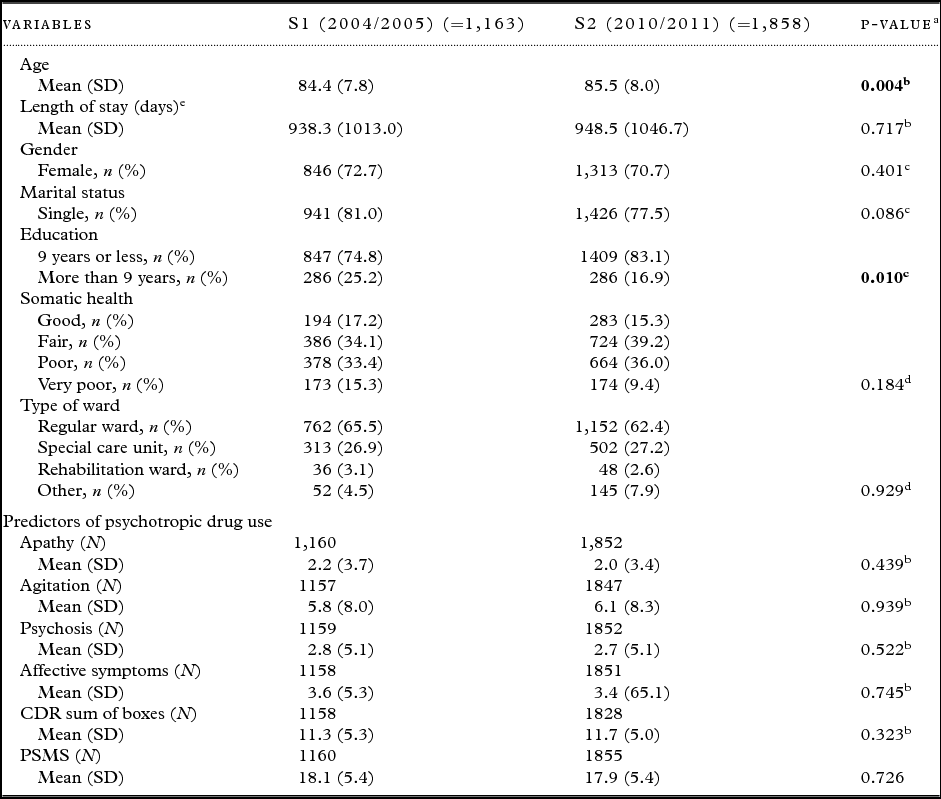
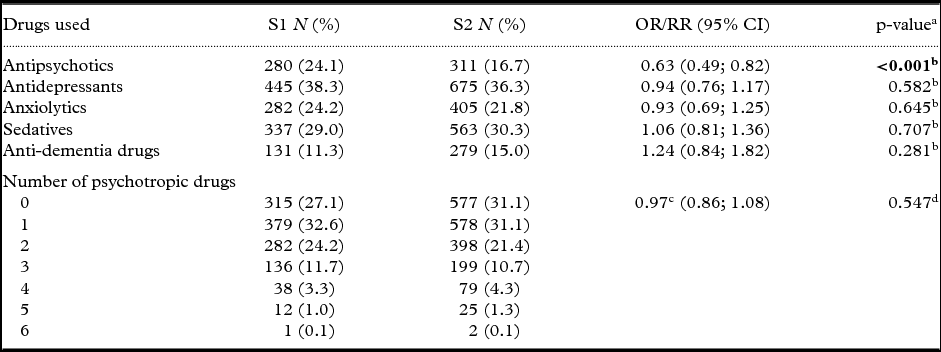
Demographic and clinical descriptive data of S1 and S2 are presented in Table 1. The mean age was higher in S2 (86 years, SD = 8) than in S1 (85 years, SD = 8). Less people had a higher education (more than nine years) in S2 (17%) compared to S1 (25%). The use of psychotropic drugs in S1 and S2 is presented in Table 2. The odds of using antipsychotic drugs in S2 were 37% lower than in S1 (0.63 OR, 95%CI = 0.49–0.82, p < 0.001). More specifically, conventional antipsychotics were used in 12.0% and 6.6% of the patients at S1 and S2, respectively (not shown in the table). The most commonly used conventional antipsychotics were haloperidol (4.0% at S1 and 2.2% at S2) and levomepromazine (2.5% at S1 and 1.3% at S2) at both points in time. Atypical antipsychotics were used in 13.2% and 10.9% at S1 and S2, respectively. The most commonly used atypical antipsychotics were risperidone (7.4% at S1 and 5.1% at S2) and olanzapine (3.1% at S1 and 4.0% at S2). For the other psychotropic drugs or total number of psychotropic drugs, there were no differences between the two time points.
Descriptive characteristics of the two study samples of residents in NH

aBold text indicates a statistically significant difference with a p-value less than 0.05.
CDR = Clinical Dementia Rating scale, PSMS = Physical Self-Maintenance scale.
bLinear mixed model.
cLogistic regression model for hierarchical data.
dMultinomial regression model for hierarchical data.
ep-value calculated on ln scale.
Prevalence of psychotropic drug use at S1 and S2. Crude odds ratios (OR) with 95% CI for use of psychotropic drugs in S2 with respect to S1 (reference year); rate ratio (RR) with 95% CI calculated for total number of psychotropic drugs

aBold text indicates a statistically significant difference with a p-value less than 0.05.
bSAS GLIMMIX procedure used to fit a logistic regression model containing random effects for nursing home.
cRate ratio comparing S1 and S2.
dSAS GLIMMIX procedure used to fit a Poisson regression model containing random effects for nursing home.
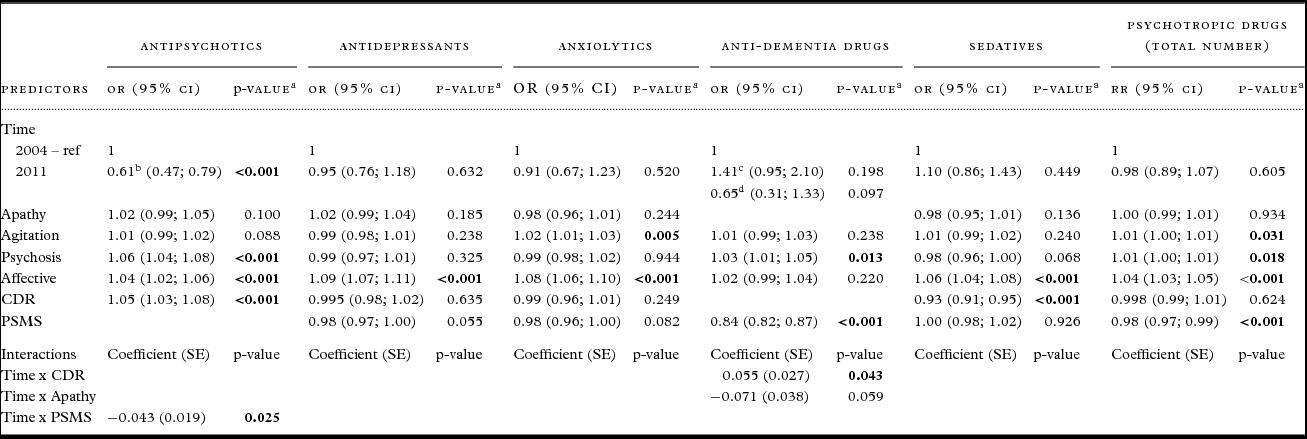
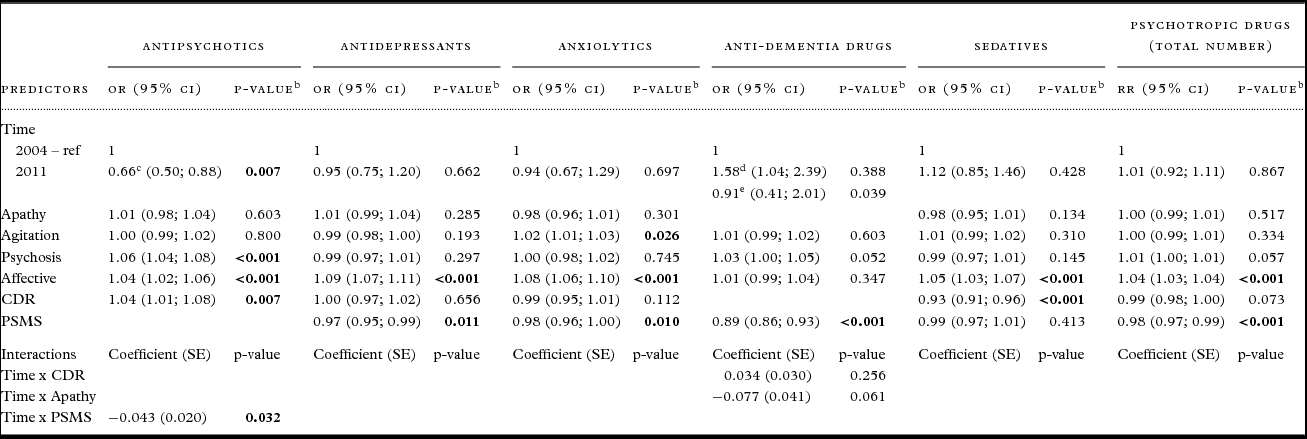
The significant decrease in antipsychotic drug use in the unadjusted models, described above persisted after adjusting for relevant predictors and confounding variables (Tables 3 and 4).
Crude regression coefficients with 95% CI from logistic regression models for hierarchical data for the specific psychotropic drug groups and number of psychotropic drugs as outcome variable

aBold text indicates a statistically significant difference with a p-value less than 0.05.
bOR for S2 is calculated at the average value of PSMS equal 17.97.
cOR for S2 is calculated at the average value of CDR equal 11.52.
dOR for S2 is calculated at the average value of Apathy equal 2.04.
Adjusted regression coefficientsa with 95% CI from logistic regression models for hierarchical data for the specific psychotropic drug groups and number of psychotropic drugs as outcome variable

aBold text indicates a statistically significant difference with a p-value less than 0.05.
bAdjusted for confounders age, gender, marital status, education, Ln of length of stay, somatic health, use of coercive measures, type of unit.
cOR for S2 is calculated at the average value of PSMS equal 17.968.
dOR for S2 is calculated at the average value of CDR equal 11.52.
eOR for S2 is calculated at the average value of Apathy equal 2.04.
Factors associated with psychotropic drug use
Results of the logistic regression analyses with specific psychotropic drug groups use as outcome are presented in Tables 3 and 4. In the unadjusted model, the use of antipsychotic drugs was associated with higher scores on the NPI psychosis subscale, higher scores on the NPI affective subscale, and higher CDR sum of boxes. There was a significant interaction between time and PSMS, showing that the odds for using antipsychotic drugs were lower in S2 among those with scores above 15 on the PSMS scale (see figure S1). Use of antidepressants was associated with higher scores on the NPI affective subscale. Use of anxiolytics was associated with higher scores on the NPI agitation subscale, and higher scores on the NPI affective subscale. Use of anti-dementia drugs was associated with higher scores on the NPI psychosis subscale and lower scores on the PSMS (higher level of functioning). Use of sedatives was associated with higher scores on the NPI affective subscale, and a lower CDR sum of boxes score. There were no significant interactions in the models for antidepressants, anxiolytics, and sedatives. There was a significant interaction between time and CDR sum of boxes, with higher odds for anti-dementia drug use in S2 than in S1 for CDR sum scores above 13 (see figure S2). For apathy, there was a downward trend indicating lower odds for being prescribed anti-dementia drugs in S2 than in S1, but this trend never reached the 0.05 significance level (see figure S3). This interaction was kept in the model due to its contribution according to the AIC. The number of psychotropic drugs was associated with higher scores on the NPI agitation subscale, higher scores on the NPI psychosis subscale, higher scores on the NPI affective subscale and lower scores on the PSMS scale (higher level of functioning). There were no significant interactions in the model.
The results of the logistic regression model for antipsychotics remained the same after adjusting for confounders (Table 4). The use of antidepressants was associated with higher scores on the NPI affective subscale as well as lower scores on the PSMS scale (higher level of functioning) in the adjusted model. Use of anxiolytics was associated with higher scores on the NPI agitation subscale, higher scores on the NPI affective subscale, and lower scores on the PSMS scale (higher level of functioning), which was not found in the unadjusted model. The results for sedatives remained the same after adjusting for the confounders. Use of anti-dementia drugs was associated with lower scores on the PSMS (higher level of functioning), but no longer with psychosis. There was a significant interaction between time and CDR sum of boxes as well as apathy (as was found in the unadjusted model). However, they did not reach the 0.05 significance level, but these interactions were kept in the model due to their contribution according to the AIC. The number of psychotropic drugs was associated with higher scores on the NPI affective subscale and lower scores on the PSMS scale (higher level of functioning). Higher scores on the NPI psychosis subscale as well as higher scores on the NPI agitation subscale were no longer significantly associated with psychotropic drug use. There were no significant interactions in the model.
Discussion
This study of two large NH samples demonstrates a significant decrease in the prescription of antipsychotic drugs between 2004 and 2011. The decrease remains significant when we adjust for relevant demographic and clinical variables. There are only minor changes for the other psychotropic drugs. Additionally, this study presents the predictors of use of specific psychotropic drug groups.
Whereas previous research reported increase in prescribing of psychotropic drugs except for antipsychotics in Norwegian nursing homes (Nygaard et al., Reference Nygaard2004; Ruths et al., Reference Ruths2013), this study found a significant decrease in the prescription of antipsychotic drugs and no change in prescribing of any other psychotropic drug. The change in antipsychotic drug prescriptions might be explained by treatment recommendations against its use except in the most severe conditions of aggression or psychosis (NICE, 2006; Azermai et al., Reference Azermai2012; Steinberg and Lyketsos, Reference Steinberg and Lyketsos2012; Ballard and Corbett, Reference Ballard and Corbett2013). The FDA black box warning had some effect on the prescription of antipsychotic drugs (Dorsey et al., Reference Dorsey2010). Recently, reports on antipsychotic drug use among UK general practitioners (The Information Centre for Health and Social Care, 2012) and in special health services (Barnes et al., Reference Barnes, Banerjee, Collins, Treloar, McIntyre and Paton2012) have indicated a substantial decrease in antipsychotic drug use among old people with dementia. The present study demonstrates that the use has decreased from 24.1% to 16.7%, a more than 30% reduction in use. It is the first study to show robust decrease in antipsychotic drug use in nursing home patients with dementia even when adjusting for relevant clinical variables. The first reports on increased risk of cerebrovascular adverse events and increased mortality risk associated with AP use came more than ten years ago (Schneider et al., Reference Schneider, Dagerman and Insel2005, Wang et al., Reference Wang2005). In spite of this, the prevalence of antipsychotic drug use has been relatively stable in NH settings until 2009 (Ruths et al., Reference Ruths2013). Our findings indicate that it takes several years to implement scientific knowledge in clinical practice in NHs. Interestingly, previous studies reported that an increase of antidepressants might have counterbalanced the reduction of antipsychotic drug use. However, in the current study the physicians did not increase the use of alternative medications to treat NPS. However, since no information about the use of non-pharmacological treatments is available, we do not know if other actions were taken to treat the symptoms. Also, other psychotropic drugs are already used extensively in the two studies. Additionally, the institutions in S1 participated in an observational longitudinal study, one might have expected that this caused greater alertness towards drug prescribing. However, our analyses showed only a small overlap between the two study populations and this overlap is not likely to influence the results significantly.
We found that (1) the use of specific psychotropic drug groups as well as the number of psychotropic drugs used, except for anti-dementia drugs, were associated with more affective symptoms and (2) the use of specific psychotropic drug groups as well as the number of psychotropic drugs used, except for sedative drugs, were associated with a higher level of functioning (for antipsychotic drug users with scores above 15 on the PSMS scale in S2). Interestingly, a higher level of functioning was associated with more drug use. Additionally, the association between the PSMS scale and antidepressants and anxiolytics only became significant after adjusting for the confounders. We do not know the reasons for this; however, it is likely that NPS are more noticeable in active patients and cause more staff distress rather than in bed-bound patients. Whereas previous research reported that more aggressive and agitated behavior is associated with antipsychotic drug use (Nijk et al., Reference Nijk2009), this study found that more affective symptoms, depressive or anxiety symptoms, were associated with antipsychotic drug use. Many causes can lead to affective symptoms; therefore, the assessment and treatment should be closely monitored and possibly adjusted.
This is the first study on change in psychotropic drug use that has adjusted for disease severity and NPS in order to decide whether the change in psychotropic drug use is due to change in clinical practice or merely a change at the disease or symptom level. A key strength of our research was the large sample size and comparable data at both points in time. Data from a wide variety of nursing homes from different regions and municipalities were collected and is likely to mirror the Norwegian nursing home population. The overlap of nursing homes in both samples led to a small proportion of residents participating twice; however, this overlap was negligible. Additionally, trained nurses comprehensively assessed the residents using the same protocol in 2004 and 2011 and using validated and reliable assessment scale for NPS, dementia, and ADL.
This study has some limitations. First, information about the institutions beyond type of ward was not available, and associations could not be explored between drug utilization and, for example, available physician and nursing staff time. Second, we had a larger proportion of withdrawals of residents in 2010/2011 due to new research regulation in Norway. At this time point a written informed consent, in addition to a more comprehensive research protocol, was needed for the clinical data collection by the resident or residents’ next of kin, which was not necessary previously. However, we do not think that this has led to a bias in the two samples as we do not see any differences in the demographic data of the two samples except for age.
Conclusion
This study of two large NH samples demonstrates a significant decrease in the prescription of antipsychotic drugs and no change in prescription of other psychotropic drugs. However, the widespread use of psychotropic medications highlights the importance of first trialing non-pharmacological treatment approaches. If medication treatment is subsequently initiated, it is important for clinicians to use the lowest effective dose and monitor for adverse events. Future research is needed to investigate the extent to which this occurs in nursing homes and assisted living facilities.
Description of authors' roles
G. Selbæk had the main responsibility for carrying out the study. He took part in the statistical analyses. S. Janus took part in the statistical analyses and wrote the paper. K. Engedal, S. Bergh, A. Helvik, and S. Ruths participated in the statistical analyses and the writing of the paper. J. Benth was responsible for the statistical design of the paper and participated in the writing of the paper. S. Zuidema took part in carrying out in the study, the statistical analyses and the writing of the paper.
Acknowledgment
Data collection was funded by unrestricted grants from the Eastern Norway Regional Health authorities. SJ was supported by Alzheimer Nederland. The funding sources had no involvement in the study design; in the collection, analysis, and interpretation of the data; in the writing of the report; or in the decision to submit the paper for publication.
Conflict of interest
None.
Supplementary material
To view supplementary material for this article, please visit https://doi.org/10.1017/S1041610217001788