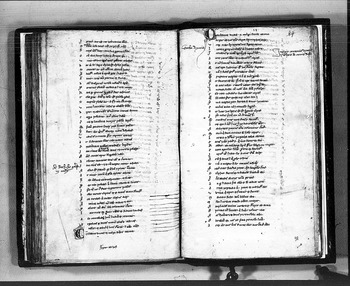
Among the manuscripts of Ovid's Metamorphoses used by N. Heinsius (1620–1681) and as yet unidentified or given up for lost is the so-called fragmentum Caesenas (Cs),Footnote 2 the collation of which was not carried out by Heinsius himself but provided for him by the Hamburg jurist Lucas Langermann (1625–1686), who was a correspondent of Heinsius, Gronovius and Vossius, among others.Footnote 3 According to M.D. Reeve, he was also responsible for adding these notes, using the siglum c, to Oxon. Bodl. Auct. S.V.5, which also includes the collations—by another hand—of A (= Vrbinas ueterrimus, our V2) and B (= Berneggerianus, our P2).Footnote 4 The variants provided by this fragment affect lines 9.235–11.169 and 13.1–403, although this does not imply that these were the exact limits of its content, as we shall see below. Some of these variants ended up in the notes of the editions by Heinsius himself and by those who continued his work (the most prominent example being the admirable edition of Ovid by P. Burman, in 1727Footnote 5 ), and it was D.A. Slater who rescued the collation of Bodl. Auct. S.V.5 from obscurity when he included the greater part of the readings of c (the siglum he himself retains) among the rich store of information presented in his work. F. Munari included the fragment in his catalogue,Footnote 6 clearly pointing to the uncertainty surrounding its dating (‘aetatis incertae’, the same expression as used by Slater) while adding the information that it was not at that time to be found in Cesena. The succinct information offered by Slater is used by I. Marahrens for her dissertationFootnote 7 and by W.S. Anderson for his edition.Footnote 8 R.J. Tarrant, in turn, explicitly states that the fragment is now lost.Footnote 9 In the following pages, however, I will attempt to show that this fragment is not lost, but still preserved in the Biblioteca Malatestiana in Cesena.
In the first place, references to the fragment are strikingly few and far between, and it is significant that in the collation that appears in Oxon. Bodl. Auct. S.V.5, unlike the case of A and B, neither the beginning of the volume (p. 12) nor the beginning of Book 9 (p. 234) nor the page on which it is first mentioned (p. 242) provides any information or details on the identity of the fragment, or the siglum to be used for it. Rather, the first reference appears unannounced in the margin at line 9.235, subsequent references continuing down to 11.169 (p. 294), from which point on they do not reappear, with no warning of this interruption and no mention of the possible cause. References to the fragment reappear at 13.2 (p. 338) and continue as far as line 403 of the same book (p. 352), where, however, there appears a note in the same hand: ‘deficit fragm. Caesen.’.Footnote 10
The only mention of the fragment by Heinsius is to be found in his note on Met. 9.506(507),Footnote 11 from which much of the information we have stems. It reads as follows: ‘v. 506. Thalamos timuere sororum] vetustum apud Caesenates fragmentum, cujus excerpta V. Cl. Lucas Langermannus mecum communicavit, tenuere, & quinque praeterea ex nostris.’ This is all we know, which gives rise to the obscurity surrounding the document.
Now, the Biblioteca Malatestiana possesses—to our knowledge—two manuscripts containing the Metamorphoses, neither of which appears to have been collated to date.Footnote 12 The codex which interests us here is the one bearing the catalogue reference S.I.5 (= Cs2).Footnote 13 According to the oldest catalogue record, by G.M. Muccioli,Footnote 14 this is a twelfth-century manuscript, not only on the basis of palaeographical evidence but also because written at the top of the last page is ‘1121’ (the cataloguer erroneously states ‘1185’). R. Zazzeri,Footnote 15 however, dates it to the eleventh century, although he provides no arguments to support his claim. Munari dates it to the period between the twelfth and the fourteenth centuries, while it is ascribed to the fourteenth century by F.T. Coulson and B. Roy.Footnote 16 The most recent and most complete description (2007), by Raffaella Crociani, dates the manuscript to the thirteenth century.Footnote 17 The same scholar recognizes that what we have is a composite manuscript that is the result of the sewing of some central fascicles (9–15, fols 65–102) between another two groups of fascicles (1–8, fols 1–64; 16–17, fols 103–22), which she considers to be the ‘nucleo originario del manoscritto’. This original nucleus, she argues, was copied by a thirteenth-century hand (A), while the central group was the work of a different hand (B), albeit a contemporary one (according to Crociani). An analysis of the spellings of the two hands in fact indicates that the central block (hand B) was copied at the end of the twelfth century or beginning of the thirteenth, and that hand A is possibly from the end of the thirteenth century. The central block has a text frame of around 40 lines per page and is almost entirely free of marginal and interlinear notes. The ‘original nucleus’ has smaller lettering, with some 60/65 lines per page, and the annotations (almost always exegetical, not textual) appear profusely throughout. As regards the reference ‘1121’, while it is true that it seems to be a date, it is also true that neither hand can date back so far, which, together with the fact that the figure appears on the back cover of the manuscript, would suggest that this page formed part of the cover of a different manuscript and was re-used to make a complete codex out of Cs2. Footnote 18
As regards the contents of each part, the original nucleus (which we shall refer to specifically henceforward as Cs2) contains 1.1–9.252 and 13.364–15.879, while the central fascicles (henceforward Cs) contain 9.234–13.403. They are therefore complementary blocks and the present central fascicles, in the opinion of Crociani,Footnote 19 ‘hanno sostituito gli originali fascicoli centrali, andati perduti forse in seguito ad una caduta’.
The first fact that is patently evident is that this central block coincides with the range of the fragmentum Caesenas. The second and much more significant fact is that its text also coincides. Indeed, a collation of 13.1–403Footnote 20 in Cs (fols 98–102) shows that its text coincides completely not only with the variants of c pointed to by Heinsius and Slater in their respective notes but also with all the hundred-odd annotations written by Langermann in the margins of Oxon. Bodl. Auct. S.V.5, which I list below with my comments on occasional divergences:Footnote 21
-
- 2 clipei dominus] inu. ord. Cs*
-
- 8 a (om. Cs [a.c.])] ego Cs(suprascr. p.c.)
-
- 9 igitur fictis] inu. ord. Cs*Footnote 22
-
- 11 isti] illi Cs
-
- 14 narret] narrat Cs*
-
- 15 sine] sum Cs*Footnote 23
-
- 29 causam] causa Cs
-
- 39 traxit] tranxit Cs Footnote 24
-
- 42 simus] sumus Cs
-
- 44 umquam] nôquam Cs
-
- 54 spicula] piscula (per comp.) Cs Footnote 25
-
- 74 trepidantem] metuentem Cs
-
- 77 perstas] perstat Cs
-
- 84 timoris] furoris Cs
-
- 85 sanguineae] sanguineo Cs*
-
- 91 ignesque] ignemque Cs
-
- 93 puppes] naues Cs
-
- 97 Aiaci] aiace Cs
-
- 101 semel] tamen Cs
-
- 104 incautum] incaptum Cs
-
- 105 ipse] ille Cs* || ab (sic Cs [suprascr. u.l.])] in Cs
-
- 116 trahenti] ferenti Cs Footnote 26
-
- 130 poteremur] potiremur Cs
-
- 133 succedat] succedit Cs
-
- 142 auctor] actor Cs
-
- 144 nam mihi] namque mihi Cs || Arcesius] acrisius Cs
-
- 146–7 addita nobis | altera] altera nobis | addita Cs
-
- 151 Telamon Peleusque] peleus telamonque Cs
-
- 156 Pthiam haec Scyrumue] phyam uesirumqueFootnote 27 Cs
-
- 157 Achilli] origo Cs*
-
- 158 num2] nec Cs
-
- 163 cultu natum] inu. ord. Cs
-
- 169 euertere] uertere Cs
-
- 174 Chrysenque et Cillan] crissamque et sicillam et Cs*
-
- 175 Scyron] cirum Cs
-
- 176 Lyrnesia] lerneia Cs Footnote 28
-
- 183 aut (sic Cs [a.c.] )] haut Cs (p.c. a manu prima)
-
- 184 erant] sunt Cs
-
- 188 publica commoda] commoda puplica Cs
-
- 191 populi] populis Cs* || datique] dati Cs*
-
- 195 lintea] carbasa Cs Footnote 29
-
- 196 et] ad Cs || orator] ortator Cs
-
- 201 iunctum] uictum Cs
-
- 218 auctore suam] actore suum Cs || uocem] factum Cs*
-
- 220 cur] dum Cs*
-
- 221 dat] detFootnote 30 Cs
-
- 223 uidi] uidit Cs
-
- 229 auersos] aduersos Cs
-
- 230 terrore (sic Cs [suprascr. a manu prima] )] pauoreFootnote 31 Cs || pauentes] timentes Cs Footnote 32
-
- 231 Telamoniades (sic Cs [suprascr. u.l. a manu prima])] talonionidesFootnote 33 Cs || quidquam] quisquam Cs*
-
- 232 at] et Cs
-
- 235 repono] reposco Cs
-
- 251 uictor uotisque] uotis uictorque Cs
-
- 255 Lycii] licii Cs
-
- 257 Coeranon] ceramon Cs || Iphitiden] ýphidonFootnote 34 Cs || Chromiumque] cromumqueFootnote 35 Cs
-
- 258 Alcandrumque] Alchandrumque Cs || Haliumque] alimqueFootnote 36 Cs || Noemonaque] nemonaque Cs || Prytaninque] pridanumqueFootnote 37 Cs
-
- 259 Chersidamante] residamante Cs || Thoona] dodona Cs Footnote 38
-
- 260 Charopem] claropê Cs*
-
- 271 sed] sic quoque Cs Footnote 39 || ne] me Cs*
-
- 282 timorque] dolorque Cs (dub. prob. Tarrant in app.)
-
- 290] rudis et] rudisque leg. S.V.5 in c, sed perperam Footnote 40
-
- 297 incepto (sic Cs [î suprascr. u.l. a manu prima])] acepto Cs*Footnote 41 || accessisse] accessi Cs*
-
- 299 uocas] uocat Cs
-
- 302] uobis] nobis Cs Footnote 42
-
- 303] nequeam] nequeo Cs
-
- 304] Vlixis (sic Cs [u.l. suprascr. a manu prima] )] ulixes Cs
-
- 309 decorum] decorum est Cs
-
- 316 bellique (sic Cs [p.c.] )] belloque Cs (a.c.) Footnote 43
-
- 317 feros … dolores] feros … labores Cs
-
- 319 sed et felix] sed est felix Cs || satis] sic quoque Cs Footnote 44
-
- 320 delenda] delendaque Cs*
-
- 327 sollertia] sententia Cs*
-
- 328 sis (sic Cs [p.c.])] sit Cs (a.c.)
-
- 332 sic] sit Cs
-
- 338 comparat] conferat Cs
-
- 340 fortis … Aiax] fortis aiax ubi est Cs
-
- 341 uerba] dicta Cs* || audet] audes Cs*
-
- 345 auferre] referre Cs*
-
- 352 cum] pro Cs
-
- 357 Andraemone] ademone Cs*
-
- 358 Idomeneus] ydoneus Cs
-
- 368 tantum] sic quoque Cs Footnote 45
-
- 371 proque] perque Cs || cura quibus] curis quas Cs
-
- 381 fatale] fale Cs*
-
- 383 re] tum Cs
-
- 386 uicit] uincit Cs
-
- 394 rubefactaque] rubefacta Cs Footnote 46
-
- 395 uiridi genuit] inu. ord. Cs
-
- 396 Oebalio] eubalio Cs*
-
- 399 Hypsipyles] ýphiles Cs Footnote 47
-
- post 399–401 transierat tandem portu uotoque potitus om. Cs
-
- 402 reuexit] reuixit Cs
-
- 403 imposita est sero] sic quoque Cs Footnote 48
-
- ad hunc u. ‘deficit fragm. Caesen.’ exhib. S.V.5
In short, once cases of doubt and of misreadings and mistranscriptions have been cleared up, it is obvious that the text cited for c and the text available in Cs are one and the same.
It is now time to consider how and when the piecing together of the two parts of the manuscript came about, although it was obviously after Langermann's collation in the middle of the seventeenth century. As stated above, Crociani assumed that the central block had been added to make good a possible loss, and this would be consistent with the crossing out of the redundant lines. In fact, the first part of Cs2 ends (fol. 64v) with 9.252, while Cs opens (fol. 65r) with 9.234. Now, on this fol. 65r one hand has framed verses 234–52 within straight lines and scored this section out by means of a large X, adding in both margins the annotation ‘vacant’.Footnote 49 In the latter part of the combined codex (fol. 102v) there is no crossing out but the note ‘vacant’ does appear, twice. In addition, on this same page, which contains 13.363-403, a vertical line in the left-hand margin, in the same hand and ink as the above-mentioned 65r points precisely to the elimination of lines 13.364-403, prompting the reader to jump, after the first line (13.363) of that folio (102v), directly to the first line of the following one (fol. 103r, 13.364). Both scorings out indicate quite clearly that the text on which the copy is based is that of Cs2, in other words, that it is the fascicles of Cs which are incorporated into Cs2 and complete it.Footnote 50
However, it is scarcely credible that, in Cesena itself, the fragment used by Langermann should contain almost exactly the same text as was housed in the fascicles lost in the middle of Cs2. It seems more reasonable to consider a near coincidence: that is, that in Cs2 part of the text between 9.252 and 13.364 was indeed lost or else suffered serious deterioration. On finding available in Cesena itself the fragment of Cs containing the part of the text that had deteriorated or been lost from Cs2, the librarians were forced to decide which surplus folios or fascicles should be sacrificed and chose to keep the fragment of Cs in one piece, leading, as we have seen, to a physically well-assembled codex and one with a relatively low level of redundant overlap (56 lines). The reasons that prompted the librarians to opt for keeping Cs in one piece are not entirely clear, although this decision must have had something to do with the distribution of the folios of Cs2. Footnote 51
It seems highly likely that the missing fragment of Cs2, which was replaced by Cs, occupied three quaternions, that is 24 folios, in view both of the general configuration of Cs2 itself and of the length of the text being copied. As regards the configuration, as Crociani (n. 17) points out in precise detail, the whole ‘nucleo originario’ comprised eight quaternions in the opening block (fols 1–64) and one quaternion (fols 103–10) + one senion (fols 111–22) in the closing block. Thus, according to our own reconstruction, codex Cs2 can be assumed to have been designed as the sum total of 12 quaternions and one senion in which the whole text of the Metamorphoses, and this alone, would fit. As regards the length of the text of these three quaternions, the calculation is as follows: a maximum average of 65 lines per page (130 lines x 24 fols) would provide room for up to 3,120 lines, and this figure is consistent with the 3,070 lines of text of the Metamorphoses which are missing in Cs2 (545 [Book 9] + 739 [10] + 795 [11] + 628 [12] + 363 [13]), to which would have to be added the linking subscriptiones/tituli of the corresponding books.Footnote 52 In other words: the librarians noticed that in Cs2 part of the text of Books 9 to 13 of the Metamorphoses was missing or damaged and found fragment Cs, which contained that very text.Footnote 53 For practical reasons and since they had to eliminate all the folios with redundant text, they chose to incorporate the fragment in its entirety, since to do this they would only have to unsew the three quaternions of Cs2 (nos 9–11) containing 9.252–13.364 (if these folios were indeed damaged and not simply lost in whole or in part).
This, however, does not clear up all the doubts presented by the text. The most obvious one is this: if Cs had the unbroken text up to 13.403, why did Langermann stop annotating at 11.169 and continue at 13.2? Bearing in mind that the text of Met. 11.186–13.1 takes up the present folios 83–97, it seems reasonable to suspect that the cause lies in another loss of fascicles of text, but this time from Cs.
In fact, line 11.169, to which the last annotation in S.V.5 for this book corresponds, is on fol. 82v of Cs. However, this page does not stop there but at 11.185, and therefore Langermann had at hand at least these additional lines.Footnote 54 Now, if he mentioned no interesting readings between 11.169 and 11.185, this is because Cs displays no notable variants: only the non-metrical at (for atque) in 11.173 and the more interesting humoque (for humumque) at the end of the page and folio at 11.185, an omission that in any case is not at odds with the economy with which Langermann regularly deals with the readings of the fragment.Footnote 55 In short, he may well have seen both readings but not have considered them worthy of mention.
As regards the end of this assumed lacuna in Cs, the last line copied on fol. 97v corresponds to 13.1 (followed only by the catchwords surgit ad hos: 13.2, at the end of the quire comprising fols 90–7Footnote 56 ). This line, 13.1, appears immediately after 12.628, with no subscriptio or titulus between the two or in the margins. The line appears inside the regular text frame and is in the same hand as those above, although the beginning of a new book is indicated by an initial ornamental C- (Consedere), in two colours of ink, similar to (possibly slightly smaller, owing to the lack of space at that position in the page) and in the same hand as those opening Books 10 (fol. 71v), 11 (fol. 80v) and 12 (fol. 90r). Now, the same line is repeated (13.1 bis), with an even more elaborately decorated ornamental C-, at the beginning of fol. 98r, although it occupies a space above the text frame, just below the upper edge of the folio and the indication of the book number (‘13’) found top-centre on all the rectos. At first sight it might seem logical to think that the copyist himself, after copying the text as normal, was not fully satisfied on seeing that this ‘orphaned’ line (especially being the first verse of the book) stood in isolation and that he therefore repeated it in this prominent position. However, careful analysis of the lettering reveals that, although similar, it is not in the same hand (compare the abbreviation of et, the lower stroke of the g and the left-hand corners of the s-longa) and, in addition, the initial capital is in a single colour and the ink used for the whole line different. This makes me inclined to assume that this second copyist came across a document in which Book 13 began with the second line, a deficiency he was able to make up for easily by adding the first line (13.1 bis) in the available space.
(fols 97v – 98r)

CONCLUSION
The textual and codicological evidence analysed above paints a picture that would appear to stretch the imagination somewhat but which, in the end, is logical: into the hands of Lucas Langermann comes a fragment (today's folios 65–82 and 98–102) containing the text of Ov. Met. 9.234–11.185 and 13.1(bis)–403, the most significant readings of which he transfers to Oxon. Bodl. Auct. S.V.5 with the siglum c. Footnote 57 In parallel with this, the Biblioteca Malatestiana in Cesena has housed since 1587 a manuscript of the Metamorphoses (S.I.5 = Cs2) left to that institution, which was already in its second century of existence, by the doctor Niccolò II Masini, as can be seen from the frontispiece (fol. IIr): Ouidium hunc ab antiqua maiorum suorum bibliotheca sumptum, Franciscanae huic donauit Nicolaus Masinius IIs. physicus. Anno salutis M.D.LXXXVII. Footnote 58 In the course of a restoration of this manuscript,Footnote 59 and either because of a loss of text between Books 9 and 13 (not mentioned in any of the descriptions) or because of relative deterioration, recourse was had to this other contemporary fragment, which at the time of the restoration did contain the fifteen central folios (fols 83–97) with the text of Met. 11.186–13.1, although these folios had also been lost by the time Lucas Langermann collated it. In 2005 UNESCO included the Biblioteca Malatestiana of Cesena in its Memory of the World Register; the story reconstructed in these pages demonstrates just how well deserved this status is.