1. Introduction
Volcanic rocks are a key component of Earth’s continental crust and can be formed in various tectonic settings by the mass and/or heat transfer from the mantle to the crust (Wu et al. Reference Wu, Sun, Ge, Zhang, Grant, Wilde and Jahn2011). Volcanic rocks therefore play an essential role in the interpretation of both crustal growth and tectonic evolution (Windley et al. Reference Windley, Alexeiev, Xiao, Kröner and Badarch2007; Wu et al. Reference Wu, Sun, Ge, Zhang, Grant, Wilde and Jahn2011). The Great Xing’an Range (GXR) in NE China covers an area of c. 100 000 km2 and is characterized by widespread Mesozoic volcanic rocks and coeval granitoid intrusions (Lin et al. Reference Lin, Ge, Sun, Wu, Chong, Kyung, Myung, Moon, Chi and Sung1998; Shao et al. Reference Shao, Liu, Chen and Han2001; Fan et al. Reference Fan, Guo, Wang and Lin2003; Zhang et al. Reference Zhang, Ge, Wu, Wilde, Yang and Liu2008 a, Reference Zhang, Gao, Ge, Wu, Yan, Wilde and Li2010; Wu et al. Reference Wu, Sun, Ge, Zhang, Grant, Wilde and Jahn2011). These igneous rocks constitute one of the largest igneous provinces in the world and have attracted considerable recent research attention on account of their importance in inferring the cessation of the development of the Central Asian Orogenic Belt (CAOB) and the superposition of the Mongol–Okhotsk and Palaeo-Pacific tectonic regimes (Zhang et al. Reference Zhang, Ge, Wu, Wilde, Yang and Liu2008 a, Reference Ying, Zhou, Zhang and Wang2010; Wu et al. Reference Wu, Sun, Ge, Zhang, Grant, Wilde and Jahn2011; Wang et al. Reference Wang, Xu, Gao, Zhang, Pei, Zhao and Yang2013; Xu et al. Reference Xu, Pei, Wang, Meng, Ji, Yang and Wang2013). Recently published zircon U–Pb ages and 40Ar−39Ar ages (Ge et al. Reference Ge, Li, Lin, Sun, Wu and Yin2001; Wu et al. Reference Wu, Lin, Wilde, Zhang and Yang2005; Wang et al. Reference Wang, Zhou, Zhang, Ying, Zhang, Wu and Zhu2006; Zhang et al. Reference Zhang, Zhou, Ying, Wang, Guo, Wan and Chen2008 b; Gou et al. Reference Gou, Sun, Zhao, Ren, Zhang, Fu, Wang and Wei2010; Yang et al. Reference Yang, Gao, Chen, Zhou, Zhang, Jin and Zhang2012) show that Mesozoic volcanic rocks in the GXR were erupted mainly during the Middle Jurassic – Early Cretaceous period (166–113 Ma), peaking at 136–122 Ma with a rock association of predominantly felsic rocks (e.g. dacites, rhyolites and rhyolitic tuffs) and minor intermediate to basaltic rocks (e.g. trachytes, trachyandesites, andesites and basaltic andesites) (Wang et al. Reference Wang, Zhou, Zhang, Ying, Zhang, Wu and Zhu2006; Zhang et al. Reference Zhang, Ge, Wu, Wilde, Yang and Liu2008 a, Reference Ying, Zhou, Zhang and Wang2010). Geochemical and petrogenetic investigations have revealed that the Early Cretaceous volcanic rocks formed in an extensional setting, which is further evidenced by the occurrence of coeval metamorphic core complexes (Zhang et al. Reference Zhang, Shao and Zheng1998; Liu et al. Reference Liu, Siebel, Li and Pan2005), A-type granitoids (Wu et al. Reference Wu, Sun, Li, Jahn and Wilde2002) and extensional basins (e.g. the Songliao and Hailar Basins) (Meng et al. Reference Meng2003; Ji et al. Reference Ji, Meng, Wan, Ge, Yang, Zhang, Dong and Jin2019 a, b). Nevertheless, the specific geodynamic processes that led to the extensional tectonic setting remain contentious, with the various schemes proposed including (1) upwelling of a mantle plume (Lin et al. Reference Lin, Ge, Sun, Wu, Chong, Kyung, Myung, Moon, Chi and Sung1998; Ge et al. Reference Ge, Lin, Sun, Wu and Li2000); (2) gravitational collapse of orogenically thickened crust after closure of the Mongol–Okhotsk Ocean (MOO) (Fan et al. Reference Fan, Guo, Wang and Lin2003; Meng et al. Reference Meng2003; Xu et al. Reference Xu, Ge, Pei, Meng, Yu and Yang2008; Ying et al. Reference Ying, Zhou, Zhang and Wang2010; Guan et al. Reference Guan, Liu, Wang, Wang, Wang, Shi and Chen2018); (3) large-scale lithospheric delamination related to subduction of the Palaeo-Pacific Plate (Wu et al. Reference Wu, Lin, Wilde, Zhang and Yang2005, Reference Wu, Sun, Ge, Zhang, Grant, Wilde and Jahn2011; Zhang et al. Reference Zhang, Gao, Ge, Wu, Yan, Wilde and Li2010; Li et al. Reference Li, Suo, Li, Zhou, Santosh, Wang, Wang, Guo, Yu, Lan, Dai, Zhou, Cao, Zhu, Liu, Jiang, Wang and Zhang2019; Suo et al. Reference Suo, Li, Jin, Zhang, Zhou, Li, Wang, Liu, Wang and Somerville2019); and (4) rollback of the subducted Palaeo-Pacific flat slab and subsequent upwelling of asthenospheric mantle (Ji et al. Reference Ji, Meng, Wan, Ge, Yang, Zhang, Dong and Jin2019 a, b). However, regardless of the particular geodynamic processes that were involved, intense crust–mantle interactions and vertical accretion of continental crust are expected to have occurred in the GXR during the Early Cretaceous Epoch, as indicated by the upwelling of asthenospheric-mantle materials to various degrees.
Crust–mantle interaction within the GXR has so far been poorly constrained, as previous studies were based mainly on geochemical and geochronological data on either the widespread crust-derived felsic rocks or individual mantle-derived mafic–intermediate igneous outcrops (Ge et al. Reference Ge, Lin, Sun, Wu and Li2000; Fan et al. Reference Fan, Guo, Wang and Lin2003; Zhang et al. Reference Zhang, Ge, Wu, Wilde, Yang and Liu2008 a, Reference Ying, Zhou, Zhang and Wang2010; Gou et al. Reference Gou, Sun, Zhao, Ren, Zhang, Fu, Wang and Wei2010, Reference Gou, Sun, Liu, Ren, Zhao and Liu2013; Wu et al. Reference Wu, Sun, Ge, Zhang, Grant, Wilde and Jahn2011; Dong et al. Reference Dong, Ge, Yang, Zhao, Wang, Zhang and Su2014; Ji et al. Reference Ji, Ge, Wang, Yang, Zhao, Bi and Dong2016, Reference Ji, Ge, Yang, Wang, Zhang, Wang and Bi2018). In this context, exploration of the processes and mechanisms of crust–mantle interaction is required by simultaneously studying both the mantle- and crust-derived rock associations in the same volcanic formation, the results of which should also provide insights into the Early Cretaceous geodynamic setting of the GXR. The Tulihe area, located in the northern segment of the GXR, contains not only crust-derived rhyolites and rhyolitic tuffs, but also some associated coeval mantle-derived trachytes and trachyandesites, the investigation of which should provide key information regarding the above issues. Here we present whole-rock geochemical, geochronological and zircon Lu–Hf isotopic data for the different types of Early Cretaceous volcanic rocks in the Tulihe area of the northern GXR, with the aim of evaluating the petrogenesis and genetic relationships of these rocks, inferring crust–mantle interaction and further constraining extension-related geodynamic processes in the GXR.
2. Geological setting
The Xing’an–Mongolian Orogenic Belt (XMOB) has been traditionally considered as the eastern segment of the CAOB and is located between the North China and Siberia cratons (Fig. 1a) (Sengör et al. Reference Sengör, Natal’in and Burtman1993; Li, Reference Li2006; Windley et al. Reference Windley, Alexeiev, Xiao, Kröner and Badarch2007; Cai et al. Reference Cai, Sun, Yuan, Xiao, Zhao, Long and Wu2012; Jiang et al. Reference Jiang, Sun, Kröner, Tumurkhuu, Long, Zhao, Yuan and Xiao2012; Xu et al. Reference Xu, Pei, Wang, Meng, Ji, Yang and Wang2013; Liu et al. Reference Liu, Li, Feng, Wen, Neubauer and Liang2017). The XMOB is composed of a collage of micro-continental blocks, including the Erguna and Xing’an blocks in the NW of the range, the Songnen Block in the centre and the Jiamusi–Khanka Block in the east (Wu et al. Reference Wu, Lin, Wilde, Zhang and Yang2005, Reference Wu, Sun, Ge, Zhang, Grant, Wilde and Jahn2011; Li, Reference Li2006). Throughout the Phanerozoic Eon, the XMOB underwent a complex tectonic-magmatic evolution involving multiple stages of accretion and collision (Sengör et al. Reference Sengör, Natal’in and Burtman1993). During the Palaeozoic Era, the XMOB was controlled by the Palaeo-Asian Ocean tectonic system, which led to the amalgamation of several micro-continental blocks, multi-arc systems and accretionary complexes (Wu et al. Reference Wu, Sun, Ge, Zhang, Grant, Wilde and Jahn2011; Xiao & Santosh, Reference Xiao and Santosh2014). Scissor-type closure of the Palaeo-Asian Ocean occurred during the Late Permian – Middle Triassic period along the Solonker–Changchun–Yanji suture zone, which led to soft collision of the North China and Siberian cratons (Li, Reference Li2006; Eizenhöfer et al. Reference Eizenhöfer, Zhao, Sun, Zhang, Han and Hou2015). Since the Mesozoic Era, the XMOB has been affected primarily by closure of the MOO and subduction of the Palaeo-Pacific Plate, leading to the widespread occurrence of Mesozoic volcanic rocks and coeval granitoid intrusions (Zhang et al. Reference Zhang, Gao, Ge, Wu, Yan, Wilde and Li2010; Xu et al. Reference Xu, Pei, Wang, Meng, Ji, Yang and Wang2013; Zhou et al. Reference Zhou, Cao, Wilde, Zhao, Zhang and Wang2014; Yang et al. Reference Yang, Ge, Yu, Ji, Liu, Zhang and Tian2016; Guan et al. Reference Guan, Liu, Wang, Wang, Wang, Shi and Chen2018; Li et al. Reference Li, Suo, Li, Zhou, Santosh, Wang, Wang, Guo, Yu, Lan, Dai, Zhou, Cao, Zhu, Liu, Jiang, Wang and Zhang2019; Suo et al. Reference Suo, Li, Jin, Zhang, Zhou, Li, Wang, Liu, Wang and Somerville2019).
(a) Simplified tectonic map of the Central Asian Orogenic Belt (CAOB) showing the location of NE China (modified from Zhou et al. Reference Zhou, Cao, Wilde, Zhao, Zhang and Wang2014). (b) Tectonic subdivisions of NE China (modified after Liu et al. Reference Liu, Li, Feng, Wen, Neubauer and Liang2017). (c) A detailed geological map of the Tulihe region (modified form HBGMR, 1993), showing sample locations.

The N–S-aligned GXR is located in the western segment of the XMOB (Fig. 1b), formed during late Mesozoic intracontinental tectonism after the closure of the Palaeo-Asian Ocean and final amalgamation of the XMOB (Zhang et al. Reference Zhang, Gao, Ge, Wu, Yan, Wilde and Li2010; Wu et al. Reference Wu, Sun, Ge, Zhang, Grant, Wilde and Jahn2011). The GXR comprises the Erguna, Xing’an and Songnen blocks, which are separated by the Xinlin–Xiguitu and Hegenshan–Heihe sutures, respectively (Wu et al. Reference Wu, Sun, Ge, Zhang, Grant, Wilde and Jahn2011). The Erguna Block is considered to be the eastern extension of the Ereendavaa Block in central Mongolia and is bordered to the NW by the Mongol–Okhotsk belt and to the SE by the Xing’an Block (HBGMR, 1993). This block is an ancient microcontinent with a Precambrian basement that is composed of the amphibolite-facies Xinghuadukou Group and the greenschist-facies Jiageda Group, as well as Cambrian–Proterozoic (700–464 Ma) granitic rocks (Wu et al. Reference Wu, Sun, Ge, Zhang, Grant, Wilde and Jahn2011; Tang et al. Reference Tang, Xu, Wang, Zhao and Li2015, Reference Tang, Xu, Wang, Zhao and Wang2016; Zhao et al. Reference Zhao, Qiu, Liu and Wang2016; Hou et al. Reference Hou, Zhao, Han, Eizenhöfer, Zhang and Liu2020). Recent geochronological data have suggested that magmatic events within the Erguna Block can be subdivided into four stages: Neoproterozoic, Early Palaeozoic, Late Palaeozoic and Mesozoic. In addition, Mesozoic magmatic activities were distributed from north to south across the block and can be divided into three stages: Early–Late Triassic (235–250 Ma), Late Triassic – Early Jurassic (225–175 Ma) and Late Jurassic – Early Cretaceous (155–120 Ma) (HBGMR, 1993; Ge et al. Reference Ge, Wu, Zhou and Abdel Rahman2005, Reference Ge, Sui, Wu, Zhang, Xu and Cheng2007a; Wu et al. Reference Wu, Sun, Ge, Zhang, Grant, Wilde and Jahn2011; Tang et al. Reference Tang, Xu, Wang, Zhao and Li2015, Reference Tang, Xu, Wang, Zhao and Wang2016).
The Xing’an Block was previously considered an ancient microcontinent with a Precambrian basement. However, recent geochronological research has shown that most of these basement rocks formed during the Palaeozoic – early Mesozoic period (Miao et al. Reference Miao, Fan, Zhang, Liu, Jian, Shi, Tao and Shi2003, Reference Miao, Liu, Zhang, Fan, Shi and Xie2007; Xu et al. Reference Xu, Xu, Wang and Gao2012). Several early Palaeozoic magmatic arc assemblages have also been identified in the Xing’an Block, including the Duobaoshan (c. 490 Ma) and Baolidao (510–420 Ma) arcs (Ge et al. Reference Ge, Wu, Zhou and Zhang2007 b; Chen et al. Reference Chen, Jahn and Tian2009). In addition, the block also contains huge volumes of late Palaeozoic and Mesozoic igneous rocks, which have been divided into four stages of formation: Carboniferous (340–300 Ma), Permian (290–260 Ma), Middle Jurassic (187–157 Ma) and Early Cretaceous (145–120 Ma) (Wu et al. Reference Wu, Sun, Ge, Zhang, Grant, Wilde and Jahn2011). Recent age data indicate that the Shangkuli Formation in the GXR is Early Cretaceous in age rather than Late Jurassic (e.g. Ge et al. Reference Ge, Li, Lin, Sun, Wu and Yin2001; Wang et al. Reference Wang, Zhou, Zhang, Ying, Zhang, Wu and Zhu2006; Zhang et al. Reference Zhang, Ge, Wu, Wilde, Yang and Liu2008 a, Reference Ying, Zhou, Zhang and Wang2010).
The Songnen Block is composed mainly of the Songliao Basin in its central part, the southern GXR in the west and the Lesser Xing’an-Zhangguangcai Range in the east (HBGMR, 1993; Wu et al. Reference Wu, Sun, Ge, Zhang, Grant, Wilde and Jahn2011). It has been suggested that a unified Precambrian basement exists beneath the Songliao Basin (HBGMR, 1993; Wu et al. Reference Wu, Sun and Li2000). However, subsequent research has revealed that Palaeozoic–Mesozoic granitoids and Palaeozoic strata are widespread in the basement (Gao et al. Reference Gao, Xu, Yang, Pei, Liu and Hu2007; Pei et al. Reference Pei, Xu, Yang, Zhao, Liu and Hu2007), with minor 2.5–0.9-Ga granitic gneisses exposed around the Songliao Basin (Wang et al. Reference Wang, Zhou, Zhang, Ying, Zhang, Wu and Zhu2006; Wu et al. Reference Wu, Sun, Ge, Zhang, Grant, Wilde and Jahn2011; Zhang, Reference Zhang2011; Qiao & Ma, Reference Qiao and Ma2018). Phanerozoic granites and volcanic rocks are well developed in this block, with most of them formed during the Mesozoic Era (Wu et al. Reference Wu, Sun, Ge, Zhang, Grant, Wilde and Jahn2011), together with minor components formed during early Palaeozoic time (508–471 Ma) (Liu et al. Reference Liu, Chi, Dong, Zhao, Li and Zhao2008; Wang et al. Reference Wang, Guo, Zheng, Donskaya, Gladkochub and Zeng2012). Granitoids of the eastern part of the block (i.e. the Lesser Xing’an-Zhangguangcai Range) were emplaced during the Late Triassic – Middle Jurassic period, whereas granitoids and volcanics in the western part (i.e. the southern GXR) formed mainly during Late Jurassic – Early Cretaceous time.
3. Field relations and sample descriptions
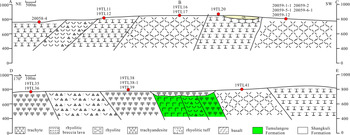
The volcanic rocks investigated in this paper are located in the Tulihe area of Yakeshi City, Hulunbuir, Inner Mongolia Autonomous Region, and the tectonic affiliation of this area is to the eastern Erguna Block (Fig. 1b). The stratigraphic succession of the Tulihe area is composed chiefly of the Jurassic – Early Cretaceous Tamulangou, Shangkuli and Yiliekede formations, together with the Early Carboniferous Xiertala Formation (Fig. 1c) (HBGMR, 1993). The Tamulangou Formation is widespread in the study area and consists of trachyandesite and basalt, with interbedded tuffaceous clastic rock, and is in unconformable contact with the overlying Shangkuli Formation (Fig. 2) (HBGMR, 1993). The Yiliekede Formation, which is composed of andesite, basalt, trachyandesite and dolerite, has limited exposure and unconformably overlies the Shangkuli Formation (HBGMR, 1993). The Xiertala Formation, which consists of sandstone, siltstone, pelite and tuff, has only limited exposure in central Tulihe and is in faulted contact with the overlying Shangkuli Formation (HBGMR, 1993). The Shangkuli Formation has a thickness of c. 370 m and can be subdivided from bottom to top into three members. The emphasis of our study is on the third member, which comprises rhyolite, rhyolitic breccia lava, trachyte, trachyandesite and volcanic glass (HBGMR, 1993). Two transverse-cutting profiles across the sampling localities are displayed in Figure 2. As shown in the profiles, our field observations reveal that the rhyolitic rock unit and the trachytic rock unit were interbedded with each other and the change between the two rock units is sharp.
Transverse cutting profiles showing the sampling strategy and contact relationship of different volcanic rocks of the Shangkuli Formation in the Tulihe region.

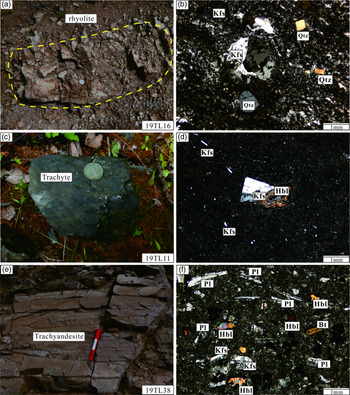
For this study, we analysed and interpreted 17 volcanic rock samples collected from the Shangkuli Formation in the Tulihe area. All of these samples were used for whole-rock geochemical analysis, and three representative samples were used for zircon U–Pb dating and Hf isotope analysis. The locations of the volcanic samples are given in Table 1. Of the three representative samples, the rhyolite (sample 19TL16) is grey-yellow in colour and displays porphyritic texture and either massive or fluidal structure. Its phenocrysts (c. 15 vol.%) are composed of alkali feldspar, quartz and plagioclase, with a groundmass of glassy or microcrystalline texture (Fig. 3a, b). The trachyte (sample 19TL11) is grey-black in colour, displays porphyritic texture and massive structure, and contains phenocrysts (c. 10 vol.%) of alkali feldspar, plagioclase and minor hornblende with altered rims. The groundmass is microcrystalline sanidine and displays trachytic texture (Fig. 3c, d). The trachyandesite (sample 19TL38) is dark-grey in colour, displays porphyritic texture and massive structure, and has phenocrysts (c. 15 vol.%) of plagioclase and minor hornblende. The groundmass is sanidine and displays trachytic in texture (Fig. 3e, f).
Major (wt%) and trace (ppm) elements of the volcanic rocks from the Shangkuli Formation in the Tulihe region, northern Great Xing’an Range

Representative field photographs and microphotographs (cross-polarized light) of the Tulihe Shangkuli Formation volcanic rocks. Kfs – K-feldspar; Qtz – quartz; Hbl – hornblende; Pl – plagioclase; Bt – biotite.

4. Analytical methods
4.a. Zircon U–Pb dating
Zircon grains were extracted from three representative volcanic rock samples by combining heavy liquid and magnetic separation, and were then hand-picked under a binocular microscope at Langfang Yuneng Rock Mineral Sorting Technology Service Co., Ltd., Hebei Province. The hand-picked zircon grains were pasted onto a double-sided tape, mounted within a colourless epoxy and polished to half of the original thickness at Kaidezheng Technology Co., Ltd., Beijing. Cathodoluminescence (CL) images, transmitted and reflected transmitted light photomicrographs were acquired in order to ascertain the internal structure of the zircon and to guide isotopic analysis. Laser ablation – inductively coupled plasma – mass spectrometry (LA-ICP-MS) zircon U–Pb dating was carried out at the Key Laboratory of Mineral Resources Evaluation in NE Asia, Ministry of Land and Resources, Jilin University, Changchun, China. The Agilent 7900 ICP-MS instrument, equipped with a 193-nm Arf excimer laser system (produced by COMPEx Germany), was used to complete zircon U–Pb analysis. Helium was used as carrier gas to provide efficient aerosol transport to the ICP and minimize aerosol deposition around the ablation site and within the transport tube. The analytical spots were 32 μm in diameter with an ablation time of 45 s and an ablation rate of 7 Hz. The standard zircon 91500 was used as an external standard to normalize isotopic fractionation during analysis, and the standard Nist 610 silicate glass was applied for the instrument optimization. The detailed analytical procedures have been described by Yuan et al. (Reference Yuan, Gao, Liu, Li, Günther and Wu2004). Raw data were processed using the GLITTER program. Uncertainties of individual analyses are reported with 1σ error, and weighted mean ages were calculated at 1σ confidence level. The common Pb correction was completed using the method proposed by Andersen (Reference Andersen2002). The data processing, concordia plots and average age calculation were accomplished by the ISOPLOT (Version 3.0) program (Ludwig, Reference Ludwig2003).
4.b. Major- and trace-element analysis
After petrographic examination, 17 volcanic samples were crushed to remove the altered surfaces and select fresh chips. The fresh chips were then ground to c. 200 mesh in an agate ringmill. Whole-rock major- and trace-element analyses were determined in Wuhan Sample Solution Analytical Technology Co., Ltd., Wuhan, China. Major elements were analysed by X-ray fluorescence spectrometer (ZSXPrimus). Based on the USGS rock standards BHVO-2, GSP-2, W-2A, GBW07103 and GBW07316, the analytical precision and accuracy are better than 5% for major elements. Trace-element compositions were determined by an ICP-MS (Agilent 7700e), with the veracity of analysis results mostly within 5–10% from repeatedly analysed USGS rock standards AGV-2, BHVO-2, BCR-2 and RGM-2. For further details of the analytical procedures, see Rudnick et al. (Reference Rudnick, Gao, Ling, Liu and McDonough2004).
4.c. Zircon Hf isotope analysis
In situ zircon Hf isotopic analyses were carried out at the Institute of Geology and Mineral Resources, Tianjin, China. The Hf isotopic analyses were finished by a Neptune multi-collector (MC)-ICP-MS with a 193-nm Fx ArF Excimer laser system, manufactured by Thermo Fisher Scientific Co., Ltd and ESI Co., Ltd., USA, respectively. The further details and instrument settings of the analytical procedures were described by Xie et al. (Reference Xie, Zhang, Zhang, Sun and Wu2008) and Geng et al. (Reference Geng, Li, Zhang, Zhou and Li2011). The Lu–Hf isotopic analyses were determined on the same spots that were used for U–Pb isotopic analyses, with a spot diameter of 50 μm, an ablation time of 23 s and an ablation rate of 8 Hz. The standard zircon 91500 and GJ-1 were used as external standards to optimize the analytical instrument. Measured 176Hf/177Hf and 176Lu/177Hf ratios were adopted to calculate initial 176Hf/177Hf ratios based on the decay constant of 1.865 × 10⁻¹¹ a−1 (Scherer et al. Reference Scherer, Munker and Mezger2001). The ϵHf(t) values were calculated according to the present-day chondritic ratios of 176Hf/177Hf = 0.282772 and 176Lu/177Hf = 0.0332 (Blichert-Toft & Albarde, Reference Blichert-Toft and Albarède1997). In the calculation of the one-stage and two-stage Hf model, 176Hf/177Hf, 176Lu/177Hf and fcc were 0.28325, 0.282772 and –0.548, respectively (Blichert-Toft & Albarède, Reference Blichert-Toft and Albarède1997; Veevers et al. Reference Veevers, Saeed, Belousova and Griffin2005).
5. Analytical results
5.a. Zircon U–Pb ages
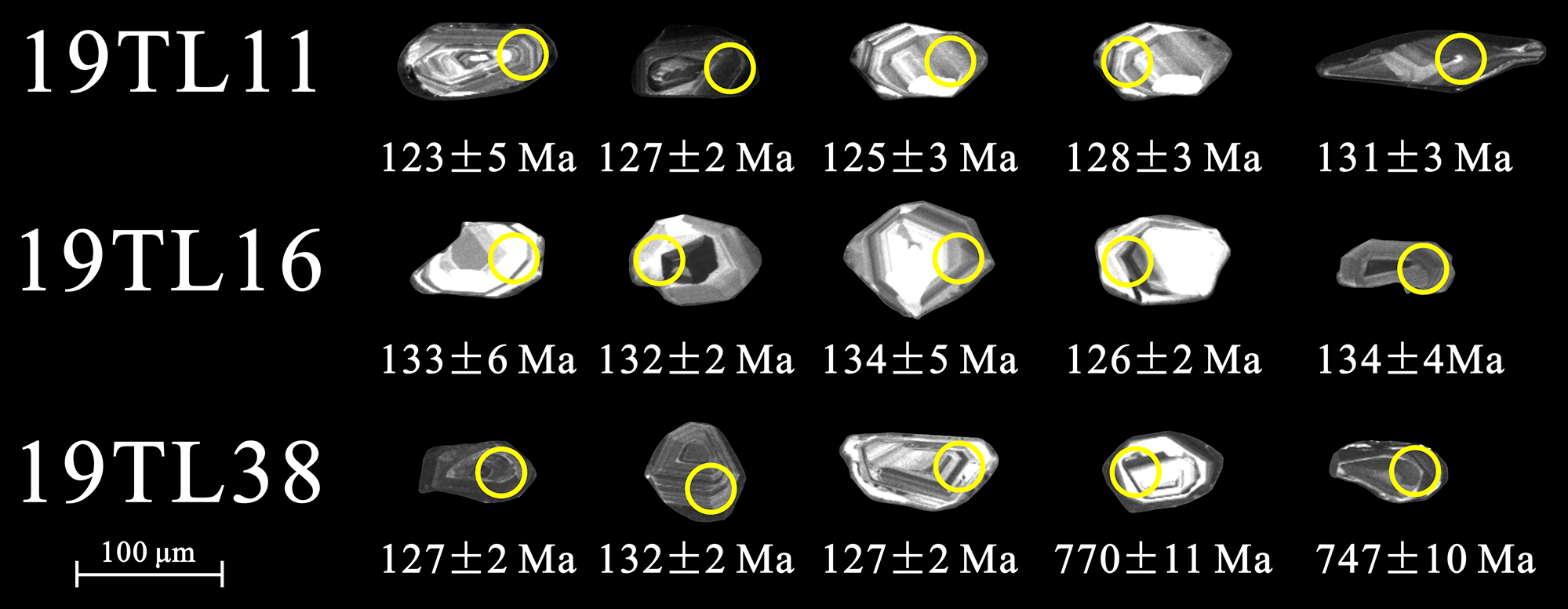
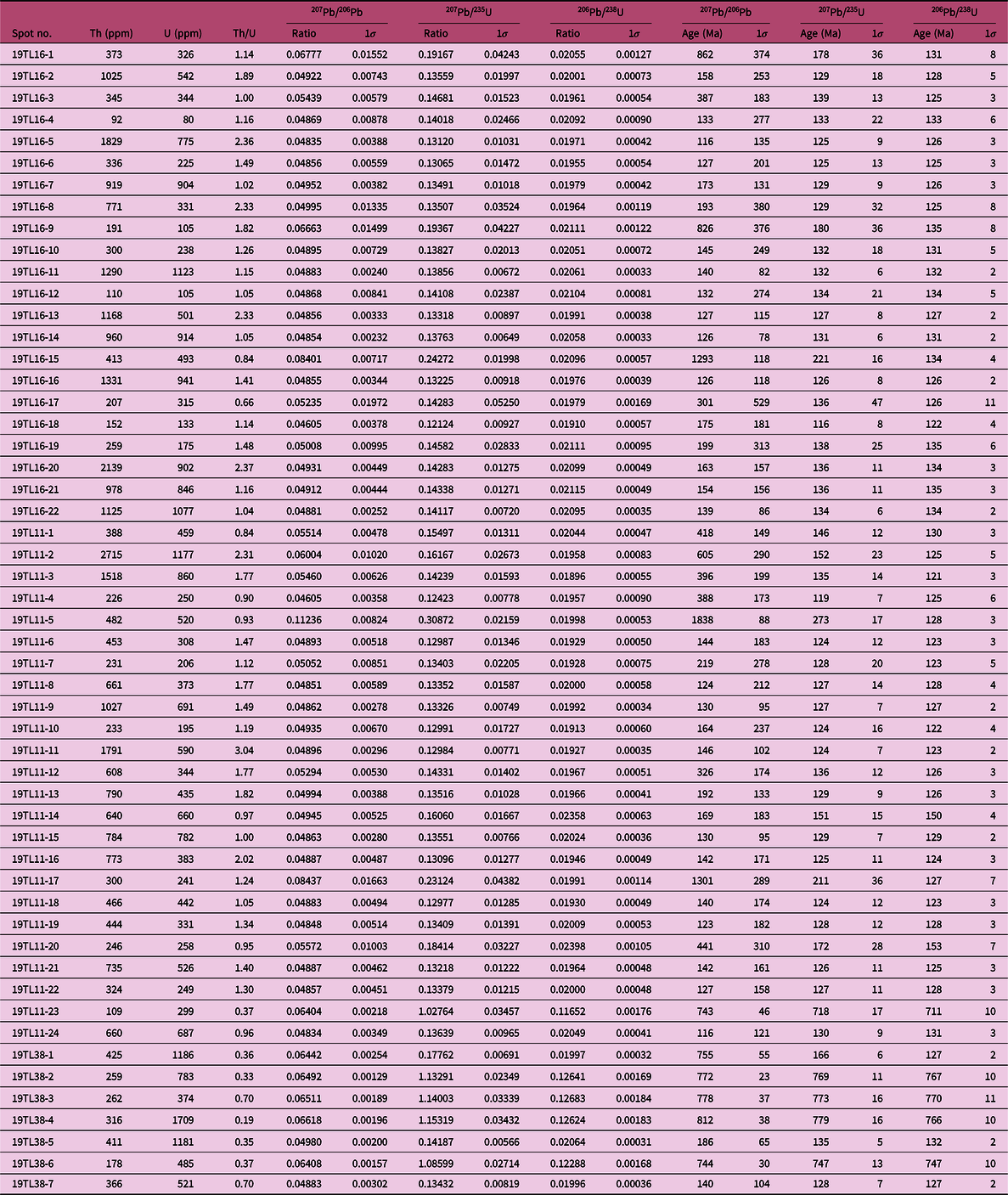
In this paper, three representative volcanic samples (samples 19TL11, 19TL16 and 19TL38) collected from the Shangkuli Formation in the Tulihe area were chosen for LA-ICP-MS zircon U–Pb dating. The CL images of representative zircons are shown in Figure 4 and the U–Pb data are listed in Table 2. Zircon grains from these samples are colourless, transparent and euhedral–subhedral in shape. They mostly display clear oscillatory growth zoning in CL images. In addition, the zircon grains all have high Th/U ratios ranging from 0.19 to 3.04, indicating their typical magmatic origin.
Representative cathodoluminescence (CL) images of zircons from the volcanic rocks of the Shangkuli Formation in the Tulihe area. Yellow solid circles represent the analytical sites for LA-ICP-MS dating, with a uniform size of 32 μm.

LA-ICP-MS U–Pb zircon data of the Shangkuli Formatiom in the Tulihe region, northern Great Xing’an Range

Sample 19TL16 is a rhyolite collected from the northern part of the Tulihe region (50° 29ʼ 2.27ʼʼ N, 121° 24ʼ 47.14ʼʼ E). Three analyses were excluded from the calculations because of high discordancy. A total of 22 analytical spots have 206Pb/ 238U ages varying from 123 to 135 Ma. They define a weighted mean age of 130 ± 2 Ma (mean square weighted deviation, MSWD = 1.5; n = 22) (Fig. 5a), which is interpreted as the eruption age of the rhyolite.
LA-ICP-MS U–Pb concordia diagrams for three volcanic samples from the Shangkuli Formation. The weighted mean age and MSWD are shown in each figure.

Sample 19TL11 is a trachyte collected from the northern part of the Tulihe region (50° 29ʼ 27.26ʼʼ N, 121° 25ʼ 49.84ʼʼ E). One analytical spot was excluded from the calculations because of high discordance. A total of 21 analyses of zircons from this sample yielded a weighted mean 206Pb/ 238U age of 126 ± 1 Ma (MSWD = 0.88; n = 21) (Fig. 5b), representing the crystallization age of the trachyte. Three analytical spots gave 206Pb/ 238U ages of 150, 153 and 711 Ma, which are considered to represent the crystallization ages of inherited or captured zircons entrained by the trachyte.
Sample 19TL38 is a trachyandesite collected from the southeastern Tulihe region (50° 15ʼ 48.72ʼʼ N, 121° 45ʼ 21.23ʼʼ E). Three analyses were excluded from the calculations because of high discordance. The remaining seven analyses produce 206Pb/ 238U ages scattered between 127 and 770 Ma, with two groups defining weighted mean ages of 129 ± 2 Ma (MSWD = 2.1; n = 3) and 762 ± 10 Ma (MSWD = 1.1; n = 4) (Fig. 5c). The younger age of 129 ± 2 Ma is considered to represent the formation age of the trachyandesite, while the older age of 762 ± 10 Ma is interpreted as the crystallization age of inherited or captured zircons in the trachyandesite.
5.b. Geochemistry
The LA-ICP-MS zircon U–Pb dating results clearly show that the studied volcanic rocks of the Tulihe region were all formed during the Early Cretaceous Epoch (126–130 Ma). The whole-rock major- and trace-element compositions for 17 representative samples of the Early Cretaceous volcanic rocks are listed in Table 1. According to their petrological and geochemical characteristics, these volcanic rocks are subdivided into two groups: rhyolites and trachytic volcanics.
5.b.1. Rhyolites
All the rhyolite samples contain high concentrations of SiO2 (74.13–81.73 wt%), Na2O + K2O (6.30–9.84 wt%) and Al2O3 (9.44%–12.93 wt%), but low concentrations of total Fe2O3 (0.86–2.07 wt%), CaO (0.13–0.35 wt%) and MgO (0.15–0.50 wt%), with corresponding Mg no. values of 14–48. Concentrations of Al2O3, K2O, TiO2 and P2O5 decrease with increasing SiO2 concentration. After excluding two samples (19TL16, 19TL17) because of their excessive K2O concentration, the K2O/N2O values of the remaining samples have a range of 1.30–2.64, and the Rittman index ranges from 1.02 to 3.11. These rhyolite samples yield A/CNK (molar ratio of Al2O3/(CaO + Na2O + K2O)) ratios of 0.98–1.21, indicating metaluminous to weakly peraluminous characteristics (Fig. 6a). All these samples exhibit subalkaline affinities in the total alkalis versus silica (TAS) diagram (Fig. 6b), and belong to high-K calc-alkaline series in the K2O versus SiO2 diagram (Fig. 6c).
Plots of (a) A/NK (molar ratio Al2O3 /(Na2O + K2O)) vs A/CNK (molar ratio Al2O3/(CaO + Na2O + K2O)) (after Maniar & Piccoli, Reference Maniar and Piccoli1989); (b) Na2O + K2O vs SiO2 (after Irvine & Baragar, Reference Irvine and Baragar1971); and (c) K2O vs SiO2 (after Peccerillo & Taylor, Reference Peccerillo and Taylor1976) for the volcanic rocks from the Shangkuli Formation.

The total REE (rare earth element) content of these rhyolite samples ranges over 49–175 ppm, with an average value of 119 ppm. They all have similar chondrite-normalized REE patterns (Fig. 7a), characterized by enrichment in light rare earth elements (LREEs), with (La/Yb)N ratios of 8.19–16.14 and LREE/HREE ratios of 8.53–14.07. The rhyolite samples exhibit negative Eu anomalies (Eu/Eu* = 0.18–0.57). In the primary-mantle (PM) -normalized trace-element diagram (Fig. 7b), they are enriched in large-ion lithophile elements (LILEs, e.g. Rb, Th, U and K), and depleted in high-field-strength elements (HFSEs, e.g. Nb, Ta, P and Ti).
(a) Chondrite-normalized REE patterns and (b) primitive-mantle (PM) -normalized trace-element diagrams for the volcanic rocks from the Shangkuli Formation. The values of chondrite and PM are modified after Sun & McDonough (Reference Sun, McDonough, Saunders and Norry1989).

5.b.2. Trachytic volcanic rocks
The trachytic volcanic samples contain moderate concentrations of SiO2 (57.87–65.14 wt%) and variable concentrations of Na2O + K2O (7.61–9.62 wt%), Al2O3 (15.42–17.29 wt%), TiO2 (0.76–1.29 wt%), P2O5 (0.20–0.56 wt%), total Fe2O3 (3.43–6.55 wt%), CaO (2.28–4.57 wt%) and MgO (0.76–2.36 wt%), with Mg no. values range from 30 to 46. With increasing SiO2 concentration, TiO2, Al2O3, CaO, MgO, P2O5 and total FeO concentrations obviously decrease. The K2O/Na2O values of the trachytic volcanic samples range from 0.44 to 1.51, with the Rittman index and A/CNK ratios ranging from 3.20 to 4.40 and from 0.88 to 0.99, respectively (Fig. 6a). They fall within the trachyte and trachyandesite field and exhibit subalkaline affinities on the TAS diagram (Fig. 6b), belonging to the high-K calc-alkaline series in the K2O versus SiO2 diagram (Fig. 6c).
These trachytic volcanic samples have high total REE contents of 208–237 ppm, with an average value of 222 ppm. They all have similar chondrite-normalized REE patterns (Fig. 7a), characterized by enrichment in LREEs, with (La/Yb)N ratios of 16.76–22.18 and LREE/HREE ratios of 11.92–15.69. They exhibit a weak negative Eu anomaly (Eu/Eu* = 0.80–0.85). In the PM-normalized trace-element diagram (Fig. 7b), the trachytic volcanics are enriched in LILEs (e.g. Rb, K, Ba and Sr) and depleted in HFSEs (e.g. Nb, Ta, P and Ti).
5.c. Zircon Hf isotope analyses
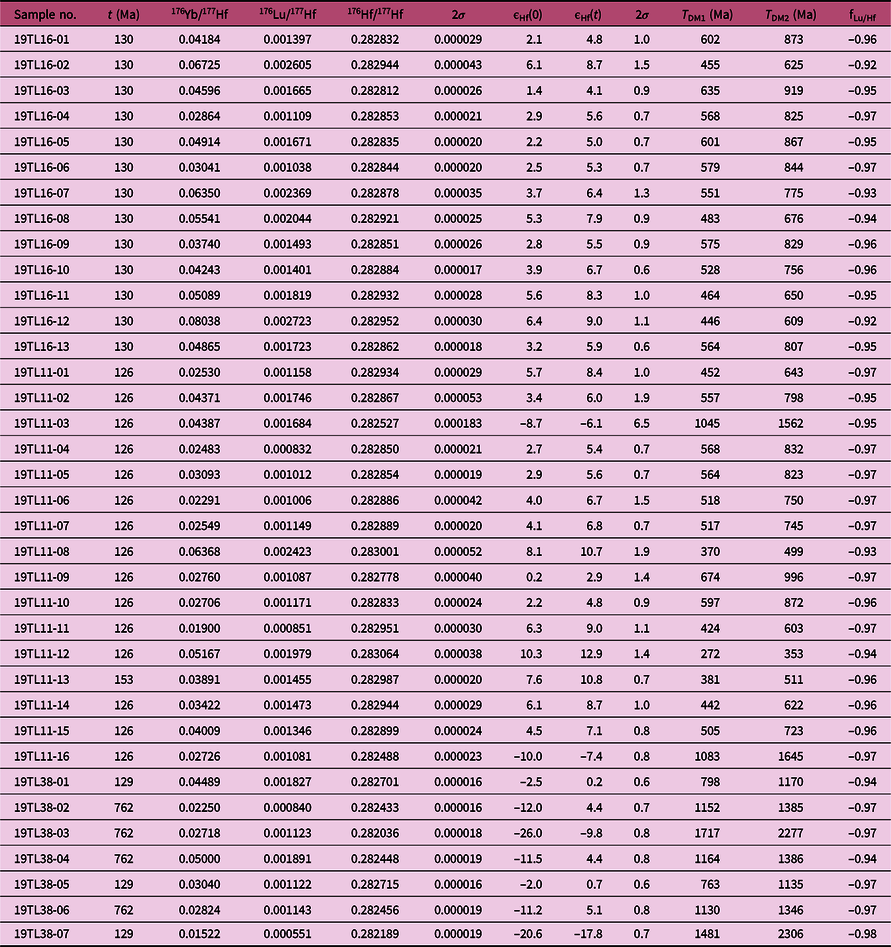
The results of zircon Hf isotope analyses is shown in Table 3. The magmatic zircons from the rhyolite sample 19TL16 have initial 176Hf/177Hf ratios of 0.282812–0.282952, ϵHf(t) values of +4.1 to +9.0, and two-stage model ages (T DM2) of 919–609 Ma, respectively.
Zircon Hf isotopic compositions of the Shangkuli Formatiom in the Tulihe region, northern Great Xing’an Range

The magmatic zircons from the trachyte sample 19TL11 have initial 176Hf/ 177Hf ratios of 0.282527–0.283064. Their corresponding ϵHf(t) values and two-stage model ages (T DM2) range from −7.4 to +12.9 and from 1645 to 353 Ma, respectively. One captured zircon with an age of c. 153 Ma yielded a initial 176Hf/ 177Hf of 0.282987, ϵHf(t) value of +10.8 and T DM2 age of 511 Ma.
The magmatic zircons from the trachyandesite sample 19TL38 have initial 176Hf/177Hf ratios of 0.282189–0.282715, ϵHf(t) values of −17.8 to +0.7 and T DM2 ages of 2306–1135 Ma. Four captured zircons with an age of c. 762 Ma yielded initial 176Hf/ 177Hf ratios of 0.282036–0.282456, ϵHf(t) values of −9.8 to +4.4 and T DM2 ages of 2277–1385 Ma.
6. Discussion
6.a. Eruption age of the volcanic rocks from the Shangkuli Formation
The previous stratigraphic chronological subdivision for the Shangkuli Formation was based mainly on regional stratigraphic contact relationships, stratigraphic correlations, animal and plant fossil data, and rock associations. On the basis of the fossil assemblage of Coptoclaua longipoda and Equisetites sp., the Shangkuli Formation in the Tulihe area was previously considered to have formed during the Late Jurassic Epoch (HBGMR, 1993). However, with the development of high-precision isotope-based geochronological techniques, whole-rock Rb–Sr and Ar–Ar and LA-ICP-MS zircon U–Pb methods have been applied to better constrain the chronology of the Shangukli Formation.
Zircon crystals from the volcanic rocks dated during this study display euhedral or subhedral shapes with clear oscillatory growth zoning in CL images and have Th/U ratios ranging from 0.19 to 3.04, both of which indicate a magmatic origin. The LA-ICP-MS zircon U–Pb dating results are therefore interpreted to represent the eruption ages of the magma. The weighted mean 206Pb/238U ages from rhyolite (sample 19TL16), trachyte (sample 19TL11) and trachyandesite (sample 19TL38) vary from 126 ± 1 Ma to 129 ± 2 Ma, suggesting that both the rhyolitic and trachytic volcanic rocks of the Shangkuli Formation in the Tulihe area were erupted during the Early Cretaceous Epoch. These Mesozoic ages are consistent with the previous dating results of rhyolites, dacites and andesites reported by Ge et al. (Reference Ge, Li, Lin, Sun, Wu and Yin2001) and Zhang et al. (Reference Zhang, Ge, Wu, Wilde, Yang and Liu2008 a). Combining our new ages with published zircon U–Pb ages from the Baiyingaolao, Manketouebo and Manitu formations in the central and southern GXR (e.g. Zhang et al. Reference Zhang, Gao, Ge, Wu, Yan, Wilde and Li2010; Dong et al. Reference Dong, Ge, Yang, Zhao, Wang, Zhang and Su2014), we conclude that late Mesozoic volcanic rocks in the entire GXR formed mainly during the Early Cretaceous Epoch. This intense Early Cretaceous volcanic event has also been shown to be an important stage of large-scale mineralization in eastern China (Yang et al. Reference Yang, Wu and Wilde2003; Wu et al. Reference Wu, Lin, Wilde, Zhang and Yang2005). Of note, our trachytic volcanic samples (19TL11 and 19TL38) contain two groups of captured zircons with ages of 153–150 and 770–711 Ma, respectively. Late Jurassic magmatic events were widely distributed in the Xing’an and Erguna blocks and could have provided the c. 150 Ma captured zircons. Magmatism between 790 and 737 Ma has been identified in the Erguna Block (Wu et al. Reference Wu, Sun, Ge, Zhang, Grant, Wilde and Jahn2011; Sun et al. Reference Sun, Ren, Zhao and Peng2012; Tang et al. Reference Tang, Xu, Wang, Wang, Xu and Zhang2013) and is a possible source of captured zircons with ages of 770–711 Ma.
6.b. Petrogenesis
6.b.1. Juvenile crustal source and fractional crystallization of the rhyolites
Rhyolites originate from fractional crystallization of mantle-derived basaltic or andesitic magmas (Soesoo, Reference Soesoo2000; Lee & Bachmann, Reference Lee and Bachmann2014), or from partial melting of crustal materials (Rapp & Watson, Reference Rapp and Watson1995; Gao et al. Reference Gao, Rudnick, Yuan, Liu, Liu and Xu2004). Fractional crystallization of mantle-derived basaltic or andesitic magmas can be excluded because the volume of the felsic volcanic rocks in the study area greatly exceeds that of the coeval basaltic and andesitic rocks. Our rhyolite samples exhibit high SiO2 and total alkali contents, low MgO and transition metal (e.g. Cr, Co and Ni) contents, enrichment in LREEs and LILEs (e.g. Rb, Th, U and K), and depletion in HREEs and HFSEs (e.g. Nb, Ta, P and Ti), indicating that the primary magmas were derived from partial melting of crustal material (Xu et al. Reference Xu, Ji, Pei, Meng, Yu, Yang and Zhang2009; Tang et al. Reference Tang, Xu, Wang, Zhao and Li2015). In addition, the rhyolites have Nb/Ta ratios of 11.83–15.54 (mean of 13.82) and Zr/Hf ratios of 26.30–37.80 (mean of 29.79), which are closer to the ratios of crust (11.4 and 33, respectively; Taylor & McLennan, Reference Taylor and McLennan1985) than to those of primitive mantle (17.8 and 37.0, respectively; Sun & McDonough, Reference Sun, McDonough, Saunders and Norry1989). The rhyolites are enriched in Rb and K, but depleted in Ba, Sr and Ti, which is consistent with the characteristics of low Ba–Sr volcanic rocks classified by Ge et al. (Reference Ge, Lin, Sun, Wu and Li2000) and Zhang et al. (Reference Zhang, Gao, Ge, Wu, Yan, Wilde and Li2010). Combining this information with their depletion in HFSEs and high K2O/Na2O ratios suggests that the rhyolite samples might have originated from the partial melting of continental crust rather than oceanic crust (Chappell & White, Reference Chappell and White1992; Beate et al. Reference Beate, Monzier, Spikings, Cotton, Silva, Bourdon and Eissen2001). The geochemical diversity of crust-derived magmas is controlled primarily by source compositions and the conditions of melting (Patiño Douce & Beard, Reference Patiño Douce and Beard1995). Dehydration melting experiments have shown that the partial melting of low-K basaltic rock in all cases generates intermediate–felsic magma with low K2O/Na2O ratios (< 1) (Rapp & Watson, Reference Rapp and Watson1995). However, felsic magma with high K2O/Na2O ratios (> 1) results from the partial melting of medium- to high-K basaltic rock (Sisson et al. Reference Sisson, Ratajeski, Hankins and Glazner2005). The studied rhyolites all have high K2O/Na2O ratios (> 1), and K-feldspar was a fractionated phase, suggesting that the magma source was characterized by enrichment in K. In addition, in a CaO–K2O–Na2O diagram (not included), all of the rhyolite samples plot in the field of medium- to high-K melts. In view of their positive ϵHf(t) values (+4.1 to +9.0) (Fig. 8a, b) and young T DM2 ages (917–607 Ma), we propose that Early Cretaceous rhyolites in the Tulihe area were probably derived from the partial melting of dominantly juvenile, K-rich basaltic lower continental crust. Of note, two rhyolite samples exhibit relatively high Mg no. values of 47.6 and 43.2, implying that mantle materials had an influence on the partial melting of the continental crust.
ϵHf(t) vs t (Ma) diagram of the volcanic rocks from the Shangkuli Formation. CAOB – Central Asian Orogenic Belt; YFTB – Yanshan Fold and Thrust Belt.

The studied rhyolites exhibit clear linear trends in Harker diagrams (Fig. 9), indicating a non-negligible degree of fractional crystallization during magma evolution, as verified by the La–(La/Sm) diagram (Fig. 10 a). CaO contents decrease with increasing differentiation index (Di), indicating that fractional crystallization of plagioclase and/or apatite occurred (Fig. 11a). The rhyolites exhibit negative Eu anomalies (Eu/Eu* = 0.18–0.57), depletion in Ba and Sr, and high Rb/Ba and K/Ba ratios, suggesting that plagioclase and K-feldspar were the major crystallization phases during magma differentiation (Lightfoot et al. Reference Lightfoot, Hawkesworth and Sethna1987; Han et al. Reference Han, Wang and Jahn1997). Fractional crystallization of K-feldspar is also supported by the pattern shown in a CaO–Di diagram (Fig. 11a). The rhyolites have low Sr contents (10.0–54.9 ppm), but high Yb (1.54–2.20 ppm) and Y (13.43–20.07 ppm) contents, which, in combination with depletion in medium REEs (MREEs) relative to HREEs, indicate that hornblende was the main residual mineral in the magma source, as further supported by the pattern shown in a Dy–Er diagram (Fig. 11c) (Zhang & Li, Reference Zhang and Li2012). The depletion of P, Ti, Nb and Ta implies that fractional crystallization of apatite likely occurred and that Ti-bearing phases were the residual phases. The (La/Yb)N–La diagram (Fig. 11d) shows that monazite and allanite also underwent fractional crystallization.
Major-element Harker diagrams of the volcanic rocks from the Shangkuli Formation.

Plots of (a) La/Sm vs La of the rhyolite samples; (b) Sr/Y vs Y of the trachytic volcanic samples; (c) Mg no. vs SiO2 of both the rhyolitic and trachytic volcanic samples; and (d) Th/La vs SiO2 of the trachytic volcanic samples. AFC – assimilation and fractional crystallization.

Diagrams of (a) CaO vs Di; (b) Ba/Sr vs Sr; (c) Dy vs Er; and (d) (La/Yb)N vs La. Di – differentiation index; Mon – monazite; Allan – allanite; Ap – apatite; Sph – sphene; Zr – zircon; Pl – plagioclase; Kfs – K-feldspar; Hbl – hornblende; Bt – biotite.

The studied felsic volcanic rocks have similar mineralogical and geochemical characteristics to those of the intrusive granitic rocks. The felsic volcanic rocks can be divided into M-, S-, I- and A-types according to their magmatic source characteristics and tectonic affinities (Whalen, Reference Whalen1985; Whalen et al. Reference Whalen, Currie and Chappell1987; Chappell & White, Reference Chappell and White1992). The studied rhyolites originated from the partial melting of juvenile continental crust, meaning that they cannot be classified as M-type rhyolites (Whalen, Reference Whalen1985). P2O5 contents of the rhyolite samples decrease with increasing SiO2 content, suggesting that they do not belong to S-type rhyolites. In (10 000 × Ga/Al) versus (Zr + Nb + Ce + Y) (Fig. 12a) and (FeOt/MgO) versus (Zr + Nb + Ce + Y) diagrams (Fig. 12b), the samples plot in the I-type field. In addition, A-type rhyolites are usually formed in relatively high-temperature and low-pressure magmatic environments (Collins et al. Reference Collins, Beams, White and Chappell1982) and have relatively high zircon saturation temperatures (T Zr) (> 900°C). Using the calculation method proposed by Watson & Harrison (Reference Watson and Harrison1983), zircon saturation temperatures calculated for the rhyolite samples yield a range of 731–841°C with a weighted mean of 792°C, further showing that our studied rhyolites belong to I-type rhyolites.
Discrimination diagrams of (a) 10 000 × Ga/Al vs Zr + Nb + Ce +Y; (b) FeOt/MgO vs Zr + Nb + Ce +Y for the volcanic rocks from the Shangkuli Formation (Whalen et al. Reference Whalen, Currie and Chappell1987). FG – highly fractionated I-type; OGT – unfractionated I, S and M type; A – A type.

In summary, we propose that the rhyolites in this paper are highly fractionated I-type rocks that were derived from the partial melting of a dominantly juvenile, K-rich basaltic lower continental crust, and subsequently underwent fractional crystallization of plagioclase, K-feldspar, hornblende, apatite, Ti-bearing phases, monazite and allanite.
6.b.2. Mantle source and assimilation and fractional crystallization of the trachytic volcanic rocks
Several genetic mechanisms have been proposed for the origin of trachytic volcanic rocks, including: (1) extensive fractional crystallization of mantle-derived basaltic magmas with or without crustal assimilation (Soesoo, Reference Soesoo2000; Bonin, Reference Bonin2004; Lee & Bachmann, Reference Lee and Bachmann2014); (2) magma mixing involving crustal- and mantle-derived magmas (Guo et al. Reference Guo, Nakamura, Fan, Kobayoshi and Li2007; Reubi & Blundy, Reference Reubi and Blundy2009); and (3) partial melting of mafic lower crust at high-pressure conditions (Huang & Wyllie, Reference Huang and Wyllie1975; Lubala et al. Reference Lubala, Frick, Roders and Walraven1994; Gao et al. Reference Gao, Rudnick, Yuan, Liu, Liu and Xu2004). Our trachytic volcanic samples have intermediate SiO2 contents (57.87–65.14 wt%) with relatively low Sr/Y ratios (19.89–56.39) but high Y (19.79–22.61 ppm) and Yb (1.62–1.78 ppm) contents, similar to those of igneous rocks distributed in modern arcs (e.g. Tatsumi, Reference Tatsumi2006), and cannot be explained in terms of the origin of crust-derived adakitic rocks formed at high pressures (Fig. 10b). The Rb/Sr (0.05–0.37), Lu/Yb (0.14–0.15), Nb/Ta (14.61–17.34) and Zr/Hf (39.50–42.85) ratios of the trachytic volcanic samples coincide with those of mantle-derived magma (Rb/Sr < 0.5, Lu/Yb = 0.14–0.15, Nb/Ta = 17.8, Zr/Hf = 37.0; Sun & McDonough, Reference Sun, McDonough, Saunders and Norry1989), suggesting that their primary magma originated from a mantle source rather than mafic lower crust. Furthermore, the trachytic samples have higher La/Nb ratios (3.53–4.09) and La/Ta ratios (55.76–66.57) than those of basalts derived from asthenospheric mantle (La/Nb < 1; La/Ta c. 10; Fitton et al. Reference Fitton, James, Kempton, Ormerod and Leeman1988; Thompson & Morrison, Reference Thompson and Morrison1988), indicating that they were derived predominantly from lithospheric mantle (La/Nb > 1; La/Ta > 20; Fitton et al. Reference Fitton, James, Kempton, Ormerod and Leeman1988; Thompson & Morrison, Reference Thompson and Morrison1988). Lithospheric-mantle-derived Mesozoic igneous rocks in the northern GXR generally have moderately radiogenic Nd and Hf isotopic compositions (ϵNd(t) = −0.2 to +3.6; ϵHf(t) = −4.6 to +7.7; Zhang et al. Reference Zhang, Zhou, Ying, Wang, Guo, Wan and Chen2008 b; Guo et al. Reference Guo, Fan, Gao, Li, Miao, Zhao and Li2010; Wang et al. Reference Wang, Xu, Xu, Gao and Ge2015 a). Of note, in the present study, six magmatic zircons with high ϵHf(t) values (8–13; Fig. 8; Table 3) were found in the trachytic rocks, implying that a more depleted asthenospheric mantle existed within their source region and contributed both heat and juvenile materials to the magmatism that formed these rocks (Yang et al. Reference Yang, Ge, Bi, Wang, Tian, Dong and Chen2018).
We consider that the trachytic volcanic rocks originated from a predominantly lithospheric-mantle source. However, the trachytic rocks have higher SiO2 contents and lower MgO, Cr, Co and Ni contents compared with primary-mantle-derived magma, indicating that the mafic minerals (e.g. hornblende) underwent fractional crystallization, an interpretation that is supported by the positive correlation between Dy and Er (Fig. 11c). CaO contents decrease with increasing Di, indicating fractional crystallization of plagioclase and/or apatite (Fig. 11a). Fractional crystallization of plagioclase is also supported by the weak negative Eu anomalies and the negative correlation between Al2O3 and SiO2 (Fig. 9a), as well as the pattern displayed in a (Ba/Sr)–Sr diagram (Fig. 11b). Monazite and allanite also underwent fractional crystallization, as inferred from a (La/Yb)N–La diagram (Fig. 11d). The trachytic volcanic samples show a negative correlation between SiO2 and P2O5 and Ti2O (Fig. 9e, f), and exhibit marked depletion in P and Ti, implying that fractional crystallization of apatite and Ti-bearing minerals likely occurred.
The trachytic volcanic samples show a wide range of zircon Hf isotopic compositions (–17.8 to +12.9; Fig. 8), precluding a simple, common evolution through a closed-system fractionation process, as such a mechanism cannot produce such variable isotopic compositions (Yang et al. Reference Yang, Wu, Wilde and Zhao2008). Rather, these features could have been induced by wall-rock assimilation or mixing of mafic and silicic melts prior to the eruption of mantle-derived magmas, as clearly shown in an Mg no. versus SiO2 diagram (Fig. 10c). Contamination of magma by continental crustal materials can occur during the formation of mantle-derived volcanic rocks. Our trachytic volcanic samples exhibit slightly positive Zr and Hf anomalies, implying that these samples underwent some degree of crustal contamination, given that crustal materials are enriched with Zr and Hf. In addition, Th and U are enriched relative to LREEs, which can be explained by crustal contamination. This interpretation is supported by the positive linear correlation between SiO2 and Th/La (Fig. 10d). Three analysis spots with negative ϵHf(t) values of –17.8 to –7.4 in the Early Cretaceous trachytic volcanic samples, together with the presence of captured zircons with ages of c. 762 Ma, suggest that ancient crustal rocks were involved in the petrogenesis of these rocks. Furthermore, no mafic microgranular enclaves were observed in the field observations, and disequilibrium minerals and melting corrosion structures were not observed in microscopic observations, meaning that there is no direct evidence for magma mixing. Combining the various above-mentioned lines of evidence, we support the explanation of crustal contamination, while acknowledging that the possibility of magma mixing cannot be completely ruled out.
In summary, the primary magma of the trachytic volcanic rocks most likely originated from a predominantly lithospheric-mantle source with some involvement of asthenospheric-mantle materials, following which the basaltic magma underwent extensive assimilation and fractional crystallization (AFC) processes before eruption at the surface.
6.c. Early Cretaceous intense crust–mantle interaction linked to rollback of the Palaeo-Pacific flat-subducting slab
The studied Early Cretaceous volcanic rocks of the Shangkuli Formation consist of the c. 130 Ma rhyolite and c. 129–126 Ma trachyandesite-trachyte. As discussed in Section 6.b, these rocks are products of the partial melting of juvenile lower continental crust and lithospheric mantle, respectively. Most importantly, upwelling of asthenospheric mantle has been shown to have occurred within their source regions and contributed both heat and juvenile materials for magma generation, as indicated by the relatively high Mg no. values of the rhyolites and the exceptionally high ϵHf(t) values of both the rhyolites and trachytic rocks. These features, together with the coexistence of coeval A-type and bimodal igneous rocks surrounding the study area (e.g. Zhang et al. Reference Zhang, Gao, Ge, Wu, Yan, Wilde and Li2010; Wu et al. Reference Wu, Sun, Ge, Zhang, Grant, Wilde and Jahn2011; Gou et al. Reference Gou, Sun, Liu, Ren, Zhao and Liu2013), as well as the high zircon saturation temperatures of the felsic rocks and the elevated geotherm in the region (Zhang et al. Reference Zhang, Gao, Ge, Wu, Yan, Wilde and Li2010), clearly show that intense crust–mantle interaction occurred during the Early Cretaceous Epoch within the northern GXR. The period of intense Early Cretaceous crust–mantle interaction corresponds very closely to the interval of widespread extension in NE China (e.g. Zhang et al. Reference Zhang, Gao, Ge, Wu, Yan, Wilde and Li2010; Xu et al. Reference Xu, Pei, Wang, Meng, Ji, Yang and Wang2013; Ji et al. Reference Ji, Meng, Wan, Ge, Yang, Zhang, Dong and Jin2019 a, b; Liu et al. Reference Liu, Wei, Zhang, Chen and Zhang2020). In fact, most of eastern China, including the eastern North China and Yangtze cratons and SE China, were also characterized by Early Cretaceous extension (e.g. Zhou & Li, Reference Zhou and Li2000; Zhou, Reference Zhou2003; Zhai et al. Reference Zhai, Meng, Liu, Hou, Hu, Li, Zhang, Liu, Shao and Zhu2004; Zhang et al. Reference Zhang, Gao, Ge, Wu, Yan, Wilde and Li2010; Ma et al. Reference Ma, Jiang, Hofmann, Dai, Hou, Zhao, Chen, Li and Jiang2014, Reference Ma, Jiang, Hofmann, Xu, Dai and Hou2016; Qian et al. Reference Qian, Ren, Richard, Zhang, Zhang, Hong, Ding and Wu2017; Wu et al. Reference Wu, Yang, Xu, Wilde and Richard2019). However, the deep geodynamic processes that led to the widespread extension and abundant Early Cretaceous volcanism remain contentious.
A mantle plume model was initially proposed to explain the extensive late Mesozoic magmatism and the large amount of heat required in the GXR (Lin et al. Reference Lin, Ge, Sun, Wu, Chong, Kyung, Myung, Moon, Chi and Sung1998; Ge et al. Reference Ge, Lin, Sun, Wu, Yuan, Li, Chen and Yin1999). However, this model was subsequently precluded because: (1) Early Cretaceous igneous rocks in the GXR are characterized by predominantly high-K calc-alkaline felsic rocks and a lack of ocean-island-basalt (OIB) -type basaltic rocks (Wang et al. Reference Wang, Zhou, Zhang, Ying, Zhang, Wu and Zhu2006; Zhang et al. Reference Zhang, Ge, Wu, Wilde, Yang and Liu2008 a, Reference Ying, Zhou, Zhang and Wang2010); and (2) late Mesozoic magmatism in the GXR lasted for a relatively long period of time (c. 40 Ma) and shows a distinct NNE-trending linear distribution, distinguishing it from the short-lived intense period of magmatic eruption and ring-like distribution of igneous rocks expected to result from a mantle plume.
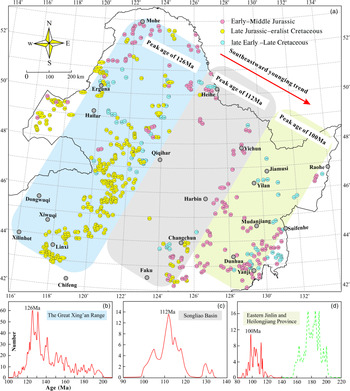
More recent studies have identified a genetic relationship between late Mesozoic magmatism in NE China and the evolution of the MOO (Fan et al. Reference Fan, Guo, Wang and Lin2003; Ying et al. Reference Ying, Zhou, Zhang and Wang2010; Xu et al. Reference Xu, Pei, Wang, Meng, Ji, Yang and Wang2013; Wang et al. Reference Wang, Tang, Xu and Wang2015 b). Closure of the MOO was induced by clockwise rotation of the Siberian Craton relative to the northern China–Mongolia Block, with a scissor-type closure from west to east during the Early Jurassic – Early Cretaceous period (Zorin, Reference Zorin1999; Fan et al. Reference Fan, Guo, Wang and Lin2003; Meng, Reference Meng2003; Parfenov et al. Reference Parfenov, Berzin, Khanchuk, Badarch, Belichenko, Bulgatov and Prokopyev2003; Tomurtogoo et al. Reference Tomurtogoo, Windley, Kroner, Badarch and Liu2005; Ji et al. Reference Ji, Meng, Wan, Ge, Yang, Zhang, Dong and Jin2019 a, b). The MOO near the Erguna Block closed during or prior to the Middle Jurassic Epoch, and the northern GXR underwent significant crustal shortening and thickening. Accordingly, post-orogenic collapse and extension of the Mongol–Okhotsk orogenic belt has been invoked to explain Late Jurassic – early Early Cretaceous magmatic activity near the Mongol–Okhotsk suture. However, late Early Cretaceous igneous rocks are distributed widely over the whole of NE China, even extending to the North China and South China cratons, which lie distant from the Mongol–Okhotsk suture; this pattern is difficult to explain using this model (Zhang et al. Reference Zhang, Ge, Wu, Wilde, Yang and Liu2008 a, Reference Ying, Zhou, Zhang and Wang2010). Moreover, the NNE-trending distribution of late Early Cretaceous volcanism in the GXR, along with a marked SE-wards younging of magmatic events from the GXR to eastern Heilongjiang and Jilin Province (EHJP) (Fig. 13; Zhang et al. Reference Zhang, Gao, Ge, Wu, Yan, Wilde and Li2010; Ji et al. Reference Ji, Meng, Wan, Ge, Yang, Zhang, Dong and Jin2019 a, b), indicates the close relationship of this volcanism to the Palaeo-Pacific subduction regime rather than to Mongol–Okhotsk orogenic collapse.
(a) Spatiotemporal distribution of the Jurassic and Cretaceous magmatic rocks in NE China. For age data and related references please see online Supplementary Table S1 (available at http://journals.cambridge.org/geo). Probability plots of the U–Pb ages of zircons from Mesozoic igneous rocks in (b) the GXR, (c) Songliao Basin and (d) Eastern Jilin and Heilongjiang Province.

Westwards subduction of the Palaeo-Pacific (Izanagi) Plate beneath the NE China continental margin started at latest during the Early Jurassic Epoch (Wu et al. Reference Wu, Sun, Ge, Zhang, Grant, Wilde and Jahn2011; Yu et al. Reference Yu, Wang, Xu, Gao and Pei2012; Guo et al. Reference Guo, Li, Fan, Li, Zhao, Huang and Xu2015; Wang et al. Reference Wang, Ge, Yang, Bi, Ji, Dong and Xu2017; Ji et al. Reference Ji, Meng, Wan, Ge, Yang, Zhang, Dong and Jin2019 a), at which time the dip angle of the Izanagi Plate was steep (Manea et al. Reference Manea, Manea, Ferrari, Orozco, Valenzuela, Husker and Kostoglodov2017; Ji et al. Reference Ji, Meng, Wan, Ge, Yang, Zhang, Dong and Jin2019 a). At the boundary between the Early and Middle Jurassic epochs (Gutscher et al. Reference Gutscher, Maury, Eissen and Bourdon2000; Beate et al. Reference Beate, Monzier, Spikings, Cotton, Silva, Bourdon and Eissen2001; Bourdon et al. Reference Bourdon, Eissen, Gutscher, Monzier, Hall and Cotten2003), the dip angle of the Izanagi Plate changed from steep to flat, which was most likely caused by subduction of aseismic ridges or plateaus (e.g. Yuejinshan and Raohe accretionary complexes; Zhou et al. Reference Zhou, Cao, Wilde, Zhao, Zhang and Wang2014; Sun et al. Reference Sun, Xu, Wilde and Chen2015; Khanchuk et al. Reference Khanchuk, Kemkin and Kruk2016; Bi et al. Reference Bi, Ge, Yang, Wang, Tian, Liu, Xu and Xing2017) beneath the Eastern Asian continental margin during the Jurassic Period (Ji et al. Reference Ji, Meng, Wan, Zhu, Ge, Zhang, Yang and Dong2019 b). Using geochronological data obtained from previous studies, we identified a period of magmatic quiescence in the Songliao Basin and EHJP during the Late Jurassic – early Early Cretaceous (Xu et al. Reference Xu, Pei, Wang, Meng, Ji, Yang and Wang2013), consistent with the period of flat subduction of the Izanagi Plate. The occurrence of c. 163 Ma low-K adakitic lavas in the Hailar Basin, which were derived from the partial melting of subducted Palaeo-Pacific oceanic crust, indicates that the flat Izanagi slab had extended beneath the northern GXR by that time (Ji et al. Reference Ji, Meng, Wan, Zhu, Ge, Zhang, Yang and Dong2019 b). As the flat-subducting slab was being subducted beneath the thicker lithosphere under the northern GXR, it would have induced rollback of the subducted Izanagi Plate (Liu et al. Reference Liu, Gurnis, Seton, Saleeby, Müller and Jackson2010; Antonijevic et al. Reference Antonijevic, Wagner, Kumar, Beck, Long and Zandt2015; Ji et al. Reference Ji, Meng, Wan, Zhu, Ge, Zhang, Yang and Dong2019 b). In our synthesis of late Mesozoic magmatic activities in NE China, we identified a SE-wards trench-wards-younging trend from the northern GXR to the EHJP after c. 140 Ma, which is consistent with progressive rollback of a flat-slab segment of the Izanagi Plate (Fig. 14). The formation ages of the Tulihe volcanic rocks reported in the present study are late Early Cretaceous (130–126 Ma), that is, within the time interval of rollback of the subducted Izanagi Plate. Furthermore, the petrogenesis of these two types of volcanic rocks involved intense crust–mantle interaction, which can be explained by rollback of the subducted Izanagi Plate. Large-scale upwelling of the asthenosphere caused by continuous rollback of the Izanagi oceanic slab heated the metasomatized lithospheric mantle and overlying crust, resulting in high-degree partial melting and the formation of widespread late Early Cretaceous magmatism in NE China, including the 130–126 Ma volcanic activity in the Tulihe area.
Schematic model showing the geodynamic processes for NE China during late Early Cretaceous time (modified from Ji et al. Reference Ji, Meng, Wan, Ge, Yang, Zhang, Dong and Jin2019a, b).

7. Conclusions
-
1. Our new LA-ICP-MS zircon U–Pb ages indicate that the rhyolites and trachytic volcanic rocks of the Shangkuli Formation in the Tulihe area of the northern GXR, NE China, formed during late Early Cretaceous time (130–126 Ma).
-
2. The highly fractionated I-type rhyolites were derived from the partial melting of a dominantly juvenile, K-rich basaltic lower crust, whereas the trachytic volcanic rocks originated from a dominantly lithospheric-mantle source with involvement of asthenospheric-mantle materials, and subsequently underwent extensive AFC processes.
-
3. Late Early Cretaceous intense crust–mantle interaction within the northern GXR and coeval widespread magmatic rocks in the whole of NE China were related to upwelling of asthenospheric mantle induced by rollback of the Palaeo-Pacific flat-subducting slab.
Acknowledgements
We express gratitude to the Wuhan Sample Solution Analytical Technology Co., Ltd, Wuhan, China, for their work in the whole-rock major- and trace-element analysis. We thank the Key Laboratory of Mineral Resources Evaluation in Northeast Asia, Ministry of Land and Resources, Jilin University, Changchun, China for their advice and assistance with the LA-ICP-MS zircon U–Pb dating. We also thank the Institute of Geology and Mineral Resources, Tianjin, China for their support and aid with the zircon Hf isotopic analyses. The final version of the paper benefited from the perceptive comments of two anonymous reviewers and Editor Kathryn Goodenough. This work was financially supported by the National Natural Science Foundation of China (92062216 and 41802049).
Supplementary material
To view supplementary material for this article, please visit https://doi.org/10.1017/S0016756821000170.