INTRODUCTION
Malaria is one of the world's most difficult health problems to solve, with several hundred million debilitating cases of the disease yearly, killing an estimated 660 000 people, mostly children under the age of five (WHO, 2012). Majority of these deaths occur in sub Saharan Africa where the disease is highly endemic and most difficult to manage. Efforts to control this disease are hampered by drug resistance in parasites, insecticide resistance in mosquitoes, and lack of an effective vaccine (Maciel et al. Reference Maciel, Fazio, Naaf_Pimenta and Miranda2008). Initiatives by the World Health Organization (WHO), the Gates Foundation, the Global Fund and the World Bank for reduction and eradication of this disease are achieving great success (Co et al. Reference Co, Johnson, Murthy, Talwar, Hickman and Johnson2010). This is attributable to a number of actions, most significant of which is the recommendation of artemisinin-based combination therapy (ACT) as first line treatment of uncomplicated malaria by the World Health Organization (WHO, 2010). Unfortunately, the success achieved so far is now being confounded by increasing reports of Plasmodium falciparum resistance to ACT (Phyo et al. Reference Phyo, Nkhoma, Stepniewska, Ashley, Nair, McGready, Moo, Al-Saai, Dondorp, Lwin, Singhasivanon, Day, White, Anderson and Nosten2012; WWARN, 2012; Rogers et al. Reference Rogers, Sem, Tero, Chim, Lim, Muth, Socheat, Ariey and Wongsrichanalai2009; Dondorp et al. Reference Dondorp, Nosten, Yi, Das, Phyo, Tarning, Lwin, Ariey, Hanpithakpong, Lee, Ringwald, Silamut, Imwong, Chotivanich, Lim, Herdman, An, Yeung, Singhasivanon, Day, Lindegardh, Socheat and White2009; Noedl et al. Reference Noedl, Se, Schaecher, Smith, Socheat and Fukuda2008). The emergence of parasites resistant to artemisinin, and the development of multidrug-resistant strains is now of great concern and thus, there is an urgent need for the development of therapies that can counter the spread of existing and emerging drug resistance. A strategy being considered in fighting the spread of plasmodium resistance is to reposition, repurpose or find new uses for drugs that are already used for other indications (Weisman et al. Reference Weisman, Liou, Shelat, Cohen, Guy and De Risi2006; Nzila et al. Reference Nzila, Ma and Chibale2011). This has been exploited in the past in the treatment of malaria and tuberculosis with the use of sulpha-based drug and fluoroquinolones, respectively, which were initially developed for other indications (Nzila et al. Reference Nzila, Ma and Chibale2011). One class of drugs that has been found to possess antimalarial activity are the fluoroquinolone antibiotics. They possess several favourable properties such as excellent bioavailability, good tissue penetrability and a relatively low incidence of adverse and toxic effects (Sharma et al. Reference Sharma, Jain and Jain2009). Several studies have reported the potency of fluoroquinolones against blood and hepatic stages of P. falciparum isolates in vitro (Tripathi et al. Reference Tripathi, Sharma, Valecha and Biswas1993; Yeo et al. Reference Yeo, Rieckmann and Christopherson1998; Hamzah et al. Reference Hamzah, Skinner-Adams and Davis2000; Pradines et al. Reference Pradines, Rogier, Fusai, Mosnier, Daries, Barret and Parzy2001; Mahmoudi et al. Reference Mahmoudi, Ciceron, Franetich, Farhati, Silvie, Eling, Sauerwein, Danis, Mazier and Derouin2003; Dahl and Rosenthal, Reference Dahl and Rosenthal2007). Ciprofloxacin (CFX), norfloxacin and Pefloxacin have been clinically assessed in patients with acute uncomplicated P. falciparum malaria and results from the studies indicate the potential of fluoroquinolones as possible antimalarials (Sarma Reference Sarma1989; Deloron et al. Reference Deloron, Lepers, Raharimalala, Dubois, Coulanges and Pocidalo1991; McClean et al. Reference McClean, Hitchman and Shafran1992; Stromberg and Bjorkman Reference Stromberg and Bjorkman1992). However, in some of these trials, there were limitations to the potency of the drugs in achieving sufficient efficacy against falciparum malaria. This was attributed to a delayed effect of the drugs on the parasites and probably the low dose of the drugs administered during the trials. These drawbacks limit the potential clinical usefulness of fluoroquinolones as antimalarials but they have been proposed to be considered for use in combination with rapidly acting antimalarial drugs (Pradines et al. Reference Pradines, Rogier, Fusai, Mosnier, Daries, Barret and Parzy2001). The potential clinical value of CFX as a partner drug with more rapidly acting antimalarial drugs including mefloquine and chloroquine against drug resistant plasmodium infection has been documented (Andrade et al. Reference Andrade, De Pilla Varotti, De Freitas, De Souza, Vasconcelos, Boechat and Krettli2007; Gbotosho et al. Reference Gbotosho, Happi, Woranola, Abiodun, Sowunmi and Oduola2012). However, pharmacokinetic interaction between chloroquine and CFX in the studies appeared to limit the efficacy of the combination of lower doses of CFX with chloroquine (Ilo et al. Reference Ilo, Ilondu, Okwoli, Brown, Elo-Ilo, Agbasi and Orisakwe2006, Reference Ilo, Ezejiofor, Agbakoba, Brown, Maduagwuna, Agbasi and Orisakwe2008; Gbotosho et al. Reference Gbotosho, Happi, Woranola, Abiodun, Sowunmi and Oduola2012). This represents a major drawback and necessitates the need to evaluate the combination of other rapidly acting antimalarial drugs with CFX. In the present study, the interaction between CFX and amodiaquine (AQ) was evaluated in a murine model to determine the potential benefits of the combination in the treatment of chloroquine-resistant Plasmodium berghei infection.
MATERIALS AND METHOD
Drug samples
AQ was obtained from Sigma, St. Louis, MO, USA and CFX was graciously provided by Bond Pharmaceuticals, Awe, Oyo State, Nigeria. Stock solutions of the compounds were prepared in distilled water and stored at −20 °C till time of usage.
Animals
Experimental animals used in this study were male Swiss albino mice (7–10 weeks old) weighing 20–22 g. The animals were obtained from the animal facility of the Malaria Research Laboratories, Institute of Advanced Medical Research and Training (IMRAT), University of Ibadan, Ibadan. The mice were used in accordance with the NIH Guide for the care and use of laboratory animals, NIH publication (volume 25, number 28), revised 1996.
Antimalarial test in vivo
A modification of the Peter's suppressive tests in vivo (Peters, Reference Peters1965) was used. Briefly, 35 male albino mice weighing 20–22 g were inoculated intravenously through the tail vein with 1 × 10⁶ red blood cells infected with CQ-resistant P. berghei ANKA strain. The infected animals were separated into 7 groups of 5 mice per group and were treated by oral drug administration 2 h post infection. Groups of animals receiving varying doses of CFX alone (40, 80 or 160 mg kg−1 body weight) or CFX (80 and 160 mg kg−1) in combination with AQ were treated twice daily for 5 days. AQ (10 mg kg−1 body weight) was administered once daily for 3 days. Two control groups were used, one treated with AQ alone at 10 mg kg−1 body weight given daily for 3 days while the second control group were treated with normal saline. Drugs stocks were diluted to the desired final concentration with distilled water so that each animal received 200 μl at time of administration of each drug.
Parasiticidal activity was assessed daily from day 4 post infection till day 14, and then on days 21, 28, 35 and 42. Blood smears were prepared from the tail, methanol-fixed, stained with Giemsa and microscopically examined by counting parasitaemia in 1000 erythrocytes. Mortality was monitored daily. Inhibition of parasite growth in drug treated group was calculated in relation to parasite growth in the non-drug treated control group. All treatment regimens were tested in three independent experiments.
Statistical analysis
Student's t-test was used to analyse the differences in mean parasitaemia level on days following treatment initiation, and analysis of variance between groups (ANOVA) was used to compare difference in percentage inhibition of parasite growth. Chi-square with Yates correlation was used in analysing the proportions of survival.
RESULTS
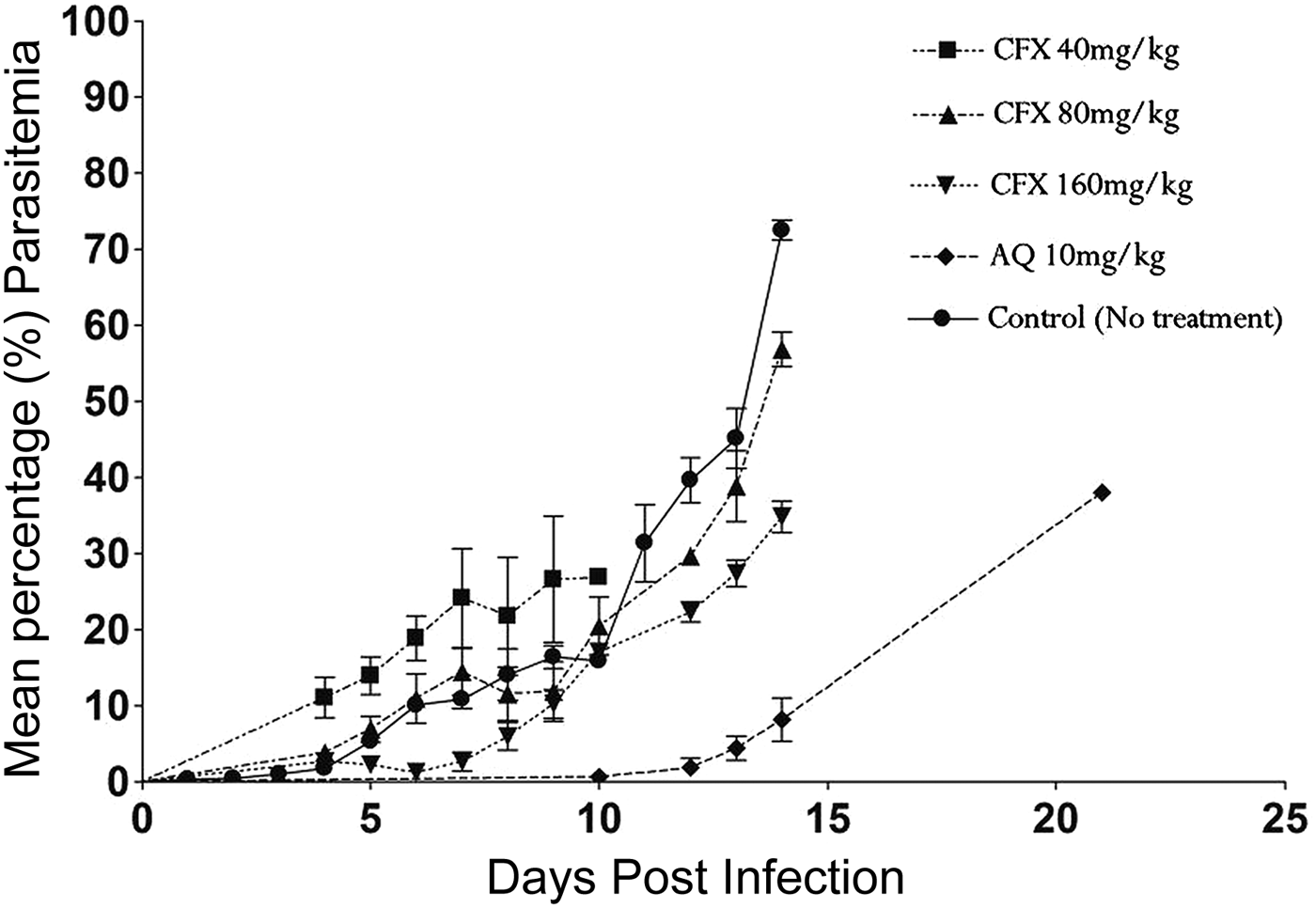
The mean percentage parasitaemia versus time in the untreated control animals and in animals treated with CFX or AQ alone are shown in Fig. 1. The mean percentage parasitaemia in the untreated control group ranged from 1·8% on day 4 post infection to 72·51% on day 14 when it peaked. By day 16 post infection, all animals in the control group had died. Animals treated with AQ (10 mg kg−1) alone, had 100% suppression of parasitaemia (P < 0·05) till day 9 post infection after which recrudescence of parasitaemia was observed on day 10. In the group of animals treated with CFX (40 mg kg−1) alone there was no significant difference (P > 0·05) in parasite suppression when compared to the untreated control as both groups showed a similar parasite growth profile. In contrast, parasite suppression in the group of animals that received 80 mg kg−1 body weight of CFX alone ranged from 13·94 to 54·64% relative to the untreated control with the highest suppression occurring on day 10 post infection. In the group of animals that received 160 mg kg−1 of CFX alone, there was a significant reduction in parasitaemia ranging from 35·6 to 92·7% during the follow up period (P < 0·05). The highest suppression occurred on day 6.
Response of chloroquine-resistant P. berghei ANKA infection in mice to treatment with AQ alone and varying doses of CFX.

Assessment of antimalarial activity of AQ alone and AQ plus CFX
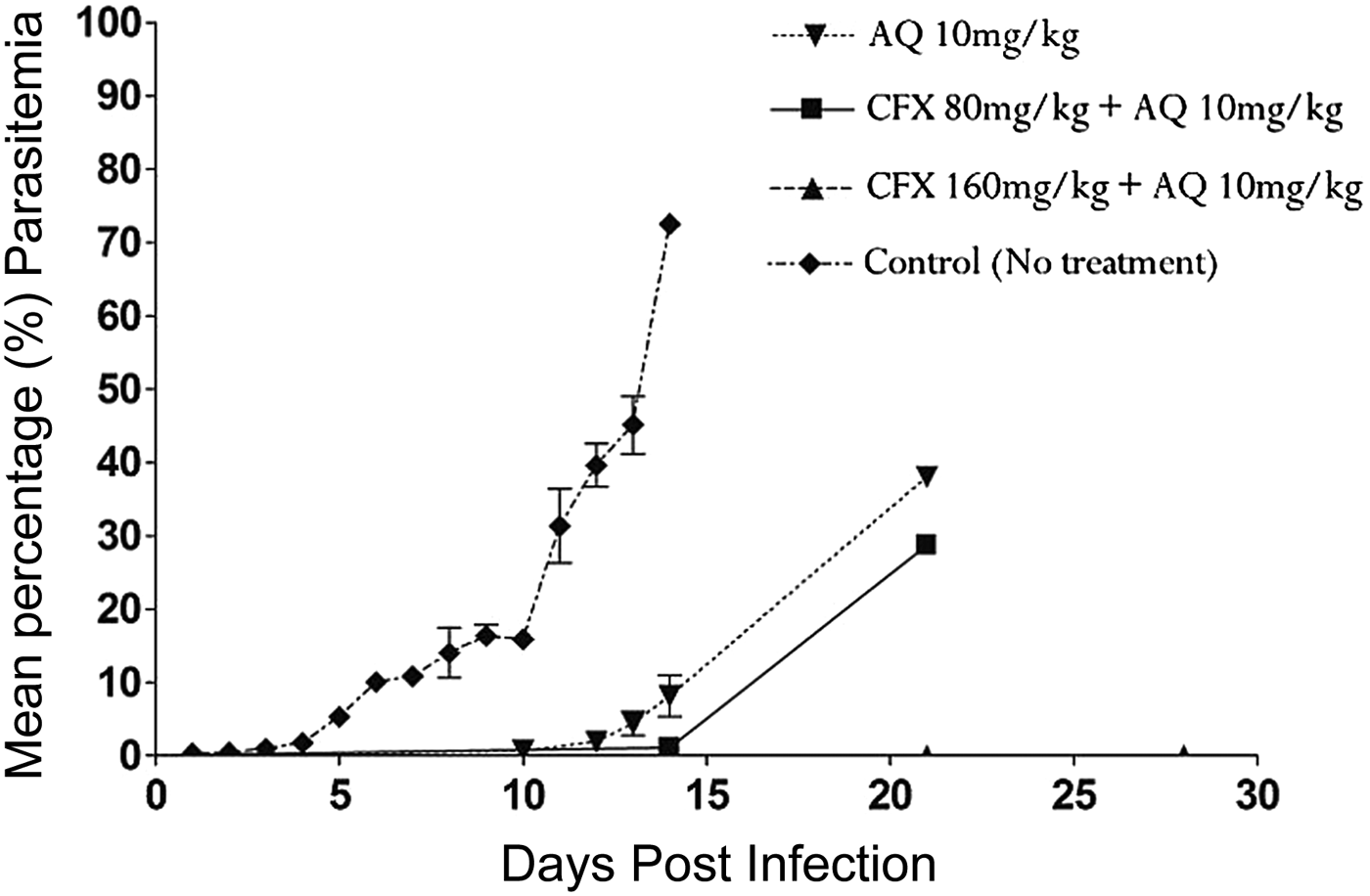
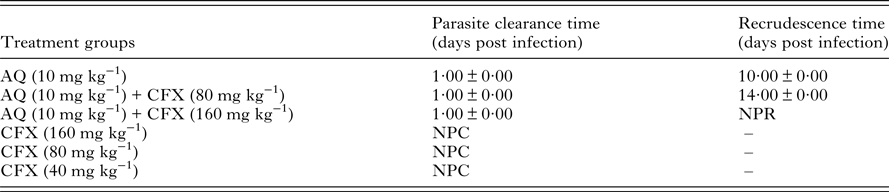
In the group of animals that received AQ combined with 80 mg kg−1 CFX [AQ+CFX (80)], the parasite clearance time was similar to the group of animals that received AQ alone, however mean parasite recrudescence time was significantly longer in the AQ+CFX (80) group compared to the group of animals that received AQ (10 mg kg−1) alone (P = 0·018). Recrudescence occurred in the AQ alone treatment group on day 10 (mean parasitaemia on day 10 = 0·16%) while treatment with AQ+CFX (80) showed 100% suppression of parasitaemia till day 13 post infection with parasite recrudescence occurring on day 14 (mean parasitaemia on day 14 = 0·28% versus 8·18% in the AQ only treatment group on day 14) (Fig. 2). The combination of AQ 10 mg kg−1 and CFX 160 mg kg−1 [AQ+CFX (160)] resulted in complete parasite suppression without recrudescence in any of the animals throughout the period of follow up (Fig. 2). Results of the parasite clearance and recrudescence time in the different treatment groups are shown on Table 1. The mean parasitaemia in the different treatment groups after recrudescence are shown in Table 2. Parasitaemia after recrudescence in the animals was 4–29 folds lower in the AQ+CFX 80 mg kg−1 compared to the AQ alone treatment group between days 14 and 21.
Comparative response of chloroquine-resistant P. berghei ANKA infection to AQ alone, or AQ in combination with 80 mg kg−1 or 160 mg kg−1 CFX.

Parasite clearance and recrudescence time after treatment with AQ alone, or selected doses of CFX (alone), or combination of AQ with selected doses of CFX in mice infected with chloroquine-resistant P. berghei ANKA

NPC - NO PARASITE CLEARANCE; NPR - NO PARASITE RECRUDESCENCE.
Mean percentage parasitaemia after parasite recrudescence in animals infected with chloroquine-resistant P. berghei and treated with AQ alone or AQ combined with varying doses of CFX

a All dead.
Survival rate of animals
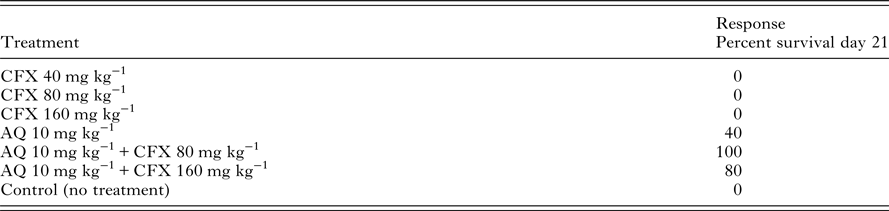
The rate of survival of animals treated with AQ alone, CFX alone or AQ in combination with varying doses of CFX on day 21 post infection is shown in Table 3. The day-21 survival rate in animals treated with CFX (40, 80 and 160 mg kg−1) alone was 0% as all animals died between day 10 and 18. The day 21 survival rates in the group of animals that received AQ alone or AQ combine CFX 80 mg kg−1 or CFX 160 mg kg−1 were 40, 100 and 80%, respectively. There was significant difference between the survival rates of the animals in the AQ only treatment group compared with the group of animals that received AQ combined with CFX (P = 0·0035). The only animal that died in the AQ+CFX 160 mg kg−1 group died on day 18, despite the fact that parasitaemia was completely suppressed in animals in this treatment group. The death recorded in this animal may have been from toxicity based on observed status (weight loss, sluggish movement and loss of fur) of the mouse before its eventual death.
The survival rate of animals infected with chloroquine resistant P. berghei ANKA and treated with varying doses of CFX alone, AQ alone or AQ combined with varying doses of CFX

DISCUSSION
Reports of reduced in vivo and in vitro susceptibilities of P. falciparum to artemisinin derivatives in western Cambodia, Thailand, French Guiana, Senegal and Nigeria (Jambou et al. Reference Jambou, Legrand, Niang, Khim, Lim, Volney, Ekala, Bouchier, Esterre, Fandeur and Mercereau-Puijalon2005; Dondorp et al. Reference Dondorp, Nosten, Yi, Das, Phyo, Tarning, Lwin, Ariey, Hanpithakpong, Lee, Ringwald, Silamut, Imwong, Chotivanich, Lim, Herdman, An, Yeung, Singhasivanon, Day, Lindegardh, Socheat and White2009; Rogers et al. Reference Rogers, Sem, Tero, Chim, Lim, Muth, Socheat, Ariey and Wongsrichanalai2009; Bustamante et al. Reference Bustamante, Folarin, Gbotosho, Batista, Mesquita, Brindeiro, Tanuri, Struchiner, Sowunmi, Oduola, Wirth, Zalis and Happi2012; Phyo et al. Reference Phyo, Nkhoma, Stepniewska, Ashley, Nair, McGready, Moo, Al-Saai, Dondorp, Lwin, Singhasivanon, Day, White, Anderson and Nosten2012), highlight the urgent need to develop new and alternative antimalarial drugs. The fluoroquinolones are synthetic antibiotics with broad spectrum of activity against gram-positive and gram-negative bacteria and mycobacterium (Da Silva et al. Reference Da Silva, De Almeida, De Souza and Couri2003). The antimalarial activity of fluoroquinolones including CFX against P. berghei in vivo and chloroquine sensitive and resistant strains of P. falciparum in vitro has been well documented (Salmon et al. Reference Salmon, Deloron, Gaudin, Malhotra, Lebras and Pocidalo1990; Mahmoudi et al. Reference Mahmoudi, Ciceron, Franetich, Farhati, Silvie, Eling, Sauerwein, Danis, Mazier and Derouin2003). More interestingly, although limited, studies in vitro and in vivo in mice have described beneficial interaction between CFX and chloroquine or mefloquine against P. falciparum and P. berghei infections (Kazzim et al. Reference Kazzim, Adegbolagun, Osho and Anumudu2006; Andrade et al. Reference Andrade, De Pilla Varotti, De Freitas, De Souza, Vasconcelos, Boechat and Krettli2007; Gbotosho et al. Reference Gbotosho, Happi, Woranola, Abiodun, Sowunmi and Oduola2012) thus providing a potential alternative chemotherapeutic strategy. Unfortunately, pharmacokinetic interactions between chloroquine and CFX appeared to hinder efficacy of the combination in mice infected with P. berghei especially at lower doses of CFX (Ilo et al. Reference Ilo, Ezejiofor, Agbakoba, Brown, Maduagwuna, Agbasi and Orisakwe2008; Gbotosho et al. Reference Gbotosho, Happi, Woranola, Abiodun, Sowunmi and Oduola2012) thus limiting the potential clinical use of the chloroquine-CFX combination. Our study describes a dose-dependent potentiation of intrinsic antimalarial activity of AQ against chloroquine-resistant P. berghei by CFX. The efficacy of the combination was demonstrated by enhanced sensitivity of P. berghei infection in mice to the combination of AQ plus CFX and enhanced survival rates of the animals compared with response to AQ or CFX alone. CFX, at the two doses employed (80 and 160 mg kg−1) in this study had a significantly greater beneficial effect on AQ activity against P. berghei compared to its effect on chloroquine activity against the parasites in previous studies (Gbotosho et al. Reference Gbotosho, Happi, Woranola, Abiodun, Sowunmi and Oduola2012). This is the first report of interaction of CFX with AQ raising hope of potential clinical application of this antibiotic/antimalarial combination. The combination of AQ combined with CFX appears to provide a more superior clinically relevant antimalarial/antibiotic therapeutic option in the management of malaria than the chloroquine with CFX combination. The highest dose of CFX employed in this study produced complete clearance of parasitaemia in the animals without any recrudescence throughout the duration of the study when combined with AQ. In the study by Gbotosho et al. (Reference Gbotosho, Happi, Woranola, Abiodun, Sowunmi and Oduola2012) beneficial interaction was only recorded in the combination of CFX (160 mg kg−1) with chloroquine which achieved a significant reduction in parasitaemia without complete parasite clearance. The superiority of the AQ/CFX combination is further highlighted with the intermediate dose of CFX (80 mg kg−1) achieving maximum suppression up till day 13 post infection. In addition, parasitaemia in the animals that received AQ+CFX 80 mg kg−1 was significantly lower (4–29 folds) than in animals that received AQ alone during recrudescence of parasitaemia. The superiority of the AQ/CFX combination was also demonstrated in the day-21 survival rates of the animals. The group of animals that received AQ+CFX 80 mg kg−1 exhibited 100% survival while no animal survived by day 21 after receiving CQ+CFX 80 mg kg−1 in a previously reported study (Gbotosho et al. Reference Gbotosho, Happi, Woranola, Abiodun, Sowunmi and Oduola2012).
Pharmacokinetic interaction between CFX and chloroquine has been reported (Ilo et al. Reference Ilo, Ilondu, Okwoli, Brown, Elo-Ilo, Agbasi and Orisakwe2006, Reference Ilo, Ezejiofor, Agbakoba, Brown, Maduagwuna, Agbasi and Orisakwe2008) leading to increased rate of CFX excretion and decreased bioavailability of CFX which appears to have hindered the expected beneficial effect between CFX and chloroquine especially at lower doses of CFX (Gbotosho et al. Reference Gbotosho, Happi, Woranola, Abiodun, Sowunmi and Oduola2012). Although AQ and chloroquine are both 4-aminoquinolines, results from this study indicates that the nature of interaction between CFX and AQ appears to differ from its interaction with chloroquine. AQ is a known antimalarial drug and there are documented reports of antimalarial activity of CFX, in vitro and in vivo in animal models. However, detailed studies are required to establish the efficacy of the combination against malaria, while pharmacokinetic studies are required to understand the nature of interaction and determine appropriate doses prior to clinical application of the combination.
Antibiotic/antimalarial combinations provide a potentially useful alternative chemotherapeutic strategy in control of malaria in disease endemic regions. Clarithromycin, a macrolide antibiotic and potent inhibitor of cytochrome P450 3A4 has been shown to significantly reverse mefloquine resistance in Plasmodium yoelii nigeriensis (Tripathi et al. Reference Tripathi, Pandey and Rizvi2011). In that study, the combination resulted in 100% cure rate. Similarly, synergistic interaction between clarithromycin and quinine or quinidine in vitro against P. falciparum and in vivo against P. yoelii nigeriensis has been documented (Pandey et al. Reference Pandey, Dwivedi, Singh, Siddiqui and Tripathi2013). It is postulated that clarithromycin might have caused reduced CYP3A4 activity leading to increased plasma level of quinine and quinidine to produce enhanced antimalarial activity. Furthermore, parasite apicoplast disruption by clarithromycin synergizes the antimalarial action of quinine and quinidine. Although the nature of interaction between AQ and CFX in our study is not clearly defined, our results are consistent with a previous report of synergistic interaction between mefloquine and lower doses of CFX in mice infected with chloroquine-sensitive P. berghei (NK 65) as well as in vitro against P. falciparum (Andrade et al. Reference Andrade, De Pilla Varotti, De Freitas, De Souza, Vasconcelos, Boechat and Krettli2007). The findings in our study and other reports thus represent a potentially good starting point for development of new drug combinations.
In our study, evidence of toxicity was observed in the form of sluggishness, weight loss and loss of fur in some animals treated with AQ in combination with CFX 160 mg kg−1 although, there was no patent parasitaemia in this group of animals. This finding was consistent with reports from previous studies with the combination of chloroquine and CFX 160 mg kg−1 (Gbotosho et al. Reference Gbotosho, Happi, Woranola, Abiodun, Sowunmi and Oduola2012). The doses of CFX employed in this study were selected based on prior studies on activities of CFX in mice (Salmon et al. Reference Salmon, Deloron, Gaudin, Malhotra, Lebras and Pocidalo1990; Gbotosho et al. Reference Gbotosho, Happi, Woranola, Abiodun, Sowunmi and Oduola2012). In the study by Reference Salmon, Deloron, Gaudin, Malhotra, Lebras and PocidaloSalmon et al (1990), doses of CFX ranging from 40 mg kg−1 body weight to 240 mg kg−1 body weight were employed with the lower dosages of 40 and 80 mg kg−1 body weight being poorly active against the chloroquine resistant N67 strain of Plasmodium yoelii. Although the doses of CFX employed in the present study probably give concentrations in blood higher than those clinically achievable in humans, the therapeutic activities achieved suggest that the combination of CFX and standard dose of AQ might prove useful in the treatment of malaria.
The potential target of CFX in malaria parasites is suggested to be the apicoplast with the mechanism of action related to the dysfunction of this organelle (Dahl and Rosenthal, Reference Dahl and Rosenthal2007), thus, it presents an opportunity to selectively combat malaria parasites with little adverse effect on the host, as the apicoplast is known to be a viable target within parasites. The potentiation of antimalarial activity of AQ by CFX observed in this study raises the hope for developing antibiotic/antimalarial combinations. However, detailed pharmacokinetic, toxicological and dose finding studies are required to further validate the beneficial interaction of the combination prior to clinical application of the combination.
ACKNOWLEDGEMENT
The authors acknowledge Mrs S. Braimoh for technical assistance.
FINANCIAL SUPPORT
This study was supported by grants from the European Union and developing Countries Clinical Trials partnership (EDCTP) the Forgarty International Centre/NIH, USA and the Multilateral Initiative for Malaria in Africa (MIM/TDR). Grace Gbotosho was supported by the MIM/TDR projects A20239 and A 20244, the Wellcome Trust African Institutions Initiative Grant; Institute for Infectious Diseases of Poverty, World Bank funded African Centre of Excellence for Infectious of Infectious diseases. Christian Happi was supported by EDCTP grant award no TA2007/40200016 for Senior Research fellowship and Forgarty International Research Collaboration Award (FIRCA) no. NIH RO3TW007757-03, World Bank funded African Centre of Excellence for Infectious of Infectious diseases. Akintunde Sowunmi is supported by Swiss Pharma PLC grant.