


INTRODUCTION
Echinoderms have been called a ‘boom–bust’ phylum because of the large fluctuations of some species (Uthicke et al., Reference Uthicke, Schaffelke and Byrne2009). There are many factors involved in the regulation of the structure of urchin population; where predation, recruitment, pollution, diseases, large-scale oceanographic events, food supplies, niche variability are some of them (Hyman, Reference Hyman1955; Dayton et al., Reference Dayton, Currie, Gerrodette, Keller, Rosenthal and Tresca1984; Hughes, Reference Hughes1994; Sala & Zabala, Reference Sala and Zabala1996; Sala & Ballesteros, Reference Sala and Ballesteros1997; Reference Tuya, Cisneros-Aguirre, Ortega-Borges and Haroun2007; Lessios, Reference Lessios, Fernández-Palacios, de Nascimento, Hernández, Clemente, González and Díaz-González2013; García-Sanz et al., Reference García-Sanz, Navarro and Tuya2014). Hence, the ecological processes triggering these population explosions cannot be easily determined (Lessios et al. (Reference Lessios, Garrido and Kessing2001); Hernández et al., Reference Hernández, Clemente, Sangil and Brito2008; Lessios, Reference Lessios, Fernández-Palacios, de Nascimento, Hernández, Clemente, González and Díaz-González2013). Expansion and crashes are more common than was usually thought. Overpopulation of sea urchins may generate extensive areas devoid of macroalgae (Lessios, Reference Lessios, Fernández-Palacios, de Nascimento, Hernández, Clemente, González and Díaz-González2013) called ‘urchin barren’.
The presence of barrens has been extensively documented in the coastal zones of temperate environments and in subtropical and tropical regions (Sammarco, Reference Sammarco1982; McClanahan & Curtis, Reference McClanahan and Curtis1991; McClanahan, Reference McClanahan1994; Alves et al., Reference Alves, Chicharo, Serräo and Abreu2001; Brito et al., Reference Brito, Hernández, Falcón, García, González-Lorenzo, Gil-Rodríguez, Cruz-Reyes, Herrera, Sancho, Clemente, Cubero, Girard and Barquín2004; Tuya et al., Reference Tuya, Sánchez-Jerez and Haroun2005; Clemente et al., Reference Clemente, Hernández, Rodríguez and Brito2010; Lessios, Reference Lessios, Fernández-Palacios, de Nascimento, Hernández, Clemente, González and Díaz-González2013; García-Sanz et al., Reference García-Sanz, Navarro and Tuya2014). The development of barrens has been reported on rocky substrates of the Macaronesian islands, without associated anthropogenic factors (Lawrence, Reference Lawrence1975). However, higher densities of the sea urchins have been linked with overfishing and areas protected from high wave action (Bortone et al., Reference Bortone, Van Tassell, Brito, Falcon and Bundrick1991; McClanahan et al., Reference McClanahan, Kamukuru, Muthiga, Yebio and Obura1996; Tuya et al., Reference Tuya, Boyra, Sánchez-Jerez, Barbera and Haroun2004a, Reference Tuya, Sánchez-Jerez and Haroun2005, Reference Tuya, Cisneros-Aguirre, Ortega-Borges and Haroun2007). Barrens are considered undesirable due to the negative impact on fisheries productivity (Clemente et al., Reference Clemente, Hernández, Rodríguez and Brito2010). Several studies have evaluated the role of Diadema africanum in subtidal coastal ecosystems, because it has become the most voracious consumer of the sublittoral vegetation in the Canary Archipelago with densities up to 12 urchin m−2 (Alves et al., Reference Alves, Chícharo, Serräo and Abreu2003; Brito et al., Reference Brito, Hernández, Falcón, García, González-Lorenzo, Gil-Rodríguez, Cruz-Reyes, Herrera, Sancho, Clemente, Cubero, Girard and Barquín2004; Hernández et al., Reference Hernández, Clemente, Sangil and Brito2008; Clemente et al., Reference Clemente, Hernández, Rodríguez and Brito2010).
The long-spined sea urchin Diadema africanum (Rodríguez et al., Reference Rodríguez, Hernández, Clemente and Coppard2013) is considered one of the most well known echinoid because of its important role as a benthic grazer in the Eastern Atlantic (Randall et al., Reference Randall, Schroeder and Starck1964; Tuya et al., Reference Tuya, Sánchez-Jerez and Haroun2005; Lessios, Reference Lessios, Fernández-Palacios, de Nascimento, Hernández, Clemente, González and Díaz-González2013). The spatial distribution of Diadema has been linked to a variety of factors, including predation (Dayton et al., Reference Dayton, Currie, Gerrodette, Keller, Rosenthal and Tresca1984; Sala & Ballesteros, Reference Sala and Ballesteros1997), settlement and recruitment (Young & Chia, Reference Young and Chia1982), availability of trophic resources (Menge, Reference Menge1992) and competitive interactions (Hagen & Mann, Reference Hagen and Mann1992). Changes in density may influence changes in the dimensions of some morphological structures of sea urchins, particularly the Aristotle's lantern (Garrido, Reference Garrido2003). This pentagonal structure forms an efficient scraping tool to acquire food, and its analysis provides important information about food limitation or plastic resource allocation (Ebert, Reference Ebert1980; Levitan, Reference Levitan1991). Therefore, the main objectives of this study were to: (1) determine the current population density of D. africanum; and (2) compare differences in the Aristotle's lantern across different space, time and vertical conditions.
MATERIALS AND METHODS
Study area
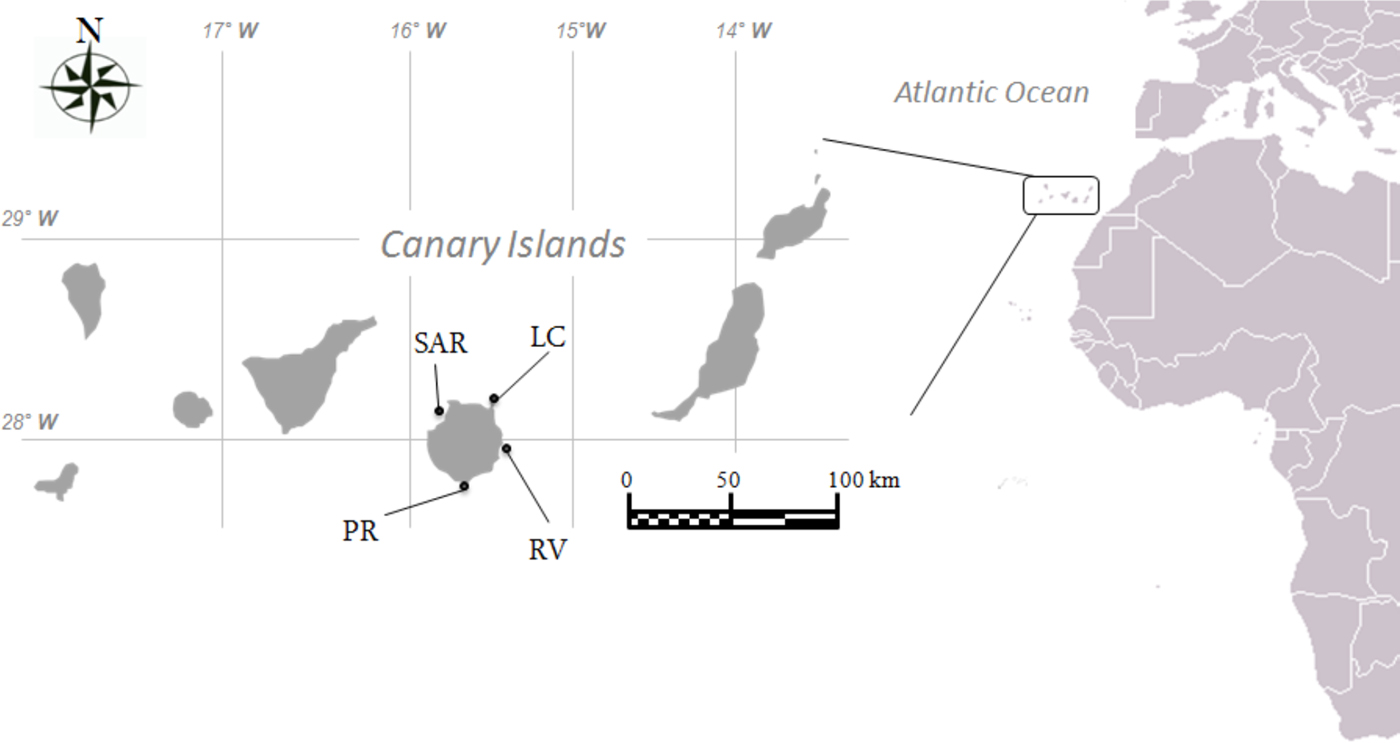
Surveys were conducted during 2005, 2006 and 2007 in four different areas on the island of Gran Canaria in the Canary Islands (Figure 1). The sites were La Catedral (LC: 28°10′57″N 15°24′11″W), Sardina del Norte (SAR: 28°08′56″N 15°42′02″W), Risco Verde (RV: 27°51′24″N 15°23′9″W) and Puerto Rico (PR: 27°47′47″N 15°43′59″W). Gran Canaria Island is nearly a round island with different environmental characteristics at the four sampling sites. LC and SAR are located far from urban areas, and are under the influence of north-east winds. Both sites have deep waters and are characterized by extensive rocky substrates. RV is a shallow water area on the east side of the island, protected from the wind, has a sandy substrate below 15 m and is adjacent to an urban centre. The fourth site, PR, is located to the south-west and is shallow, with a mixed substrate of rocks, gravel and sand below 10 m depth.
Study area and sampling sites in Gran Canaria: Sardina (SAR); PR (Puerto Rico); Risco Verde (RV); La Catedral (LC).
LC and SAR are colonized by sea urchins and exhibit no erect algae, but there are some encrusting red algae; whereas RV and PR are characterized by erect algae, predominantly of the genera Padina, Dictyota and Stypocaulon spp. (see Cabanillas-Terán, Reference Cabanillas-Terán2009 for more details). Censuses were conducted at three different depth ranges according to the specific topography of each site. Ten metres was the common depth for all sites (Table 1). Samples were taken in two seasons: warm (October–November) and cold (March–April), according to the time when the water exhibits its maximum (23–24°C) and minimum (17–18°C) peaks of temperature (Hernández et al., Reference Hernández, Clemente and Brito2011).
Sampling depths for the four sites in Gran Canaria.

Survey methodology and population structure
Mean density was estimated using a belt-transect methodology (Vanderklift & Kendrick, Reference Vanderklift and Kendrick2004). At each site, eight random transects of 5 m2 were placed parallel to the shoreline and separated 10 m from each other. All crevices and small holes were carefully inspected to avoid missing any individuals. Censuses were performed in 2005, 2006 and 2007 at each of the sampling sites in both the cold and warm seasons at different depths (Table 1). A total of 792 Diadema africanum were collected randomly across all sites for morphometric analysis during cold and warm seasons of 2005, 2006 and the cold season of 2007 (25 individuals by site by depth). Individuals were collected randomly, brought to the laboratory, labelled and frozen for later analyses. Once in the laboratory, the Aristotle's lantern diameters were measured (caliper error: 0.05 mm). Depth range in Table 1 was established according to the presence of D. africanum at these depths. We divided individuals in four size-classes following Tuya et al. (Reference Tuya, Boyra, Sánchez-Jerez, Barbera and Haroun2004a, Reference Tuya, Boyra, Sánchez-Jerez, Barbera and Harounb): class 1: 1.5–3.5 cm; class 2: 3.5–5.4 cm; class 3: 5.5–7.4 cm; and class 4: 7.5–10 cm.
Statistical analysis
The Kolmogorov–Smirnov and Levene tests were run to test normality and homogeneity of variance for all biometric parameters (Zar, Reference Zar2010). We ran a two-way analysis of variance (ANOVA) to test spatial and temporal differences in mean abundance and (10 m) mean size. This model incorporates time as the fixed and site as the random factor. In addition, we ran different one-way ANOVAs to determine potential differences in depth at each site of mean density, but also differences in depth and among sites for the Aristotle's lantern width. Multiple post-hoc Tukey's HSD analyses were run when ANOVAs were significant to identify specific subsets. Furthermore, we ran the parametric Pearson correlation among mean density of D. africanum and depth. All statistical analyses were performed in the free-license statistical software R-3.0.1 with a P value of 0.05 (R Core Team, 2013).
RESULTS
The sea urchin D. africanum exhibited an overall density of 7.59 ± 2.92 (mean ± standard deviation) urchin m−2 at Gran Canaria. The overall abundance varied from 2.09 ± 1.42 urchin m−2 (PR) to 10.12 ± 3.17 urchin m−2 (SAR). Seasonal highest density of D. africanum was recorded at RV during the cold season of 2005 at 5 m (12.98 ± 4.47 urchin m−2), while PR displayed the lowest density during the cold season in the same depth and year (0.75 ± 0.45 urchin m−2) (Figure 2). A two-way ANOVA found spatial differences in mean abundance of the species, while seasonality was not relevant (Table 2). The post-hoc analysis determined that the most important differences in abundances occurred between RV with respect to LC/PR (P < 0.001), and between PR/SAR (P < 0.001). On the other hand, the abundance across a vertical gradient (depth) exhibited higher densities at 20 m in LC and in RV at 5 m (Figure 2). Differences in depth were found within PR (ANOVA, F = 38.69, df = 1, P < 0.001) and SAR (F = 13.20, df = 1, P < 0.001), while LC (F = 2.01, df = 1, P = 0.159) and RV (F = 0.0008, df = 1, P < 0.997) did not exhibit a great vertical changes in abundance. Furthermore, we did not find a strong relationship between depth and mean density of D. africanum (r = 0.247, N = 384, P < 0.01).
Spatial and temporal density of Diadema africanum in Gran Canaria from cold season 2005 to winter of 2007 at three depths (5, 10, and 20 m) at four sites (see Materials and Methods for sites acronyms). The X axis represents time with cold-2005 (c-05), warm-2006 (w-06), etc. Depths are represented by square (5 m), circle (10 m), and triangle (20 m). Bars represent 95% of confidence interval of the mean.

A two-way analysis of variance on the abundances, and sizes of the sea urchin Diadema africanum at four sites of Gran Canaria. SS, sum of squares; MS, mean of squares.

*, comparisons were run only for 10 m data (the only common depth among sites).
Overall mean size of D. africanum during the study was 5.06 ± 1.01 cm. The maximum average mean size was recorded in RV (5.53 ± 0.92 cm), followed by PR, LC and lastly SAR, with 4.29 ± 0.68 cm. The spatial variability showed that RV and PR were the two sites with greater mean sizes at some intervals, whereas SAR and LC remained below 6.0 cm (Figure 3). The classes two and three together represented 94% of the whole sample, and class 2 alone represented more than 65% of the individuals collected during the study.
Seasonal mean size distribution of Diadema africanum at four sites in Gran Canaria. The X axis represents time with cold-2005 (c-05), warm-2006 (w-06), etc. Depths are represented by square (5 m), circle (10 m), and triangle (20 m). Bars represent 95% of confidence interval of the mean. There are some missing data because not all sites were measured in all seasons. Lack of information (SAR c-05, PR w-06 and c-07 at 10 m) represents missing data.

Differences in depth of mean sizes showed that in PR and RV mean sizes increase between 5 and 10 m, whereas in LC and SAR sizes diminished between 10 and 20 m (Figure 3). The two-way ANOVA performed only at 10 m found significant spatial and temporal mean sizes (Table 2). All sites exhibited differences (P < 0.001) among the others in a post-hoc analysis, whereas temporal differences were not remarkable except between the warm seasons of 2005 and 2006 (P = 0.095), and between the cold seasons of 2006 and 2007 (P = 0.997).
The morphometric analysis of the Aristotle's lantern structure found that the width of the structure decreased in a vertical gradient, notably between 10 and 20 m (F = 12.307, d = 2, P < 0.001). A post hoc comparison found a lack of difference only between 5 and 10 m (P = 0.245) (Figure 3A). On the other hand, the width of the lantern was greater at PR and RV and lower in LC and SAR (Figure 3B). A one-way ANOVA found spatial differences (F = 8.43, d = 3, P < 0.001), whereas post hoc comparisons did not find differences between either RV and PR or LC and SAR (P > 0.05).
DISCUSSION
The general stability displayed at all sites in abundance confirms the high seasonal stability of D. africanum population on Gran Canaria. Temporal stability in abundance of this invertebrate agrees with previous studies conducted throughout the Canary Archipelago (Brito et al., Reference Brito, Cruz, Moreno-Pérez and Bacallado1984; Bortone et al., Reference Bortone, Van Tassell, Brito, Falcon and Bundrick1991; Tuya et al., Reference Tuya, Ortega-Borges, Del Rosario-Pinilla and Haroun2006, Reference Tuya, Cisneros-Aguirre, Ortega-Borges and Haroun2007; Hernández et al., Reference Hernández, Clemente, Sangil and Brito2007; Clemente et al., Reference Clemente, Hernández, Rodríguez and Brito2010; Hernández et al., Reference Hernández, Clemente and Brito2011). The existence of a depth gradient was notable at least for PR and SAR. This result agrees with other studies conducted in Canary Islands (Tuya et al., Reference Tuya, Boyra, Sánchez-Jerez, Barbera and Haroun2004b; Hernández et al., Reference Hernández, Clemente, Brito, Falcon, García and Barquin2005, Reference Hernández, Clemente, Sangil and Brito2007). The hydrodynamic action in intertidal and subtidal environments affects the distribution patterns of marine organisms (Roberts et al., Reference Roberts, Cummins, Davis and Chapman2006).
The existence of higher densities of D. africanum in deeper areas in PR and SAR could be supported by the negative relationship between depth and wave effect (Roberts et al., Reference Roberts, Cummins, Davis and Chapman2006). The sea urchin D. africanum is weakly resistant to unidirectional hydrodynamic forces, because its morphology does not allow a large adhesive surface area to attach to the bottom (Tuya et al., Reference Tuya, Cisneros-Aguirre, Ortega-Borges and Haroun2007). Higher hydrodynamics in shallow areas also may limit D. africanum recruitment, according to Tuya et al. (Reference Tuya, Cisneros-Aguirre, Ortega-Borges and Haroun2007), which affects population growth. Nevertheless, the vertical distribution of D. africanum in the Macaronesia Archipelago showed that the species was more abundant in shallow water areas (Entrambasaguas et al., Reference Entrambasaguas, Pérez-Ruzafa, García-Charton, Stobart and Bacallado2008), as occurs with Diadema antillarum in the Caribbean (Hendler et al., Reference Hendler, Miller, Pawson and Kier1995).
The vertical Aristotle's lantern results (Figure 4) agreed with other studies that indicate a limited growth of D. africanum at greater depths (Levitan, Reference Levitan1988; Garrido, Reference Garrido2003; Hernández et al., Reference Hernández, Clemente, Brito, Falcon, García and Barquin2005, Reference Hernández, Clemente, Sangil and Brito2007). However, we only found this behaviour in LC, whereas SAR displayed an inverse relationship and PR and RV did not exhibit a clear pattern (Figure 3). The reduction in width of this structure may be a result of food restrictions due to a decrease in vegetation cover and/or lower primary production limited by light intensity (Alves et al., Reference Alves, Chicharo, Serräo and Abreu2001; Lessios et al., Reference Lessios, Garrido and Kessing2001a, Reference Lessios, Kessing and Pearseb). In addition, Levitan (Reference Levitan1991) found that Diadema might adjust its body size as a function of available resources, as an adaptive strategy to protect against the harmful effects of increased density.
The Aristotle's lantern width variation on a depth gradient (A) and among the four sites in Gran Canaria (B). Grey colums represent 95% of confidence interval of the mean.

A limiting factor shaping abundance and size of D. africanum are food resources, and in barrens this factor is determinant. Urchin barrens have greater development in deeper zones due to continuous grazing activity, whereas in shallower waters, grazing remains restricted during night-time (Tuya et al., Reference Tuya, Martín and Luque2004c). It has been demonstrated for sea urchins of temperate zones that recruitment may be favoured under high density conditions, due to higher larval settlement success (Balch et al., Reference Balch, Scheibling, Harris, Chester, Robinson, Mooi and Telford1998; Tuya et al., Reference Tuya, Ortega-Borges, Del Rosario-Pinilla and Haroun2006). However, when densities reached 10 urchin m−2 or higher, sea urchins may collapse benthic production (Tuya et al., Reference Tuya, Boyra, Sánchez-Jerez, Barbera and Haroun2004b). The existence of a correlation between size and urchin barrens development found here is consistent with other studies (Black et al., Reference Black, Johnson and Trendall1982; Ebert, Reference Ebert, Jangoux and Lawrence1983; McClanahan (Reference McClanahan and Curtis1991); Levitan & Sewell, Reference Levitan, Sewell, Jamieson and Campbell1998; Garrido, Reference Garrido2003). For instance, we found that barrens with less algal cover have higher densities but smaller urchins.
Further studies on the trophic ecology would provide a better understanding of how D. africanum can persist over long periods with a high reproductive success and seasonal stability, even at the limit of the carrying capacity of the environment. Despite extensive studies on the biological role of this species, there are still some questions as to how this species is dominant and is the key genera on both sides of the Atlantic.
To conclude, population density of D. africanum exhibited high temporal stability in Gran Canaria, while changing across a vertical gradient and between sites. The existence of higher densities and smaller sizes in deeper areas explains how the density–size strategy displayed by Diadema sp. (Levitan, Reference Levitan1989, Reference Levitan1991) accounts for the high stability of the urchin barrens, once developed, remaining as areas of permanent desertification at subtidal depths throughout the Canary Archipelago.
ACKNOWLEDGEMENTS
We would like to thank the logistic support provided by the Department of Biology, Marine Sciences Faculty, University of Las Palmas de Gran Canaria and the University Foundation. We also want to express our gratitude to the students of scientific diving for supporting fieldworks.
FINANCIAL SUPPORT
The first author expresses gratitude to the Mexican National Council for Science and Technology (CONACyT) for a scholarship.



