Introduction
Grasslands provide important herbaceous and sometimes woody forage for grazing animals in China (Liao & Jia Reference Liao and Jia1996) and grassland is the largest terrestrial landscape, resource and ecosystem by area in China. There are c. 393 million hectares of grasslands (40% of the total land area of China). Grassland resources are distributed in three regions, namely the temperate arid grassland region in northern China (comprising 41% of China's total grassland area), the Qinghai–Tibetan Plateau alpine grassland region in western China (38%), and the humid secondary grassland region in southern and eastern China (21%) (Su Reference Su and West1995).
One-third of the grasslands in China have been overgrazed by livestock since the 1970s, and grassland degradation (defined here as non-arable land [excluding forest] degradation and desertification, which cause serious economic, social and environmental problems; Nelson Reference Nelson2006), is accelerating (Xu & Li Reference Xu, Li, Hong and Ren2002). Land-use and cover changes and rapid population growth have made China's grasslands highly susceptible to degradation and desertification (Wang et al. Reference Wang, Xu and Liu1999). Grassland degradation has severely affected not only the lives of local residents, who depend primarily on grassland resources for their livelihood and spiritual needs, but also the ecological security of the whole country (Wang & Li Reference Wang and Li1999; Wang et al. Reference Wang, Xu and Liu1999; Xu & Li Reference Xu, Li, Hong and Ren2002; Yang Reference Yang2002). Chinese scientists and officials have been challenged to revise policies and management strategies to insure the future of grassland natural resource.
The ‘Grassland Ban’ is a public policy formulated by the Chinese Government in 2002 to restore and improve grassland environments and to ensure sustainable development of a livestock industry in pastoral areas of China. It involves four management strategies, namely initiating grazing bans on severely-degraded grassland, keeping moderately-degraded grassland fallow, initiating grazing rotation on slightly-degraded grassland and rearing livestock in sheds (Guo Reference Guo2006). Farmers who lose their rights to grassland use owing to implementation of this policy are to be compensated for five years with both grain and cash on the basis of grassland productivity (which varies with geographical location) and land area. These practices were initially implemented in Inner Mongolia and Xinjiang in late 2002–early 2003, and implementation has subsequently extended to all pastoral areas of northern and western China, which are inhabited by most Chinese ethno-linguistic groups, including Mongolians, Tibetans, Kazaks and Hui (Guo Reference Guo2006).
Implementation of this policy, especially grazing bans, may change the lifestyles of local ethnic herders because it restricts traditional grazing of grasslands and free access to the resource. Conservation policies that restrict traditional land uses tend to antagonize people who were once stewards of the land (Mehta & Kellert Reference Mehta and Kellert1998; Mehta & Heinen Reference Mehta and Heinen2001). Understanding human attitudes to new conservation policies is critically important in modifying and updating long-term conservation strategies. However, little social science research has investigated public attitudes towards and beliefs about the Grassland Ban Policy (GBP).
Evaluation of the implementation of new or reformed rangeland/grassland policies can be achieved in a number of ways. For example, interviews with herders and officials at all levels of government and a resurvey of herding households were conducted to examine implications of Mongolia's 1994 Land Law, which authorized land possession contracts (leases) over pastoral resources (Gimenez et al. Reference Gimenez, Maria and Batbuyan2004). Evaluation of the 1990s land-use reforms in the arid and semi-arid rangelands of Australia used a case study of a pastoral rangelands Landcare group (Gill Reference Gill2004). Interviews, livestock and rainfall data, policy documents and aerial photos were employed to assess the use of carrying capacity in implementation of rangeland reform in Namaqualand, South Africa (Benjaminsen et al. Reference Benjaminsen, Rohde, Sjaastad, Wisborg and Lebert2006).
Previous anthropological studies in China, including of ethnic Mongolians (Williams Reference Williams1997; Taylor Reference Taylor2006), ethnic Hui in Ningxia (Ho Reference Ho2000), ethnic Kazaks in northern Xinjiang-Uygur and ethnic Tibetans in western Sichuan (Banks et al. Reference Banks, Richard, Li and Yan2003) evaluated another national grassland policy, the Household Responsibility of Grassland of 1985 designed to facilitate full use of rangeland resources by devolving use rights of grasslands to individual households, based on a contract between government and farmers. Grassland ‘privatization’ and household enclosures implemented under this policy in pastoral areas of northern and western China have generated conditions for greater economic inequality and depletion of natural resources. The GBP may be expected similarly to generate effects on pastoral livelihoods and environments. We used a mail survey (Salant & Dillman Reference Salant and Dillman1994) in 2004 to assess public attitudes towards the GBP and public knowledge of the implications of it for improvement of the grassland environment. The objectives of the study were to: (1) identify the attitudes of stakeholders (farming households, extension workers and local officials) from different regions towards the GBP and its application, (2) compare overall attitudes toward grassland management with beliefs about the environmental condition of grasslands, and (3) consider possible improvements to the GBP and its implementation.
Methods
Sampling
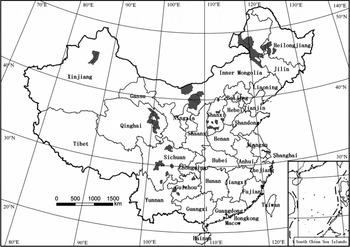
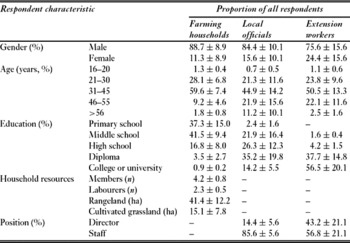
The study was conducted April–October 2004 using mail survey questionnaires in 40 counties distributed among four pastoral regions of China. Four counties were selected from Qinghai and Xinjiang provinces in the north-west region; 11 from Guizhou and Sichuan provinces in the south-west region; 13 from Inner Mongolia and Heilongjiang provinces in the north region; and 12 from Shanxi province in the central region (Fig. 1). Three parallel surveys of farming households, extension workers and local officials generated the data. These sectors differed in characteristics such as age, gender and education level (Table 1). For farming household surveys, 10–15 families were randomly selected from 2–3 villages in each county. Approximately 10% of the families in each village were selected. For extension worker and local official surveys, 2–3 individuals were randomly selected and surveyed out of 20–30 staff in each county.
Location of surveyed counties (dark areas) in pastoral areas of northern and western China.

Characteristics of survey respondents (means ± SD). – = not applicable.

The questionnaire survey was formulated and administered following the total design method (Dillman Reference Dillman1978). A cover letter, stamped return envelope and the survey questionnaire were mailed to each survey participant, who was asked to complete the questionnaire and return it by post. Within 1–2 weeks a postcard reminder was sent and those who did not return questionnaires in a timely fashion were contacted again by mail (Salant & Dillman Reference Salant and Dillman1994). Local community leaders were asked to help farmer interviewees to fill out the questionnaires if they were unable to read and write Chinese. This involved translating the questions and recording answers. Returned questionnaires were checked for errors, such as incomplete or redundant answers, by trained staff. Of the 500 questionnaires sent to farmer households, 400 completed and valid questionnaires were returned (an 80% response rate). Of the 100 questionnaires mailed to local officials and extension workers, 75 and 68 returned valid questionnaires respectively.
Survey instrument
Survey questionnaires covered: (1) the background of interviewees, including gender, age, education level and occupation; (2) attitudes of interviewees to the GBP; (3) interviewee knowledge of grassland condition and understanding of the GBP; (4) measures taken to improve grassland production and grassland condition; and (5) suggestions from interviewees about degradation control and grassland restoration.
There were different design styles for items covered in the questionnaires, which were based on Dong et al. (Reference Dong, Kang, Xiong and Liu2005). Item 1 (background) was designed as tables to be completed by interviewees. Item 2 (attitudes) involved a series of statements concerning the GBP about which respondents could indicate agreement, disagreement or uncertainty. Item 3 (knowledge) comprised a series of questions with optional answers to be chosen by the interviewees. Items 4 and 5 (measures and suggestions) were open voluntary questions. We undertook an extensive literature review of current issues to cross-check the information obtained.
Analytical methods
The questionnaire data were collected separately from farming households, extension workers and local officials and also grouped by region (north-west, south-west, north and central). One-way analysis of variance (ANOVA) was used (SPSS 10.0; Huang et al. Reference Huang, Luo and Chen2001) to examine regional differences in attitudes and beliefs among the three interviewee sectors. Systematic qualitative techniques (Miles & Huberman Reference Miles and Huberman1994) were used to analyse interviewee statements to open questions and other information.
Results
Local perceptions of the grassland environment
The respondents from farming households claimed that grassland conditions had changed significantly in past decades, grass production and coverage having decreased, good forage species having declined heavily and spring dust-storms having been frequent in pastoral areas of the north and north-west China. Farming households attributed these changes mostly to increased grazing pressure on grasslands since implementation of the Household Responsibility of Grassland policy in 1985. Grassland fencing and fragmentation as a consequence of this policy broke their traditional nomadic and rotational management systems, leading to overstocking in certain years. Severe dryness during 1994–2004 (especially 1998–2000) in north and north-west China had, according to farming households, accelerated these forms of grassland degradation. Farmers stated that their livelihoods (i.e. family incomes generated from livestock raising, food supplies from pastoral production) had been negatively influenced by these changes and urged actions to mitigate the degradation of grassland.
Local officials stated that grassland degradation caused by overgrazing and accelerated by climate changes was not only a threat to pastoral livelihoods, but also a stress to ecological security of vast pastoral areas and neighbouring regions. Local officials stated that the Household Responsibility of Grassland policy was initially formulated by central government to encourage local households to manage their rangeland and livestock more efficiently by decentralizing grassland user rights to pastoralists. However, driven by national economic development and high external demand for pastoral products, local farmers had pushed their livestock numbers beyond the carrying capacity for the sake of short-term profit. Local officials indicated that overexploitation of grassland resources for pastoral production deteriorated the environment in vast pastoral areas of China, while monitoring and assessment of grassland conditions were given little attention by past development-oriented government policies in grassland resources management. Therefore, local officials called for conservation-based policies to promote the sustainable development of both grassland resources and pastoral livelihoods.
Responses of farming households to the GBP
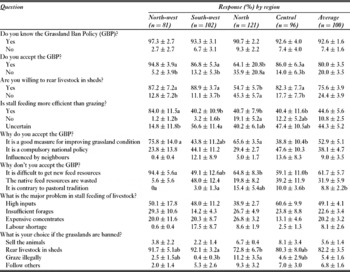
Most respondents (average 92.6%) were aware of the GBP, however acceptance of it varied (p < 0.05) from 64.1% in the north to 94.8% in the north-west (Table 2). In the north-west and north, acceptance of the GBP by respondents was generally based on the belief that the policy would help improve grassland conditions and rejection of the GBP was most often because of difficulty in obtaining new feed resources (Table 2). In the south-west and central regions, respondents had positive attitudes to the GBP and believed it was essential for improving grassland conditions. However, some respondents had negative attitudes, as they believed that new feed resources were not available and native feed resources were being wasted.
Farming household responses to questions in the survey (mean ± SD). Within rows, data followed by different letters are significantly different (p < 0.05).

Farming household attitudes to the regulation of stall feeding and beliefs about the benefits of this regulation also varied regionally (Table 2), >80% of respondents in the north-west, south-west and central regions being willing to accept this regulation, while 45% in the north region rejected it. About 84% of respondents in the north-west region believed stall feeding was more profitable than grazing, although 60% of those in the south-west, north and central regions thought stall feeding was less profitable. On average, high input requirements were the most serious problem faced by farmers in stall feeding, followed by insufficient forage, expensive concentrates and labour shortages (Table 2).
Most respondents (average 82%) indicated that they had shifted their livestock production system from grazing to stall feeding after implementation of the GBP, and the rest had sold animals, grazed illegally or followed other farming household choices (Table 2). The proportion of respondents who chose stall feeding was lower in the north (p < 0.05) than in the other three regions, while the proportion of respondents who chose illegal grazing in this region was greater (p < 0.05). More than 60% of farmers in the north-west and north relied on a ‘cut and carry’ (forage) stall feeding system to raise animals for dairy or meat production, while most farmers in the south-west and central regions had a stall feeding system based on straw or crop residues with small amounts of added concentrates.
Most respondents suggested that technical and policy support was needed to sustain the GBP. Technical training in forage improvement, grazing management, weed control, animal feeding and breeding, marketing and alternative enterprises was strongly endorsed by most respondents. In terms of policy support, most respondents felt that reductions in grassland taxes and rents, subsidies and compensation for livestock production and prohibition of certain activities (including mining, herb collection and hunting) should be guaranteed by law or decree.
Responses of local officials to the GBP
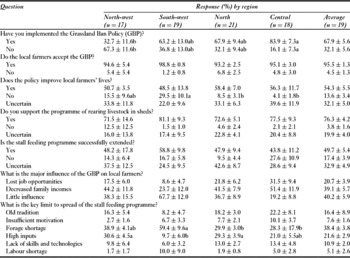
Responses about implementation of the GBP varied among regions (Table 3), 84% of central region respondents had implemented the GBP compared to 33% in the north-west. Over 90% of respondents reported that the GBP had been accepted by farming households. About half the respondents believed the GBP positively affected the lives of local farmers, while the remainder thought it had no effect or was negative. Local officials believed decreased family incomes and loss of job opportunities were two major negative impacts of the GBP on farmers.
Local official responses to questions in the survey (mean ± SD). Within rows, data followed by different letters are significantly different (p < 0.05).

Although the majority of respondents (average 76%) supported the stall feeding programme, only half reported its successful implementation (Table 3). Forage shortages, high input costs, the tradition of grazing, insufficient motivation and labour shortages were generally considered to be the major limitations in implementation. Forage shortage was much more significant and high input costs less significant in limiting implementation of the programme in the south-west region than elsewhere.
The local official respondents reported that they had employed numerous measures to motivate acceptance of the GBP by local farmers, and had helped local farmers to solve practical problems in production systems. Reducing land rent and tax on agricultural products and financial subsidies for agricultural production were the most successful measures taken by local government in all regions. Literacy education for farming households had substantially motivated implementation of the GBP in the north-west and south, where illiteracy was a major limitation in extending policies and technologies. Creating job opportunities and transferring surplus labour were important strategies adopted by local governments to stimulate implementation of the GBP in the north and central regions.
Most local official respondents reported they had developed close relations and links with non-governmental organizations (NGOs) such as the Environment Protection Association, Green Volunteer Organization, Poverty Reduction Organization and Farmer Association, as well as with commercial enterprises, processing industries, research institutes/universities, training centres, social services, and individual farming households and local communities. These relationships were very effective in solving some social and technical problems associated with implementation of the GBP. Active involvement of farmers in implementation of the GBP could be stimulated by a number of preferential strategies, however some local officials indicated that incomplete reward mechanisms (such as bonuses) and motivation strategies (such as promotion) were discouraging them from effectively sustaining improvements in the GBP.
Responses of extension workers to the GBP
The respondents reported the GBP had been fully extended in the central region but not in the north-west, south-west and north (Table 4). Regional differences were also found in respondent beliefs about the stall feeding programmes. The proportion of respondents believing ‘stall feeding can produce more profits than grazing’ was higher in the north-west, south-west and central regions than in the north. The majority of respondents (66%) in the north were not sure about the relative benefits of stall feeding.
Extension worker responses to questions in the survey (mean ± SD). Within rows, data followed by different letters are significantly different (p < 0.05).

Extension workers did not differ in responses about the causes of grassland degradation, overgrazing being seen as most important, followed by global climate change, overfarming, land reclamation and other human activities, including infrastructure construction, mining and herb collection (Table 4). Nearly all respondents (average 94%) from different pastoral regions believed the GBP had been effective in improving grassland environments. Reducing the number of grazing animals was considered the most important measure for controlling grassland degradation. Other measures, such as confining grassland uses, reseeding degraded grassland, and surveying and monitoring grassland condition were also significant in improving grassland environments. The extension worker survey indicated that measures for grassland improvement had been implemented and should be sustained in the future.
The extension workers reported that technology transfer and information dissemination were most important in effective implementation of the GBP. New or improved technologies (including rotational grazing, grazing fallow, stall feeding, silage/hay production, straw treatment, animal health care and feeding, milking, milk processing and marketing) had been successfully transferred from research institutes to local communities and individual households. Local households had also been encouraged to participate in implementation of the GBP and stall feeding programmes, through regular training courses and workshops, exchange of individual experiences and farm demonstrations. They had also disseminated updated information about policy making and regulation, grassland condition, and livestock production and marketing systems directly to local farmers through TV programmes, newspapers, newsletters and brochures. Extension efforts and activities had been effective over the first two years in promoting the GBP in all study areas. However, most extension workers were worried about the sustainability of this policy because of insufficient financial support and unstable national policies concerning the GBP.
Discussion
To formulate effective policies it is necessary to understand the structure and operation of particular management regimes. The extent of policy effectiveness also depends on the incentives and expectations of individuals required to enforce institutional rules or comply with their terms (Swallow & Bromley Reference Swallow and Bromley1995). In China, lessons learned from implementation of the Household Responsibility of Grassland Policy or User Rights Grassland Policy indicate that to effectively formulate and implement policy, there was a need to re-centre user groups as an integral part of the biotic community (including grasses, animals and human beings) in grassland management, because this policy greatly affects people's livelihoods and land tenure arrangements (Banks et al. Reference Banks, Richard, Li and Yan2003; Taylor Reference Taylor2006).
In the present study, some progress has been made in implementing the GBP in pastoral regions of China, but more improvements are required to sustain it. Underlying factors including economically marginal pastoralism, cultural practices, ethnic history and regional variations in China's poorest areas and fringes have been overlooked in this centralized national policy, particularly in relation to unexpected problems in its implementation (for example the low acceptance of the GBP and stall feeding practices in some regions). This suggests that, as in Inner Mongolia (Taylor Reference Taylor2006), those involved in development interventions should work with supra-local supportive state mechanisms to more fully incorporate the local communities in policy planning. Such an approach emphasizes local experiences, viewpoints and sentiments in the management of common property resources. In this way, social factors in ecosystem dynamics will receive attention in policy-making, and new synergies can be formed among various stakeholders.
The greater proportion of northern farmers who were unwilling to accept the GBP and the stall feeding programme than those in the other three regions reflects the predominantly larger ranches of northern farmers, who are concerned more about the impact of the GBP on their lives; central and south-west farmers are supported by more diverse land use, while small-scale subsidy-driven livestock farming dominates indigenous production systems in the north-west. Since serious grassland degradation has hindered development of livestock production and pastoral economies in vast ranges of the north and north-west (Wang et al. Reference Wang, Xu and Liu1999; Meng & Gao Reference Meng and Gao2002), farmers in these regions focused on grassland improvement when deciding whether to accept the GBP or not. Forage deficiencies in cold and dry environments are traditionally key problems limiting livestock production in rain-fed pastoralism in the north-west (Yang Reference Yang2002), and this problem negatively affected acceptance of the GBP by local farmer households. In contrast, the belief that native feeds were being wasted and that the local grazing tradition has been broken reflected negatively on acceptance of the GBP by local farmers in the other three regions. In line with these findings, it is suggested that adapted community-based land-use practices and indigenous knowledge of different ethnographical groups be included in formulation of new grassland management policies.
Stall feeding might be the alternative for livestock production in pastoral regions of China following implementation of the GBP. However, the profit margin from stall feeding was questioned by farmers who have a long history of well-developed rotational or nomadic grazing systems. Some extension workers thought high input costs would be the most serious problem for farmers in shifting livestock production from grazing to stall feeding in response to the GBP. Herding is not just an economic activity for ethnic pastoral farmers in pastoral regions of China; it has strong linkage with their culture, tradition and history (Williams Reference Williams1997; Ho Reference Ho2000; Banks et al. Reference Banks, Richard, Li and Yan2003; Taylor Reference Taylor2006). The ethnic Mongolians in the north, ethnic Tibetans and ethnic Muslim groups in the north-west, and ethnic Tibetan-origin groups in the south-west are mostly pastoralists whose cultures and traditions have evolved with the development of livestock grazing systems. The GBP and stall feeding might alter their historical farming systems and erode their traditions and cultures related to herding. Therefore, regulation of stall feeding in the GBP should be reassessed and reconsidered in the future by policy makers, based on such groups’ cultural and traditional needs.
Regional variations in public attitudes and beliefs about the GBP, as well as regional differences in implementation of the GBP imply that land-use patterns, resource availability, infrastructure development, incentives and driving forces and related factors play important roles in effective implementation of the GBP nationwide. Banks et al. (Reference Banks, Richard, Li and Yan2003) also reported that regional differences in the unique natural features (including ecological fragility) of China's rangelands, access to water resources, remoteness of residential quarters, difficulties in demarcation and reliance on group enforcement of any policy and legal measures made the implementation of national grassland policies difficult. In addition, various cultural practices, regional histories and the political economy in pastoral regions mostly inhabited by Chinese ethnic groups can influence implementation of a national grassland policy (Williams Reference Williams1997; Ho Reference Ho2000; Banks et al. Reference Banks, Richard, Li and Yan2003; Taylor Reference Taylor2006). Similarly, since social and geographical factors may influence the implementation of the GBP, these should be taken into account.
Incentives and motivation are important driving forces for the effective implementation of land reform policies (Swallow & Bromley Reference Swallow and Bromley1995). Holechek and Hess (Reference Holechek and Hess1995) suggested that USA policy makers could reform federal grazing land policy by coupling grazing fees to grazing intensity, with ranchers adopting conservative sustainable grazing intensities paying low fees, whereas those using heavy grazing intensities would be charged higher fees. In China, compensation with grain and cash for temporary loss of pastoral productions was an effective incentive for local farmers to adopt the GBP.
Incompatibility between policy governance, institutional structures and individual incentives (for example, 35% of northern farmers reported they did not accept the ban, while local officials claimed 93% acceptance) may be associated with regional variations in public attitudes and beliefs about the GBP and its implementation. Similar flaws were apparent during implementation of the Household Responsibility of Grassland or User Rights Grassland Policy in China (Williams Reference Williams1997; Ho Reference Ho2000; Banks et al. Reference Banks, Richard, Li and Yan2003; Taylor Reference Taylor2006). Serious consideration should be given to incorporating multiple stakeholder perspectives. The positive responses of local officials to the GBP and the stall feeding programme being similar in all regions implies that if an authority figure at the grass-roots level endorses this national policy, then effective extension follows.
In general, most respondents believed the GBP to be an effective means of controlling grassland degradation and improving grassland condition. This is consistent with other findings about perceived ecological benefits from implementation of the GBP (Dan Reference Dan2003; Li et al. Reference Li, Yang and Xu2004; Huang & Wang Reference Huang and Wang2004). However, the present study found that reduced family incomes and job opportunities had a negative impact on the smooth implementation of the GBP. These and other findings suggest that mitigation of conflicts between resource conservation and community development should be addressed to sustain implementation of land reform policy (Gary Reference Gary1999; Jan & Kevin Reference Jan and Kevin2002).
The present survey also indicated that important problems need to be solved and that some improvements in the GBP are needed for its sustainable implementation. Most respondents regarded overgrazing as the primary cause of grassland degradation, a view consistent with other studies (Wang & Li Reference Wang and Li1999; Zhao & Hou Reference Zhao and Hou2001; Xu Reference Xu2002; Yang Reference Yang2002; Li Reference Li2003; Zhu Reference Zhu2003). Maintaining a balance between forage production and animal requirements is the principle of sustainable grassland production (Zhang Reference Zhang1991; Dong et al. Reference Dong, Jiang and Huang2002), and this was stressed by most professionals in this study.
Conclusions
More research is required on related technologies including improved grassland management, forage cultivation, harvest and storage, animal feeding and housing, and animal healthcare. Involvement of NGOs should be strengthened by providing them with opportunities for input to decisionmaking, technology transfer, training and education, marketing, research activities and social services for sustainable development of grassland production systems in China. Implementation of the GBP can be further strengthened by improving collaboration between farmers, local officials, extension workers, government agencies and NGOs. For future implementation of the GBP, we suggest that tax reduction, continued financial subsidies and elimination of illiteracy among the rural population are priority issues to be addressed. Moreover, incentive measures such as salary enhancement, professional development, and moral and material awards should be considered to encourage the active involvement of local officials and extension workers in GBP implementation.
ACKNOWLEDGEMENTS
The authors thank the National Key Subject (NKBRSF project 2007CB106807) and the National Natural Science Foundation of China (NSFC 30600083) for financial support. The comments and suggestions of the anonymous referees are appreciated.