

For developing countries, signing bilateral investment treaties (BITs) has become an attractive way to try to stimulate greater inward foreign direct investment (FDI). By granting numerous substantive rights to investors and allowing for international arbitration of any disputes that arise, signatory governments signal their receptiveness to outside investment and commit to protect whatever investment they receive. In turn, foreign investors should be more willing to invest in countries who have signed BITs because of these additional protections. This is the standard account advanced in existing scholarship on the effects of BITs on FDI. Yet the investment-treaty story does not end once an agreement is signed. Instead, investors will look to see whether the promises made in the treaties are being upheld and will reevaluate their investment decisions as new information is revealed. Governments that sign BITs, then, could receive more or less investment in the years after they sign the treaties.
To provide a more complete answer to the central question of whether these treaties are effective in generating greater investment, we shift the study of BIT effects in an important new direction by emphasizing compliance, or lack thereof, with the treaties. We inject an important, overlooked caveat to the claim that BITs should be beneficial: governments who sign BITs should receive greater FDI, but only if they are not later revealed to have violated their treaty commitments. Existing studies typically record when a state signs a BIT and then examine whether more FDI flows to that state from that point onward. In effect, ongoing future compliance with the treaties is assumed. Yet this assumption is rendered problematic by the emergence of a significant number of investor-state disputes in which an investor explicitly claims that a BIT signatory is not complying with its treaty obligations. Therefore, compliance with the treaties, as revealed by the presence or absence of subsequent treaty-related disputes, should be a critical determinant of BITs' ability to stimulate greater investment.
Our central claim is that the net investment effect of BITs is contingent upon the future behavior of the governments who sign them. Investment treaties should stimulate greater investment flows into signatories provided that no new information arises that contradicts the investor-friendliness signified by the treaty. However, given the substantial uncertainty that surrounds investment decisions, any new information that reveals a weak host-state commitment to respect FDI could damage that state's reputation in the eyes of investors. Once an investment dispute emerges, investors will rethink their assessments of political risk in the “defendant” country and be less likely to invest in a country with a now questionable track record.
The key cog in this theoretical account is the international arbitration institution, which reveals information to investors about whether governments are upholding the terms of the treaties. These legal institutions, which are largely neglected in FDI studies within political science and economics, generate new information that is salient to investors as long as the cases taken before them are observable and legal judgments are not rendered confidentially. Most disputes arising from BITs are taken before the International Centre for the Settlement of Investment Disputes (ICSID), a prominent and heavily utilized arbitral institution affiliated with the World Bank. The ICSID arbitration process transmits information to global investors and thus has the potential to reduce future investment in two ways. First, the mere appearance of a government before an arbitration venue like ICSID sends a negative but noisy signal to investors that could make them hesitant to direct future investment into that country. Second, losing an arbitral panel ruling should be particularly damaging, since it provides more precise information to investors about what a government has done and the definitive illegality of its actions.
Our empirical tests reveal robust support for these hypothesized relationships between investment dispute activity and future FDI inflows. We find that signing BITs is associated with greater future investment, ceteris paribus, but BIT-signatory governments whose policies are challenged before an international arbitration body consistently receive less FDI afterwards. If the government ultimately loses the dispute, it suffers an even greater loss in inward FDI, which can more than offset any gains received from signing even multiple BITs. Overall, the empirical evidence reveals that BITs, through their provisions for dispute resolution, help those governments who steer clear of treaty violations but harm those who fail to comply with the terms of the treaties.
Theoretical Development
BITs arose a half-century ago to govern and stimulate investment between contracting parties and now serve as the primary international vehicle by which FDI is regulated. According to recent estimates from the United Nations Conference on Trade and Development (UNCTAD), 179 countries are parties to at least one BIT, and these countries have signed a total of 2,676 BITs with one another.Footnote 1 Countries as diverse as Germany, Italy, China, and Egypt have signed more than 100 BITs with various partners, which attests to the widespread global coverage of the treaties.Footnote 2 Irrespective of the identity of the signatories, a defining feature of BITs is that they historically have been signed between a capital-rich “home” country, which is the likely source of any investment, and a developing “host” country that seeks to attract greater investment from investors in the home country.Footnote 3
BITs represent the latest and most widespread attempt by governments to address the pervasive time inconsistency problem that plagues much foreign investment.Footnote 4 Before any investment is made, investors from the home country have considerable bargaining leverage over potential host governments who seek to attract the investment. But once the investment is made and costs are sunk, bargaining leverage shifts to the host government, who then may face political and/or economic incentives to renege on the contract. It is therefore difficult for investors to determine ex ante a host government's true, long-term commitment to foreign participation in the domestic market.
Existing Research on the FDI Effects of BITs
BITs reassure fearful investors in two ways.Footnote 5 First, signing BITs is a way for host governments to signal their true intention to refrain from interfering with foreign investment. According to this “signaling” logic, negotiating a BIT is a way for an investment-seeking government to convey its seriousness about protecting inward investment.Footnote 6 Governments that sign multiple treaties may be able to send a more effective signal, and this accumulation of numerous treaties demonstrates a stronger general commitment to protect investment and to promote a healthy investment climate for all foreign investors. To be effective, however, the signals must be “costly,” or informative enough to differentiate committed liberalizers from governments with other intentions. The major worry for investors is that an initial signal to protect investment may turn out to be “cheap talk,” if a government later changes course and behaves in ways that are hostile toward investment.
A second line of argument is that BITs increase the credibility of host states' promises to abide by the terms of a contract, which then should stimulate greater inward FDI. BITs provide significant protections to foreign investors because they include provisions on national treatment, most-favored nation status, the ability to repatriate profits, and appropriate compensation in the event of a taking.Footnote 7 Most importantly, these promises are made credible due to investor-state dispute settlement clauses that allow aggrieved investors to challenge via international arbitration any policies of host governments that violate these BIT commitments.Footnote 8 A government that violates its treaty commitments and is challenged by investors through international arbitration would suffer direct financial costs of contesting the litigation, reputational costs associated with being a defendant, and the payment of a potentially sizable arbitration award. Therefore, a BIT signatory is likely to uphold the treaty's terms because of the prospect of these self-inflicted costs, which in turn should reassure investors, who then are more likely to invest in the country. Many scholars utilize some type of credibility-based logic to argue that BITs should lead greater FDI to flow into signatories.Footnote 9 Several studies provide in-depth, credibility-based theoretical accounts, either through the development of formal modelsFootnote 10 or lengthy discussions that draw on numerous scholarly traditions.Footnote 11
A sizeable number of the aforementioned studies provide evidence that BITs are associated with greater levels of FDI.Footnote 12 Perhaps the most robust finding is that the number of BITs a country signs is positively correlated with inward FDI.Footnote 13 The validity of this finding is enhanced by that fact that these studies examine a wide range of countries over a long time-series and utilize more reliable country-level FDI data. Several others also find that BITs stimulate greater FDI more narrowly among the pair of treaty signatories.Footnote 14 Because these latter studies rely on dyadic FDI data, which is more incomplete, this more specific positive finding is less robust and somewhat more contested.Footnote 15 Therefore, although mounting evidence shows that BITs in the aggregate are associated with greater inward FDI, particularly at the country level, more research is needed to illuminate precisely how, and under what conditions, BITs should produce the desired investment benefits.
A limitation of existing empirical approaches is the inability to parse out the precise mechanisms by which BITs increase FDI. Although many studies advance nuanced theoretical arguments, they typically utilize a common, undifferentiated empirical strategy. Regardless of the logic posited, the default measurement approach is to tally each country's number of BITs (for those that use a country-level research design) or to assign to all pairs of countries a zero or one for a BIT dummy variable (for those that employ a dyadic design). The validity of the resulting empirical findings is not in question, yet it is difficult to ascertain the causal mechanism at work or to pinpoint the conditions under which BITs will increase FDI. Indeed, studies that employ nearly identical research designs and generate similar results sometimes attribute their positive findings to very different logics.Footnote 16 Neumayer and Spess, in fact, acknowledge this empirical limitation: “How important is the signaling effect, which benefits investors from all countries, compared to the commitment effect, which only relates to investors from BIT partner countries, is difficult to say.”Footnote 17
Various studies have begun to employ empirical approaches that test theoretical mechanisms more directly. For instance, Tobin and Rose-Ackerman interact a BIT variable with various indicators for the political risk or level of development of treaty signatories to determine whether BITs have a greater effect on FDI in countries where political risk is high or development is low.Footnote 18 Egger and Pfaffermayr, as well as Haftel, distinguish in their measurement strategy between signed and ratified BITs—with the logic that the former can only serve as signals whereas the latter represent more credible commitments.Footnote 19 Our approach similarly advances and tests precise arguments regarding the impact of BITs by focusing not just on treaties, but also on the information environment created by the use of international arbitration to solve investment disputes. This approach stands in contrast to other studies of investment treaty impacts and reintegrates the BIT literature with the larger focus on compliance in international law and organization.
The Importance of BIT Compliance
Our foundational claim is that BITs should only be credible—and generate greater FDI—for those signatories for whom no evidence emerges of behavior that contradicts the letter of the law. Therefore, we introduce compliance as an important, yet omitted, concept within the study of BITs. Simply put, whether the desired gains encoded in investment and other treaties are realized depends on whether governments live up to the commitments stipulated in the agreements.Footnote 20
Existing studies of the FDI effects of BITs fail to include compliance as an explanatory variable, despite the fact that treaty compliance is a major theme in international relations scholarship on the environment,Footnote 21 trade agreements,Footnote 22 and current account liberalization.Footnote 23 In fact, the dominant approach toward evaluating the BIT-FDI relationship not only neglects compliance but implicitly assumes that governments automatically comply with all of their concluded BITs. In effect, once a treaty enters into force, it is recorded and entered into empirical tests without any follow up to see whether the signatories actually adhere to their BIT-related commitments. But the reality is that not all governments comply with the BITs they have signed. The hundreds of investment disputes that have been arbitrated under BIT guidelines suggest that any assumption of widespread compliance is untenable. Therefore, the issue of compliance with BITs needs to be incorporated directly into our theories and empirical tests.
In fact, compliance is essential to the credibility-based logic by which BITs should increase FDI, which makes the omission of compliance from existing studies even more striking. We emphasize the important distinction between what Büthe and Milner usefully characterize as “ex ante” and “ex post” information.Footnote 24 Recall that BITs are believed to enhance host government credibility because any future treaty violations committed by the host can be enforced by investors and will require compensation by host states. Thus, knowing that their poor behavior would be punished, host governments should behave in accordance with the treaty's proscriptions. This ex ante account of BIT credibility, however, hinges on the assumption that treaty signatories will not renege in the future from the pledges enshrined in the BIT. But some governments certainly do take future, ex post, actions that harm investors and contravene their treaty obligations. Therefore, although the treaties promise enhanced credibility, this credibility is contingent on future behavior.
Despite the importance of what happens after a treaty is signed, nearly all studies of BITs focus only on the ex ante half of the story and predict that BITs should have an unconditionally positive effect on FDI into the indefinite future. Yet much of the information that is revealed ex post, long after a BIT enters into force, will be received negatively by investors. Governments may renege on some aspect of the treaty, take actions that flout their treaty obligations, or refuse to pay compensation to investors. These types of ex post actions provide valuable, updated information to the investment community that counteracts any positive information that the country's signing of a BIT might have conveyed ex ante. Yet even those who stress the importance of ex post information, such as Büthe and Milner, do not include in their empirical tests any measures of ex post actions that should negatively affect future FDI flows, such as treaty violations or investment disputes.
Investors want to know whether a government has signed a BIT, but they also care about that government's behavior after any treaty is signed. BITs should produce FDI benefits for governments as long as they do not do anything to disrupt the initial credibility they receive from concluding a treaty. But when a government clearly contravenes its BIT obligations, the credibility-based investment boost once provided by the treaty no longer applies. In fact, existing investors may withdraw from the country and prospective investors may look elsewhere, thus resulting in less investment than would have occurred otherwise. This potential for BITs to actually be harmful to signatories—and result in less FDI—is novel in the literature and is an important original contribution. The key is that compliance determines the nature of the treaties' effects: BITs should positively affect FDI in the absence of any negative information but can negatively affect FDI if noncompliance is observed.
How, then, do investors learn whether governments are or are not complying with the treaties? Compliance with treaty obligations can be difficult to monitor,Footnote 25 and in the BIT context this problem is acute given the vastness of the global investment landscape. Thankfully, the unique enforcement provisions in BITs provide an important way for compliance to be observed. As noted earlier, BITs contain investor-state dispute settlement clauses, which legal scholars have lauded as the most important element of the treaties.Footnote 26 These clauses constitute a major shift in investment relations because they give investors direct recourse to enforce the treaties themselves. Multinational firms who have grievances no longer must convince their own government to pursue their claims but instead may seek redress against the host government directly through international arbitration. This reduces the potential for delay and guarantees that any perceived violation by a BIT-signatory host government can be pursued by firms in a neutral, third-party setting. For our purposes, this also means that treaty violations are singled out by those firms who are directly harmed by noncompliance and who have the strongest incentives to pursue such violations. Therefore, to identify possible treaty violations, one can look to the international arbitration venues where these claims are handled.
ICSID Disputes as a Source of Information on BIT Compliance
BITs typically specify multiple venues through which investors may pursue their grievances, yet among the arbitration options ICSID clearly stands alone as the single most important arbitral venue.Footnote 27 It is used far more than all other options combined, its strong institutional structure enhances its effectiveness, and most importantly, its proceedings and awards are widely observable. Investors have turned to ICSID to contest foreign governments' violations of BITs more than eight times as frequently as they have turned to all other institutionalized arbitration bodies.Footnote 28 Moreover, ICSID's prominence is enhanced due to its establishment by an international convention as well as its direct ties to the World Bank. Its functioning is aided by a secretary-general with unique abilities to disregard frivolous cases and to appoint arbitrators as well as a secretariat that disseminates information on ICSID cases and proceedings. Another major source of ICSID's power is that its awards carry the same effect as the judgment of a national court; rulings are legally binding on the parties and the domestic courts of an ICSID member state can be used to enforce the award.Footnote 29
For our purposes, the most important feature of ICSID disputes is their observability. In contrast to other arbital venues, ICSID consistently publicizes information, through its Web site and various publications, about the nature, timing, and outcomes of its proceedings and awards. Therefore, when investors pursue claims against host governments before ICSID, important details about the arbitration process are observed by other investors or potential investors. Others will know when a dispute has been registered and can follow any subsequent debates over jurisdiction of the dispute and will be able to identify when a three-person arbitral panel has been formed. Once the panel hears arguments from both parties on the merits of the dispute, observable outcomes include a settlement agreement between the two sides or a tribunal ruling in favor of the claimant (the investor) or the respondent (the host state). From beginning to end this process takes on average slightly less than three years, with the period from the constitution of a panel to the issuance of an award spanning the last two-thirds of that period.Footnote 30 During this entire process, interested audiences can follow the timing and evolution of all of the aforementioned major events.
ICSID has provided a vast amount of information about compliance with BITs due to the rising number of disputes it has arbitrated during the past few decades.Footnote 31 ICSID was established in 1966 and sporadically heard investment treaty disputes in the 1970s. From the early 1980s until the mid-1990s, it received several such disputes annually (see Figure 1). At that point the number of disputes increased markedly, reflecting the increasing number of BITs in existence (and a larger volume of worldwide FDI), which generated greater opportunities for ICSID to be used.Footnote 32 Beginning in 1997, it received approximately a dozen or more investment disputes each year for the next six years. Since 2003, an even greater number of investment disputes (an average of twenty-seven per year) have been brought by investors before ICSID.
The growth of BITs and ICSID cases

The disputes brought before ICSID have involved dozens of countries and clarified compliance with several important treaty provisions.Footnote 33Table 1 lists all of the countries that have been respondents in ICSID disputes through 2007. Disputes involving these countries have centered on several of the most important substantive provisions of BITs: right of establishment, national treatment, fair and equitable treatment, expropriation, repatriation of profits, and performance requirements.Footnote 34 Across all of these issues, ICSID awards provide valuable, unique information that evaluates the degree to which specific government actions comply with these obligations. ICSID arbitration is particularly relevant given the shift away from obvious acts of expropriation toward more nebulous actions that constitute “creeping expropriation,” or policy changes that have the effect of “takings.”Footnote 35 Indeed, a recent UNCTAD report concludes that arbitration outcomes of BIT-related disputes are difficult to predict, which highlights the unique value of ICSID tribunals as an ex post information source—a public good for all investors.Footnote 36
ICSID respondent countries (through 2007)

Evidence suggests that investors are keenly aware of happenings at ICSID and view the events at ICSID as a valuable source of information about the behavior of host governments who have signed BITs.Footnote 37 Firms often follow happenings at ICSID directly, and they also receive such information from secondary sources, including major financial newspapers.Footnote 38 Firms with international business interests also regularly subscribe to newsletters and updates from external political risk services such as Global Insight, PRS Group, and Stratfor. They also may receive industry-specific newsletters (for example, Energy Compass from the Energy Intelligence Group, Inc.) that may be part of membership in an industry-defined organization. All of these services typically highlight investment disputes in countries of interest. Firms, then, are able to use the information from ICSID arbitration cases to help them discern a state's track record for upholding its BIT commitments.
The role of ICSID as an information source can be likened to that of other international institutions that provide information on compliance. One notable historical example is the Lex Mercatoria or “Law Merchant” of medieval Europe, an important legal regime comprised of legal codes, traders, agents, and judges that generated reputations for traders based on their past record of paying outstanding debts to others.Footnote 39 More directly relevant is Simmons's study of the information-dissemination role of the International Monetary Fund (IMF), in which the organization conveys information about a state's record of compliance with its Article VIII commitments.Footnote 40 This IMF-generated reputation becomes an important determinant of future behavior, since a state with a poor reputation for compliance with Article VIII commitments may have a difficult time obtaining future capital.Footnote 41 Like Simmons, we emphasize the role of international institutions in generating state reputations; in our account, those states who develop a poor, ICSID-generated reputation for compliance with BITs should receive less FDI in the future.
Hypotheses
At any given time investors cannot reliably discern the attitudes and behaviors of all foreign governments toward foreign investment. Investors possess some prior beliefs about whether a host government is committed to respecting the rights of foreign investors, but their assessments are imperfect and incomplete. Signing a BIT is an important step that a government can take to reassure investors, but it is not a guarantee of future behavior. Even a well-intentioned government may in the future decide to modify the terms of investment or to behave in ways that contravene its obligations under its BITs. Firms therefore continually reconsider decisions such as whether to devote additional investment into a country, how to reinvest earnings, and whether to extend operations into a new country. Our hypotheses, and the accompanying empirical tests, reflect that both investment treaties and investment disputes before ICSID serve as important informational shortcuts for firms when they make these investment decisions. Büthe and Milner provide evidence that corroborates these dynamics: “(S)enior executives of multinational companies who have been involved in FDI decisions and foreign investment advisors to major U.S. and European MNCs,” they assert, “have told us that they look for information about BITs and a country's record of disputes under their BIT as one of the pieces of information that is easy and quick to obtain but also (in their assessment) genuinely informative.”Footnote 42
The Positive Effects of BITs on FDI
Although our primary emphasis is on the informational role that ICSID plays, and the FDI effects of being a defendant before ICSID, we first consider the hypothesized positive effects that BITs should have on FDI flows into treaty signatories. Therefore, the first model we estimate includes only control variables and a measure of each country's BIT activity. By controlling for this “baseline” effect of BITs we can then isolate the negative FDI effects of investment dispute activity through ICSID from the positive impact of BITs on FDI more generally.
All else equal, we expect BITs to increase inward FDI flows into signatories for the reasons suggested earlier. BITs offer increased legalization of investor rights to foreign investors, such as the ability to pursue dispute settlement through ICSID, which reduces the credible commitment problem for states who hope to attract FDI. By signing BITs, governments not only signal a greater ex ante willingness to respect FDI, but make a potentially more costly commitment to doing so. In turn, this commitment should decrease the estimated risk of potential investments and increase FDI to a BIT-signatory country.
H1: Governments will attract greater FDI flows as they sign a greater number of BITs with partner countries, ceteris paribus.
Since our focus is on FDI flows at the country level, we consider the total number of BITs that each government has signed.Footnote 43 The logic is that the more BITs a country signs, the stronger the commitment it makes to uphold investment and the greater number of legally enforceable commitments it generates. Following others in the literature, our primary variable to test H1 is a cumulative count of the total number of BITs a country has signed at any given time.Footnote 44 Our tallies are drawn primarily from the list of BITs reported on the UNCTAD Web site, and supplemented with treaty data from ICSID and our own research.
For our next two primary hypotheses, we identify and evaluate two information-based mechanisms through which ICSID might harm governments who have signed BITs: (1) the reputational costs of any involvement before an ICSID arbitration tribunal, and (2) the reputational costs of losing a dispute before ICSID. This twofold distinction is noteworthy, since it is important to consider merely being a defendant separately from more definitively losing a dispute. An analogy to criminal justice is instructive. As is the case when an alleged criminal is indicted, an ICSID dispute filed against a government signals some potential yet unverified guilt on the part of the respondent. Yet like the outcome of criminal proceedings, when a ruling is handed down or a plea agreement is reached, additional and more definitive information is conveyed about the guilt of the responding government.
Informational Effects of ICSID Filings
The first hypothesis considers the potential FDI losses associated with being the respondent in an ICSID dispute. Firms may want to believe that host states are innocent until proven guilty, but a host country's appearance before ICSID already conveys a negative signal regarding its relationship with another foreign investor and its possible noncompliance with a BIT.
We expect that when an investor initially registers a dispute at ICSID, even if the arbitration process is not concluded or no award has been issued, other firms should be more reluctant to invest in the respondent country. Because challenging a government's treatment of FDI before ICSID is a costly and time-consuming endeavor, formally registering a dispute sends a strong message to the international investment community about the government's allegedly poor behavior. Of course, not all governments who appear as ICSID respondents have violated the terms of a BIT; those issues are left for an ICSID panel to decide. But the initial filing of a dispute before ICSID is likely to give pause to current and future investors.
The registration of a dispute at ICSID also reflects an unwillingness on the part of the accused government to grant any accommodation to the aggrieved investor or to resolve the dispute short of international arbitration. This antagonistic attitude is likely to be poorly received by other investors. Therefore, the filing of a case before ICSID immediately brands the respondent country as an actor that is hostile to investors. We believe this initial signal is particularly revealing because it contradicts the host country's earlier attempts to cultivate a better reputation through signing BITs. The effects of this initial negative signal should then last throughout the duration of a dispute's tenure under ICSID jurisdiction.
H2: Governments whose behavior is challenged via ICSID arbitration will experience reduced FDI flows, ceteris paribus.
Given the challenges of capturing empirically the timing of these effects, we consider three alternate indicators to test this ICSID-respondent hypothesis, including only one at a time in our econometric tests. Our primary indicator measures the number of ICSID cases pending against a country at any given time. The use of cases that are “pending” provides a good conceptual fit, since it reflects the current level of overall uncertainty surrounding the country's adherence to BITs. Nevertheless, we also consider additional variables that reflect varying lengths of time during which the negative effects of filings might be felt. Two additional variables are substituted into our empirical tests to capture different time windows for the contemporaneousness of filings before ICSID: the number of ICSID disputes filed against a country within the past two years, and the number of ICSID disputes filed against the country within a longer, five-year window.
Informational Effects of ICSID Losses
A second hypothesis moves beyond considering the negative impact of appearances before ICSID and instead emphasizes the outcomes of those appearances. As discussed earlier, ICSID arbitration panels have the ability to assess culpability in investment disputes and to demonstrate more conclusively that a state has violated the terms of a BIT. ICSID awards can reinforce or recast a state's reputation to the broader investment community by providing additional information that is highly pertinent to investors. According to Yackee, “authoritative, impartial arbitration awards have the tremendous potential to increase the reputation costs of the host state's breach by publicly clarifying both the fact surrounding the dispute and the content of the relevant legal rules, and by applying those facts to the rules.”Footnote 45 Therefore, we also consider the unique impact that “losing” an ICSID dispute might have on a country's inward FDI.
In this regard, being on the losing end of an ICSID award constitutes an additional cost that could further harm noncompliant BIT signatories. There are important distinctions between being a respondent before ICSID and actually losing the dispute. First, one would expect losing an award to be more damaging that simply being taken before ICSID. This is because a judgment that goes against a state is a more concrete indictment of its behavior and a clearer statement that the state has violated the terms of the treaty. Thus, respondent governments that lose an ICSID award, and are revealed to have not complied with a BIT, stand to lose amounts of FDI beyond what they would expect to lose merely by being a respondent. Second, recall that there is an average three-year time lag between the registration of a dispute before ICSID and the issuing of an award. Therefore, a government that loses a dispute should expect to lose a substantial amount of FDI later in this process, once the negative judgment is issued.
In contrast, we do not necessarily expect that respondent governments who receive an award ruling in their favor should get any boost in FDI from “winning” the dispute. Avoiding a negative ruling does not mean that the country has done anything particularly positive in the eyes of investors or that it has done something to elevate its reputation beyond where it was before the dispute was registered at ICSID. Yet the judgment in its favor does mean that the country will avert the significant additional costs they would have incurred if they had “lost” the dispute.
H3: Governments who lose disputes via ICSID arbitration will experience reduced FDI flows, ceteris paribus.
To test this hypothesis, we consider two different operational measures to capture what it means to “lose” a dispute before ICSID, and we employ multiple time windows for capturing the length of time during which these losses should have an impact. Our first measure for an ICSID loss emphasizes the importance of being on the losing end of a definitive award ruling by an ICSID panel. A definitive ruling against the responding state is a particularly strong and clear signal that the state has violated its BIT commitments and presents additional risk to investors. Such a ruling clarifies exactly what the respondent state did that was harmful to investors and why the action violated the commitments enshrined in BITs. Within our data, nearly one-half of the disputes before ICSID in which a panel is constituted are resolved with this type of definitive ruling against the responding state.Footnote 46 Our primary operational measure, then, captures the number of rulings in the past two years that have found treaty violations against the respondent. We also broaden the window for negative rulings to five years to explore a broader window for the timing of reputational effects.
A second approach to coding ICSID losses broadens the scope of possible “losing” outcomes to include informal settlements between the investor and responding state, along with negative award rulings. The logic is that settlements may reflect a de facto admission of guilt by the respondent, and as such, also send a signal that generates reputational costs. Approximately one-third of ICSID disputes that reach the panel-constitution stage end with a settlement, which, when combined with outright rulings against the respondent, means that 80 percent of dispute outcomes convey “guilt” on the part of the respondent.Footnote 47 Therefore, we generate a second variable that identifies all of the aforementioned negative rulings and adds the number of disputes in which an informal settlement was reached by the parties. We consider the number of negative rulings and settlements within the past two years and then once again expand the time window to five years to check for robustness of findings.
ICSID filings (H2) and ICSID losses (H3) each should exert an independent, negative effect on FDI flows into a country. Thus far we have considered these effects separately, yet we also consider both hypotheses simultaneously. Therefore in one final model we include the variable that captures negative ICSID rulings against a country within the past two years (our primary measure to test H3) as well as the variable that captures the number of pending ICSID disputes filed against the country (our primary measure to test H2). This two-pronged approach facilitates a direct assessment and comparison of H2 and H3 within the same model. If both ICSID filings and ICSID rulings produce reputational costs, we would expect to see negative and statistically significant relationships between both variables and FDI flows. Stated differently, this empirical setup allows us to assess the unique impact of losing ICSID disputes (that is, to test H3), even after controlling for the fact that disputes that have been filed against the country (that is, that are pending) already should have exerted some negative effect on the country's inward FDI.
To perform these empirical tests of our two investment dispute hypotheses (H2 and H3), we assemble and code original data on the participants, timing, and outcomes of all ICSID disputes that emerge from BITs. Particular attention is paid to capturing the timing at which ICSID disputes are filed and the timing of award rulings that go against the defendant state as well as informal settlements. The ICSID Web site is the primary source of data on the participants, timing, and outcomes for each dispute.Footnote 48 Supplemental data on dispute outcomes also is drawn from the International Institute for Sustainable Development, Investment Treaty Claims, American Society for International Law, and the Institute for Transnational Arbitration. Although the overwhelming majority of investor-state disputes before ICSID have a BIT as their source of jurisdiction, approximately forty ICSID disputes during the time period under investigation are brought under different treaty auspices—such as the North American Free Trade Agreement (NAFTA) or the Energy Charter Treaty—or are based on a separate concession agreement between an investor and an ICSID member state. We drop these cases from our codings of ICSID disputes and our analyses, since despite some conceptual overlap they do not match with our emphasis on violations of BITs and BIT noncompliance.
Control Variables
In addition to these primary hypotheses and variables of interest, we include in our statistical tests additional explanatory variables that should affect FDI flows into a country.Footnote 49 One important set of controls identifies various political and economic “shocks”; that is, unforeseen negative political and economic developments that might also lead to reduced FDI. A skeptic might argue that ICSID disputes merely reflect (or result from) these types of shocks and thus provide no unique information to firms. However, by controlling for these other types of information-revealing shocks in our empirical model, we generate a more difficult test for our hypotheses that ICSID disputes should have independent and statistically significant effects on future FDI.
We include three control variables to capture unforeseen political and economic events that should alarm investors. Our first variable captures a range of domestic political shocks, or internal actions that threaten domestic political stability. We utilize data from the Banks Cross-Polity Time Series data set on different types of domestic political unrest that may afflict a country.Footnote 50 Our operational measure for domestic political shocks is an unweighted count of the number of general strikes, government crises, antigovernment demonstrations, riots, purges, revolutions, or acts of guerilla warfare in a given country in a given year.Footnote 51 Our second variable, which is taken from the PRS Group's International Country Risk Guide, reflects the level of threat to a country's incumbent leadership from external sources.Footnote 52 This external threat variable captures a range of actual and threatened hostile actions, such as economic sanctions or cross-border conflict, which should scare off foreign investors. It ranges from 0 to 12, with higher values reflecting lower levels of external threat, and thus less risk to investors. The third and final variable captures the various economic crises—banking, currency, or debt—that should make foreign investors less likely to devote future FDI to that country in the aftermath of the crisis. Our data on these economic crises come from a new IMF data set, which captures the universe of these crises globally from 1970–2007.Footnote 53 Because the different types of economic crises often occur concurrently and thus are not necessarily independent, we combine the data on each of the three types of crisis into a single domestic economic shocks indicator.Footnote 54
Two additional domestic political variables also are included. The first is the standard Polity net democracy score, which is scaled at −10 to 10.Footnote 55 Although the positive effects of democracy on FDI remain debated, we include this democracy variable in our estimations to facilitate comparability with other FDI models.Footnote 56 To this we add a measure of property rights protection, which is constructed similarly to Jakobsen and de Soysa.Footnote 57 This variable aggregates four indicators (investment profile, bureaucratic quality, corruption, and law and order) from the PRS Group's data set and ranges from 0 to 30, with higher levels indicating greater property rights protection (and lower investor risk).Footnote 58
Our remaining collection of control variables includes those variables with the most accumulated explanatory power across existing country-level FDI models.Footnote 59 We include a variable for population, which serves as a proxy for country size.Footnote 60 The logic here is that larger economies are expected to attract greater investment aimed at the sizeable domestic market. Level of development also is included and is measured using gdp per capita (using PPP in current international dollars). Development captures two possible logics for greater FDI. It serves as a proxy for the level of human capital in the host country, and also captures the incentives for firms to engage in market-oriented FDI due to the availability of domestic consumers. We utilize the natural log of both of the two variables above (population and gdp per capita) due to concerns with their skewed distribution.Footnote 61 We also include a measure of economic growth, which is measured as the annual change in GDP in the country. This should be a robust predictor of FDI, since fast-growing economies are more likely to attract the attention of foreign investors. Next we incorporate annual measures of exchange rate levels to create measures of exchange rate volatility. Greater volatility previously has been found to be associated with lower levels of net FDI inflows. Our method for creating this variable follows Li and Resnick.Footnote 62 All four of the variables mentioned above are taken from the World Bank's World Development Indicators.Footnote 63 Additionally, we include an annualized measure of financial openness for each country, taken from Chinn and Ito, with the logic being that states with fewer capital controls should receive more FDI.Footnote 64 Finally, we include as a control the total world fdi for any given year, which captures the longitudinal changes of the magnitude of foreign investment. This variable can be viewed as controlling for global push factors that have contributed to long-term increases in worldwide FDI, such as low rates of return in MNC home countries or corporate strategic trends, and is drawn from the same UNCTAD data set as our dependent variable, described below.
Dependent Variable
Our dependent variable is the log of net fdi inflows, measured annually at the country level. We conduct our analyses at the country level because our reputation-based argument is most consistent with this level of analysis, and on account of the superior quality of country-level FDI data. Our net fdi inflows data are taken from UNCTAD's FDI Statistics database and are reported in millions of US dollars.Footnote 65 We use net inflows (FDI inflows less FDI outflows) for both conceptual and practical reasons. For one, the reputational logic we present should apply to both current investors and potential new investors. Firms who currently have investment in a country are likely to reconsider the investment climate in the host country (including the host country's participation in BITs and ICSID disputes) on an ongoing basis as they decide whether to repatriate earnings or even liquidate their assets. Similarly, potential new investors are likely to consider whether a potential host country has signed BITs and whether it recently has been a defendant in ICSID disputes (and whether it has lost those disputes). Furthermore, the FDI data reported in the most comprehensive sources, such as UNCTAD, do not distinguish separately between inflows and outflows. We take the logged value of net fdi inflows in order to address concerns with skewness in the data.
Following several other country-level studies of FDI, we utilize the actual (logged) values of net FDI inflows instead of standardizing these FDI inflows values as a percentage of GDP.Footnote 66 We want to estimate the average cost, in terms of lost FDI, that countries experience, and this unstandardized variable allows a more direct estimation of that number. Furthermore, we feel that including some type of standardizing variables on the left-hand side of the regression equation (for example, FDI as a percentage of GDP) could create artificially large correlations with some independent variables (for example, population, GDP, GDP per capita, etc.).
Empirical Tests
Our sample consists of all countries, except the highest-income ones, over a period spanning three decades. Given the nature of our arguments, we exclude Organization for Economic Cooperation and Development (OECD) countries, which do not feel the need to sign investment treaties with each other because their role in the international investment regime is qualitatively different than that of the low- and middle-income countries.Footnote 67 Because international investment arbitration was not used extensively before the 1980s, and due to the temporal coverage of some control variables, our temporal domain stretches from 1984–2007, which we believe to be the appropriate time period for analysis.Footnote 68 Data coverage for the dependent variables and all explanatory variables is good, and thus concerns with listwise deletion of cases are minimal.
We employ a statistical model that is appropriate given our panel of data. Because there may be relevant but omitted explanatory variables that we cannot easily capture with regressors, such as a country's geography or its historic relationship to foreign firms, we include fixed country effects. By effectively including a dummy variable for each country (minus one), fixed-effects models allow for the possibility of persisting differences in FDI levels across countries. As noted earlier, we include as a regressor a measure of annual global FDI flows to control for nonlinear worldwide trends in investment patterns.Footnote 69 In general, our results are highly robust to different estimators and alternate strategies for dealing with the cross-sectional and temporal dynamics of our panel setup.
Primary Findings
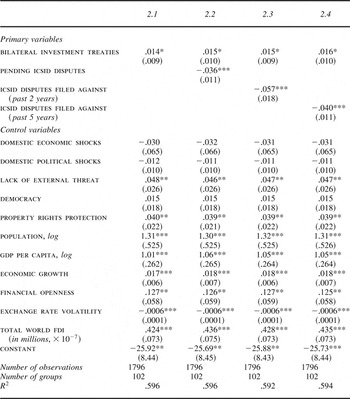
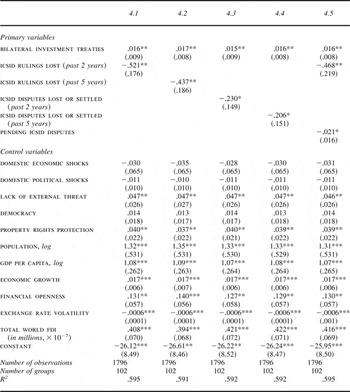
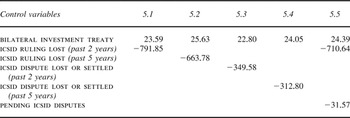
Results for the empirical tests of our three hypotheses are contained in a pair of tables (see Tables 2 and 4), which we discuss consecutively and in greater detail below. During the course of these discussions we also present the substantive effects of the primary variables, holding all other variables constant, in a parallel manner in Tables 3 and 5, respectively.Footnote 70
The effects of ICSID filings on FDI inflows

Notes: All control variables lagged one year. Fixed-effects estimation, standard errors clustered on country.
*** p < .01;
** p < .05;
* p < .10 (one-tailed tests).
Substantive effects of BITs and ICSID filings on FDI inflows

Note: Amounts show increases (decreases) in FDI inflows in millions of real US dollars.
The effects of ICSID losses on FDI inflows

Notes: All control variables lagged one year. Fixed-effects estimation, standard errors clustered on country.
*** p < .01;
** p < .05;
* p < .10 (one-tailed tests).
Substantive effects of BITs and ICSID losses on FDI inflows

Note: Amounts show increases (decreases) in FDI inflows in millions of real US dollars.
On the whole, our findings are supportive of all three primary hypotheses. Governments do seem to receive a notable boost in FDI as they sign more BITs. However, governments who later are accused before ICSID of violating the commitments enshrined in BITs experience statistically and substantively significant reductions in foreign investment. In fact, a single ICSID dispute filed against a government on average offsets the FDI gains associated with the signing of between two and three additional BITs. More notably, governments who eventually lose ICSID disputes experience even greater losses in inward FDI. The FDI losses associated with losing an ICSID ruling, and thus developing a poor reputation for respecting foreign investment, typically undo the FDI gains produced by a dozen or sometimes more BITs.
We first need to place our discussion about the reputational costs of ICSID filings and ICSID losses in the broader context of BITs. Although the negative FDI effects of ICSID activity are both novel and important, our findings confirm that BITs in general have positive effects on FDI. The baseline model (2.1) in Table 2 reveals that the number of BITs concluded is positively associated with a country's net FDI inflows. In fact, we find consistent support for H1 throughout all of the models we report in Tables 2 and 4. Across these two tables, the coefficient on the bilateral investment treaties variable is positive and statistically significant at the 90 or 95 percent level of confidence. Governments who sign more BITs consistently do receive greater foreign investment, ceteris paribus. Stated differently, governments who sign BITs and then abide by their obligations (that is, who experience zero ICSID disputes) should reap the rewards of the added credibility that the treaties generate.
The substantive effects presented in Table 3 (based on the four models depicted in Table 2), show that each treaty a government signs consistently produces somewhere between $21 million and $24 million in additional FDI per treaty.Footnote 71 Furthermore, the aggregate effects of signing several BITs can be substantial. For instance, those governments who had signed approximately twenty BITs by 1999, such as Thailand and Jordan, could have expected to receive between $400 and $500 million per year in increased investment inflows due to their BITs, ceteris paribus. For most governments, then, BITs should be economically beneficial. It is only those governments who sign BITs but then are challenged before ICSID who need to worry about potential losses of FDI.
Turning to the first of two ICSID-related hypotheses (H2), the evidence in Table 2 indicates that ICSID filings consistently have a negative and statistically significant effect on FDI. Governments who appear as respondents in investment arbitration disputes receive less FDI across all three relevant model specifications in Table 2. Most notably, FDI inflows decrease as the number of pending ICSID disputes against a government increases (see Model 2.2 in Table 2). This is consistent with the argument that pending disputes before ICSID generate considerable uncertainty about a government's commitment to respect FDI. Column 3.2 in Table 3 shows that in substantive terms, each pending ICSID case against a government is associated with a $55 million reduction in annual FDI on average. This finding suggests that investors react not only negatively but also swiftly to an ICSID filing, without giving respondent governments the benefit of the doubt or allowing them the benefit of the arbitration hearing.
Furthermore, appearing before ICSID attaches a stigma to governments that seems to linger past the date of initial filing. The next set of findings in Table 2 demonstrate that governments also experience notable FDI losses as the number of ICSID disputes filed in the past two and past five years increases. Disputes filed in the past two and five years are both predictors of lower FDI levels, and these findings are significant at the 99 percent level of confidence (see Models 2.3 and 2.4 in Table 2, respectively). In substantive terms, each ICSID case registered against a government in the past two years reduces future FDI inflows by nearly $86 million (see column 3.3 in Table 3). At the same time, each additional BIT increases FDI by approximately $23 million annually. Therefore, holding all else constant, a country that has signed twelve BITs would expect to gain approximately $280 million in inward FDI annually, yet would stand to lose two-thirds of this amount ($172 million) if it had two ICSID cases registered against it in the past two years. The experiences of Egypt (in 1989 and 1993) and Bolivia (in 2002) are consistent with these patterns, since both saw net FDI drop by hundreds of millions of FDI annually in the few years immediately after having disputes registered against them at ICSID.
The next hypothesis (H3), which emphasizes the costs associated with losing ICSID disputes, also receives strong and robust support. The findings across all model specifications in Table 4 provide consistent support for the proposition that by nature of its ability to determine noncompliance ICSID generates significant reputational costs for treaty violators. All coefficient estimates for “lost” ICSID disputes in Table 4 are negative and significant at the 90 percent level of confidence or greater.
According to the first two models in Table 4, losing an ICSID dispute ruling leads to negative and statistically significant reductions in inward FDI. In other words, even beyond the financial penalties in arbitration awards, ICSID arbitration panels impose sizeable costs on BIT participants deemed to have violated treaty commitments. The substantive effects of losing an ICSID award are large. Governments on average stand to lose more than $791 million in FDI annually if they have lost an ICSID dispute in the past two years (see column 5.1 in Table 5), which effectively outweighs the benefits provided by signing twenty-five additional BITs. These losses persist fairly robustly over time, too. Each ICSID ruling that a government has lost within the past five years is associated with a substantial loss of $663.8 million in FDI (see column 5.2 in Table 5). Stated differently, the FDI benefits of signing more than twenty BITs (20 × $25.6 million) would be outweighed by the reputational costs of losing a single ICSID panel ruling during the past five years. These findings demonstrate that a clear violation of a BIT can be extremely costly for governments.
If we broaden the conceptualization of losing to include settlement agreements in ICSID disputes during the past two and five years, the same negative relationship continues to hold, albeit at weaker levels of statistical and substantive significance. The coefficient estimates for these variables, which capture a broader notion of losing (negative rulings and settlements), are negative and significant at the 90 percent level of confidence (see Models 4.4 and 4.5 in Table 4). These are important findings, since they suggest that even the appearance of losing, as signaled by a settlement with the investor, is associated with losses in the form of reduced FDI. In substantive terms, governments who have either lost an ICSID ruling or agreed to a preruling settlement within the past two or five years can expect to lose between $300 to $350 million in FDI (see columns 5.3 and 5.4 in Table 5). Thus, even after settlement agreements it may take years for a country to return to predispute levels of FDI.Footnote 72
The final notable result is contained in Model 4.5, in which pending ICSID disputes (H2) as well as recent negative ICSID rulings (H3) both lead to reduced FDI. We conclude from these parallel findings that the two reputational mechanisms function independently. At one level, investors punish governments who merely appear as ICSID respondents because this suggests noncompliance with investment rules. In addition, they severely punish governments who later are more conclusively deemed by an ICSID panel to have violated their commitments. Although the dual effects of pending and completed disputes are difficult to disentangle, this final set of results in Table 4 illustrates that losing ICSID disputes is particularly costly. Column 5.5 in Table 5 depicts the positive FDI effects of each additional BIT ($24.4 million) as well as the negative FDI effects of ICSID filings ($31.6 million) and negative ICSID rulings ($710.6). As an illustration, a government that has signed fifteen BITs—the mean number of BITs for low- and middle-income countries in 2004—would all else equal expect to receive a little more than $372 million in additional FDI per year thanks to the BITs. But a government with fifteen BITs who was the respondent in two recent ICSID cases—one of which it loses via a negative award ruling—would lose more than twice the gains from BITs (a loss of more than $773 million) because of the negative signals sent to investors due to its involvement at ICSID.Footnote 73
Gambia presents a poignant illustration of the ups and downs that can occur after signing BITs and then experiencing an ICSID dispute. Gambia concluded its first BIT in 1993 and experienced steadily increasing net FDI flows from 1995 to 1999. However, in 1999 Swiss company Alimenta registered a dispute against Gambia at ICSID, alleging takeover of the largest industrial plant in the county. FDI flows into Gambia dropped from 1999–2001 while the case was pending and then dropped more severely (by two-thirds) after Gambia settled the case with Alimenta in 2002 for $11 million. FDI inflows did not return to predispute levels until 2007, five years after the ICSID settlement.
Sensitivity Checks
The results above have been shown to be robust to different ways of conceptualizing involvement before ICSID and “losing” an ICSID dispute; nevertheless, we also explore whether our results are sensitive to various changes in our sample as well as transformations and substitutions of important variables.Footnote 74 As noted earlier, there are strong theoretical reasons to apply our arguments to the population of lower- and middle-income countries, while excluding the highest-income countries from the sample. Our original sample-composition rule was to exclude OECD countries from the sample, yet we also consider a slightly broader exclusion rule of dropping from the analyses all countries classified as “high income” by the World Bank for the duration of our time period (and retaining all countries classified by the World Bank as “lower,” “lower middle,” and “upper middle” income).Footnote 75 All of the original results in Tables 2 and 4 continue to hold when we use this new sample of countries. In fact, the findings for the BIT and ICSID variables are nearly identical across the two samples, with similar coefficients and the same levels of statistical significance, except for a handful of instances in which p-values actually decrease using the World Bank-based sample.
Other issues related to sample composition also are investigated, with no or negligible changes to primary findings. Because Argentina signed more than fifty BITs in the 1990s—and then became the respondent in an unusually large number of ICSID cases, largely due to the peso crisis in the early 2000s—we reestimate all of our analyses after dropping Argentina. Fourteen of the eighteen variables that test H1, H2, or H3 retain their original signs and statistical significance, and the other four variables are correctly signed but fall just short of statistical significance. Any potential skew attributable to the Argentina case, or the overall increase in ICSID filings in recent years, would be reflected most obviously in the results for the pending icsid disputes variable (Model 2.2 in Table 2). Therefore, we also reestimate this model using a logged value of the number of pending disputes (instead of the untransformed version of this variable). The logged number of pending ICSID disputes continues to return a negatively signed coefficient that is statistically significant at conventional levels.
A final sensitivity check explores the impact of other types of ICSID dispute resolutions on FDI flows. Although we theorize only about the importance of ICSID losses and do not necessarily expect ICSID “wins” to benefit the respondent state, we briefly explore this possibility. We include in the Table 4 estimations an indicator of whether the respondent state has “won” a judgment from an ICSID panel in the past two or five years. In all cases the coefficient estimate for disputes recently won is positive but barely distinguishable from zero, and never comes close to conventional levels of statistical significance.
Findings for Control Variables
These unique findings for the effects of ICSID disputes on FDI are particularly noteworthy because they emerge even after we control for a range of additional factors that also should affect foreign investment. Most of the control variables in Tables 2 and 4 affect FDI in the predicted manner, at a high degree of confidence, and yet a government's involvement at ICSID is still a strong predictor of reduced FDI flows. However, the FDI effects of the control variables also are interesting in their own right and warrant some discussion.
All five macroeconomic control variables exhibit the predicted signs as predictors of FDI flows and are statistically significant at conventional levels. Perhaps not surprisingly, economic growth (economic growth) is associated with greater inward investment. Across all estimations in Tables 2 and 4, countries with more rapidly rising GDP are more likely to attract greater FDI inflows. Country size (population) also is positive and significant, which is consistent with the idea that larger countries are more attractive locations for firms to establish operations due to the size of their domestic market.Footnote 76 Similarly, level of development (gdp per capita) is yet another positive predictor of FDI flows across all models we estimate. Governments with fewer restrictions on capital flows (financial openness) also attract larger amounts of FDI. Finally, recent volatility in a country's exchange rate leads to less investment, ceteris paribus.
Findings for various domestic political variables are mixed. The degree to which a country protects property rights consistently is positively associated with increased FDI flows. The coefficient on the property rights protection variable is positive and significant at the 95 percent level of confidence across all nine models presented in Tables 2 and 4. There is suggestive evidence that democratic regimes tend to receive greater FDI—the estimated coefficient for the democracy variable is always positive—yet it always falls just short of conventional levels of statistical significance. This weakly positive finding is not surprising, given debates and divergent findings in the existing literature about whether or not democracy increases FDI.Footnote 77
External security threats to a country, or the lack thereof, are found to have a robust effect on FDI flows. The evidence across Tables 2 and 4 suggests that countries that are free from such external threats receive greater FDI, ceteris paribus. In contrast to external political threats, there is only limited evidence that domestic political instability reduces FDI, since the coefficient on the domestic political shocks variable is negative across Tables 2 and 4 but always falls just below the 90 percent level of confidence. Finally, there is no consistent evidence that domestic economic crises lead to a reduction in FDI, as we had expected.Footnote 78 Coefficient estimates for the domestic economic shocks variable consistently are negative, but never statistically significant.
Conclusion
This research illuminates important new pathways through which BITs should affect FDI. BITs establish procedures for the international arbitration of investment disputes, and the emergence and resolution of disputes before a prominent body like ICSID provides valuable information to other investors about states' lack of compliance with their BITs. At the outset we confirm that BITs in general do increase FDI for those governments who sign them. This initial finding contributes to a growing literature that identifies a positive overall association between BITs and FDI. However, when we then explore the record of BIT-signatory governments who have appeared before ICSID, we find that they experience substantial losses in FDI. This is a major original contribution that has not been identified in any other empirical study of BITs. These potential FDI losses occur through two distinct channels. First, governments experience reduced FDI upon becoming an ICSID respondent, even if the case is pending or unresolved. Second, the ultimate loss of an ICSID dispute, or even the perception of a loss, leads to large further decreases in FDI. This one-two punch generated by investment arbitration activity recasts the debate over the workings of BITs by demonstrating an important new source of costs associated with the treaties—the reputational costs of noncompliance. From a policy standpoint, this potential for BITs to ultimately harm signatories can have profound real-world consequences and suggests that governments who are unsure about their future ability to abide by the treaties may be better off not signing BITs in the first place.
Our findings should not be normatively troubling, however. Governments sign investment treaties with the expectation that they will be followed. If compliance is an important norm in the international system (that is, pacta sunt servanda) then our results should be welcomed. Indeed, the many governments who sign BITs and then seemingly comply with their terms, as evidenced by the lack of any challenges before ICSID, experience significant FDI increases that can be attributed to the treaties. Therefore, in terms of our contribution to the existing literature on BITs, we do not conclude that the overall effect of BITs is negative, or that most governments who sign BITs should expect to suffer potential losses of FDI. In our analyses BITs consistently have a robust, positive effect on FDI flows, ceteris paribus. Furthermore, governments who are one-shot respondents at ICSID are unlikely to see the reputational losses from a single ICSID dispute outweigh the long-term FDI benefits of signing BITs. Moreover, the evidence suggests that FDI in these situations should rebound in three to five years. What we do emphasize, however, is that the credibility-enhancing properties of BITs are not universal, but rather are contingent on a government's continued compliance with the treaties.
For scholars of political economy, the dynamic of “contingent credibility” has important implications for multiple research areas in which institutions are thought to generate credible commitments. We demonstrate that ex ante commitments to adhere to pledges, even those that impose significant constraints on governments, are not automatically credible. Credibility is achieved by following through on the commitment and carrying out the course of action to which one has pledged. These dynamics we have illustrated with regard to BITs should be applicable to treaty cooperation across a range of issue-areas, and well as to arguments about delegation to domestic and international institutions.
For scholars of international institutions, this research illuminates the reputation-generating effects of contemporary international organizations and pinpoints a precise mechanism through which an important international organization affects the behavior of many actors. Other international institutions, particularly arbitration and dispute settlement bodies, should have similar reputational effects that will be observable in the future behavior of actors within a similar context. Dispute settlement through the World Trade Organization (WTO) represents one application of this logic, in which governments take cues from previous WTO panel decisions and subsequently are more likely to challenge particular trade barriers from those countries who previously have been found “guilty” of violating trade obligations.
We believe this research fills an important gap in scholarship on the effects of investment treaties on FDI. By highlighting the importance of compliance and investment disputes, and drawing on theories of international institutions as providers of information and generators of reputations, we uncover important new causal pathways. Investment treaties may provide the benefits that signatory governments seek, but these benefits are not automatic. Instead, they are contingent upon upholding the terms of the treaties and avoiding being called out to a global audience before an international arbitration body. For governments who fail to do so, the repercussions can be severe.