My research subject was communicating with me — not in my head or in my dreams, but over email. I read Yvonne Rainer’s all-caps note at 8:00 a.m., the morning I arrived at the Getty Research Center in Los Angeles, CA, while waiting for the first box from the “Yvonne Rainer Papers.”
2 August 2018, 6:45 a.m.
YR to EC:
Subject heading: EMILY!!!
AS I WAS GOING TO SLEEP LAST NIGHT IT HIT ME THAT THERE ARE THREE KEY ELEMENTS OF PoSS THAT ARE ESSENTIAL TO ITS RECONSTRUCTION, WHICH YOU MAY OR MAY NOT BE AWARE OF:Footnote 1
1) THE COMPLETE ORIGINAL AND LEGIBLE SCORE, WHICH LAYS OUT THE PERFORMANCE COMPONENTS BY NAME AND THE INITIALS OF PERFORMERS WHO ARE RESPONSIBLE FOR THEM AS INDICATED IN THE 30-SECOND INTERVALS OF THE GRID — ONLY HALF OF THIS SCORE WAS REPRODUCED IN WORK 1961–73 — IN THE LATE 60S I HAD THE COMPLETE SCORE FRAMED AND GAVE IT TO RAUSCHENBERG — AFTER HE DIED, HIS ASSISTANT, AFTER CONSULTING WITH ME, SENT IT TO THE GETTY — I DON’T KNOW IF THEY KNEW WHAT IT WAS OR WHETHER THEY REMOVED IT FROM THE FRAME AND FILED IT WITH THE OTHER PoSS MATERIAL OR IF IT REMAINS FRAMED AND IS STORED SOMEWHERE ELSE!!!
2) THE 1/4-INCH AUDIO TAPE THAT CONTAINS MY VOICE READING EXCERPTS FROM WILLIAM BENTLEY’S DIARY — I DON’T KNOW IF THIS IS STORED WITH THE OTHER PoSS MATERIAL OR SOMEWHERE ELSE — Footnote 2
3) A COMPLETE LIST FROM THE AUDIO TAPE OF THE WORD PHRASES THAT SERVED AS CUES FOR THE PERFORMERS TO CHANGE WHAT THEY WERE DOING EVERY THIRTY SECONDS — TO MAKE THIS LIST, I HAD LISTENED TO THE TAPE WHILE HOLDING A STOPWATCH AND JOTTED DOWN A COUPLE OF WORDS EVERY 30 SECONDS —
I BELIEVE ALL THREE OF THE ABOVE COMPONENTS, THOUGH INCOMPLETE, APPEAR IN WORK 1961–73 — ALSO THE PROCESS BY WHICH THEY WERE CREATED — (I don’t have the book out here in Greenport)
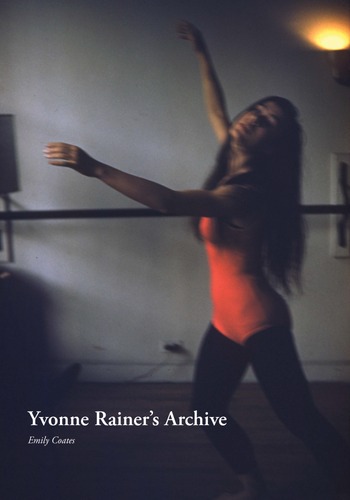
Yvonne Rainer dancing, New York, 1958. (Photo by Al Held)

I MAY HAVE DISCUSSED ALL THIS WITH YOU BEFORE, BUT I DON’T REMEMBER WRITING IT DOWN IN SUCH DETAIL —
I FERVENTLY HOPE THAT YOU WILL FIND THESE MATERIALS IN THE ARCHIVE —
GOOD LUCK! XYZ
Rainer was writing to me from Greenport, NY, on summer holiday with her partner, Martha Gever. I had come to the Getty to research her evening-length dance Parts of Some Sextets (1965), which she and I were planning to reconstruct, commissioned by Performa 19. Never one to shy away from a creative assignment, Rainer accompanied me to LA virtually; she responded to my queries, writing up memories that came to her in dreams and during waking hours to fill in blank spots about the dance. Having performed — and exchanged countless emails — with Rainer for 20 years, I knew that all-caps signaled something special: agitation, creative inspiration. It could go either way.
2 August 2018, 11:07 a.m.
EC to YR:
Hi Y — the three key elements you’ve written out are excellent. Thank you! I had already found and requested them, in fact; though I haven’t yet looked at the Rauschenberg PoSS score or gotten my hands on the audio tape, I can see they’re here.
Here’s one example of the cueing list, below. (Note the New Haven address on the back?)
More from me today.
xoEm
As 2 August 2018 unfolded, I learned that the 1965 audio recording was not, in fact, there; nor was half the score, as I later communicated to Rainer. Two out of three of her required materials were missing.
Rainer had created Parts of Some Sextets, which she nicknamed PoSS, with a stellar group of performers over a period of six months. She presented it in March of 1965 a mere five times, at two venues — the Wadsworth Atheneum in Hartford, CT, and Judson Church in Greenwich Village, New York City — and never again. Ironically, Rainer eventually became a filmmaker, but she never filmed her 1960s dances. More than 50 years later, this left us with only photographs, written notes, and her own memory to illuminate the details. Since the early 2000s, Rainer has reconstructed fragments from her early dances, with the help of dancer-choreographer Pat Catterson, but she had never tried to recreate one of her evening-length pieces. Essentially flying blind, the bountiful scholarship on Rainer’s work and its influence across dance, visual art, and film had seen only a slim representation of her choreographic production.
Many great dances of the 20th century have remained in repertory over decades, usually when the choreographer has founded a company that persists, which then becomes the keeper of the work. But by the early 1970s, Rainer had disbanded any semblance of a performance group and transitioned into making films. Her early dances consequently exist mainly in the form of notes — scraps of language accompanied by brief explanations of her process and content — found in her book Work 1961–1973, which she published in Reference Rainer1974, upon leaving the dance world.Footnote 3 The one dance that lived on is Trio A (1966), Rainer’s four-and-a-half-minute treatise on energy and effort, captured on film by the dance historian Sally Banes in 1978. A precious document of the work danced by 44-year-old Rainer, the film has unintentionally winnowed the interpretation of 12 years of performance output down to one dance. So meaningful is her book Work that the year I met Rainer, in Reference Rainer1999, when I was dancing with Mikhail Baryshnikov’s company White Oak Dance Project, she gave each dancer a copy. Baryshnikov had asked her to -create a new work with White Oak (After Many a Summer Dies the Swan), and the invitation pulled her back into dance after 25 years of filmmaking: she may have needed to reopen her past identity for herself as much as for our small ensemble.
While Work 1961–1973 appears to contain meticulous details on each dance, Rainer herself says she can no longer decipher most of those notes. The chemistry between the original audience, the sociopolitical context, and the choreography is also gone. Exacerbated by the absence of a video or film recording, the problem is familiar to those engaged in dance preservation and documentation: there is always a vanishing point, beyond which contemporary minds and bodies can never really recreate exactly what happened and how.
As I’ve taught Rainer’s work at Yale for the past 14 years, the “monster mattress dance,” as she calls Parts of Some Sextets, kept rearing its enigmatic head. Built in 30-second intervals out of a series of 31 movements, with 10 dancers and a stack of 12 mattresses, the dance seemed to hold a pivotal role in her oeuvre. By 1965, she had made two evening-length works, Terrain (1963) and Room Service (1964) — neither of which have since been restaged in full. Her artistic concerns had evolved in reaction to the ideas she had explored in those pieces, while also extending in new directions. Reflecting on her concerns in PoSS, she wrote an essay for the Tulane Drama Review (TDR) titled “Some Retrospective Notes on a Dance for 10 People and 12 Mattresses Called ‘Parts of Some Sextets,’ Performed at the Wadsworth Atheneum, Hartford, Connecticut, and Judson Memorial Church, New York, in March, 1965” (Rainer Reference Rainer1965b). Both a process diary and a treatise, the essay describes moving away from the “goofy glamour” of her previous work toward an intrinsic interest in uninflected, task-based action, foreshadowing her seminal dance, Trio A. Ominously, in hindsight, Rainer added a postscript about what she thinks she was searching for but unsuccessfully achieved in Parts of Some Sextets: “NO to spectacle, no to virtuosity […]” (1965b:178). This single, run-on thought has since dominated the way her body of work in dance is remembered and taught.Footnote 4 (Note to future iconoclasts: if you want a sentence to stick to your work like superglue, start it off with NO!) Yet few who quote these lines have read the complete essay, and slim to none had ever seen the work she was actually writing about, because they couldn’t.Footnote 5 In the most thorough analytic effort, art historian Carrie Lambert-Beatty devotes an entire book chapter to Parts of Some Sextets and “serial time.” Performing a virtuosic scholarly analysis, Lambert-Beatty interprets what she can, namely the photographs and the score, while fully admitting the inadequacies of theorizing the performance through archival shards (Lambert-Beatty Reference Lambert-Beatty2008:75–125). Parts of Some Sextets laid the ground for everything that followed in Rainer’s work, and she never made anything quite like it again. I convinced her that the world needed to see this dance.
The materials I found in Rainer’s Getty papers sometimes directly applied to Parts of Some Sextets, but mostly immersed me in a jumble of disconnected details, the notes and jottings and daily records that often comprise the “lives of performers,” as she later titled her first feature-length film. Some of the bits could not be pieced together, or perhaps were insignificant, save for what they revealed about Rainer’s preoccupations, processes, and calendar during the years 1962 to 1966. Why had she scratched a New Haven address on the back of yellow legal paper upon which she had also written the score for the dance? She couldn’t recall. So much for a grand academic thesis on Parts of Some Sextets’ tenuous tie to New Haven, where I now live. What we did not know, we would need to fill in.
2 August 2018, 1:00 p.m.
YR to EC:
Ah so, things are moving along — I remember, at least in part, almost everything except Corridor Solo and Quartet, even “Bob’s Diagonal” — But we can invent Corridor Solo (It goes up and down stage in a corridor) — “Duet” can be seen in a long-range photo in Work: Lucinda and Tony Holder are center and there are other photos of Morris and me doing it at Judson — I remember parts of it —
Have no idea what that New Haven address refers to — You can check it out when you’re home — I couldn’t open either of the JPG’s you sent — Later, xyz
2 August 2018, 2:20 p.m.
EC to YR:
Y, here’s the score you gave Rauschenberg. But it’s only half the dance. (You note in your essay that the dance lasts two of these sheets of graph paper.) Any idea about the other half?
You describe your thinking in the second half of the dance/on the second piece of graph paper, in your essay draft (in a notebook dated 1963–65), so we could just recreate it if need be.
I found a good description of the Quartet movement! It’s great you feel you remember enough of the other material to fill in elsewhere.
More soon,
Em
2 August 2018, 4:17 p.m.
YR to EC:
I would need your help to fill in the Quartet, also Corridor Solo, but where is the other half of the score and what do you mean “recreate it if necessary?” from where?
Are you staying nearby the Getty? How do you get up there? Are they helping you with the archive? Have you found the audio tape?
It’s very yoomid here; how’s the weather out there?
Stay cool — xyz
Finding the other half of the score preoccupied Rainer’s attention from the East Coast, but I felt less worried. If I had been working on the reconstruction without her, as Millicent Hodson memorably staged Rite of Spring in 1987 without its choreographer, Vaslav Nijinsky, the gaps would have felt far more daunting. In our project, the creator herself could replicate her process to recreate the missing score, or make something new. The mystery was more compelling to me: after handing over the first half of the score, framed as a work of art, to the superstar Rauschenberg, who had properly preserved it for decades, had she really misplaced the second piece of graph paper upon which she scored the final third of the dance? Barbara Moore, who was instrumental in assembling PoSS photos for us by the late Peter Moore, pointed out to Rainer and me that archival work is like forensics. The research involves carefully comparing what is known against the tsunami of human experience that is unknown. Woe to archivists who figure out how to categorize reality after the fact.
While I had not found complete information on Parts of Some Sextets, I could piece together a vivid picture of a different sort: I could see the artist I now know well at a moment when her signature Rainer style was still in formation. Language was key to this process. Rainer has always been a word-oriented, writerly dance artist — this much is widely known. Each dance has an accompanying essay, up through the seven new dances she created in the 21st century. Whereas film gave her the opportunity to script her art with writing at the fore, I had always assumed that her early creative process in dance was more circular, consisting of toggling back and forth between moving in the studio and writing down her reflections. But her 1962 to 1966 papers suggest that language was integral to her movement practice, used not only to document the ideas she produced with her body but also as a source of choreographic forms. The materials suggest a constant pull to the page, even as the words in her notebooks jump off the page, as if generated by the energy of her motions.
To be sure, the archive makes inscription seem most important, because the studio time has disappeared from view. Still, writing was integral to Rainer’s process of creating her early dances in a number of significant ways. Her artistic voice emerged through painstaking procedures of note-taking, transcribing, and copying — a physicalized grappling with language.
Rainer was a fastidious copier and kept each of her versions as she rewrote. Throughout the folders on her ’60s choreography there are multiple drafts of choreographic notes, performance scripts, essays, and found texts that she used in performance. The available 1960s writing technologies are on display, from worn white notebooks and yellow legal pads scrawled with blue and black ballpoint ink and pencil, to typewritten sheets and Xeroxes. Each version of a text changes slightly — fussily, sometimes, as she moves toward the verbal precision that satisfies her. Many final versions of the choreographic notes ended up published in Work, along with her essays, and thus sing out with a degree of familiarity. But in the many drafts she kept, Rainer’s thoughts are still in flux, revealing roiling layers of creative processing.
She recorded her choreographic phrases in vivid language, often using numbered lists of discrete actions. The phrases tend to be modular — first this, followed by that, then that — as opposed to amorphous or fluid (unless the direction was to be so). The language captures, and possibly at times produces, the radical juxtapositions she is known for in her choreography. On a piece of loose yellow legal paper describing the “Bach” section in Terrain, for instance, there is a “hit hip” and a “pelvis whack,” followed by “6 counts of romantic pose,” “dead pose,” and “begin with shaking, end with promenade” (Rainer Reference Rainer1963e). In another section, the “Walking Solo” from Terrain, the hip whack returns, newly contextualized: “Air version of hip whack and leg vibration in 2nd moving u.s. Stop still - hand on hip - back to audience” (Rainer Reference Rainer1963f). This apparently airborne sequence trails off dramatically in:
Cheesecake.
Palsy
Wrestling
These words suggest different rhythms and physical states — sharp, smooth, vibratory, or flaunting — as much as they also evoke sharply contrasting, near-vaudevillian contexts. Did she play around in the studio and then figure out the language to notate the actions? Or write actions out, and then try them? In her early 1960s work, both occurred.
In Rainer’s Dialogues (1964), language appears to lead. She worked out movement possibilities on a loose-leaf notebook page labeled “Weights and Measures”: “How heavy, deep, wide, wet, hot, cold, thick, narrow, fast, slow, red, dense, neat, salty, noisy” (Rainer Reference Rainer1964a). The long line of adjectives reads like she’s brainstorming the infinite variety that the body in motion could achieve. The adjectives guide the movement. On the backside of the same page, she writes out the possibilities for her duet with “Cindy” (Lucinda Childs), in a list that focuses on expanding theatrical potential, in discrete assignments: “big eyes, shake self and make excruciating expression, mock complacency, mock grief, mock contempt.” This duet has not been revived, but presumably their movements had a metaphoric quality, morphing the verbal phrases into choreographic images that bore their trace.
A speckling of movie references show up in Rainer’s notes, too — harbingers of her transition to filmmaking and a device she uses to this day to stretch her movement vocabulary: “Garbo walk”; “death run” (from Godard’s Breathless [1960]); “walk forward à la Metropolis”; “Armageddon”; or “Egyptian sit” followed by “Donald O’Connor bit,” on a loose notebook paper titled “with Judy” (Rainer Reference Rainer1964b). The Godard “death run” shows up in two pieces I have performed: the rules-based game “Diagonal” (1963) and the Baryshnikov commission, After Many a Summer Dies the Swan (1999). In rehearsals for both works, Rainer never showed us the movie clip; she just gave us the words and demonstrated the action: hands clutched to the lower back, chest protruding, staggering ahead. The physical image moved from the screen to her notebook and then into her repertoire through language. Off-the-wall art references appear in her notebooks, too. In the middle of one nighttime rambling, she wrote: “Now I’m seeing Hieronymus Bosch on the ceiling” (Rainer Reference Rainer1965–66). (Bosch appeared during an acid trip; the artist seems to have infused Rainer’s sensibility in Parts of Some Sextets, perhaps unconsciously so.)
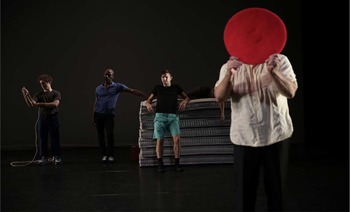
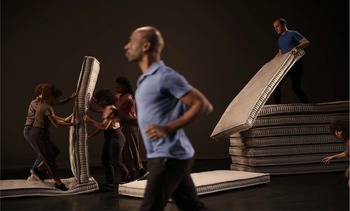
Yvonne Rainer, Parts of Some Sextets (1965/2019). A Performa 19 Commission. Dancers, from left: Patrick Gallagher, David Thomson, Timothy Ward, Jon Kinzel. (Photo by Paula Court; courtesy of Performa)

Rainer’s written notes reflect her process of setting choreography. I found a coffee-stained piece of white notebook paper upon which she worked out the directives for Diagonal, a rules-based game that originally appeared in Terrain (1963), which Rainer and Pat Catterson revived in 2014 and I have performed. The choreography consists of a series of movement options that the dancers call out at their discretion, labeled 1–10, and A through D, with D broken down into “sub” actions 1, 2, 3, and 4 (Rainer Reference Rainer1963c). Her handwritten notes show strikethroughs, revisions, and lines redirecting the movement labeling. “Str. legged waddle arms” was #4 but became #8; the “Stiff leg 2nd - puffed cheek - spread finger - walk” moved from #6 to #5; and there were other adjustments to the seemingly arbitrary assignments, for reasons unclear. Sharing the folder with this fragile record, there is a fully typed out version of Diagonal, which is crisp and final — the rules have been set, the dance has gelled (Rainer Reference Rainer1963d). Even still, there are loose threads. The typewritten score includes one last option, the call “SLOW,” performed by three or four dancers: the group pulls away and descends to the floor, while “Judy” (Judith Dunn) performs a slow somersault and “2 men lift Trish high up” (Trisha Brown). This call never made it into the 2014 restaging.
When I knew the choreography of a dance I came upon in the archive, from having performed or seen others perform restagings, the written descriptions sneaked up on me — much like meeting old friends in the scraps of notepaper and ideas jotted down so long ago. “I’ve danced this,” I blinked with a start, after reading a description of a ballet adagio written out in pencil on a loose notebook page titled “Meditation from Thais” (Rainer Reference Rainer1963b). I marked the pathways gently, at my table in the Getty Reading Room, to be sure: right leg goes up to second, then effacé, a pas de chat, and a soutenu. Copied straight from Mia Slavenska’s ballet class, circa 1963, according to Rainer, she repurposed this material as one of my options in her 2013 piece The Concept of Dust.
Ballet vocabulary populates Yvonne’s early 1960s choreographic notes. For those who reduce postmodern dance to a purely pedestrian affair, look at the language: “chassé,” “plié,” “pas de chat,” “tombé,” “soutenu,” “grande ronde de jambe”… Her simultaneous homage to and argument with classicism shows up in the lexicon, when she intersperses the vocabulary of -classical ballet among “wiggles,” “flaps,” and more, such as in this sequence: “Leg shimmy into splat walk, to arabesque, big pelvis whack” (Rainer Reference Rainer1963g). Here, too, her language reveals a marked shift in her choreographic agenda — much like mineral stratifications that date land formations. Right around 1964–65, the ballet terms fade away, replaced by tasks, objects, and more general, albeit still idiosyncratic, actions. To describe the phrase “Quartet,” which she used in Parts of Some Sextets, she wrote in her notebook: “Stand up, flip R foot back; pivot to L on L leg while looking down” (Rainer Reference Rainer1965a). Her polemic with 19th-century Romanticism quiets down as other preoccupations come to the fore.
Yvonne Rainer, Parts of Some Sextets (1965). Dancers, from left: Joseph Schlichter, Robert Morris, Lucinda Childs, Yvonne Rainer, Robert Rauschenberg, Sally Gross, Deborah Hay. (Photo by Peter Moore © 2021 Barbara Moore / Licensed by VAGA at Artists Rights Society [ARS], NY, courtesy Paula Cooper Gallery, New York)

Fastidiously, Rainer transcribed and retranscribed the found texts that she used in her dances. A folder on Terrain contained multiple transcriptions of texts by Spencer Holst, a writer present in the downtown scene, which she used in the “Talking Solos,” at that time titled “Holst Solos.” Rainer had copied his writing by hand in pen on a small notepad, with words scratched out, then typed it up, overlaying her own editing in the new document: “First three scribbled out,” she notes of her own adjustments to one part of his text (Rainer Reference Rainer1963a). Each version is preserved. I discovered in one notebook her excerpted transcription of the Diaries of William Bentley, which provides the voiceover text for Parts of Some Sextets. The transcription fills 40 pages (Rainer ca. 1965a). As she later narrates in her essay about the dance in TDR, she spent four weeks in the New York Public Library copying down parts from the 18th-century diaries that she liked best to use in Parts of Some Sextets. Why the handwritten transcription? I wondered in the notes I took while at the Getty. I assumed that copy machines were not readily available in public libraries circa 1965, but when I asked Rainer about the choice recently, she offered a more pragmatic reason: excerpting. She had pulled the juiciest passages out of the many volumes of Bentley’s diary. Photocopying everything would have been unnecessary.
The serial transcriptions of Rainer’s different scripts may have been functional — she needed copies for herself and her performers in rehearsal. But they also do a kind of meta-work. Think for a moment about the hours Rainer spent transcribing by hand, in contrast to today’s quick-as-a-wink means of scanning or typing and editing texts using a computer. Copying someone else’s words into your own handwriting creates an intimacy with the mind and language of another. But something more happens in this muscled appropriation of the texts, too. For a postmodernist engaged in collage, she was taking over authorship — priming the texts for the choreographic contexts in which she would ultimately situate them. This process is hidden from view, unless you look in Rainer’s archive.
Most startlingly of all, her unpublished writing reveals some of her most influential ideas in their infancy. Topping the familiarity charts, in a green spiral notebook dated 1965–66, I came upon an unassuming note in the margins: “(1st Trio),” connected with an arrow to an “A” with a circle drawn around it (Rainer Reference Rainer1965–66). Not even the title had been set! What follows is a complete description of the beginning of her seminal work Trio A, a dance clearly in progress, which begins halfway down the page: “Face L. — plié, arms down and swinging, head looking behind L. at floor.” So iconic is this beginning, I nearly cried out, sitting there in the reading room, like stumbling upon a loosely sketched draft of Michelangelo’s Sistine Chapel. Rainer is as clear as possible in her description, and yet if I had not known the dance fully, as someone who has performed it for 20 years and is authorized by Rainer to teach it, there is no way I would have been able to piece together the choreography from her words. Embodied action translates fitfully into language, in the best of circumstances. And yet the passage undeniably described Trio A, as if the dance had gotten up off the page and began to motor along in the Getty Institute’s special reading room.
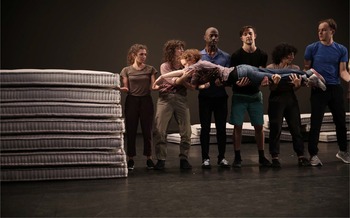
Yvonne Rainer, Parts of Some Sextets (1965/2019). A Performa 19 Commission. From left: Mary Kate Sheehan, Liz Magic Laser, Emily Coates, David Thomson, Timothy Ward, Rachel Bernsen, Nick Mauss. (Photo by Paula Court; courtesy of Performa)

The description continues over several pages, possibly written on different days, as Rainer moves from pencil into pen. Eventually, about a third into the dance as we know it, the choreographic detail unravels away from the now-set material, into something like brainstorming. Choreography that does not now include speaking apparently might have in 1965: “Turn head side to side while hands flap ears like semaphore. Speak softly - mention a part of the body, move that part. Mention another part, etc. Make it continuously. Other possibilities: a point of focus, a point in the space to go to, a way of arriving at that place” (Rainer Reference Rainer1965–66). The passage ends with ideas for movements to include, many of them seeking contradictory coordination, which never ended up in the final dance: “Perhaps a sudden huge stretching up of body followed by a crashing over of torso.” Or, my favorite, “Use ‘Donald O’Connor’ walk on forearms – sparingly.” (According to Rainer, this had been a reference to “Make ’em Laugh,” O’Connor’s daredevil solo in the 1952 movie Singin’ in the Rain.)Footnote 6
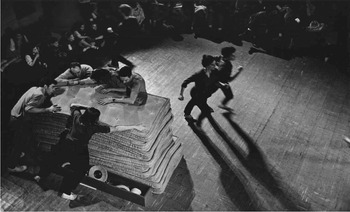
Yvonne Rainer, Parts of Some Sextets (1965). Dancers, from left: Robert Rauschenberg, Tony Holder, Judith Dunn, Deborah Hay, Steve Paxton, Sally Gross, Robert Morris, with Joseph Schlichter (under mattress). (Photo by Peter Moore © 2021 Barbara Moore / Licensed by VAGA at Artists Rights Society [ARS], NY, courtesy Paula Cooper Gallery, New York)

Alongside working out the movement in Trio A, in the same notebook Rainer began to think through her agenda in composing the dance. On one page, she sketched out her thoughts on effort in classical ballet and modern dance, a topic that she would later explore more fully in her published 1966 essay, “A Quasi-Survey of Some ‘Minimalist’ Tendencies in the Quantitatively Minimal Dance Activity Midst the Plethora, or an Analysis of Trio A” (Rainer [1968] 1999). In her notebook, the ideas are not yet linked to visual art and are still inchoate — which typically, for Rainer, means fussing with the wording: “What makes one movement different from another is not so much different relationship arrangements of parts of the body as differences in of out energy output investment. Most Western ballet Much Western dancing looks the same because it involves a maximal output of energy even where that output is camouflaged by seeming effortlessness” (Rainer Reference Rainer1965–66). In the final essay, the first sentence appears verbatim. The second sentence in the notes begins the same in the essay, “Much Western dancing,” but in a different paragraph, and then shifts to a more specific deconstruction of “Graham-oriented modern dance” (Rainer Reference Rainer1965–66). While tracking minute draft changes may only appeal to Rainer aficionados and writing professors, the tweaks signal just how much her choreographic ideas evolved through the writing.
The notebook also contains the seeds of another prominent idea in Trio A — her challenge to spectatorship:
Internal focus vs extroverted focus. Movement relationship, people relationship (when they are “close” together) belong to the former; accentuated space patterns, sound, simultaneous & separated occurrences, prolonged duration, repetitive rhythm, in fact - any kind of repetition, expand the focus away from the human personal, psychological confrontation with the performer. The performer is a residue from an obsolescent art-form: theatre. How to use the performer as a medium rather than a persona?
Trio A Pressured, choreographed by Yvonne Rainer in 1966, performed by Emily Coates and Yvonne Rainer at Dia Beacon, 22 October 2011. (Photo © 2011 Paula Court)

In pencil, possibly tacked on later, she writes: “Is a ‘ballet mechanique’ the only solution?” (Rainer Reference Rainer1965–66). Famously, in Trio A, the performer continuously averts her gaze away from the spectator’s, breaking centuries of Western dance convention. Rainer challenges that convention not by turning the dancer into a robotic automaton, insensate to the outer world — the “ballet méchanique” approach — but rather by holding onto humanness: the dancer makes a choice to turn her head, highly aware of the viewer, inviting a different contract of witnessing and reception. In the “space patterns, sound, simultaneous and separate occurrences […] any kind of repetition,” she was working out the compositional strategies she would use to dismantle the traditional contract of spectatorship.
Trio A’s averted gaze has yielded a great deal of scholarly attention, from Rainer herself as well as other theorists. And for Rainer, her published writing has circulated farther than her dances ever could have. A choreographer who writes imprints herself in the archive — but these words may also, inadvertently, overpower the choreographic work. Rainer’s “NO” postscript to her Parts of Some Sextets essay must have set off shock waves immediately, based on the thoughts she scratched out in list form in the 1965–66 notebook:
-
1. Never complain, never explain.
-
2. The word is more powerful than the leg.
-
3. Many people were distressed by the TDR piece and reacted as tho I had dumped the whole of Western Civilization into the Indian Ocean. Me and LeRoi Jones. (Rainer Reference Rainer1965–66)
All those “no’s” had garnered a reaction. But it is her surrounding thoughts that are most telling: “The word is more powerful than the leg” is a choreographer coming to terms with the imbalanced reception of the mediums in which she creates. To her surprise, her words carried greater force. This struggle encapsulates a pervasive tension in Rainer’s papers between physicality and language. Hers is a loquacious archive, for a dance artist — but the words -contain an incredible amount of body. And when you look beyond the narrowed chute of language that made it out in published, public form, Yvonne’s thought processes, when rendered choreographically, explode with a sensuality that her published theorizing sometimes belies. In reality, they are two sides of the same coin: her use of language in her studio practice sculpted her body; and her use of her body as her medium affected her writing. But the studio practice we can no longer see.
Rainer wrote down thoughts about her body and movement outside of the context of a dance studio, too. In the same notebook in which she works out Trio A, she systematically recorded sensations that seem to have been produced (does this ring a bell, Yvonne?) on acid.Footnote 7 The trip begins with an awe-struck account, scribbled in pencil:
Everything seems an extension of everything else. Scale changes. Color - but not as you would imagine. I take it back - Begins to be prismatic. Yellow + white especially. Purple peripherally - but not there when you go to look. It’s really taking over now after an hour.
(Rainer Reference Rainer1965–66)Characteristically organized, even on LSD, she recorded the time of each entry. Just before midnight, her attention turns from colors to her body:
flexing my foot - I focus on the transparency of my skin on my leg. I watch the muscles mesh as in an X-ray. I have X-ray eyes.
11:55 WOUF! I am observing my own body - my two legs bent up. They belong to some ancient guru. Those knees are not mine. From out of my flesh comes gardens
From Rainer “HIGH” (as she describes her state) comes lucid reflections on corporeality, relevant to her artistic concerns:
The exquisite containment of my body. I can’t say it’s euphoria or ecstasy - My stomach is too queasy, the art-nouveau rainbow bit is too persistent. But - yet - still - I have this strange sense of limits - physical limits - & it seems such an exquisite knowledge. Perfect containment. Something to do with a finely-tuned awareness of just how - something to do with my own particular mass and volume. It occupies exactly as much space as it needs to & it doesn’t need any more than it’s got.
(Rainer Reference Rainer1965–66)As the drug takes effect, she tracks the physical sensations. She feels “incredibly light. My feet rise as on the moon.” Observing her state is “really like observing someone coming in and taking over. I am inhabited by a visitor.”
By 1:20 a.m., she returns to her physical being:
This body thing again. I keep petting myself. This extra-special corporeality of things. It’s not that I am especially sexy sensuous aroused erotic it’s just that everything is. Sensuality is not a state of being. It is an inherent attribute of things to be sensuous and I am in the nature of things.
(Rainer Reference Rainer1965–66)Soon after, Hieronymus Bosch appeared on the ceiling.
I frankly became addicted to the archive over the three days I was there — a sensation much like falling in love. I fell in love with interpreting the hidden stories implicit in Rainer’s handwritten notes and fastidious copying. I fell in love with the open-endedness of her questions and ideas in-process. I fell in love with 30-something Rainer’s reflexive assessments of her art, as a counterbalance to the hardened, reductive narratives that get rehashed in the dance and art historical criticism and theory on her oeuvre. Rainer’s archive invites loosening the more -calcified -conclusions about her work, in favor of greater fluidity, openness, and uncertainty in how we understand the thrust of an artistic practice bound up in both dancing and writing — and even presents the tools for this loosening.
I propose we reread Rainer’s 1960s oeuvre through her writing on acid. Not just to say that she used drugs and this affected her art (they all did). But rather, that we accept these reflections as another kind of theory. And why not? They are as revealing of her artistic production as her published writing. Unlike in the neatly edited, argumentative essays, her thoughts while high are flowering, lush, and unbounded. They mirror, in a different way than her essays, her enthrallment with physical forms. She is thoroughly and completely body-absorbed.
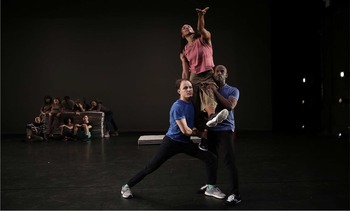
Yvonne Rainer, Parts of Some Sextets (1965/2019). A Performa 19 Commission. Dancers, from left: Emily Coates, Mary Kate Sheehan, Rachel Bernsen, Shayla-Vie Jenkins, David Thomson, Nick Mauss, Liz Magic Laser. (Photo by Paula Court; courtesy of Performa)

Two art historians have recently situated Rainer’s fascination with embodiment within the sociopolitical context of the 1960s. Carrie Lambert-Beatty takes up a program note that Rainer composed for her evening-length work The Mind Is a Muscle (1968), in which she thinks through the ontology of dance in relation to the political crises of the times — the Vietnam War and the mass circulation of images of violence. Countering the spectacularized, dehumanized representations of people through media such as television, “my body remains the enduring reality,” Rainer wrote (in Lambert-Beatty Reference Lambert-Beatty2008:145). Elise Archias has situated Rainer’s fascination with embodiment as a counterpoint to other approaches to framing everyday life in 1960s experimental performance. Linking Rainer, Carolee Schneemann, and Vito Acconci, Archias finds that all three artists risk “visual-sensuous form,” in the midst of spectacularized, capitalist culture, in order to “say something about embodied practice in general and, in that, promote a form of concrete counterabstraction” (Archias Reference Archias2016:26).
These analyses worthily attach Rainer’s physical practice to the wider world, but her acid trip meditation is completely insular. She is alone; the room she is in dissolves away. Her bodily sensations inspire poetry: “My feet rise as on the moon.” Dance and art historians often read Rainer’s words more than her physicality — but here, she is a mess of sensations. With so many modes of expression available to her, it’s easy to forget that Rainer is a dancer. In these notes, it’s clear that her first site of inquiry, her first means of knowing and speaking, is her own body.
There is something both disingenuous and highly sophisticated about a dancer’s knowledge. Embodied knowledge doesn’t require verbal articulation, though eloquence in language never hurts. For most people, movement is harder to read than language. It’s open-ended and ambiguous, subject to a wider range of interpretation — which is why many people misunderstand dancing as primal, when it’s inextricable from culture. Rainer’s female body here is proto-political: she is gathering the phenomenological resources that she will soon hurl in support of the anti–Vietnam war effort. It’s also proto-feminist.Footnote 8 While Rainer tends more often than not to tether movement to language and context, in this passage, she accepts the exquisite containment of physical forms as a kind of perfect and originary knowledge of the world.
Rainer’s archive points toward reading her artistic vision through her ambiguities and interrogations, more than any final conclusions. Also, toward remembering that a huge part of her thinking existed in embodied, sensuous form. While she may have phrased cogent questions in her writing, often the answers came out far more ambiguously in their choreographic iterations. In a notebook labeled “1963–65,” I discovered a draft of Rainer’s Parts of Some Sextets essay for TDR. In the draft, immediately following her series of “no’s,” she tries to think through what remains — but scribbles out these thoughts entirely: “So what is left for an audience to hang on” she writes, followed by words she has erased. Then, “I want neither to burn them nor to bore them.” The area of concern she is trying to reach, she notes, is that of “nothing happening” (Rainer Reference Rainer1963–65). In the published essay, Rainer determines that the “nothing happening” she sought in Parts of Some Sextets resulted in a failed dance that “went nowhere.” But in the draft for the TDR essay, she tips more toward probing the blossoming potentiality of nothingness: “I am not opposed to seduction,” she writes. “It can be a source of sport and pleasure and enlightenment. I am simply wondering out loud if [there is] not another alternative that has not been atte[nded to]” (Rainer Reference Rainer1963–65). Suspecting something more lies in the “doing nothing,” she nonetheless cuts herself off and limits her speculations in the final, published essay. Declaratives like “went nowhere” make for strong writing (and Rainer is a strong writer with a knack for declaratives!). But declaratives also mislead, capping and containing a potentially much richer practical inquiry. I realized in the Getty archive that Rainer’s rhetorical flourishes in the TDR essay had cut off the messier strands of inquiry, apparent in her earlier draft.
Yvonne Rainer, Parts of Some Sextets (1965). Dancers, from left: Joseph Schlichter, Robert Rauschenberg, Deborah Hay ( foreground), Robert Morris, Yvonne Rainer, Judith Dunn (background). (Photo by Peter Moore © 2021 Barbara Moore / Licensed by VAGA at Artists Rights Society [ARS], NY, courtesy Paula Cooper Gallery, New York)

It may be startling to learn that Rainer had never seen Parts of Some Sextets when she wrote this assessment of the work in 1965. She was too busy dancing in it. And this is why being able to see a repertoire is essential for filling in the gaps of knowledge that an archive cannot fully preserve — knowledge that even the choreographer herself lacked at the time. One of the most immediate impressions, once we got Parts of Some Sextets on its feet in 2019, was just how sexy the dance is. The mattress rolling and hauling is almost fetishistic in its Olympian resonance. In a movement she calls “human fly,” groups of performers encircle a stack of mattresses, hugging the mattresses and each other. The dance can be funny in its sensuality, too: one person slides across the top of a stack of mattresses, while on a mattress apart, someone else slithers in the opposite direction underneath. The mattresses’ weighty, pliable mass becomes another body, juxtaposed against the unique masses of the diverse performers. And the performers, in turn, appear to be on par with objects, or things, erasing the animate/inanimate divide. This is the dance in which she first investigated “nothing happening” and pursued denial as an aesthetic m.o?!
What Rainer could not perceive in 1965 was that an intrinsic sensuality flooded into the space in which she thought she was theorizing nothingness. With Parts of Some Sextets, she had successfully created a highly original and idiosyncratic “alternative,” as she described it, to the clichéd seductiveness of Western concert dance that she railed against. Discovering an enthralling ontological link between people and things, she achieved her midnight, acid-induced epiphany: the dance highlighted, in the words of her acid trip, a cosmology, the “inherent attribute of things to be sensuous and I am in the nature of things.”
Yvonne Rainer, Parts of Some Sextets (1965/2019). A Performa 19 Commission. From left, foreground: Nick Mauss, Shayla-Vie Jenkins, David Thomson; from left, rear: Brittany Engel-Adams, Liz Magic Laser, Mary Kate Sheehan, Jon Kinzel, Rachel Bernsen, Patrick Gallagher, Timothy Ward, Emily Coates. (Photo by Paula Court; courtesy of Performa)

But I’m getting ahead of myself.
2 August 2018, 9:18 pm
EC to YR:
Hi Y,
Just finished the second day. I had lunch with Andrew Perchuk this afternoon — he’s now the acting director of the Getty Research Institute. So very busy! It’s always lovely to see him.
Glenn Phillips tells me the second half of the score (on the second sheet of graph paper in that size) is here in the archive. Apparently the image I sent you is the one you gave to Rauschenberg, and the other half of the score was included in your papers. He needs to help me find it, because the finding aid online isn’t pulling it up.
It does not look like the audio tape of you reading the Bentley diary is here. I asked Glenn about this as well. He said it could be among unmarked audio tapes. He advised me to listen in and around 1965 to see if it’s attached to something else. I need to do this tomorrow.
Do you specifically recall saving the audio tape of you reading the Bentley text, in your archive?
I got absorbed in your notebooks from 1963–66, in which I found a lot of interesting stuff. Not all directly related to Parts of Some Sextets, but this is definitely helping me fill in my own understanding of the context around the dance. They included some of your raw thoughts on effort, repetition, and the state in which “nothing happens” — which you flesh out in the later more polished and published essays.
Yvonne Rainer, Parts of Some Sextets (1965). Dancers: Yvonne Rainer (center), Steve Paxton (right). (Photo by Peter Moore © 2021 Barbara Moore / Licensed by VAGA at Artists Rights Society [ARS], NY, courtesy Paula Cooper Gallery, New York)

I also found several letters and your contract with the Wadsworth Atheneum for the March ’65 shows! You were paid $1,400 for those performances. Also, the mattress receipt, totaling about $170.
I found correspondence between you and Michael Kirby, guest editor of TDR, in which you tell him and Richard Schechner to LAY OFF on any further editing of your essay “Some Retrospective Notes…” — it’s a great exchange in which you defend the writing artist’s right to idiosyncrasies of expression. Schechner finally responds to you directly to say, basically, don’t worry, we won’t touch it.
I’m staying about 10 minutes from the Getty — Performa rented me a car. One more day, tomorrow.
Oh yes, and on my way out I was asking one of the archivists about a box from your papers that someone else is coming in to look at tomorrow. I said “Who knew there’d be a run on Box 21 of the Yvonne Rainer papers?” He responded to say that your archive is among the most popular!
soxxEm
3 August 2018, 8:25 am
YR to EC
Thanks, Em: Are you able to xerox the stuff you need? It’s really important to locate that 1/4 inch audio tape, otherwise the list of word cues would be worthless without the whole recording — I remember packing a bunch of audio stuff; hopefully that tape was included — Although the Bentley Diaries have been published, I doubt if I could go through it and select the appropriate excerpts — I had spent a week in the main NY public library doing that — Hope you can locate the second half of the score —
Regards to Andrew and Glenn if you see them today — xyz
3 August 2018, 7:10 pm
EC to YR
Hi Y,
You speaking the Bentley diaries is not here in the archive. I’ve looked through every possible lead.
But hope is not lost. Fortunately, there is significant transcription of Bentley’s diaries. You copied the text from the book into a notebook, which I’ve had photocopied. I haven’t yet compared whether you’d published all of this transcription in Work (where a transcription of the diaries does appear).
And if it came down to it, I will look through the actual Bentley book and identify your cue phrases. Out of curiosity, do you remember how you excerpted it for the performance script? At your whimsy (i.e. the text you liked best), or systematically?
The other item that is not here is the second half of the PoSS score written out on graph paper. The “Partial Score” sent to the Getty by the Rauschenberg estate covers cues #1–40. This is the one also published in Works. From your other notes for PoSS, you have written out 59 cues from the Bentley transcription, so it appears about 20 choreographic instructions are missing. We know the Bentley text, we just don’t know what actions you arranged for those last 20 cues.
There is some confusion around whether the Getty has this other half of the PoSS score. In the event that it doesn’t turn up, there is still a way forward.
My feeling is that we can reconstruct precisely the #1–40 cues, and then have you do something like the process you describe from 1965, in which you make marks in pencil on the columns you’ve created (or I could do it, but since you’re involved it would be better if it were you!) We would thus create a “new” score for the last third of the dance.
I hope you like this idea. We knew that some amount of “revisioning” would be necessary.
After this trip, I have a significant number of pieces of information from various sources, to use for the recreation. There are holes, too, needless to say. And I have many questions for you, based on the information I’ve gathered.
But I continue to be excited — if not more excited — about this reconstruction project. Glenn tells me that no researcher has worked directly on PoSS “because they perceive the dance to be too complicated.” And yet, this is the dance that led you to write the No Manifesto, that began to generate your new approach to movement (no more “goofy glamour”), and the dance in which you really pressed into the repetition and discontinuity of an image, and explored TIME. It’s the mother lode, in short.
More from me as I wrap this trip up.
Love,
Em
3 August 2018, 8:44 p.m.
YR to EC
Hi Em: Where to start:
The Bentley transcriptions in Work are not complete — I don’t know whether you’ve noticed, but my selection process focused mainly on odd and somewhat sensational events, like the man whose face was eaten away by cancer, or the sea monster, or the elephant coming to town, etc — If I skimmed the whole publication, I might be able to identify the original selections, especially with the help of the word cues —
There’s another element in PoSS that had a minor role, at least in the Judson performance: Behind the initial stack of mattresses was a long “tool box” almost the length of the mattresses — in it was stashed all kinds of paraphernalia gathered from Canal Street: gears of different weights and sizes, balls, maybe a couple of dumbbells — The performers had the option of carrying one of these around when a particular movement permitted —
There’s also something called “rope duet” which in photos is being performed by Morris and Lucinda, attached to each other by a long rope — I remember almost nothing about it — I performed it at Judson either before 1965 or after, with Alfred Kurchin, whom I ran into several years ago in NY —
Have you begun to think about when and where to rehearse and perform this leviathan and whom to recruit and how to pay them, etc etc?
I admire your stamina and ambition — xxyz
6 August 2018, 10:08 a.m.
EC to YR
Hi Y,
A TOOLBOX?!! Remarkably, there is no indication in the archival materials that this prop was involved. Good to know!
I did notice the lineup of sensationalist events excerpted from the Bentley. I actually think we have the entire transcript written out in a notebook of yours. I have photos of those pages and the Getty has also photocopied them for me — they’re sending all photocopies to me this week. I need to read through and check it against your list of word cues to be sure. I’ll let you know.
There’s plenty of photo documentation of the “rope duet” that might coax your memories. I found photos both of [Robert] Morris and [Lucinda] Childs and you and Al Kurchin. Do you happen to have his email info? If he’s still living I should talk to him, too.
Andrew will be in NYC in early September; I invited him to watch our whole program rehearsal on Sept 6. He’ll be gone by the next week’s public showings.
PoSS rehearsals will need to be next summer — one of my next steps is a scheduling conversation with Performa.
With the materials I have, I’m going to outline what is known, and what is not known. Then, sometime this fall, you and I should find time to sit down with the materials I’ve collected, so I can ask you questions. Would a date in October work to do this?
That red-eye flight is bruising… I got in from LA at 5:30 a.m. Saturday morning. I’ve been stumbling around all weekend jet-lagged! Hope things are peaceful in Greenport.
xossEm
PS after three days in your archive, I’ve become suddenly mindful that this correspondence might also end up in that archive — a funny meta-awareness creeps in.
Our revival had begun.Footnote 9