




No CrossRef data available.
Children's emotion processing: Relations to emotionality and aggression
Published online by Cambridge University Press: 01 June 2004
Abstract
We examined the relations between emotionality, emotion processing, and aggression in 182 first- and second-grade children. Consistent with Tomkins' and Izard's theoretical predictions, emotionality correlated with emotion processing. In particular, the happiness component of emotionality correlated with emotion attribution accuracy and empathy, the anger component correlated with anger attribution bias and empathy, and the fear component correlated with fear attribution bias. Multiple emotion processing deficits—including emotion attribution accuracy, anger attribution bias, and self-report of empathy—placed children at risk for heightened levels of teacher-reported aggression. Mediational analyses revealed that an emotion processing risk index fit a model of significant partial mediation between happiness and aggression but not between anger and aggression. The results suggest the multifaceted manner in which children's emotion experiences may influence the development of aggressive tendencies.The authors thank the teachers, staff, parents, and students of the Smyrna, DE, school district for their enthusiastic participation in this project and the dedicated work of Fran Haskins and our many research assistants at the University of Delaware.
Information
- Type
- Research Article
- Information
- Copyright
- © 2004 Cambridge University Press
Different discrete emotions motivate particular perceptions, thoughts, and behaviors (Isen, 2002; Izard, 2001). These findings and others have led several theorists to assert that over time the frequent experience of a particular discrete emotion will lead to stable affective–cognitive patterns (Caprara, 1996; Izard, 1991; Malatesta & Wilson, 1988; Tomkins, 1963). The present investigators and others have measured stable individual differences in such processing patterns in children, and these individual differences in emotion processing predict children's social adjustment (Barth & Bastiani, 1997; Denham, 1998; Izard, 1977; Schultz, Izard, & Ackerman, 2000; Schultz, Izard, Ackerman, & Youngstrom, 2001). We do not know, however, how strongly children's emotionality influences the development of their emotion processing. The answer to this question holds important implications for the development and refinement of effective preventive interventions (Izard, 2002). The present study explores this question and tests mediational models linking young children's emotionality, emotion processing, and aggression.
Three types of emotion processing relate to aggression and represent the focus of the present study: emotion attribution accuracy, emotion attribution bias, and empathy. Emotion attribution accuracy reflects how accurately children perceive and encode emotion signals (Denham, 1998). Emotion attribution biases represent tendencies to perceive or encode particular discrete emotions (Barth & Bastiani, 1997; Pollak, Cicchetti, Hornung, & Reed, 2000; Schultz et al., 2000). Empathy reflects both the accurate detection of others' emotion signals and a vicarious experience of the perceived emotion (Hoffman, 1991). The first two of these three components represent aspects of step two in Dodge's five-step social information processing model, the interpretation of social information (Crick & Dodge, 1994). In the present study we assess the third component, empathy, by children's self-reports of affective response to social stimuli. Defined in this manner, empathy most closely resembles step 4, or the enactment of behavioral response, within Dodge's model. Other processing patterns associated with different steps within Dodge's model have also related to aggression (Dodge, Lansford, Burks, Bates, Pettit, Fontaine, & Price, 2003; Schultz & Shaw, 2003). The present study therefore represents an initial examination of some of the ways in which emotionality may influence processing patterns relevant to aggression, most clearly related to step 2 within the social information processing model.
Emotionality and Emotion Processing
Figure 1 presents the conceptual model tested in the present study. Individual differences in infants' and children's emotion expressions display significant stability over time (Abe & Izard, 1999; Kagan & Snidman, 1991; Lemery, Goldsmith, Klinnert, & Mrazek, 1999; Rothbart, Ahadi, & Hershey, 1994). Some evidence suggests that genetic factors may predispose individuals to experience certain discrete emotions (Eley & Plomin, 1997). Other researchers find significant stability in the emotion environments (e.g., family conflict, other environmental stress) in which children live (Bradley, 1989).

A causal model linking emotionality, emotion processing, and aggression.
Izard's differential emotions theory proposes that positive emotions such as happiness and interest facilitate many aspects of children's development (Izard, 1991). For example, whereas children induced to feel happiness exhibit higher levels of prosocial behavior (Harris & Siebel, 1975), negative emotion experiences may inhibit empathic and prosocial responding (Eisenberg & Miller, 1987). Positive emotions can also facilitate aspects of cognitive and social–cognitive development. A line of research by Isen and her colleagues finds that a positive mood fosters creativity and the ability to make associations between stimuli (Isen, 1999). Other studies suggest that positive affect facilitates the speed with which one processes information (Carlson, Felleman, & Masters, 1983). Children with generally happy moods may tend to process emotion information more quickly than their peers and more readily make associations between facial expressions, behaviors, situational events, and emotion labels. In the present study we therefore expected children who experienced or exhibited happiness more often to attribute emotions to others more accurately and report higher levels of empathy.
Tomkins proposed that some people systematically misattribute emotion states to others, especially negative ones, based on the degree to which people have either experienced different emotion states themselves or observed different emotion states in others (Tomkins & McCarter, 1964). Izard (1977) describes this development as one in which increased exposure to a particular emotion may strengthen children's “affective–cognitive structures” related to that emotion. If in subsequent interactions the emotion signals are ambiguous or person and contextual cues differ, the strength of children's existing affective–cognitive structures may influence their emotion attributions. For example, a child prone to react angrily to events may tend to presume that peers will also express anger often. When she interacts with peers and cannot readily determine how they feel, she may tend to attribute anger to their actions and statements.
Tomkins' hypothesis regarding the influence of trait emotionality on emotion attributions has not been tested directly in children. Recent studies have found that the experience of anger in children's environmental contexts, however, predicts biases toward perceiving anger. For example, on an emotion situations task, children from home environments at risk for greater levels of anger expression—in particular, having more depressed caregivers and unstable family environments (e.g., many changes in residence or relationship)—displayed greater anger attribution bias (Schultz et al., 2000). Children from physically abusive home environments also displayed biases toward perceiving and/or interpretting anger in others' facial expressions (Camras, Sachs–Alter, & Ribordy, 1996; Pollak et al., 2000). Additionally, two studies show that children's current emotion state influences their emotion attributions, albeit weakly (Carlson et al., 1983; Meerum Terwogt, Kremer, & Stegge, 1991). Related studies using the hostile attribution bias methodology find that (a) children are more likely to display hostile attribution biases in threatening situations (Dodge & Somberg, 1987), (b) aggressive children report both greater levels of personal emotional distress and hostile intent in others in provocative situations (Crick, 1995; Crick, Grotpeter, & Bigbee, 2002), and (c) depressed third- to sixth-grade children exhibit greater hostile attribution bias than nondepressed children (Quiggle, Garber, Panak, & Dodge, 1992). Collectively, these results suggest a link between emotionality and emotion attributions, especially related to anger. We expect children's anger to predict anger attribution bias but do not make other specific hypotheses.
Emotionality and Aggression
Aggressive children experience anger more often than other children (Arsenio, Cooperman, & Lover, 2000; Crockenberg & Langrock, 2001; Eisenberg, Fabes, Murphy, Shepard, Guthrie, Mazsk, Poulin, & Jones, 1999; Jenkins & Oatley, 2000). Many children are quick to anger in response to situational events (e.g., being bumped), and this leaves them at risk for engaging in aggressive interactions. We know little about the relationship between other components of emotionality, especially positive ones, and aggression. A recent line of research by Arsenio and his colleagues suggests that positive emotionality may protect children from aggressive interactions (Arsenio et al., 2000; Arsenio & Lover, 1995). Happy children may exhibit greater frustration tolerance and/or, as described previously, develop interpersonal skills that buffer against potentially provocative situations. It remains unclear, however, whether increased positive emotionality protects against aggressive interactions beyond the effects of decreases in negative emotionality (e.g., anger proneness). We investigated this in the present study.
Emotion Processing and Aggression
Growing evidence suggests that aggressive children tend to process emotion information differently than other children. Two initial studies have found that aggressive and hostile preschool children tend to attribute “anger” to others (Barth & Bastiani, 1997; Schultz et al., 2000). These results parallel findings from several studies that show aggressive children in middle childhood tend to perceive others as acting “mean” or “hostile” toward them, especially in ambiguous situations (Crick & Dodge, 1996; Dodge & Price, 1994; Dodge, Price, Bachorowski, & Newman, 1990; Dodge & Somberg, 1987; Lochman & Dodge, 1994; Quiggle et al., 1992).
Aggressive children also often display lower levels of empathy and empathic arousal than nonaggressive children (Kaukiainen, Bjoerkqvist, Lagerspetz, Oesterman, Salmivalli, Rothberg, & Ahlbom, 1999; Zahn–Waxler, Cole, Welsh, & Fox, 1995; for a review, see Miller & Eisenberg, 1988). For example, preschool children who exhibited lower sympathetic arousal—in particular, heart rate response—during a sadness induction task also displayed higher levels of aggression (Zahn–Waxler et al., 1995). High levels of empathy may prevent aggressive interactions both by signaling the empathically aroused child to attend to the others' emotion and by helping children anticipate how others' will feel when they enact particular behaviors.
The relationship between aggression and emotion attribution accuracy is less clear. Whereas some studies find significant relations between emotion attribution accuracy, other emotion-related competencies (e.g., knowledge of emotion cues and display rules), and observed aggression (Arsenio et al., 2000; Casey, 1996; Casey & Schlosser, 1994; Rogosch, Cicchetti, & Aber, 1995; Underwood, Coie, & Herbsman, 1992), others do not (Cook, Greenberg, & Kusche, 1994; Iannotti, 1978; Izard, Fine, Schultz, Mostow, Ackerman, & Youngstrom, 2001). Differences in the samples of aggressive children utilized in these studies may help explain these discrepancies. Whereas most studies that found a significant relationship between emotion attribution accuracy and aggression have utilized clinic samples with diagnosed disorders (e.g., Casey, 1996; Casey & Schlosser, 1994) or samples of abused children (e.g., Rogosch et al., 1995), all the studies that failed to find a significant relationship used community samples. Although aggressive children within community samples may or may not also experience other social and behavioral difficulties such as peer rejection, aggressive children in other samples may represent children with multiple adjustment difficulties.
Another possibility is that a deficit in emotion attribution accuracy by itself does not constitute substantially heightened risk for aggressive interactions. Only in conjunction with other information processing deficits (e.g., anger attribution bias) or temperamental qualities (e.g., high activity levels) might low levels of emotion attribution accuracy place a child at risk for aggression. Researchers have also found significant but modest individual relationships between aggression and anger attribution bias and aggression and empathy. Multiple information processing skills cohere to determine a course of action within an interpersonal exchange; therefore, no single skill will likely determine children's behavioral tendencies strongly (Crick & Dodge, 1994). In the present study we examined the additive effects of emotion processing deficits by creating and analyzing an emotion processing risk index.
Mediational Role of Children's Emotion Processing
As stated at the outset, several theorists hold that children's emotionality influences the development of stable emotion–cognition patterns. These stable patterns, in turn, will motivate patterns of behavioral responses. These maladaptive connections between emotions, thoughts, actions, and situational contexts have been implicated in psychopathology and social maladjustment (Cicchetti, Ackerman, & Izard, 1995; Keltner & Kring, 1998).
If anger proneness influences anger attribution bias, for example, anger proneness may motivate an unfortunate cycle in which children perceive anger and hostility in others and react aversively and aggressively toward them. They may subsequently provoke interactions with peers characterized by anger and reinforce their anger attribution bias. Although a history of aggressive interactions may also influence the development of emotion processing patterns, some evidence suggests that emotion processing patterns play a causal role in the formation of aggression. For example, when either rejected or popular children believe that hostile intent motivated another child's actions toward them, they report responding with aggression much more than when they perceive the other as having prosocial or unclear intentions (Dodge, Murphy, & Buchsbaum, 1984; Dodge & Somberg, 1987). Multiple longitudinal data sets have fit mediational models in which, rather than emotionality, physical abuse and harsh discipline predict information processing, which subsequently predicts aggression (Rogosch et al., 1995; Dodge, Pettit, Bates, & Valente, 1995; Weiss, Dodge, Bates, & Pettit, 1992).
On the other hand, emotion processing may have little to do with the relationship between emotionality and aggression. Happiness, for example, might influence aggressive behaviors through a variety of other mediating factors (e.g., peers tease happy children less often), or anger proneness may motivate aggression more directly (e.g., in response to provocative social situations angry children react with aggressive posturing impulsively and little cognitive processing). In this competing hypothesis, emotionality or aggression may relate to emotion processing, but emotion processing does not help explain the relation between emotionality and aggression. We designed the present study to test these competing hypotheses.
Method
Participants
Twenty first- and second-grade teachers in two public elementary schools in a rural, predominantly middle-class community in Delaware sent permission forms home with all 471 children in their classes. We interviewed the 190 students (48% female) who brought back completed permission forms. Eighty-six percent of these children were European American, 13% African American, and 1% was of other ethnic identities. Children's mean age was 7 years, 9 months (minimum = 77 months, maximum = 112 months). Of the 190 students, we had complete measures for 182. The eight students without complete information did not differ significantly from the other 182 on demographic characteristics or study variables.
Procedure
Ten female and male undergraduate and graduate students trained in children's assessment techniques examined the children. Testing occurred in private rooms in the children's schools, and the complete testing session lasted approximately 45 min. The investigators handed packets to all teachers on the same day and encouraged them to complete questionnaires within 2 weeks. We paid teachers for their participation.
Measures
Emotionality.
Teacher report
The Differential Emotions scale—Form VIII (DES-VIII; adapted from Izard, 1979) assessed teacher-reported child emotionality. The DES-VIII asks teachers how much of the time children express each of seven basic emotions (interest, happiness, sadness, anger, fear, shame, and guilt) in their peer interactions and during classroom instruction. Teachers respond on a 6-point scale ranging from very seldom to very frequently. To remain consistent with emotions measured in the peer nomination and emotion attribution procedures, teacher ratings of happiness, sadness, anger, and fear were of interest in the present study. Teachers' responses to questions concerning emotion expressions in peer interactions correlated highly with their responses to questions concerning emotion expression in the classroom (Pearson rs for happiness, anger, sadness, and fear ranged from .46 to .72). We therefore standardized and aggregated the two scores for each emotion to produce single indexes of teacher-reported happiness, anger, sadness, and fear expression.
Peer nomination
A sociometric interview developed by Coie and colleagues (Coie, Dodge, & Coppotelli, 1982) and modified by Terry (Terry & Coie, 1991) measured children's emotionality as perceived by peers. We asked children “which kids in the class …” (a) “are the happiest, the ones who smile all the time?” (happy), (b) “are the saddest, the ones who cry a lot?” (sad), (c) “get angry a lot?” (anger), and (d) “get scared a lot?” (fear). Children produced names of children in their classrooms without the aid of classroom rosters. We standardized scores for the number of nominations children received for each of these questions within classrooms.
Research focused on sociometric status suggests that children's peer ratings reliably reflect their actual peer standing if at least 50% of children in the classroom respond to peer nomination questions (Cairns, Gariepy, & Kindermann, 1990). A similar standard has not been established for peer nominations of emotionality. We used Fisher's r to z transformation to examine the correspondence between peer nominations and teacher reports of emotionality in classrooms in which we received at least 50% participation rate (N = 116) and less than 50% participation (N = 66). Correlations between peer and teacher reports did not differ, depending upon participation rate, for happy: .37 (≥50%) versus .53 (<50%); for sad: .30 versus .30; for anger: .42 versus .36; for fear: −.08 versus −.10. We therefore included all participants regardless of participation rate within their classroom.
We examined the overall convergence between teacher- and peer-reported emotionality. Teacher reports and peer nominations correlated significantly for three of the four emotions: for happy, r = .40, p < .01; for sad, r = .30, p < .01; for anger, r = .40, p < .01; but for fear, r = −.07, p = ns. We standardized these variables and additionally created single, aggregated indexes of happiness, sadness, and anger.
Emotion attribution accuracy
The Assessment of Children's Emotion Skills (ACES; Schultz, Trentacosta, Izard, Leaf, & Mostow, 2004) assessed children's emotion attribution accuracy. ACES includes sections concerning social behaviors, social situations, and facial expressions. The social behaviors and social situations sections each contain 15 one- to three-sentence items. In response to each item, children label the protagonist's feeling by choosing either happy, sad, mad, scared, or no feeling. Three items each for happy, sad, angry, and afraid describe behaviors or situations associated with emotion arousal that reflect the theoretical functions of emotion as described in differential emotions theory (Izard, 1991). For example, the emotion behavior items related to sadness reflect the lethargic and withdrawn somatic response motivated by sadness. Or, the emotion situation items related to anger each describe events in which a person is blocked from a desired goal, in response to which anger would motivate tendencies to act to achieve or retain the goal. For the purposes of eliciting children's attribution biases, each section also includes three additional items that describe social behaviors or social situations not associated exclusively with one discrete emotion. Appendix 1 presents the vignettes used in the social behaviors and social situations sections.
The facial expressions section includes 26 photographs of elementary-aged children posing facial expressions. Four photographs each contain happy, sad, mad, and afraid faces. For the purposes of eliciting children's biases, an additional 10 photographs are included that contain a mixture of emotion signals and did not receive consensus as depicting a particular emotion during pilot testing. For all sections of ACES, items are randomized within blocks containing happy, sad, angry, afraid, and ambiguous items. The emotion attribution accuracy score reflected how many items a child answered correctly on the 40 items for joy, sadness, anger, and fear across the three sections (M = 29.7, SD = 4.2). These items cohered moderately well (Cronbach's α = .68).
Emotion attribution biases
ACES' three sections also jointly produce emotion attribution bias scores. To calculate an anger attribution bias score, we first counted how many times children said “mad” to ambiguous items and to happy, sad, and afraid emotion category items. We then divided this count by the total number of ambiguous items (i.e., 16) plus the number of happy, sad, and afraid emotion category items that a child answered incorrectly (M = 14.3%, SD = 10.0). Children's “anger” responses on the 46 nonanger items cohered moderately well (Cronbach's α = .66). By not including items children answered correctly in our calculation of anger bias scores, we procedurally partial out children's emotion attribution accuracy scores from their anger attribution bias scores. It therefore becomes possible that some children have both a high emotion attribution accuracy score and a high anger attribution bias score. We calculated all other emotion attribution bias scores in a similar fashion (for happy: M = 8.7, SD = 7.3; for sad: M = 41.6, SD = 13.7; for fear: M = 15.2, SD = 12.0; for “no feeling”: M = 19.9, SD = 12.1), and these scores all cohered moderately well (for sad, Cronbach's α = .69; for fear, Cronbach's α = .68; for no feeling, Cronbach's α = .70), except for happy attribution bias (Cronbach's α = .46).
Empathy
A revised version of Bryant's (1982) Empathy Index used by Eisenberg, Fabes, Murphy, Karbon, Smith, and Maszk (1996) assessed children's levels of empathy. This questionnaire contains seven empathy-related statements in response to which children either agree or disagree (e.g., “When I see someone being picked on, I feel kind of sorry for them”). Children's aggregate score across the seven items exhibited good internal consistency (α = .79) and indexed children's level of empathy (M = 6.0, SD = 1.7).
Aggression
We assessed children's aggression with a revised version of the Teacher Observation of Classroom Adaptation–Revised (TOCA-R). The TOCA-R (Werthamer–Larsson, Kellam, & Wheeler, 1991) contains 31 items that reflect children's academic, social, and aggressive behaviors. In a semistructured interview, teachers rate children on these items using a 6-point scale ranging from almost never to almost always. Teachers completed a 26 item self-completed version of the TOCA-R previously used by researchers on the Fast Track Project (Dodge, Laird, Lochman, Zelli, & Conduct Problems Prevention Research Group, 2002; Karns & Conduct Problems Prevention Research Group, 1997). This 26 item version of the TOCA-R retains the 3 factors—cognitive concentration, authority acceptance, and social contact—previously revealed to underlie the TOCA-R (Werthamer–Larsson et al., 1991). The authority acceptance scale contained 10 items related to aggressive interactions with peers (e.g., “fights,” “yells at others,” “teases classmates,” “harms others”) and disobedience (e.g., “disobedient,” “breaks rules”). It exhibits good internal consistency (α = .94; Karns et al., 1997) and indexed children's aggression (M = 17.8, SD = 9.2).
Results
We conducted analyses of variance to test for gender differences in all variables. Boys were rated as angrier than girls both by teachers (boys: M = .18, SD = 1.77; girls: M = −.34, SD = 1.52; F (1, 180) = 4.36, p < .05, η2 = .02) and by peers (boys: M = .18, SD = .92; girls: M = −.18, SD = .88; F (1, 180) = 7.33, p < .05, η2 = .04). Girls (M = 30.5, SD = 3.6) had higher levels of emotion attribution accuracy than boys (M = 29.1, SD = 4.5), F (1, 180) = 5.62, p < .05, η2 = 03. Teachers rated boys (M = 19.4, SD = 8.8) as more aggressive than girls (M = 16.0, SD = 9.3), F (1, 180) = 6.47, p < .05, η2 = .04. Significant gender differences did not appear for other emotionality indices, emotion attribution biases, or empathy. We conducted correlations to test for the effects of age on all variables. Older children had greater emotion attribution accuracy (r = .37, p < .01). Children's age did not correlate with emotionality indices, emotion attribution biases, empathy, or aggression.
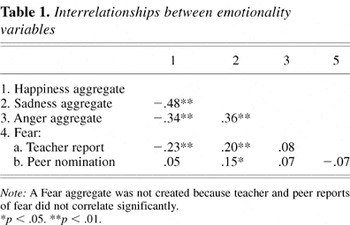
Table 1 presents the interrelationships between the emotionality variables. Higher levels of happiness significantly but moderately predicted lower levels of sadness, anger, and teacher reports of fear. Higher levels of sadness predicted higher levels of anger and both teacher and peer reports of fear.
Interrelationships between emotionality variables

Emotionality and emotion processing
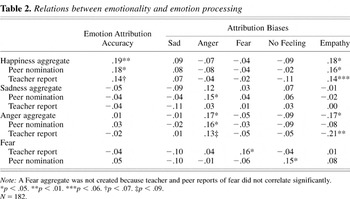
Emotionality variables significantly correlated with several facets of emotion processing. Table 2 presents correlations between emotionality and these emotion processing variables. The aggregate index of happiness predicted emotion attribution accuracy and empathy, with more frequent experiences of happiness correlating with greater emotion attribution accuracy and empathy. The aggregate index of anger predicted anger attribution bias and empathy, with more frequent experiences of anger correlating with greater anger attribution bias and less empathy. More frequent experiences of sadness as nominated by peers also correlated with greater anger attribution bias. Students whom teachers reported as more often experiencing fear showed greater fear attribution bias, and peer nominations of fear correlated positively with a “no feeling” attribution bias.
Relations between emotionality and emotion processing

To examine whether or not positive emotionality corresponded with emotion processing independent of the effects of negative emotionality, we conducted partial correlations between the happiness aggregate and emotion processing variables, controlling for all negative emotionality indexes. Happiness correlated significantly with emotion attribution accuracy, partial r (183) = .17, p < .01, and approached significant correlation with empathy, partial r (183) = .14, p < .06.
Emotionality and aggression
We next analyzed the correspondence between emotionality and aggression. Because teachers reported on aggression, to avoid a method variance problem we limited these analyses to peer nominations of emotionality. Peer nominations of happiness, r (182) = −.31, p < .01, sadness, r (182) = .22, p < .01, and anger, r (182) = .43, p < .01, significantly correlated with aggression. To examine the combined contribution of these emotionality variables on aggression, we conducted a multiple regression. The block of these emotionality variables accounted for 24% of the variance in aggression, F (4, 178) = 14.14, p < .01. Anger (β = .37, p < .01) and happiness (β = −.24, p < .01) contributed significant unique variance to aggression.
Emotion processing and aggression
To examine the relationship between emotion processing variables and aggression we first conducted correlations between these variables. Higher levels of anger attribution bias (r = .16, p < .05) and lower levels of emotion attribution accuracy (r = −.16, p < .05) and empathy (r = −.25, p < .01) correlated with aggression. Other emotion attribution biases did not correlate with aggression significantly.
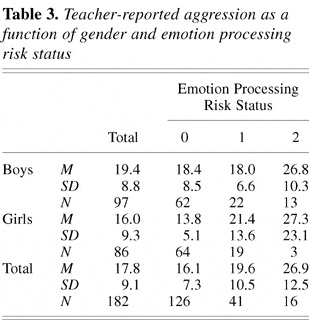
To examine the cumulative effects of emotion processing, we followed a procedure used by Dodge et al. (1995) to create an emotion processing risk index. For each of our emotion processing variables we assigned children a score of 1 if they were a standard deviation or more lower (for emotion attribution accuracy and empathy) or higher (for anger attribution bias) than the sample's mean. We added these three scores together to compute an emotion processing risk index. One hundred twenty-five children (62 boys, 63 girls) had emotion processing risk scores of 0, 41 children (22 boys, 19 girls) had scores of 1, and 16 children (13 boys, 3 girls) had scores of 2 (reflecting two or three emotion processing deficits). We conducted a univariate analysis of variance with emotion processing risk and gender as independent variables and aggression as the dependent variable. A main effect was found for emotion processing risk, F (2, 177) = 9.27, p < .01, η2 = .10, and an interaction occurred between emotion processing risk and gender, F (2, 177) = 3.66 p < .05, η2 = .04. Table 3 presents levels of aggression as a function of gender and emotion processing risk. To understand the interaction effects, we conducted separate univariate analyses for boys and girls. Levels of emotion processing risk corresponded with aggression significantly for boys, F (2, 94) = 5.81, p < .01, η2 = .11, and for girls, F (2, 83) = 8.53, p < .01, η2 = .17. We used Sidak's adjustment (1967) to compare mean differences. Boys with no emotion processing deficits did not display significantly different levels of aggression than boys with one deficit. Boys with two deficits displayed more aggression than boys with both zero or one deficits. Girls with no deficits were rated as less aggressive than girls with both one or two deficits, however, and no significant difference was found between girls with one or two deficits.
Teacher-reported aggression as a function of gender and emotion processing risk status

Mediational models
We next explored whether or not emotion processing risk might mediate relations between emotionality and children's aggression. In the preceding analysis that included all emotionality indexes, happiness and anger contributed unique variance to the prediction of aggression. Neither happiness nor anger correlated significantly with an interaction term for the aforementioned interaction between gender and emotion processing risk. We tested a model that included peer nominations of happiness and anger, the emotion processing risk index, and teacher-reported aggression.
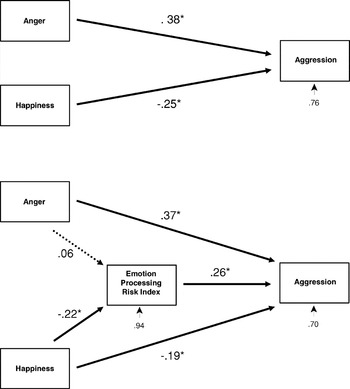
We tested whether or not emotion processing might mediate between emotionality and aggression by conducting path analyses using the LISREL software program (Joreskog & Sorbom, 1993). The test of mediation involves evaluation of two models. First, we tested models that only included direct effects between happiness, anger, and aggression. Second, models were computed that included both these direct effects but also indirect effects through emotion processing. Sobel's (1988) product of coefficients was used to determine if the indirect pathways were significant.
Figure 2 presents the path coefficients for both models. In the first model the direct paths from happiness to aggression and anger to aggression were significant. This model accounted for 24% of the variance in aggression. We then tested the model that included mediating pathways through emotion processing risk. The path from happiness to emotion processing risk was significant. Anger did not predict emotion processing risk significantly. Because this model is saturated (i.e., all possible paths were fixed), fit indices were perfect. The indirect effect of happiness on aggression via emotion processing risk was significant, t (182) = −2.22, p < .05. Whereas in the initial model the direct effect from happiness to aggression was −.25, in the second model that included an indirect path through emotion processing, the direct effect was reduced to −.19. Emotion processing therefore fit a model of significant partial mediation of the effects of happiness on aggression, accounting for 24%, that is, (−.25 − [−.19])/−.25, of the shared variance between these variables. Overall, this model accounted for 30% of the variance in aggression.

The mediational model. The numbers represent the standardized path coefficients and disturbance terms; (…) a nonsignificant path. *p < .05.
Discussion
Results confirmed theoretical assertions concerning emotionality, emotion processing, and aggression. Children's emotionality significantly correlated with how children processed emotion information. Both individual facets of emotion processing and an emotion processing risk index correlated with children's levels of aggression. In mediational analyses, the emotion processing risk index fit a model of significant partial mediation between happiness and aggression but not between other emotionality indexes (e.g., anger) and aggression. Most of the shared variance between emotionality and aggression was left unexplained by emotion processing risk, however, suggesting that emotionality may motivate aggressive interactions more greatly either directly or through other indirect effects untested in the present study.
Emotionality and emotion processing
Happier children attributed emotions to others more accurately and reported higher levels of empathic response. Happiness predicted emotion attribution accuracy significantly even after controlling for negative emotionality indexes. These results support the assertion of differential emotions theory (Izard, 2002) that the experience of positive emotions facilitates adaptive development. Happiness may help a child acquire emotional competence in several ways. For one, happier children tend to engage others in friendly interaction more often (Abe & Izard, 1999). Happy children therefore more often place themselves in situations in which they will learn about emotion cues, expressions, triggers, and behaviors. Positive mood also facilitates certain types of information processing (Isen, 1999), so on certain occasions happy children may learn more from the situations they experience than do less happy children. Bidirectional effects also probably occur, with more empathic children maintaining more positive and supportive relationships and subsequently experiencing and expressing more positive emotions.
The present study also provides the first empirical support that children's emotionality predicts patterns in their emotion attributions. Anger-prone children tended to perceive others as angry, and fear-prone children tended to perceive others as scared. These results support Tomkins and McCarter's (1964) hypothesis regarding the origins of emotion attribution biases and add to a literature that shows emotion to impact cognition.
Contrary to predictions by Tomkins and McCarter (1964), particular discrete emotions did not predict attribution biases of the same emotion in all cases. Children who received more nominations as the saddest child in their classrooms, for example, displayed heightened anger attribution bias (but not sad attribution bias). Similarly, investigators have found depressed children in middle childhood to display heightened hostile attribution biases (Quiggle et al., 1992), and induced sadness led children to label sad stimuli not as “sad” but as “angry” (Carlson et al., 1983). Tomkins (1962) noted that prolonged sadness activates anger. Consistent with this, in middle childhood depressed children self-report as high or higher amounts of anger experience as sadness (Blumberg & Izard, 1985). Children therefore may not display attribution biases consistent with their most salient expressed emotion or inferred emotion experience in all cases but rather attribute emotions consistent with the function and motivational qualities of the emotion experienced (e.g., sadness, anger, and fear motivate different aspects of self-protection and heightened sensitivity to different kinds of threat, happiness motivates periods of tranquility and positive social interactions). Consistent with this hypothesis, in another study induced happiness led boys to label angry faces not as “happy” or “angry” but as “sad” (Carlson et al., 1983). When presented with a clearly negative emotion stimuli, an attribution of sadness (as opposed to anger or fear) may function to elicit sympathy in the appraiser and motivate approach and prosocial behaviors.
Emotionality and individual facets of emotion processing related weakly in the present study, with the strongest prediction (r = −.21) occurring between teacher-reported anger and empathy. Methodological difficulties probably limited the strength of the findings in the present study. Reliable assessment of children's levels of emotionality has proven difficult (Daleiden, Chorpita, & Lu, 2000). Indeed, we found modest correspondence between teachers and children concerning children's levels of emotionality. The two emotions for which children and teachers corresponded most strongly (anger and happiness) involve the most visible behavioral signs of emotion (temper tantrums and smiles) and also were the two emotions that most consistently correlated with emotion processing patterns. Other investigators have successfully utilized parental reports of emotionality, but we did not have access to parents for the present study. More reliable assessment of children's emotionality may produce more robust findings.
A notable limitation to our study is the low participation rate (40%). Some of the most angry and aggressive children in the classrooms may not have participated in the study, restricting the distribution of emotionality, emotion processing, and aggression scores. Within lower income urban samples of children we have found significantly higher rates of anger attribution bias and aggression and stronger relationships between anger attribution bias and aggression.
Emotion processing and aggression
Results confirm previous findings that aggressive children often differ from other children in their emotion attribution accuracy, anger attribution bias, and empathic responding. Additionally, however, our results suggest that the existence of multiple deficits in these domains place children at heightened risk for aggressive interactions. Our risk index accounted for substantial proportions of variance in teacher-reported aggression. Typically, individual facets of emotion or social information processing account for limited variance in social or behavioral outcomes. The predictive strength of the risk index suggests the complexity of children's social–cognitive functioning and the empirical fruitfulness of aggregate measures of information processing.
We found that the relationship between emotion processing and aggression was slightly different for boys and girls. Emotion processing deficits correlated with aggression both for boys and girls, but the strength of this association was stronger for girls. Whereas for girls a single emotion processing deficit increased their likelihood of displaying aggressive tendencies, for boys deficits were required in two of the three emotion processing domains. This finding is consistent with a line of theory and empirical evidence that characterizes females as more emotion-focused than males. For example, on average, females are more emotionally expressive than males (Kring & Gordon, 1998), and girls talk about emotions more than boys (Cervantes & Callanan, 1998). An atypical pattern of processing emotions may be more apparent and salient within girls' than boys' peer groups and more likely to lead to conflict in peer interactions.
The present results concerning anger attribution bias and aggression replicate others (Barth & Bastiani, 1997; Schultz et al., 2000) and add conceptual and methodological components. Conceptually, children's tendencies to perceive others as “angry” early in life may lay the foundation for “hostile” attribution biases and other social information processing biases and deficits later in life. Whereas the ability to discriminate among emotion expressions appears in the first few months of life, understanding intentions apart from situational outcomes does not appear clearly until the age of 4 or 5 (Flavell, Miller, & Miller, 1993). In the preschool years, as the ability to understand intention develops, children's tendencies to attribute “anger” to peers may influence their developing notion of intent. If a peer throws a ball and hits a child, for example, the child's perception of the peer's emotion expressions and subsequent inferences about her feelings will influence the attribution of intent. One study showed that perceiving others as “angry” corresponds strongly with perceiving their intentions as “mean” (Keane & Parrish, 1992). Those children who do not bias toward perceiving anger will more likely interpret these events as accidental and/or check with the peer why the event occurred. Those children who tend to see others as “angry” will tend to interpret these types of events as purposeful and may subsequently develop strong associations between unexpected events and acting “mean.”
Additionally, in the tasks of the present study children respond to situations involving hypothetical peers. This suggests that some children have a bias toward perceiving anger not just in their personal interactions (e.g., a belief that “people tend to get angry with me”), as examined by the attribution of intent methodology, but in a global manner (e.g., a belief that “people anger often”). The study of biases in young children's emotion processing should prove fruitful for understanding aspects of social information processing important to early social adaptation.
Methodologically, at early ages assessing anger biases on emotion recognition tasks may prove more stable and externally valid than hostile attribution biases as assessed by the Dodge methodology. One investigation found that children's hostile attribution bias showed moderately weak stability (r = .35) from kindergarten to first grade (Dodge et al., 1995). Studies following young children's anger attribution bias from one school year to the next have not occurred. Anger attribution bias among children in the present study, however, showed significant stability from the fall to the late spring (r = .55). Additionally, some studies have failed to find that preschool children's hostile attributions predict aspects of their social functioning significantly (Dodge & Price, 1994; Pettit, Dodge, & Brown, 1988). The present study suggests that procedures that index perceptual biases in children's emotion processing may prove fruitful in assessing and predicting young children's social adjustment.
Mediational role of emotion processing
Happiness contributed significant unique variance to the prediction of aggression beyond that which was accounted for by anger. This finding corresponds with another recent finding that suggests that happiness makes a unique contribution to aggression (Arsenio et al., 2000) and provides evidence of the protective effects of positive emotionality (Izard, 2002). A significant portion of the relation between happiness and aggression was accounted for by the emotion processing risk index. Our emotion processing risk index fit a model of significant partial mediation between happiness and aggression. Whereas happiness accounted for 6% of the variance in aggression by itself, after controlling for emotion processing happiness only accounted for 4% of the variance. This suggests that one way in which children's happiness (and lack thereof) may lead to more frequent aggressive behaviors is by influencing how children process emotion information. In particular, greater experiences of happiness may lead children to label others' emotions more accurately and feel more empathy for others, and these characteristics of emotion processing may help children prevent or more quickly resolve hostile and aggressive interactions with peers.
Our results confirm the association between anger and aggression. Peers reported more aggressive children to be the angriest children in their classrooms. The emotion processing risk index, however, did not fit a model of significant mediation between anger and aggression. Anger therefore may predominantly affect aggression through other indirect and/or direct mechanisms.
One should expect the variables in the present study to mediate between emotionality and aggression only partially because emotion attributions and empathy represent only a few of the ways in which children process emotion and social information. Within Dodge's information processing model (Crick & Dodge, 1996), emotion attributions represent the second of six information processing steps. A potentially important component of emotion processing not measured in the present study is how well children attend to others' emotion cues. In one study, deficits at Step 1 of Dodge's social information processing model, that include attentional processes, placed children at higher risk for later conduct problems than deficits on any other single step of the model (Dodge et al., 1995). A high score on an emotion attribution accuracy task in an experimental setting does not necessarily mean that in actual peer interactions children attend to others' emotions and apply this skill. Some children who performed well on the present emotion attribution accuracy task may pay little attention to how others' feel. Future studies that include measurement of attention to emotion cues may help explain the relationship between emotionality and aggression further.
Other steps in Dodge's social information processing model include setting a goal for oneself within the social interaction, the production of a variety of possible responses to a situation, and predicting what might happen if one enacted different possible responses. Facets of children's trait emotionality probably impact completion of all of these information processing tasks. Additionally, emotionality may foster aggressive behaviors more directly. For example, anger often motivates the instantaneous production of an angry face or the tensing of arm and leg muscles. These behaviors may increase aggressive tendencies with minimal cognitive mediation by the child (Izard, 1993).
Although our theoretical framework posits that emotionality influences emotion processing that, in turn, influences aggression, reverse or reciprocal causal paths may exist. Evidence suggests that individual differences in empathy may partially have genetic origins (Zahn–Waxler, Schiro, Robinson, Emde, & Schmitz, 2001). Lower levels of empathy may contribute to conflict in social interactions and thereby heighten levels of negative emotions experienced by some children. Additionally, children more often act with malevolent intent toward aggressive children (Schwartz, 2000). To some extent an anger attribution bias may develop as a result of aggressive interactions with other children or, at least, a reciprocal process may occur in which the two phenomena mutually and cyclically influence each other.
Conclusion
The present study provides another important step toward understanding the role of emotions in the development of aggression. Anger is not only the emotion most often experienced during aggressive interactions but also may influence the development of information processing biases or deficits that correspond with aggressive interactions. Happiness may facilitate the development of emotion processing skills that protect against aggressive interactions. These results have implications for psychologists, educators, and public health workers focused on the prevention of violence. Developers of prevention programs not only need to address information processing biases and promote empathic responding, but they also need to consider how patterns of emotion processing relate to children's feelings. Breaking the natural correspondence between children's feelings and their perceptions of others' feelings may require additional steps in programs. Teachers and other professionals may need to teach children to observe others carefully, particularly in provocative situations, to demonstrate that children sometimes have false assumptions about others' feelings, to direct children to have clear evidence before attributing emotions to others, and to promote a climate and expectation of empathic responding. Additionally, program developers should recognize that positive emotionality may not just protect children from negative emotion states but also facilitate the development of emotion processing skills important for social interactions. Some children may therefore respond best to prevention programs that not only teach particular emotion and social skills but actively attempt to promote children's positive emotionality (Izard, 2002).
Appendix: ACES Social Behaviors and Social Situations Vignettes
Directions
I'm going to tell you about some kids your age, and I want you to tell me if they would feel happy, sad, mad, or scared. Sometimes you might think they would feel two emotions, like both mad and sad. If so, I want you to pick the feeling you think they would have more strongly. Sometimes they may not feel any emotion strongly, and you can tell me that by saying, “no feeling.” Don't say “no feeling” just because you're not sure how they would feel, though. If you think they would feel something, I want you to take a guess at what it is, okay?
Following each vignette, the interviewer says, “Do you think (child's name) feels happy, sad, mad, scared, or no feeling?”
Social behaviors
Happy
5. You see Terry running to join you and the other kids in the game.
8. Jeff is being nice to everybody.
14. You see Joanne skipping down the hallway and whistling.
Sad
1. Jack doesn't feel like playing ball at recess. Instead, he just sits alone.
10. Jill talks softly, and her eyes seem watery.
15. Jenn walks slowly with her head down.
Mad
2. You see Shelley hit another girl. [Shelley is the protagonist]
9. David calls another boy a bad name. [David is the protagonist]
12. Rosa has her arms crossed.
Scared
4. At recess you watch Mark play with some other kids. Mark gets the ball, and his body seems to freeze.
7. When the teacher asks Laurie a question, you see Laurie look down.
11. A group of kids are called into the principal's office. You see Patrice walking at the back of the group slowly.
Ambiguous
3. Instead of playing with his new toy, Marquis just sits there.
6. Mark doesn't want anyone to talk to him.
13. Janell doesn't feel like playing ball at recess. Instead, she sits alone.
Social situations
Happy
2. Kelly just finished coloring a picture. You tell her that it looks “nice.”
9. Alex made a nice card for his friend. His friend likes the card a lot.
15. It is the first day of school. Your friend Maria hasn't seen you all summer. She sees you in class.
Sad
3. Jasmine took care of her kitten, which she loved very much. One day the kitten disappeared and never came back.
10. Mary's grandfather died.
12. Brian was at the park, and his mother bought him an ice cream cone. Brian took one lick and then accidentally dropped the ice cream cone.
Mad
5. Melissa is building a big tower of blocks. Another kid comes over and knocks it over and laughs.
7. Lonnie is in line for lunch. Another boy steps in front of him without asking.
13. James brings his favorite candy bar to school in his book bag. A boy sees the candy bar, takes it, and eats it.
Scared
4. Juan walks down the hall. A big kid walks right at Juan and tells him to get out of the way.
8. Sarah was riding her bike. She went down a big hill and started going faster than she wanted.
14. Michael is playing in the woods with another boy. The other boy runs away and leaves Michael alone in the woods. It's getting dark.
Ambiguous
1. Tim's parents told him that they would take him to the fair. When it is time to go, his parents say that none of them can go.
6. Scott lets another boy play with his favorite toy. The other boy plays with the toy, and it breaks.
11. Adrian's parents are having a fight in the bedroom. He can hear them yelling.
References
REFERENCES
Abe, J. A., &
Izard, C. E.
(1999).
A longitudinal study of emotion expression and personality
relations in early development.
Journal of Personality and Social Psychology
77,
566–577.CrossRefGoogle Scholar
Arsenio, W. F.,
Cooperman, S., &
Lover, A.
(2000).
Affective predictors of preschoolers' aggression and peer
acceptance: Direct and indirect effects.
Developmental Psychology
36,
438–448.CrossRefGoogle Scholar
Arsenio, W. F., &
Lover, A.
(1995).
Children's conceptions of sociomoral affect: Happy
victimizers, mixed emotions, and other expectancies. In
N. Killen &
D. Hart (Eds.),
Morality in everyday life: Developmental perspectives (pp.
87–128).
Cambridge:
Cambridge University Press.
Barth, J. M., &
Bastiani, A.
(1997).
A longitudinal study of emotion recognition and preschool
children's social behavior.
Merrill–Palmer Quarterly
43,
107–128.Google Scholar
Blumberg, S. H., &
Izard, C. E.
(1985).
Affective and cognitive characteristics of depression in 10- and
11-year-old children.
Journal of Personality and Social Psychology
49,
194–202.CrossRefGoogle Scholar
Bradley, R. H.
(1989).
The use of the HOME Inventory in longitudinal studies of child
development. In
M. H. Bornstein &
N. A. Krasnegor (Eds.),
Stability and continuity in mental development: Behavioral and
biological perspectives (pp.
191–215).
Hillsdale, NJ:
Erlbaum.
Bryant, B. K.
(1982).
An index of empathy for children and adolescents.
Child Development
53,
413–425.CrossRefGoogle Scholar
Cairns, R. B.,
Gariepy, J. L., &
Kindermann, T.
(1990).
Identifying social clusters in natural settings.
Unpublished manuscript,
Social Development Laboratory, University of North Carolina at
Chapel Hill.
Camras, L. A.,
Sachs–Alter, E., &
Ribordy, S. C.
(1996).
Emotion understanding in maltreated children: Recognition of
facial expressions and integration with other emotion cues. In
M. Lewis &
M. W. Sullivan (Eds.),
Emotional development in atypical children (pp.
203–225).
Mahwah, NJ:
Erlbaum.
Caprara, G. V.
(1996).
Structures and processes in personality psychology.
European Psychologist
1,
14–26.CrossRefGoogle Scholar
Carlson, C. R.,
Felleman, E. S., &
Masters, J. C.
(1983).
Influence of children's emotional states on the recognition of
emotion in peers and social motives to change another's emotional
state.
Motivation and Emotion
7,
61–79.CrossRefGoogle Scholar
Casey, R. J.
(1996).
Emotional competence in children with externalizing and
internalizing disorders. In
M. Lewis &
M. W. Sullivan (Eds.),
Emotional development in atypical children (pp.
161–183).
Mahwah, NJ:
Erlbaum.
Casey, R. J., &
Schlosser, S.
(1994).
Emotional responses to peer praise in children with and without a
diagnosed externalizing disorder.
Merrill–Palmer Quarterly
40,
60–81.Google Scholar
Cervantes, C. A., &
Callanan, M. A.
(1998).
Labels and explanations in mother–child emotion talk: Age and
gender differentiation.
Developmental Psychology
34,
88–98.CrossRefGoogle Scholar
Cicchetti, D.,
Ackerman, B. P., &
Izard, C. E.
(1995).
Emotions and emotion regulation in developmental psychopathology.
Development and Psychopathology
7,
1–10.CrossRefGoogle Scholar
Coie, J. D.,
Dodge, K. A., &
Coppotelli, H.
(1982).
Dimensions and types of social status in the school: A cross-age
comparison.
Child Development
59,
815–829.Google Scholar
Cook, E. T.,
Greenberg, M. T., &
Kusche, C. A.
(1994).
The relations between emotional understanding, intellectual
functioning, and disruptive behavior problems in elementary-school-aged
children.
Journal of Abnormal Child Psychology
22,
205–219.CrossRefGoogle Scholar
Crick, N. R.
(1995).
Relational aggression: The role of intent attributions, feelings of
distress, and provocation type.
Development and Psychopathology
7,
313–322.CrossRefGoogle Scholar
Crick, N. R., &
Dodge, K. A.
(1994).
A review and reformulation of social information-processing
mechanisms in children's social adjustment.
Psychological Bulletin
115,
74–101.CrossRefGoogle Scholar
Crick, N. R., &
Dodge, K. A.
(1996).
Social information-processing mechanisms in reactive and proactive
aggression.
Child Development
67,
993–1002.CrossRefGoogle Scholar
Crick, N. R.,
Grotpeter, J. K., &
Bigbee, M. A.
(2002).
Relationally and physically aggressive children's intent
attributions and feelings of distress for relational and instrumental
peer provocations.
Child Development
73,
1134–1142.CrossRefGoogle Scholar
Crockenberg, S., &
Langrock, A.
(2001).
The role of specific emotions in children's responses to
interparental conflict: A test of the model.
Journal of Family Psychology
15,
163–182.CrossRefGoogle Scholar
Daleiden, E.,
Chorpita, B. F., &
Lu, W.
(2000).
Assessment of tripartite factors of emotion in children and
adolescents II: Concurrent validity of the affect and arousal scales
for children.
Journal of Psychopathology and Behavioral Assessment
22,
161–182.CrossRefGoogle Scholar
Denham, S. A.
(1998).
Emotional development in young children.
New York:
Guilford Press.
Dodge, K. A.,
Lansford, J. E.,
Burks, V. S.,
Bates, J. E.,
Pettit, G. S.,
Fontaine, R., &
Price, J. M.
(2003).
Peer rejection and social information-processing factors in the
development of aggressive behavior problems in children.
Child Development
74,
374–393.CrossRefGoogle Scholar
Dodge, K. A.,
Laird, R.,
Lochman, J. E.,
Zelli, A., &
Conduct Problems Prevention Research Group.
(2002).
Multidimensional latent-construct analysis of children's
social information processing patterns: Correlations with aggressive
behavior problems.
Psychological Assessment
14,
60–73.CrossRefGoogle Scholar
Dodge, K. A.,
Murphy, R. R., &
Buchsbaum, K.
(1984).
The assessment of intention-cue detection skills in children:
Implications for developmental psychopathology.
Child Development
55,
163–173.CrossRefGoogle Scholar
Dodge, K. A.,
Pettit, G. S.,
Bates, J. E., &
Valente, E.
(1995).
Social information-processing patterns partially mediate the effect
of early physical abuse on later conduct problems.
Journal of Abnormal Psychology
104,
632–645.CrossRefGoogle Scholar
Dodge, K. A., &
Price, J. M.
(1994).
On the relation between social information processing and socially
competent behavior in early school-aged children.
Child Development
65,
1385–1397.CrossRefGoogle Scholar
Dodge, K. A.,
Price, J. M.,
Bachorowski, J., &
Newman, J. P.
(1990).
Hostile attributional biases in severely aggressive adolescents.
Journal of Abnormal Psychology
99,
385–392.CrossRefGoogle Scholar
Dodge, K. A., &
Somberg, D. R.
(1987).
Hostile attributional biases among aggressive boys are exacerbated
under conditions of threat to the self.
Child Development
58,
213–224.CrossRefGoogle Scholar
Eisenberg, N.,
Fabes, R. A.,
Murphy, B.,
Karbon, M.,
Smith, M., &
Maszk, P.
(1996).
The relations of children's dispositional empathy-related
responding to their emotionality, regulation, and social
functioning.
Developmental Psychology
32,
195–209.CrossRefGoogle Scholar
Eisenberg, N.,
Fabes, R. A.,
Murphy, B. C.,
Shepard, S.,
Guthrie, I. K.,
Mazsk, P.,
Poulin, R., &
Jones, S.
(1999).
Prediction of elementary school children's socially
appropriate and problem behavior from anger reactions at age 4–6
years.
Journal of Applied Developmental Psychology
20,
119–142.CrossRefGoogle Scholar
Eisenberg, N., &
Miller, P. A.
(1987).
The relation of empathy to prosocial and related behaviors.
Psychological Bulletin
101,
91–119.CrossRefGoogle Scholar
Eley, T. C., &
Plomin, R.
(1997).
Genetic analyses of emotionality.
Current Opinion in Neurobiology
7,
279–284.CrossRefGoogle Scholar
Flavell, J. H.,
Miller, P. H., &
Miller, S. A.
(1993).
Cognitive development
(3rd ed.).
Englewood Cliffs, NJ:
Prentice–Hall.
Harris, M. B., &
Siebel, C. E.
(1975).
Affect, aggression, and altruism.
Developmental Psychology
11,
623–627.CrossRefGoogle Scholar
Iannotti, R. J.
(1978).
Effect of role-taking experiences on role taking, empathy,
altruism, and aggression.
Developmental Psychology
14,
119–124.CrossRefGoogle Scholar
Isen, A. M.
(1999).
Positive affect. In
T. Dalgleish &
M. J. Power (Eds.),
Handbook of cognition and emotion (pp.
521–539).
New York:
Wiley.
Isen, A. M.
(2002).
Missing in action in the AIM: Positive affect's facilitation
of cognitive flexibility, innovation, and problem solving.
Psychological Inquiry
13,
57–65.Google Scholar
Izard, C. E.
(1993).
Four systems for emotion activation: Cognitive and noncognitive
processes.
Psychological Review
100,
68–90.CrossRefGoogle Scholar
Izard, C. E.
(2002).
Translating emotion theory and research into preventive
interventions.
Psychological Bulletin
128,
796–824.CrossRefGoogle Scholar
Izard, C. E.,
Fine, S. E.,
Schultz, D.,
Ackerman, B. P., &
Youngstrom, E. A.
(2001).
Emotion knowledge as a predictor of social behavior and academic
competence in children at risk.
Psychological Science
12,
18–23.CrossRefGoogle Scholar
Jenkins, J. M., &
Oatley, K.
(2000).
Psychopathology and short-term emotion: The balance of affects.
Journal of Child Psychology and Psychiatry and Allied Disciplines
41,
463–472.CrossRefGoogle Scholar
Joreskog, K, &
Sorbom, D.
(1993).
LISREL 8: Structural equation modeling with the SIMPLIS command
language.
Hillsdale, NJ:
Erlbaum.
Kagan, J., &
Snidman, N.
(1991).
Temperamental factors in human development.
American Psychologist
46,
856–862.CrossRefGoogle Scholar
Karns, A., &
Conduct Problems Prevention Research Group.
(1997).
Social health profile and TOCA-R: Technical report.
Unpublished manuscript,
Pennsylvania State University,
University Park, PA.
Kaukiainen, A.,
Bjoerkqvist, K.,
Lagerspetz, K.,
Oesterman, K.,
Salmivalli, C.,
Rothberg, S., &
Ahlbom, A.
(1999).
The relationships between social intelligence, empathy, and three
types of aggression.
Aggressive Behavior
25,
81–89.3.0.CO;2-M>CrossRefGoogle Scholar
Keane, S. P., &
Parrish, A. E.
(1992).
The role of affective information in the determination of intent.
Developmental Psychology
28,
159–162.CrossRefGoogle Scholar
Keltner, D., &
Kring, A. M.
(1998).
Emotion, social function, and psychopathology.
Review of General Psychology
2,
320–342.CrossRefGoogle Scholar
Kring, A. M., &
Gordon, A. H.
(1998).
Sex differences in emotion: Expression, experience, and physiology.
Journal of Personality & Social Psychology
74,
686–703.CrossRefGoogle Scholar
Lemery, K. S.,
Goldsmith, H. H.,
Klinnert, M. D., &
Mrazek, D. A.
(1999).
Developmental models of infant and childhood temperament.
Developmental Psychology
35,
189–204.CrossRefGoogle Scholar
Lochman, J. E., &
Dodge, K. A.
(1994).
Social-cognitive processes of severely violent, moderately
aggressive, and nonaggressive boys.
Journal of Consulting and Clinical Psychology
62,
366–374.CrossRefGoogle Scholar
Malatesta, C. Z., &
Wilson, A.
(1988).
Emotion cognition interaction in personality development: A
discrete emotions, functionalist analysis.
British Journal of Social Psychology
27,
91–112.CrossRefGoogle Scholar
Meerum Terwogt, M.,
Kremer, H. H., &
Stegge, H.
(1991).
Effects of children's emotional state on their reactions to
emotional expressions: A search for congruency effects.
Cognition and Emotion
5,
109–121.CrossRefGoogle Scholar
Miller, P. A., &
Eisenberg, N.
(1988).
The relation of empathy to aggressive and
externalizing/antisocial behavior.
Psychological Bulletin
103,
324–344.CrossRefGoogle Scholar
Pettit, G. S.,
Dodge, K. A., &
Brown, M. M.
(1988).
Early family experience, social problem solving patterns, and
children's social competence.
Child Development
59,
107–120.CrossRefGoogle Scholar
Pollak, S. D.,
Cicchetti, D.,
Hornung, K., &
Reed, A.
(2000).
Recognizing emotion in faces: Developmental effects of child abuse
and neglect.
Developmental Psychology
36,
679–688.CrossRefGoogle Scholar
Quiggle, N. L.,
Garber, J.,
Panak, W. F., &
Dodge, K. A.
(1992).
Social information processing in aggressive and depressed children.
Child Development
63,
1305–1320.CrossRefGoogle Scholar
Rogosch, F. A.,
Cicchetti, D., &
Aber, J. L.
(1995).
The role of child maltreatment in early deviations in cognitive and
affective processing abilities and later peer relationship
problems.
Development and Psychopathology
7,
591–609.CrossRefGoogle Scholar
Rothbart, M. K.,
Ahadi, S. A., &
Hershey, K. L.
(1994).
Temperament and social behavior in childhood.
Merrill–Palmer Quarterly
40,
21–39.Google Scholar
Schultz, D.,
Izard, C. E., &
Ackerman, B. P.
(2000).
Children's anger attribution biases: Relations to family
environment and social adjustment.
Social Development
9,
284–301.Google Scholar
Schultz, D.,
Izard, C. E.,
Ackerman, B. P., &
Youngstrom, E. A.
(2001).
Emotion knowledge in economically-disadvantaged children:
Self-regulatory antecedents and relations to social maladjustment.
Development and Psychopathology
13,
53–67.CrossRefGoogle Scholar
Schultz, D., &
Shaw, D. S.
(2003).
Boys' maladaptive social information processing, family
emotional climate, and pathways to early conduct problems.
Social Development
12,
440–460.Google Scholar
Schultz, D.,
Trentacosta, C.,
Izard, C. E.,
Leaf, P., &
Mostow, A.
(2004).
Children's emotion processing: The development of the
Assessment of Children's Emotion Skills (ACES).
Manuscript submitted for publication.
Schwartz, D.
(2000).
Subtypes of victims and aggressors in children's peer groups.
Journal of Abnormal Child Psychology
28,
181–192.CrossRefGoogle Scholar
Sidak, Z.
(1967).
Rectangular confidence regions for the means of multivariate normal
distributions.
Journal of the American Statistical Association
62,
626–633.Google Scholar
Sobel, M. E.
(1988).
Direct and indirect effects in linear structural equation models.
In
J. S. Long (Ed.),
Common problems/proper solutions (pp.
46–64).
Beverly Hills, CA:
Sage.
Terry, R., &
Coie, J. D.
(1991).
A comparison of methods for defining sociometric status among
children.
Developmental Psychology
27,
867–880.CrossRefGoogle Scholar
Tomkins, S. S.
(1962).
Affect, imagery, consciousness: Vol. 1. The positive affects.
New York:
Springer.
Tomkins, S. S.
(1963).
Affect, imagery, consciousness: Vol. 2. The negative effects.
New York:
Tavistok.
Tomkins, S. S., &
McCarter, R.
(1964).
What and where are the primary affects? Some evidence for a theory.
Perceptual and Motor Skills
18,
119–158.CrossRefGoogle Scholar
Underwood, M. K.,
Coie, J. D., &
Herbsman, C. R.
(1992).
Display rules for anger and aggression in school-age children.
Child Development
63,
366–380.CrossRefGoogle Scholar
Weiss, B.,
Dodge, K. A.,
Bates, J. E., &
Pettit, G. S.
(1992).
Some consequences of early harsh discipline: Child aggression and a
maladaptive social information processing style.
Child Development
1992,
1321–1335.CrossRefGoogle Scholar
Werthamer–Larsson, L.,
Kellam, S., &
Wheeler, L.
(1991).
Effect of first-grade classroom environment on shy behavior,
aggressive behavior, and concentration problems.
American Journal of Community Psychology
19,
585–603.CrossRefGoogle Scholar
Zahn–Waxler, C.,
Cole, P. M.,
Welsh, J. D., &
Fox, N. A.
(1995).
Psychophysiological correlates of empathy and prosocial behaviors
in preschool children with behavior problems.
Development and Psychopathology
7,
27–48.CrossRefGoogle Scholar
Zahn–Waxler, C.,
Schiro, K.,
Robinson, J. L.,
Emde, R. N., &
Schmitz, S.
(2001).
Empathy and prosocial patterns in young MZ and DZ twins:
Development and genetic and environmental influences. In
R. N. Emde &
J. K. Hewitt, (Eds.),
Infancy to early childhood: Genetic and environmental influences on
developmental change (pp.
141–162).
New York:
Oxford University Press.

A causal model linking emotionality, emotion processing, and aggression.
Interrelationships between emotionality variables
Relations between emotionality and emotion processing
Teacher-reported aggression as a function of gender and emotion processing risk status
The mediational model. The numbers represent the standardized path coefficients and disturbance terms; (…) a nonsignificant path. *p < .05.
 You have
Access
- 207
- Cited by