


Does the form of democratic government matter for economic outcomes? Specifically, does it matter for economic performance whether a country has a presidential or a parliamentary constitution? In this paper I show that it does, at least when it comes to fiscal outcomes: on balance, budget deficits are smaller in presidential than in parliamentary democracies. The reason, I suggest, has to do with the way presidential constitutions define the relationship between the voters and the government; specifically with the fact that electoral identifiability—the ability of voters to identify and punish those responsible for economic policies—is by design high in presidential systems, thus generating incentives for the president—the head of the government—to keep budgets under control. Moreover, I show that, given their incentives to control budget deficits, presidents vary in their capacity to do so.
Most of the comparative studies of presidentialism have focused on the impact that a system in which the executive and the legislature are independent from one another might have on the survival of democracy. There were empirical and theoretical reasons for this concern. A cursory look around the world shows that there is only one long-living democracy that is also presidential—the United States. At the same time, Latin America, the region of the world where presidential institutions have dominated since the 19th century, is also the region with the highest level of regime instability, understood here as shifts between dictatorship and democracy: whereas the 18 countries that comprise the core of Latin America represent 9% of world, they experienced 37% of the 157 regime transitions that took place between 1946 and 2002. Finally, whereas the expected life of a parliamentary democracy that existed during the 1946 to 2002 period was 58 years, that of presidential democracies was only 24 years.1
The probability that a parliamentary democracy would die at any time during the 1946–2002 period was 0.0171, against 0.0416 for a presidential one.
More recently, scholars have moved on to inquire about the impact of the form of government on aspects other than the survival of democracy, including economic policy (Eaton 2000, Persson and Tabellini 2003, Weaver and Rockman 1993), economic growth (Alvarez 1997), cleavage management (Lijphart, Rogowski, and Weaver 1993), ethnic conflict (Saideman et al. 2002), international peace (Elman 2000), international cooperation (Minnich 2005), and the “quality” of democratic governance (Foweraker and Landman 2002). Yet, even as they do so, the explanatory focus has remained on the relationship between the government and the legislature and the implications that allegedly follow from the fact that presidential democracies are based on the separation of powers between the executive and the legislative branches: conflict under presidentialism and cooperation under parliamentarism.
This article shares the concern of the more recent comparative literature by moving beyond the study of the impact of the form of government on democratic survival. To this end, it focuses on the relationship between forms of government—presidential and parliamentary—and the central government's budget balances. Budget policies and the outcomes they generate are central for a country's economic performance, and, ever since it became apparent that purely economic models of budget deficits were not sufficient to account for the variation observed in democratic countries, identifying their political determinants has been a central component of the political economy research agenda (Drazen 2000).
At the same time, this article departs from the recent comparative and political economy literatures in that it argues that the form of government matters for fiscal outcomes for reasons that are unrelated to the way executive–legislative relationship is structured under each type of democratic system. There are plausible reasons why the status of the government vis-à-vis the legislature should matter for budget performance; all of them ultimately boil down to the loss of decisiveness that a government has to incur when a single party does not alone control a majority of legislative seats. Yet, as I show next, the government's numerical composition (coalition or single-party) and its legislative strength (minority or majority) have no impact on budget balances, whether the system is presidential or parliamentary. What matters is the type of system itself and the way each structures the relationship between the voters and the government.
In what follows, I develop this argument by first discussing the way in which the form of government, the government numerical composition, and its legislative strength interact with one another and potentially affect budget balances and, second, by showing that of these variables, only the form of government has a real effect on budget balances. I then argue that the reason for this is the different ways in which each of these broad constitutional frameworks structures the relationship between the voters and the government, providing some evidence that supports this view. In essence, the argument I make is that presidential institutions generate incentives for governments to keep budgets under control. But budget balances vary considerably even among presidential democracies. I proceed, then, to argue that the institutional strength of presidents—their ability to control the legislative process or to veto legislation—positively affects budget balances.
THE POLITICAL DETERMINANTS OF BUDGET BALANCES
Ever since Roubini and Sachs (1989) convincingly demonstrated that purely economic models were not sufficient to account for the fiscal behavior of democratic governments, the search for the political determinants of fiscal policy in general, and of budget deficits in particular, has been intense. Much of the existing literature has been based on implicit or explicit models focusing on the interaction between the government and the legislature. In these models, fiscal policies in general, and budget deficits in particular, are thought to be affected by the “strength” of the government vis-à-vis the legislature: what seems to matter for fiscal outcomes is the government capacity to act unhindered by the necessity to bargain with parties in and out of government; hence the concern with whether or not government parties hold a majority of seats in the legislature and whether the majority status is achieved alone or through the formation of a multi-party coalition.
There are plausible reasons why the status of the government should matter for budget performance. They generally point to the loss of decisiveness that a legislative situation in which no party holds more than 50% of the seats allegedly imposes on government action. If the government has a minority status, then action on the budget will be hindered by the fact that it will have to negotiate with external parties to raise the revenue or cut the expenditures that are necessary for reducing budget deficits. If the government achieves majority status through the formation of a multiparty coalition, government capacity will be compromised by the necessity of reconciling the views of the parties that are part of the government. And if the government is based on a multiparty coalition that does not achieve majority status (a situation that is, in fact, not uncommon in democracies), then the problems will be compounded: not only must the parties inside the government agree on an appropriate course of action, but also, once this is achieved, the government must contend with the out-of-government parties to approve its policies. Thus, in minority situations, that is, situations in which no party holds more than 50% of the legislative seats, governments will be required to negotiate—within the government, between the government and the legislature, or both—in order to act on the budget. And this negotiation is inherently problematic.
To see why, it is sufficient to consider the collective action problems involved in budget policies. On the one hand, the structure of interaction among parties involved in budget policies is characterized by the problems typical of “common pool resource” situations, in which actors do not fully internalize the costs of their dipping into the common resources and end up consuming too much of them. Thus, because the benefits of government-spending programs tend to be relatively concentrated while the costs of raising the revenue necessary to pay from these programs are diffuse, actors will have an incentive to push for more government spending than they would have been willing to support had they been fully responsible for their costs. If left unchecked, this situation is likely to produce unsustainable budget deficits. On the other hand, policies aimed at closing the budget deficit are subject to a similar problem because they too are public goods: all parties presumably benefit from a healthy fiscal position, but no party has the incentive to bear the costs of bringing this position about. Moreover, the costs of stabilization policies are not equally distributed among the parties, who may then engage in a “war of attrition” as they attempt to shift or simply delay the realization of these costs (Alesina and Drazen 1991). Given this scenario, it is understandable that budget balances are considered to be dependent on the number of actors involved in setting policy. A “strong” government, in this view, that is, a government composed of one or few parties, which together command a majority of seats in the legislature, would presumably facilitate the circumvention of the collective action problems inherent to budget policies.
Empirical research on the political determinants of budget deficits, therefore, has been dominated by an attempt to isolate the effects, if any, of the status of democratic government with respect to the legislature. One strand, initiated by Roubini and Sachs (1989) with their “index of political cohesion,” has attempted to measure this status directly. Since then, several studies have tried to refine and correct their index (De Haan and Sturm 1997), to separate their components on the argument that each of them may have varying effects on fiscal outcomes (Edin and Ohlsson 1991), or to generate alternative measures aimed at capturing the same concept, namely, the variation in the government strength with respect to the legislature (Huber, Kocher, and Sutter 2003). Another strand of empirical research on budget deficits has considered features of the electoral and party systems, but with the ultimate goal of tapping the strength of the executive with respect to the legislature.2
One notable exception is Hallerberg and Marier (2004), who consider the role of the “personal” vote on budget deficits and how, in systems where this vote is pervasive, the centralization of presidential authority reduces budget deficits.
Intuitive as the predictions about the impact of executive “weakness” on budget outcomes are, empirical support for the existence of such an impact is, at best, mixed, with a nontrivial number of studies concluding that, on balance, coalition and minority government do as well as majority and single-party government when it comes to budget balances (Sakamoto 2001).
The form of government has also been considered in some recent studies of the political determinants of budget outcomes (e.g., Persson and Tabellini 2003; Ricciuti 2004), although the nature of its effect has been undertheorized. There are two ways in which the form of government might affect budget balances. In the first, the form of government matters to the extent that it may eliminate the difficulties raised by coalition governments when it comes to budget policy. In parliamentary democracies, governments are by design dependent on the support of a legislative majority in order to exist. To the extent that their defection implies the government's loss of support by a legislative majority, coalition partners under parliamentarism are able to credibly threat to veto policies that go against their interests. In presidential systems, governments are elected independently from the legislature and serve for a fixed term in office; they are not subject to removal by a vote of no confidence. Therefore, threats from coalition partners who are dissatisfied with the policies proposed by the government are not credible because they cannot affect government survival. Presidential governments, in this sense, may act unhindered by the necessity to accommodate disparate policy preferences in order to survive in office. Thus, because the costs of coalition are felt under parliamentarism, but not under presidentialism, budget balances should be higher in the latter than in the former.
An alternative perspective postulates that the coalition problem is, in fact, worse in presidential than in parliamentary systems. According to this view, presidentialism is a system of “mutual independence” of executive and legislative powers (Stepan and Skach 1993, 17–18), which implies a general lack of incentives for coalition formation. Even if coalitions were to form under presidentialism, they would be fragile, composed of undisciplined parties incapable of offering reliable legislative support to the government. Under parliamentarism, undisciplined parties may imply a government defeat on an important legislative bill and the consequent fall of the government. Political parties, therefore, enforce discipline to remain in government. Under presidentialism, however, because the government exists independently from the legislature, the costs of undisciplined parties are lower or nonexistent; parties have no incentive to discipline their members, and individual legislators have no incentive to comply in case parties try to impose discipline (Linz 1994; Mainwaring and Shugart 1997). Thus, in presidential democracies, even if a president were lucky enough to belong to a party or a coalition that controlled a majority of seats in congress, he or she could not necessarily count on the support of that majority in order to govern. Minority presidents, thus, according to this view, face a fundamental problem of governability (Mainwaring 1993): given the lack of institutional incentives for coalition formation and disciplined legislative behavior, the only way minority presidents may govern is by buying the support of shifting majorities in a political spot market where the currency is government funds, with clearly deleterious consequences for the government's ability to keep the budget under control. Thus, presidential democracies would be doubly disadvantaged when compared to parliamentary democracies: even if some presidents were able to overcome the allegedly chronic propensity for interbranch conflict through coalition formation, they would still find themselves paralyzed, but now due to intragovernment conflict.
Note that these views generate opposite predictions about budget balances, but rely on the same explanatory mechanism: the idea that the independence between executive and legislative powers that defines presidentialism fundamentally affects coalition dynamics. This is possible due to what each of these views assumes about the goals of political parties in each system. In the first view, there is an implicit assumption that parties (and the president) under presidentialism exclusively care about staying in power; had parties cared about offices and policies, coalition partners would be able to make credible threats even under presidentialism because they could withdraw support for policies that the government wants to pass. Consequently, the need to reconcile disparate views would characterize coalition governments in both parliamentary and presidential systems.
A similar assumption underlies the second view. As Cheibub, Przeworski, and Saiegh (2004) have demonstrated, once parties are assumed to care about offices and policies, there are conditions under presidentialism in which presidents will have an incentive to make coalition offers and parties will have an incentive to accept them. These conditions are not exceptional and, as they show, coalition governments under presidentialism are not infrequent. Moreover, echoing studies of parliamentary democracies (Austen-Smith and Banks 1988), they also show that failure to form coalition governments under presidentialism does not imply legislative ineffectiveness. Thus, the theoretical foundation for the negative effect of the form of government on budget policies does not seem to be a strong one.
In a subsequent section, I propose another way in which one of the defining features of presidential and parliamentary democracies impacts on budget balances—the way they structure the relationship between the voters and the government. As Shugart and Carey (1992) have noted, voters in presidential systems have two agents—the president and the legislature—whereas in parliamentary systems they only have one. Presidential systems, for this reason, allow for the independent calibration of “governability” and “representation” which, in parliamentary systems, must necessarily be traded off against each another. Under presidentialism, voters always directly delegate to one person the power to form the government, regardless of how representative the system is. This fact, I argue, implies a high degree of electoral identifiability and incentive for presidents to keep their budgets under control. Under parliamentarism clarity as to who will be in charge of the government is not always high, which implies that the identification of who is responsible for economic policy in general and fiscal outcomes in particular is not always straightforward. We should expect, therefore, that, holding other factors constant, budget balances should be higher in presidential than in parliamentary democracies. The reasons, however, have nothing to do with the status of the government relative to political parties and the legislature; rather, they have to do with the ability of voters to directly elect the head of the government.
There are, thus, three political variables that may, in isolation or in interaction, affect central governments' budget balances: the government's coalition status, the government's majority status, and the broad constitutional framework under which democratic governments must operate. What does the empirical record say about these effects?
COALITIONS, MINORITY GOVERNMENTS, AND PRESIDENTIAL SYSTEMS
The first step in isolating empirically the effects of coalition, minority, and presidential governments on fiscal outcomes is to produce adequate indicators of these political and institutional variables. Information on these variables comes from a dataset compiled by the author. In it, political regimes were first classified as democracies and dictatorships according to the criteria first elaborated in Alvarez et al. 1996. Democracies, in turn, were classified as parliamentary, mixed, and presidential according to criteria fully elaborated in Cheibub (2006). In this classification, what distinguishes presidential from parliamentary and mixed democracies is the absence of the vote of confidence, which allows the legislature to remove the government in the middle of the legislative term. What distinguishes parliamentary from mixed systems, in turn, is the fact that the government's existence in the latter depends both on the legislature (through the vote of no confidence) and on a directly elected president (who can remove the government unilaterally or by dissolving the legislature and calling early elections). Data on the composition of the government and on the share of seats held by the parties in government were collected for all the countries that were classified as democratic, thus allowing the construction of indicators of the coalition and majority status of the government. Coalition governments are those in which two or more political parties hold cabinet positions. Minority governments are those in which the parties that form the government together hold less than 50% of the seats in the lower or only legislative house (see Appendix 1).
The aspect of fiscal performance of interest here are budget deficits. I use information on the central government overall budget balance as a percentage of gross domestic product, published by the World Bank (2004). See Appendix 2 for definition of and source for this and the other variables used in this paper. This dataset contains information for 157 countries beginning as early as 1970 and ending as late as 2002. Given that the analysis here only pertains to democratic regimes, budget data coverage is reduced to 1,608 observations for 98 countries (29% of the countries have fewer than 10 observations, and 37% have more than 20). Of these, 57% have a parliamentary constitution, 15% a mixed constitution, and 28% a presidential constitution, which is identical to the proportions observed among all democratic regimes that existed between 1970 and 2002. Regarding the regional distribution of democracies, the sample defined by the availability of budget data is roughly equivalent to the sample of democracies that existed in the 1970 to 2002 period. The largest deviations occur in the industrial countries (+6%), Sub-Saharan Africa (-3.9%), Oceania and the Pacific Islands (-3.6%), and the Caribbean (-3.3%). Finally, the frequency of minority and coalition governments in the sample defined by the availability of budget data is almost identical to that frequency in the sample of democracies that existed between 1970 and 2002. Thus, although uneven in its coverage, the dataset used in this paper seems to be reasonably representative of the full set of democratic countries in the relevant period.
I start the empirical analysis with a purely economic model of budget deficits, specified on the basis of theoretical considerations and data constraints. Even among economists, there is no generally accepted model of budget deficits. Existing models, however, have in common the fact that they tend to include variables that capture the cyclicality of budget policies, debt-servicing costs, demographic characteristics that impact government spending, and temporary shocks to government spending. Here I employ a model that contains indicators for each of these factors: growth of real gross domestic product (GDP), expressed in 1995 prices; government interest payments as a percentage of total revenue; the percentage of the population that is under 15 and over 65 years of age; and a dummy variable indicating whether a country is involved in a foreign war in the current year.3
There are, of course, other variables that could be included in this model. Perhaps the most notable absence is an indicator for the occurrence of elections since several studies have found evidence of an electoral budget cycle both in developing (Schuknect 1996) and industrialized countries (Drazen 2000). I decided against including such a variable, given the peculiarities in modeling the budget effect of elections across types of democratic systems: in presidential systems one must consider both presidential and legislative elections, which may or may not coincide and may have different effects on the budget; in parliamentary systems legislative elections are the only ones that matter, and in some systems they are not set exogenously. For this reason, the coefficient on the election variable, variously defined, is not always statistically significant. It should be noted, however, that the inclusion of a variable for elections does not alter the other coefficients in any significant way.
The time-series cross-sectional structure of the data raises a number of estimation issues. One is the possibility of heteroskedasticity and spatial correlation, which, according to Beck and Katz (1995) should be dealt with by using ordinary least squares (OLS) for estimating coefficients and computing panel-corrected standard errors (PCSEs). Serial correlation is also an issue, which, again according to Beck and Katz (1996), should be addressed by introducing the lagged dependent variable on the right-hand side of the equation. The temporal structure of the data also raises the possibility of nonstationarity in the time series and, again, the risk of spurious correlations. Finally, unobserved cross-country differences may lead to omitted variable bias, a problem that is not dealt with by the computation of PCSEs.
There is no one solution to all these issues, and the existing standard solutions are, sometimes, out of reach due to the limitations of the existing data. Therefore, the approach adopted here is to mitigate these problems as much as possible and to test the robustness of the findings to different estimating assumptions. Thus, the primary statistical model to be used in the analysis below is a population-averaged, cross-section, time-series regression model with standard errors adjusted for clustering on country. The results, however, do not change in any meaningful way if other models are used. The unit heterogeneity issue is mitigated by the inclusion of dummy variables for Latin America and the core OECD countries (Western Europe plus the United States, Canada, Japan, Australia and New Zealand). In this way we can control for possible unobserved effects of being a rich, industrial democracy, or of being part of a region that is characterized by a common history of Iberian colonization and similar insertion in the world economy. Serial correlation does not seem to be a problem in these data,4
The Woolridge (2002) test for autocorrelation in panel data (generated with the command xtserial in STATA) yeilds the following results: F(1,85) = 1.515, Prob > F = 0.2218. This means that the hypothesis that there is no first-order autocorrelation in the data cannot be rejected.
Finally, stationarity does not seem to be a problem in these data either. The coefficient on the lagged budget balance, regardless of the variables included and the model estimated, is never close to one (the upper bound of a 99% confidence interval is never higher than 0.75); the same is the case when the first differenced budget balance is regressed on the lagged budget balance. The augmented Dickey–Fuller test proposed by Elliot, Rothenberg, and Stock (1996), implemented for each country separately, rejects the hypothesis of nonstationarity for 25 countries at the 1% level, 47 countries at the 5% level, and 65 countries at the 10% level. This represents, respectively, 26%, 49%, and 68% of the countries for which budget information is available.5
The models on which the test is based have no trend, and the critical values are the ones obtained through simulations by Elliot, Rothenberg, and Stock (1996). Note that for some of the countries the time series on which the test is based include years that are out of the sample of interest here since the country was under an authoritarian regime.
The test was performed with the stata command xtfisher.

Given all these complexities, it is heartening that the coefficients for all variables in the economic model of central government budget balances are quite robust to estimating assumptions. As Table 1 indicates, positive balances in the previous year are associated with positive balances in the current year; economic growth is associated with higher budget balances; higher interest payments and a large dependent population reduce budget balances, as does the occurrence of wars (although the standard errors for this last factor is quite large); countries in Latin America tend to have higher budget balances, whereas those in the core OECD area (rich industrial democracies) tend to have lower budget balances. These effects are quite consistent across estimation methods as a comparison of columns 1 to 3 in Table 1 demonstrates: although the magnitude of the coefficients does change as we change estimation methods, their sign and statistical significance never do.
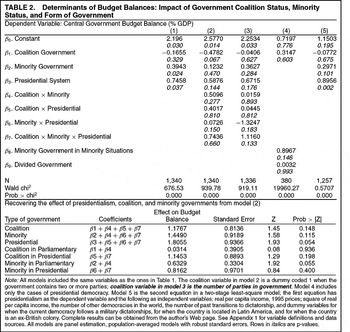
The average budget balance of central governments in democratic systems was negative for the 1970 to 2002 period: -3.12%. Coalition governments tend to have smaller budget balances than single-party governments, although the difference is small: -3.27% to -2.90%. Minority governments, in turn, seem to do better than majority governments, a result that goes counter to the spirit of Roubini and Sachs' (1989) argument and the findings reported by Edin and Ohlsson (1991). Finally, the budget balance is about 0.5% higher in presidential than in parliamentary democracies. These observations seem to be corroborated by multivariate analysis: column 1 in Table 2 shows that the coefficient for coalition governments is negative but not statistically significant, and the coefficients for minority and presidential governments are positive and statistically significant.

But this is not the whole story. The argument about the importance of government “strength” for keeping the budget in check involves the interaction between the form of government and the government's coalition and minority status. Thus, the negative effect of coalition status should be stronger in, or perhaps exclusive to, parliamentary systems, where dissention among coalition partners may bring the government down. Under this logic, things would be even worse if the government were minority coalition. On the other hand, presidential governments that do not control a majority party would have low budget balances given that in order to obtain majority support for its legislative initiatives the government presumably would have to rely on piecemeal support bought in a legislative spot market. Column 2 of Table 2 presents a model in which the form of government and the government's coalition and minority status are interacted, thus allowing us to evaluate these claims.
Note that the effect of each of the three factors of interest here—the form of government, coalition, and majority status—can be recovered from this table, in isolation or in interaction with each other. What emerges from an examination of the numbers in the lower panel of Table 2, where these effects are recovered, is that the form of government has a substantial impact on budget balances, and that the impact of the government's coalition and minority status is either nonexistent or contrary to expectations: if anything (given that the joint coefficients are not statistically significant), coalition and minority governments seem to improve budget balances. Presidentialism, in turn, does have a positive effect on budget balances: the coefficient is larger in magnitude and the standard error smaller than the ones estimated for the overall effects of coalition and minority status. The effect of coalition status, if any, vanishes once we control for the form of government: in parliamentary systems it is estimated to be small in magnitude (0.03% of the GDP) and not statistically significant; minority parliamentary governments, in turn, have a substantive effect, but they increase rather than decrease the central government's budget balance. Thus, the notion that coalition and minority governments, whether in parliamentary or presidential democracies, pay a price in terms of fiscal discipline is not supported by the data.
It could be the case that what matters is not the coalition status of the government per se but the number of parties that compose the government (Kontopoulos and Perrotti 1999): the difficulty in reaching an agreement among coalition members would increase with additional coalition partners. Yet, I find no evidence to support this claim. Column 3 of Table 2 presents a model identical to the one in column 2, except that the coalition indicator is replaced with the variable designating the number of coalition partners. According to these estimates, the addition of one extra party to a parliamentary coalition government reduces budget balances by 0.03% of the GDP, a number that is not significant, substantively or statistically.
Finally, minority governments need to be disaggregated to account for the possibility of “divided” governments, that is, the situation in which there is a minority government even if there is one party that holds more than 50% of the legislative seats. Column 4 in Table 2 separates the two cases by creating indicators for minority governments when no party holds more than 50% of the seats and for divided governments. Because divided governments only exist in presidential democracies, the sample is restricted to the cases of presidentialism. Divided government, as we can see, is of no consequence for budget balances, a finding that is consistent with Mayhew's (1991) conclusions in his study of the United States.
As for the form of government, the effect of presidentialism on budget balances is substantial and quite robust. As we can see in the lower panel of Table 2, governments in presidential democracies have budget balances that are close to 2% of the GDP larger than governments in parliamentary and mixed systems. This effect is not a product of the fact that most presidential systems are found in Latin America; recall that the estimates presented in Table 2 were generated with a model that controls for a country's location in Latin America (which, by the way, is never found to have an impact on budget balances). Neither is it a product of a process of selection in which countries that have presidential democracies also have, for unrelated reasons, a propensity to keep their budgets under control. Column 5 presents estimates of an instrumental variable model that takes this possibility into consideration. In this model, presidentialism is instrumented by its location (since 1946, 60% of all presidential country-years occurred in Latin America); by a dummy variable indicating the type of dictatorship that preceded the current democracy (as Cheibub 2006 has shown, presidential democracies tend to emerge out of military dictatorships more often than out of civilian dictatorships); by the number of past transitions to democracy (Przeworski 2004); by a dummy variable indicating the country's status as a previous British colony; by real per capita income (and its square: presidential democracies, in and out of Latin America, occur in middle-income countries); and by the number of other democracies in the world (to control for possible international democratization effects). Once this is done, we find that, again, presidentialism has a positive and significant impact on budget balances: they are almost 1% of the GDP higher than those in parliamentary democracies.
We find, thus, that whereas the status of the government—coalition or single-party, majority, or minority—does not have an effect on central government's budget balances in contemporary democratic regimes, the form of government does: presidential governments seem to be better at keeping their budget under control than governments in parliamentary democracies (which confirms the findings reported by Persson and Tabelinni 2003). This is not because presidential governments, secure in office for a fixed term, are not subject to the costs of ruling that parliamentary governments in multiparty contexts face. Not only are coalitions frequent in presidential democracies (Cheibub [2006] estimates that they occur in half of the country-years in which no party holds more than 50% of the seats in the lower house), the costs that they are alleged to impose on parliamentary governments are simply not detected in the data.
Policy compromise and bargaining are of the essence in democratic governments and, given a situation in which no one party commands a majority of seats in the legislature, the difference between coalition and single-party governments depends essentially on the location where bargaining will take place: within the government or within the legislature as a whole. There are theoretical and empirical arguments showing that policy effectiveness should not vary according to coalition or minority status of democratic governments. As Austen-Smith and Banks (1988) have demonstrated formally and Strom (1990) has demonstrated empirically, given a minority situation, that is, a situation in which no party holds more than 50% of the seats in the lower house, minority governments in parliamentary democracies are often supported by legislative majorities and, therefore, are not any less effective legislatively than majority governments. Cheibub, Przeworski, and Saiegh (2004), in turn, have shown that the same is true for presidential democracies: there are minority governments in presidential democracies that, like their counterparts under parliamentarism, are supported by a legislative majority and, consequently, are not any less effective legislatively than majority coalition governments. Thus, the status of the government with respect to the number of parties and the number of legislative seats it controls should be of relatively little overall policy consequence. For this reason the finding reported here about coalition and minority status should come as no surprise. The form of government, however, does matter for the size of the central government's budget balance: presidential democracies, regardless of the political conditions under which their governments exist, have higher budget balances than parliamentary democracies. In the next section I suggest why this is so.
ELECTORAL IDENTIFIABILITY
Presidential systems, I contend, have higher budget balances because presidents are identified with the performance of the government in a way that prime ministers—at least in certain types of parliamentary governments—are not. One of the differences between presidential and parliamentary democracies is the fact that, in the former, voters always choose the head of the government whereas in the latter this is not always the case. There are some parliamentary systems in which voters know who the serious contenders for government formateur are and, as in England (Cox 1987), legislative elections are in fact about choosing a national government. These are parliamentary systems with high electoral “identifiability” (Powell 1989; Strom 1990). In other parliamentary systems, electoral identifiability is relatively low: although voters do form an expectation about who will be in the government, preelection identification of the members of the government, let alone of the head of the government, is not as easily achieved. Although in these systems legislative elections obviously constrain the process of government formation, the specific government that will emerge depends on postelectoral bargaining that takes place hidden from the voters. These are systems with low electoral “identifiability.”
The high degree of electoral identifiability, institutionally guaranteed in presidential democracies, matters for the central government's budget balance because it is the president, as the head of the government, who is held accountable for the government's performance; it is he or she who will want to make sure that the budget is under tight control.7
Hallerberg and Marier (2004) make a similar point when they say that “one should keep in mind that the president (or her party where the president is barred from standing for reelection) is ultimately the one whom voters will evaluate in the next elections. Presidents have an incentive to have a central player monitor the budget even when she forms coalitions.”
This focus on the impact of electoral identifiability is related to the argument about “clarity of responsibility” in the economic vote literature (Powell and Whitten 1993). According to this argument, voters' ability to punish governments electorally depends on the institutional context; punishment is possible only when institutions are such that voters are able to clearly assign responsibility for government policies. One, still unexplored, implication of this argument is that, when “clarity of responsibility” is high, governments will strive for good performance in anticipation of voters' electoral judgment. Because voters can directly choose the head of the government, presidential institutions provide a context of more “clarity of responsibility” than parliamentary institutions (Shugart and Carey 1992).
Note that the argument developed here is distinct from that proposed by Roubini and Sachs (1989) and those who followed in their footsteps. In their analyses, it is the internal workings of coalition governments (the collective action problem involved in acting on the budget) that leads to higher budget deficits. Here, the mechanism is related to the president's concern with the electoral consequences of poor governmental performance. It is not coalition governments per se, but the fact that presidential institutions clearly allow voters to affect the fate of the actor who is considered to be responsible for government policies, that explains the differences in budget balances across parliamentary and presidential systems.
A complete and direct test of the “accountability” mechanism underlying budget performance in democratic systems requires data that are not yet available. But there is some indirect evidence in support of this mechanism. For instance, Strom (1990, 73) provides estimates of the “identifiability of preelectoral governmental options” for 15 parliamentary democracies. They range from zero in the Netherlands, France, and Finland (where, before the elections, voters cannot identify the governments that will be formed after the elections) to 0.1 in Belgium; 0.87 in Ireland; and 1.0 in Canada, England, and Sweden. It turns out that the average budget balance is lower in parliamentary democracies with low levels of electoral identifiability; an increase of 0.10 in the degree of electoral identifiability (more or less the difference between Spain and Iceland) increases the central government's budget balance by 0.20% of the GDP.
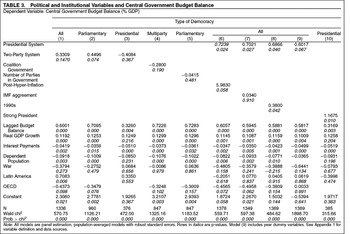
In parliamentary democracies, electoral identifiability is the highest when there are only two political parties competing. The central government's budget balances should, therefore, be significantly higher in two-party than in multiparty parliamentary democracies. In presidential democracies, in turn, electoral identifiability of the government is high by institutional design, and the nature of the party system should have no impact on the government's budget balance. As columns 1 to 3 of Table 3 demonstrate, this is, indeed, the case. The nature of the party system—as indicated by a dummy variable that flags the cases in which there are no more than two political parties—matters for the central government's budget balances in parliamentary, but not in presidential democracies: in the former, budget balances are higher in two-party than in multiparty systems by about 0.5% of the GDP; in the latter, we cannot safely reject the hypothesis that the difference between the two systems is actually zero.

Note that this result is not due to the fact that two-party systems do not produce coalition governments. If the mechanism leading to higher budget balances had to do with the number of parties in the government, and not with electoral identifiability, then the coalition variable should affect the government's budget balance in a sample constituted exclusively of multiparty parliamentary democracies, where identifiability would be relatively low across the board. Of the 851 multiparty parliamentary country-years observed in the dataset used here (which, to remind, is defined by the availability of budget data), 58% were coalition governments; thus, if it is the difficulties of governing in coalition that matters, the central government's budget balance should be lower in these cases than in the 42% that were single-party governments. But as one can see in Table 3, this is not the case. After restricting the sample to multiparty parliamentary democracies, we find that the effect on budget balances of coalition government (column 4) and the number of government parties (column 5) is not statistically significant.
The argument put forward in this section is that presidentialism has a positive effect on budget balances because of the relatively high level of electoral identifiability of presidents: because presidents are held electorally responsible for government performance, they have an incentive to keep budget balances in check. Yet, if voters are either indifferent to the budget or prefer higher deficits, both plausible possibilities, then presidents may be faced with the opposite incentive regarding budget balances.
Although a direct test of this hypothesis is beyond the scope of this paper, the notion that voters prefer higher deficits does not seem to be correct, particularly in the context of economic transformations that have prevailed throughout the world since the mid-1980s.8
Brender and Drazen (2005) show in a cross-national context that budget deficits do not improve incumbents' reelection chances.
The dilemmas of the so-called dual-transition process with retrospective voters was best captured by Przeworski (1991), but dominated the research agenda in the early 1990s. On “macroeconomic populism,” see Dornbusch and Edwards (1991).
Yet, subsequent research has shown that under some conditions voters were capable of more sophisticated reasoning, including intertemporal comparisons of well-being. The implication, of course, was that popular support for policies that implied short-term deprivation (such as deficit reduction) could be expected; and such support was indeed observed in many democracies (see Buendia 1991; Pereira et al. 1993; Przeworski 1996; Stokes 1996). Moreover, even if voters do not fully understand budget deficits, presidents (or some of their advisors) do. In post-hyper-inflation contexts, where price stabilization has become the overwhelming concern of economic policy, governments are likely to find that keeping budget deficits in check is an essential component of the overall strategy of preventing inflation from reappearing or getting out of control. Thus, even if voters do not value low budget deficits, governments know that they are an element in generating what voters care about: low inflation.
Column 6 in Table 3 presents evidence that supports this interpretation. The variable “post-hyper-inflation” codes the years following a fall in inflation rates of at least 300%. These, we can assume, are the years during which inflation control is central for both voters and government. We can see that, given the usual control variables (which remain mostly unchanged), the central government's budget balances are almost 6% higher than at any other time, and that the impact of presidentialism remains unchanged from what it was found to be before.10
These results remain substantively unchanged if we interact the “post-hyper-inflation” variable with presidentialism, not shown here for reasons of space. Note also that the result does not change if different cutoff points for a drastic reduction in inflation are used.
A second possible objection to the interpretation of the impact of presidentialism on budget balances offered in this paper has to do with the role of external factors. There are two ways in which such factors may have played a role. First, the role of external factors may be direct: for instance, democracies under an International Monetary Fund (IMF) agreement, which almost invariably includes budget-deficit controls, are likely to have higher budget balances than those not under an IMF agreement, regardless of their form of government. Second, with the intensification of globalization, many countries have felt increasing pressure to keep their books in shape. In this case, the effect of presidentialism could be a reflection of the fact that, at the same time that many presidential democracies reemerged, governments of any type felt the need to act on their budgets.
Columns 7 to 9 of Table 3 allow us to examine these hypotheses. Column 7 shows that the effect of IMF agreements is not statistically different from zero and that the impact of presidentialism remains unchanged. As for the “globalization” hypothesis, it is correct in the sense that budget deficits were smaller toward the end of the period analyzed in this study. However, controlling for time effects does not eliminate the impact of presidentialism. As column 8 shows, a variable indicating the post-1990 years, the moment where the pinch of globalization or the pressures of international institutions were more strongly felt by governments throughout the world, has a positive and significant effect over the central government's budget balances, but leaves the coefficient for the presidentialism variable unchanged. And, as column 9 demonstrates, the effect of presidentialism remains statistically and substantively significant even after year dummy variables are introduced in the model.
It seems safe, therefore, to conclude that the impact of presidentialism on the central government's budget balances is not an artifact of assumptions regarding voters' preferences or of the fact that governments during the period covered by the data have been subject to international pressures toward higher budget balances. Moreover, the evidence presented in this section suggests the plausibility of the argument that the positive effect of presidentialism on budget balances is due to its institutionally high degree of electoral identifiability.
PRESIDENTIAL POWERS AND BUDGET BALANCES
Electoral identifiability provides the incentive for presidents to keep budgets under control. Yet, budget balances vary widely in presidential democracies: the average GDP share of central government budget balances between 1970 and 2002 was -2.35%, with a standard deviation close to 4%; during this period, two presidential countries—Brazil and Nicaragua—experienced 5 years with deficits of at least 10% of their GDP, whereas three presidential countries—Nicaragua again, Panama, and Venezuela—experienced surplus of at least 5% of their GDP. Clearly, not all presidents are able to translate their incentives for keeping budgets under control into action.
Several recent papers (e.g., Alesina et al. 1999; Filc and Scartascini 2004; Gleich 2003; Hallerberg and Marier 2004; Stein, Talvi, and Grisanti 1998; von Hagen 1991; von Hagen and Harden 1995) have shown that the institutions organizing the budget process have an impact on budget balances: “hierarchical,” as opposed to “collegial” budget institutions lead to lower deficits (higher balances). If it is true that presidents have a stronger incentive than prime ministers to keep control over the budget, budget institutions should be, on average, more “hierarchical” in presidential than in parliamentary systems because it is through these institutions that presidents will be able to control the budget (Hallerberg and Marier 2004). It should also be true that presidents operating under constitutions that grant them more powers to affect the budget process should generate higher budget balances than presidents with little such powers.
There are two ways in which the president may exert power when it comes to the budget. The first has to do with the president's dominance over the budget process, that is, with the existence of a constitutional configuration that favors the president over the legislature when it comes to setting, amending, and approving the budget law. In this case the president is able to set the agenda when it comes to the budget and, in this way, is able to shape it so that it will be closer to his or her preferences. The second way presidents have to influence the budget process comes from the president's ability to veto legislation, which allows him or her to prevent or undo legislative logrolling that leads to the expansion of budget deficits. Either one of these powers allows presidents to exert an effective control over budget balances and, in this sense, they characterize a strong president when it comes to the budget process. Accordingly, given that presidents have an incentive to keep the budget under control, we should observe higher budget balances when presidents are strong in this sense, that is, when the president dominates the legislative process or when the president can effectively veto legislation.
To assess both types of presidential powers, information on the president's dominance of the legislative budgetary process and ability to veto legislation was collected for all presidential democracies that existed between 1946 and 2002. Overall, 82 constitutions and constitutional amendments were consulted, yielding information for 952 (out of a possible 996) country-years of presidential democracies.
Presidential Control of the Budget Process
Presidential dominance over the budget process can be characterized in terms of three aspects, which in combination define an institutional configuration that either favors the president in the budget process or does not.
Power of Initiation
In some presidential countries, such as in Chile under the 1980 constitution, or in Brazil under the 1988 constitution, the president has the exclusive power to initiate budget legislation; in others, such as the United States, Sri Lanka, Cyprus, as well as Chile under the 1925 constitution, there is nothing specifying that the executive has the exclusive power to propose budget law.
Power of Amendment
With the exception of the 1995 Armenia charter, no presidential constitution forbids the legislature to amend the budget proposal. In the vast majority of cases, however, the legislature's power of amendment is limited in scope and/or substance. Thus, if the constitution stipulates that the budget proposal may be amended but amendments are restricted in terms of substantive areas, then the legislature is constrained, even if not entirely, in its capacity to amend the budget. In the 1988 Brazilian constitution, for example, article 66, §3, precludes amendments that affect appropriations for personnel and their indirect costs, debt servicing and constitutional tax transfers to the states, counties and federal district. If amendments pertaining to any area of the budget are possible but cannot imply increased expenses, then the legislature is similarly restricted in its capacity to amend the budget. In these cases, which are the most common in presidential democracies, congress is free to act on any aspect of the budget, as long as the changes it proposes do not imply new expenditures, or expenditures not funded by new taxes.
Default Situation (Reversal Point)
If no budget is approved, life goes on, and many constitutions specify exactly how life must go on if such a situation emerges. Cases such as that of the United States, where there are no provisions for when a budget law is not passed, although not rare, are less frequent than the cases in which the constitution specifies what should transpire if no budget law were passed. Given that the constitution specifies the reversal point in the budget process, there are only two situations that clearly favor the president. The first, obviously, is when the constitution explicitly says so: article 198 of the 1979 Peruvian constitution, for instance, stipulates that the executive's proposal is to be adopted if the budget law is not approved before December 15. The second occurs when the constitution stipulates that the previous year's budget is to be adopted if a new budget is not approved and the legislature is limited in its power to amend a budget proposal that is initiated by the president. In all other cases, the failure of the budget process in the legislature does not favor the president; either it is neutral or it favors the legislature.
To summarize, budget initiative can be an exclusive presidential power or not; the legislature, in turn, is sometimes restricted in its ability to amend the budget, and other times it is free to amend the budget; and if the budget law is not approved in time, the default situation may either favor the president or not. Presidents are said to dominate the budget process in two specific circumstances: when the legislature is limited in its capacity to amend a budget proposal, which in turn is exclusively initiated by the president; and when no one actor has the exclusive power to initiate the budget proposal, the legislature has limited amendment power, and failure to pass the budget law implies the adoption of the executive's proposal. In all other configurations, the constitution does not favor the president when it comes to the budget; hence the president does not dominate the budget process.
Effective Presidential Veto
Although the vast majority of presidential democracies grant presidents the power to veto legislation, and thus the power to exert a significant level of influence over the legislative process, it is not always the case that such power can be effectively exercised. Because most constitutions allow the legislature to override the presidential veto, effective presidential veto depends both on the constitutional provisions granting the president that power and on the distribution of seats in the legislature. Thus, unlike presidential dominance of the budget process, the president's capacity to veto legislation is not dependent on purely constitutional provisions.
Effective presidential veto depends on the combination of institutional and political factors. On the one hand, it depends on the distribution of seats in congress or, more specifically, on the share of seats held by the parties in government. On the other hand, it depends on the following institutional provisions: whether veto power is partial or total; the type of congressional majority necessary to override the presidential veto; whether the system is unicameral or bicameral; and whether in bicameral systems veto override is by a vote in each chamber separately or in a joint session of both chambers. It is the combination of these rules with the share of legislative seats held by the government that determines whether the president has effective veto powers (Cheibub 2002).
If presidents are held accountable for government performance and, because of this, have an incentive to keep control over the budget, budget balances should be higher when presidents are constitutionally and politically strong, that is, when they can set the budget agenda, can effectively veto legislation, or both. These are the cases in which presidents will be constitutionally and politically in a position to keep the budget under control. In the sample of presidential democracies that existed between 1970 and 2002, strong presidents existed in 58% of the country-years. As column 10 in Table 3 demonstrates, budget balances are, indeed, higher when presidents are strong: given its economic determinants, the GDP share of the budget balance is 1.17% higher when presidents are strong than when they neither control the budget process nor cannot veto legislation.
CONCLUSION
The broad message that emerges from this paper is that democratic institutions matter; but what they matter for and the way in which they matter must be better specified. The vast majority of the work concerned with forms of democratic government has focused on their impact on democratic survival. The main institutionalist explanation for the instability of democracy in developing countries, particularly in Latin America, has emphasized the presence of presidential institutions and the incentives they engender for non-democratic behavior. Recent research (Cheibub, Przeworski, and Saiegh 2004) has shown that the difference in democratic survival between parliamentary and presidential democracies cannot be attributed to the structure of incentives that are supposed to follow from the principle that distinguishes these regimes. Nothing in the chain of reasoning that, according to the institutionalist explanation, leads from separation of powers to democratic instability and the ultimate demise of the regime seems to be supported by theoretical and empirical analysis. Presidential and parliamentary systems would have equal chances of surviving as democracies had they existed under similar conditions. As I argued elsewhere (Cheibub 2006), however, they do not, and it is these conditions, and not the intrinsic nature of presidentialism, that cause presidential democracies' relatively higher level of regime instability.
But the form of government is not irrelevant. This paper has shown that budget balances are higher in presidential than in parliamentary democracies. The reason, I argued, is that the relationship between voters and the government is structured differently in the two systems. Policy responsibility in presidential systems is located in the president—the head of the state and the head of the government—regardless of the legislative environment he or she faces; voters can, by design, exert a substantial degree of electoral control over those responsible for policies they care about. In parliamentary systems, policy responsibility is not always clear: in some systems, such as England and Germany, voters are able to identify the government choices available at election time and, thereby, exert a degree of control over government action; in others, such as Finland, the Netherlands, or Belgium, such clarity is absent and voters are unable to exert the same degree of control over government action. Identifiability, therefore, varies in parliamentary systems in a way that it does not in presidential ones, and because of this, presidents, more than prime ministers, have an incentive to keep budgets under control. But not all presidential systems are the same and, given the incentives inherent to the system, it matters whether the president has the constitutional ability to affect budget outcomes.
Thus, this paper joins several recent others that have examined the impact of government formation rules beyond democratic consolidation, finding that presidential institutions may, in some circumstances, have a positive impact on specific outcomes. It departs from them, however, in that it explores an aspect that has been underanalyzed—the way they structure the relationship between voters and the government and shape the incentives for government behavior under each system. In this sense, the paper shifts the attention away from the aspect that has been at the center of much of the comparative and empirical literature on the form of democratic government: the systemic differences regarding interbranch relationship. Here the findings are unambiguous: the government's legislative status—whether it is composed by one or many parties and whether it controls a majority of legislative seats—has not impact on its ability to keep the budget in check. This is true for parliamentary and presidential democracies alike, even though in one the government is subject to early removal by a legislative vote, whereas in the other the government serves a fixed term in office. Even though such difference has been deemed crucial for democratic performance, the finding that it has no impact on performance should come as no surprise. Policy bargaining is of the essence in democratic regimes, and institutional distinctions matter not because they eliminate the necessity of bargaining among political actors to set governmental policies, but because they privilege different loci where the bargaining takes place: the political party in single-party majority governments, the government in multiparty governments, or the legislature in minority governments. It is the content of the bargaining, rather than where the decision is ultimately made or the number of participants involved in it that should matter for budget balances. This is why the indicators of the coalition and minority status of the government have no impact once economic and social conditions that affect the budget are kept constant.
Finally, this paper has shown that the specific ways in which presidential systems are structured also matter for their performance with respect to substantive outcomes (as opposed to simply the survival of democracy). Thus, the way the legislative powers of the president are structured—but also the way the president and/or the legislature are elected (Hallerberg and Marier 2004) or the limits on presidential re-election (Cheibub 2002)—are of great significance in bringing about outcomes such as broader representation, accountability, fiscal restraint, and macroeconomic stability, to name just a few. This is of practical relevance if we consider that whereas broad constitutional frameworks such as presidentialism and parliamentarism are hard to change, the details of their operation are much less so, thus suggesting a course of action for countries that, for historical reasons, are “stuck” with a given form of government.
APPENDIX 1
Partisan Composition of the Government and Distribution of Legislative Seats
Information on the partisan composition of the government and distribution of legislative seats was taken from the following sources: General Sources: Arthur S. Banks, Political Handbook of the World (New York: McGraw-Hill, various years); Arthur S. Banks, Alan J. Day, and Thomas C. Muller, Political Handbook of the World 1997 (New York: McGraw-Hill, 1997); Inter-Parliamentary Union Parline Database, (http://www.ipu.org/parline-e/parlinesearch.asp); Keesing's Contemporary Archives (London: Keesing's Limited, various years); Library of Congress Country Studies (http://lcweb2.loc.gov/frd/csquery.html); Library of Congress Portals to the World (http://www.loc.gov/rr/international/portals.html); Regional Surveys of the World (London: Europa Publications, various years); U.S. Department of State, Country Reports on Human Rights Practices for 1999 (http://www.usis.usemb.se/human/human1999/toc.html). Europe and OECD: Jan-Erik Lane, David McKay, and Kenneth Newton, Political Data Handbook, OECD Countries, 2nd ed. (Oxford: Oxford University Press, 1997); Parties and Elections in Europe (http://www.parties-and-elections.de/indexe.html); Jaap Woldendorp, Hans Keman, and Ian Budge, Handbook of Democratic Government: Party Government in 20 Democracies, 1945–1990 (Boston: Kluwer Academic, 1993); ZPC, European Governments (http://www.terra.es/personal2/monolith/00europa.htm). Africa: Michael Bratton and Nicolas Van de Walle, Political Regimes and Regime Transitions in Africa: A Comparative Handbook (East Lansing: Department of Political Science, Michigan State University, 1996); Marion Doro, ed., Africa Contemporary Record: Annual Survey and Documents (New York: Africana, various years); Shaheen Mozaffar, ‘Africa: Electoral Systems in Emerging Democracies’, in Josep Colomer, ed., The Handbook of Electoral System Choice (New York: Palgrave, 2003); Dieter Nohlen, Michael Krennerich, and Bernhard Thibaut, eds, Elections in Africa: A Data Handbook (Oxford: Oxford University Press, 1999). Asia and the Pacific: Rommel C. Banlaoi and Clarita R. Carlos, Political Parties in the Philippines: From 1900 to the Present (Makati City, Philippines: Konrad Adenauer Foundation, 1996); Rommel C. Banlaoi and Clarita R. Carlos, Elections in the Philippines: From Pre-Colonial Period to the Present (Makati City: Konrad Adenauer Foundation, 1996); Choe Yonhyok, How to Manage Free and Fair Elections: A Comparison of Korea, Sweden and the United Kingdom (Goteburg: Goteburg University, 1997); Dieter Nohlen, Florian Grotz, and Christof Hartman, eds, Elections in Asia and the Pacific: A Data Handbook (Oxford: Oxford University Press, 2001). Latin America: Grace Ivana Dehesa, ‘Gobiernos de Coalicion en el Sistema Presidencial: America del Sur’ '[Coalition governments in presidential systems: South America] (doctoral dissertation, European University Institute, Florence, 1997); Dieter Nohlen, ed., Enciclopedia electoral Latinoamericana y del Caribe (San Jose, Costa Rica: Instituto Interamericana de Derechos Humanos, 1993); Political Database of the Americas (http://www.georgetown.edu/pdba/english.html); Arturo Valenzuela, 'Party Politics and the Crisis of Presidentialism in Chile: A Proposal for a Parliamentary Form of Government.@ In The Failure of Presidential Democracy: The Case of Latin America, volume 2. ed. Juan J. Linz and Arturo Valenzuela. Baltimore: Johns Hopkins University Press. pp. 91–150.
APPENDIX 2
Variable Definitions and Sources
Variables are grouped by table and definitions are given only in the first table the variable appears.
TABLE 1: Central Government Budget Balances: Overall central government budget balance, including grants, % of GDP (World Bank 2004, series GB.BAL.OVRL.GD.ZS); Lagged Budget Balance: Central Government Budget Balances lagged one year; Real GDP growth: GDP growth, annual % (World Bank 2004, series GDPGR.NY.GDP. MKTP.KD.ZG); Interest Payments: Central government interest payments, % of current revenue (World Bank 2004, series GB.INT.DECT.RV.ZS); Dependent Population: Sum of population ages 0–14 and 65 and above, % of total (World Bank 2004, series SP.POP.0014.TO.ZS and SP.POP.65UP.TO.ZS); War: Dummy variable coded 1 when the country is involved in an interstate war or an interstate intermediate armed conflict (Gleditsch et al. 2002); Latin America: Dummy variable coded 1 for the following countries: Argentina, Bolivia, Brazil, Chile, Colombia, Costa Rica, Cuba, Dominican Republic, Ecuador, El Salvador, Guatemala, Honduras, Mexico, Nicaragua, Panama, Paraguay, Peru, Uruguay, and Venezuela; OECD: Dummy variable coded 1 for the following countries: Austria, Australia, Belgium, Canada, Denmark, Finland, France, Germany, Greece, Iceland, Ireland, Italy, Japan, Luxembourg, Netherlands, New Zealand, Norway, Portugal, Spain, Sweden, Switzerland, United Kingdom, and the United States.
TABLE 2: Coalition Government: Dummy variable coded 1 when the government is composed by at least two parties, 0 otherwise; Minority Government: Dummy variable coded 1 when the parties composing the government hold less than 50% of the seats in the legislative lower house, 0 otherwise. Presidential System: Dummy variable coded 1 when a country has a democracy with a presidential form of government, 0 otherwise. Divided Government: Dummy variable coded 1 when no party controls more than 50% of the seats in the legislative lower house and minority government = 1.
TABLE 3: Two-party System: Dummy variable coded 1 if the number of parties in the legislature is smaller or equal to 2, 0 otherwise; Number of Parties in Government: Total number of parties holding cabinet positions; Post-Hyper-Inflation: Dummy variable coded 1 for the years following a fall in the inflation rate of at least 300%, 0 otherwise. Inflation rate is the annual change in the consumer price index (World Bank 2004, series FP.CPI.TOTL.ZG); IMF Agreement: Dummy variable coded 1 for the years in which a country is under an IMF agreement, 0 otherwise (Vreeland 2003); 1990s: Dummy variable for the years 1990–1999; Strong President: Dummy variable coded 1 when a president in a presidential system dominates the budget process or has effective veto power, as defined in the text, 0 otherwise. Data on constitution come from Constitution Finder, University of Richmond (http://confinder.richmond.edu/index.php) and Constitutions of the Countries of the World, Oceana Online, Oceana Publications.
I would like to thank Eduaro Alemán, David Brown, Argelina Figueiredo, Jeniffer Gandhi, Mark Hallerberg, Indrid Haukur Indridason, Marcus Kurtz, Pierre Landry, Janet Morford, Nicholas Sambanis, Lee Sigelman, Andrew Schrank, Mehmet Adil Tezgul, and two anonymous referees for helpful comments and suggestions on earlier versions of this paper. All mistakes are my own responsibility.




Comments
No Comments have been published for this article.