INTRODUCTION
Logging and conversion of forest to agricultural land continues at an unprecedented rate worldwide (Green et al. Reference GREEN, CORNELL, SCHARLEMANN and BALMFORD2005), with deforestation rates in South-East Asia among the highest of any tropical region (Sodhi et al. Reference SODHI, KOH, BROOK and NG2004, Wahid et al. Reference WAHID, ABDULLAH and HENSON2005). In Sabah, Malaysia the reduction in forest cover has been largely due to the expansion of agricultural areas into logged forest, particularly oil palm (Elaeis guineensis Jacq.) which now covers over 800,000 ha (McMorrow & Talip Reference MCMORROW and TALIP2001). Despite this rapid loss of natural forest, relatively little research has focused on the impacts of oil palm expansion on the environment (Turner et al. Reference TURNER, SNADDON, FAYLE and FOSTER2008), with many of the studies that have been carried out focusing on birds and mammals rather than invertebrates (Aratrakorn et al. Reference ARATRAKORN, THUNHIKORN and DONALD2006, Peh et al. Reference PEH, SODHI, DE JONG, SEKERCIOGLU, YAP and LIM2006).
Conversion to oil palm has been shown to have a negative impact on overall biodiversity (Fitzherbert et al. Reference FITZHERBERT, STRUEBIG, MOREL, DANIELSEN, BRÜHL, DONALD and PHALAN2008) as well as on the richness and diversity of specific arthropod taxa including beetles (Chung et al. Reference CHUNG, EGGLETON, SPEIGHT, HAMMOND and CHEY2000a, Reference CHUNG, HAMMOND, EGGLETON, SPEIGHT and CHEYb; Davis & Philips Reference DAVIS and PHILIPS2005), moths (Chey Reference CHEY2006) and ants (Pfeiffer et al. Reference PFEIFFER, HO and TEH2008). Similarly, Chang et al. (Reference CHANG, HII, BUTTNER and MANSOOR1997) recorded a reduced abundance in the majority of mosquito species studied, both as adults and larvae in an area following conversion from forest to oil palm. However, not all studies have shown such a clear negative impact of habitat conversion. Hassall et al. (Reference HASSALL, JONES, TAITI, LATIPI, SUTTON and MOHAMMED2006) found lower species richness of isopods in oil palm compared with some areas of primary forest but no difference compared with others. In Malaysia and Singapore, Liow et al. (Reference LIOW, SODHI and ELMQVIST2001) found higher species richness of bees in oil palm plantations than areas of primary forest. Although not comparing forest and oil palm specifically, Mayfield (Reference MAYFIELD2005) in Costa Rica found no difference in the number of species of insect visiting oil palm inflorescences close to and far away from forest fragments. In some studies, forest conversion has also resulted in a reduction in the number of individuals with a few species dominating the samples (Chung et al. Reference CHUNG, EGGLETON, SPEIGHT, HAMMOND and CHEY2000a, Liow et al. Reference LIOW, SODHI and ELMQVIST2001). However, other studies have found a higher abundance of individuals in oil palm (Davis & Philips Reference DAVIS and PHILIPS2005, Hassall et al. Reference HASSALL, JONES, TAITI, LATIPI, SUTTON and MOHAMMED2006), although these are probably species which were previously characteristic of open habitats or agricultural areas (Chey Reference CHEY2006, Davis & Philips Reference DAVIS and PHILIPS2005). Therefore, although detrimental overall, the specific impact of oil palm expansion on arthropods is far from straightforward. It is important that we gain a greater understanding of the overall effects of oil palm expansion on arthropods as they constitute the majority of biomass (Fittkau & Klinge Reference FITTKAU and KLINGE1973) and biodiversity in tropical ecosystems, carry out crucial ecosystem services (Samways Reference SAMWAYS2005), and can be important pests of oil palm plantations (Mariau et al. Reference MARIAU, DESMIER DE CHENON and SUDHARTO1991).
In the tropics, epiphytes are known to house a high density and species richness of arthropods and are therefore an important component of the tropical ecosystem (Ellwood & Foster Reference ELLWOOD and FOSTER2004, Kabakov Reference KABAKOV1967, Karasawa & Hijii Reference KARASAWA and HIJII2006, Nadkarni & Longino Reference NADKARNI and LONGINO1990, Paoletti et al. Reference PAOLETTI, Taylor, STINNER and BENZING1991, Richardson Reference RICHARDSON1999, Sergeeva et al. Reference SERGEEVA, KHOLOPOVA, TEN and THU1989, Walter & Behan-Pelletier Reference WALTER and BEHAN-PELLETIER1999). No study has yet investigated the effect of forest conversion to oil palm on the arthropod fauna in epiphytes, although they can be abundant in plantations, especially if management is limited (Nadarajah & Nawawi Reference NADARAJAH and NAWAWI1993). It is possible that epiphyte-dwelling arthropods are less affected by habitat conversion than arthropods living in other parts of the ecosystem, as some species of epiphyte are able to control temperature variation and evaporative water loss in their local area (Freiberg Reference FREIBERG2001, Stuntz et al. Reference STUNTZ, ZIEGLER, SIMON and ZOTZ2002, Turner & Foster Reference TURNER and FOSTER2006). Therefore, they could provide a stable microclimate and a refuge from the harsh microclimatic conditions that are found in plantations.
Bird's nest ferns are common epiphytes in Malaysia (Ellwood et al. Reference ELLWOOD, JONES and FOSTER2002). They can be found across a range of habitat disturbances and house a high abundance and biomass of arthropods (Ellwood & Foster Reference ELLWOOD and FOSTER2004, Piggott Reference PIGGOTT1996). The ‘bird's nest’ is formed by a cone of upward-facing leaves that channel falling litter and rainwater into a large root mass at the base of the plant, providing the fern with nutrients and water. Two closely related species (Asplenium nidus L. and Asplenium phyllitidis D. Don (Aspleniaceae)) are reported to form ‘bird's nests’ in this way (Holttum Reference HOLTTUM1966, Piggott Reference PIGGOTT1996), although recent genetic evidence indicates that both may be part of a larger complex of cryptic species (Yatabe & Murakami Reference YATABE and MURAKAMI2003).
In this study, we investigated the overall effects of habitat conversion on the arthropod fauna. We compared the abundance and biomass of arthropods collected from epiphytic bird's nest ferns, the lower canopy and the leaf litter, between areas of primary forest, logged forest and oil palm plantation in Sabah, Malaysia. By comparing the whole arthropod community between habitats, we were able to determine the overall effects of forest conversion to oil palm on arthropods.
STUDY SITE
Fieldwork was carried out from March–June 2002 at Danum Valley Field Centre (DVFC), Sabah, Malaysia (4′ N, 117′E: altitude c. 170 m asl, for details of site see Marsh & Greer Reference MARSH and GREER1992). Primary forest sites were located within the Danum Valley Conservation Area; an area predominantly made up of lowland, evergreen dipterocarp rain forest (Marsh & Greer Reference MARSH and GREER1992). At DVFC, the average annual rainfall is 2785 mm and is not strongly seasonal (Fox Reference FOX1978, Walsh & Newbery Reference WALSH and NEWBERY1999). Recorded temperatures at DVFC are typical of a wet equatorial climate (Marsh & Greer Reference MARSH and GREER1992), with a mean maximum daily temperature of 31.0 °C and a mean minimum daily temperature of 22.5 °C (courtesy DVFC Hydrology project).
Logged forest sites were located within an area of forest, logged in 1988 with a modified uniform system (Whitmore Reference WHITMORE1998). Logging extraction data from the site indicates that approximately 170 000 m3 of timber was extracted from a 2300-ha area in 1988. The logged forest site was located 4 km east of DVFC and therefore has a similar climate to that of the field centre.
Oil palm plantation sites were located within Sebrang Estate (5′N, 118′E, altitude c. 150 m, about 96 km from DVFC), an area of oil palm plantation that is owned and managed by Borneo Samudera. This site is about 4 km from the Tabin Wildlife Reserve, where annual rainfall averages 1500–3000 mm, and is not strongly seasonal. Recorded temperatures in Tabin range from a mean maximum temperature of 32.0 °C to a mean minimum temperature of 22.0 °C. Therefore the local climate at the oil palm sites is comparable with that of the primary and logged-forest sites.
Sebrang oil palm estate is a mosaic of areas of different-aged palms, with planting dates from 1974–2002. After establishment, oil palm plantations are intensively managed (Teo Reference TEO2000), often including the removal of bird's nest ferns, as they are thought to reduce harvest efficiency (Piggott Reference PIGGOTT1996). However, this is not part of the management practice in Sebrang Estate (Sebrang Estate Manager, pers. comm.), making it an excellent site in which to study the arthropod fauna of bird's nest ferns within a plantation ecosystem. Oil palm sites were chosen that were planted between 1984 and 1988 to minimize heterogeneity.
METHODS
We surveyed 20 transects of 100 × 20 m in each of the three habitats and recorded the location and maximum diameter of bird's nest ferns below 15 m in the canopy. We also surveyed the density and size of bird's nest ferns in plantation areas planted in 1976 and 1995 to assess how the abundance of ferns changed with age of the plantation. A random sub-sample of 60 ferns was chosen from which to sample arthropods (20 from each habitat). Of these, six were selected from a small size class (0–50 cm diameter), eight from an intermediate size class (50–100 cm diameter), and six from a large size class (>100 cm diameter). At the same locations as each sample fern, we also collected arthropods from the leaf litter and the lower canopy.
Arthropod collection
Arthropods were collected between 09h00 and 12h00 to minimize any confounding influence of diurnal factors on the arthropod community (Basset et al. Reference BASSET, ABERLENC, BARRIOS, CURLETTI, BÉRENGER, VESCO, CAUSSE, HAUG, HENNION, LESOBRE, MARQUEÁS and O'MEARA2001, Costa & Crossley Reference COSTA and CROSSLEY1991). It should be noted, however, that such a sampling regime will necessarily under-sample any arthropods that are active at other times of the day or during the night. At each site, we selected four 1-m2 areas of forest floor, located 1 m out from a point directly below the fern in the directions North, South, East and West (samples combined to give a single sample from each site). In the case of the oil palm sites, it was necessary to take litter samples 3 m out, to avoid a zone that is heavily sprayed with herbicides around the base of each tree (Sebrang Estate Manager, pers. comm.). Sample areas were scraped clear of leaf litter, which was quickly bagged to minimize loss of any arthropods. Ferns were sampled on the same day that leaf litter was collected. Ferns were cut away from their support and immediately placed into a bag, again minimizing the loss of any arthropods. Winkler-type apparatus were used to extract arthropods from the fern and litter samples. After 3 d, arthropods that had been trapped were removed with the aid of hand lens and stored in fresh alcohol. The remaining material in the apparatus was hand sorted and any animals added to these samples. Leaf-litter and fern samples were dried after arthropods had been extracted and weighed to obtain dry-weight values.
Canopy arthropods were collected as soon as possible after litter and fern samples had been collected. Owing to time constraints, this could not be on the same day, but was always within 2 d of the fern and litter arthropod collections. We used a fogging machine (Swingfog SN 50–10PE, Swingtec GmbH, Germany) containing pybuthrin 33BB non-persistent insecticide to sample arthropods from the lower canopy. Insecticide fogging of the canopy is usually carried out in the early hours of the morning to avoid wind, which can blow insecticide away from the sample area. However, to avoid the confounding influence of diurnal changes in arthropod composition, fogging was carried out at the same time of day as the other samples were taken (09h00–12h00). Wind speeds were low, since we fogged only in the lower canopy, allowing good insecticide cover at all sample times. At each site we set up four collection trays in which to catch falling arthropods (again, samples were combined to give a single sample from each site). Each tray consisted of a collection funnel (1 m2) with a jar of 75% alcohol attached to its base. Each site was fogged for 1.5 min with the fogging machine operated from the ground and moved around to ensure that the sample area above the trays was well covered by insecticide. The collection trays were left for 1 h after fogging to catch arthropods that had not yet fallen.
Environmental variables were also measured at the time that collections were made, so we could assess how these changed between habitats. These were in the form of point readings at the time of litter collection for relative humidity and temperature (using a Vaisala HM 34 humidity and temperature meter). At the same time, canopy cover was assessed, using a spherical densiometer (following methods detailed by Lemmon Reference LEMMON1957).
Arthropod identification
All insects and arachnids were sorted to ordinal level and ants, endopterygote insect larvae, centipedes, millipedes and isopods to groups of their own. The length of each animal was measured to the nearest millimetre and its biomass calculated by standardized regression equations following Schoener (Reference SCHOENER1980) for all insects, non-insect hexapods and arachnids, and M. and B. Richardson (unpubl. data) for myriapods.
Data analysis
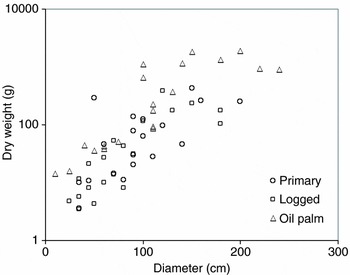
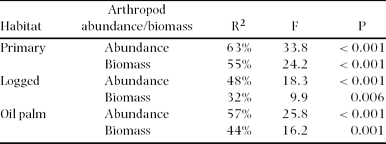
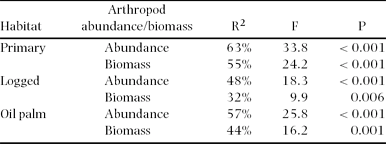
Differences in fern density and size (diameter) between habitats were assessed using Kruskal–Wallis tests. For collected ferns, there was a significant positive relationship between fern diameter and fern dry weight in all three habitats (Linear regression: primary: F1,17 = 13.4, P = 0.002, logged: F1,18 = 44.3, P < 0.001, oil palm: F1,18 = 48.0, P < 0.001) (Figure 1). We used this regression to calculate the total dry weight of ferns per area. We compared dry weight between habitats using a General Linear Model (GLM). Differences between habitats in arthropod abundance and biomass were assessed using GLMs for non-social insects and ants and Kruskal–Wallis tests for termites, with fern dry weight (log10-transformed) included as a co-variable for the fern samples. Social insects (ants and termites) were analysed separately from non-social arthropods, as the presence of a colony could skew results. As termites only appeared regularly in litter samples, fern and canopy termite samples were excluded from this analysis. Fern arthropod abundance and biomass all increased significantly with fern diameter in each habitat (Table 1). We used this relationship to calculate the total number and biomass of arthropods housed in ferns per area and compared this between habitats using a GLM. Differences in community structure across habitats for fern, canopy and litter arthropods were assessed by summarising differences using a Detrended Correspondence Analysis (DCA) and then comparing axis-one and axis-two sample scores from the DCA against habitat type using GLMs for parametric data and Kruskal–Wallis tests for non-parametric data. In the case of fern samples, it was necessary to compare axis-two and axis-three scores instead, as inspection of the ordination plots revealed that axis one was dominated by two termite nests. Differences in measured environmental variables were also assessed using GLMs for parametric data and Kruskal–Wallis tests for non-parametric data. Where necessary, data were log10+1-transformed prior to analysis.
Scatter plot of fern diameter against fern dry weight in primary forest, logged forest and oil palm plantation. Fern diameter is positively related to fern dry weight in all habitats (N = 20 ferns in each habitat).

Linear regression analysis results for arthropod abundance and biomass against fern diameter in primary forest, logged forest and oil palm. Fern diameter explained a significant proportion of the total arthropod abundance and biomass in the ferns in all habitats (N = 20 ferns in each habitat).
RESULTS
Bird's nest ferns were found at fairly high densities in the understorey of both primary and logged forest as well as in oil palm plantations, with an average of 80 ha−1 in primary forest, 51 ha−1 in logged forest and 112 ha−1 in oil palm. This density of ferns was significantly different between the three habitats (Kruskal–Wallis, H = 7.7, df = 2, P = 0.021), with oil palm plantations having more ferns than the logged forest. Ferns also established quite quickly in young oil palm (an average of 45 ha−1 in 7-y-old oil palm) and increased in abundance as plantations matured (an average of 971 ha−1 in 26-y-old oil palm). Fern diameters differed significantly between the three habitats (Kruskal–Wallis, H = 55.6, df = 2, P < 0.001), with oil palm ferns being larger than those in both the primary and logged forests. Dry weight of fern material also differed significantly between the three habitats (GLM, F2,57 = 22.2, P < 0.001), with oil palm plantations having a higher biomass of fern material per area (131 kg ha−1) than primary forest (4 kg ha−1), which had a higher biomass than logged forest (2 kg ha−1).
All of the measured environmental parameters varied significantly between the three habitats: canopy cover (Kruskal–Wallis, H = 37.5, df = 2, P < 0.001), temperature (GLM, F2,57 = 66.5, P < 0.001), relative humidity (Kruskal–Wallis, H = 32.5, df = 2, P < 0.001), dry weight of the sampled ferns (Kruskal–Wallis, H = 12.5, df = 2, P = 0.002) and dry weight of the sampled leaf litter (GLM, F2,57 = 5.7, P = 0.006). The oil palm plantation had a more open canopy (average canopy cover: primary forest = 90%, logged forest = 92%, oil palm = 67%), and was hotter (average temperature: primary forest = 26.6 °C, logged forest = 24.2 °C, oilpalm = 30.9 °C) and less humid (average relative humidity: primary forest = 84.9%, logged forest = 89.4%, oil palm = 72.1%) than the primary and logged forest. The ferns collected in the oil palm plantation were heavier than those from the primary and logged forest (average dry weight of the ferns: primary forest = 102 g, logged forest = 72 g, oil palm = 547 g). The dry weight of leaf litter was also lower in the oil palm plantation than the primary forest, but not significantly different from the logged forest (average dry weight of the leaf litter: primary forest = 438 g, logged forest = 348 g, oil palm = 310 g).
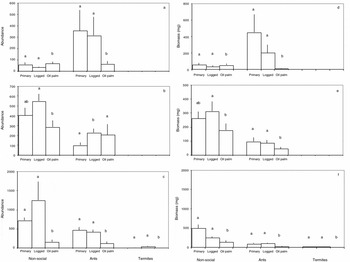
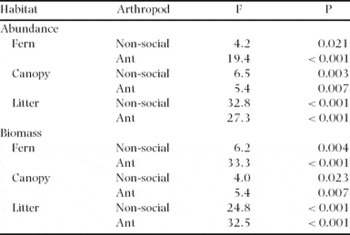
Overall, total arthropod abundance declined by 67.2% in the ferns, 2.3% in the canopy and 77.1% in the litter between primary forest and oil palm plantation, while total arthropod biomass declined by 87.5% in the ferns, 37.9% in the canopy and 72.4% in the litter (Figure 2). There was generally a lower abundance and biomass of non-social arthropods, ants and termites in the oil palm plantation compared with the forest habitats (Table 2, Figure 2). In the ferns, with fern dry weight included as a co-variable, abundance and biomass of non-social arthropods were significantly lower in the oil palm compared with the primary and logged forest, although abundance per fern increased by 13.9% and biomass decreased by 5.3% between primary forest and oil palm.
Non-social arthropod, ant and termite abundance and biomass per sample in primary forest, logged forest and oil palm plantation. Abundance in the ferns (a), abundance in the canopy (b), abundance in the litter (c), biomass in the ferns (d), biomass in the canopy (e), biomass in the litter (f). Owing to very low occurrences in the ferns and canopy, termites are only included in the litter samples. Standard error bars are shown. N = 20 sample points in each habitat. Different letters denote a significant difference between habitats (fern dry weight included as a co-variable in the fern analyses).

Abundance and biomass of non-social arthropods and ants compared between habitats in epiphytic bird's nest ferns, canopy and leaf litter using GLMs (N = 20).

Both abundance and biomass of ants in the ferns were significantly lower in the oil palm than in the primary and logged forest, with samples declining by 82.2% per fern in abundance and 98.4% in biomass between the primary forest and oil palm. In the canopy, both the abundance and biomass of non-social arthropods were lower in the oil palm than the logged forest, with a 29.0% decline in abundance and 31.7% decline in biomass between the primary forest and the oil palm plantation. The abundance of ants in the canopy was lower in the oil palm than in the logged forest and the biomass lower than in both the primary and logged forest, with abundance actually increasing by 105% in the oil palm compared with the primary forest, but biomass declining by 54.4%. In the litter, the non-social arthropod abundance and biomass was lower in the oil palm than in the primary and logged forest, with abundance declining by 78.3% and biomass by 70.8% between the primary forest and oil palm. The abundance and biomass of ants in the litter was also lower in the oil palm than in both the primary and logged forest, with abundance declining by 74.9% and biomass by 78.8% between the primary forest and oil palm. Finally the abundance and biomass of termites in the litter was lower in the oil palm than in the logged and primary forest (abundance: Kruskal–Wallis, H = 17.1, df = 2, P < 0.001, biomass: Kruskal–Wallis, H = 15.9, df = 2, P < 0.001), with abundance declining by 99.0% and biomass by 97.9% between the primary forest and the oil palm.
Despite this dramatic overall reduction in abundance and biomass of oil palm arthropods, not all taxa showed the same response (Appendices 1 and 2). For example, in the ferns, Coleoptera, Araneae, Isopoda and Blattodea had a higher abundance in oil palm than in the primary forest and Diplopoda, Chilopoda and Araneae had a higher biomass. This was reflected by a significant change in the community structure between habitats (DCA: axis two: eigenvalue = 0.168, Kruskal–Wallis, H = 9.7, df = 2, P = 0.008, axis three: eigenvalue = 0.132, Kruskal–Wallis, H = 10.9, df = 2, P = 0.004), with primary and logged forest both differing significantly from oil palm in axis two and primary forest differing from logged forest and oil palm in axis three. In the canopy, Formicidae, Acari, Coleoptera, Isopoda, Blattodea, Lepidoptera and Diplura had a higher abundance in oil palm compared to primary forest and Blattodea, Lepidoptera and Mantodea, had a higher biomass. Again this was reflected by a significant change in the community structure (DCA: axis one: eigenvalue = 0.216, GLM, F2,57 = 15.1, P < 0.001, axis two: eigenvalue = 0.075, Kruskal–Wallis, H = 31.2, df = 2, P < 0.001), with primary and logged forest both differing significantly from oil palm in axis one and all habitats differing from each other in axis two. In contrast in the leaf litter, there was a more general decline in all taxa in the oil palm relative to the forest with no significant change detected in the composition (DCA: axis one: eigenvalue = 0.344, GLM, F2,57 = 1.8, P = 0.174, axis two: eigenvalue = 0.054, GLM, F2,57 = 1.7, P = 0.201).
Fern arthropod abundance per transect was significantly different between habitats (GLM, F2,57 = 3.6, P = 0.034), with the logged forest having a significantly lower abundance than the primary forest and oil palm plantations, which did not differ from each other. Arthropod biomass also differed significantly between habitats (GLM, F2,57 = 7.2, P = 0.002), with the primary forest having a higher biomass than the logged forest, but not different from the oil palm plantation. Overall per hectare the percentage of total arthropod abundance and biomass housed in ferns compared to that in the canopy and leaf litter was very low, but was relatively higher in oil palm plantations compared with the forest (abundance: primary = 0.37%, logged = 0.18%, oil palm = 1.19%; biomass: primary = 0.88%, logged = 0.22%, oil palm = 0.77%).
DISCUSSION
Our results clearly demonstrate the dramatic negative effect that oil palm plantations have on the overall arthropod community, which has only been shown before for specific taxa (Chang et al. Reference CHANG, HII, BUTTNER and MANSOOR1997, Chey Reference CHEY2006, Chung et al. Reference CHUNG, EGGLETON, SPEIGHT, HAMMOND and CHEY2000a, Reference CHUNG, HAMMOND, EGGLETON, SPEIGHT and CHEYb; Davis & Philips Reference DAVIS and PHILIPS2005, Pfeiffer et al. Reference PFEIFFER, HO and TEH2008). This ecosystem-wide loss of arthropods is probably due to the dramatically altered structural habitat and harsher environmental conditions in plantations. Such an ecosystem-wide decline in arthropods is likely to have negative consequences on overall biodiversity and ecosystem functioning in the plantation landscape.
However, not all taxa showed the same negative response in all parts of the ecosystem, resulting in an altered community structure in the fern and canopy between habitats, with some groups (particularly beetles, woodlice and cockroaches) being more common in oil palm. Ants particularly differed in their response compared with the rest of the arthropod community, being affected to a greater degree by habitat change in epiphytes than in the canopy. Such variability between taxa is probably due to species-specific differences in tolerance to agricultural landscapes. It is likely that the arthropods that do well in a plantation are species that are more common in the wider agricultural landscape (Chey Reference CHEY2006, Davis & Philips Reference DAVIS and PHILIPS2005) and so are considered to be of less conservation importance than forest specialists, which may have been lost. However, these arthropods can still be important in the functioning of oil palm plantations and the ecosystem as a whole, aiding decomposition, preying on pests, or providing a food source for predators.
Of the three areas of habitat studied, the leaf litter was the most adversely affected in oil palm, with abundance and biomass of nearly all groups declining dramatically. Such a response may well reflect the reduced leaf litter input in oil palm ecosystems as well as the high levels of disturbance that this area would receive as palm fruits are harvested.
Bird's nest ferns were common across all three habitats, but reached their highest density, size and total biomass in oil palm plantations, perhaps due to a more favourable environment and the large areas of suitable habitat on oil palm trunks. They are, therefore, a significant structural component of both forest and plantation habitats. They also housed a considerable density of arthropods, although only a low percentage of the total arthropod community in each habitat. Owing to their relative increase in size and density in plantations, bird's nest ferns represented a numerically more important component of the total arthropod community in plantations compared with forest, and therefore perhaps a useful foraging source for insectivorous predators.
Palm oil is now the number one source of vegetable oil worldwide, with some 37 708 000 Mg produced in 2005 (27% of the world's total oil and fat production). In Malaysia, the area under oil palm has increased from only 54 000 ha in 1960 to 4.05 million ha in 2005. Expansion of oil palm cultivation is set to increase in the future, as alternative uses for the oil and byproducts of the industry are found (Basiron Reference BASIRON2007). Pressure on remaining areas of tropical forests in palm oil-producing countries is therefore likely to increase. It is crucial that we investigate the effects of this expansion on arthropods, and what impact this has on the ecosystem services within plantations. Our results have demonstrated that, at the ordinal level, arthropods differ in their response to habitat change. Identifying winners and losers as a result of forest conversion to oil palm is important in determining the long-term impact of oil palm expansion. Further work is needed to investigate management strategies that can be employed to render plantations more favourable for arthropods, in particular those that carry out beneficial ecosystem functions. Only in this way can we maintain arthropod communities and consequently healthy ecosystem functioning in the ever-expanding oil palm landscape.
ACKNOWLEDGEMENTS
We would like to thank J. Larenus and A. Karolus for all their help during data collection, Dr V. K. Chey for his support during the project, M. and B. Richardson for kindly letting us use their biomass regression equations, G. Reynolds and the Royal Society Southeast Asia Research Programme for providing useful advice and practical support in the field, Borneo Samudera and Sebrang Estate for kindly allowing research to be carried out in their plantation, the Economic Planning Unit and the Danum Valley Management Committee for permission to undertake fieldwork in Malaysia, the DVFC management and staff for making our stay so pleasant and M. D. F. Ellwood, J. L. Snaddon, T. M. Fayle and H. Corley for their helpful comments on the script. Research was funded by the Natural Environment Research Council.