Infants and children who undergo cardiac surgery can often experience considerable haemodynamic instability in the postoperative period. The cause of this postoperative haemodynamic instability can be multi-factorial, including but not limited to preoperative disease severity, for example, pulmonary hypertension and congestive heart failure, exposure to an extracorporeal cardiopulmonary bypass circuit, use of intraoperative deep hypothermic circulatory arrest, and postoperative inflammation and capillary leak inherent to a complex and often prolonged surgical procedure.Reference Wernovsky, Wypij and Jonas 1 , Reference Hoffman, Wernovsky and Atz 2 These children frequently develop postoperative low cardiac output syndrome, which typically consists of tachycardia, hypotension, oliguria, and poor peripheral perfusion. It has been found that up to 25% of patients undergoing cardiac surgery can have symptoms of low cardiac output syndrome.Reference Wernovsky, Wypij and Jonas 1 , Reference Hoffman, Wernovsky and Atz 2
Several studies have described the use of systemic corticosteroid therapy with hydrocortisone to decrease the effects of postoperative low cardiac output syndrome and improve haemodynamic integrity in many of these patients.Reference Shore, Nelson and Pearl 3 – Reference Verweij, Hogenbirk, Roest, van Brempt, Hazekamp and de Jonge 8 These haemodynamic benefits do not appear to be universal but rather have been observed in ~40% of patients in whom it is administered.Reference Millar, Thiagarajan and Laussen 6 – Reference Verweij, Hogenbirk, Roest, van Brempt, Hazekamp and de Jonge 8 Some centres including our institution often obtain random total serum cortisol concentrations to guide hydrocortisone therapy, based on the assumption that patients with low serum cortisol concentrations may be more likely to benefit from this therapy. Studies to date, however, have not supported this practice, although the definition of what constitutes haemodynamic benefit has varied between these reports.Reference Millar, Thiagarajan and Laussen 6 – Reference Verweij, Hogenbirk, Roest, van Brempt, Hazekamp and de Jonge 8 The significance of random total serum cortisol concentrations therefore remains unclear, and there are currently no clear guidelines for the implementation of hydrocortisone therapy in this patient population.
The primary aim of our study was to determine whether random total serum cortisol concentration can be predictive of clinical response to hydrocortisone in patients recovering from cardiac surgery at our institution. On the basis of the current literature, we hypothesised that haemodynamic response to hydrocortisone therapy would not be significantly related to pre-hydrocortisone serum cortisol concentrations. Our secondary aim was to determine whether significant clinical differences exist between patients who responded favourably to hydrocortisone therapy and those who do not.
Materials and methods
We performed a retrospective review of patients <21 years of age who underwent cardiovascular surgery at Riley Hospital for Children at Indiana University Health between 1 January, 2011 and 31 December, 2013. This review was approved by the Institutional Review Board at Indiana University.
Patient population
All patients in our institution who undergo surgery with cardiopulmonary bypass are given an intraoperative dose of methylprednisolone (30 mg/kg) before surgical incision. Postoperatively, patients who receive hydrocortisone therapy for haemodynamic instability are administered 1 mg/kg intravenously every 6 hours. Hydrocortisone is typically administered after blood for serum cortisol measurement is collected but before the result of this measurement is available. The decision to continue hydrocortisone therapy after the result of the serum cortisol measurement is available is at the discretion of the primary service. Patients who received hydrocortisone therapy for haemodynamic instability within the first 72 hours postoperatively and had pre-hydrocortisone treatment serum cortisol measurements obtained were reviewed. Patients who received less than three doses of hydrocortisone or patients receiving extracorporeal life support during hydrocortisone therapy were excluded.
Cortisol assay
Cortisol measurements were performed using the Access Cortisol assay (Beckman Coulter, Inc., Fullerton, California, United States of America), which is a competitive binding immunoenzymatic assay that utilises a chemiluminescent substrate to determine the concentration of cortisol in the sample.
Data collection
We recorded the following demographic, preoperative, and perioperative data: age, gender, weight, height, body surface area, race, underlying genetic abnormalities, cardiac lesion and surgical procedure, Society of Thoracic Surgeons-European Association for Cardio-Thoracic Surgery Congenital Heart Surgery mortality categories – STAT mortality categories,Reference Jacobs, O’Brien and Pasquali 9 and duration of cardiopulmonary bypass and aortic cross-clamp.
Postoperative data collected included pre-hydrocortisone total serum cortisol concentrations (µg/dl), the postoperative time point at which the measurement was obtained, and the total number of postoperative doses of hydrocortisone received. We also recorded heart rate, systolic blood pressure, diastolic blood pressure, pulse pressure, that is, systolic blood pressure–diastolic blood pressure, central venous pressure, and vasoactive-inotrope score at the following time points: 1 hour before initial hydrocortisone dose, at the time of hydrocortisone initiation (Time 0), and at 6, 12, and 24 hours after the initial hydrocortisone dose. Vasoactive-inotrope score was calculated using the following formula: dopamine (µg/kg/minute)+dobutamine (µg/kg/minute)+[100×epinephrine (µg/kg/minute)]+[100×norepinephrine (µg/kg/minute)]+[10×milrinone (µg/kg/minute)]+[10,000×vasopressin (U/kg/minute)].Reference Gaies, Gurney and Yen 10 We recorded the following outcome variables: occurrence of postoperative infection, duration of mechanical ventilation, duration of vasoactive medications, duration of ICU stay, and in-hospital mortality. Postoperative infection was defined as clinically relevant positive blood, urine, respiratory, or wound cultures or culture-negative sepsis – that is, systemic inflammatory response syndrome with suspected infection – treated with ⩾7 days of antimicrobial therapy. This latter definition has been used previously.Reference Pasquali, Hall and Li 11
Data analysis
We defined patients who responded favourably to hydrocortisone as patients in whom, at 24 hours after hydrocortisone initiation, either (1) systolic blood pressure was increased or unchanged and vasoactive-inotrope score decreased or (2) systolic blood pressure increased by ⩾10% of baseline and vasoactive-inotrope score was unchanged. We have used this definition previously.Reference Mastropietro, Davalos, Seshadri, Walters and Delius 12 Data for patients who responded favourably and those who did not are represented as absolute counts with percentages for categorical variables, means with standard deviations for normally distributed continuous variables, and medians with interquartile ranges (25, 75%) for skewed variables. Variables were compared using Fisher’s exact tests, t-tests, or Mann–Whitney U tests as appropriate.
Results
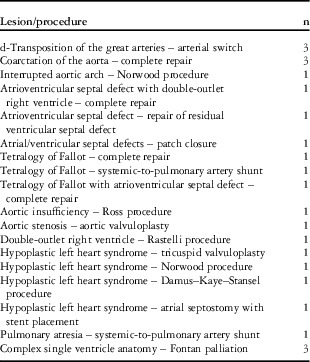
During the study period, 24 patients met inclusion criteria for review. Cardiac lesions and surgical procedures for all patients are summarised in Table 1. The median age for the entire cohort was 1.4 months (range 0.1–232 months). In all, six patients (25%) had underlying genetic abnormalities, the most common of which was Trisomy 21. The mean total serum cortisol level for all patients was 29.4±32.5 µg/dl (range: 1.6–124.7 µg/dl), obtained at a median time of 5.4 hours (range: 0–46 hours) after surgery.
Cardiac lesions and surgical procedures.

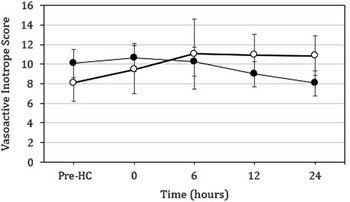
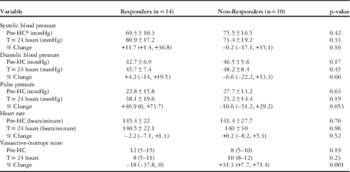
Among all, 14 (58%) patients responded favourably to hydrocortisone. Haemodynamic changes in systolic blood pressure, diastolic blood pressure, pulse pressure, heart rate, and vasoactive-inotrope score are compared in Table 2. At 24 hours after initiation of hydrocortisone therapy, the median change in vasoactive-inotrope score was –18% in patients who responded favourably and +31% in those patients who did not respond favourably, p=0.001. The changes in vasoactive-inotrope score over time in patients who responded favourably to hydrocortisone and those who did not are illustrated in Figure 1. Further, the median change in pulse pressure was +41% in those who responded favourably and –11% in those who did not respond favourably, p=0.053.
Mean hourly changes in vasoactive-inotrope score after initiation of hydrocortisone. In patients who responded favourably (dark circles), the vasoactive-inotrope score steadily decreased after hydrocortisone was started (time 0), whereas the vasoactive inotrope score in patients who did not respond or responded unfavourably (white circles) was increased. Error bars represent standard error of the mean.

Comparison of haemodynamic changes.

Continuous data are represented as mean±standard deviation, and skewed data are represented at median (25%, 75%); statistical significance p<0.05
* Pre-HC: measurements one hour before hydrocortisone therapy
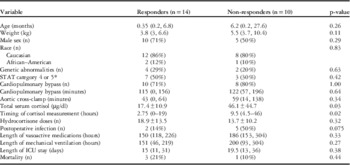
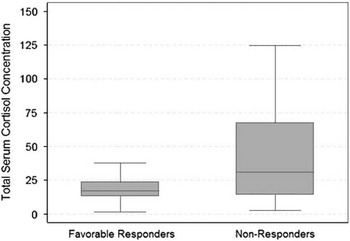
Patients who responded favourably to hydrocortisone therapy had lower mean pre-hydrocortisone total serum cortisol concentrations, 17.4±10.9 µg/dl, compared with those who did not respond favourably, 46.1±44.7 µg/dl (p=0.03) as illustrated in Figure 2. Demographic, intraoperative, and postoperative data for those who responded favourably and those who did not are provided in Table 3. Timing of cortisol measurements were significantly earlier in the postoperative courses of patients who responded favourably, at a median of 2.75 hours (range: 0–19 hours), as compared with 9.5 hours (range: 4.5–46 hours) in patients who did not respond favourably, p=0.02. There was also a near-significant trend towards a greater occurrence of postoperative infection in patients who did not respond favourably. Otherwise, all other patient characteristics including number of doses of hydrocortisone received and patient outcomes did not differ between study groups.
Comparison of patient characteristics.

* Society of Thoracic Surgeons-European Association for Cardio-Thoracic Surgery Congenital Heart Surgery mortality categories Categorical data represented as absolute counts with percentages, normally distributed continuous data are represented as mean±standard deviation, and skewed continuous data are represented as median (25%,75%); statistical significance: p-value <0.05
Discussion
The reference ranges for what are considered to be a normal morning and evening total serum cortisol concentrations are 8–25 µg/dl and 4–20 µg/dl, respectively. Patients with normally functioning hypothalamic–pituitary adrenal axes should have total serum cortisol concentrations elevated above these ranges during times of stress or illness, indicating increased activation of the axis. Thus, for critically ill patients including children recovering from cardiac surgery, who by definition are stressed while combating their underlying disease processes, low-to-normal total serum cortisol concentration could be indicative of an insufficient response of the hypothalamic–pituitary adrenal axis.Reference Bronicki 13 , Reference Bronicki and Chang 14 Gajarski et al reported such abnormalities in a cohort of children recovering from cardiac surgery with cardiopulmonary bypass. In this study, patients with abnormal adrenocorticotropic hormone to cortisol ratios – that is, high adrenocorticotropic hormone and low cortisol levels – had significantly higher inotrope requirements as compared with the rest of the cohort.Reference Gajarski, Stefanelli, Graziano, Kaciroti, Charpie and Vazquez 15 Abnormalities of the hypothalamic–pituitary adrenal axis in children recovering from cardiac surgery have also been reported in other studies.Reference Wald, Preze, Eickhoff and Backer 16 , Reference Menon, Ward and Lawson 17 For this reason, systemic corticosteroid therapy for the treatment of low cardiac output syndrome in children recovering from paediatric cardiac surgery has become relatively commonplace.
To date, studies attempting to utilise total serum cortisol concentration as a means of identifying optimal or poor candidates for hydrocortisone therapy within this patient population have not been fruitful. To our knowledge, this report is the first study to find a relationship between total serum cortisol concentration and clinical response to hydrocortisone in children recovering from cardiac surgery. Contrary to our study hypothesis and previous reports,Reference Millar, Thiagarajan and Laussen 6 – Reference Verweij, Hogenbirk, Roest, van Brempt, Hazekamp and de Jonge 8 we found that patients who had a favourable haemodynamic response to hydrocortisone therapy were more likely to have lower total serum cortisol concentrations as compared with those who did not respond. In addition, our proportion of favourable responders (58%) was higher than what has been reported previously.Reference Millar, Thiagarajan and Laussen 6 – Reference Verweij, Hogenbirk, Roest, van Brempt, Hazekamp and de Jonge 8 The disparity between our findings and previous studies is likely explained, at least in part, by differences in the definition of a favourable haemodynamic response. Millar and colleagues were the first to examine the relationship between total serum cortisol concentration and haemodynamic response to hydrocortisone therapy.Reference Millar, Thiagarajan and Laussen 6 The authors defined a favourable haemodynamic response as an increase of 20% or greater in systolic blood pressure without an increase in inotropic support. This study also included non-surgical patients with cardiac disease – that is, patients who did not undergo cardiac surgery. Sasser et al also reported their experience, including only children recovering from cardiac surgery, but defined a favourable haemodynamic response as a decrease in vasoactive-inotrope score of <50% by 24 hours after hydrocortisone therapy.Reference Sasser, Robert and Carlo 7 Our less-stringent definition categorised favourable responders as patients with an increase in systolic blood pressure but not yet had their inotrope infusions weaned as well as patients with relatively unchanged systolic blood pressures but with reduced inotrope dosages. We speculate that this definition likely included a larger proportion of patients with relatively low total serum cortisol concentrations as favourable responders as compared with previous studies, accounting for the observed difference in our results.
Verweiji et al also reported their experience with total serum cortisol concentration and haemodynamic response to hydrocortisone therapy but approached the question differently.Reference Verweij, Hogenbirk, Roest, van Brempt, Hazekamp and de Jonge 8 These authors defined low cortisol as <100 nmol/L (=3.6 µg/dl) and then reviewed the haemodynamic responses of patients with total serum cortisol concentration <100 nmol/L and >100 nmol/L. There was no difference in haemodynamic response between the two groups. This study, however, included children recovering from cardiac surgery up to 156 hours after cardiopulmonary bypass. By restricting our patient population to patients who received hydrocortisone within the first 72 hours after surgery, we hoped to minimise the heterogeneity in the likely aetiology of our patients’ low cardiac output syndrome, which could affect how a patient responds to the therapy. In other words, low cardiac output syndrome within the first 72 hours after surgery experienced by our patients was most likely related to the stress inherent to the surgery itself rather than to other potential aetiologies that could occur later in the postoperative course – for example, sepsis and effects of unrecognised residual lesions.
On the basis of our data, we are not able to provide a total serum cortisol concentration below which patients are more likely to respond to hydrocortisone therapy. In fact, patients with low-to-normal total serum cortisol concentrations were noted in both favourable responders and in patients who did not respond favourably to hydrocortisone therapy. Patients with elevated total serum cortisol concentrations, however, were almost exclusively in the group of patients who did not respond favourably. These findings suggest that a favourable haemodynamic response to hydrocortisone is not reliant simply on low pre-administration total serum cortisol concentrations, but further systemic corticosteroid administration in patients in whom total serum cortisol concentrations are already elevated is likely unhelpful and potentially harmful. Indeed, postoperative corticosteroid therapy has been associated with the development of postoperative infections in children recovering from cardiac surgery,Reference Mastropietro, Barrett and Davalos 18 , Reference Turcotte, Brozovich and Corda 19 and we observed a near-significant trend towards increased incidence of postoperative infections in those patients who did not respond to hydrocortisone therapy. Thus, low-to-normal total serum cortisol concentrations are likely not sufficient to accurately predict a favourable haemodynamic response to hydrocortisone therapy, but elevated total serum cortisol concentrations could potentially spare children from harmful effects of unnecessary additional corticosteroid administration; further research regarding this is warranted.
Of note, our study also found that a favourable haemodynamic response to hydrocortisone was not associated with better postoperative outcomes. We observed no significant difference in duration of mechanical ventilation, duration of vasoactive medication administration, length of ICU stay, or mortality between patients who did and did not respond favourably to hydrocortisone therapy. A recent single-centred, randomised trial of hydrocortisone therapy in neonates recovering from cardiac surgery with cardiopulmonary bypass reported a decreased incidence of low cardiac output syndrome in patients who received hydrocortisone but also did not show a difference in the aforementioned clinical outcomes.Reference Robert, Borasino, Dabal, Cleveland, Hock and Alten 20 Neither this study nor our study was adequately powered to test these important clinical outcomes, underscoring the need for a larger, multi-centred study to better answer this question. In fact, based on our data, it may be reasonable to exclude patients with elevated postoperative total serum cortisol concentrations from these future investigations.
This study is limited by its relatively small sample size and its retrospective, single-centre design. Our inclusion and exclusion criteria may have led to some selection bias – for example, we also did not include patients who were on extracorporeal membrane oxygenation support because of the difficulty in assessing the haemodynamic response to hydrocortisone in patients receiving this modality. Preoperative administration of methylprednisolone at our institution could have also influenced our findings. There are currently no data available on the cross-reactivity of the cortisol assay used at our institution and methylprednisolone. If cross-reactivity exists, methylprednisolone, which has a terminal half-life of 2.5 hours,Reference Ito, Kusunoki, Oka, Ito, Okuno and Yoshioka 21 could have falsely elevated our serum cortisol measurements obtained in the early postoperative period. Elevated serum cortisol concentrations, however, were more commonly observed in patients who did not respond favourably, from whom samples were obtained and in whom timing of cortisol measurements were significantly later in the postoperative period, when minimal methylprednisolone would have been present. In addition, we did not have free cortisol and cortisol-binding globulin measurements available for any of our patients. Future prospective studies should include these data in order to optimally characterise patients’ serum cortisol activity before hydrocortisone therapy. Finally, we also acknowledge that our definition of responders and non-responders may not properly categorise all patients. Larger studies powered to determine whether short-term improvements in haemodynamic integrity are associated with more meaningful clinical outcomes such as duration of mechanical ventilation, ICU length-of-stay, and mortality are needed.
In conclusion, simple measurement of total cortisol concentration may be of some value to clinicians caring for haemodynamically unstable children recovering from cardiac surgery. In particular, administration of hydrocortisone therapy to patients with elevated total cortisol concentrations is likely of little benefit and could be potentially harmful.
Comparison of postoperative cortisol levels in favourable responders to hydrocortisone and those who did not respond favourably. Favourable responders had lower mean pre-hydrocortisone cortisol levels (17.4±10.9 µg/dl) compared with those who did not respond favourably (46.1±44.7 µg/dl), p=0.03.

Acknowledgements
None.
Financial Support
This research received no specific grant from any funding agency, commercial, or not-for-profit sectors.
Conflicts of Interest
None.
Ethical Standards
The authors assert that all procedures contributing to this work comply with the ethical standards of the United States of America guidelines on human experimentation set forth by the National Commission for the Protection of Human Subjects of Biomedical and Behavioral Research, and with the Helsinki Declaration of 1975, as revised in 2008, and has been approved by the institutional review board of Indiana University.