Introduction
Knowledge about the course of panic and variables influencing its course is necessary to understand the nature of panic disorder (PD). Moreover, these data are necessary to inform individuals with panic, and to be able to plan treatment and treatment facilities. Hence, this theme has been addressed in multiple clinical studies, most often leading to the conclusion that PD is a chronic or intermittent disorder (Goodwin et al. Reference Goodwin, Faravelli, Rosi, Cosci, Truglia, de Graaf and Wittchen2005).
However, methodological issues may have led to an overestimation of the degree of chronicity. First, in most previous studies the course was investigated in clinical samples. It is likely that clinical samples are biased towards chronicity, as those with a longer duration of symptoms are more inclined to seek treatment (Buller et al. Reference Buller, Winter, Amering, Katschnig, Lavori, Deltito and Klerman1992), or to remain in treatment for longer periods. Second, most studies included individuals irrespective of the duration of their symptoms. Such a cross-sectional identification of cases may lead to a substantial over-representation of chronic cases (Cohen & Cohen, Reference Cohen and Cohen1984). Third, previous studies focused on the course of PD only. Including subthreshold panic disorder (sub-PD) in panic research is being recommended (Shear & Maser, Reference Shear and Maser1994) because sub-PD is common, and is associated with impaired functioning (Kessler et al. Reference Kessler, Chiu, Jin, Ruscio, Shear and Walters2006; Batelaan et al. Reference Batelaan, de Graaf, van Balkom, Vollebergh and Beekman2007a) and with substantial economic costs for society (Batelaan et al. Reference Batelaan, Smit, de Graaf, van Balkom, Vollebergh and Beekman2007b). Despite its clinical relevance, data regarding the prognosis of sub-PD are lacking.
Assessment of whether the course of panic is chronic requires general population studies that investigate panic episodes from the onset of the episode onwards in both PD and sub-PD (Cohen & Cohen, Reference Cohen and Cohen1984; Shear & Maser, Reference Shear and Maser1994; Katschnig & Amering, Reference Katschnig and Amering1998; Ballenger, Reference Ballenger, Gelder, Lopez-Ibor and Andreasen2000). However, apart from one study conducted by Eaton et al. (Reference Eaton, Anthony, Romanoski, Tien, Gallo, Cai, Neufeld, Schlaepfer, Laugharne and Chen1998), these studies are almost non-existent. Eaton et al. (Reference Eaton, Anthony, Romanoski, Tien, Gallo, Cai, Neufeld, Schlaepfer, Laugharne and Chen1998) investigated the course of panic attacks in 32 individuals with PD from the general population and concluded that panic is not always a chronic disorder, but that its course is more varied when studied in the general population.
With regard to predictors of course, multiple variables, although not always consistently throughout different studies, have been found to predict the course of panic attacks in patient samples (e.g. Roy-Byrne & Cowley, 1994/Reference Roy-Byrne and Cowley1995; O'Rourke et al. Reference O'Rourke, Fahy, Brophy and Prescott1996). In general population samples, predictors of course have hardly been investigated (Eaton et al. Reference Eaton, Anthony, Romanoski, Tien, Gallo, Cai, Neufeld, Schlaepfer, Laugharne and Chen1998; Katschnig & Amering, Reference Katschnig and Amering1998).
The present study aimed to clarify the naturalistic course of panic attacks from the onset of an episode in subjects with PD or sub-PD from the general population. Subjects with either first-ever incident episodes of panic or recurrent-incident episodes were included. In addition, we aimed to determine which variables predict remission. Data from the Netherlands Mental Health and Incidence Study (NEMESIS) were used. The course was investigated by examining remission, chronicity and recurrence of panic attacks. Differences between the course of PD and the course of sub-PD were examined.
Method
Procedures
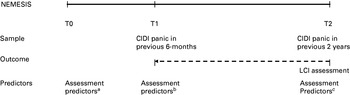
Data were obtained from the NEMESIS; the methodology of the NEMESIS has been described more fully elsewhere (Bijl et al. Reference Bijl, van Zessen, Ravelli, de Rijk and Langendoen1998). In brief, the NEMESIS is a prospective psychiatric epidemiological survey conducted among the adult general population (ages 18–64 years) of The Netherlands. The survey consists of three waves of interviews carried out in 1996, 1997 and 1999. Procedures were approved by the ethics committee of the Netherlands Institute of Mental Health and Addiction. Participants in the survey were representative of the Dutch population with regard to gender, civil status and urbanization level. Only the 18–24 years age group was somewhat under-represented (Bijl et al. Reference Bijl, van Zessen, Ravelli, de Rijk and Langendoen1998). The design of the present study is presented in Fig. 1 and is outlined below.
Design. a Including the following putative predictors: gender, education, parental psychiatric history, childhood trauma, somatic disorders, and combined with data of T1, history of anxiety disorder, history of affective disorder, history of alcohol/drug disorder, history of panic symptoms, and history of agoraphobic symptoms. b Including the following putative predictors: age, cohabitation status, employment, mastery, neuroticism, self-esteem, positive life events, negative life events, ongoing difficulties, social support, and combined with data of T0, history of anxiety disorder, history of affective disorder, history of alcohol/drug disorder, history of panic symptoms, and history of agoraphobic symptoms. c Including the following putative predictors: severity of panic (subthreshold panic disorder versus panic disorder), frequency of panic at start of panic episode, burden at start of panic episode, and functioning at start of panic episode.

The Composite International Diagnostic Interview (CIDI) and the Life Chart Interview (LCI)
To identify subjects with PD or sub-PD, the Composite International Diagnostic Interview (CIDI; WHO, 1990) was used in its computerized version (Smeets & Dingemans, Reference Smeets and Dingemans1993). The CIDI is a fully structured interview for diagnosing mental disorders and can be administered by trained interviewers who are not clinicians (Robins et al. Reference Robins, Wing, Wittchen, Helzer, Babor, Burke, Farmer, Jablenski, Pickens and Regier1988). It has acceptable psychometric properties for almost all diagnoses, including PD (Wittchen, Reference Wittchen1994). To warrant adequate diagnostic interviewing, all interviewers in NEMESIS were trained by the World Health Organization (WHO) CIDI centre (Bijl et al. Reference Bijl, van Zessen, Ravelli, de Rijk and Langendoen1998). PD was classified according to DSM-III-R criteria. Sub-PD is defined as the subject experiencing at least one sudden attack of intense fear, in a situation in which most people would not be afraid. This experience may not be attributable to an organic cause and must have been accompanied by at least two of the 13 panic-related symptoms in the DSM-III-R. Thus, this definition of sub-PD includes both limited symptom attacks (LSAs, that is with two or three panic-related symptoms) and infrequent panic attacks (IPAs, that is with at least four panic-related symptoms).
The third wave of the NEMESIS included a Life Chart Interview (LCI; Lyketsos et al. Reference Lyketsos, Nestadt, Cwi, Heithoff and Eaton1994) for subjects with depression (Spijker et al. Reference Spijker, de Graaf, Bijl, Beekman, Ormel and Nolen2002) or panic. The panic-LCI was administered to all respondents answering positively to a stem question regarding anxiety attacks during the past 3 years. It retrospectively assessed the 2-year course of panic attacks in eight 3-month periods. The presence and frequency of panic attacks and also the panic-associated level of functioning and burden were assessed. Memory cues were used to improve recall.
Outcome variables
The course of attacks was investigated by assessing several outcome criteria: remission, time to remission, remission rate, chronicity, and recurrence rate. Remission was defined as the absence of attacks during 6 consecutive months, including both LSAs and IPAs. Time to remission was defined as the number of months from onset of panic attacks to the beginning of this 6-month period. If in either the first 3-month period or the last 3-month period before remission only a single attack was reported, it was assumed that this attack was experienced halfway through the 3-month period. The remission rate was defined as the number of remissions divided by the total observed person-months. Chronicity was regarded as present if the episode with attacks lasted at least 12 months. Recurrence was defined as the re-occurrence of attacks following remission.
Putative indicators of remission
Predictor variables of remission consisted of multiple variables including sociodemographics, psychobiological, environmental, psychiatric and panic-related factors (see Table 3). Most of these have been included in previous research (Roy-Byrne & Cowley, 1994/Reference Roy-Byrne and Cowley1995; O'Rourke et al. Reference O'Rourke, Fahy, Brophy and Prescott1996). These were assessed prior to the investigated 2-year period, during either the first or the second wave of the NEMESIS, except for most of the panic-related factors, which were assessed retrospectively in the third wave.
Sociodemographics included gender, age (lower versus higher than the average age of 39 years in the research sample), living with a partner, education (lower than versus equal to or higher than secondary school), and paid employment. Psychobiological variables included parental psychiatric history of anxiety or depression, reported childhood trauma, mastery, neuroticism, self-esteem, and chronic somatic illness. Parental psychiatric history was considered positive when one or both biological parents had ever exhibited an affective or anxiety disorder. Childhood trauma was considered present in cases of experiencing emotional neglect, psychological abuse or physical abuse on two or more occasions prior to age 16, or sexual abuse on one or more occasions prior to age 16. Mastery (i.e. locus of control) was assessed using the Mastery Scale (Cronbach's α=0.81) (Pearlin & Schooler, Reference Pearlin and Schooler1978); neuroticism was assessed with the short form of the Neuroticism Scale from the Amsterdam Biographical Questionnaire (ABV; Ormel & Rijsdijk, Reference Ormel and Rijsdijk2000), a 14-item, three-point scale (Cronbach's α=0.80) that is based on the Maudsley Personality Inventory; and self-esteem was recorded on the Rosenberg Self-Esteem Scale (Cronbach's α=0.86) (Rosenberg, Reference Rosenberg1965). Personality scores were dichotomized such that one-third of the research sample received unfavourable ratings. Chronic somatic illness was assessed by means of a list of 31 chronic somatic disorders for which treatment or monitoring had taken place by a physician in the 12 months preceding the interview (absent versus present). Environmental factors consisted of positive life events, negative life events, ongoing difficulties and level of social support. Life events and ongoing difficulties were recorded using a questionnaire developed from the Life Events and Difficulties Schedule (LEDS; Brown & Harris, Reference Brown and Harris1987). The questionnaire covered nine positive and nine negative life events, and three ongoing difficulties that were included if, according to the subject, these had had impact on their mental health. Social support was assessed using the Social Support Questionnaire for Satisfaction (SSQS; Doeglas et al. Reference Doeglas, Suurmeijer, Briancon, Moum, Krol, Bjelle, Sanderman and van den Heuvel1996) (Cronbach's α=0.74), assessing the actual amount of social support in relation to the desirable amount of social support. Scores were dichotomized such that one-third of the research sample received unfavourable ratings. Psychiatric factors included a (lifetime) history of an anxiety disorder, affective disorder or a history with an alcohol or drug disorder as assessed by the CIDI during the first and second waves of the NEMESIS. Anxiety disorders included social phobia, simple phobia, generalized anxiety disorder, and obsessive compulsive disorder; affective disorders included major depressive disorder, bipolar disorder, and dysthymia; alcohol and drug disorders included alcohol abuse, alcohol dependence, and drug abuse and drug dependence. Panic-related factors included the severity of panic (i.e. PD versus sub-PD), a history of panic symptoms, a history of agoraphobic symptoms and, at the beginning of the panic episode, frequency of attacks, panic-associated burden and panic-associated level of functioning. The severity of panic (i.e. PD and sub-PD) was assessed by the CIDI during the third wave. A history of panic symptoms was assessed by the CIDI in the first and second waves of the NEMESIS. A history of agoraphobic symptoms was also assessed by the CIDI in the first and second waves of the NEMESIS. The LCI retrospectively assessed frequency of panic attacks, burden due to panic and level of functioning. Scores concern the first 3-month period in which the subject had reported panic. Frequency was dichotomized as one attack per 3-month period versus more frequent attacks. Burden was assessed on a five-point ordinal scale; functioning was assessed as a mark ranging from 0 to 10; both burden and functioning were regarded as interval variables.
Sample
Subjects were selected if the following criteria were met: subjects should have participated in all three waves of the NEMESIS; they should have developed an episode of sub-PD or PD during the 2 years preceding T2 (as this period was investigated by the LCI); and they should have completed the LCI. As mentioned earlier, panic was investigated (retrospectively) from the onset of an episode onwards, irrespective of the presence of previous panic. Thus, subjects may have had a history with panic but should have been in remission at the start of the period investigated by the LCI. Therefore, subjects with a 6-month CIDI classification of sub-PD or PD at T1 were excluded. Thus, the selected sample is an inception cohort. Finally, all subjects should have had the opportunity to achieve remission and should therefore have been followed up for 6 months after the 3-month period in which the onset of panic was reported.
Of the 7076 subjects who had taken part at the baseline interview in the NEMESIS (T0), 5618 were reinterviewed at T1 (response 79.4%). A total of 4796 subjects participated in all three waves (response of those interviewed in the second wave 85.4%) (de Graaf et al. Reference de Graaf, Bijl, ten Have, Beekman and Vollebergh2004). Of these, 161 reported a new episode of sub-PD or PD during the 2 years preceding the third wave, of whom 134 completed the LCI (83.2%). Five subjects were excluded because no panic attacks were reported in the LCI despite answering the stem question positively. Finally, 25 subjects were excluded because the available observation time was insufficient to achieve remission, leaving a study sample of 104. Of these, 31 had PD and 73 had sub-PD.
Subsamples were constructed to investigate time to remission, chronicity and recurrence. Time to remission was calculated in those who reached remission (n=79, PD n=20, sub-PD n=59). Chronicity was investigated in subjects with at least a 12-month observation period, in order to avoid a situation in which subjects for whom only a short observation period was available would be regarded as ‘not chronic’ (n=93, PD n=30, sub-PD n=63). Recurrence of panic was investigated in a subsample consisting of subjects who had reached remission and for whom at least an additional 6-month observation period was available (n=60, PD n=14, sub-PD n=46). Because of the small size of this subsample, especially with regard to PD, recurrence rates were not calculated.
Attrition and selection bias
Twelve-month PD or sub-PD at baseline did not predict loss to follow-up between baseline and the third wave while adjusting for sociodemographic variables and the presence of somatic disorders [odds ratio (OR) 1.10, 95% confidence interval (CI) 0.87–1.40]. χ2 statistics showed that subjects who completed the LCI did not differ significantly from subjects who did not participate with regard to age (p=0.97), level of education (p=0.38), the presence of a chronic somatic disorder (p=0.81), previous panic symptoms (p=0.64), a mental disorder in the second wave (p=0.79) or agoraphobia in the second wave (p=0.19). However, women more often filled out the LCI than males (87.6% v. 72.9%, p=0.02) and those with PD more often filled out the LCI than those with sub-PD (94.9% v. 79.5%, p=0.03).
Statistical analysis
Prognosis
Our first aim was to investigate the prognosis of episodes of PD and sub-PD from the onset of the episode by examining several outcome variables: remission, time to remission, remission rate, chronicity, and recurrence. Remission rates per 100 person-months were computed by dividing the number of observed remissions by the number of total person-months observed, multiplied by 100. The observed months are those from onset of panic until remission (for those achieving remission) or until censoring at the end of the investigated period in the LCI (for those not achieving remission).
To compare the course of PD and sub-PD, the sample was divided into two panic categories, PD and sub-PD, according to their CIDI ratings at the third wave and the severity of panic during the previous 2 years. Study characteristics across these groups were compared by means of a t test (average age) and χ2 statistics (other characteristics). Differences between PD and sub-PD were tested for all outcome criteria. For the proportions of remission, chronicity and recurrence, differences between PD and sub-PD were tested using χ2 statistics. For remission rates, differences were tested using a Cox proportional hazard regression model. The assumption of proportionality of hazard was checked with a log minus log plot. For average time to remission in those achieving remission, differences between PD and sub-PD were tested using the non-parametric Mann–Whitney U test.
Predictors
Our second aim was to determine which variables predicted remission. To heighten statistical power, the sample was not stratified according to severity of panic (sub-PD versus PD); instead, severity of panic was entered as a putative variable. Overall estimates of the relative risk of remission were computed from Cox proportional hazards regression models. Because of the relatively small sample size, both significant (p<0.05) and marginally significant associations (0.05<p<0.1) are reported. Associations between putative predictors and remission were tested in subsequent bivariate analyses. In a first multivariate model we included gender, age and the variables showing significance or a trend (p<0.1) in the bivariate analysis, except for panic-related factors. These were not included for two reasons. First, they are assumed to be closely related to the outcome variable. Second, panic-related factors were assessed retrospectively; recall bias may be different for those with a short episode of panic and those with long-lasting panic. In a second multivariate model, those panic-related factors that showed significance or a trend in bivariate analyses were included as well to assess which variables are most important in determining the course of panic attacks. We assessed whether predictors of course explained differences in prognosis between PD and sub-PD by testing the significance of product terms between severity of panic (i.e. PD versus sub-PD) and the covariates included in the second multivariate model.
Post-hoc analyses
To asses the impact of methodological choices on the results, several post-hoc analyses were conducted. First, we investigated the course of panic episodes from the onset of an episode onwards. This choice was based on the assumption that including prevalent cases would lead to an over-representation of chronic cases. We verified this assumption in a post-hoc analysis by comparing the percentage that achieved remission of a sample already experiencing panic at T1 with the percentage of the study sample that achieved remission. Second, in this study sub-PD included both LSAs (with two or three panic-related symptoms) and IPAs (with at least four panic-related symptoms). Post-hoc analyses were conducted to investigate whether outcomes differed between subjects with LSAs and those with IPAs. In addition, the number of panic-related symptoms in attacks (two or three versus at least four) was entered as a putative predictor of remission. Third, this study used a general population sample, as clinical samples may be biased towards chronicity. In post-hoc analyses the potential impact of help seeking on the results was investigated.
Results
Sample
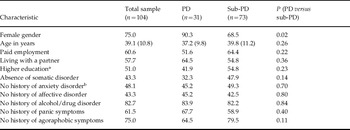
The sample consisted of 104 subjects, whose characteristics are shown in Table 1. Of the total sample, 31 (29.8%) fulfilled the criteria for PD, the remaining 73 (70.2%) fulfilled the criteria for sub-PD. The mean age was 39.1 years and 75.0% were female. Compared to subjects with sub-PD, those with PD were more often female (p=0.02).
Baseline characteristics of sample regarding sociodemographics and illness-related factors (n=104)

PD, Panic disorder; sub-PD, subthreshold panic disorder.
Values given as percentage or mean (standard deviation).
a Secondary school or above.
b Other than PD and agoraphobia.
Prognosis
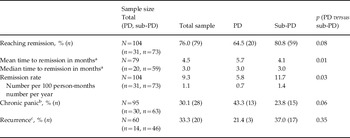
Table 2 shows the prognosis of panic in subjects with PD and sub-PD using the different outcome criteria. Within the follow-up period, remission was achieved by 64.5% of those with PD, and by 80.8% of those with sub-PD (p=0.08). The mean time to remission was 5.7 months in subjects with PD versus 4.1 months in subjects with sub-PD (p=0.01). To calculate remission rates, 853 observed person-months were available. The remission rate was 5.8/100 person-months observed in PD (=0.7/person-year observed) and 11.7/100 person-months observed in sub-PD (=1.4/person-years observed) (p=0.03). Remission had not occurred within 1 year in 43.3% of those with PD, compared to 23.8% of those in sub-PD (p=0.06). Within the remaining follow-up period (average 10.4 months), a recurrence occurred in 21.4% of those with PD and in 37.0% of those with sub-PD (p=0.35). Except for recurrence, estimates of course were more favourable for those with sub-PD than PD, but significance was not reached on all outcome criteria.
Association between panic disorder (PD) and subthreshold panic disorder (sub-PD) and the prognosis of panic in the general population

a Examined in a subsample of those reaching remission.
b Examined in a subsample of those being investigated for at least 1 year.
c Examined in a subsample consisting of subjects who had reached remission and for whom at least an additional 6-month observation period was available.
Predictors
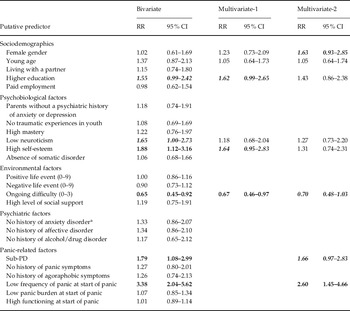
Several putative indicators showed a (marginally) significant association with remission in bivariate analysis (see Table 3). Remission was significantly associated with high education [relative risk (RR) 1.55, 95% CI 0.99–2.42], low neuroticism (RR 1.65, 95% CI 1.00–2.73), high self-esteem (RR 1.88, 95% CI 1.12–3.16), less ongoing difficulties (RR 0.65, 95% CI 0.45–0.92), sub-PD (RR 1.79, 95% CI 1.08–2.99) and a low frequency of attacks at the start of the panic episode (RR 3.38, 95% CI 2.04–5.62). In the first multivariate model, high education (RR 1.62, 95% CI 0.99–2.65), high self-esteem (RR 1.64, 95% CI 0.95–2.83) and less ongoing difficulties (RR 0.67, 95% CI 0.46–0.97) remained significant in predicting remission. In the second multivariate analysis including gender, age and all variables showing a significance or a trend (p<0.1) in the bivariate analysis, remission was significantly predicted by female gender (RR 1.63, 95% CI 0.93–2.85), less ongoing difficulties (RR 0.70, 95% CI 0.48–1.03), sub-PD (RR 1.66, 95% CI 0.97–2.83) and a low frequency of panic at the start of the episode (RR 2.60, 95% CI 1.45–4.66). Thus, the prognosis of PD remained less favourable compared to course of sub-PD, even when correcting for all potential confounders. Product terms between severity of panic (PD versus sub-PD) and the covariates included in the second multivariate model were not significant, indicating that the associations were similar for both PD and sub-PD.
Predictors of remission of panic disorder (PD) or subthreshold panic disorder (sub-PD) in the general population (n=104)

RR, Relative risk; CI, confidence interval.
Bold: RR significant at p<0.05; Bold italic: RR marginally significant at 0.05<p<0.1.
Multivariate analysis-1 corrected for gender, age and all variables showing a significance (p<0.05) or a trend (p<0.1) in bivariate analysis except panic-related variables (see Method section). Multivariate analysis-2 corrected for gender, age and all variables showing a significance (p<0.05) or a trend (p<0.1) in the bivariate model.
a Other than PD and agoraphobia.
Post-hoc analyses
First, we verified whether a sample consisting of prevalent cases would be more chronic compared to the main study sample consisting of incident cases. As expected, those who already experienced panic at T1 (n=40) achieved remission less often during the period between T1 and T2, compared with the study sample (55.0% v. 76.0%, p=0.01). Second, we investigated whether within the sub-PD group outcomes differed between those with LSAs and those with IPAs. Of the 104 subjects of the sub-PD group, 15 subjects had LSAs and 58 had IPAs. Remission was achieved by 86.7% (n=13) of those with LSAs and by 79.3% (n=46) of those with IPAs (p=0.72). Of those with LSAs who achieved remission (n=13), the mean time to remission was 3.2 months, and the median time to remission was 3.0 months. Of those with IPAs who achieved remission (n=46), the mean time to remission was 4.3 months, and the median time to remission was 3.0 months. The difference in time to remission between LSAs and IPAs was not significant (p=0.80). The remission rate was 14.4/100 months (1.7/year) for those with LSAs, and 11.0/100 months (1.3/year) for those with IPAs (p=0.57). Of those with at least a 12-month observation period (LSA n=14, IPA n=49), 14.3% (n=2) of those with LSAs had chronic panic, compared with 26.5% (n=13) of those with IPAs (p=0.49). Of those who had reached remission and for whom at least an additional 6-month observation period was available (LSA n=12, IPA n=34), recurrence occurred in 58.3% (n=7) of those with LSAs and in 29.4% (n=10) of those with IPAs (p=0.09). The number of panic-related symptoms in attacks (two or three versus at least four) was entered as a putative predictor of remission but did not significantly predict remission in bivariate analysis (RR 1.48, 95% CI 0.81–2.69). Third, the potential impact of treatment on the results was investigated. Of our study sample, 57.7% had sought professional help for their panic attacks. In bivariate analysis, the absence of help seeking was associated with a higher chance to achieve remission (RR 1.47, 95% CI 0.94–2.30). When entered in the multivariate model, the absence of help seeking no longer significantly predicted remission (RR 1.14, 95% CI 0.69–1.91), whereas other associations remained similar.
Discussion
Main findings
Using data from a large epidemiological survey, the NEMESIS, in which the LCI for panic was used, this study retrospectively examined the prognosis of panic from the onset of the episode up to a maximum of 2 years, in an inception cohort comprising 104 subjects with (first-ever or recurrent) incident episodes of sub-PD or PD. In addition, the role of multiple variables in determining outcome was explored. The 2-year course of panic attacks was varied. The majority of those with both PD (64.5%) and sub-PD (80.8%) achieved remission within the investigated period, and the mean time to remission was relatively short (5.7 months in PD and 4.1 months in sub-PD). However, 43.3% of those with PD and 23.8% of those with sub-PD had not achieved remission within 1 year after onset of panic. In addition, 21.4% of those with PD and 37.0% of those with sub-PD who achieved remission had a recurrence within the remaining follow-up period.
For those with PD, the remission rate reported in this study (0.7/year) is higher than the rate (0.14/year) found by Eaton et al. (Reference Eaton, Anthony, Romanoski, Tien, Gallo, Cai, Neufeld, Schlaepfer, Laugharne and Chen1998). The difference can be explained by the different definitions of remission used; in the present study 6 panic-free months were required to achieve remission whereas in the earlier study subjects had to be panic free for a year. In our study, estimates of the course were more favourable for sub-PD than for PD, in general. This is in line with previous research. Ehlers (Reference Ehlers1995) reported that 92% of those with PD at baseline experienced panic attacks during the 1-year follow-up, as compared with 50% of those with infrequent panic attacks at baseline. Kessler et al. (Reference Kessler, Chiu, Jin, Ruscio, Shear and Walters2006) reported that the 12-month prevalence of panic attacks was 35.7% in those with lifetime panic attacks only, 41.4% in those with lifetime panic attacks and agoraphobia, 57.4% in those with lifetime PD only, and 62.6% in those with lifetime PD with agoraphobia.
Several variables predicted remission in the bivariate analysis. In multivariate analysis, remission was associated with female gender, high education, high self-esteem and the absence of ongoing difficulties. Previous research has mentioned the role of these or related variables but the results are not consistent (Roy-Byrne & Cowley, 1994/Reference Roy-Byrne and Cowley1995; O'Rourke et al. Reference O'Rourke, Fahy, Brophy and Prescott1996). Panic-related factors (i.e. sub-PD and a low frequency of attacks at the beginning of the episode) seemed to be the most important panic-related variables in predicting remission. In previous research using patient samples, severity and panic frequency at baseline have not consistently predicted outcome (e.g. Roy-Byrne & Cowley, 1994/Reference Roy-Byrne and Cowley1995; O'Rourke et al. Reference O'Rourke, Fahy, Brophy and Prescott1996; Katschnig & Amering, Reference Katschnig and Amering1998). Our positive findings may be explained by the broad range of severity, due to the inclusion of subjects with sub-PD in our sample.
Methodological considerations
The present study is one of the few studies investigating the course of panic attacks from the onset of the panic episode in subjects from the general population. As was assumed in the introduction and was verified by a post-hoc analysis, a major bias towards chronicity was thus avoided. A drawback of investigating the course in a general population sample and investigating the course from the onset of a panic episode is the resulting small sample size, which in turn may limit statistical power. In the present study, we included not only subjects with PD but also those with sub-PD. This offers the opportunity to investigate the course of mild panic. Such data are lacking but are important, given their prevalence and clinical relevance. Official criteria for sub-PD are lacking. In the present study, sub-PD consists of subjects with LSAs (with two or three panic-related symptoms) and subjects with IPAs (with at least four panic-related symptoms). Post-hoc analyses revealed that estimates for those with IPAs were in between LSAs and PD on all outcome variables, which is consistent with the view that the nature of panic is continuous. Differences between LSA and IPA did not reach statistical significance on any outcome variable, which is probably due to the small sample sizes, especially for those with LSAs. The number of panic-related symptoms in attacks (two or three versus at least four) did not significantly predict outcome. Only a few previous studies have provided detailed prognostic information. In our study, the LCI assessed the course of panic in 3-month periods, thereby providing more detailed information on course compared to the LCI that was used in the previous study assessing 1-year periods (Eaton et al. Reference Eaton, Anthony, Romanoski, Tien, Gallo, Cai, Neufeld, Schlaepfer, Laugharne and Chen1998). In both studies, the LCI was assessed retrospectively, which may result in bias. In our study we attempted to minimize bias by using multiple memory cues. Because previous research has shown that retrospective assessment results in overestimating the frequency of attacks (Margraf et al. Reference Margraf, Taylor, Ehlers, Roth and Agras1987; de Beurs, Reference de Beurs1993), any remaining bias would imply that we provided a too pessimistic view on the course of panic, which would strengthen our conclusion that panic is not inevitably chronic in the general population. However, for several reasons we may also have provided a too optimistic view on the course of PD. First, the LCI only assessed the course of panic attacks, but the course of other aspects such as agoraphobia, anticipatory anxiety and level of functioning were not considered as these aspects were not assessed in the LCI. Including multiple outcome criteria is advised in PD research (Roy-Byrne & Cowley, 1994/Reference Roy-Byrne and Cowley1995; Shear & Maser, Reference Shear and Maser1994; van Balkom et al. Reference van Balkom, Spinhoven, Bakker, Rammeloo, Graatsma, Adriaanse and van Dyck2000) because, for example, overall improvement may be more closely related to other aspects than to panic attacks (Michelson et al. Reference Michelson, Pollack, Lydiard, Tamura, Tepner and Tollefson1998). Second, because of the study design, subjects with the most chronic panic (i.e. continuing panic for years) were not included. Third, course was only assessed in a limited time period whereas panic may fluctuate over longer time intervals (Bruce et al. Reference Bruce, Yonkers, Otto, Eisen, Weisberg, Pagano, Tracie Shea and Keller2005). As little is known about predictors of the course of panic attacks in the general population, a wide range of putative predictors were included in the present study. As a drawback, this increased the risk of false-positive findings. Apart from panic-related factors that were assessed retrospectively at T2, all were assessed prior to the development of panic. In addition to the selected putative predictors, other variables may predict the course of panic attacks but have not been assessed in the NEMESIS. These may consist of genetic variables, other biological variables, and psychological variables. For example, anxiety sensitivity (i.e. the fear of anxiety) predicted an unfavourable course of panic in other research (Ehlers, Reference Ehlers1995; Benítez et al. Reference Benítez, Shea, Raffa, Rende, Dyck, Ramshaw, Edelen and Keller2009).
Finally, treatment influences the course of panic (van Balkom et al. Reference van Balkom, Bakker, Spinhoven, Blaauw, Smeenk and Ruesink1997; de Beurs et al. Reference de Beurs1999). In our study sample, 57.7% had sought professional help for their panic. This may seem high for a general population sample. It should be realized, however, that subjects with panic often seek help (see, for example, Leon et al. Reference Leon, Portera and Weissman1995). More important, the question regarding help seeking had a very low threshold, and seeking help does thus not imply that adequate treatment was provided. In bivariate analysis, the absence of treatment was associated with a higher chance of remission. In multivariate analysis, treatment was no longer statistically significant and the other results remained similar. It is difficult to interpret these results in a naturalistic study such as the present one because the association between treatment and remission may run in two directions: those with an unfavourable course may more often seek help, and those who seek help may more often achieve remission.
Conclusion
Our main conclusion is that panic attacks are not inevitably chronic and persistent in a general population sample. Given the variability of its course, treatment plans should be guided by prognostic predictors. However, reliable data on prognostic factors are lacking. In our study, women, those without ongoing difficulties, those with subthreshold panic and those with a low frequency of panic attacks at the beginning of the episode were most likely to achieve remission. However, these factors explained only a small part of the variability and cannot as yet be used in clinical practice. It may be that biological and additional psychological variables are required to better predict the course of panic attacks. These variables should be included in further epidemiological research. In addition, as in the study by Eaton et al. (Reference Eaton, Anthony, Romanoski, Tien, Gallo, Cai, Neufeld, Schlaepfer, Laugharne and Chen1998) and also in studies using patient samples (Keller et al. Reference Keller, Yonkers, Warshaw, Pratt, Gollan, Massion, White, Swartz, Reich and Lavori1994; Bruce et al. Reference Bruce, Yonkers, Otto, Eisen, Weisberg, Pagano, Tracie Shea and Keller2005), a substantial part of those achieving remission had a relapse within the follow-up period available. Given the findings of these previous studies and the current study, it is worrying to see that treatment guidelines focus on symptomatic remission and that very few data are available on the effect of interventions aimed at preventing relapse (Gorman et al. Reference Gorman, Shear, Cowley, Cross, March, Roth, Shehi and Wang1998). The identification of prognostic factors and the development of relapse prevention programmes are therefore the next two steps for research in PD.
Acknowledgements
A grant to study the epidemiology of panic disorder was provided by ZonMW (The Netherlands Organization for Health Research and Development) under contract 100-002-011.
Declaration of Interest
None.