Introduction
Quebec is Canada's second most populous province, after Ontario, with eight million inhabitants. Quebec's population is rapidly ageing: roughly 16 per cent of it is currently over 65 years of age, a figure that is expected to rise to 26 per cent by 2031 (Camirand et al. Reference Camirand, Dugas, Cardin, Dubé, Dumitru and Fournier2010). Although most older people in Quebec consider themselves to be in good health, about 32 per cent have disabilities and need long-term care services (Camirand et al. Reference Camirand, Dugas, Cardin, Dubé, Dumitru and Fournier2010). Under the Quebec public health-care system, older people can receive services at home, in intermediate facilities (e.g. foster families), or in institutions such as nursing homes (NHs). Since the rate of institutionalisation in public NHs has progressively decreased from 8.5 to 3 per cent over the last 20 years, public NHs are now restricted to people with serious cognitive and physical disabilities and those who have unstable and complex health needs (Lévesque Reference Lévesque2007). Consequently, there has been a progressive rise in the number of assisted-living facilities (ALFs). ALFs currently account for 70 per cent of the places available to older adults (Ministère de la Santé et des Services sociaux du Québec 2010) and are mostly operated by for-profit private companies (86 per cent) (Conseil des Aînés 2007). Like in many other countries, our NHs provide 24-hour professional nursing care and supervision. Residents may also receive physical, occupational and other rehabilitative therapies as needed. NHs equate to ‘residential care homes’ in the United Kingdom (UK) and Australia (Howe, Jones and Tilse Reference Howe, Jones and Tilse2013). They can be differentiated by mandatory pre-admission assessment of residents whose entry is based on care needs, whereas entry to ALFs does not require this assessment and is based on the resident's choice (Howe, Jones and Tilse Reference Howe, Jones and Tilse2013). ALFs provide residential care for older people, combined with either nursing or other types of personal care, but the level of care provided is usually lower than in public NHs (Hébert et al. Reference Hébert, Dubuc, Buteau, Desrosiers, Bravo, Trottier, St-Hilaire and Roy2001a). As they are not covered by Quebec's public health-insurance programme, not everyone has access to such facilities.
Overall, these settings reflect the diversity of provision and may be compared to the variety of ALF models found in the United States of America (USA) (Cutler Reference Cutler2007). To date, there is little consensus on the place that these settings should occupy in terms of level of need offered to which clientele, and there is significant disparity in definitions and use of assisted living across countries (Gibson et al. Reference Gibson, Carter, Helmes and Edberg2010; Kane, Chan and Kane Reference Kane, Chan and Kane2007). Despite these differences, they are commonly defined as a combination of some kind of housing and services (Frank Reference Frank2001). In the UK, Brooker et al. (Reference Brooker, Argyle, Scally and Clancy2011) compared this type of setting of long-term care support to housing with care, where extra-care housing is one of its forms. According to other perspectives, they are perceived as alternative settings, both cheaper and offering the same services as NHs, while providing residents with more independence and control over their lives (Croucher, Hicks and Jackson Reference Croucher, Hicks and Jackson2006). In other cases, they are viewed as occupying a place between home and an NH (Kane, Chan and Kane Reference Kane, Chan and Kane2007, Stone and Reinhard Reference Stone and Reinhard2007). Finally, in some countries, they constitute an integral part of services provided in the community, as is the case, for example, in Denmark (Schulz Reference Schulz2010; Stuart and Weinrich Reference Stuart and Weinrich2001). These various points of view are conditioned by the political, legislative and financial systems in each health-care system, demand and consumer preferences, and interests and motivation of residential care managers.
As in the case of many jurisdictions, the province of Quebec recognises that there is a need for affordable service-enriched housing for the elderly with less restrictive living environments, which could be enhanced by linking housing and community-based care (Castle Reference Castle2008; Cohen et al. Reference Cohen, Mulroy, Tull, Bloom and Karnas2007; Pynoos et al. Reference Pynoos, Liebig, Alley and Nishita2005). To this end, Quebec's Minister of Health and Social Services (Ministère de la Santé et des Services sociaux du Québec 2005) authorised a subsidy programme to offer a variety of alternate housing models (AHMs) for frail elderly people. This programme allows private and community organisations to offer housing services for older people within the framework of a partnership with other sectors and public health-care services, which retain the responsibility for providing social and health-care services. In this programme, public services are provided by our health and social services centres (HSSCs), which are responsible for delivering home-care services at the local level. Care and services are provided by health professionals including physicians, nurses, social workers, physiotherapists, occupational therapists, nutritionists and homemakers. In addition, given available resources, HSSCs generally provide, in collaboration with their partners (community groups, the social-economy sector, the private sector), other services such as personal and domestic assistance, civic-support services, accompaniment, friendly visits and respite (Trahan and Caris Reference Trahan and Caris2002). The contributions and responsibilities of each party are governed contractually. This form of service provision aims to ensure appropriate services for people with moderate-to-severe disabilities who would otherwise have been eligible for NH admission. Under this programme, older people should have the same quantity and quality of services as in an NH, but in a more homelike environment that provides care and support services within the community. AHMs should not accommodate more than 50 residents under contract but can take in other residents according to their own admissions criteria. Finally, AHMs must comply with all legal and regulatory requirements applicable in Quebec as well as all regulations, bylaws, orders and decrees of the concerned municipalities (Ministère de la Santé et des Services sociaux du Québec 2004).
The opportunity to assess the AHM programme occurred with the implementation of the first 31 AHMs across Quebec. The main objective of the study reported in this paper was to assess whether this programme enabled the health-care and social services system to meet the needs of elderly people and their families in a way that is comparable or superior to the care provided to similar elderly people in NHs. As part of a larger study, three aims were addressed: (a) to compare how facility characteristics and services provided by AHMs and NHs differ; (b) to examine the personal characteristics of residents living in AHMs; and (c) to compare residents with similar characteristics within AHMs and NHs in terms of unmet needs, quality of care, satisfaction with care and services, and psycho-social adaptation to the residence.
Methods
Design and sample
This study used a cross-sectional and individually matched group design. Residents were chosen according to a two-stage sampling strategy, with facilities chosen at the first level and residents at the second. We obtained a list of AHMs and NHs from provincial records, which were updated with information from key health-care professionals. Of the 31 AHM projects that were submitted to the provincial programme, four had not yet been built. We also excluded four AHMs whose residents were primarily under 65 years of age. We invited all remaining 23 AHMs to participate. Because residents shared similar clinical characteristics within the same setting (Bravo et al. Reference Bravo, Charpentier, Dubois, DeWals and Emond1998), we selected a random subsample of five or ten residents in each AMH (housing with less than 25 or with 25 or more residents, respectively). Admissible residents were those covered by the programme, who were aged over 65 years and had lived in the residence for at least three months. For each AHM, we identified an NH in the same geographical area and selected the same number of residents to form a comparison group. To enhance group comparability, residents were matched for gender, age and disability profiles (Dubuc et al. Reference Dubuc, Hebert, Desrosiers, Buteau and Trottier2006). Written informed consent was obtained from all residents prior to participation. In the case of participants with cognitive impairments, consent was obtained from their legal representatives. Residents who declined to participate were replaced by the next resident on the randomly ordered list.
Data collection and measures
Facility administrators were informed of the study and its purpose through a personalised letter and a telephone call in which they were invited to participate and provide information about their facility. Subsequently, the study co-ordinator visited the facility to determine their physical and organisational characteristics. The EPO questionnaire (French acronym for ‘physical and organisational environments’) was used to assess these characteristics (Lestage, Dubuc and Bravo Reference Lestage, Dubuc and Bravo2008). This questionnaire is a descriptive tool that comprises 13 dimensions (e.g. safety and security, personal control) where each dimension is scored up to 100. A score of 100 indicates that the dimension is totally covered in the facility.
The administrators were also asked to provide a list of all residents covered by the programme who met our eligibility criteria. Potential candidates were contacted by telephone to set an interview date. Trained experienced nurses and social workers collected the data from the residents using uniform, standardised and well-validated instruments. Interviews were conducted by the same assessors at approximately the same time in an AHM and its paired NH. Proxy interviews with the person who provided the most assistance to the subject were conducted for those who were unable to answer.
To assess resident characteristics, we collected information on socio-demographics, level and profile of disability, cognitive status, behavioural symptoms and level of social functioning. The socio-demographic variables included age, gender, marital status, living situation and time living in the setting. The level of disability was evaluated with the SMAF (Functional Autonomy Measurement System) (Desrosiers et al. Reference Desrosiers, Bravo, Hébert and Dubuc1995; Hébert et al. Reference Hébert, Guilbeault, Desrosiers and Dubuc2001b). This tool assesses 29 items covering the five domains of activities of daily living (ADLs) (seven items), mobility (six items), communication (three items), mental functions (five items) and instrumental activities of daily living (IADLs) (eight items). Every function is assigned a score according to precise criteria based on information obtained by questioning the resident, by observation or by questioning a third party. The score indicates what the individual is able to do in everyday situations: on their own (0); on their own but with difficulty (0.5); with assistance (1); with partial assistance (2); or with full assistance (3). The total disability score (maximum value of 87) is obtained by summing the scores for each item. A case-mix classification system, called Iso-SMAF profiles, has also been developed using the 29 items of the SMAF and cluster analysis techniques (Dubuc et al. Reference Dubuc, Hebert, Desrosiers, Buteau and Trottier2006). In this classification, there is a progression of disabilities from the first to the 14th profile. To summarise, profiles can be grouped into four broad categories: persons with disabilities mainly in IADLs (profiles 1, 2 and 3); persons with IADL and ADL disabilities with predominant mobility problems (profiles 4, 6 and 9); persons with IADL and ADL disabilities with predominant cognitive problems (profiles 5, 7, 8 and 10); and persons with mixed and severe disabilities (profiles 11, 12, 13 and 14) (Dubuc et al. Reference Dubuc, Hebert, Desrosiers, Buteau and Trottier2006).
Cognitive status was assessed with the Mini-Mental State Examination (MMSE) (Folstein, Folstein and McHugh Reference Folstein, Folstein and McHugh1975; Hébert, Bravo and Girouard Reference Hébert, Bravo and Girouard1992). This short test comprises 11 items assessing abilities in relation to temporal and spatial information, attention, immediate and short-term recall, language, and the ability to follow simple verbal and written commands. The total score ranges from 0 to 30; a score below 24 reflects moderate to severe cognitive deficits. Behavioural symptoms were evaluated with the Cohen-Mansfield scale (Cohen-Mansfield, Marx and Rosenthal Reference Cohen-Mansfield, Marx and Rosenthal1989). This seven-point scale was used to rate how often residents manifested 34 agitated behaviours over the two last weeks. Results are presented across four main types of behaviours (physically non-aggressive, verbally non-aggressive, physically aggressive and verbally agitated). The level of social functioning was determined with the Social SMAF (Pinsonnault et al. Reference Pinsonnault, Desrosiers, Dubuc, Kalfat, Colvez and Delli-Colli2003), which consists of six items scored on a four-level scale: 0 (independent), 1 (needs supervision), 2 (needs help) and 3 (dependent).
To measure outcomes data were gathered regarding unmet needs, quality of care, satisfaction with care and services, and psycho-social adaptation of the resident to his/her residence. Unmet needs were measured with the handicap section of the SMAF (Hébert et al. Reference Hébert, Guilbeault, Desrosiers and Dubuc2001b). While completing the SMAF, available resources (public sector, private sector or family) to compensate for each disability can also be evaluated and a score representing unmet needs is deducted. If available resources compensate or if no disability is measured for a given function, the score for that item is zero and the needs are considered to have been fulfilled. If not, the score is equal to the disability score. This way of proceeding treats unmet needs as both the absence of and insufficient assistance with any SMAF item. An unmet need score ranging from 0 to 87 is then obtained.
The quality of care was assessed using the QUALCARE scale (Phillips, Morrison and Chae Reference Phillips, Morrison and Chae1990a, Reference Phillips, Morrison and Chae1990b). This consists of 52 statements, answered on a five-grade scale, across six dimensions that affect the quality of care received by the resident (environmental, physical, medical management, psycho-social, human rights and financial). Scores were assigned retrospectively after the assessor spent time in the facility, directly observing and interacting with the residents and their care providers. A score of 1 reflects the best possible care and 5 the worst. The satisfaction with care and services was evaluated with the Health Care Satisfaction Questionnaire that comprises 26 statements, each answered on two four-grade scales, one for perception and the other for importance (Gagnon et al. Reference Gagnon, Hebert, Dube and Dubois2006). Combining the two scales results in scores ranging from −8 to 16 for each statement. Subscales (three) and total scores are obtained by averaging scores over relevant statements. The Adaptation to the residence scale was used to assess the resident's psycho-social adaptation (Castonguay and Ferron Reference Castonguay and Ferron1999). This adaptation is a dynamic balance between the person and his environment which is reflected in the personal, social and physical areas, as well as on a facility-wide basis. It reflects a resident's ability to maintain a sense of self-identity and continue valued roles and interaction with others while adapting to life in a new environment. It consists of 17 items answered by ‘yes’ or ‘no’. The total score ranges from 0 to 17, where a result of 17 indicates the best possible adaptation. This is the only evaluation that cannot be completed when the resident is cognitively impaired. Note that eligible residents were assessed with the QUALCARE scale in their facility in two two-hour visits. One of the two visits took place with no staff member in the resident's apartment or room, which allowed residents or their family to speak more freely about their living conditions. Part of the other visit took place with staff members working with the resident in order to assess the quality of their interactions. Assessors observed how staff members communicated on a personal/social level and how they established relationships with the resident. They also note the approach that is used during meals and care delivery. In addition to administering the questionnaire during these interviews, the assessor also assessed some physical and emotional aspects of the residents. They also visited the areas where residents spent their time, paying attention to the participants’ physical and human environments.
For the QUALCARE, the SMAF, the Cohen-Mansfield and the Social SMAF, the information was obtained by questioning the resident, by observation or by questioning a third party. Some information about the residents was completed by asking facility staff and family members about their observations over the previous week.
Statistical analysis
Data were summarised using means and percentages according to variable type and distribution. Comparisons between residents were made with Student's paired t-test. All analyses took into account the finite population and the intra-facility correlation. Our sample size – limited by the number of eligible facilities and the within-facility homogeneity on the primary outcome measure of resident quality of care, measured by the QUALCARE scale (Bravo et al. Reference Bravo, Girouard, Gosselin, Archambault and Dubois1995) – had 80 per cent power to detect an effect size of 0.8 between groups at a statistical significance level of 5 per cent. Analyses were performed with SURVEY procedures in SAS (SAS Institute, Inc., Cary, NC, USA) version 9.2.
Results
Facility participation and characteristics
All administrators from the 23 AHMs that were approached agreed to participate in the study. In one case, it was not possible to identify an NH in the same geographical area with residents showing levels of functioning as high as those in the AHM. The other 22 matched NHs agreed to participate.
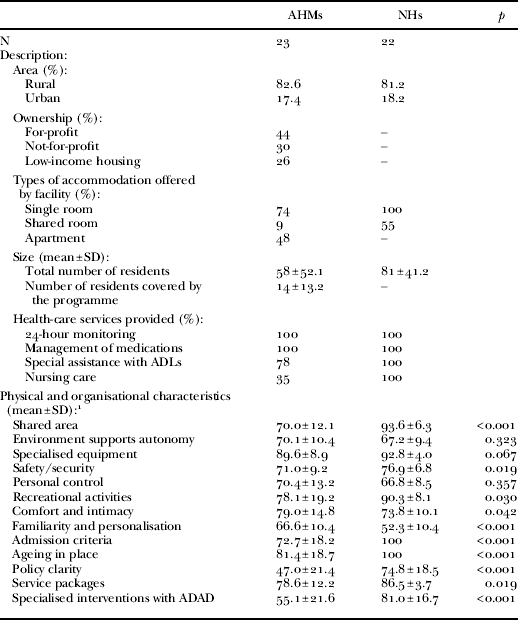
The AHMs were very heterogeneous in terms of their general features (see Table 1). The majority (82 per cent) were in rural areas, and nearly half of the AHMs were for-profit. There was a wide variation in the total number of residents per AHM, but the mean number was lower than in NHs. The AHMs had residents covered by the programme living along with residents who were not. The former were primarily aged 65 years or older but were relatively independent. As with the NHs, some AHMs offered only rooms, while others had only apartments or a mix of both. Overall, most of the AHMs provided rooms and nearly half offered apartments. Few of the AHMs had an institutional appearance with, for example, long hallways, which are frequently seen in NHs. Most of the AHM housing units were furnished and decorated with residents’ personal belongings, whereas the NHs were usually furnished with neutral, standard furniture. The AHM rooms were often larger than in the NHs; some rooms were also equipped for preparing light meals. In some NHs, two unrelated residents shared accommodations and bedrooms, whereas all the AHMs provided private full bathrooms and only a few had shared units that were occupied by couples. Both the NHs and AHMs provided access to safe outside areas, and to materials and rooms designated for leisure activities.
Description and physical and organisational characteristics of facilities

Notes: AHM: alternate housing model. NH: nursing home. SD: standard deviation. ADLs: activities of daily living. ADAD: Alzheimer's disease and associated disorders. 1. EPO questionnaire (French acronym for physical and organisational environments): values in the scale could range from 0 to 100, 100 describing a situation in which the dimension is covered perfectly by the facility.
The NHs provided all necessary care and services on a regular basis, such as housekeeping, laundry, meal preparation, personal care, surveillance, and specialised services provided by health professionals, including physicians, nurses, social workers, physiotherapists, occupational therapists, speech therapists and nutritionists. In most of the AHMs meal preparation, housekeeping and laundry were handled by facility employees. Nursing and personal care were primarily provided by the staff from the public HSSC through home-care services. In some AHMs, personal care was delivered by nurse aides from the AHM or a community organisation, such as a service co-operative. Night supervision was primarily provided by a nurse aide on duty, although an employee without clinical training was sometimes paid for surveillance. Only four AHMs had a night nurse available. Lastly, some AHMs had regular services provided by a social worker, occupational therapist or physiotherapist from home-care services. Nevertheless, these professionals were not present in most of the AHMs on a regular basis, if at all, especially those from rehabilitation services. For medical follow-up, 56 per cent of the AHMs had an agreement with a physician who visited regularly or who agreed to visit when necessary. In other cases, residents continued to receive care from their attending physicians outside the AHM.
Table 1 also shows EPO scores on the various domains of the physical environment. There were no significant differences observed between the two settings in terms of supporting autonomy (e.g. wheelchair accessibility), provision of specialised equipment and personal control. The NHs, however, performed better than the AHMs with respect to shared area, safety/security, recreational activities, policy clarity, service packages (the availability of services for ADLs), and use of specialised interventions for elderly people with Alzheimer's disease and associated disorders. By contrast, the AHMs offered more comfort (e.g. large rooms with a personal bathroom, abundant supply of natural light, variation in decoration throughout facility, dignified furnishings, personal storage space) and privacy (e.g. door locks, controlled access to private space, disclosure of personal information), as well as more familiarity (e.g. notification of preferences for meals, activities, flexible scheduling, telephone call with family for mutual sharing of information) and personalisation (e.g. personalised furniture, belongings, articles, pictures). AHM policies for admission and resident retention were more stringent than NH policies. Nine AHMs did not admit older people with dementia and mild to severe behavioural symptoms. Most AHMs (20/23) did not admit or support any older people with major behavioural symptoms. Some did not provide help with eating and two AHMs did not admit older people with mobility problems. Overall, apart from two facilities that were specifically adapted for people with cognitive disorders, the AHMs were less well equipped to take in people with cognitive impairments because few were structured to support residents who might ‘wander’.
Residents’ socio-demographic and clinical characteristics
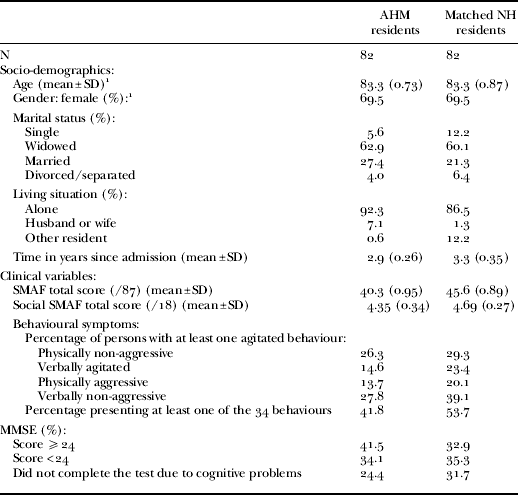
Of the 130 eligible AHM residents, 121 (93 per cent) agreed to take part in the study. Approximately 15 per cent of these residents had low levels of disability (Iso-SMAF profiles 1–3), while 60 per cent had moderate disabilities (profiles 4–9) and 25 per cent had substantial disabilities (profiles 10–14). Given the higher functional autonomy of some AHM residents, it was not possible to match all the participants from the AHMs to an NH resident since NHs are mainly reserved for people with severe disabilities. Consequently, 82 of the 121 AHM participants were matched to 82 NH residents. Table 2 presents data for these 82 pairs. It should be emphasised that the NH residents in this study were selected solely for comparison purposes and do not represent the NH population.
Resident socio-demographics and clinical characteristics
Notes: AHM: alternate housing model. NH: nursing home. SD: standard deviation. SMAF: Functional Autonomy Measurement System. MMSE: Mini-Mental State Evaluation. 1. Used for matching.
Overall, there were no significant differences in demographics between groups. The mean age of residents was 83 years. Two-thirds were women, most were widows and most lived alone. The proportion of residents living with a spouse in an AHM was greater than for those living in an NH. Of the NH participants, 12 per cent shared a room with another resident. AHM and NH residents had been living in their facilities for three years on average. In addition, almost all participants had children, most of whom lived nearby. Finally, half of the residents had five to eight years of schooling.
Despite the matching procedure taking disability profiles (from residents’ charts) into account, we noted a small but significant difference between groups in terms of disability scores measured with the SMAF. This situation resulted from changes in the disability status of NH residents, which had not been updated in their clinical charts. Overall, residents in both groups had moderate to severe levels of disability. No difference was observed for other clinical variables. In terms of cognitive functions, about 60 per cent had mild to severe cognitive problems. About half of the residents had at least one ‘disturbing’ behavioural symptom in the previous week. About two-thirds of such symptoms were non-aggressive, while the remaining were aggressive, but their frequency was fewer than once in the preceding week. Both the AHM and NH residents had little difficulty in social functioning.
Unmet needs, quality of care, satisfaction with care and services, and psycho-social adaptation to the residence
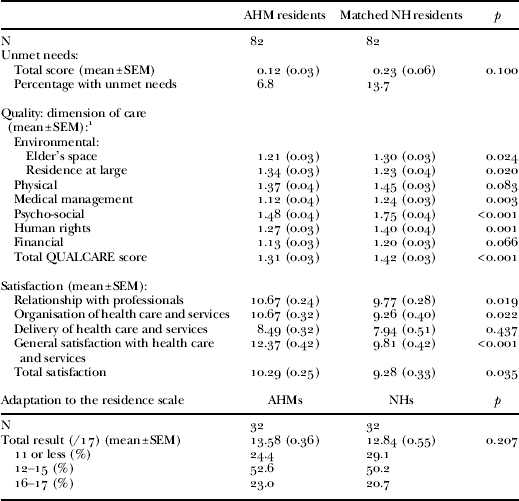
Table 3 provides the details of the findings for these outcomes. A person is considered as having an unmet need for a given disability if he or she needs help but reports not receiving any or enough help for that disability (Dubuc et al. Reference Dubuc, Dubois, Raîche, Gueye and Hébert2011). The percentage of residents with all needs fulfilled was 93 per cent among AHM residents compared to 86 per cent among NH residents. The unmet needs among the AHM residents were related to bathing, grooming, meal preparation and shopping; sometimes needs were unmet because a person refused services. The unmet needs of the NH residents concerned bathing, grooming, using the toilet, using a wheelchair, getting around outside, behaviour management and cleaning the room.
Comparison of alternate housing models (AHMs) and nursing homes (NHs) on effect measures
Notes: SEM: standard error of mean 1. A score of 1 reflects the best possible care and 5 the worst.
Given that a QUALCARE score of 1 reflects the best possible care and 5 the worst, the level of quality of care seemed to be satisfactory in both settings (Table 3), although the AHMs (1.31) had a statistically (p < 0.001) better total score than the NHs (1.42) and scored better on six of the seven sub-dimensions of care. The immediate living environment (room or apartment) seemed better for residents in the AHMs, while the NHs scored better for overall facility environment. Finally, weaknesses in the psycho-social aspects of care were noted in both settings.
Residents in both settings seemed to be relatively satisfied but, overall, the AHM residents were significantly more satisfied than their NH counterparts (Table 3). AHM residents had higher scores on relationship and organisation dimensions. The relationship dimension concerns interpersonal relations, whereas organisation relates to the accessibility of services at convenient times, the ease in obtaining appointments with a professional, and so on. There was no difference, however, between groups for the care-delivery dimension, which received the lowest score in both settings. Satisfaction with care delivery concerns the way professionals deliver services, offer choices, give prevention advice or information about available services, inform where to go, indicate what to do, and so on. Satisfaction with ADLs and IADLs was the highest rated aspect in both settings.
Psycho-social adaptation to the residence addresses the interaction between the resident (personal and social aspects) and his or her environment (Castonguay and Ferron Reference Castonguay and Ferron1999). The overall scores reveal moderate adaptation in both settings. Classifying participants into three categories (good, moderate and low) revealed that only 28 per cent of the AHM residents had presented a good level of psycho-social adaptation to their residence. Half of the residents had moderate adaptation problems that required care-givers to be watchful, whereas about one-quarter had severe adaptation problems. These residents felt that they had little control over their lives at the residence and that they received little social support. The results were similar in NHs, no significant difference (p=0.207) was noted.
Discussion
The first aim of this study was to describe characteristics and provision of services in AHMs and to establish how they differed from NHs. We observed highly varied physical and organisational environments among the AHMs in terms of ownership, size, accommodation, services and staffing. In most cases, the AHMs were more comfortable, warm and homelike than the NHs. One feature of the AHMs was that most of their rental units provided more space and privacy, and were furnished with the occupant's own belongings. As pointed out by Bergland and Kirkevold (Reference Bergland and Kirkevold2006), having residents furnish their rooms with their own furniture can help make them feel more at home. Unlike the NHs, residents in the AHMs also had their own personal living space and provision for private bathing and toilet use. Moreover, several AHMs have been developed in rural areas, enabling people to stay in their communities instead of being forced to move to a distant urban NH. This has allowed many individuals to postpone entering an institutional setting far away from their relatives and friends. Lastly, the integration of more independent people in some AHMs is a positive element that fosters an environment where the patterns of living more closely resemble those of ‘home’ and enables people with greater dependency to feel that they are still living in the community.
The AHMs typically focused on services such as housekeeping, laundry and meals. They were also able to provide or co-ordinate basic personal services, supervision, scheduled health-related services and some social activities. These services seemed to adequately respond to the needs of residents, although a minority of them had severe disabilities. Despite many favourable factors in the AHMs, various elements call into question their real capacity to support individuals with growing and increasingly complex needs until the end of life. With the exception of five AHMs that had higher service capacity (e.g. incontinence, behaviour management and nursing services), most of the AHMs had attributes that lead us to believe they would have difficulty caring for people with high-skill needs. Such attributes include limitations in the physical environment (few amenities for users with cognitive deficits or severe physical loss of independence), lack of round-the-clock professional supervision and restrictive admissions criteria for individuals with significant cognitive deficits. This also calls into question AHMs being considered as true alternatives to NHs.
There was a wide spectrum of AHM residents, ranging from those with high-level functioning who required only assistance with some ADLs to heavily dependent residents who should have been eligible for NH admission. Many of the AHMs were also able to admit some elders with severe disabilities, but most were striving for a balance of residents with moderate and high care needs. These characteristics differed somewhat from the resident population targeted by the programme, i.e. people with moderate-to-severe disabilities who would have been eligible for NH admission. Two factors probably explain this discrepancy. First, to a large extent NHs have not been admitting people with moderate disabilities for a long time. This may have created a misunderstanding of the targeted clientele. Additionally, there is no global consensus between regions in Quebec on specific NH eligibility criteria, except the specification of severe disabilities with complex health-care needs. Therefore, AHM administrators may have interpreted this criterion in their own way and selected their residents in terms of the physical and organisational environment provided and the services they were able to get under their contract with the HSSC. Another possible explanation may be linked to the expectation that older people should benefit from the same quantity and quality of services as in an NH, but in a more homelike environment. Part of the rationale for having a mix of residents was probably to encourage the development of a more active community and to provide a more homelike environment. However, some studies reported tension between ‘fit’ and ‘frail’ residents (Frank Reference Frank2001). What emerges across some of these studies is a sense, in some cases, of hostility and discrimination towards those who are disabled. Others revealed conflicts because residents do not want to be cruel to other significantly impaired residents but they do not want to be forced to live with them. For some residents, it is important that their AHM does not become a nursing setting.
Many AHMs revealed to us that it was also a way to keep a balance in the staff workload. These results led us to some questions: Is it realistic to apply a social model that focuses on a homelike environment and favours resident independence and choices whilst addressing, at the same time, the needs of people with severe disabilities? Will an environment that was previously well matched to a person with a moderate level of disability be supportive enough for elderly people with deteriorating abilities? Is a housing model that does not provide continued 24-hour assistance and services with nursing staff able to address high-skill needs on a long-term basis?
In the last decade, some studies have emphasised that AHMs as assisted-living facilities have admitted and kept older adults with more disabilities than in the past (Spillman, Liu and McGilliard Reference Spillman, Liu and McGilliard2002; Stone and Reinhard Reference Stone and Reinhard2007). Considering the differences in study design, physical environments, eligibility criteria, clinical outcomes and specificities of each health-care system, however, there still is limited evidence of their ability to take care of elderly residents with complex needs (Cutler Reference Cutler2007; Hawes and Phillips Reference Hawes and Phillips2007). In fact, evaluations of UK models of housing with care suggest many limitations (Croucher, Hicks and Jackson Reference Croucher, Hicks and Jackson2006). In the review by Croucher, Hicks and Jackson of British studies, these settings do not seem to easily accommodate people with severe cognitive problems or with high levels of dependency. Following the results of a study carried out in the USA (Frank Reference Frank2001) that underlined that assisted living repeatedly ends up being a temporary stop for older adults, there are no studies in the UK that have identified housing and care schemes where residents could age in place under any circumstances. According to Frank (Reference Frank2001), if ageing in place is not possible in assisted living, this may contribute to a high sense of liminality for residents because they do not know how long they can stay in their residence. Then again, although some settings offer opportunities to access care services, it was observed that some residents may decline these services simply on the grounds of cost. It is also possible that those who do not have sources of informal support, and cannot afford care services, may have unmet needs (Croucher, Hicks and Jackson Reference Croucher, Hicks and Jackson2006). International experience suggests that alternative settings do not provide a substitute for an NH in the absence of substantial financial support from the government, community health-care resources and a continuous system of quality monitoring (Andrews and Phillips Reference Andrews and Phillips2002; Ball et al. Reference Ball, Perkins, Whittington, Connell, Hollingsworth, King, Elrod and Combs2004; Stuart and Weinrich Reference Stuart and Weinrich2001).
If we think in terms of quality of care, staffing is certainly an issue in providing care and services to residents with high levels of needs (Allen Reference Allen2011). Some authors support the premise that adequate staff time and resources are absolutely necessary to support social activities and also over time as levels of residents frailty increase (Croucher, Hicks and Jackson Reference Croucher, Hicks and Jackson2006). Moreover, many studies have confirmed that nurse-to-resident ratio and staff qualifications are predictors of NH quality (Hyer et al. Reference Hyer, Thomas, Branch, Harman, Johnson and Weech-Maldonado2011; Kim et al. Reference Kim, Kovner, Harrington, Greene and Mezey2009; Spilsbury et al. Reference Spilsbury, Hewitt, Stirk and Bowman2011). Thus, we can also ask why the number and qualification of staff needed to provide good quality of care would be different in other settings with a similar case-mix population. Perhaps another way to meet these challenges would be to modify the way professionals deliver their services and to adhere to the philosophy of restorative care or reablement that can be used at different levels of care (Glendinning and Newbronner Reference Glendinning and Newbronner2008; Lewin and Vandermeulen Reference Lewin and Vandermeulen2010; Mitty Reference Mitty2010; Resnick et al. Reference Resnick, Galik, Gruber-Baldini and Zimmerman2009a, Reference Resnick, Gruber-Baldini, Galik, Pretzer-Aboff, Russ, Hebel and Zimmerman2009b). This philosophy focuses on the restoration or maintenance of physical function in providing care with (helping the person to continue to do what he or she is able to complete for his or her own care) as opposed to providing care for (provide complete assistance for bathing). Restorative care, in particular, has been acknowledged as a simple, effective approach to reduce functional decline even in assisted living (Resnick et al. Reference Resnick, Gruber-Baldini, Galik, Pretzer-Aboff, Russ, Hebel and Zimmerman2009b).
With regards to unmet needs, one of the programme's objectives was that the AHMs provided all care and services required, depending on resident clinical condition. We observed overall that the required needs were well fulfilled, regardless of the level of services required. Therefore, the selected partnering mechanism enabled our system to focus on the health-related services required by community-living elders, regardless of where they lived. Nevertheless, we also noted that, in some specific AHMs and NHs, certain residents had unmet needs. Unmet needs are associated with many negative health-related events for elderly people living in the community (e.g. falling, incontinence and use of emergency services) (Gaugler et al. Reference Gaugler, Kane, Kane and Newcomer2005; Sands et al. Reference Sands, Wang, McCabe, Jennings, Eng and Covinsky2006). Studies have found that rates of unmet needs increase as the number of ADL/IADL limitations increase (Dubuc et al. Reference Dubuc, Dubois, Raîche, Gueye and Hébert2011; LaPlante et al. Reference LaPlante, Kaye, Kang and Harrington2004; Newcomer et al. Reference Newcomer, Kang, Laplante and Kaye2005). As a result, monitoring older people according to their needs and minimising unmet needs should be established routinely in all long-term care settings, especially those that provide care to residents with severe disabilities (Dubuc et al. Reference Dubuc, Dubois, Raîche, Gueye and Hébert2011).
Quality of care seemed to be satisfactory in both the AHMs and NHs, which suggests that Quebec's older people with a moderate level of disability are generally housed in relatively good quality facilities. Nevertheless, the AHMs ranked higher in this regard. Several factors could account for this. In a study of quality-related factors (Bravo et al. Reference Bravo, Dubois, Charpentier, De Wals and Emond1999), quality of care was better when the number of collaborations between private and public sectors was high. In our study, the partnering between the AHMs and the public sector – particularly with home-care services, which are more familiar with community approaches – could account, in part, for the good quality of care noted in the AHMs. Smaller settings and private apartments equipped and decorated in accordance with occupant preferences may have also been positive factors in terms of quality and satisfaction with care (Hawes and Phillips Reference Hawes and Phillips2007; Morgan et al. Reference Morgan, Eckert, Gruber-Baldini and Zimmerman2004). The smaller settings, which afforded residents more opportunities for exercising their choices and responsibilities, could also account for these results (Cooney, Murphy and O'Shea Reference Cooney, Murphy and O'Shea2009). Nevertheless, as we noted for unmet needs, quality of care was also lower in some specific AHMs and NHs. This highlights the relevance of monitoring quality in the various living settings that offer services for the elderly with disabilities, whether in the private or public sector.
Residents seemed to be relatively satisfied in both settings, but the AHM residents were significantly more satisfied than those in NHs. Positive outcomes for this issue are congruent with the fact that needs related to disabilities were well fulfilled and that care was of good quality. Results in favour of AHMs, however, are probably linked to some characteristics found in this setting that are associated with a higher level of satisfaction, such as personalised care, personal space and more privacy (Edelman et al. Reference Edelman, Guihan, Bryant and Munroe2006; Morgan et al. Reference Morgan, Eckert, Gruber-Baldini and Zimmerman2004).
The last aspect studied was psycho-social adaptation of the residents to their residences. Despite positive results with respect to quality of care, satisfaction with care and services received, and met needs, only one-quarter of participants in both settings demonstrated a good level of psycho-social adaptation. In fact, many residents moving into long-term care settings may be grieving the life they are leaving behind (e.g. friends, home, possessions). Staff members must recognise the difference between grief associated to this transition and evidence of depression. They must notify signs and symptoms of depression and provide emotional support, talk with the resident and provide time to allow the resident to cope with these feelings. Other studies have also shown that older people living in institutions did not adapt well to their environments, even though they received good care (Chao et al. Reference Chao, Lan, Tso, Chung, Neim and Clark2008). It should be pointed out that this assessment assumes that residents have control over their environment and social support. The level of autonomy, social support, social interactions and number of social activities are important contributors to the adaptation process (Brandburg Reference Brandburg2007; Chao et al. Reference Chao, Lan, Tso, Chung, Neim and Clark2008, Cummings Reference Cummings2002). As reported by Frank (Reference Frank2001), some residents feel that doing some tasks such as shopping and cooking would give them a sense of self-worth, and feelings of confidence and responsibility. Having nothing to do leads them to feel useless, without a clearly defined role, and may amplify their sense of loss of control over their lives. Given that, in both types of settings, the psycho-social domain of the quality of care assessment was the lowest and that three domains of the EPO questionnaire (environment that supports autonomy, personal control, familiarity and personalisation) were also the lowest, these factors probably affected the psycho-social adaptation of these individuals.
If we consider the type and the focus of services provided, we can deduce that these AHM projects tend to reproduce the old institutional model centred on physical care rather than emphasising psycho-social aspects and functional recovery. AHMs offered mostly nursing and personal care, and no or few rehabilitation services and recreational activities. However, results reported by Cooney, Murphy and O'Shea (Reference Cooney, Murphy and O'Shea2009) suggest that settings that foster social relations and offer rehabilitation services enhance the quality of life of residents. If important goals of these facilities include providing a homelike setting and a nice living environment, they must consider that fostering social relationships within their environment will contribute to a greater sense of feeling at home (Street et al. Reference Street, Burge, Quadagno and Barrett2007; Wiles Reference Wiles2005).
Other models of housing that offer care are more successful in this regard. Examples of this are the Green House project in the USA and the Adards community in Australia (Angelelli Reference Angelelli2006; Rabig et al. Reference Rabig, Thomas, Kane, Cutler and McAlilly2006). These models are designed for a small number of residents needing nursing home levels of care. The physical environment is residential, offering residents opportunities for privacy (private room with their own belongings) and community participation. They have access to all areas of the house and meals are served at a large dining table where staff, elders and visitors eat together. There is no institutional schedule and flexibility is a feature of household operations. The frontline care staff members, who are usually certified nursing assistants, have broadened roles including cooking, housekeeping, personal laundry, personal care to residents, implementation of care plans and assisting residents to spend time according to their preferences. We should point out that these initiatives required a major change in the way services are provided. They can be characterised by a change in paradigm, in which services are no longer designated merely to support older people in their settings but to optimise their functioning in all aspects of life.
An interesting programme which involves these aspects is the Enriched Opportunities Programme (EOP) developed in the UK and evaluated for an 18-month period with a cluster-randomised controlled trial by Brooker and colleagues (Brooker et al. Reference Brooker, Argyle, Scally and Clancy2011; Brooker and Woolley Reference Brooker and Woolley2007). This multi-level intervention focuses on improving quality of life for people with dementia in extra-care housing through a whole-scheme approach including a specialist staff role (EOP Locksmith), leadership, staff training, individualised care-work, community liaison and the provision of activities. The EOP had a positive impact on the quality of life and depressive symptoms of the EOP participating residents. The latter were also more likely to be seen by different community health professionals. This is could have contributed to the fact that a smaller number of EOP residents were moving to a nursing and care home compared to residents in the control group and had fewer hospital inpatient days (Brooker et al. Reference Brooker, Argyle, Scally and Clancy2011). Although, these results are encouraging for people with dementia, it is not certain that this programme could be completely applied for residents with health and mobility problems, as improving social participation may be more difficult for them (Croucher, Hicks and Jackson Reference Croucher, Hicks and Jackson2006).
Despite these initiatives, there is still room for improvement in the way services are provided and in the collaboration between public, private and community settings in Quebec to provide living settings that truly respond to the wishes of elderly people with disabilities. Despite the progress represented by this programme in many aspects, much work remains to be done in providing facilities that respond to the needs of elderly people with severe disabilities. A worthy goal for future research would be to comparatively assess various new housing models that focus on care for older adults with severe disabilities in connection with concepts such as ageing in place, resident–setting fit, restorative approaches, psycho-social aspects, negative health-related events, quality of care and quality of life.
The study reported here had a number of strengths that contributed to its validity. All the AHMs that were available at the time of the study were assessed and individual participants were randomly selected from the residents who met our selection criteria. The number of residents to be assessed was calculated by taking into account the intra-institutional correlation, meaning that residents from an AHM tend to present some similar characteristics (Bravo et al. Reference Bravo, Charpentier, Dubois, DeWals and Emond1998). For each AHM resident assessed, a similar resident was chosen from an NH in the same area to which the older person would have normally been referred. All the targeted AHMs and NHs agreed to take part in this study and the rate of resident participation was very high. The sample and participation rates therefore promoted good representation of Quebec AHMs. The study had the power needed to detect major differences in terms of effects and the ability to compare results based on similar residents. Another strength is that we used assessment instruments that are standardised, recognised, reliable and valid. Most instruments, such as the QUALCARE, the SMAF and the Cohen-Mansfield Agitation Inventory, were applicable to all residents, regardless of their levels of independence and cognitive capabilities. This is quite useful in populations that contain a high percentage of individuals with cognitive impairments. As for information bias, all the interviews were conducted by social workers or nurses with several years of experience in long-term care settings. Lastly, the assessments in the AHMs and paired NHs in each region were conducted at the same time and by the same teams of interviewers.
The study also has several limitations. The main one is that it was cross-sectional, which does not allow pre- and post-intervention measurements. Although it was possible to assess certain short-term effects on residents, this type of study design limits the possibility of identifying cause-and-effect relationships. It also precludes documentation of certain effects of relevant care achieved over the medium and long terms, such as the maintenance of or changes in state of health and functional independence, the impact of the settings on the use of other services (e.g. hospital and emergency care), other outcomes pertaining to the quality of care (e.g. falls and pressure ulcers) and the quality of life of residents. This approach was adopted due to the study's short duration (24 months), as specified under the terms and conditions of the research grant. It is also important to note the small number of urban AHMs in the study. Although this is representative of Quebec, it limits the generalisability of our conclusions to other areas in which elders come from multicultural settings. Lastly, the difficulty in matching NH residents to AHM residents resulted in some people being excluded in setting comparisons. Residents with high levels of functioning, however, were not targeted by the programme; statistical power was therefore preserved. For those people with low levels of disability, matching with other setting types, such as the home or intermediate resources, would have been preferable. However, when the study started there was no indication that certain AHMs would include such residents.
Conclusion
This study described the characteristics of AHMs and their residents, portrayed the structures and resources put into place, and assessed quality of care and resident satisfaction. These elements provide stakeholders with evidence to help in adjusting programmes and activities, specifying the needs of residents and the various players involved, and assessing the value of and the place occupied by AHMs in the health and social services system. Even though AHM residents had less severe disabilities than their NH counterparts, we do not believe that this calls into question the relevance of ensuring that this type of resource continues to exist. AHMs represent for older people an option that offers advantages over traditional ALFs. They provide an opportunity for older people to access a diversified choice of housing that is better distributed geographically, while providing an assurance that they will receive adequate care services. As some AHMs were able to answer the needs of residents with a high level of disability, it seems that it is possible in particular situations to satisfy these needs. Several of the AHMs in our study were situated outside urban areas, allowing the older person to remain in their community. Without these AHMs, some older people would have been forced to live in an NH, often further away from their previous place of residence. For policy makers, in the context where they have to control spending, this model enables a service to be supplied to disabled older adults while preserving a certain control over the quality of care and services delivered, without having the expense of the infrastructure and basic services offered in AHMs. In NHs, these expenses are publicly funded. Finally, the creation of AHMs appears to be a good strategy for providing a useful range of housing types in the community.
Acknowledgements
We would like to express our gratitude to the residents and staff of the facilities that participated in this study. The authors thank Mélissa Brossoit-Richard, Eugénie Cadieux, Lucie Laroche, Catherine Lestage and David Pépin for their assistance in data collection and analysis. We also acknowledge the support of the Faculty of Health Sciences, Curtin Health Innovation Research Institute, Australia, in editing the paper. The Ethics Review Board of the Health and Social Services Centre at the University Institute of Geriatrics of Sherbrooke (HSSC–UIGS) approved all study procedures. This work was supported by grants from the Fonds québécois de la recherche sur la société et la culture and the Ministère de la Santé et des Services sociaux du Québec. The first author was supported by the Fonds de recherche en santé du Québec. The authors certify they do not have any actual or potential conflict of interest, including any financial, personal or other relationships with other people or organisations that might bias the work reported in the paper or interfere with objective judgement. We therefore declare we do not have any conflicts of interest.