Introduction
‘Operation Tabarin’ was a secret wartime operation to establish a permanent British presence in the Antarctic and became the foundation for the present day Antarctic activities of the British Antarctic Survey. Beck (Reference Beck1984) identified the political drivers for establishing such an operation in the middle of a world war and Dodds (Reference Dodds2002) has summarised the original purpose as that of countering Argentine encroachment of territory formally claimed as part of the British Empire since 1908. It is timely to revisit Tabarin using a wider range of British Government files deposited in The National Archives (TNA) in order to determine its role in the development of British policy for the Antarctic. There remain, however, a significant number of files still closed, or with parts removed or redacted as far back as the 1920’s, which undoubtedly contain material highly relevant to piecing together this debate within the British Government.
‘Operation Tabarin’ had little direct bearing on the conduct of the war against the axis powers. Rather, it was an integral part of a long term imperial strategy from the earliest years of the twentieth century to paint Antarctica pink, the colour of the British Empire in 20th century atlases. The noted polar explorer and biologist Colin Bertram had plans for a British Antarctic Expedition in 1940, which would have built on the achievement of the British Graham Land Expedition (BGLE) of 1934–1937, of which he had been a member. This might also have established permanent bases, but the war had intervened. As it was, the war provided a cover story for Tabarin, once its existence became publicly known, both in regard to United States’ sensibilities to British imperial designs and to counter any South American complaints. Britain's distinctive role in Antarctic diplomacy, law and science may be said to have developed from that modest wartime operation.
In this paper, we will set Tabarin in the broader context of Britain's imperial ambitions for Antarctica. We will demonstrate that Tabarin had its roots directly in William Bruce's decision to hand over the observatory established on Laurie Island by the Scottish National Antarctic Expedition to Argentina in 1904. In so doing, we will review the decisions, debate and controversy within government that ultimately made the operation necessary as it endeavoured to find an effective response to what it saw as Argentine encroachment on British sovereign territory. We also briefly describe the operation, how it was presented to the British public during the war and its early postwar development.
The Scotia expedition and Letters Patent
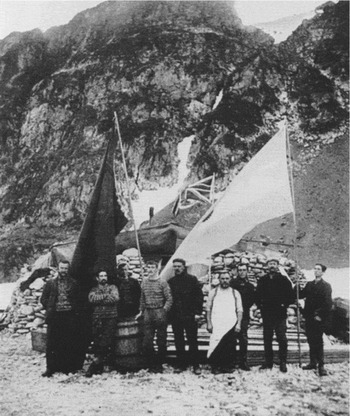
The sixth International Geographical Congress of 1895 in London stressed that the exploration of the Antarctic regions was the greatest piece of geographical exploration still to be undertaken (Anon. 1896). As such it marked the start of an heroic age in Antarctic exploration, most famously the expeditions led by Amundsen, Scott and Shackleton. The Scottish National Antarctic Expedition, led by the naturalist, William Speirs Bruce, obtained much less publicity and was significantly under-resourced as all of its funds came from private sources (Speak Reference Speak2003). Among its achievements was the establishment of a meteorological and geomagnetic observatory, first on the expedition ship Scotia on 26 March 1903, and then on Laurie Island in the South Orkney Islands from 1 November 1903. (Figs. 1, 2) Bruce wanted this to be a permanent observatory for excellent scientific reasons, but with no government backing for the expedition and little prospect of finding long term financial support from private backers he had few options. On arrival in Buenos Aires in December 1903, he therefore wrote to the resident British Minister (W.H.D. Haggard), emphasising the importance of maintaining the observatory and therefore of placing:
before the Argentine National . . . . Meteorological Office the suggestion that their Government should continue the work during the coming year. To aid this purpose I shall be glad to offer passage to four scientists on board the Scotia and hand over to them the house and observatory, with eighteen months food supply (Bush Reference Bush1982, I: 549–550).
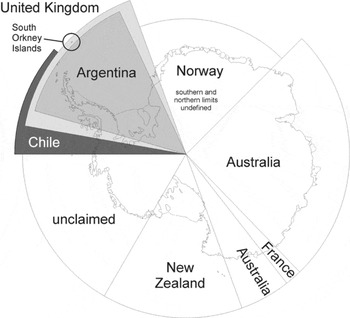
Map showing the Antarctic continent with the various territorial claims indicated. Note that for clarity the northern limit (60°S) of the three overlapping claims (Argentina, Chile and the UK) is staggered slightly.

Scottish and Argentine staff of the Laurie Island meteorological station standing in front of Omand House with national flags flying (From Bruce Reference Bruce1992).

Haggard passed this offer to the Argentine Government on 29 December 1903. It responded with remarkable alacrity, publishing a Presidential Decree on 2 January 1904 which inter alia authorized the Director of the Argentine Meteorological Service:
‘to take over . . . the installation offered by Mr William S Bruce in the South Orkney Islands and to establish a meteorological and magnetic observatory thereon’ (Bush Reference Bush1982, I: 550–551; Haggard Reference Haggard1904a).
In fact, the Argentine Minister for Foreign Affairs formally notified Haggard of the decree on 8 January, only three days after Haggard first raised Bruce's proposal with the British Foreign Secretary and before he had received any instructions from London (Terry Reference Terry1904; Haggard Reference Haggard1904b). Haggard's letter included the telling passage that:
the Opposition papers are suggesting to the Government that the Argentine Republic should take possession of the South Orkneys. In conversation with Mr Bruce, he seemed to me not to have made up his mind whether they were likely to be of any use whatever to Great Britain or no (Haggard Reference Haggard1904a).
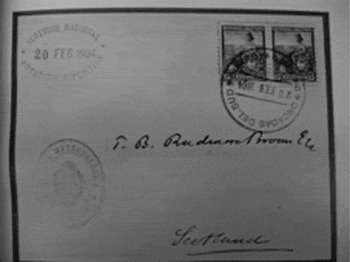
Bruce and Haggard effectively gave the observatory away, perhaps in gratitude to the Argentines in generously supporting the further leg of Bruce's expedition with provisions and overhauling Scotia. Although the Argentine Government did not publicly accede to the media pressure from the newspapers, on 21 January they did formally designate one member of the party departing with Bruce as Postmaster for the South Orkney Islands (Bush Reference Bush1982, I: 555 and references therein), the provision of a postal service being perceived as an important demonstration of effective administration of a territory over which a claim has been made. It seems likely that the Argentine Government was aware of the significance of its action. Bruce sailed on 21 January and the formal handover of the observatory took place on 22 February 1904, with the lowering of the British flag and the raising of the Argentine one.Footnote 1 Bruce's meteorologist R.C. Mossman, remained in charge for the first year as an employee of the Argentine Meteorological Department, and afterwards went back to Argentina and rose to become Director of the Meteorological Service. Mail (Fig. 3) bearing the postmark ‘Orcades del Sud, Distrito Rio Gallegos’ was sent on Scotia in February 1904 for onward posting in South Africa and a further tranche was dispatched in January 1905 on board Uruguay, after which postal activities ceased until 1942 (Pirie Reference Pirie1935). For most of the next 25 years Argentina staffed the observatory with foreign nationals from the UK, Norway, Sweden, Germany, Denmark, Russia and Hungary and only after 1927 were Argentines in the majority (Moneta Reference Moneta1939).
A photograph of an item of mail despatched from Laurie Island on Scotia in February 1904 (From Pirie Reference Pirie1949).

Britain had rights to the South Orkney Islands both through discovery (by Powell in 1821) and through occupation by the Bruce expedition, whereas Argentina, prior to the Scotia expedition had shown no interest in the island group. But, however precipitate Haggard's action might have seemed, it was personally approved by the Foreign Secretary, the Marquess of Lansdowne, on 26 April 1904, following correspondence with the Admiralty and Colonial Office (CO) (Lansdowne 1904). The approval was accompanied by copies of this correspondence. The first intimated that the Lords Commissioners of the Admiralty: ‘do not attach any importance to the possession of these islands from a Naval point of view, nor does it appear that His Majesty's Government ever laid claim to them, nor that they are of any value’ (MacGregor Reference MacGregor1904), The second pointed out the Secretary of State for the Colonies concurred with this view, adding that: ‘in Mr Lyttelton's opinion no objection need be taken to the decree of the Argentine Government authorizing the installation of a meteorological and magnetic observatory in these islands’ (Lucas Reference Lucas1904). The Foreign Secretary similarly concurred, so Haggard was informed that: ‘in these circumstances, therefore, it will be unnecessary for you to take any action in the matter’ (Lansdowne 1904). Crucially, there was no affirmation of British sovereignty over Laurie Island as part of the handover of the station, and no acknowledgement by Argentina of such British sovereignty.
The British Government may not have seen any value in the South Orkneys in 1904, but there was already evidence developing of potential revenue to be obtained from regulating the whaling industry developing in the waters of South Georgia, to the northeast, another island over which Britain had rights through discovery, but hitherto had demonstrated little interest. In March 1905 Haggard informed the Foreign Office (FO) that Captain Carl Larsen, a renowned Norwegian polar explorer had, with the help of the Tornquist Bank in Argentina, launched Compania Argentina de Pesca whose aim was to carry out whaling in the vicinity of South Georgia (Haggard Reference Haggard1905). Larsen had in fact commenced whaling operations based at Grytviken, in South Georgia in December 1904 (Hart Reference Hart1988). In August 1905 the CO raised with the FO and the Admiralty whether a cruiser should be dispatched to the island to ascertain the facts and require the company to take out a licence if necessary (Lucas Reference Lucas1905). Separately, and further complicating the position, the Governor of the Falkland Islands (William Allardyce), alerted by Haggard to a possible challenge to British jurisdiction over South Georgia, had issued a licence to a different enterprise, the South Georgia Exploration Company (Allardyce Reference Allardyce1905). The British Legation (Harford Reference Harford1905) noted in November 1905 that the latter company had endeavoured to evict Larsen from South Georgia, but reported that Larsen's company was now seeking a lease from the Falkland Islands Government. It also drew attention to how Larsen's weather observations at South Georgia might be developed by Argentina into a scientific observatory there to form a network with the South Orkneys and other projected locations. The question of whether Argentina was moving towards contesting British sovereignty over South Georgia therefore now came to the fore.
HMS Sappho visited Grytviken from 32 January to 4 February 1906 to inspect Larsen's activities (Hart Reference Hart1988). However, Larsen's company had by then applied for a lease of land at Grytviken from the Falkland Islands Government. The British Government formed the view that this had been done with the full knowledge of the Argentine Government and that the latter was therefore not contesting British sovereignty. It was decided to offer facilities for an Argentine observatory at South Georgia if requested, but no such request was forthcoming (Gorst Reference Gorst1906).
The broader question of what other South Atlantic and Antarctic territories could reasonably and with advantage be put under British sovereignty was raised by a request from Norway in 1906 about jurisdiction consequent on a proposed Norwegian whaling expedition to the South Shetland Islands. A letter from Allardyce in February 1906 suggested that perhaps the South Orkney and South Shetland Islands should be incorporated more formally within the dependencies of the Falkland Islands (Allardyce Reference Allardyce1906). The Norwegian government was informed that Britain considered the South Shetlands to be under British sovereignty, and discussions continued within Government and with Allardyce over which islands could be rightfully claimed for the Crown. During 1906 the Government was moved to remind the Argentine government that the South Orkney Islands were British territory following notice of a report in a Buenos Aires newspaper of what was described as a permanent observatory in the South Orkneys (Haggard Reference Haggard1906a). A similar note was delivered on 4 January 1907 after Haggard had reported that Argentine staff heading for Laurie had been appointed as ‘Comisarios’ – a cross between a police official and magistrate (Townley Reference Townley1907a; Haggard Reference Haggard1906b). The Argentine Minister for Foreign Affairs asked for time to consider the issue, but in conversation with the Resident Minister in Buenos Aires (W.B. Townley), expressed surprise that the British Government claimed these islands (Townley Reference Townley1907b).
This complex pattern of possible Argentine challenges to British sovereignty and the possibilities for revenues from whaling provided the basis on which Britain determined which territories it had rights to as a result of discovery, and to bring them under the jurisdiction of the Falkland Islands government as dependencies thereof. This was formalised by establishing the Falkland Islands Dependencies (FID) by Letters Patent in 1908, under which provision was made for the government of:
. . . the group of islands known as South Georgia, the South Orkneys, the South Shetlands, and the territory known as Graham's Land, situated in the South Atlantic Ocean to the south of the 50th parallel of south latitude, and lying between the 20th and 80th degrees of west longitude . . . . as Dependencies of our Colony of the Falklands.Footnote 2
The Argentine Minister for Foreign Affairs asked for a copy of the Letters Patent in November 1908, which he later acknowledged without comment (Foreign Office 1948: 156, 16).
The stage had thus been set for more than a century of protest and counter-protest, and of claim and counter-claim. As a CO official minuted some forty years later: ‘it is no good crying over spilt milk now, but that this arrangement (giving the Laurie Island observatory to Argentina) was a great mistake is abundantly clear’ (Barton Reference Barton1947).
Following a ‘violent press campaign’ in Argentina, the resident minister in Buenos Aires, Townley, suggested in 1911 that the South Orkneys might be ceded to Argentina as a gift to mark that country's centenary celebrations after British residents had pointed out to him that the islands were useless to the UK but valuable to Argentina because of the observatory. Interdepartmental discussions resulted in the CO vetoing the proposal. The Admiralty had no objection, but the CO pointed to the loss of whaling revenue. A further proposal for a quid pro quo of the South Orkneys for Argentine recognition of the British claim to the Falkland Islands was similarly rejected, lest it was interpreted as evidence of the British Government having doubts over the strength of its claim to the Falklands (Foreign Office 1948: 156, 17 and footnote). This was the first clear political coupling in British files of sovereignty over the South Orkneys with that of the Falklands. Both claims were based on occupation, Argentina claimed continuous occupation of the South Orkney Islands whilst Britain had occupied the Falklands since 1833. When Sir R. Tower succeeded as British Minister in 1911 he suggested a different approach. This was that the islands be ceded in return for Argentina providing the site for a new British legation building in Buenos Aires. The CO agreed reluctantly to this and a draft convention was developed and agreed by both sides. But in 1914 a new Argentine Government was apparently unwilling to foot the expense for its part of the bargain, though it seems possible that it foundered because Argentina was unable to accept the word ‘cession’ (Foreign Office 1948: 156, 17 and footnote). In 1913 the resident minister in Argentina reported to the Governor of the Falklands that the Argentine Government was apparently considering establishing a wireless station at Orcadas in the clear belief it was within their authority (Tower Reference Tower1913). Reorganisation of the Argentine Meteorological Office seems to have caused the scheme to stall (Tower Reference Tower1915) but there is every sign in the correspondence that the Foreign Office wanted to avoid making a fuss about it despite its implications for the authority of the Falkland Islands as a licensing authority.
Anglo-Argentine tension in the interwar years
The interwar years of the 1920s and 1930s were marked, from a British perspective, by attempts to square a difficult circle. There was an increasing recognition of the apparent weakness of its claim to the Dependencies and, therefore, debate as to the various stratagems by which they might be retained both for their intrinsic value (mostly seen as whaling but also the possibility of mineral wealth), concern lest encouragement might be given to claims for the considerably more valuable possession of the Falkland Islands, and finally apprehension about the impact any apparent display of weakness in the Southern Ocean might have upon British claims to sovereignty in other parts of the Empire. There was need for diplomacy of the highest order in retaining good relations with Argentina, given estimates of some £300 million of British investment in that country, the presence of a large British community, and the volume of meat products exported to Britain (Dodds Reference Dodds2002; Darnley Reference Darnley1928).
Meanwhile, in 1920 the Argentine government was contemplating closure of the Laurie Island Observatory on economical grounds, and only a very vigorous local press campaign prevented this (Foreign Office 1948: 157, 23). Instead Argentina moved to establish a wireless telegraphy station on the island, and it became obvious to the British Government by early 1927 both the permanency of this, and of Argentina's refusal to apply for either a licence under the Falklands Islands Wireless Telegraphy Ordinance and Regulation of 1925, or a call signal from the groups reserved for wireless stations in the British Empire.Footnote 3
There followed in 1927 a claim by the Argentine Postal Administration, through the International Bureau of the Universal Postal Union, that its territory included de jure and de facto the South Orkneys and South Georgia, and de jure the Falkland Islands, whilst de facto jurisdiction was being prevented by British occupation (Anon. 1927a). This represented a significant escalation by Argentina, being the first clear statement of its views on sovereignty over the South Orkneys and South Georgia. It led to much discussion within and between the CO, Foreign Office and Admiralty, and culminated in the matter being debated at a Cabinet meeting on 14 December 1927. The briefing memorandum for this meeting (Anon. 1927b) shows that the main issue at stake was the possibility that Argentina would reopen its claim to the Falklands at a forthcoming Pan-American Congress. The Cabinet discussion of the memorandum remains redacted from the typewritten conclusions (Anon. 1927c). But one course of action identified in the accompanying paper was for the resident minister in Buenos Aires to indicate that Britain would view such action as an unfriendly act. However, there is nothing in the later departmental papers to indicate that decisions were taken that significantly changed British policy. As a CO official minuted in December 1927, the dilemma for the British Government was: ‘whether it is better from the point of view of international relations to have the matter out now or to wait indefinitely for something to turn up’ (Grindle Reference Grindle1927). An FO official wrote, in February 1928, of how simply: ‘either allowing the matter to rest where it is, or of making a formal notification to the (postal) Bureau at Berne disputing the Argentine's Government's claim’ provided no satisfactory solution. Nor indeed did arbitration, in as much as it ‘would almost certainly give rise to an inconvenient demand for arbitration of the Falkland Islands dispute’ (Snow Reference Snow1928). However emphatic the FO instruction, the resident ministers, and later ambassadors, in Buenos Aires did everything possible to avoid such protest which might prejudice what was otherwise perceived to be the excellent relations between the two countries. The Argentine government did not feel constrained by such scruples and continued to press on with its ‘encroachments’, though not to the point of forcing a show down. By 1930, at least unofficially via newspaper articles (for example La Nación (Buenos Aires) 4 July 1930) Argentina was now making the point that priority of discovery was not alone sufficient to claim territory, rather for such title to be valid effective occupation and possession was necessary.Footnote 4
Whilst defence of title to individual island groups in the South Atlantic was complicated, and seen by the FO as secondary to the broader diplomatic need to maintain good relations with Argentina, considerable store was set in the inter-war years upon painting Antarctica pink. Beck (Reference Beck1983) attributes much of the impetus to developing a coherent Antarctic policy to Leopold Amery, Under-Secretary of State at the CO, with the active support of the Colonial Secretary, Viscount Milner. It was Amery who in 1920 developed the detailed policy in concert with Australia and New Zealand for a gradual extension of imperial control over the whole Antarctic continent. The reasoning was that it would be better if Antarctica were brought under a single jurisdiction and that the British Empire was the obvious choice! An Imperial Order in Council of 1923 (Headland Reference Headland2009: 276, 1959) appointed the Governor General of New Zealand as Governor of the ‘Ross Dependency”’ (a substantial sector of Antarctica lying between 150°W and 160°E and stretching from the Pole to 60°S). The Imperial Conference of 1926 appointed, on 18 November, an Antarctic CommitteeFootnote 5 to take the work further. Amery, now the Colonial Secretary, wrote in his diary that day how: ‘the process of incorporating the Antarctic in the British Empire which I started pushing when I was (Parliamentary) Under-Secretary in 1919 is now going to make a substantial further stride and I hope I may be justified some day by the discovery of some value in that continent even if only it should be for the purpose of all round winter sports’ (Amery Reference Amery1953: 383; Barnes and Nicholson Reference Barnes and Nicholson1980: 482). Such future British domination of the Antarctic was founded upon what was perceived to be three essential steps: 1) publishing a summary of the proceedings of the Imperial Conference indicating British interest, 2) taking local formal possession, and 3) issuance of Letters Patent annexing the area and making provision for its government. The conference recognised that ‘government’ required occupation and control, but concluded that they need not be continuous (as such was taken to be impractical for the polar regions). The most effective approach was seen to be through periodic visits by ship (Bush Reference Bush1982, II: 100–109). The conference also invoked a version of the ‘sector principle’ applicable to the southern hemisphere.Footnote 6
One direct outcome of this policy was the British-Australian-New Zealand Antarctic Research Expeditions of 1929–1931 led by Sir Douglas Mawson and strongly supported by the Australian government. He was provided with a Royal Commission specifying the territories that he was to claim for the Crown and consequently took possession of what became Australian Antarctic Territory extending from 160°E to 45°E except for the small French claim to Adélie Land (Officer Reference Officer1937).
Somewhat contrary to the grand imperial activities, the British response to Argentina's incursions in the island dependencies remained one of letting ‘sleeping dogs lie’. This allowed Argentina to gain a solid foothold in the South Orkneys so that by the end of the 1930s its claim to Laurie Island was arguably better than Britain's as a result of 25 years of continuous occupation and administration, and getting still better as the years progressed. Whilst Britain gave higher priority to its economic investment, Argentina felt no such constraint and so it retained the initiative.
Long term management of the whale oil revenues needed a secure scientific basis. The establishment of the Interdepartmental Committee for the Dependencies of the Falkland Islands in 1918 provided the British Government with such a scientific basis on which to develop its whaling policies. Their report was published in 1920 (Interdepartmental Committee 1920) and almost two thirds of its 36 recommendations were concerned with managing the whaling and sealing industries throughout the Dependencies. To implement this an advisory committee was established called the Discovery Committee (Mackintosh Reference Mackintosh1950) with representation from the CO, the Admiralty, the British Museum, Department for Scientific and Industrial Research and other scientific bodies. Research began at South Georgia in 1925 but over the next 13 years ranged widely over the Southern Ocean with a considerable focus on the South Orkney and South Shetland Islands as well as the west coast of the Antarctic Peninsula. This activity also explicitly provided the opportunity for administrative acts within the FID. Also, whilst it was not organised through the British Government, the establishment of the Scott Polar Research Institute at Cambridge in 1920, from funds given by the public to commemorate Captain Scott and his companions, provided Britain with a focus for all its polar scientific and expedition activities (Dowdeswell Reference Dowdeswell and Riffenburgh2007). This provided a facility that was not matched anywhere until 1928 when the Norges Svalbard- og Ishavsundersøkelser was established in Norway. All this was grist to the mill as evidence of governance and support for polar activities.
Enter the United States
The attitude of the United States government added further complications. Its official position on making territorial claims based on discovery was clearly enunciated by Secretary of State Charles E. Hughes in 1924 to the Norwegian ambassador with regard to an Arctic expedition planned by Amundsen: ‘this government cannot admit that such taking of possession . . . could establish the basis of rights of sovereignty in the Polar regions’ (Hughes Reference Hughes1924). Officially the United States government neither recognised territorial claims in the Antarctic, nor made such claims. That official position did not, however, stop United States citizens, in some cases with congressional encouragement, making such claims, most obviously in the case of the four privately funded expeditions of Lincoln Ellsworth, and the two led by Admiral Byrd. Of particular note politically was President Roosevelt's presentation of a gold medal to Ellsworth in June 1936, for claiming Antarctica: ‘between the eightieth and one hundred and twentieth meridians west of Greenwich, representing the last unclaimed territory in the world’ (Headland Reference Headland2009: 299). And on his fourth expedition Ellsworth was provided with an oral summary in strict confidence of a secret documentFootnote 7 prepared by the State Department of the appropriateness of him making territorial claims in the name of the United States, preferably, but not exclusively in regions not claimed by other states.
From a British perspective, it was Byrd's further expedition, the United States Antarctic Service (USAS) Expedition of 1939–1940, that posed the greatest threat to the status quo within the Antarctic. It was funded by congress through the budget for ‘Expenses, Division of Territories and Inland Possessions’ of the Department of the Interior for the purpose of: ‘investigation and survey of natural resources of the land and sea areas of Antarctica’. Roosevelt provided Byrd with a detailed set of sailing orders (Roosevelt Reference Roosevelt1939) in late November 1939 that laid out the objectives of the expedition, including the preferred locations of the two wintering bases. Both possible locations for the East Base were within the FID, and the West Base was within New Zealand's Ross Dependency. Hence Britain's concern. Byrd's orders made plain that the US recognised no territorial claims and that expedition members must not compromise this position, but went on to say that: ‘Members of the Service may take any appropriate steps such as dropping written claims from airplanes, depositing such writings in cairns etc, which might assist in supporting a sovereignty claim by the United States Government’, but that: ‘no public announcements of such act shall, however be made without specific authority from the Secretary of State’. The orders also give detailed instruction on controlling all communications written or verbal concerning the expedition.
The British government became increasingly aware of the expedition's more covert intentions. The ambassador in Washington (Lord Lothian) reported on 11 July 1939 to the Foreign Secretary (Lord Halifax) how, at an interdepartmental conference with the President, Byrd was quoted as asserting that the expedition's purpose was to establish permanent bases and thereby put the United States’ earlier territorial claims beyond any question of international law (Lothian Reference Lothian1939a). A further despatch to Halifax, of 18 July, confirmed the location of the two bases (Lothian Reference Lothian1939b). As a consequence, the British government reaffirmed to the USA both its own, and the New Zealand claim to their respective sectors, but offered every possible assistance to the expedition (Lothian Reference Lothian1939c). This was declined by the State Department (Wells Reference Wells1939).
Antarctica at war
The wartime priority for the British government in the South Atlantic was to protect the convoys carrying Argentine meat and to ensure free passage around Cape Horn to New Zealand. Coastal defence gun batteries were provided in the Falklands and South Georgia, and a provision made for a ‘scorched-earth’ policy, in the event of a German attack on South Georgia.Footnote 8 The ‘armed merchant cruiser’, HMS Queen of Bermuda, destroyed, in March 1941, the oil and coal stocks remaining at the derelict whaling station upon Deception Island, in the South Shetlands, lest they might be of use to a German surface raider.Footnote 9 The cruiser HMS Neptune searched the South Atlantic islands to the east of South Georgia in October, but found no substantive evidence of their use. However, reports emerged from the interrogation of prisoners toward the end of the war of advanced plans by Germany to establish a meteorological and wireless/telegraphy station on Kerguelen Island in 1942 (Anon. 1944).
British interests in the FID continued to be threatened by Argentine, Chilean and US activities. In 1938 the Norwegian government had invited both Chile and Argentina to take part in a proposed international polar exhibition and congress of polar explorers scheduled for 1940 (Comision Nacional del Antarctico 1948). Both countries accepted and began to make plans for attending. However, on 17 March 1939 Norway notified both countries it had formally annexed Dronning Maud Land, which was apparently done to forestall the claim by the German government expedition aboard Schwabenland. In response, the Argentine government, by presidential decree, appointed a Comisíon Provisional on 15 July 1939. A central purpose of this was to draw up proofs of Argentina's various territorial claims in preparation for the Norwegian congress (The New York Times 25 July 1939; Foreign Office 1940: 6, 36–37). The decree highlighted the Argentine claim to be: ‘the only country in the world which maintains a permanent observatory in the Antarctic regions’ and indicated the intention to continue exploration of ‘those parts of Antarctic lands most closely connected with Argentinian territory’ (Anon. 1946). In the event, the congress was cancelled because of the war, but the Argentine government recognised the value of the plans prepared by the provisional committee and proclaimed it as the permanent Comisíon Nacional del Antárctico (National Antarctic Commission) on 30 May 1940.Footnote 10 Dodds (Reference Dodds1997) has suggested that this was a direct reaction to the Norwegian claim to Antarctic territory in 1939, citing Hanessian (Reference Hanessian and Hatherton1965) as the authority for this, but Hanessian provides no proof or sources to support this claim.
In Chile, Julian Escudero Guzman, professor of international law at the University of Chile, had been asked by the government, in September 1939, to appraise Chilean interests in the Antarctic (Christie Reference Christie1951). His report gave rise to Decree 1747 of 6 November 1940, setting out the limits of Territorio Antarctico Chileno (Anon. 1946) and as a follow up in March 1942 a Chilean Antarctic Committee was created to develop future actions, which turned out to include teaching school children that this area was Chilean, incorporating the area within a Chilean naval zone and finally, in 1947, organising the dispatch of an Antarctic expedition.
There was accordingly overlap between Argentine, Chilean and British claims. The British government formally notified the Chilean government, on 25 February 1941, that it did not recognise the Chilean claim to any part of the FID (Churchill Reference Churchill1941). Argentina also resisted the Chilean claim but accepted on 12 November 1940 an invitation from Chile to form a joint technical commission to study and reconcile their differences;Footnote 11 the joint meeting took place in Santiago in March 1941. As part of its developing policy the Argentine government had sought inclusion of two of its nationals on Byrd's expedition. Byrd invited two Argentine and two Chilean nationals as guests on his ship, but pleaded that his very limited provisions prevented their over-wintering. The significance of there being no such invitation to British nationals was perhaps underlined by statements of the American Secretary of State, Cordell Hull, suggesting that the American republics must assert their respective claims alongside those of the European nations (Auburn Reference Auburn1982).
The Argentine Director of Posts and Telegraphs was reported, in November 1941, to have ordered the establishment of a permanent post office on Laurie Island in the South Orkneys (Foreign Office 1948: 162, 50). Meanwhile Bertram warned the Dominions Office in the spring of 1940 of the intentions of the Byrd expedition (Bertram Reference Bertram1940). He highlighted further the ‘misinformation’ published the previous year by the American academic William Hobbs (Hobbs Reference Hobbs1939). Hobbs purported to show how British claims to ownership of Graham Land, on the basis of priority by discovery, were without foundation but his arguments were comprehensively attacked by Hinks (Reference Hinks1939) and Brown (Reference Brown1939). Bertram emphasised that: ‘despite the war it would be a short-sighted policy for this country to neglect too completely its Antarctic possessions, in particular the Graham Land sector, which undoubtedly has the greatest potential value’. Bertram's letter was copied by the Dominions Office to the FO and CO, which in turn copied it to the Governor of the Falklands (Sir Alan Cardinall) who took it very seriously.Footnote 12
Japan's entry into the war in December 1941 focussed attention onto the possibility of Japanese incursions into the Southern Atlantic and hence the further vulnerability of the Falkland Islands to attack. Initially Britain did not wish to commit its own forces to reinforce the islands and turned to the USA. However the Americans did not want to become involved in the Falklands because of the Argentine dimension. The question of asking the USA to defend the Falklands produced a flurry of internal memos examining the possibility that this would negate British sovereignty but other options were also considered.Footnote 13 The possibility of Canadian troops was investigated (Churchill Reference Churchill1942a), but finally, Winston Churchill personally overruled his chiefs of staff in requiring a battalion of British troops to be sent to reinforce the Falklands garrison (Churchill Reference Churchill1942b).
Although Byrd's expedition had been hurriedly pulled out after the congressional withdrawal of monies in 1941, the United States seemed to be positioning itself to make territorial claims. Chile appeared also to be similarly preparing for much greater political involvement and resource development in Antarctic after the war. Argentina both defied the United States in maintaining its neutrality toward the Axis powers, and further tested British resolve by instructing the relief ship to Laurie Island, the naval transport Primero de Mayo, also to call at Port Foster on Deception Island, in the more extensive South Shetland Islands, where, in February 1942, it removed the British marks of occupation, left by the earlier visit of the HMS Queen of Bermuda. Primero de Mayo's commanding officer took formal possession by hoisting the Argentine flag, depositing an act of possession, and having the walls and roof of the derelict factory daubed in the Argentine colours (Headland Reference Headland2009: 307, 2365; Mossop Reference Mossop1942a; Eden Reference Eden1942a).
It was accordingly ironic that, as the axis threat in the South Atlantic began to recede with increasing allied success, and preparations were made to run down the Falklands’ garrison, it became ever more urgent for Britain to decide upon the establishment of permanent British bases within the South Atlantic and then on the Antarctic continent itself.
Lead up to ‘Operation Tabarin’
Up until the end of 1941 neither the Argentine government nor the British government had been willing to risk a show down on the question of the South Orkneys. But Argentina's more provocative stance towards the end of 1941 and into 1942 caused protracted interdepartmental discussions led by Victor Perowne, head of the South American department at the FO, with the Admiralty and CO as to the value of the islands and what the response should be. Perowne's own view was that the main value of ‘our title is as a set-off to the Argentine claims to the Falklands’ and, therefore, the more ‘we refuse to countenance Argentine encroachments in the South Orkneys’, the stronger the British bargaining position (Perowne Reference Perowne1942a). Both the Admiralty and CO were firm that the islands should be retained, but seemed to believe that all that was required was to protest formally to the Argentine government. However, it was not until June 1942 that the new ambassador (Sir David Kelly) was so instructed. He demurred, claiming that the time was not right. He was supported by Perowne, to the frustration of the Admiralty and CO. It was of great significance that the FO's own legal advisors voiced their serious misgivings about the utility of a protest note, with W.E. Beckett (second legal advisor) minuting on 16 September: ‘paper protests have some value: paper administrative measures such as attaching an island nominally to some other island for administrative purposes have a somewhat greater value, but the greatest weight is attached to actual physical occupation and use’. In a nutshell: ‘if we want to make sure of our title to these islands we must establish something permanently there ourselves, difficult and tiresome as it may be’ (Beckett Reference Beckett1942). The governor (Cardinall) of the Falklands agreed, suggesting that his officials should visit the various parts of the dependencies in the southern summer: ‘to perform administrative acts’ (Waldock Reference Waldock1942). The Admiralty was however unable to spare a ship for this purpose.Footnote 14
At this point the Foreign Secretary, Sir Anthony Eden stepped into the fray, noting on 19 September 1942, how: ‘whether purposely or not we have been extraordinarily dilatory about this business’. It had taken six months to decide to take any action, two months for the despatch to reach Buenos Aires, and now, it seemed, such protest was regarded by ‘our legal advisers as inadequate’. Eden wrote of how ‘I don't know how much these islands matter, but I agree . . . that if we want to keep them we are not likely to do so by these means’. As Eden minuted the Permanent Under Secretary of State at the FO, Sir Alexander Cadogan, ‘of letter writing there is no end’. Cadogan ‘should call a meeting of Departments interested, put the position to them and try to agree a line’. If necessary, the ‘decision arrived at can then have ministerial approval’ (Eden Reference Eden1942b). This intervention led to an interdepartmental meeting of 24 September 1942, chaired by Cadogan which agreed ‘to some action of this kind being taken, which might include the establishment of permanent, or semi-permanent, settlements in both the South Orkneys and the South Shetlands’, and a formal protest to the Argentine government (Waldock Reference Waldock1942).
Kelly was instructed to deliver the protest note on 14 October 1942, but Eden, intervened to stop this, letting it be known that: ‘unless His Majesty's Government are prepared to establish physical possession . . . it would be otiose to protest . . . since (1) a protest in itself would be insufficient . . . and (2) His Majesty's ambassador considers as much trouble might result from the protest as from physical occupation’. As the FO warned both the Admiralty and CO: ‘if steps are made to establish physical possession there will be a strong Argentine reaction’. The priority in taking any further action was to decide whether: ‘the continuance of British possession is so essential as to justify the running of the risks of the Argentine reaction involved’ (Perowne Reference Perowne1942b).
In a memorandum in response the Admiralty's military branch acknowledged that it would ‘difficult to suggest’ that the: ‘South Orkneys and South Shetlands have any positive value to the Admiralty, although it would be fair to point out that in hostile or weak neutral hands they could be a considerable danger to us as a base for raiders’ (Mossop Reference Mossop1942c). The Admiralty's director of plans added a footnote to this memorandum, on 12 November 1942: that ‘the attitude of the Argentine Government was sufficient to convince us that if they were allowed to gain possession . . . they could not be relied upon to enforce the observance of their neutrality’. Not only might the South Atlantic islands be allowed to become a base for both German and Japanese raiders, but there was an important point of principle, in as much as any discernible weakness could have far reaching ramifications for other British territorial possessions. He cautioned that: ‘the Foreign Office are preparing for doing nothing’, and emphasised that: ‘We should not allow ourselves to be jockeyed into submission merely for the want of taking a strong line with the Argentinans (sic)’.
The CO concurred, an official minuting how, as to ‘a cover story’, ‘it occurs to me. . . that it might help us if we were to tell the Americans that they [Tabarin] were there as observers to report the presence of enemy raiders, and mention that at least one had been seen in these waters in recent months. This would provide some sort of reply to those of our American friends who are making ready to assist at the dismemberment of the Empire. At the same time, it will provide a useful shield against any Argentine annoyance that may be provoked by our acts. They may get sympathy if they protest against our “imperialistic designs on their territory”, but hardly at British attempts to further “hemispheric defence”!’ (Morrison Reference Morrison1942).
A further interdepartmental meeting of 6 January 1943,Footnote 15 chaired by Cadogan, considered a range of options in the light of an intelligence report that Primero de Mayo was about to make a further tour of the dependencies. The options were (1) to make no response, (2) to negotiate an exchange with the Argentine government as would include cession of the South Orkneys, (3) to deliver a protest note, (4) to take physical action without delivering the note, and (5) to take physical action and deliver such a warning note. With the dismissal of the first two options, discussion focused on what physical action could be taken. There was further detailed discussion, on 11 January 1943, following the Admiralty offer of HMS Carnarvon Castle to make a tour of the dependencies, ostensibly to counter axis raider activity. Administrative acts would be performed by a Falkland Islands Government official aboard, and at the same time they would appraise the feasibility of establishing permanent bases in the following summer.Footnote 16
For the FO the most pressing question was the bearing of Anglo-Argentine relations upon the conduct of the war. Perowne outlined their critical state on 15 December 1942, emphasising how the effect of the ‘neutrality policy’ pursued by the president had favoured the axis powers. ‘Although a great many people, especially in the City of London, appear still to think in terms of gunboats’, there was very little in fact ‘open to us by way of sanctions’, particularly given British dependence upon meat imports. Whilst the position had been made easier by the ‘tougher’ United States attitude, the effect had yet to be seen, during which time ‘our general policy should remain frigid, if correct’ (Perowne Reference Perowne1942c). The FO view was emphasised by Eden's report to the cabinet, of 4 January 1943,Footnote 17 of how the Argentine government had published ‘a rude statement’ implying ‘that His Majesty's Government approved the Argentine Government's policy of neutrality’. Eden had issued a communiqué making it unmistakably clear how much HMG ‘deplored the policy of Argentina in remaining in diplomatic relations with the enemies of humanity.’ The FO continued to have misgivings about taking action, with Perowne minuting on 12 January 1943 how: ‘it is painfully obvious . . . from what passed at the interdepartmental meeting . . . on the subject of the action to be taken to confirm our title to the FID, that neither the Admiralty nor the CO have the faintest conception of the situation in which we find ourselves as regards our Argentine policy’ (Perowne Reference Perowne1943a). The differing agendas of the CO and FO were bound to make finding common ground difficult, with the FO seeing the priority as being to protect food supplies from Argentina, whilst the CO were much more concerned about the principle of protecting British rights and the broader consequences for the post-war empire should Britain's claim to the FID not be defended.
Whilst the FO agreed to visits in the South Shetlands and South Orkneys (Coronation Island and Signy Island), officials strongly resisted the Admiralty and CO insistence the ship at least show herself off Laurie Island, lest it provoke an ‘international incident’. Admiralty and CO believed such fears were exaggerated, even ‘defeatist’ (Acheson Reference Acheson1943). FO officials conceded on 23 January ‘that a landing might be made’ if ‘the Argentine party was friendly’. Such grudging accordance however required ministerial approval and the Admiralty was informed as late as 26 January that Eden was ‘not disposed to accept the arrangements agreed upon interdepartmentally as regards the tour of Carnarvon Castle’, intended to seek Cabinet sanction and requested that the ship be heldFootnote 18 in Stanley pending the decision of Cabinet’ (Perowne Reference Perowne1943b). As a CO official (Andrew B. Acheson) minuted, ‘it is one of the difficulties with which we are faced in discussing these matters at departmental level that tempers are beginning to run high’ (Acheson Reference Acheson1943).
A memorandumFootnote 19 drafted within the FO and initialled by Eden, was submitted to the war cabinet, outlining recent Argentine ‘encroachments’ and reporting the impending departure of an ‘Argentine Naval Transport’. It warned of how, if further acts of sovereignty were performed, ‘a situation will be reached in which it will be impossible to dislodge her except by forceful action amounting to aggression against Argentine territory. This situation may already exist at Laurie Island’. The memorandum summarised the proposal that Carnarvon Castle should tour the dependencies, make landings at which administrative acts would be carried out, and obliterate evidence of any previous Argentine visit. The ship would make a friendly call on the Argentine meteorological station. There was similarly intimation of how: ‘permanent occupation should be established next year on all the islands except (probably) Laurie Island’. Whilst the tour must be kept secret, so as not to invite any Argentine physical response, it should be described, in the case of enquiry: ‘as a search for traces of enemy raiders’. As to the United States, Eden wrote of how: ‘it would appear desirable in view especially of pan-American aspects of the question to inform the United States Government immediately it is decided to take any action such as that proposed’.
The decisions taken at the war cabinet meeting on the afternoon of 28 January 1943 were crucial for the future of Britain in Antarctica. Clement Attlee chaired the meetingFootnote 20 as Winston Churchill was returning from his Casablanca meeting with Roosevelt. Although the printed cabinet conclusions remain closed, there are typewritten copies in Admiralty and FO files.Footnote 21 Handwritten minutes taken by a secretary Lawrence Burgis also survive (Burgis Reference Burgis1943). Eden introduced his memorandum to ministers in a way that made responsibility for any operation collectively theirs. It was for them to decide: ‘if importance was attached to the Islands’. In the words of the cabinet conclusions, Eden: ‘felt bound to warn the War Cabinet that the Argentine Government would almost certainly react to the . . . steps proposed. There was also the possibility that they might try to bring the question up to a Pan-American Conference and that the United States might offer mediation.’
The cabinet conclusions reported the Colonial Secretary, Oliver Stanley, as arguing that: ‘he could not believe . . . that the Argentine would react very strongly, the Islands legally belonged to us and he was strongly in favour of the action proposed’. The First Sea Lord fully supported Stanley's position as briefed by Admiralty officials. Burgis's minutes suggest discussion fell in to two parts, approval of the tour and implied approval of occupation, and secondly how the US should be informed. In the terse words of the Cabinet Secretary, the war cabinet:
(a) Agreed that action should proceed on the lines set out in paragraph 4 of W.P. (43) 41;Footnote 22
(b) Agreed that the Admiralty should inform the United States Naval Authorities (as a matter of naval routine) that one of our armed merchant cruisers was paying a visit to these Dependencies.
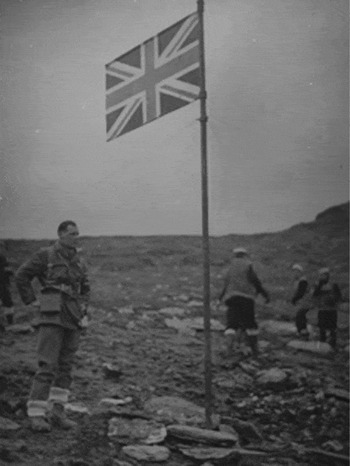
Carnarvon Castle carried out her mission, first visiting Deception Island, hoisting the British flag and removing various Argentine emblems that the embassy in Buenos Aires returned to the Argentine Government. (Fig. 4). There was a similar ceremony on Signy Island in the South Orkneys, and a visit made to Laurie Island, where a landing party was received cordially by the Argentine scientist in charge who was told the ship was on a cruise in search of enemy raiders.Footnote 23Primero de Mayo visited Deception Island a month later, obliterating the British emblems and overpainting the Argentine colours on the buildings. Emblems were similarly left at Port Lockroy and in the vicinity of Byrd's East Base in Marguerite Bay, both lying off Graham Land. The naval attaché secured through intelligence the report made by the Chilean naval officer, Captain Cordovez aboard Primero de Mayo, to his Minister of Foreign Affairs. It was apparent that he had seen the British emblems removed from Deception Island, and their covert replacement with Argentine emblems which the Argentines had tried to conceal from him. Cordovez anticipated further re-imposition of British marks of sovereignty, concluding his report: ‘I hazard this opinion because of the interest which Great Britain is bestowing on the Antarctic problem is manifest, if it is considered that in the midst of a great war, she detaches a vessel from her Naval forces in the Atlantic to carry out the act which has recently been undertaken’ (Cordovez Reference Cordovez1943).
Photograph of sailors carrying out ‘administrative’ acts on Deception Island during the visit of HMS Carnarvon Castle (Crown Copyright).

‘Operation Tabarin’ begins
Now with cabinet authority, a further interdepartmental meeting, of 27 May 1943, saw the priority to be establishing permanent bases on Deception Island in the South Shetland Islands and Signy Island on the South Orkney Islands, their cost to be met, at the governor's suggestion, by the revenue obtained from philatelists in purchasing a set of FID stamps issued for the purpose. In the event most of the cost was met from the Admiralty vote. Perowne thought that the cabinet decision might be reviewed in the light of the overthrow of the Argentine government by a military coup in July 1943. The FO accepted, however, the ambassador's (Sir David Kelly) recommendation that any response by the Argentine government could be contained provided Britain won the race to install permanent bases at the relevant locations, that there should be no intervention on Laurie Island and that absolute secrecy was maintained (Kelly Reference Kelly1943). This was essentially de facto recognition of how, unless force was used to remove the Argentine personnel, Laurie Island was probably lost to the British Empire (Foreign Office 1948: 163, 59).
An interdepartmental ‘expedition committee’Footnote 24 turned to the expertise of Neil Mackintosh from the Discovery Committee and James M. Wordie, chairman of the Scott Polar Research Institute in Cambridge. Wordie, as a notable polar explorer and distinguished scientist, had been seconded to naval intelligence whilst Mackintosh was the renowned expert on the Southern Ocean. Brian B. Roberts, a Scott Polar scientist and previously a member of the British Graham Land Expedition of 1935–1937, was the third highly influential figure in conferring a scientific identity upon what might otherwise have been a largely military occupation. However, he did not take any formal role in Tabarin until after February 1944 when he assumed a part-time appointment in the FO research department (Roberts Reference Roberts1940–1943).
The logistical priorities were to recruit sufficient volunteers to man the proposed stations, and find a vessel of sufficient sturdiness and bunker capacity to deliver the cargo and men to the Antarctic. James W.S. Marr, a lieutenant in the Royal Naval Volunteer Reserve on secondment to the South African Naval Forces, was identified as expedition leader. A marine biologist with the Discovery Investigations, he had taken part in Shackleton's final Antarctic expedition and was a member of the British, Australian, New Zealand Antarctic Research Expedition of 1929–1930. John Mossop, an official from the Admiralty's military branch I, secured Marr's release, minuting how retention of his naval rank would be ‘an advantage vis-à-vis the Argentine Naval party on Laurie Island’ (Mossop Reference Mossop1943). The expedition would ‘probably be sent on the same pretext as last year, ie that we are looking for raider hide-outs’. Marr joined the expedition committee, following his return in July 1943.
The committee, which met regularly through the latter half of 1943, envisaged an over-wintering base on Deception Island and at Hope Bay, on the coast of Graham Land, and, if limited resources permitted, a summer occupation of Signy Island in the more remote South Orkneys. Such change of plan had been required to counter the Argentine and Chilean territorial claims to Graham Land. Marr's ‘Political Instructions’ and ‘Regulations’Footnote 25 made it plain that ‘the main political object of the expedition’ was to establish ‘parties on the islands concerned rather than to deny access to them to Argentine and/or Chilean parties’. They emphasised how ‘force, in a sense implying the possibility of bloodshed or similar violence, should at all costs be avoided’. Marr was otherwise required ‘to establish bases at selected points in the FID and to conduct scientific research and survey therefrom (sic)’. A detailed scientific programme, which was to constitute ‘the principal occupation for the shore party’, was prepared by Mackintosh,Footnote 26 covering the disciplines of sea-ice, geology and physiography, glaciers, surveying, meteorology, zoology, botany, and tidal observations. Mossop and Roberts are reputed to have chosen ‘Operation Tabarin’ as the naval codeword for the expedition, reflecting both the Antarctic ‘night’ work and the chaotic organisation called for by the expedition - much like the Bal Tabarin, the Parisian nightclub, (Fig. 5) after which the operation was named (Roberts Reference Roberts1943–1961; Dodds Reference Dodds2002).
The Bal Tabarin night club in Paris (Courtesy www.notrefamille.com).

There are already detailed accounts (Wordie Reference Wordie1947; Fuchs Reference Fuchs1982), of the survey and research undertaken as part of Operation Tabarin. The expedition sailed from the Falkland Islands on 29 January 1944 in two small vessels, HMS William Scoresby and SS Fitzroy, arriving at Deception Island on 2 February. They left three days later, having helped Dr W.R. Flett (a geologist) and his party of five to establish base camp. Marr's party of nine men was landed at Port Lockroy on Goudier Island, off Wiencke Island on the Graham Land Coast. Ice conditions had made it too dangerous for Fitzroy to enter Hope Bay, and it would have been too protracted an operation to transfer its cargo to the other ship. Both ships departed on 17 February, with Scoresby making a further visit to both bases in April 1944.
The secret revealed
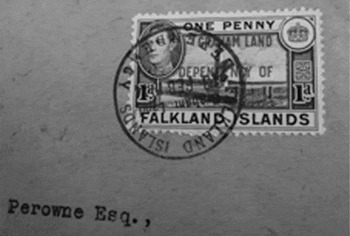
There proved little chance of the expedition remaining secret. Ironically, security was compromised because of the issue of special Falkland Islands stamps overprinted with the names of the dependency from whose ‘post office’ members of the expedition posted their letters, prior to the ships’ departure (Fig. 6). Whilst perceived as a way of strengthening the administrative position in the dependencies, such deliberate posting of both official and personal letters was bound to betray the existence of the parties. As Perowne minuted on 4 March 1944: ‘we were never very keen on this action . . . but the CO attached importance to it, and we felt that we could not press our view’. Particularly as all the letters had to pass through Montevideo: ‘knowledge of what we have been doing in the Antarctic will leak out’. An attempt to prevent the letters leaving Port Stanley failed. Perowne informed the ambassador of how: ‘we are not proposing to say anything to the Argentine (for obvious reasons), Chilean or United States Governments at this stage’ but, with the new stamps posted: ‘the question of publicity has become unavoidable’. A short press statement would have to be issued: ‘saying that a British scientific expedition has been sent to the Dependencies to establish bases at selected points from which scientific research and survey can be undertaken’ (Perowne Reference Perowne1944).
One of the official letters posted to Perowne at the FO from Operation Tabarin (Crown Copyright).

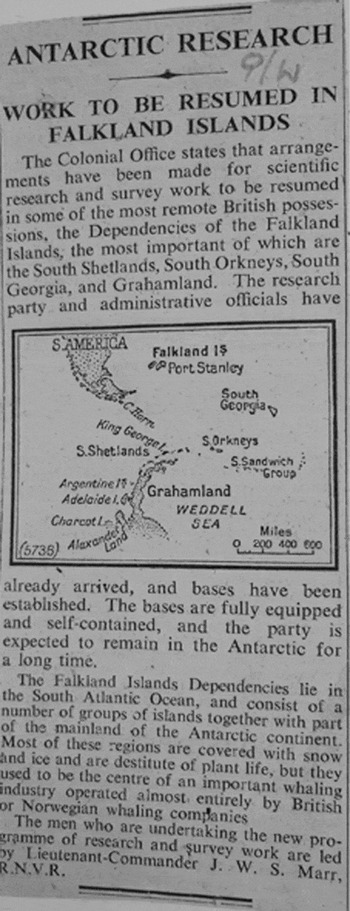
It was not until 23 April 1944 that ‘higher authority’ approved the statement. The Times led the next day with the headline ‘Antarctic Research’ (The Times (London) 24 April 1944; Fig. 7). The article was remarkable on two counts. First, it seems incredible that readers should be expected to believe that, in the middle of a global war, ‘scientific research and survey work’ was being resumed. Indeed, as Brian Roberts minuted (Roberts Reference Roberts1944a) later in 1944, American scientists on the previous Byrd Expedition had read such reports with disbelief, asking him what was really going on. South American readers would have especially noted reference to ‘administrative officials’ and of how ‘the party is expected to remain in the Antarctic for a long time’. The second reason was that it was almost certainly the route by which Winston Churchill learnt further of the expedition. He had simply approved the cabinet decision following his return to the country. There was accordingly consternation when Eden received one of the Prime Minister's personal minutes, of 24 April 1944, asking: ‘What is the reason for sending an expedition of perfectly good fighting men to the South Pole? If you are seeking to establish our claims as against the United States the fact might at least have been kept secret during this period of preparation for solemn events’ (Churchill Reference Churchill1944). Eden pointed succinctly to the Cabinet decision, Churchill's approval of it, and of how the action was: ‘not aimed against the United States, who have no claims over this territory, but against Argentine and Chilean claims and encroachments’ (Eden Reference Eden1944).
Reproduction of The Times article of 24 April 1944.

Did permanent mean permanent?
Questions were soon asked within the CO as to what should happen after the first winter's occupation. The expedition committee was reconvened on 8 May 1944 to consider Marr's request to transfer from Port Lockroy to Hope Bay, thereby opening up possibilities for inland survey and research, and, therefore, his request for a more ice capable ship, sledge dogs and air support. Marr pointed to how a more elaborate expedition, with attendant publicity, would have enhanced political value. There is a telling hand written annotationFootnote 27 on a CO letter that gave notice of this meeting, noting that: ‘the more noise we make the less the Argentine toy soldiers will dare to make a fuss (of a physical variety)’. The FO official prefaced the expedition committee's agenda with a statement that the: ‘Foreign Office felt it might be desirable to consider precisely what ultimate objective should be contemplated in regard to the Falkland Island Dependencies. If it was merely to be a matter of keeping the Argentine and Chileans out, it might be necessary to envisage a considerable extension of activities in the Dependencies. A possible alternative might be to work towards an international conference at which territorial claims could be settled by agreement, in which case HMG would probably have to make concessions in some areas as the price of being left in undisputed possession of others’. Others pointed to the practical purpose of the interdepartmental meeting, it being for the FO to raise such political questions separately with those competent to make such decisions.Footnote 28
The expedition committee assumed a second expedition would go ahead, agreeing that Hope Bay should be occupied and that a more capable vessel than Fitzroy must be found. It was not until a sealer SS Eagle, and a team of 20 sledge dogs, were secured from Newfoundland that planning for Hope Bay could proceed with greater assurance. News that a second expedition was being planned broke in The Daily Telegraph of 7 September 1944 (The Daily Telegraph (London) 7 September 1944). The zoologist appointed to take charge of the dogs had told a friend at Scotland Yard, who relayed what he had learnt to the press!Footnote 29 Whilst the governor and officials were alarmed by how such intelligence might enable the Argentine and Chilean governments in taking counter-action, Roberts pointed to the increasing difficulty of keeping the number and location of the bases secret, now that they had begun to provide weather data. As Roberts remarked, such functions as weather reporting highlighted the need for a public name for the expedition. The two most widely canvassed in meetings with the CO were the ‘FID Survey’ and the ‘Antarctic Research and Development Service’. No final decision was made, Roberts surmised, because: ‘the CO still definitely expects the whole expedition to be concluded in the autumn of 1945. As I understand the position, an occupation lasting only one or two years will not greatly assist our case. Could Mr Beckett (Foreign Office legal adviser) comment on the point?’ (Roberts Reference Roberts1944b). There is a hand written response from Beckett, warning: ‘An occupation . . . of one or two years will not achieve our objective. We must have some continuous – ie either someone always there summer or winter or at least a continuous series of parties occupying every summer. If we go for 2 or 3 years & then give up at the present time someone else can nip in when we give up.’ Henderson, an FO official, added that ‘Mr Beckett is clearly right’. The FO at had begun to recognise, by the autumn of 1944, that permanent occupation was essential to establish legal title and hence that Tabarin must be extended into the post-war period.
The continued political priority was emphasised by the decision of the expedition committee,Footnote 30 on 14 February 1945, to defer consideration of Mackintosh's suggestion that the Discovery committee and Tabarin should be combined. The logistical priority was rather to ensure the permanence and greater number of British bases, both on the South Atlantic islands and on the Antarctic continent. Both Deception Island and Hope Bay must be occupied and, if manpower permitted, Port Lockroy and a new base in the South Orkneys. The question was put to the FO as to whether, as a precautionary measure, a base might also be established where Byrd's East Base had been so hurriedly abandoned in Marguerite Bay. Presumption of a third wintering party was confirmed by Perowne's correction of the expedition committee's minutes of 14 February 1945, in which he pointed to how ‘Beckett and Henderson both emphasised that continuous (his underlining) occupation is desirable.’ The amendment was accordingly made (Perowne Reference Perowne1945). For a detailed discussion of the legal arguments concerning territorial claims in the FID as they stood just post war, see Waldock (Reference Waldock1948).
From ‘Tabarin’ to FIDS
Tabarin was an ‘Admiralty’ operation only to the extent that its cost was met entirely by the wartime naval vote. Even then, the Admiralty insisted that the CO took responsibility for actual expenditure and that the CO would be answerable to parliament, even to the extent of seeking a letter from the CO specifically stating that any request from Marr could be regarded as having CO approval behind it. This funding arrangement removed the need to seek parliamentary approval to allocate funds to the CO with the attendant risks of a leak.Footnote 31 Whilst Marr retained his naval standing, his instructions, political, organisational and scientific, emphasised how his parties were employed by the Colonial Secretary, through the office of the governor of the Falklands, with command and control via that route. Only the expedition's ships and their crews were answerable immediately to the Admiralty.
The post-war ‘civilianization’ and, therefore, permanence of Tabarin made ever more pressing decision as to its relationship with the CO, and how it should be publicly described. Whilst Roberts favoured ‘FID Survey’ and Mackintosh remained undecided, James Wordie went as far as to head his letters to the CO with the words ‘Graham Land Survey’ (Wordie Reference Wordie1945). He did not carry the day. An interdepartmental meeting at the CO, on 30 May 1945, agreed the name ‘FID Survey’, or ‘FIDS’ for short, which the Colonial Secretary confirmed in a despatch to the governor, in July 1945.Footnote 32 Organisationally, the UK end of FIDS was now run from the Mediterranean Office of the CO, essentially by one principal grade officer (J. Barton), whilst the cost was met from the colonial and Middle Eastern services vote from the end of the 1945–1946 season. Barton was advised and assisted by an informal committee comprising of Mackintosh and Wordie with Roberts acting as its secretary. Meanwhile operational command rested with the field leader (by then Surgeon Commander Bingham), under the direction of the governor. Organisationally this was hardly optimum. Difficulties quickly arose through poor communication amongst the various groups with a finger in the pie. Barton and the informal committee members pressed for reform, particularly for the Discovery committee and FIDS to be merged, and, although the organisational deficiencies were well recognised within the CO,Footnote 33 reform was slow to come. The FIDS committee was formalised in June 1946, but stability was only achieved by the establishment in May 1948 of the FIDS scientific committee by the CO with a membership approved by the Secretary of State and Wordie as the first chairman (Roberts Reference Roberts1943–1961).
Discussion
A narrative has been provided of how Britain's participation in the ‘heroic age of Antarctic exploration’ gave rise to an imperial determination to retain as large a presence as possible in both the Southern Ocean and upon the Antarctic continent. The development of international law required more than simply a proclamation of sovereignty, and by the latter stages of the World War II, it was recognised that some measure of permanent occupation would be essential to underpin the claim. From the Antarctic viewpoint the inter-war response of the British government to Argentina and other encroachments may be perceived as a curiously dispiriting story of short-sightedness, naivety, missed opportunity, inaction and interdepartmental quarrelling. But in the larger context of the British foreign policy, particularly regarding the USA and South America, it may have been inevitable. Alternatively, such a policy of appeasement may be seen to have been extraordinarily successful, given the inherent weakness of the British position, both as to title of those possessions and the physical means of defending them. Either way, decisive action came when it might have been least expected: in the midst of a global war.
There is abundant scope for counter-factual history. What if Larsen had been quicker in starting a whaling industry in the Southern Ocean, and Bruce had been able to attract official support for his Scotia expedition? As it was, Bruce wanted in 1904 to leave his observatory on a permanent footing, and Britain had not yet recognised the fiscal value of South Georgia, the South Orkneys and South Shetlands as whaling bases. And yet, within four years, the British government had gazetted Letters Patent, laying claim to those and other parts as the FID. As for Argentina, the correspondence of the British legation pointed, as early as 1903, to a general scientific ambition which readily took advantage of Bruce's offer. Through all the political machinations of the last century the observatory that Bruce established on Laurie Island in 1904 has continued to operate. As the oldest Antarctic observatory by far, it provides unique and valuable scientific data sets on the Antarctic environment, data sets that grow in importance with each passing year. As such it stands as a fitting memorial to Bruce's scientific vision, if not to his political and the British government's judgement!
As it was, Britain faced an increasing dilemma in the inter-war years, anxious on the one hand that Britain, and the dominions of Australia and New Zealand, should dominate the Antarctic, and, on the other hand, conscious of the weakness of their claim to the FID, whether based on discovery or, even more strikingly, occupancy, coupled with the political vulnerability of the heavy British investment, economic and cultural, within Argentina itself. Nor was the significance of such a dilemma confined to the dependencies. As the various Argentine Antarctic ‘pin-pricks’ came to be assessed, whether in terms of the establishment of a wireless station, postal claims, and perpetration of symbolic acts of sovereignty by visiting Argentine vessels, such encroachment upon particular islands and groups became coupled by the British government with the retention of the Falkland Islands themselves. The fact that use of international arbitration over Laurie Island would only complicate matters for the Falklands was a major reason why Britain so often followed a ‘let sleeping dogs lie’ policy between the two world wars. Even so, as Perowne had pointed out in 1942, a major reason for maintaining title to the South Orkneys was because they might provide a bargaining counter in any arbitration over sovereignty of the Falklands. Moreover, any discernible weakness in the Southern Atlantic could well have far reaching repercussions for other colonial possessions and, not least, British Guiana and British Honduras. It was the combination of all these factors that forced the British government into a position of apparent inaction. It is relevant to note, as to the significance of the Falkland Islands in Anglo-Argentine relations, that Sir David Kelly referred in his memoirs only once to ‘the ever-thorny question of the FID’, in a chapter devoted entirely to his years as ambassador to Argentina, 1942–1946 (Kelly Reference Kelly1952: 289).
The outbreak of war made little immediate difference to Britain's position, particularly given the apparent solidarity of pan-American sentiment as to neutrality in the European war. Even as a schism developed between the United States and Argentine governments, following the latter's refusal even to break diplomatic relations with the axis powers, the FO was reluctant to provoke Argentine opinion. It was the Admiralty and CO, citing Argentina's increasing isolation, which caused the war cabinet to approve Carnarvon Castle's tour of the dependencies and, less immediately, permanent occupancy. Neither decision was directed towards the axis threat. The avowed desire to extend the research and survey work of the Discovery committee onto the Antarctic islands and land mass (Wordie Reference Wordie1947) became similarly a cover for countering further Argentine incursions. And yet, through the culture of survey and research within the CO, and more particularly, the ‘expert’ advice from the Discovery committee and Scott Polar Research Institute, and the personal commitment of Marr, Flett and their successors in the Antarctic itself, Tabarin laid the foundation for what became a sustained and major post-war scientific endeavour, instead of merely a military occupation.
With the establishment of FIDS, Britain embarked upon what might be called a ‘base race’ with Argentina and Chile and, at an altogether greater scale, with the United States, as an integral part of their political ambitions to obtain access to such natural resources as might be discovered within Antarctica and its waters. Such national aspiration, together with the wider complexities of the cold war and increasing Soviet involvement, laid the foundations for a remarkable political resolution of the Antarctic problem, essentially a territorial truce, in the form of the Antarctic Treaty, concluded in 1959 and ratified in 1961. As a further adaptation to circumstances, the FID became the British Antarctic Territory (BAT) and the FID Survey (FIDS) became the British Antarctic Survey (BAS) in 1962 (Dudeney Reference Dudeney and Riffenburgh2007). With the rapid demise of perceptions of empire in the 1960s, and absorption of the CO into the FO, BAS joined Britain's scientific establishment, as a component body of the recently founded Natural Environment Research Council, not least as recognition of its distinguished role in the International Geophysical Year and the consequent part played in furtherance of what became Britain's Antarctic Treaty obligations.
Acknowledgements
The authors gratefully acknowledge the support provided by the award of Leverhulme Emeritus Fellowships, awards made by the Trans-Antarctic Association and British Antarctic Territory funds, and the guidance and assistance of The National Archives, Scott Polar Research Institute Archives, British Antarctic Survey Archives and Churchill College Cambridge archive. Our thanks go to Peter Fretwell of the Mapping and Geographic Information Centre at BAS for the map. The quality of our arguments was materially improved in responding to questions raised by two reviewers, for whose comments we are most grateful.