BACKGROUND
It is not easy to identify the history of psychiatric intensive care in the UK. The old asylums in the 19th and early 20th centuries had specialist refractory wards for the management of seriously disturbed patients, which were occupied by patients drawn mainly from the hospitals' large long-stay populations. As bed numbers decreased during the second half of the 20th century, care moved to the community, many old asylums closed and new psychiatric units were opened, often situated in the grounds of large district general hospitals. Numbers of admissions increased dramatically while lengths of stay went down, and inpatient care began to focus more and more on short term treatment of the acutely ill, mostly on open wards. Difficulty in containing the more seriously ill and disturbed of those patients led to the creation of specialist psychiatric intensive care units – wards with low bed numbers, high nurse staffing numbers, resilient furnishings, simple layouts to promote observation and locked doors. Where the original asylum building was retained, the refractory ward transformed over time into the psychiatric intensive care unit (PICU) more recognisable today.
PICUs therefore exist to manage and contain the most disturbed psychiatric patients on a short term basis, a role that is reflected in the type of patients they accept: patients who are assaultive, seriously self harming and/or at high risk of absconding (Bowers et al. Reference Bowers, Jeffery, Bilgin, Jarrett, Simpson and Jones2008a). A significant part of what a PICU provided to the wards it supported was security. PICUs were locked whereas acute wards were open, allowing patients to more readily abscond, or to escape the supervision of staff in the hospital grounds, thus posing risks to themselves or others. That arrangement has been changing over the last fifteen years, and now the majority of acute wards are also locked (Bowers et al. Reference Bowers, Alexander, Callaghan, Eales, Guy, Mccann and Ryan2002; Garcia et al. Reference Garcia, Kennett, Quraishi and Durcan2005), with a range of impacts on patients feelings and behaviour which may be negative (Nijman et al. Reference Nijman, Bowers, Haglund, Cochrane, Simpson and van der Merwe2011; Muir-Cochrane et al. Reference Muir-Cochrane, van der Merwe, Nijman, Haglund, Simpson and Bowers2012). Over the same time period, PICUs have been taking increasing numbers of transfers from the prison system, and treatment necessity coupled with bureaucratic delays means these patients stay for long periods, reducing the beds available to support staff managing difficult patients on the general acute psychiatric wards.
These changes are calling into question the purpose of PICU provision. In addition, the high cost of PICUs (Hyde & Harrower-Wilson, Reference Hyde and Harrower-Wilson1996) is focussing attention on them to identify whether any cost savings can be made. We have argued elsewhere that the purpose of PICUs might be to keep patients and staff safer than is possible on acute wards, and/or to produce a speedier recovery through intensive treatment (Bowers et al. Reference Bowers, Jeffery, Bilgin, Jarrett, Simpson and Jones2008a). However, there is no research evidence on whether PICUs do actually deliver on these potential outcomes. The conduct of the City-128 study in 2004–05 produced a large dataset from a national sample of wards that did allow the first of these questions to be addressed. Do acute wards have fewer adverse incidents when a PICU is available to take their more disturbed patients, and is the rate of transfer of patients to PICUs from the acute wards associated with lower rates of adverse incidents? We report below on the answers we found to these two questions.
METHODS
Sample
The sample comprized 136 acute psychiatric wards with their patients and staff in England, proximate to three regional centres, in 2004–05. Acute psychiatric wards were defined as those that primarily serve acutely mentally disordered adults, taking admissions in the main directly from the community, and not offering long-term care or accommodation. A full description of the sample is available in previous publications from the study Bowers (Bowers et al. Reference Bowers, Whittington, Nolan, Parkin, Curtis, Bhui, Hackney, Allan and Simpson2008b). The study was approved by the NW Multi-centre Research Ethics Committee.
Instruments
The Patient-Staff Conflict Checklist (PCC-SR), an end of shift report by nurses on the frequency of conflict and containment events (Bowers et al. Reference Bowers, Douzenis, Galeazzi, Forghieri, Tsopelas, Simpson and Allan2005), was collected for a six month period on all participating wards. This form was also used to collect a limited amount of data on patients (age, gender, ethnicity, diagnosis, reason for admission, and postcode). Postal codes were matched with local area social deprivation data (income, employment, crime, educational attainment, etc.) to yield deprivation scores for each hospital ward (Index of Multiple Deprivation, IMD; Noble et al. Reference Noble, Wright, Dibben, Smith, Mclennan, Anttila, Barnes, Mokhtar, Noble, Avenell, Gardner and Lloyd2004). Information on the ward physical environment (including scoring of hygiene, décor, duration since last redecoration, number of repairs pending, etc., summed into a physical environment quality score) and the policies in operation was collected on a site visit by a researcher and a form completed by the ward manager. Additional instruments used included the Attitudes to Containment Measures Questionnaire (ACMQ; Bowers et al. Reference Bowers, van der Werf, Vokkolainen, Cochrane, Allan and Alexander2007); the Attitude to Personality Disorder Questionnaire (APDQ; Bowers & Allan, Reference Bowers and Allan2006); the Ward Atmosphere Scale (WAS; Moos, Reference Moos1997); the Team Climate Inventory (TCI; Anderson & West, Reference Anderson and West1999); the Multifactor Leadership Questionnaire (MLQ; Bass & Avolio, Reference Bass and Avolio1995); and the Maslach Burnout Inventory (MBI; Maslach & Jackson, Reference Maslach and Jackson1981). These were distributed to subjects by the researchers and returned anonymously via a research ‘post box’ provided to each ward. A full account of instruments, their use, validity and reliability can be found in previous publications (Bowers, Reference Bowers2009).
Data analysis
Analysis one was conducted at the level of wards with data organized as 136 cases/rows, each representing one ward. Multinomial logistic regression was conducted with access to PICU care as the dependent variable, with backward stepwise selection. This type of analysis allows a categorical dependent variable with multiple categories. In this case, wards with access to an on site PICU, and wards with access to an off site PICU (at another hospital), were compared to wards with no PICU access (as reported by the ward manager). This analysis was first conducted separately for each domain (patient, service environment, physical environment, patient routines, conflict, containment, staff demographics, and staff group factors). Variables found to be significant in these domain analyses were then entered into a further regression analysis, resulting in a final model across all domains. Clustering at the level of NHS Trusts was controlled for in the analysis.
Analysis two used a dataset of over 40,000 shift reports from those wards that had some from of PICU access. Multilevel random effects modelling was used, with PICU transfers as the dependent variable, utilizing poisson regression with number of beds on each ward as the exposure or offset variable. Three level models were explored. Shifts were at the lowest level (1), wards at level 2 and trusts at level 3; shifts were nested in wards, which were nested in trusts. Shifts were chosen as a level because of clustering effects in am, pm and night shifts; wards for similar reasons, and trusts because they represent organizational units with single local policies and operational procedures. When a dataset such as this is hierarchically organized (shifts occur on individual wards, which exist in individual trusts), failing to control for the clustering of similar observations at each level leads to biased results. Multilevel modelling takes this into account, and thus yields greater accuracy. As in analysis one, each group of variables (domain) was used to build a separate initial model, and then the significant variables were used to construct a final comprehensive model using the same process of backward selection. All analyses were conducted using Stata 11 (StataCorp, 2009).
RESULTS
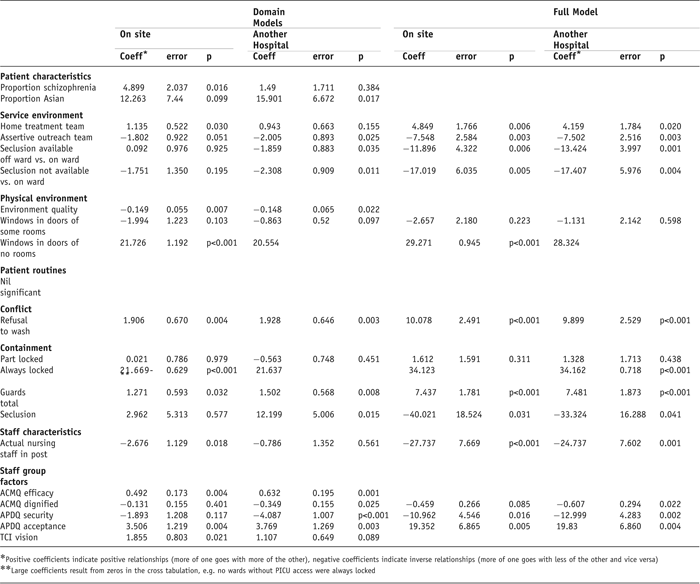
The features of wards with access to an on site PICU, and wards with access to a PICU at another hospital, were contrasted with those without access to a PICU at all, using multinomial logistic regression on the sample of 136 wards. If PICU provision effected a lower level of disturbance on the acute wards served, then it could be expected that, controlling for all other factors (patient characteristics, physical environment, etc.) aggression and other conflict behaviours would be lower on those acute wards with more ready access to PICU provision. Most wards had on site PICU access (n = 73, 54%) or access to a PICU on another site (n = 44, 32%), the remainder having no access to a PICU at all, as reported by their ward managers. The results are summarized in Table 1. The first two columns of figures present the initial domain models. For example first all patient characteristics were assessed together for their relationship to PICU availability, with only two patient features found to be statistically significant: the proportion suffering from schizophrenia and the proportion of Asian ethnicity. Then (for example) all the service environment variables were modelled together, producing eight separate domain models. The last two columns present the final combined model, in which all the previous variables found significant in the domain models were brought together in a single model, and excluded one by one until only those still significantly associated with PICU access were retained.
Multinomial logistic regression models contrasting wards with access to an on site PICU, and wards with access to a PICU at another hospital, with those without access to a PICU
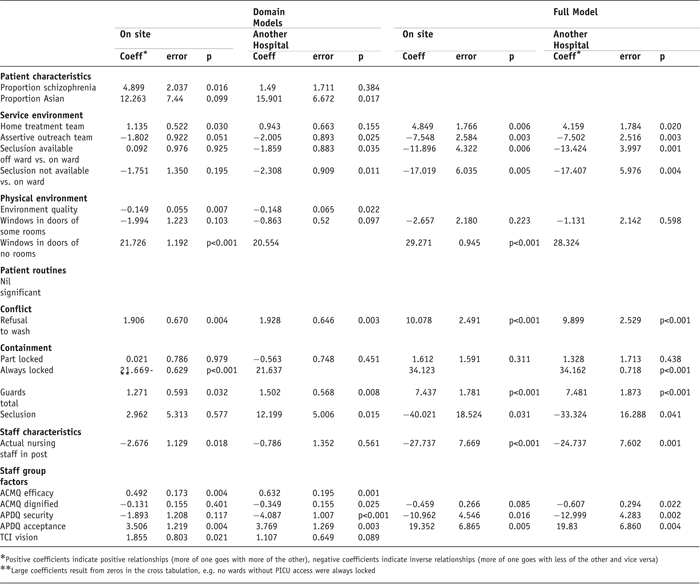
* Positive coefficients indicate positive relationships (more of one goes with more of the other), negative coefficients indicate inverse relationships (more of one goes with less of the other and vice versa)
** Large coefficients result from zeros in the cross tabulation, e.g. no wards without PICU access were always locked
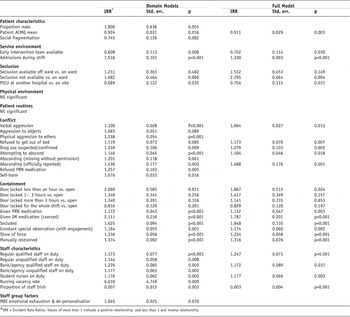
The actual transfer rate from the study acute wards to PICUs was also modelled using Poisson regression across 40,231 shifts on the 117 wards that had access to a PICU. The rate of PICU transfer was very low, 0.04 per 24 hour period or about one transfer every 25 days. The results are summarized in Table 2. Once again, the first column shows the domain models and the second shows the combined full model, made from bringing forward significant results from the domain models into a single model. It is important to keep clear that Table 2 shows what is associated with PICU transfers during the shift, taking into account the availability of PICU care an all other significant ward and patient features. Table 1 shows what is associated with the actual differing levels of provision of PICU care.
Poisson regression multilevel model of PICU transfers for the 117 wards with access to PICU care provision either on or off site (IRR = Incident Rate Ratio)

* IRR = Incident Rate Ratios. Values of more than 1 indicate a positive relationship, and less than 1 and inverse relationship
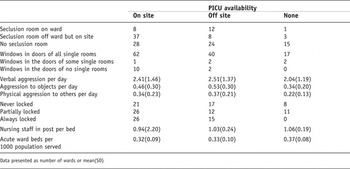
We will now describe the results by domain, elucidating them with the help of the descriptive statistics shown in Table 3.
Selected descriptive statistics showing differences between wards by access to PICU care

Data presented as number of wards or mean(SD)
Patient characteristics
Although there are some indications in the domain models that patient characteristics could be associated with PICU provision and PICU use, in neither case were these retained in the final models. It would therefore appear that the type of patients admitted to a ward had little influence over whether a PICU was an option in the care of patients, and if it was present, whether it was used.
Service environment
PICU availability did seem to be linked in some way to the provision of specialist teams in the community. Wards with access to PICU care were more likely to have their local community served by a home treatment team and less likely to be served by an assertive outreach team. Actual transfers to PICU care seemed to be associated in some way with the absence of an early intervention team. However, there was a stronger and more complicated association with the provision of seclusion, as can be seen in Table 3. When a PICU was available on site, seclusion was most likely either to be available but not on the acute ward itself, or not be available at all. When a PICU was available off site, seclusion was more likely to not be available at all, or to be available on the acute ward itself. Where there was no PICU access, most often there was no seclusion access either. The relationship between seclusion use and PICU provision is returned to under the containment domain below.
Physical environment
No features of the ward physical environment were associated with the PICU transfer rate. There was an indication that a worse quality physical environment on the acute ward was associated with the provision of a PICU, but this was not retained in the final combined model. Having no windows in the doors of single rooms was positively associated with the provision of an on site PICU. Table 3 shows that this association was in the context of the vast majority of all wards in the sample having windows in the doors of all single rooms.
Patient routines
The holding of regular ward community meetings and the number of patient activity sessions provided were not associated with PICU provision or use.
Conflict
Rates of aggression, alcohol/substance use, absconding and medication refusal did not differ between those wards that had a PICU and those that did not. Only the rate of refusal of patients to attend to their personal hygiene was associated with PICU provision in a positive direction. Mean daily rates of aggression under the three conditions are presented in Table 3. Transfers to PICU care were associated with a range of conflict behaviours, primarily aggression, drug use and absconding.
Containment
While the PICU transfer rate was not strongly associated with door locking status, actual PICU provision was, as shown in Tables 1 and 3. Wards with PICU access were much more likely to be permanently locked than open, and none of the wards without PICU access were in the always locked category. PICU access was also positively associated with the provision of security guards. Occurrence of a PICU transfer was strongly associated with other severe containment methods including coerced IM medication, constant special observation, show of force, manual restraint and seclusion. However, controlling for seclusion access, the provision of PICU care was associated with less seclusion use, even though transfers to PICU were associated with seclusion (for those wards that had PICU access).
Staff characteristics
The occurrence of PICU transfers was positively associated with the numbers of qualified nursing staff on duty, with some indications of relationships with nurse ethnicity and the vacancy rate on the ward concerned. The relationship between staff characteristics and PICU care provision yields an interesting and different picture, with fewer staff on the acute ward associated with the provision of PICU care, and to a stronger extent when the PICU is on site. Table 3 provides figures on nursing staff per bed to make this relationship more clear and to quantify it. Although not statistically significant, acute ward bed to population ratios also differed by PICU provision (Table 3).
Staff group factors
On the APDQ, the subscale score of ‘security’ was inversely associated but ‘acceptance’ was positively associated with the provision of PICU care. The degree to which containment was generally seen as protecting patients’ dignity by the staff (ACMQ) was also inversely associated with PICU care provision. The PICU transfer rate was not associated with any staff group factor.
DISCUSSION
The failure to find a link between the characteristics of patients on the acute ward and PICU provision or transfers is not surprising. We do know that PICUs predominantly but not exclusively provide care to male patients (Bowers et al. Reference Bowers, Jeffery, Bilgin, Jarrett, Simpson and Jones2008a), however that does not require that PICU provision or transfers would be associated with greater numbers of male patients admitted to acute wards. Similar arguments could be made about the proportion of patients suffering from schizophrenia or detained under MH legislation.
The associations found between PICU provision and transfer, and specialist community teams are unlikely to be causal, but may reflect other features of the organizations concerned, perhaps the degree to which they are rapid adopters of new ideas and service configurations.
The provision and accessibility of a PICU is associated with the transfer rates, these being 30 % higher where the PICU is on site compared to off site. Just as with PICU care, the provision of a seclusion room is the largest single factor in seclusion usage rates (Bowers et al. Reference Bowers, van der Merwe, Nijman, Hamilton, Noorthoorn, Stewart and Muir-Cochrane2010), and those seclusion rates vary widely between hospitals, with many not using it at all, and some applying seclusion to up to 25% of admitted patients (Bowers et al. Reference Bowers, Ross, Nijman, Cochrane, Noorthoorn and Stewart2012). Transfer to PICU care is seen as more acceptable than seclusion use, by both staff and patients in the UK (Whittington et al. Reference Whittington, Bowers, Nolan, Simpson and Neil2009). Many countries have embarked upon initiatives to reduce seclusion use (American Psychiatric Association et al. 2003; Janssen et al. Reference Janssen, Noorthoorn, de Vries, Hutschemaekers and Lendermeijer2008; National Mental Health Seclusion and Restraint Project, www.nmhsrp.gov.au/c/mh), with varying degrees of success (Stewart et al. Reference Stewart, van der Merwe, Bowers, Simpson and Jones2010). The complicated relationship of PICU with seclusion provision and use suggest that hospitals are adopting a variety of very different solutions to the management of disturbed behaviour, and that the issue of seclusion is in many cases intrinsically linked to PICU provision:
Not having access to a seclusion room at all is common under all types of PICU provision, but is the dominant solution when the PICU is not available at all, or is available off site. These wards therefore have lower levels of containment built in to their service structure. Critical questions for this solution are about the number and severity of injuries to patients and staff, and whether the absence of both seclusion and PICU care results in greater use of rapid tranquillization, higher doses of medication, and long duration of manual restraint with attendant risks.
A lesser number but still significant group of wards are those that have an on site PICU that provides the use of a seclusion room to its associated acute wards. Critical questions here are about who holds responsibility for the patient in seclusion (acute ward staff or the PICU staff), and about the necessity for seclusion. If the patient is sufficiently calm to be manhandled along corridors, or up and down lifts in order to reach the seclusion room on the PICU, why do they need to be in seclusion at all?
A third notable solution is the provision of a seclusion room on the acute ward where the PICU is not so accessible due to being off site. Strikingly, this substitution is not noticeable for those wards not having access to a PICU at all. The critical question here is whether free seclusion access on the acute ward is better in terms of outcomes (injury rates to staff and patients, use of other forms of containment) than either no PICU or seclusion at all, or easier access to an on site PICU.
It would appear from our findings that the future of seclusion in UK acute psychiatry is bound up with the future of PICU care. We do not have answers to the critical questions raised by each of the different combinations of seclusion and PICU provision, and these are therefore issues of priority for future research.
Reasons for admission to PICU in previous research are reported to be aggression (accounting for 30–50% of admissions), risk of absconding and generally disruptive or acutely psychotic behaviour (accounting for 10–20% of admissions each), and self-harm and/or suicide risk (10–15% of admissions) (Bowers et al. Reference Bowers, Jeffery, Bilgin, Jarrett, Simpson and Jones2008a). These are largely confirmed by those behaviours found to be associated with PICU transfers, most notably for aggression and absconding. However drug use has not previously been reported as a reason for transfer, although it is likely to be linked to acute psychotic behaviour, and an association between PICU care and drug induced psychosis has been found in the past (Brown & Bass, Reference Brown and Bass2004).
Given these reasons for transfer, it is surprising that there was no association between PICU provision and reduced rates of aggression and absconding on the acute wards in the sample. If the most high risk patients are transferred to PICU care, then it might be reasonably expected that rates of conflict on the acute wards would be significantly reduced, yet they were not. This lack of a finding does raise the question of what outcomes PICU care is designed to produce, an issue that clearly needs additional critical thought. PICU care, for example, might not actually be able to reduce the number of assaults on a unit, however, by managing them better, injuries may be less frequent and severe. The provision of a PICU to hold the more threatening patients might make the acute wards more settled places, less frightening for other patients, thus speeding their recovery. Intensive attention and treatment of the more severely ill on the PICU might also speed their recovery. In both these ways, the provision of a PICU might facilitate speedier discharge and faster turnover of patients, freeing beds for needy admissions. The ability to assemble staff more quickly on a PICU might enable the resolution of escalating crises in a way that better retains patients’ dignity. All things being equal, the longer time required to assemble staff on the acute ward may result in the crisis occurring within the view of a larger number of fellow patients. This could damage their reputation among their fellow patients, or lead to a sense of shame about their behaviour. Finally, PICUs have other roles, in relation to enabling court diversion schemes through admission of patients following offences, and through enabling the transfer of severely mentally ill prisoners from jail for periods of treatment. These functions may prove to be more important outcomes than the service provided in support of acute wards.
With the exclusion of the possibility that, controlling for seclusion access, PICU provision may reduce seclusion use, PICU care was not associated with lower rates of containment either. Actual transfer was associated with other severe containment such as manual restraint and coerced medication. Provision of PICU care was associated with more secure acute ward environments, not less, with greater provision of security guards and more use of locked doors. Perhaps PICU provision habituates staff in a unit to the use of locked doors, making their introduction on the acute wards subject to less opposition. In any case, this might make the failure of PICU provision to further reduce absconding more understandable, as where the acute wards are already locked (reducing absconding by 30%; Nijman et al. Reference Nijman, Bowers, Haglund, Cochrane, Simpson and van der Merwe2011), locked PICU care can produce no further major improvement.
The provision of PICU care is generally considered to be expensive, due to high staff to patient ratios (Hyde & Harrower-Wilson, Reference Hyde and Harrower-Wilson1996; Birnie & Natsuna, Reference Birnie and Natsuna1988). However, this study reveals that the provision of a PICU is associated with a lower staff to patient ratio on acute wards, and a lower number of acute ward beds per head of population. Extrapolating from the figures in Table 3 and from City-128 findings published elsewhere (Bowers & Flood, Reference Bowers and Flood2008), and assuming a hospital with four acute admission wards serving a 200,000 population, then a hospital with an on site PICU would have ten fewer beds across its four acute wards. Coupled with a lower staff-patient ratio, this would be equivalent to 20 fewer acute ward nursing staff – partly supplying the number required to run a 10 bed PICU with an enriched staff-patient ratio. It is hard to resist the conclusion that services have opened PICUs by a combination of reducing their acute ward bed numbers and staff as well as extra investment, and that the provision of PICU care may be less costly than it initially appears.
The differing associations of PICU care provision with the staff questionnaires are hard to explain. We are unable to think of any sensible explanation of these findings, and suspect that a combination of multicollinearity, small numbers of the ‘no PICU access’ group of wards, and outlier values may have produced these results. For example, APDQ security and acceptance are correlated at r = 0.67, even though they are associated in different directions with PICU provision. There was certainly some association between PICU access and team climate, attitude to personality disorder and acceptability of containment on the acute wards. A further study with a larger sample size might be needed to elucidate precisely what this relationship is.
LIMITATIONS
The dataset on which this analysis was conducted, although large, was cross sectional. Therefore the associations reported do not prove causality or its direction. As large numbers of variables were tested, some of the reported associations may have arisen through chance. For example, the association of refusal to wash with PICU provision seems inherently unlikely. Although the dataset was large, it was dependent largely on nurses reporting numbers of incidents at the close of a shift, a method which might be insufficiently accurate to detect relatively small effects or associations. Transfers to PICU care were relatively rare. In addition, our second analysis looked at associations between PICU transfers and other patient behaviours within the same shift, while are aware that sometimes there can be a considerable delay between the request for a transfer and its occurrence. For the comparison of wards by PICU access, we relied upon the reports of ward managers via questionnaires. These data may have been inaccurate, or may have ignored the option of transfers to private hospital facilities, or other ways of managing extremely disturbed patients such as transfer to medium secure care. Nevertheless, they should reflect the degree of ease of access to PICU as viewed from the clinical and managerial ward level.
CONCLUSIONS
As we acknowledge above, there are a range of possible functions for PICUs, only some of which are covered by this study. However, it is pertinent to compare those wards with access to PICU to those without, and on this basis the results of the present study conflict, and containment outcomes do not appear to present the former with any clear advantage. These cross-sectional data indicate that transferring patients to a PICU may not be an effective means of reducing adverse incidents on acute wards and may not have appreciable cost benefits over acute services without access to PICU. It illustrates why longitudinal studies are required to unpick these complex relationships between PICU provision and outcomes, both at the level of services and the individual patient, furthermore, it indicates that any future studies of PICU care efficacy must integrate evaluations of alternative patient management strategies, particularly seclusion.
NIHR DISCLAIMER
This paper presents independent research commissioned by the National Institute for Health Research (NIHR) under its Programme Grants for Applied Research scheme (RP-PG-0707-10081). The views expressed are those of the authors and not necessarily those of the NHS, the NIHR or the Department of Health.