Introduction
The Mini-Mental State Examination (MMSE), which contains 19 items and has a maximum score of 30 points (10 points for orientation, 6 for verbal memory, 5 for concentration and calculation, 5 for language, 3 for praxis, and 1 for visuospatial construction), is the instrument most widely used for screening for cognitive dysfunction in older adults, in both clinical and research settings (Folstein et al., Reference Folstein, Folstein and McHugh1975; Crum et al., Reference Crum, Anthony, Bassett and Folstein1993; Malloy et al., Reference Malloy1997). Researchers and clinicians have consistently reported that demographic factors, such as age, education, and gender, influence its performance (Malloy et al., Reference Malloy1997; Kim et al., Reference Kim2005). In particular, education's influence on its performance significantly limits the MMSE's usefulness as a screening test for cognitive disorders such as dementia (Malloy et al., Reference Malloy1997; Kim et al., Reference Kim2005).
Therefore, the use of normative data that adjusts for demographic influences is a standard component of MMSE performance interpretation. Normative data provide an empirical context and represent the range of performance of a group of medically/neurologically healthy individuals on a particular test (Mitrushina et al., Reference Mitrushina, Boone and D'Elia1999). Without such data, clinicians would be unable to provide valid and reliable interpretations of test results and would therefore be unable to distinguish normal from impaired performance. The ideal method for gathering normative data is to conduct a study geared toward collecting scores and other information for large numbers of persons who are representative of the normal population, while taking into consideration relatively homogeneous demographic characteristics. Mistrushina et al. (Reference Mitrushina, Boone and D'Elia1999) proposed several criteria for such normative studies: (1) an adequate sample size for each data stratum (N > 50); (2) a detailed description of the sample (e.g. geographic ethnicity and medical and psychiatric status); (3) the delineation of demographic characteristics, such as age groups, educational levels, and gender distribution; (4) a sufficient and meaningful summary of normative data (i.e. means, standard deviations, and percentiles). For example, normative studies should give the reference percentiles’ cut-off points along with the means and standard deviations in the MMSE normative data, since MMSE scores do not fit non-Gaussian distributions (Feinstein, Reference Feinstein1974).
Although many studies have reported normative data for the MMSE (Cobb et al., Reference Cobb, D'Agostino and Wolf1993; Crum et al., Reference Crum, Anthony, Bassett and Folstein1993; Magni et al., Reference Magni, Binetti, Bianchetti, Rozzini and Trabucchi1996; Grigoletto et al., Reference Grigoletto, Zappala, Anderson and Lebowitz1999; Laks et al., Reference Laks, Baptista, Contino, de Paula and Engelhardt2007; Mathuranath et al., Reference Mathuranath, Cherian, Mathew, George, Alexander and Sarma2007; Castro-Costa et al., Reference Castro-Costa, Fuzikawa, Uchoa, Firmo and Lima-Costa2008; De Silva et al., Reference De Silva2009; Hudon et al., Reference Hudon2009), only a few of them have met the reasonable standard of using a representative norm (Cobb et al., Reference Cobb, D'Agostino and Wolf1993; Crum et al., Reference Crum, Anthony, Bassett and Folstein1993). In addition, the MMSE also requires culture- and language-specific norms, since culture (Stewart et al., Reference Stewart, Johnson, Richards, Brayne and Mann2002) and/or language (Anderson et al., Reference Anderson, Sachdev, Brodaty, Trollor and Andrews2007; Castro-Costa et al., Reference Castro-Costa, Fuzikawa, Uchoa, Firmo and Lima-Costa2008; Hudon et al., Reference Hudon2009; Roos et al., Reference Roos2010) influence its performance. Although two MMSE normative studies examined elderly Korean populations (Lee et al., Reference Lee2002; Han et al., Reference Han, Jo, Jo, Kim, Park and Kang2008), they fell short of the reasonable standard for representative normative data in many ways: the samples were not representative for elderly Koreans (Lee et al., Reference Lee2002; Han et al., Reference Han, Jo, Jo, Kim, Park and Kang2008), many cells were of inadequate size (Lee et al., Reference Lee2002; Han et al., Reference Han, Jo, Jo, Kim, Park and Kang2008), the studies stratified the norms over a limited range of demographic characteristics due to the small sample size (Lee et al., Reference Lee2002; Han et al., Reference Han, Jo, Jo, Kim, Park and Kang2008), and the results presented the normative data by means and standard deviations only (Han et al., Reference Han, Jo, Jo, Kim, Park and Kang2008).
In the present study, we investigated interactive influences of age, education and gender on the MMSE performance and developed a more comprehensive set of norms than have been previously available from a large, representative, and community-dwelling elderly Korean population.
Methods
Subjects
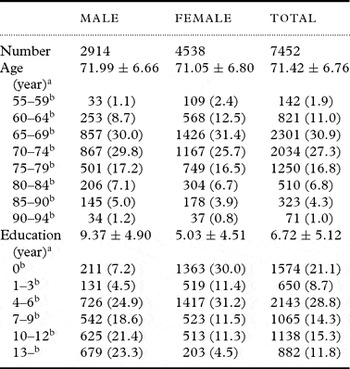
The normative sample consisted of 7452 healthy elderly subjects (2914 male and 4538 female; 55–94 years of age) who participated in the Korean Longitudinal Study on Health and Aging (KLOSHA; N = 834) (Park et al., Reference Park2007), the Nationwide Survey on Dementia Epidemiology of Korea (NaSDeK; N = 1186) (Kim et al., Reference Kim2011), the Ansan Geriatric Study (AGE; N = 1276) (Han et al., Reference Han, Jo, Kim, Jo and Park2009), or the National Dementia Screening and Registry Program (NDSRP; N = 4156). All subjects lived independently in the community. Their educational levels varied from 0 to 25 years (M = 6.72, SD = 5.12). Females comprised 61% of the sample, and males were older and better educated than females (t = 5.907, p < 0.001 for age; t = 38.501, p < 0.001 for education; Table 1).
Demographic characteristics of the subjects

a Mean ± standard deviation.
b Number (percentage).
Assessment
A geropsychiatrist with advanced training in neuropsychiatry and dementia research examined each subject according to the protocol of the Korean version of the Consortium to Establish a Registry for Alzheimer's Disease Assessment Packet (CERAD-K) Clinical Assessment Battery (CERAD-K-C) (Lee et al., Reference Lee2002). Additionally, we interviewed reliable informants to acquire accurate information regarding the subjects’ cognitive and functional changes and medical histories. A panel consisting of four psychiatrists with expertise in dementia research made all clinical decisions, including dementia diagnoses.
Research nurses or psychologists administered the Korean version of the Mini-Mental State Examination from the CERAD-K Neuropsychological Assessment Packet (MMSE-KC) to each subject.
All subjects satisfied the strict entry criteria that excluded dementia and other serious medical, psychiatric, and neurological disorders, which could affect mental function. Any diagnosis of dementia was established in accordance with the Diagnostic and Statistical Manual of Mental Disorders, Fourth Edition (DSM-IV) diagnostic criteria (American Psychiatric Association, 1994). All subjects possessed adequate vision and hearing, although many wore glasses and some required hearing aids. Individuals with minor physical abnormalities (e.g. diabetes with no serious complications, essential hypertension, mild hearing loss, etc.) were not excluded.
Statistical analysis
We performed a stepwise multiple linear regression analysis to assess the relative contributions of age, education, and gender to MMSE-KC scores, entering age and education as continuous variables and coding gender as 1 or 2 for male or female, respectively.
Additionally, we performed a series of 3 × 6 × 2 analyses of variance (ANOVAs) to determine any main effects and interactions of age (55–69, 70–79, and 80–94 years), education (0, 1–3, 4–6, 7–9, 10–12, and ≥ 13 years), or gender (female and male). We stratified age into three 10-year strata considering the number of subjects in each strata, the preliminary results of post hoc comparison between age groups, and the age strata employed in the previous studies in Korea. We stratified education into six levels according to the Korean educational system and the preliminary results of post hoc comparison between education groups. We conducted post hoc contrasts via a two-tailed t-test when we determined, by an ANOVA, that any main effect of education was significant at the p < 0.05 level. No adjustment was made for multiple comparisons.
We stratified the MMSE-KC's norms by the demographic factors that had main effects on MMSE-KC performance. To maximize the quantity of information and the data's clinical usefulness, we used overlapping strata for developing the normative data, following Pauker's procedural descriptions (Pauker, Reference Pauker1988).
Results
Effects of age, education, and sex on the MMSE-KC
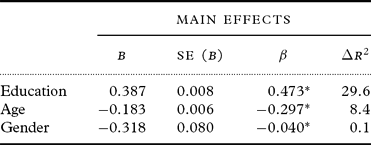
Stepwise multiple regression analyses and ANOVAs revealed that age, education, and gender significantly influenced MMSE-KC score (Table 2). Of the examined demographic variables, education accounted for the greatest proportion of the test score variance. That is, education accounted for 29.6%, whereas age accounted for 8.4% and gender accounted for 0.1%.
Stepwise multiple linear regression of education, age, and gender for the Korean version of the Mini-Mental State Examination
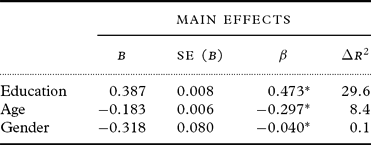
B = regression coefficient; SE (B) = standard error of B; β = standardized regression coefficient; R 2 = percentage of variance explained by each variable.
* p < 0.0001 by stepwise multiple linear regression analysis.
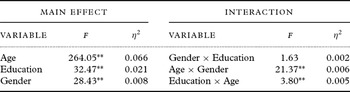
In addition, we performed a three-way ANOVA to determine any main effects of interactions among demographic variables on test scores. Age [F(2, 7414) = 264.05, p < 0.001], education [F(5, 7411) = 32.47, p < 0.001], and gender [F(1,7415) = 28.43, p < 0.001] had significant main effects on these scores. Furthermore, we observed interaction effects between any two of age, education, and gender (Table 3). Because age and education had a main effect, we conducted post hoc contrasts with two-tailed t-tests when we determined, via ANOVA, that any main effect of age and education was significant at the p < 0.05 level.
Analyses of variance for main effects and interactions between age, education, and gender for the Korean version of the Mini-Mental State Examination

Age categories are 55–69, 70—79, and 80–94 years; educational categories are 0, 1–3, 4–6, 7–9, 10–12, and ≥ 13 years; and gender categories are female and male.
*p < 0.05; **p < 0.001 by 3 × 6 × 2 analyses of variance (ANOVAs).
Normative data
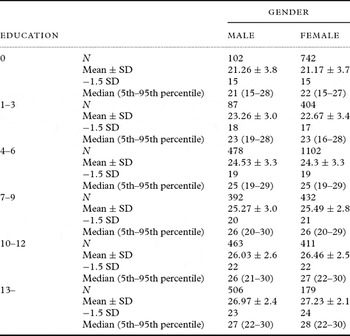
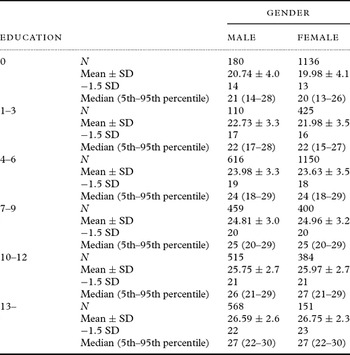
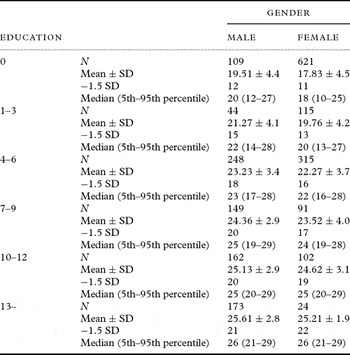
The above results on the demographic variables’ effects indicate that researchers and clinicians need to take age, education, and gender into account for an accurate interpretation of the MMSE-KC total score. Therefore, we divided the total group into three overlapping age tables and six educational level strata (0, 1–3, 4–6, 7–9, 10–12, and ≥ 13 years), separating males and females. Pauker (Reference Pauker1988) suggested overlapping age tables as a way to maximize the quantity of information obtainable from normative projects. We developed overlapping cell tables with midpoint ages at 10-year intervals (i.e. 64.5, 74.5, and 84.5 years of age, respectively, for the three strata), as Tables 4–6 show. The age range from which we estimated each normative value was 19 years (i.e. +/− 9.5 years around the midpoint age) for each table, and thus the adjacent tables’ ranges overlapped. To interpret a test score, the user should select the table with the midpoint closest to the subject's age. For the sake of convenience, the age range of subjects to whom each table should be applied is presented in each table's title. We derived each of these ranges such that all ages fall closer to one midpoint age than to any other midpoint. This overlapping age table method provides a broad normative base for each normative cell. The normative scores for each stratified cell are presented in the form of the mean, standard deviation, and a median and range from the 5th to the 95th percentiles (Tables 4–6).
Normative data for the Korean version of the Mini-Mental State Examination estimated from the ages 55–74 years and used for the ages 60–69 years

Normative data for the Korean version of the Mini-Mental State Examination estimated from the ages 65–84 years and used for the ages 70–79 years

Normative data for the Korean version of the Mini-Mental State Examination estimated from the ages 75–94 years and used for the ages 80–89 years

Discussion
We investigated the influences of age, education, and gender on MMSE performance and developed normative data for the MMSE from a large, nationally representative, community-dwelling Korean elderly population.
Consistent with previous studies on Korean elderly populations (Lee et al., Reference Lee2004; Han et al., Reference Han, Jo, Jo, Kim, Park and Kang2008), age, education, and gender significantly influenced the MMSE scores and explained 39.1% of the MMSE score variance. Of these, education had the greatest influence on MMSE performance and explained 30.4% of the MMSE score variance. As Tombaugh and McIntyre (Reference Tombaugh and McIntyre1992) point out, an education effect can increase false positives (i.e. the misclassification of the cognitively normal as impaired) in subjects with low educational attainment, particularly in those having eight years of education or less (Escobar et al., Reference Escobar, Burnam, Karno, Forsythe, Landsverk and Golding1986; Kittner et al., Reference Kittner1986; Uhlmann and Larson, Reference Uhlmann and Larson1991; Tombaugh and McIntyre, Reference Tombaugh and McIntyre1992), and also false negatives (i.e. the misclassification of the cognitively impaired as normal subjects) in those with high educational attainment (Fillenbaum et al., Reference Fillenbaum, Hughes, Heyman, George and Blazer1988).
MMSE scores also decrease with advancing age. In previous studies, the age-associated MMSE score decline begins at 55–60 years of age and then dramatically accelerates over the ages of 75–80 years (Tombaugh and McIntyre, Reference Tombaugh and McIntyre1992). This age-associated MMSE score decline is likely to be greater in subjects with low educational attainment than in those with high educational attainment, indicating that education may decelerate the age-associated cognitive decline (Tombaugh and McIntyre, Reference Tombaugh and McIntyre1992). Our data also support this interactive impact of age and education on MMSE performance, since our data show the interaction term between age and education in the general linear model is significant, and the difference in mean MMSE scores between the youngest group (55–69 years old) and the oldest group (80–94 years old) was greater in the subjects with lower educational levels than in those with higher educational levels, for both sexes.
The current study found that MMSE performance was better in men than in women, after adjusting for the effects of education and age. However, in contrast to the effects of education and age on MMSE performance, the data regarding the effect of gender on MMSE performance are conflicting (Anthony et al., Reference Anthony, LeResche, Niaz, von Korff and Folstein1982; Folstein et al., Reference Folstein, Anthony, Parhad, Duffy and Gruenberg1985; O'Connor et al., Reference O'Connor, Pollitt, Treasure, Brook and Reiss1989; Ganguli et al., Reference Ganguli1991). In general, researchers often attribute gender differences in mental health to gender-related differences in social exposure (Katzman et al., Reference Katzman1994). Over the past few decades, however, rapid social and economic changes, such as the expansion of women's formal education and labor force participation, have had profound implications for Korean women (Beekman et al., Reference Beekman, Copeland and Prince1999), which, in the future, might possibly reduce the gender effect on MMSE performance in Korea.
In addition, cultures (Stewart et al., Reference Stewart, Johnson, Richards, Brayne and Mann2002) and/or languages (Anderson et al., Reference Anderson, Sachdev, Brodaty, Trollor and Andrews2007; Castro-Costa et al., Reference Castro-Costa, Fuzikawa, Uchoa, Firmo and Lima-Costa2008; Hudon et al., Reference Hudon2009; Roos et al., Reference Roos2010) might also influence MMSE performance. Similar MMSE results may have different meanings in differing cultures. Cultural and/or linguistic diversities might affect test items’ comprehensibility and relevance, as well as affecting subjects’ acceptance of, and familiarity with, the test procedures. Asian countries, such as China, Taiwan, and Singapore, which have illiterate elderly populations, developed different cut-off values for three educational levels (Katzman et al., Reference Katzman1988). Test-taking skills and, perhaps, test anxiety as well as motivation for taking a test may vary across ethnicities (Chiu and Lam, Reference Chiu and Lam2007). According to Morgado et al. (Reference Morgado, Rocha, Maruta, Guerreiro and Martins2010), the elderly population's cognitive abilities improved in the 20 years between 1988 and 2008, which might be attributable to the complexity of the modern environment and to individuals’ improved general health and easier access to formal education. Therefore, regular updates of normative data could be warranted.
The current study provides education-, age-, and gender-stratified contemporary MMSE norms for Korean elders, which fulfill the ideal criteria for representative norms (Mitrushina et al., Reference Mitrushina, Boone and D'Elia1999). The overall sample size was large, and all except two cells had more than 50 subjects. This large sample is unique for excluding cognitive disorders through structured assessments (the CERAD-K) by geropsychiatrists and data from nationwide studies on community-dwelling elders. The normative data are finely stratified by relevant demographic factor, and summarized as both means and percentiles. We developed three overlapping, age-normative tables (55–74, 65–84, and 75–94 years of age) with six non-overlapping educational strata (0, 1–3, 4–6, 7–9, 10–12, and ≥ 13 years of education) and two gender strata. This overlapping stratification method (Pauker, Reference Pauker1988) can provide a more stable means of stratification; i.e. it can result in less abrupt mean shifts between age strata than would simple, non-overlapping age stratification. Although we estimate the normative data in each age-overlapping table from a broad age range that overlaps with adjacent one(s), these data are applicable to individuals falling within a narrow, non-overlapping age range (Lee et al., Reference Lee2004).
Currently, the MMSE is the most popular instrument for screening subjects across a wide range of studies, including epidemiological studies, biological studies, and clinical trials. However, those studies rarely apply culture-specific cut-offs, even when their subjects were multinational and/or multiethnic. If researchers apply a uniform MMSE cut-off score when conducting an international clinical trial on new anti-dementia drugs, the dementia severity of enrolled patients could vary considerably across ethnicities or countries, which might significantly confound the results of the trial with regard to therapeutic dosage, time to clinical response, and/or dropout rate. Therefore it would be better to endorse culture- or country-specific MMSE cut-off scores based on culture- or country-specific normative data in research on multiethnic populations, which researchers have found to yield better screening accuracy than uniform cut-off scores (Cullen et al., Reference Cullen2005).
Our normative data show several strengths. First, the sample size was adequate to provide comprehensive normative data. Second, because we strictly excluded cognitive and mood disorders, which are prevalent in elderly populations, through standardized diagnostic interviews by geropsychiatrists with expertise in dementia research, our data are likely not confounded by depressive patients or patients with dementia misclassified as normal elderly. Third, in developing countries, where a substantial proportion of the elderly are still undereducated, and thus where the elderly population has a wide educational range (from uneducated to postgraduate), researchers can reference our normative data. Nevertheless, several limitations in our study deserve consideration. First, we created our sample by pooling the samples of four ongoing, community-based cohorts in Korea. Although the measurement plan was uniform across these four studies, differences in sampling strategies between studies might affect the representativeness of our sample to some extent. Second, the MMSE was not administered at uniform locations. This might have influenced MMSE performance. Third, two strata in the oldest group (men with 1–3 years of education and women with 13 or more years of education) had fewer than 50 subjects. Fourth, this norm may not be directly applicable to other populations with different socio-economic attributes that may possibly influence the performance of MMSE.
In summary, this study provides a contemporary education-, age-, and gender-stratified norm for the MMSE derived from a large, community-dwelling elderly Korean population, which may be useful for evaluating individuals’ MMSE scores.
Conflict of interest
None.
Description of author's roles
J. L. Kim contributed to the conceptualization and design of the study, data analysis, and preparation of the paper. J. H. Park and Y. K. Chi were responsible for the carrying out the statistical analysis and writing the first draft of the paper. B. J. Kim, M. D. Kim, S-K. Kim, S. W. Moon, M. H. Park, J. N. Bae, J. I. Woo, S-H. Ryu, J. C. Yoon, N-J. Lee, D. Y. Lee, D. W. Lee, S. B. Lee, J. J. Lee, C-U. Lee, S. M. Chang, J. W. Han, J. H. Jhoo, C. Han, and M. J. Cho contributed to data collection and analysis. K. W. Kim designed the study, collected the data, supervised the data collection and analysis, and wrote the paper.
Acknowledgment
This work was supported by a grant from the Korean Health Technology R&D Project, Ministry for Health, Welfare & Family Affairs, Republic of Korea (Grant No. A092077).