Introduction
Depression is a multi-dimensional construct that can manifest as a constellation of several symptoms that can be measured through self-report questionnaires. One of the most widely used self-report measures of depression, the Beck Depression Inventory, 2nd edition (BDI-II; Beck et al., Reference Beck, Steer and Brown1996), contains items assessing emotional, behavioral, and somatic symptoms associated with depression. While the BDI-II measures depression as a unified construct, there is evidence items in this scale may explore different factors or syndromes of depression. Beck et al. (Reference Beck, Steer and Brown1996) found the BDI-II supports a two-factor structure, with cognitive/affective items (e.g. self-dislike, pessimism, worthlessness) and somatic/vegetative (e.g. sleep and appetite changes, loss of energy) symptoms representing separate factors. This two-factor model has been documented in multiple samples, including undergraduate students (Beck et al., Reference Beck, Steer and Brown1996; Whisman et al., Reference Whisman, Perez and Ramel2000; Storch et al., Reference Storch, Roberti and Roth2004), middle-aged unipolar depressed individuals (Schotte et al., Reference Schotte, Maes, Cluydts, De Doncker and Cosyns1997), primary care medical patients (Arnau et al., Reference Arnau, Meagher, Norris and Bramson2001), and an acute neurologic sample (Siegert et al., Reference Siegert, Walkey and Turner-Stokes2009).
This two-factor structure is not a uniform finding, however. Segal et al. (Reference Segal, Coolidge, Cahill and O'Riley2008) reported better support for a one-factor model in the BDI-II using a community-dwelling older adult sample, while others have described a three-factor model in an outpatient sample of substance abusers (Dum et al., Reference Dum, Pickren, Sobell and Sobell2008). Vanheule et al. (Reference Vanheule, Desmet, Groenvynck, Rosseel and Fontaine2008) conducted a series of confirmatory factor analyses (CFA) comparing ten BDI-II models. They explored one-, two-, and three-factor models in a large psychiatric sample and reviewed the factor structures of previously published samples. The one-factor model was the worst fitting model tested, whereas the two- and three-factor models were found to have acceptable model fit (Vanheule et al., Reference Vanheule, Desmet, Groenvynck, Rosseel and Fontaine2008).
Few past studies have explored the dimensions of self-reported depression in older adults, and overall the findings have been mixed. There is support for a two-factor BDI-II structure in a large sample of older adults (>55 years old) admitted into an inpatient mental health service and receiving a diagnosis of unipolar depression (Steer et al., Reference Steer, Rissmiller and Beck2000). This study described a non-cognitive (e.g. appetite changes, agitation, loss of energy, fatigue) and a cognitive (e.g. pessimism, guilt, worthlessness) factor. Although the composition of the two-factor structures was slightly different, it largely reflected the two-factor structure as described by Beck et al. (Reference Beck, Steer and Brown1996). However, Segal et al. (Reference Segal, Coolidge, Cahill and O'Riley2008) investigated this structure in a sample of community-dwelling older adults without psychiatric diagnoses, and their results better supported a one-factor model.
While the factor structure of the BDI-II has been explored in a large number of samples, few studies have examined older adults with depression in particular, and little is known about whether these depressive dimensions are evident in older adults with cognitive impairment. It is clinically significant to explore depression in this sample as prevalence rates of depression in cognitively impaired persons are high. While estimates can vary greatly based on assessment methods and criterion differences, major or minor depression in mild cognitive impairment (MCI) are reported to range from 11% to 68.8% in community- and hospital-based samples (Panza et al., Reference Panza2010), although population-based samples generally cluster around 20–30% (Lyketsos et al., Reference Lyketsos, Lopez, Jones, Fitzpatrick, Breitner and DeKosky2002; Geda et al., Reference Geda2008). In persons with Alzheimer's disease (AD), the prevalence has been found to cluster around 30–50% (Olin et al., Reference Olin, Katz, Meyers, Schneider and Lebowitz2002). Further, patients with MCI and depression are reported to be at more than twice the risk of progressing to dementia over a three-year period compared to non-depressed MCI patients (Modrego and Ferrandez, Reference Modrego and Ferrandez2004). Accurate identification and treatment of depression in clinically impaired persons may reduce progression rates of dementia.
The sensitivity of the BDI-II in AD patients has been questioned (Wagle et al., Reference Wagle, Ho, Wagle and Berrios2000). There is inherent speculation about the accuracy of self-report in cognitively impaired persons; this is particularly relevant in persons with disorders characterized by memory impairment such as AD and MCI amnestic type. As the BDI-II requires retrospective recall of mood, accuracy of the recall can be compromised by memory impairment. This concern was partially addressed by Feinstein et al. (Reference Feinstein, Duff and Tranel2010) who demonstrated that patients with amnesia undergoing negative mood induction validly reported sad emotions after induction even though there was no memory of the induction process. Thus, they accurately reported their emotions without recall of the source of the emotion. While AD and MCI represent different pathologies than pure amnestic disorders, this provides support for the notion that memory impairment may not interfere with one's ability to accurately report on their own emotions. Additionally, patients with memory loss secondary to MCI or early AD reported both positive and negative mood states on a non-verbal measure of mood in a manner similar to healthy older adults (Ready et al., Reference Ready, Carvalho, Green, Gavett and Stern2011).
The current study explored the factor analytic structure of the BDI-II in a large sample of older adults diagnosed with MCI and early AD. Using exploratory factor analysis, we expected older adults with cognitive impairment would exhibit a two-factor model consistent with independent cognitive/affective and somatic/vegetative depressive syndromes on the BDI-II. If similar depressive syndromes are found in our cognitively impaired sample compared to other older adult populations, this study will provide further evidence for the validity of self-reported mood in patients with cognitive impairment.
Methods
Participants and procedure
Participants were 228 older adults (mean age = 73.58, SD = 7.94; 60.2% female) referred for an outpatient neuropsychological evaluation. Education was approximately one year beyond high school (mean = 13.31, SD = 3.15; range = 4–21 years). The sample was predominately Caucasian, representative of the Rhode Island population. Participants were diagnosed with MCI (n = 137) according to the core clinical criteria proposed by the National Institute on Aging–Alzheimer's Association workgroup (Albert et al., Reference Albert2011). Participants were diagnosed with early AD (n = 85) based on the NINCDS-ADRDA criteria (McKhann et al., Reference McKhann, Drachman, Folstein, Katzman, Price and Stadlan1984). As a group, global cognition was mildly impaired, as measured by the Mini-Mental State Examination (MMSE; Folstein et al., Reference Folstein, Folstein and McHugh1975; mean = 25.66, SD = 3.53; range = 10–30). Participants endorsed minimal through severe levels of depression on the BDI-II (range = 1–42), although average depressive symptoms were minimal (mean = 9.34, SD = 8.35). Participants with primary psychiatric diagnoses or cognitive deficits thought to be secondary to a dementia other than AD (e.g. dementia with Lewy bodies, frontotemporal dementia, stroke) were excluded. The MCI group was comprised of patients with cognitive impairment not thought to be primarily due to depression. Data for these evaluations were entered into a clinical research database and extracted for use in this retrospective study that was approved by the Institutional Review Board.
Measures
The BDI-II is a 21-item self-reported measure of depressive symptoms over a two-week time period. Each item is rated on a four-point scale (0–3) and scores can range from 0 to 63. Higher scores indicate greater depression severity. Cut-off scores for this scale include: 0 to 13 = no or minimal depression, 14–19 = mild depression, 20–28 = moderate depression, and 29–63 = severe depression (Beck et al., Reference Beck, Steer and Brown1996).
Results
Review of the distributions of each item revealed positive skewness on most items, which is expected as our sample consisted mainly of non-depressed, older adult outpatients. While the full range of answers was endorsed on most items, this did not include items 9 (suicidality) and 14 (worthlessness) in which the range was restricted from 0 to 1 and 0 to 2, respectively. Using the current data, Cronbach's α reliability of the scale indicates good internal consistency reliability (α = 0.90).
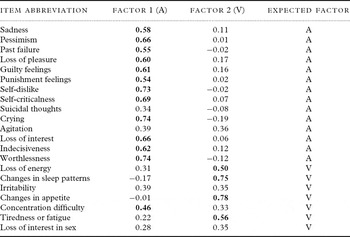
Exploratory principal component factor analysis using direct Oblimin rotation was conducted as the two factors were conceptually similar. A two-factor solution was specified based on our theoretical conceptualization of the cognitive/affective and somatic/vegetative items from the scale. The first factor represented cognitive/affective symptoms of depression (e.g. self-dislike, pessimism, worthlessness) and accounted for 36% of the variance. Adding the second factor, reflecting somatic/vegetative items (e.g. sleep and appetite changes, loss of energy), accounted for an additional 6.8% of the variance. Thus, a two-factor structure accounted for 42.8% of the total explained variance in the current sample. Consistent with the idea that the two factors were related to an overarching construct, the cognitive/affective and somatic/vegetative factors were significantly correlated (r = 0.54, p < 0.001).
Although there are no clear cutoffs for salient factor loadings in factor analysis, we used Brown's (Reference Brown2006) suggested cutoff of 0.40 or above to reflect salient factor loadings. Using this cutoff, 16 of 21 items performed as predicted, as they loaded saliently and independently on the expected factor (Table 1). While the majority of the items (13 of 21) loaded on the cognitive/affective factor, four items loaded on the somatic/vegetative factor. These items were decidedly distinct in their factor loadings compared to the cognitive/affective items. Notably, one item, concentration difficulty, loaded on the unexpected (affective) factor. Suicidal thoughts, agitation, irritability, and loss of interest in sex did not load saliently on either of the factors.
Pattern matrix from two-factor principal factor analysis with oblimin rotation

Note: A = items from cognitive/affective scale; V = items from somatic/vegetative scale. Values in bold represent salient factor loadings.
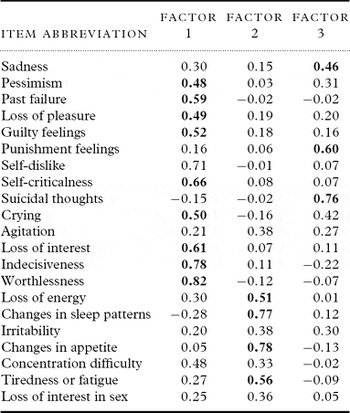
As part of our exploratory analyses, we also examined a three-factor model in our sample. Adding a third factor explained an additional 5.7% of the variance, resulting in 48.5% of the variance explained. However, the structure of this pattern matrix largely supported our two-factor model, with three items, sadness, punishment, and suicidal thoughts, loading onto the third factor (Table 2). While these items reflect cognitive affective symptoms, they are not theoretically differentiated from the items in factor 1. Thus, we feel that a two-factor model was most indicative of differential depressive syndromes in the current sample.
Pattern matrix from three-factor principal factor analysis with oblimin rotation

Note: Values in bold represent salient factor loadings.
Discussion
The current study investigated the construct validity of the BDI-II among older adults with varying degrees of cognitive impairment using exploratory factor analysis. While the structure and validity of the BDI-II has been examined in multiple samples, the current study is the first to explore this in an older adult non-psychiatric sample with cognitive impairment. Overall, results support the use of the BDI-II with cognitively impaired older adults. Within this sample, the BDI-II showed high internal consistency, in line with findings obtained in psychiatric samples (Beck et al., Reference Beck, Steer and Brown1996; Schotte et al., Reference Schotte, Maes, Cluydts, De Doncker and Cosyns1997).
Our findings support a two-factor structure in cognitively impaired older adults, suggesting separate cognitive/affective and somatic/vegetative factors. This suggests that affective components of depression may be reported separately from somatic concerns in this group. Our identified two-factor structure of depressive syndromes is consistent with the structure previously found in a diversity of samples, including undergraduate students, middle-aged patients with unipolar depression, primary care medical patients, and an acute neurologic sample (Beck et al., Reference Beck, Steer and Brown1996; Schotte et al., Reference Schotte, Maes, Cluydts, De Doncker and Cosyns1997; Whisman et al., Reference Whisman, Perez and Ramel2000; Arnau et al., Reference Arnau, Meagher, Norris and Bramson2001; Storch et al., Reference Storch, Roberti and Roth2004; Siegert et al., Reference Siegert, Walkey and Turner-Stokes2009).
Further, the factor loading values in our sample were highly consistent with these demographically diverse samples. Our findings overlapped with Siegert et al.'s (2009) factor structure in acute neurologic midlife inpatients undergoing neurorehabilitation. The structure of these two models was essentially identical for saliently loaded items, although we found that loss of pleasure loaded saliently on the cognitive/affective rather than the somatic/vegetative factor. There also was a high level of accordance between the factor structure in our sample and midlife unipolar depressed psychiatric inpatients (Schotte et al., Reference Schotte, Maes, Cluydts, De Doncker and Cosyns1997). The discrepancy of saliently loaded items in this sample and the current study was notable for double loadings for sadness, pessimism, loss of pleasure, and loss of interest in the depressed patients.
A comparable two-factor cognitive/affective and somatic/vegetative structure also was observed in two separate samples of young adult college students (Whisman et al., Reference Whisman, Perez and Ramel2000; Storch et al., Reference Storch, Roberti and Roth2004). Notably, the Whisman et al. (Reference Whisman, Perez and Ramel2000) study used CFA, a technique in which the factors are a priori loaded onto a latent variable based on their theoretical distributions. A CFA is thought to be a stronger factor analytic strategy due to minimized shared variance among the different factors (Kline, Reference Kline2005); this even more strongly supports our similarities, as well as the validity of self-reported depressive syndromes in older adults with cognitive impairment.
A limitation is the restricted variability in depression severity in our sample, which affected the overall factor loadings. While our participants endorsed a full range of depressive symptoms, average depression ratings were minimal, resulting in limited variability among the items. The constrained variability of some items may have affected their factor loadings. For example, suicidal thoughts were rarely endorsed in our sample and this item did not load on either factor. Agitation, irritability, and loss of interest in sex also did not saliently load on either factor. These unexpected item loadings may partially be related to restricted variability, although they also may be factorially complex due to contributions of both affective and vegetative symptoms reflecting in part the neuropsychiatric effects of a neurodegenerative disorder. The role of insight into our patients’ mood states also remains uncertain, although there is evidence that cognitively impaired persons may report on their mood structurally similar to cognitively intact older adults (Ready et al., Reference Ready, Carvalho, Green, Gavett and Stern2011).
Additional topics of future research include measuring the factor structure of the BDI-II using CFA in our sample. Examining the phenomenology of depression or further exploring the role of awareness in self-reported mood in this sample also may promote a better understanding of the experience of depressed mood in these older adults, better guiding treatment recommendations for clinicians.
Overall, the current study sought to improve our understanding of depressive syndromes in older adults with cognitive impairment. While this had been explored in healthy older adults, the current study was the first to explore this phenomenon in this population. Our finding of a similar two-factor model of depressive symptoms in cognitively impaired older adults as observed in healthy, neurologic, and psychiatric younger and midlife adults, provides greater support for the validity of self-report and the experience of depressive symptoms in this population. This study also has important implications for the evaluation and treatment of depressed mood in this group.
Conflict of interest
None.
Description of authors’ roles
J. Carvalho designed the study, carried out the statistical analysis, and wrote the paper; J. Tan and B. Springate assisted with the design of the study and statistical analysis, collected data, and assisted with writing the paper; and J. Davis assisted with the early conceptualization of the study and writing the paper.
Acknowledgments
A portion of this paper was previously presented at the 2012 American Neuropsychiatric Association conference in New Orleans, LA.