The high rates of trauma exposure in community-based samples in South Africa (40–100%) and consequent high prevalence of post-traumatic stress disorder (PTSD) (6–22%) in South African adolescents (Ensink, Robertson, Zissis, & Leger, Reference Ensink, Robertson, Zissis and Leger1997; Hinsberger et al., Reference Hinsberger, Sommer, Kaminer, Holtzhausen, Weierstall, Seedat and Elbert2016; Peltzer, Reference Peltzer1999; Seedat, Nyami, Njenga, Vythilingum, & Stein, Reference Seedat, Nyami, Njenga, Vythilingum and Stein2004; Suliman, Kaminer, Seedat, & Stein, Reference Suliman, Kaminer, Seedat and Stein2005) calls for innovative ways of providing evidence-based treatments for PTSD in this population that have sustained benefits. Trauma-focused interventions have a strong evidence base and are recommended as first-line treatments in adults (Bisson et al., Reference Bisson, Ehlers, Matthews, Pilling, Richards and Turner2007; Forbes et al., Reference Forbes, Creamer, Bisson, Cohen, Crow, Foa and Ursano2010). In the most recent PTSD guidelines, the International Society for Traumatic Stress Studies (ISTSS; Bisson et al., Reference Bisson, Berliner, Cloitre, Forbes, Jensen, Lewis and Roberts2019) strongly recommended prolonged exposure, amongst other cognitive-behavioural therapy (CBT) interventions, as a treatment for PTSD in adults. In a review of child and adolescent treatment for PTSD (Morina, Koerssen, & Pollet, Reference Morina, Koerssen and Pollet2016), trauma-focussed interventions were found to be the most studied form of intervention, resulting in medium to large effect sizes when compared to other active treatment or waitlist controls. The ISTSS guidelines (Bisson et al., Reference Bisson, Berliner, Cloitre, Forbes, Jensen, Lewis and Roberts2019) did not distinguish between adolescents and children and recommended CBT with a trauma focus and eye movement desensitisation and reprocessing for treatment of PTSD in children and adolescents. Notwithstanding the fact that adolescents seem to be at particular risk for trauma exposure and for developing PTSD, there had been a scarcity of studies focusing on treatment in adolescents only. In the child and adolescent treatment for PTSD review (Morina et al., Reference Morina, Koerssen and Pollet2016) only six studies treating adolescents specifically were identified, and, of those, one study (Foa, McLean, Capaldi, & Rosenfield, Reference Foa, McLean, Capaldi and Rosenfield2013) utilised a recognised trauma-focused CBT treatment protocol. To date, three additional studies provided support for the effectiveness of the prolonged exposure for adolescents (PE-A) protocol tailored for adolescents suffering from PTSD (Gilboa-Schechtman et al., Reference Gilboa-Schechtman, Foa, Shafran, Aderka, Powers, Rachamim and Apter2016; Rossouw et al., Reference Rossouw, Yadin, Alexander, Mbanga, Jacobs and Seedat2016; Rossouw, Yadin, Alexander, & Seedat, Reference Rossouw, Yadin, Alexander and Seedat2018).
Over recent years, approaches, such as an adaption of Narrative Exposure Therapy (NET) for the treatment of PTSD within multiple youth populations, including war refugees, asylum seekers and children with intellectual disabilities (KIDNET), have also shown promise (Fazel et al., Reference Fazel, Stratford, Rowsell, Chan, Griffiths and Robjant2020; Onyut et al., Reference Onyut, Neuner, Schauer, Ertl, Odenwald, Schauer and Elbert2005). A recent meta-analysis of randomised controlled trials (RCTs) in low- and middle-income countries (LMICs) (Uppendahl, Alozkan-Sever, Cuijpers, de Vries, & Sijbrandij, Reference Uppendahl, Alozkan-Sever, Cuijpers, de Vries and Sijbrandij2019) concluded that psychological treatments can be effective in treating PTSD in children and adolescents. Despite the accruing evidence for the effectiveness of these therapies, the gap between the urgent need for effective treatments and the availability of trained professionals to offer such treatments has spawned an active and promising area of clinical research examining the potential benefits of task shifting to non-specialist health care providers (e.g. Petersen, Lund, Bhana, & Flisher, Reference Petersen, Lund, Bhana and Flisher2012; Shahmalak, Blakemore, Waheed, & Waheed, Reference Shahmalak, Blakemore, Waheed and Waheed2019).
Regardless of treatment modality, an important aspect of treatment studies is the long-term maintenance of treatment gains. A recent meta-analysis (Gutermann et al., Reference Gutermann, Schreiber, Matulis, Schwartzkopff, Deppe and Steil2016) suggested that effect sizes in long-term follow-up (FU) assessments in RCTs remained stable over time (<6 and >6 months). The authors suggested that, in order to provide information about the durability of the treatment effects, more RCT studies should include and report the results from longer-term (>1 year) FU assessments. Another recent meta-analysis examining RCTs with long-term assessments (Kline, Cooper, Rytwinksi, & Feeny, Reference Kline, Cooper, Rytwinksi and Feeny2017) highlighted the enduring effects of psychotherapies for PTSD in adults. Recently, the results of a meta-analysis (Rith-Najarian et al., Reference Rith-Najarian, Mesri, Park, Sun, Chavira and Chorpita2019) provided support for the durability of CBT treatment effects for youth across conditions of anxiety, traumatic stress and depression, highlighting the importance of and the need for long-term assessments in treatment studies in this population. This is coupled with the findings that, without treatment, children and adolescents who experienced traumatic events and developed subsequent PTSD did not remit on their own (van Meijel et al., Reference van Meijel, Gigengack, Verlinden, van der Steeg, Goslings, Bloemers and Lindauer2019).
The present study aimed to examine the longer-term effectiveness of PE-A compared with supportive counselling (SC) treatments that had been delivered by nurses who were previously naïve to providing psychological treatments and who were trained for this trial to provide those treatments at community schools. PE was chosen as the therapeutic intervention because of the strong empirical evidence that it can be successfully disseminated across cultures and to relatively novice providers (McLean & Foa, Reference McLean and Foa2013). We had previously reported on FU assessments up to 6-month post-treatment (Rossouw et al., Reference Rossouw, Yadin, Alexander and Seedat2018). The current paper reports on the results of the 12- and 24-month FU assessments, while referencing the previously reported pre-treatment, post-treatment, 3-month post-treatment and 6-month post-treatment data (Rossouw et al., Reference Rossouw, Yadin, Alexander and Seedat2018) in order to provide context for the trajectory of treatment response over time. Future FU assessment of these participants at 5-years post-treatment is planned.
Method
A brief summary of the methods, which have been previously described in detail (Rossouw et al., Reference Rossouw, Yadin, Alexander and Seedat2018), is provided below. In this paper, we report on the 12- and 24-month post-treatment assessments in the same sample of adolescents. The trial is registered in the Pan African Clinical Trials Registry: PACTR201511001345372 (retrospectively registered on 11 November 2015 as a result of an administrative oversight). Ethics approval and the study protocol were accepted by the Health Research Ethics Committee of Stellenbosch University (N12/06/031) on 8 August 2012 defining primary and secondary outcomes prior to the assessment of the first participant during February 2014 (available at: https://osf.io/ugnsm/?view_only=8479849e340b44de907689f445aaabb2).
Participants
Participants were adolescents, 13–18 years of age, who had witnessed or experienced an interpersonal trauma and were suffering from chronic PTSD (>3 months). They were recruited from schools around Cape Town, South Africa. Eligible for inclusion were adolescents with a primary diagnosis of PTSD with or without a comorbid diagnosis of an anxiety, mood, substance abuse disorder or attention-deficit disorder. Adolescents with a primary substance use, conduct disorder or psychotic disorders were excluded.
Procedure
The authors assert that all procedures contributing to this work comply with the ethical standards of the relevant national and institutional committees on human experimentation and with the Helsinki Declaration of 1975, as revised in 2008. All procedures involving human subjects/patients were approved by the Health Research Ethics Committee of Stellenbosch University (N12/06/031) and the Western Cape Education Department (WCED), conditional on maintaining the anonymity of the 11 free-tuition high schools in low-income communities participating in the study. Recruiters educated students on PTSD and the availability of treatments through the RCT. Adolescents who had experienced a trauma and who were interested in receiving treatment had the opportunity to meet with a coordinator at the school and to complete a screening instrument. Adolescents who scored above the cut-off baseline score for entry into the study (Child PTSD Symptom Scale–Self Report score >11) were scheduled for a baseline assessment, accompanied by a parent or a guardian. All primary guardians provided written consent and all participants provided written assent. The baseline, mid-treatment, post-intervention, 3-, 6-, 12- and 24-month post-intervention FU assessments were conducted by two experienced independent evaluators (IEs) blinded to treatment condition. The baseline evaluation comprised of a clinical interview and completion of self-report measures (2–3 h duration) to assess eligibility and to capture baseline information. FU assessments (1.5 h duration) comprised of a clinical interview and completion of self-report measures. A sample size of 64 participants was calculated to provide 80% power for a two-tailed α level of 0.1. Eligible participants were randomised, using a statistician-generated-computer-randomised-schedule, to the two treatment arms using a parallel, permuted block procedure with six randomisations per block (1:1 ratio), by the principal investigator (JR), who was the only one that had access to the randomisation schedule.
Assessment
The assessment instruments administered at all assessment points of this RCT includes a demographic questionnaire to capture socio-demographic information about the participants and their caregivers; the Child PTSD Symptom Scale – Interview (CPSS-I; Foa, Johnson, Feeny, & Treadwell, Reference Foa, Johnson, Feeny and Treadwell2001; Gillihan, AderkaI, Conklin, Capaldi, & Foa, Reference Gillihan, AderkaI, Conklin, Capaldi and Foa2013) as the primary outcome measure of PTSD assessed by the IE; the Mini International Neuropsychiatric Interview for Children and Adolescents (MINI-KID; Sheehan et al., Reference Sheehan, Sheehan, Shytle, Janavs, Rogers, Milo and Wilkinson2010), a secondary measure assessed by the IE to determine the presence of a diagnosis of PTSD and other diagnoses at baseline and the presence of PTSD at FU; The Child PTSD Symptom Scale – Self Report (CPSS-SR; Foa et al., Reference Foa, Johnson, Feeny and Treadwell2001; Gillihan et al., Reference Gillihan, AderkaI, Conklin, Capaldi and Foa2013) administered at every treatment session to monitor treatment progress and as a self-report measure of PTSD during IE assessments; the Children's Global Assessment Scale (CGAS; Shaffer et al., Reference Shaffer, Gould, Brasic, Ambrosini, Fisher, Bird and Aluwahlia1983) used by the IE at pre-intervention as well as at post-intervention and FU assessments to provide a summary measure of functional impairment; the Beck Depression Inventory (BDI; Beck, Steer, & Garbin, Reference Beck, Steer and Garbin1988; Beck, Ward, Mendelsohn, Mock, & Erbaugh, Reference Beck, Ward, Mendelsohn, Mock and Erbaugh1961), the only tool used in this study that has been normed for adolescents in South Africa (Ward, Flisher, Zissis, Muller, & Lombard, Reference Ward, Flisher, Zissis, Muller and Lombard2003), was used to assess depression; an Expectancy of Therapeutic Outcome for Adolescents (ETO-A; Foa, Rothbaum, Riggs, & Murdock, Reference Foa, Rothbaum, Riggs and Murdock1991) scale was completed after the rationale for the treatment was explained. These non-validated scales were chosen as we replicated a previous PE-A study (Foa et al., Reference Foa, McLean, Capaldi and Rosenfield2013) and wanted to be able to compare our findings with the aforementioned study. We do not report other secondary measures here that were part of the full-assessment battery, as it is beyond the scope of this paper. These measures included psychopathology measures (anxiety and anger), as well as cognition and emotion measures (trauma-related cognitions, self-esteem, social support, affect regulation and resilience). These measures will be reported separately as part of a moderator and mediator analysis.
Training and supervision
The counsellors for the study were non-specialist health workers (NSHWs), who were nurses starting a 1-year diploma course in psychiatric nursing at Stellenbosch University. They were naïve to providing the psychological treatments and received intensive training to provide both the PE-A and SC protocols and had group supervision weekly throughout the active treatment phase of the study. Individual supervision was available to address case-specific management issues and to enhance adherence.
Treatment
The PE-A intervention group
PE-A (Foa, Chrestman, & Gilboa-Schechtman, Reference Foa, Chrestman and Gilboa-Schechtman2008) consisted of 7–14 weekly, 60 min sessions, comprising sequentially presented treatment modules addressing the following content: presentation of the treatment rationale after which participants completed a treatment expectancy questionnaire; information gathering, identifying the index trauma and conducting a breathing retraining exercise; discussion of common reactions to trauma; discussion of the rationale for in vivo exposure (confronting trauma reminders in real life), construction of an in vivo hierarchy and assignment of in vivo homework; presentation of the rationale for imaginal exposure (revisiting and recounting the traumatic memory), conducting imaginal exposure, and processing the experience and the meaning of events that were revisited; focusing on the worst moments of the trauma; discussion of the generalisation of skills learned in treatment and a focus on relapse prevention; a ‘final project’ detailing the trauma and the gains made in treatment. A reduction of at least 70% on the CPSS-SR was used to determine the number of sessions delivered. This metric has consistently shown a way to identify excellent responders (Zang, Su, McLean, & Foa, Reference Zang, Su, McLean and Foa2019). Treatment completers were defined as having completed at least seven sessions, ensuring that participants in the PE-A treatment arm received the main components of treatment across the sessions.
The SC treatment group
SC (Cohen JA, personal communication, April 2012), the comparator intervention, is an active non-trauma-focused treatment that has been used as a comparator in other trials of trauma-focused intervention (Foa et al., Reference Foa, McLean, Capaldi and Rosenfield2013). In this RCT, the time-matched SC manualised programme consisted of 7–14 weekly, 60 min sessions of client-centred therapy, focusing on establishing a trusting, empowering and validating therapeutic relationship. In session 1, participants were oriented to SC and subsequently they were the ones who directed the agenda of the sessions and were allowed to choose whether, when and how to address the trauma. The counselling NSHWs provided active listening, empathy and encouragement to talk about feelings and participants’ ability to cope, using non-directive problem-solving tools and diary keeping.
Data analysis
Linear mixed models (LMMs) using Dell Statistica (2016) were used to analyse the continuous data. The LMMs included all randomised participants regardless of missing data. No covariates were included in the LMM analysis. Possible covariates assessed in preliminary analysis and not included in the LMM (r < 0.3) were age, depression score and general anxiety scores at baseline. Effect sizes were calculated for primary (CPSS-I) and secondary (BDI, CGAS, CPSS-SR) outcomes. We obtained 84.13% (CPSS-I 84.58%, CPSS-SR 84.81%, BDI 83.9%, MINI-KID 83.9%, CGAS 83.45%) of all data for the whole dataset from baseline to the 24-month FU for the measures analysed. This included dropouts and missing data. LMM results did not vary according to the pattern of missing data. GEE was used to analyse the dichotomous outcome of a PTSD diagnosis of only those participants who were assessed for that specific assessment point.
A ‘good response’ was defined as a CPSS-I score greater than two standard deviations below the baseline mean (Jacobson & Truax, Reference Jacobson and Truax1991). Fisher's exact tests were used to calculate the proportion of participants with a good response across treatments.
Results
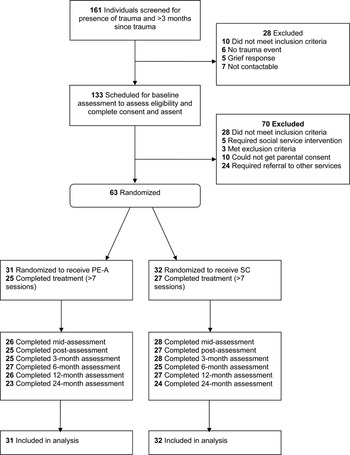
One hundred and sixty-one adolescents volunteered to participate in the study between February 2014 and June 2016 (Fig. 1). Of the 133 adolescents that completed baseline assessments, 63 were eligible for the study. Due to time constraints, we were unable to recruit the last participant to reach our goal of 64 participants. The 63 participants were randomised to receive either PE-A (n = 31) or SC (n = 32). Data from all 63 randomised participants were included in the analyses.
Consort flow diagram.

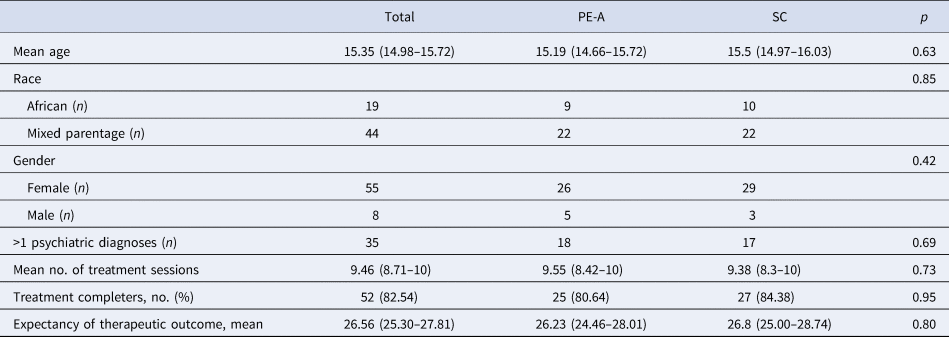
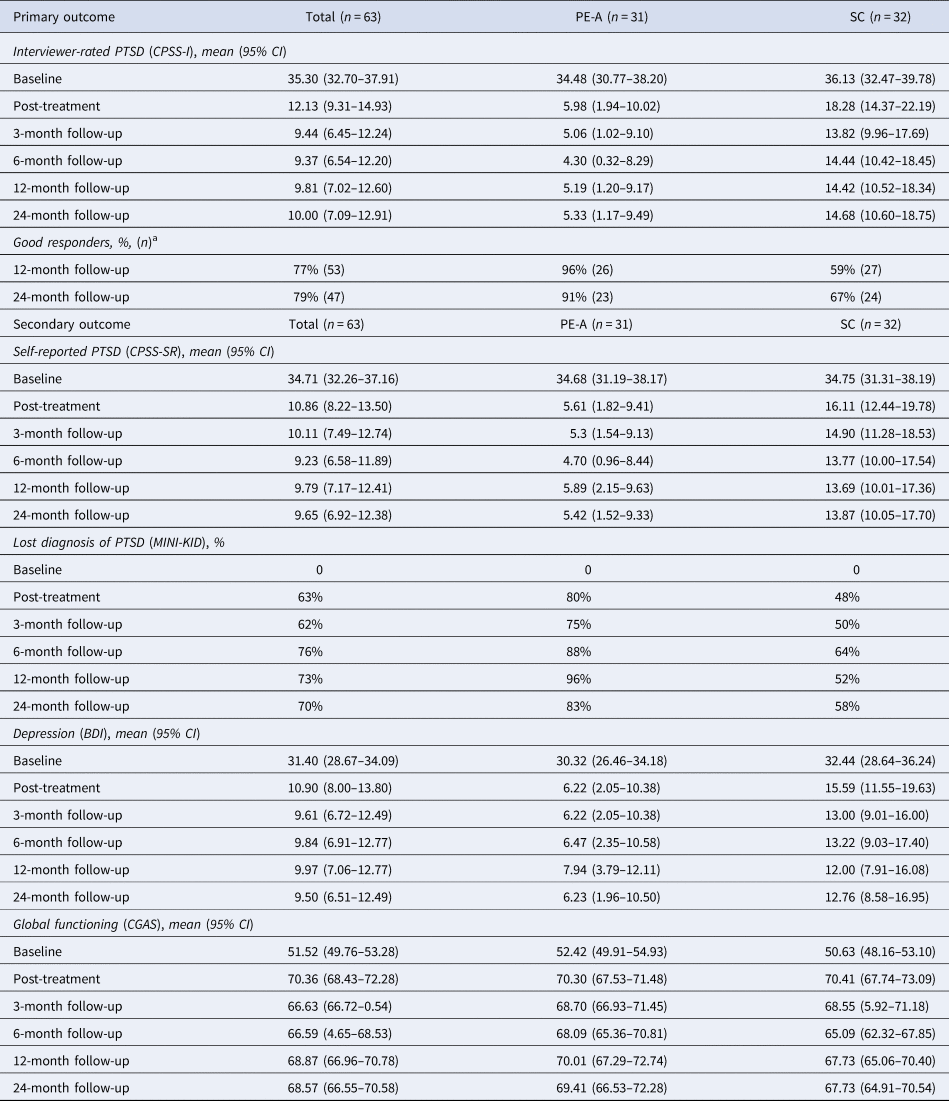
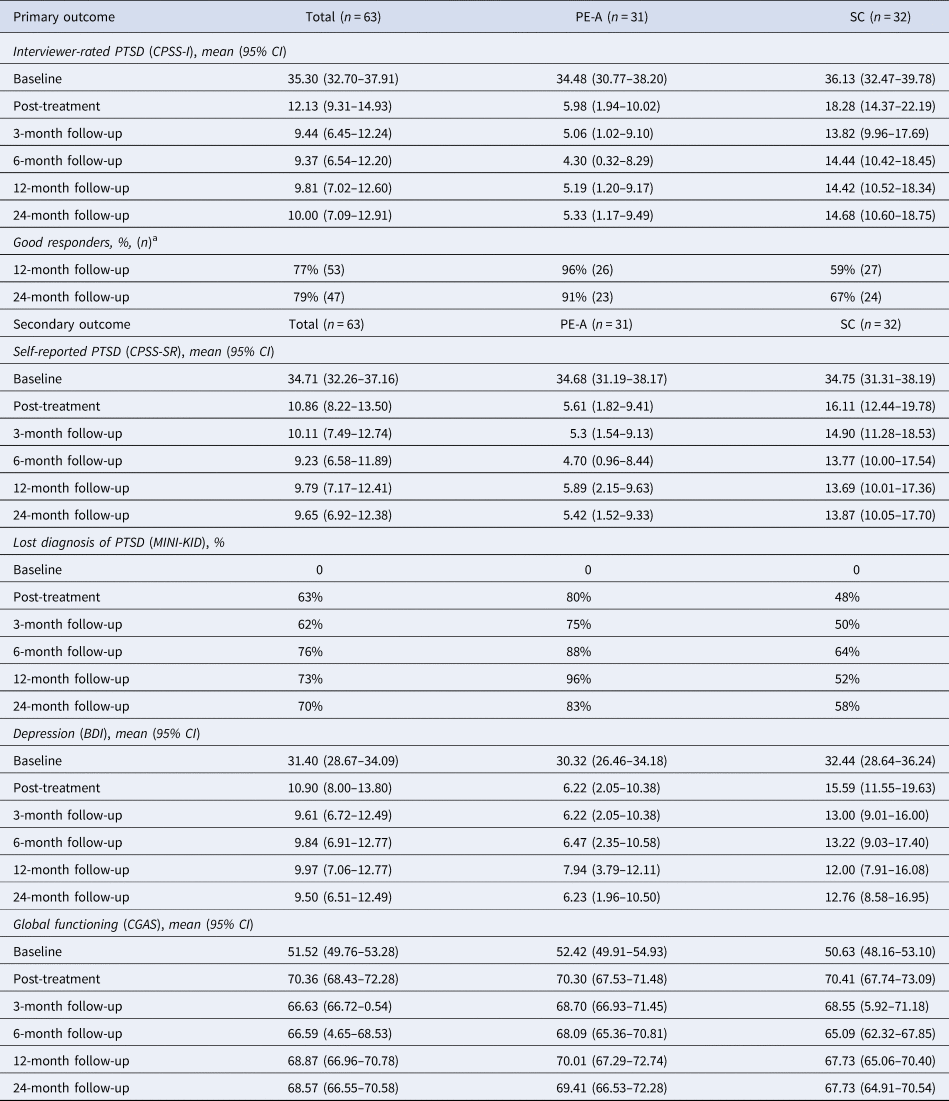
Demographic data for the sample are provided in Table 1. The trauma types experienced included sexual assault (49%), physical assault (19%) or witnessing assault (31%). Participants’ expectancy scores of PE-A and SC were similar (p = 0.80). The dropout rate was acceptable (<20%) in both treatment arms (p = 0.71). Substantially more female participants volunteered to participate in the study than males (7:1 ratio). Both treatment groups completed a mean number of nine sessions and the mean session length was 47.78 min (PE-A = 46.55; SC = 48.87; t = −1.73; p = 0.042). Table 2 depicts the data from all assessment points. Only the 12- and 24-month FU data are described in detail below.
Demographic variables for the intent-to-treat sample (N = 63)

Primary and secondary outcomes at baseline and after treatment
a n analysed at each assessment point.
Adverse events
During the original study, participants who discontinued treatment did so of their own accord. All of them had a final interview and did not accept alternative treatment or report any suicidal ideation. Adverse events occurring during treatment were documented in two participants who reported suicidal ideation which, upon further evaluation, was secondary to interpersonal conflict with a teacher and a parent, respectively. Suicide risk was assessed to be low for both adolescents and the conflict with the family and teacher was addressed. The adolescents were also informed that their counsellors and the principal investigator could be contacted for any crisis outside of weekly treatment sessions. Both participants completed treatment without further incident. At the 2-year FU, two participants were identified as having family or social problems unrelated to the trauma that had been the focus of treatment but required intervention. Both were referred for appropriate intervention and followed up. No serious adverse events were reported during the RCT.
Primary outcome
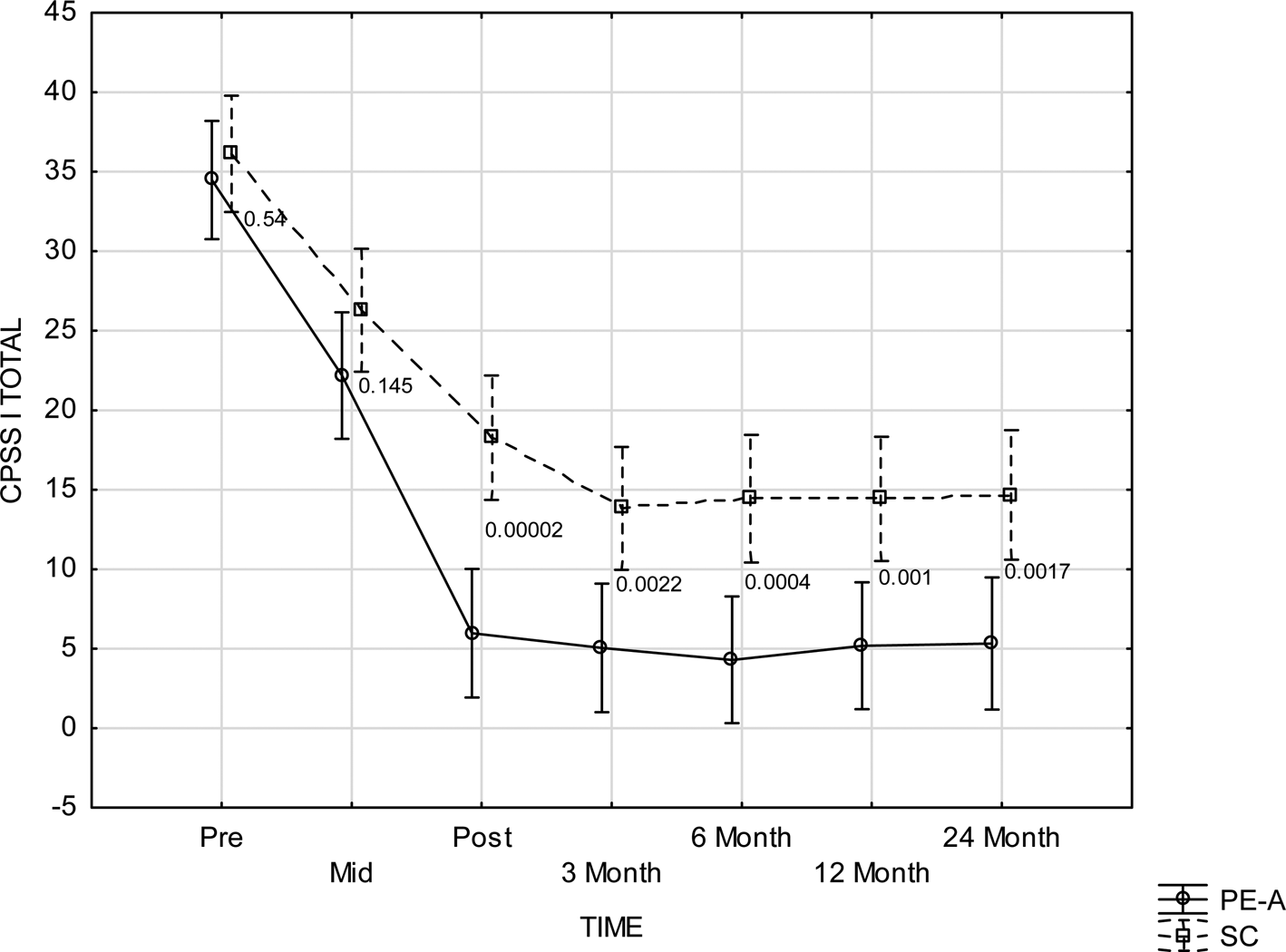
Table 2 shows the primary outcome data for both treatment arms. In both the PE-A and SC groups, there was a significant improvement in PTSD symptom severity from baseline to the 12- and 24-month FU assessments, as measured by the CPSS-I [difference in mean scores in PE-A at 12 months = 29.30, 95% CI (25.09–33.50), p < 0.001; g = 4.10; at 24 months = 29.15, 95% CI (24.79–33.52), p < 0.001; g = 3.67; difference in mean scores SC at 12 months = 21.70, 95% CI (17.57–25.82), p < 0.001; g = 2.06; at 24 months = 21.45, 95% CI (17.17–25.73), p < 0.001; g = 1.73]. At the 12- and 24-month FU, improvement in PTSD symptom severity in the PE-A group remained significantly greater than in the SC group [difference in mean scores PE-A v. SC at 12 months = 9.24, 95% CI (3.66–14.83), p < 0.001; g = 0.88; at 24 months = 9.35, 95% CI (3.53–15.17), p = 0.002; g = 0.68]. The trajectory of treatment response of the IE assessed CPSS-I scores for both PE-A and SC treatment arms is shown in and demonstrated the maintenance of gains achieved in both treatment arms over the 24-month FU period (Fig. 2).
CPSS-I comparative mean scores between PE-A and SC treatment groups.

The proportion of participants who achieved a ‘good response’ was significantly greater in the PE-A group than in the SC group at the 12-month FU (Fisher's exact t test: p < 0.01) with 25 of 26 (96%) of the PE-A group compared to 16 of 27 (59%) of the SC group meeting good responder criteria. At the 24-month FU assessment, the between-group difference was not statistically significant (Fisher's exact t test: p = 0.07), with 21 of 23 (91%) of the PE-A group compared to 16 of 24 (67%) of the SC group meeting good responder criteria.
Secondary outcomes
The improvement from baseline to the 12- and 24-month FU in self-reported PTSD symptom severity, as measured by the CPSS-SR, for both the PE-A and SC groups was significant [difference in mean scores in PE-A at 12 months = 28.79, 95% CI (24.85–32.72), p < 0.001; g = 4.04; at 24 months = 29.25, 95% CI (25.17–33.34), p < 0.001; g = 3.97; difference in mean scores SC at 12 months = 21.06, 95% CI (17.20–24.93), p < 0.001; g = 2.19; at 24 months = 20.88, 95% CI (16.87–24.88), p = 0.002; g = 1.95] with a greater reduction in PTSD symptom severity in the PE-A group than in the SC group [difference in mean scores PE-A v. SC at 12 months = 7.79, 95% CI (2.55–13.04), p < 0.01; g = 0.79; at 24 months = 8.45, 95% CI (2.98–13.91), p < 0.01; g = 0.72]. The trajectory of treatment response of the CPSS-SR scores for both PE-A and SC treatment arms is provided in online Supplementary Fig. S3 and demonstrates the maintenance of gains achieved in both treatment arms over the 24-month FU period, as well as the maintenance of the significantly greater improvement in PTSD symptom severity in the PE-A treatment group compared to the SC treatment group.
Loss of PTSD diagnosis was maintained in both PE-A and the SC groups at 12- and 24-months post-intervention FU assessments (96% and 83%, 52% and 58%, respectively), with a significantly greater percentage of participants attaining remission in the PE-A group than in the SC group at the 12-month assessment point (p < 0.01) and at the 24-month assessment point (p = 0.05).
A slightly different pattern in the severity of depressive symptoms, as measured by the BDI, was seen. Post-treatment gains were maintained in both groups [difference in mean scores PE-A at 12 months = 22.37, 95% CI (18.27–26.48), p < 0.001; g = 2.56; at 24 months = 24.09, 95% CI (19.87–28.31), p < 0.001; g = 2.84; difference in mean scores SC at 12 months = 20.44, 95% CI (16.41–24.48), p < 0.001; g = 1.86; at 24 months = 19.67, 95% CI (15.54–23.81), p < 0.001; g = 1.62]. However, gains were not significantly greater for PE-A than for SC at the 12-month FU but were again significant at the 24-month FU assessment [Difference in mean scores PE-A v. SC at 12 months = 4.05, 95% CI (1.78–9.88), p > 0.05; g = 0.41; at 24 months = 6.53, 95% CI (0.56–12.51), p = 0.03; g = 0.59]. The trajectory of treatment response of the BDI scores for both PE-A and SC treatment arms is provided in online Supplementary Fig. S4 and demonstrates the maintenance of gains achieved in both treatment arms over the 24-month FU period.
Improvement in functioning (CGAS scores) from baseline to 12 months and baseline to 24 months was significant for both groups [difference in mean scores PE-A at 12 months = 17.59, 95% CI (14.30–20.88), p < 0.001; g = 2.64; at 24 months = 16.99, 95% CI (13.57–20.40), p < 0.001; g = 2.41; difference in mean scores SC at 12 months = 17.11, 95% CI (13.88–20.34), p < 0.001; g = 2.33; at 24 months = 17.10, 95% CI (13.75–20.45), p < 0.001; g = 2.29], with similar gains maintained over time in both groups [difference in mean scores at 12 months = 2.28, 95% CI (−1.54 to 6.10); p = 0.24, g = 0.30; at 24 months = 1.68, 95% CI (2.34–5.70); p = 0.41, g = 0.19]. The trajectory of general functioning (CGAS) is provided in online Supplementary Fig. S5 and demonstrates the maintenance of the improvement in general functioning in both groups over the 24-month post-treatment period.
Discussion
The findings of this FU study indicated that treatment gains achieved by adolescents suffering from PTSD who received either PE-A or SC were durable in both treatment arms up to 2 years after treatment completion. Furthermore, there was a consistent pattern with participants in the PE-A treatment experiencing significantly greater reduction in PTSD symptoms and a greater proportion of them more likely to attain and maintain remission than those in the SC treatment. These long-term results provide information about an important aspect of treatment studies, which is the durability of the gains made during the original intervention. They are consistent with findings from several meta-analyses indicating the stability of reduced PTSD symptoms up to 12 months post-treatment (Gutermann et al., Reference Gutermann, Schreiber, Matulis, Schwartzkopff, Deppe and Steil2016; Rith-Najarian et al., Reference Rith-Najarian, Mesri, Park, Sun, Chavira and Chorpita2019), and further extend data on maintenance of gains up to 24 months post-treatment.
It is especially important to note that the PE-A and SC treatments in the original study were task-shifted to NSHW nurses that were psychotherapy-naïve, but specifically trained and supervised for this trial, with good adherence to the treatment protocols and excellent treatment-provider retention. When qualitative interviews were conducted with samples of the stakeholders, asking them about their experiences during the original treatment trial, important information emerged about factors related to accessibility, overcoming stigma, task-shifting and reasons for adherence and retention (van de Water, Rossouw, van der Watt, Yadin, & Seedat, Reference van de Water, Rossouw, van der Watt, Yadin and Seedat2018a; Van de Water, Rossouw, Yadin, & Seedat, Reference Van de Water, Rossouw, Yadin and Seedat2017; Van de Water, Rossouw, Yadin, & Seedat, Reference Van de Water, Rossouw, Yadin and Seedat2018b). Briefly, the response of participants in both treatment arms highlighted the ability to access treatment more easily by it being offered at school; the treatment providers being from outside their community reducing fears of compromised confidentiality and judgment; and the warmth and caring displayed by the treatment providers and recruiting personnel (Van de Water et al., Reference Van de Water, Rossouw, Yadin and Seedat2017; van de Water et al., Reference van de Water, Rossouw, van der Watt, Yadin and Seedat2018a). The nurses mentioned the effectiveness of the therapies and access to ongoing supervision as catalysts for their participation (Van de Water et al., Reference Van de Water, Rossouw, Yadin and Seedat2018b).
The feasibility of implementing PE therapy for PTSD in LMICs has been reviewed, highlighting its promise (Booysen & Kagee, Reference Booysen and Kagee2020). Given the challenges of living in an LMIC with limited therapeutic resources, these results demonstrating maintenance of treatment gains, including loss of PTSD diagnosis, provide a strong case for upscaling both treatments, and especially PE-A, within this community-based context.
The pattern of depression and general functioning outcomes was slightly different from that of the PTSD measures. Although participants receiving PE-A and SC maintained their significant within-treatment reduction in depression scores, the difference between treatment arms was not seen at the 12-month FU but was again present at 24-month FU. Thus, at the 24-month FU assessment, depression scores in the PE-A group were significantly lower than in the SC group. General functioning scores improved significantly within each treatment arm, indicating continued good quality of life maintained up to 2-years post-treatment. However, there was not a significant between-treatment difference in this measure, suggesting that receiving either treatment for PTSD was perceived by participants as positively impacting their everyday functioning.
Limitations and Future Directions
There were limitations to this study. Except for the BDI, other assessment tools used have not been specifically validated in a South African context. This may have limited identification of cultural nuances in phenotypic presentation. Another limitation was the fact that male adolescents were under-represented in this sample, possibly limiting the generalisability of these results across genders. A limitation related to the long-term maintenance of gains was the fact that data about other treatments that participants may have received between-treatment termination and the 12- and 24-month assessments were not recorded. Interestingly, however, the trajectory of the results remained consistent for both groups from one FU visit to the next. Despite these limitations, the robustness of the initial treatment effects and their durability over time are promising. A 5-year post-treatment FU assessment phase is in progress at the time of writing of this article and data will be collected about any other interventions that participants may have accessed during the time since the last FU assessment.
Implications
A future direction is an upscaling implementation study in primary health care clinics, which are typically the first point of contact for adolescents with mental health problems. The study would also include an economic evaluation of task-shifted PE-A that utilises lay healthcare community counsellors.
Supplementary material
The supplementary material for this article can be found at https://doi.org/10.1017/S0033291720002731
Acknowledgements
Irene Mbanga, Tracy Jacobs and Wendy Rossouw were involved in recruitment and assessment of the participants. We wish to acknowledge their commitment and hard work in making this project possible.
Authors contributions
JR, EY, SS and DA conceived of the study and initiated the study design. JR drafted the manuscript. EY, SS and DA edited the manuscript. JR was responsible for study coordination.
Financial support
JR is supported by Stellenbosch University Rural Medical Education Partnership Initiative (SURMEPI). The trial research is also supported by the South African Research Chair Initiative in PTSD, supported by the Department of Science and Technology and the National Research Foundation. JR was also funded by the Ithemba Fund and Harry Crossley Fund.
Conflict of interest
The authors declare that they have no competing interests.