Introduction
Nucleation is an important process, both for understanding the dynamics of first-order phase transitions and for practical applications, ranging from semiconductors, metals, chemicals, pharmaceutics, and the food industry, to studies of climate change. Despite a century of studies on nucleation (for a broad review, see Reference Reference Kelton and Greer1), the process is still not entirely understood, especially at a microscopic level. By far, the biggest problem with our classical understanding of nucleation is the small size of the crystalline nuclei involved in the transition (on the order of 10–1000 molecules in typical conditions). Such a small size casts doubt on the use of macroscopic thermodynamic properties in describing crystalline nuclei, for example, the use of surface tension in the presence of highly curved and rough interfaces of small nuclei. At the same time, it makes the observation of crystalline nuclei impractical for most atomic and molecular systems.
A notable class of systems in which the crystallization process is more easily accessible is colloidal suspensions. The size and the slow dynamics of typical colloidal suspensions allow for direct single-particle-level observations with confocal microscopy experiments.Reference Gasser, Weeks, Schofield, Pusey and Weitz2–Reference Taffs, Williams, Tanaka and Royall6 Moreover, the tunability of their interactions makes them amenable to direct comparisons with simple soft matter models. For example, steric stabilization can be used to prevent colloidal particles from getting close to each other within the range of attractive forces, such that their phase behavior can be described by the ideal hard-sphere model. Colloidal systems can thus be considered as an ideal benchmark for testing our understanding of the nucleation theories. In this article, we review the recent progress in the field of colloidal crystallization, focusing on nonclassical pathways. These are identified as pathways in which different order parameters take distinct roles during the liquid-to-solid transition.
Beyond classical nucleation theory
The simplest and most general understanding of nucleation is embodied in classical nucleation theory (CNT), which provides a successful framework to understand and analyze data from nucleation for a large variety of processes.Reference Kelton and Greer1 However, its predictions are experimentally very difficult to test, especially given the exponential nature of the transition, which makes the results sensitive to small changes in experimental conditions. This difficulty is exemplified in nucleation studies of systems that, despite their simple interactions, have nucleation rates that are at odds with CNT.
An example is the condensation of argon,Reference Iland, Wölk, Strey and Kashchiev7 where CNT predictions and experimentally measured rates differ by approximately 26 orders of magnitude. A second example involves the prototypical colloidal system, hard spheres (both poly(methyl methacrylate) and polystyrene microgel systems), where the discrepancy between predicted nucleation rates and experimental measurements is about 10 orders of magnitude. Numerical simulations found that the nucleation rate increases dramatically with the colloid volume fraction φ, growing by more than 15 orders of magnitude from φ = 0.52 to φ = 0.56, where it shows a maximum.Reference Auer and Frenkel8–Reference Valeriani, Sanz, Pusey, Poon, Cates and Zaccarelli15
On the other hand, experiments have found the nucleation rate to be much less sensitive to the volume fraction,Reference Iacopini, Palberg and Schöpe16,Reference Franke, Lederer and Schöpe17 whose precise determination is also a challenging problem.Reference Royall, Poon and Weeks18 There have been several attempts at resolving this inconsistency, but a consensus has yet to be found. Two recent explanations have emerged. In the first,Reference Russo, Maggs, Bonn and Tanaka19 the discrepancy is attributed to experiments, after noting that the gravitational lengths (i.e., the length scale over which the density profile changes due to gravity) of many of the colloidal samples are still very short compared to the size of the colloids. The basic idea is that the gravitational field coupled to long-range interactions (such as hydrodynamic interactions), can cause an increase in density fluctuations in the sample, triggering crystallization at a higher rate than that in the gravitation-free simulations. The second explanation attributed the discrepancy to the simulation conditions that neglect hydrodynamic interactions.Reference Radu and Schilling20 In the latter, hydrodynamic interactions have the effect of increasing the nucleation rate of colloids, thus potentially explaining the differences with experiments.
CNT rests on two main assumptions. The first is the so-called capillarity approximation, which assumes that small crystalline nuclei have the same thermodynamic properties as the bulk solid, such as specific volume or surface tension. However, many results contradict this assumption.Reference Oxtoby21,Reference Gránásy and Iglói22 Several studies have attempted to go beyond the capillarity approximation. An account of these is beyond the scope of this article (see References Reference Oxtoby21–Reference Lutsko25).
The second assumption upon which CNT rests is that the process can be described by just one reaction coordinate—all order parameters involved in the transition proceed simultaneously. This assumption has also failed to capture the dynamics of the transition, especially in simulations where different reaction coordinates can be followed during nucleation.Reference Moroni, ten Wolde and Bolhuis26–Reference Russo and Tanaka31 Recent theoretical investigations are focusing on the extension of CNT to more than one dimension.Reference Prestipino, Laio and Tosatti32,Reference Lutsko and Durán-Olivencia33
Another assumption asserts that a supercooled liquid is homogeneous, and the nucleation happens randomly in space. Recent theoretical studies showed that this is not the case, even for quasi-single-component systems.Reference Tanaka34 Effects of spatial heterogeneity also play an important role near a critical point, if it exists.Reference ten Wolde and Frenkel35 Thus, the effects of spatial heterogeneity of the melt should be taken into account.
Two-step nucleation and precursors
The inability of CNT to distinguish different pathways to crystallization, in which two or more order parameters evolve independently during the transition, has come to prominence with the discovery of two-step nucleation pathways.
Two-step crystallization refers to a nucleation pathway where, instead of direct nucleation from the gas phase (one-step crystallization), the system is found to crystallize inside disordered liquid droplets. These droplets usually form due to the presence of a metastable phase separation.Reference Erdemir, Lee and Myerson36–Reference Gebauer, Kellermeier, Gale, Bergström and Cölfen38 In colloidal systems, the process has been studied both experimentallyReference Zhang and Liu39,Reference Savage and Dinsmore40 and theoretically.Reference ten Wolde and Frenkel35,Reference Lutsko and Nicolis41–Reference Haxton, Hedges and Whitelam44 The number and variety of solutions that have been found to crystallize from dense liquid precursors lead to the idea that two-step crystallization pathways are quite universal. For example, two-step crystallization processes have been suggested for systems outside the region of stability of the dense liquid phase, where a homogeneous fluid phase represents the stable thermodynamic state of the system.Reference Gebauer, Kellermeier, Gale, Bergström and Cölfen38,Reference Lutsko and Nicolis41,Reference Galkin and Vekilov45–Reference Sear48
Perhaps the most surprising result is the suggestion that nucleation via dense amorphous regions can occur even in systems where a dense fluid phase does not exist. The best known example of such a system is given by colloidal models of hard spheres, whose crystallization behavior has been studied extensively.Reference Gasser, Weeks, Schofield, Pusey and Weitz2,Reference Auer and Frenkel8,Reference Filion, Hermes, Ni and Dijkstra10,Reference Filion, Ni, Frenkel and Dijkstra13,Reference Lechner, Dellago and Bolhuis30,Reference Pusey, van Megen, Bartlett, Ackerson, Rarity and Underwood49–Reference Martelozzo, Schofield, Poon and Pusey51 For hard spheres, several observations have suggested that the presence of a metastable fluid–fluid demixing transition is not a necessary condition for a dense precursor-mediated crystallization process.Reference Schilling, Dorosz, Schöpe and Opletal14,Reference Iacopini, Palberg and Schöpe16,Reference Schöpe, Bryant and van Megen52–Reference Schilling, Schöpe, Oettel, Opletal and Snook57 The role of density fluctuations and their priority over structural fluctuations are still subject to investigation, and for the moment, the importance of both contributions cannot be ruled out.Reference Berryman, Anwar, Dorosz and Schilling58 In the following, we focus on studies that, for colloidal systems with short-range interactions, point to an alternative nucleation pathway, where structural fluctuations, instead of density fluctuations, play a dominant role.
Two fundamental symmetries are broken at the liquid-to-solid transition: translational and orientational symmetry. Translational order is a measure of the positional order between a pair of particles in the system, while orientational order expresses the degree of angular order among three or more particles in the system. According to CNT, the crystallization process occurs in one step, with all the relevant order parameters changing at the same time across the transition. Two-step crystallization processes, instead, describe a scenario in which densification precedes structural ordering. The opposite scenario is also possible, with structural order fluctuations preceding the increase of density.
In order to study this process from a microscopic perspective, one should follow the nucleation process from the nucleation event to the growth of the crystalline nucleus over its critical nucleus size. By using local order parameters, describing the degree of translationalReference Russo and Tanaka31,Reference Leocmach, Russo and Tanaka59 and orientationalReference Auer and Frenkel8,Reference Russo and Tanaka31,Reference Steinhardt, Nelson and Ronchetti60–Reference Lechner and Dellago62 order around individual particles, it is possible to construct a statistical map of the microscopic pathway to crystallization. While most of our knowledge comes from molecular simulations of model systems,Reference Kawasaki and Tanaka11,Reference Kawasaki and Tanaka12,Reference Russo, Maggs, Bonn and Tanaka19,Reference Russo and Tanaka31,Reference Schilling, Schöpe, Oettel, Opletal and Snook57,Reference Russo and Tanaka63 recent confocal microscope experiments using colloidal systems have also started to shed light on this process.Reference Tan, Xu and Xu64,Reference Lu, Lu, Qin and Shen65
Several investigations have suggested that the crystallization in hard sphere-like particles is first triggered by a structural (bond-orientational order) fluctuation, followed by densification of the ordered region. Evidence for this comes from the study of the correlation length of fluctuations,Reference Kawasaki and Tanaka11,Reference Kawasaki and Tanaka12,Reference Russo and Tanaka31,Reference Leocmach, Russo and Tanaka59,Reference Kawasaki, Araki and Tanaka66,Reference Tanaka, Kawasaki, Shintani and Watanabe67 the lifetime of the fluctuations,Reference Kawasaki and Tanaka12,Reference Kawasaki, Araki and Tanaka66–Reference Royall and Williams70 the radial profile of crystalline nuclei,Reference Turci, Schilling, Yamani and Oettel24,Reference Oettel71 the Landau free energy profile,Reference Russo and Tanaka31 and translational versus orientational curves.Reference Russo and Tanaka31,Reference Leocmach, Russo and Tanaka59,Reference Tan, Xu and Xu64,Reference Lu, Lu, Qin and Shen65
Evidence of bond-orientational foreshadowing of crystallization has been suggested for colloidal systems, both in simulationsReference Kawasaki and Tanaka11,Reference Kawasaki and Tanaka12,Reference Russo and Tanaka31,Reference Leocmach, Russo and Tanaka59,Reference Russo and Tanaka63,Reference Kratzer and Arnold72 and experiments.Reference Tan, Xu and Xu64,Reference Lu, Lu, Qin and Shen65,Reference Mohanty, Bagheri, Nöjd, Yethiraj and Schurtenberger73 Interestingly, the role of structural fluctuations has also been investigated in a variety of different systems, such as water,Reference Russo, Romano and Tanaka74 metallic melts,Reference Li, Wu and Xiao75,Reference Debela, Wang, Cao, Lu, Zhang, Fecht, Tanaka and Jiang76 anisotropic particles,Reference Han, Lee, Choi, Choi and Kim77–Reference Mondal, Karmakar and Sengupta79 and polymers.Reference Karayiannis, Foteinopoulou and Laso80,Reference Hoy and Karayiannis81 The idea of studying crystallization under external fields (i.e., shear flow or external walls) by studying the effects of the field on the bond-orientational order is also a new direction for future research, whose power has been shown, for example, in Reference Reference Lander, Seifert and Speck82 for the case of crystallization in sheared suspensions. In this study, it was found that the crystallization rate has a nonlinear dependence on the shear intensity, which results from the suppression of bond-orientational ordered regions that are due to the shear flow.
Polymorph selection
Polymorph selection plays a fundamental role in many applications and has been the subject of many investigations.Reference Lechner, Dellago and Bolhuis30,Reference Russo and Tanaka31,Reference Russo and Tanaka63,Reference Desgranges and Delhommelle83,Reference Mithen, Callison and Sear84
The observation that nucleation starts in regions of high bond-orientational order within the metastable fluid has important consequences in determining which polymorph is nucleating. We expect the structure of a particular crystal to reflect the symmetry of the precursor region from which it nucleated.
This idea was first tested in a colloidal hard-spheres fluid.Reference Russo and Tanaka31 In hard spheres, the free-energy difference between the face-centered-cubic (fcc) and hexagonal close-packed (hcp) polymorphs is almost indistinguishable (approximately 0.1% of the thermal energy in favor of fcc).Reference Bolhuis, Frenkel, Mau and Huse85,Reference Pronk and Frenkel86 This means that there is a comparable driving force for the nucleation of either the fcc or hcp crystal. Since fcc and hcp crystals are polytypes (meaning that they differ only in the stacking sequence along the direction perpendicular to the hexagonal planes), thermodynamics predicts random stacking between fcc and hcp planes (a crystal structure known as random close-packed structure). However, many studies, both experimentsReference Gasser, Weeks, Schofield, Pusey and Weitz2,Reference Taffs, Williams, Tanaka and Royall6,Reference Pusey, van Megen, Bartlett, Ackerson, Rarity and Underwood49,Reference Palberg87 and simulations,Reference Filion, Hermes, Ni and Dijkstra10,Reference Russo and Tanaka31,Reference O’Malley and Snook88 have found that the fcc phase is much more abundant than the hcp phase. The preference for fcc nucleation can be understood by looking at the symmetry of the regions where nucleation occurs.
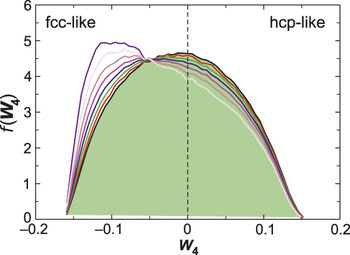
A study of the structural properties of supercooled hard spheres shows that the population of fcc-like precursor regions is bigger than the hcp-like precursor regions.Reference Russo and Tanaka31 A convenient order parameter that distinguishes between fcc-like and hcp-like orientational symmetry is W 4: The fcc structure is characterized by negative values of W 4, while the hcp structure by positive values of W 4. Figure 1 shows the probability distribution of the W 4 order parameter for precursor regions characterized by increasing values of bond-orientational order Q 6, which is a standard measure of bond-orientational order in spherically symmetric systems (see References Reference Leocmach and Tanaka5 and Reference Russo and Tanaka31 for a formal definition). While the supercooled melt has a symmetric distribution of W 4 (black curve), precursor regions progressively peak around negative values of W 4, indicating an fcc-like symmetry. The hcp-to-fcc transition would then occur at much longer time scales, due to the negligible free-energy difference between the two different polytypes.
Origin of polymorph selection in a supercooled state. Hard spheres at reduced pressure βP sD Reference Löwen, Likos, Assoud, Blaak and Van Teefelen3 = 17 (β = 1/k BT, where k B is the Boltzmann constant, T is the temperature, P s is the pressure, and D is the diameter of the colloid): Probability distribution of the order parameter W 4 (f(W 4)) for sets of particles with increasing values of Q 6: 0.25, 0.26, 0.27, 0.28, 0.29, 0.30, 0.31, and 0.32. The full area (green shaded area) is the distribution for the melt, while increasing values of Q 6 skew the distribution toward the face-centered-cubic (fcc) symmetry. Note: hcp, hexagonal close-packed; Q 6, bond-orientational order parameter.

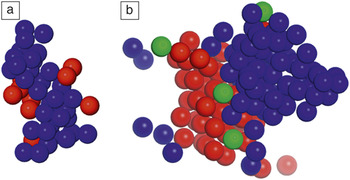
Polymorph selection was also tested in the Gaussian core model (GCM), a model for the effective interaction between the centers of mass of polymers dispersed in a solvent.Reference Likos89 The GCM has two different stable crystalline phases, a low-pressure fcc phase and a high-pressure bcc phase. The nucleation process in the GCM model was first considered, and it was shown that the description of the transition is enhanced by taking into account the prestructured particles surrounding the crystalline nucleus.Reference Lechner, Dellago and Bolhuis30 In a subsequent study, a clear link was established between the precursor regions and the crystal phase that nucleated from them, also noting a kinetic preference for the bcc phase, even in regions where the stable phase is fcc.Reference Russo and Tanaka63 A later study found that the nuclei have a mixed nature, not consisting of just a single polymorph, and the kinetic pathway selected during nucleation persists even when the nucleus is many times above its critical size.Reference Mithen, Callison and Sear84Figure 2 shows an example of a mixed-phase nucleus. These results suggest that polymorph selection is already made in a supercooled state before nucleation starts, and it is connected to the symmetry of the precursor regions formed by structural fluctuations.
Gaussian core model at pressure P s = 0.05 in units of k BT/D 3. Two snapshots of the same nucleus as it grows. (a) Precritical nucleus and (b) post-critical nucleus. The blue particles are body-centered-cubic particles, green particles are hexagonal close-packed particles, and red particles are face-centered-cubic particles, showing a mixed-phase nucleus.

Slow dynamics and external fields
It is interesting to note that regions of high bond-orientational order have been linked not only to nucleation, but also to its absence (i.e., glass formation).Reference Tanaka34 It was observed that over the time scale of heterogeneous dynamics (approximately comparable to the structural relaxation time), extended regions of high bond-orientational order displayed slower dynamics than disordered regions.Reference Leocmach and Tanaka5,Reference Kawasaki and Tanaka12,Reference Leocmach, Russo and Tanaka59,Reference Kawasaki, Araki and Tanaka66,Reference Tanaka, Kawasaki, Shintani and Watanabe67,Reference Shintani and Tanaka90,Reference Russo and Tanaka91 Apart from bond-orientational-ordered regions, highly packed regions are also characterized by slow dynamics.Reference Leocmach and Tanaka5,Reference Leocmach, Russo and Tanaka59 The most notable of these structures is icosahedral packing, which since the pioneering work of Frank, is the archetypal model of amorphous structures. However, on approaching the glass transition, the icosahedral order does not grow in size, whereas bond-orientational order grows.Reference Leocmach and Tanaka5,Reference Leocmach, Russo and Tanaka59 A link between slow dynamics and regions of extended bond-orientational order has been found in polydisperse hard spheres,Reference Leocmach and Tanaka5,Reference Kawasaki and Tanaka12,Reference Leocmach, Russo and Tanaka59,Reference Tanaka, Kawasaki, Shintani and Watanabe67 hard disks,Reference Kawasaki, Araki and Tanaka66,Reference Russo and Tanaka91,Reference Kawasaki and Tanaka92 and colloidal ellipsoids.Reference Zheng, Ni, Wang, Dijkstra, Wang and Han93
It has been shown that at high density, particles with icosahedral order outgrow the population of solid particles.Reference Russo and Tanaka31 Even a small fraction of icosahedral particles strongly suppress the crystallization process.Reference Tanaka94,Reference Karayiannis, Malshe, de Pablo and Laso95 The effect becomes more prominent with the introduction of polydispersity in particle size: It has been shown that the size asymmetry favors the formation of icosahedral environments, while suppressing the crystalline ones.Reference Leocmach, Russo and Tanaka59
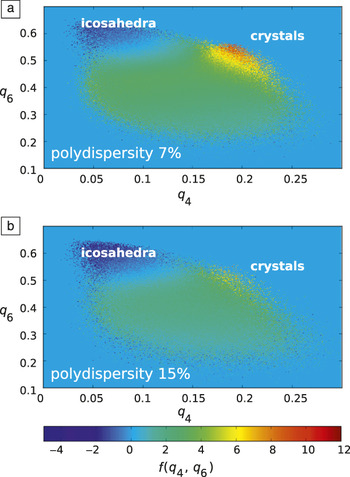
Figure 3 shows the joint probability map of the order parameters q 4 and q 6. Different from Q 4 and Q 6, these order parameters have a spatial resolution that extends only to nearest neighbors and are thus suitable to detect icosahedral order, which cannot grow to form compact domains in space. This map is convenient because crystalline particles are located in the upper right corner of the map, while icosahedral-like environments are located in the upper left corner. We can see that, going from a system with 7% polydispersity (Figure 3a) to a system with 15% polydispersity (Figure 3b), the extent of crystalline regions is highly suppressed. It is interesting to note that disorder (in this case polydispersity) does not always destabilize the crystal. In the case of particles with angular (patchy) interactions, it was shown that angular disorder does not compromise the crystallizability of the system.Reference Romano, Russo and Tanaka96 Glasses are thermodynamically unstable, and, despite the slow dynamics, they can crystallize. The study of both the staticReference Kawasaki and Tanaka97 and dynamicReference Sanz, Valeriani, Zaccarelli, Poon, Cates and Pusey98 properties of the devitrification process holds great promise for the understanding of the glass transition.
Effects of polydispersity on local structural ordering. (a) Polydisperse hard spheres at βP sD Reference Löwen, Likos, Assoud, Blaak and Van Teefelen3 = 23: joint probability distribution f(q 4, q 6) for 7% polydispersity. (b) Polydisperse hard spheres at βP sD Reference Löwen, Likos, Assoud, Blaak and Van Teefelen3 = 23: joint probability distribution f(q 4, q 6) for 15% polydispersity. The extent of crystalline regions is highly suppressed when polydispersity increases from 7% to 15%. Adapted from References Reference Russo and Tanaka31, Reference Leocmach, Russo and Tanaka59, and Reference Russo and Tanaka63. Note: β = 1/k BT, where k B is the Boltzmann constant and T is the temperature; P s, pressure; D, diameter of colloid.

Finally, we consider how an external field can couple with the orientational order in the fluid and affect its dynamics and crystallizability. This relationship was studied in a vertically vibrated quasi-two-dimensional granular liquid, and with polydisperse and bidisperse liquid Brownian simulations.Reference Watanabe, Kawasaki and Tanaka99 It was shown that the walls induce additional glassy order to the fluid, and this can be described by introducing a bond-orientational order correlation length that depends on the distance from the wall. With this simple modification, all scalings between static and dynamic length scales are the same as in the bulk. This also suggests a link between bond-orientational order and slow dynamics. Another study instead considered the effect of rough walls on colloidal suspensions under the effects of gravity,Reference Russo, Maggs, Bonn and Tanaka19 and found that while rough walls do not perturb the density field, they strongly suppress bond-orientational order up to distances comparable to the bond-orientational correlation length. This suppression of bond-orientational order is then reflected in a strong suppression of nucleation close to the walls.
Another interesting external field is shear, which has been considered in detail in one study,Reference Lander, Seifert and Speck82 showing that shear suppresses the development of crystallization precursor regions, but favors the growth of crystal nuclei once they are formed. This offers a compelling explanation for the nonmonotonous dependence of the crystallization rate on the shear rate. The response of colloids to external fields makes them ideal candidates to uncover the effect of external fields on crystallization.Reference Sandomirski, Allahyarov, Löwen and Egelhaaf100
Conclusion
We have reviewed recent progress on nonclassical pathways to crystallization in colloidal systems. Besides advancing our understanding of the nucleation process on a microscopic scale, these studies have shed light on interesting phenomena, such as polymorph selection, glassiness, and devitrification. For example, bond-orientational order plays a role also in glassy slow dynamics of a supercooled state of these systems, and colloidal systems are playing a fundamental role in linking structural information, accessible at single-particle resolution, with the microscopic dynamics. Especially interesting is the study of the effect of external fields on precursor regions and how this affects the nucleation process. Up to now, the case of external walls and uniform shear have been considered, but many other directions such as the effects on sedimentation are open to investigation.