1. Introduction
To this day, ontological emergence has been almost exclusively debated within non-Humean power-based or law-based metaphysics. Typical discussions involve dispositional essentialists or nomic necessitarians, who would usually wonder about whether a case can be made that irreducible causal powers, or irreducible governing laws, can happen to come into being under some specific circumstances. Be they enamored with emergence or rather partisans of reductionism, participants generally share a basic common ground in some version of the Eleatic principle, according to which “to be is to have determinative power” (see, e.g., Kim [Reference Kim, Beckermann, Flohr and Kim1992] or Peacocke [Reference Peacocke, Murphy and Stoeger2007] for a version restricted to causation). One of the main stakes of these debates concerns the nature of the relation that ought to exist between fundamental physical entities and nonfundamental natural entities, as well as, incidentally, the relation that ought to exist between physics and the so-called special sciences. In this respect, it is the ontological emergentists’ recurrent contention that, whatever such relations ultimately are, special sciences’ entities—be they objects, properties, or laws—should somehow be “efficacious” (Wilson Reference Wilson, Bigaj and Wurthrich2015) or “determinative” (Gillett Reference Gillett2016) in their own rights, to the effect that, granted emergence, the special sciences would be at least partly autonomous from the physical sciences.
That such debates have been overwhelmingly played out in a non-Humean arena is no real surprise. For one thing, contemporary Humeanists themselves never felt that attracted by emergence—consistently with Lewis’s own dismissal of “suchlike rubbish” (Reference Lewis1986, x)—as it seems supervenience has always been all they really needed. But it is also certainly true that, at least until recently, most of the ontological emergentists out there happened to pursue a personal agenda (e.g., vindicating irreducible agent causation in a libertarian setting [Lowe Reference Lowe2008] or arguing that social structures have irreducible causal powers [Elder-Vass Reference Elder-Vass2010]), for which, this is sure, Humeanism is of no help. As things stand, the Humeanists’ systematic repudiation of necessary connexions appears to be frontally at odds with the widespread recognition that, typically, ontological emergents are supposed to come with a decent measure of modal force.
Yet, notwithstanding Tooley-style arguments to the effect that the putative existence of yet-uninstantiated emergent properties should undermine regularity theories (Tooley Reference Tooley1977; Armstrong Reference Armstrong1983, chap. 8)—arguments that, I think, have been properly debunked (Beebee Reference Beebee2000)—advocating the irreducibility of some worldly entities and, with it, the possible autonomy of some special sciences, does not prima facie appear to be an endeavor that ought not to be pursued in a Humean setting. What appears as a good indication that such a claim is not totally unreasonable certainly is the fact that, at present, it is rather standard to trace the very birth of emergentism in the works of a philosopher, John Stuart Mill, who also happened to embrace a broadly Humean worldview (Stephan Reference Stephan, Beckermann, Flohr and Kim1992).
Unfortunately, although Mill is usually seen as the main progenitor of emergence, there have not been many attempts to exactly explicate the way in which he construed the notion. As a result, Mill’s view is often unapologetically conflated with other distinct accounts of emergence under the unfortunate umbrella label of British emergentism.Footnote 1 However, as I endeavor to show in this article, Mill’s view on emergence turns out to be rather idiosyncratic and actually provides us with some unexpected resources that allow, pace Lewis, for somehow reconciling Humeanism with (ontological) emergence.
Digging out Mill’s philosophy of emergence and emphasizing the extent to which it happens to conflict with its standard contemporary interpretation can certainly have some historical interest, but it is not what will primarily keep me busy here. The main purpose of the current article is rather to use Mill’s scattered insights on emergence as guides toward the establishment of a peaceful coexistence between Humeanism and emergence. As a secondary objective, I show that some peculiar form of ontological emergence allows for conceiving the autonomy of the special sciences in an interesting way, consistently with the reductionist ideal of a unified, all-encompassing science. Incidentally, in a companion paper to come, such a conception will be claimed to strengthen a recent variant of the Humean Best System Account (BSA) of lawhood, known as the Better Best System Account (BBSA; Schrenk Reference Schrenk, Bohse, Dreimann and Walter2008; Cohen and Callender Reference Cohen and Callender2009), for which, it has been contended, John Stuart Mill is to be considered the “patron saint” (incidentally warranting the claim that, in a certain sense, Humeanism is not necessarily hostile to emergentism; Schrenk Reference Schrenk2017).
In section 2, I first describe the main tenets that define Mill’s broadly Humean worldview and, more particularly, his specific take on lawhood. In section 3, I introduce Mill’s notorious distinction between “homopathic” and “heteropathic” combinations of causes and laws, on which the current “resultant/emergent” distinction is usually considered to collapse. I then proceed by extracting the ontological consequences of the putative existence in nature of heteropathic effects and laws, by showing that they are to be related to extensions of the Humean mosaic (sec. 4) and, with it, a conception of ultimate laws as being temporally indexed (sec. 5). On this basis, I propose a synthetical and evolutionary reconstruction of Mill’s view on the “growing Humean mosaic” and the way it gives rise to a unified science, somewhat paradoxically made of autonomous special sciences (sec. 6). I close this article by proposing semiformal definitions of Mill’s emergence that allow localizing it in the very diverse, contemporary conceptual landscape of the notion (sec. 7).
Before getting started, a note of caution is needed. It is notoriously difficult to exactly pin down Mill’s ontological commitments—most of which are broadly Humean while some have rather elusive realistic tones—as he himself investigated the logic of science rather than its underlying metaphysics. In this respect, the reconstructions found in this article are by no means meant as thorough scholarly exegeses of Mill’s philosophy of science. More modestly, I merely propose a plausible picture of the reconciliation between Humeanism and emergence that is consistent with Mill’s view, filling the gaps, when necessary, in ways that are as charitable as possible.
2. Lawhood in Humeanism
For the purpose of the current article, it is enough to delineate Mill’s broadly Humean worldview with the help of the three following features:Footnote 2
Humean supervenience (HS). The world is some sort of a vast mosaic of property instances localized at spatiotemporal points. Everything else that is not immediately part of such a mosaic supervenes on it. The property instances composing the mosaic are taken to be (i) fundamental and (ii) nonmodal, to the effect that (i) every natural property instance only obtains in virtue of the instantiation of some of these fundamental properties, and (ii) no property instance that belongs to the mosaic is modally connected to other property instances.
Regularity view of laws (RVL). Laws do not govern the succession of particular events of the mosaic. Rather, and in accordance with HS, they simply are patterns or regularities (of a special sort) among them. Lawful regularities are described by law statements, which figure in scientific theories.
Regularity view of causation (RVC). Causation is not productive. It is rather a relation of constant conjunction between discrete events of the mosaic. Consistently with HS and as with RVL, there is no (natural) modality in such a relation. Causation just is the regular succession in time of particular events.Footnote 3
With respect to RVL, the very fact that a distinction can be made between laws (of nature) and law statements is indicative of a realist facet of Mill’s philosophy of science, according to which science is in the business of revealing the way the world essentially is (Macleod Reference Macleod and Zalta2017). Mill himself acknowledges the possible confusion that follows from this: “The expression, Laws of nature, means nothing but the uniformities which exist among natural phenomena” (Reference Mill1884, 208), yet “it is the custom of science … to call the general proposition which expresses the nature of that regularity a law” (207).
Now, the orthodoxy has it that Mill is the pioneering proponent of a particular variant of RVL—although with the slight realistic tone just mentioned—namely, the so-called Mill-Ramsey-Lewis or BSA of lawhood (Earman Reference Earman1986). Among other features, such an account provides a principled way of distinguishing those regularities that appear to be merely accidental, and that are accordingly to be captured by accidentally true generalizations, from those regularities that turn out to be genuinely nomic and, as such, describable by law statements. Such a distinction can in principle be drawn through the running of some kind of competition between all the available deductive systems that concern the property instances composing the Humean mosaic, of which the theorems are true. It is the BSA’s main contention that the laws just are the axioms and the theorems of the one system that achieves the best balance between two virtues that generally tend to work against one another, namely, strength (a measure of informativeness) and simplicity (a measure of the sobriety of systematization).
Still, in Mill’s view (Reference Mill1884, 206–7), referring to the axioms and the theorems of such a best system as “laws” amounts to a “lax application” of the term. A stricter application would be to consider as laws only those regularities that are “distinct” and “independent,” such that, when they are taken for granted, “the others follow” or “result from them.” Put differently, Mill is actually considering two different kinds of law: (i) the genuine ones, which are the invariant and unconditional regularities that obtain among the fundamental property instances of the Humean mosaic and which are to be captured by law statements that are the axioms of the best deductive system that is true to the mosaic, and (ii) the derivative ones, which are regularities that obtain in virtue of those fundamental regularities and which are describable by law statements that are deducible from the axioms, that is, by the theorems of the best system. For the sake of simplicity and bearing in mind that, according to Mill, only the former are to be considered as the laws—coherently with the claim that the laws are “the fewest general propositions from which all the uniformities which exist in the universe might be deductively inferred” (207)—I will keep referring in what follows to the distinction between the laws captured by the axioms and the theorems as, respectively, the “ultimate” (or fundamental) laws versus the “derivative” (or nonfundamental) laws.
This being said, it might prima facie appear that such an account of lawhood makes it difficult, if not impossible, to take seriously the very existence, yet alone the autonomy, of laws in the special sciences, insofar as such laws are supposed not to be directly about the fundamental property instances of the Humean mosaic. As things stand, one can indeed have serious reasons to expect that, while running the competition between the available deductive systems that are true to the mosaic, the generalizations of the special sciences will at best invariably come out only as theorems of the winning system, that is, as mere derivative laws. However, Mill’s philosophy of science presents a further resource that makes this judgment premature. It is indeed an idiosyncrasy of Mill’s view that his version of the BSA—in sharp contrast with Lewis’s—comes hand in hand with some nontrivial form of antireductionism, something one can only fully appreciate with an adequate account of Mill’s emergence at hand.
3. Combining Causes and Combining Laws
In the book on induction that is part of his System of Logic, Mill discusses what he takes to be “one of the fundamental distinctions in nature” (Reference Mill1884, 244), which is about two different modes of composition of causes or, equivalently, of mutual interference between laws. The first mode, referred to as “homopathic,” is very general. It obtains as long as the Principle of the Composition of Causes (PCC) is satisfied, that is, as long as “the joint effect of several causes is identical with the sum of their separate effects” (243). PCC continuously obtains for phenomena studied by the science of mechanics. It is actually embodied in Newton’s second law,  , where the resulting effect a of the joint action F of several causes Fi is indeed always identical with the (vectorial) sum of the partial effects ai that each of these causes would have had in isolation. In corresponding nomological terms, the law about the joint cause and effect
 is identical to each of the laws about the separate causes and effects
 , insofar as these do not “interfere” with one another while they combine.
According to Mill, it is an empirical, contingent matter of fact that PCC does exceptionally fail, to the effect that causes sometimes happen to combine, and laws happen to interfere, in a “heteropathic” way.Footnote 4 In that kind of situation, which typically occurs on the occasion of chemical reactions, the joint effect of combined causes is not identical to the sum of the separate effects that these causes would have had on their own. As Mill puts it himself with respect to the synthesis of water from (di)hydrogen and (di)oxygen: “Not a trace of the properties of hydrogen or of oxygen is observable in those of their compound, water” (Reference Mill1884, 243).Footnote 5 In corresponding nomological terms, the law about the joint cause and effect is different from the laws about the separate causes and effects. Water can then be at play in nomic regularities that are “heterogeneous” with regard to any of the nomic regularities in which hydrogen and oxygen happen to find themselves at play.
This being said, one may wonder why it is the case that any failure of PCC, that is, any heteropathic composition of cause, amounts to what one would be ready to consider as a nontrivial form of emergence. In a nutshell, this relies on two complementary observations. Each breach in PCC is the occasion of (i) an extension of the Humean mosaic, that is, the advent of new fundamental property instances that belong to a new ontological domain, and (ii) the correlative advent of new ultimate laws that acts as bridge laws between the old and the new domains. Let us now flesh out these observations in more detail.
4. Emergence and the Growing Humean Mosaic
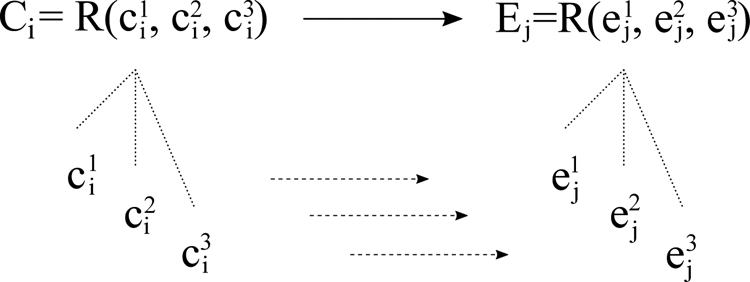
As a starting point, figure 1 provides a diagrammatic representation of the general, homopathic situation. Although it is true that Mill invariably speaks of causal composition in terms of addition, scalar or otherwise, one can easily generalize to any other kind of combinatorial relation; hence, the neutral notation  .Footnote 6 The only thing that really matters is that, in the homopathic case, it is the same relation R that holds for both the combinations of causes and effects. Indeed, it is only in this respect that the same laws obtain for both joint and separate causes and effects. In the light of the canonical mechanical illustration again, it is because both forces and acceleration combine in the same way (i.e., additively) that we have
 . From this, it follows that it is always possible to anticipate the occurrence of any homopathic effect. From knowledge of PCC, the laws
 that are about the separate causes and effects, as well as the relation R in which the causes stand with respect to one another at time ti, one can indeed predict the occurrence of Ej at tj. Equivalently, the law L[Ci, Ej] is a derivative law. Accordingly, and to state the obvious, Ej is not a fundamental property instance of the Humean mosaic. Rather, it only obtains in virtue of the instantiation of the other fundamental property instances
 standing in relation R. Thus, Ej is nothing “over and above” the instantiation of each
 standing in relation R. In contrast with the heteropathic case—and as we will see shortly—all the separate causes therefore “have their full effect” (Mill Reference Mill1884, 243).
Homopathic composition of causes and effects.

Let us now turn to the emergent case, in which PCC breaks down, that is, in which the joint effect Ej is not identical to the separate effects  standing in relation R (or, for that matter, in any relation R*; see fig. 2). In that kind of case—and this is the crux of the idiosyncrasy of Mill’s emergence that is often overlooked—the separate effects
 simply do not exist (at least in the spatiotemporal region of the phenomena under consideration), to the effect that a heteropathic combination of causes can be seen as a process during which some due effects unexpectedly give way to something utterly different. As Mill puts it himself (Reference Mill1884, 246), “At some particular points in the transition from separate to united action, the laws change, and an entirely new set of effects … take the place of those which arise from the separate agency of the same causes.”Footnote 7 Accordingly, a heteropathic effect Ej always is a new fundamental property instance of the Humean mosaic, or, to put it differently, it does not exist in virtue of anything other than itself. Nor does it exist in virtue of its cause Ci, given RVC and its underlying assumption that, so to speak, no cause contains the seed of—or produces—its effect. Nor does it exist in virtue of—or supervene on—the separate effects
 , for these are generally not coinstantiated. True, the very fact that a heteropathic effect Ej is not grounded in putatively more fundamental property instances does not prevent it from being instantiated in systems whose formation depends in some sense on a previous constellation of conditions. Although in Mill’s empiricist perspective the liquidity of water is genuinely heterogeneous from the gaseous nature of hydrogen and oxygen—to the effect that one could not recognize the relevant traces of the later in the former—it is indeed still the case that liquid water is what regularly proceeds from a transformation of hydrogen and oxygen in the appropriate conditions. The apparent air of contradiction here is typical of emergentism, which generally requires one to be committed to the somewhat paradoxical idea that emergent property instances can be dependent (on what constitutes their emergence bases) and fundamental at the same time.Footnote 8
Heteropathic composition of causes and effects. The shaded region is nonoccurrent, to the effect that Ej cannot be any relation R*—and, in particular, R—of the  .

It follows that every instance of Mill’s emergence is the occasion of an extension of the Humean mosaic. Under Mill’s view, the mosaic happens to grow through time, as new semiautonomous domains of fundamental emergent property instances are frequently added to the whole picture. As we will see in what follows, each of these extensions of the mosaic corresponds to the advent of a new domain that is definable of a special science.
5. Temporally Indexed Laws and the Autonomy of the Special Sciences
Given HS and RVL, it follows from each extension of the Humean mosaic that new laws are needed to systematize each new domain and its constitutive fundamental property instances. It is indeed the main initial underlying assumption of the heteropathic mode of interference between laws that, upon emergence, laws of nature, “when called upon to work together, cease and give place to others” (Mill Reference Mill1884, 244). Such new laws, actually L(Ci, Ej) in the simplified case depicted in figure 2, are to be considered ultimate, in the sense that they cannot be deduced from any combination of other laws (in particular, the laws  , even together with PCC and knowledge of how the separate causes
 happen to be related). As a result, the occurrence of every emergent property instance Ej is theoretically unpredictable, despite the fact that, given Mill’s commitment to determinism (201), it can of course be inductively predicted as soon as L(Ci, Ej) has come to be known as the outcome of an adequate experiment. Mill’s emergence therefore comes with the contention that all of science’s first principles are not “first” at all, at least in a temporal or historical sense. Rather, ultimate laws turn out to be temporally indexed. They all have a starting date, so to speak, which does not necessarily correspond to the date the world began (if it ever began on some specified date).Footnote 9
Mill’s growing view of the Humean mosaic and the laws that come with it has an important impact on the very structuring of science itself. It indeed turns out that any true deductive system of law statements, which achieves the best combination of strength and simplicity at some given time ti, becomes immediately obsolete as soon as some breach in PCC occurs, insofar as, then, it immediately loses strength by being unable to accommodate the new extension of the mosaic. As a result, one has to run the competition afresh with respect to the newly extended mosaic.
To understand what the result of such new competition has to be, two preliminary remarks are in order. First, in Mill’s view, it is of course possible for heteropathic laws to combine homopathically (or for heteropathic effects to subsequently combine as homopathic causes of further effects). As a result, once a new domain of events Di has emerged, these events generally combine in such a way that their joint effects also belong to Di. Accordingly, each domain has its own regularities. Some of them are ultimate, in the sense of being about the fundamental property instances of that domain, and the others are derivative, as they only obtain in virtue of a homopathic combination of these fundamental property instances. As it turns out, an intradomain competition can then be run independently for every domain Di, the result of which is the deductive system that best systematizes the events of Di. Such a system has the ultimate and the derivative laws of Di as its axioms and its theorems, respectively, and is constitutive of a freestanding special science.Footnote 10 In Mill’s own words, with Di being the chemical or the physiological domain, “there is no reason to despair of ultimately raising chemistry and physiology to the condition of deductive sciences; for though it is impossible to deduce all chemical and physiological truths from the laws or properties of simple substances or elementary agents, they may possibly be deducible from laws which commence when these elementary agents are brought together into some moderate number of not very complex combinations. The Laws of Life will never be deducible from the mere laws of the ingredients, but the prodigiously complex Facts of Life may all be deducible from comparatively simple laws of life” (Reference Mill1884, 245).
That brings us to the second remark. Mill’s way of talking sometimes erroneously suggests that heteropathic laws can contravene previous laws.Footnote 11 Of course, literally, that cannot be the case. Consistently with RVL, once an event is not obtaining, as in the case of the separate effects  in a heteropathic situation, there simply is no law “out there” that is prevented from “acting,” as Humean laws only supervene on occurrent events. Accordingly, laws that belong to a domain
 remain laws of that domain, even after a domain Di and its own laws have emerged therefrom. In particular, neither “overlaps” nor “conflicts” are expected to occur between the laws of these domains, insofar as, by definition, they are regularities among different fundamental property instances of the growing Humean mosaic. This is not a trivial point, as it is this very ingredient of Mill’s take on emergence that allows for science to remain a unified endeavor, despite the existence, within it, of several quasi-autonomous special sciences, each having its own best deductive system that is true to its own domain. As such, a separate interdomain competition can then also be run, which will designate the best deductive system for all domains of events existing at time ti. This system will invariably contain, as axioms, all the axioms of the first domain-specific best system—D 1 or physics—together with all the heteropathic laws that have appeared upon each and every breach in PCC before ti and that act as interdomain ultimate bridge laws. In this spirit, with respect to the unification of physics and chemistry, Mill contends that, “in chemistry, these undiscovered laws [the heteropathic laws] of the dependence of the properties of the compound on the properties of its elements, may, together with the laws of the elements themselves, furnish the premises by which the science is perhaps destined one day to be rendered deductive” (Reference Mill1884, 246).
6. The Dynamic Unity of Science
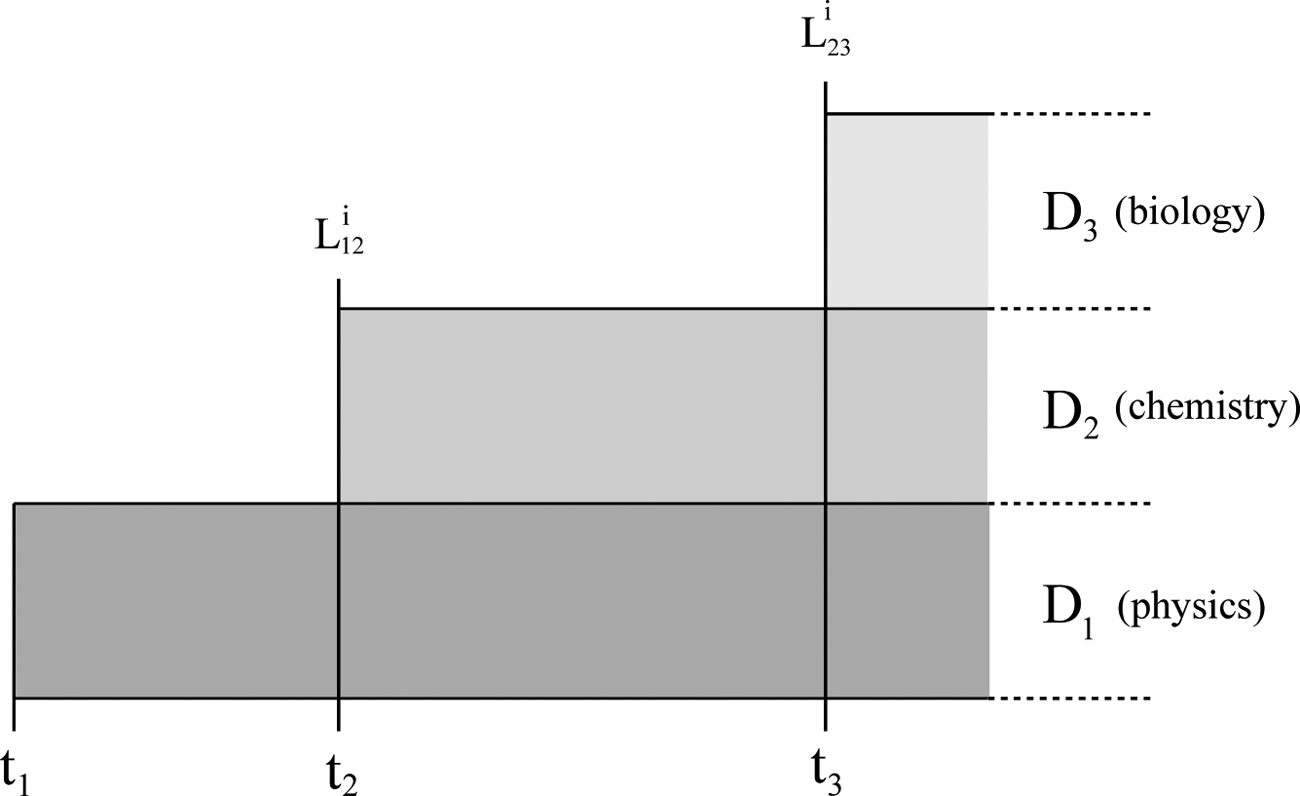
Figures 3 and 4 summarize the upshot of the discussion so far. They can both be seen as representing an emergent evolution of some sort, of which the relevant steps can be described as follows.
Mill’s growing Humean mosaic, where new quasi-autonomous domains of events Di keep stacking on one another upon each breach in PCC. Emergence is here what accounts for the existence of the various special sciences.

Mill’s growing Humean mosaic and the science that best systematizes it. Although the domains of events Di are not connected in any ontologically significant way, the associated best deductive systems  can all be unified into a single deductive system at any time. This provides a diagrammatic picture of McLaughlin’s claim that Millian laws “cluster into systematically related groups” (Reference McLaughlin, Beckermann, Flohr and Kim1992, 63).

At the very origin of the world—whenever that may be, let us say at t 1—there was nothing but physical events that combined homopathically, to the effect that the best deductive system  that was true to the only domain D 1 of the mosaic only contained, as axioms, the ultimate laws of physics (as Humean laws, these laws span the whole temporal extension of D 1, from t 1 onward until the end of time). At some later time t 2, a first breach in PCC occurred, and a new domain D 2 of fundamental property instances—those of chemistry—emerged. Although
 then remained the best deductive system available for D 1—for no law was to be contravened upon the breach in PCC—it failed to appropriately systematize the events of D 2 and, hence, could not qualify as the best system for the mosaic at t 2; that is,
 . Two new competitions were then to be run. Building on the fact that chemical events also generally combined among themselves homopathically, the first competition, internal to D 2, designated
 as the best system for D 2, making chemistry a deductive science with its own axioms and theorems (again, the corresponding laws span the whole temporal extension of D 2, from t 2 onward until the end of time). With respect to a second competition, this time run against
 , the best deductive system that came out was the one that had, as axioms, the axioms of
 together will the interdomain, heteropathic laws
 (of the form Li(C, E), with C and E belonging to D 1 and D 2, respectively). The story then kept repeating itself relative to the advent of the other domains of the mosaic and their corresponding special sciences, predicated on the further assumptions that the biological domain (D 3) emerged from the chemical domain (D 2), the psychological domain (D 4) emerged from the biological domain (D 3), and so on. At the end of time, the whole of science is in principle to be rendered fully deductive. The final best system D* will have, as axioms, the axioms of physics together with all the heteropathic laws that obtained on the occasion of each and every breach in PCC that occurred throughout history.
It is clear from such discussion that Mill’s version of the BSA essentially differs from Lewis’s, in that the former considers the supervenience basis of any law of nature to be temporally restricted to a given time interval [ti, ∞], while for the later it invariably consists of the whole history of the universe (so that ti is always arbitrarily set to zero). Restricting, as Mill does, the period over which some nomic regularities obtain and, accordingly, some best system prevails, is not prima facie inconsistent, even if it can strike one as strongly counterintuitive. As Lange recently put it:
On Lewis’s account, the laws are immutable, since the laws at each moment are fixed in the same way by the same thing: the universe’s complete history of elite-property instantiations. However, Lewis’s account entails the laws’ immutability only because a certain parameter in the account has been set to ‘the universe’s entire history’. That parameter could be set differently. For example, there is a deductive system of truths having the best combination of simplicity and informativeness regarding the elite-property instantiations during a given period. I see no grounds on which Lewis’s account could object to deeming the members of that system to be the laws during that period.
(Reference Lange2008, 88–89)That Lewis systematically and artificially fixes the laws’ starting date to zero is what makes it the case that Mill-style evolutionary emergence cannot occur in his worldview. Unsurprisingly enough, there is no room for genuine extensions of the Humean mosaic in Lewis’s atemporal block universe ontology. Because all the fundamental property instances of the mosaic are taken to belong to the unique “elite” domain D 1 spanning over the whole history of the world, it is no surprise that the laws of the special sciences can enjoy no specific autonomy.Footnote 12
By contrast, and as we have already seen, there is a genuine ontological enforcer of the special sciences’ autonomy in Mill’s version of the BSA, namely, the contingent breaches in PCC and, with them, the advent of new domains of the Humean mosaic and, correspondingly, of new laws. These are not to be fixed by—nor do they supervene on—“the universe’s entire history,” a fact that gives Mill flexibility enough, coherently with Lange’s words above, to make sense of the set of the world’s laws growing through time.Footnote 13
7. Defining Humean Emergence
We are now sufficiently equipped to capture the core of Mill’s emergence with the help of semiformal definitions. Formulating such an emergence may be achieved in two equivalent ways, causal and nomic, bearing in mind that, in both cases, what ultimately emerges is a new fundamental property instance of the Humean mosaic at a certain time.Footnote 14 In line with what has been said so far, an event Ej can be said to emerge at time  as soon as:
i) Ej is caused by a combination of causes
 , such that each single in isolation would have caused , and
ii) Ej is different from (any)
.


i) It is a law that Ej regularly follows from
, to the effect that is part of the best system D*, andii) this law is an ultimate law, to the effect that it is an axiom of the best system D*.


Here, Ej belongs to a domain Dj, while each  and
 belongs to Di. The law
 is a bridge law connecting Di to Dj, and it belongs to the best system D*, which is either the final best system D*, or the best system
 available at tj for systematizing
 .
Both these formulations render explicit what might appear today as an ambiguity in Mill’s emergence, which is probably responsible for the fact that two distinct contemporary varieties of emergence, synchronic emergence and diachronic emergence, are both taken to ultimately trace back to Mill’s homopathic/heteropathic distinction. In the proposed definitions, there are indeed two possible ways of deciding what the emergence basis of Ej actually is.
A first prima facie plausible option in this respect is to consider that the joint effect Ej emerges from the set of the “underlying,” separate effects { }. Such a possible construal of Mill’s emergence is commensurate with the traditional holist canon according to which “the whole is more than the sum of its parts” and seems at first glance congruent with his own example of water being more than hydrogen and oxygen. As such, this first line of thought is in line with the synchronic/holistic tradition of emergentism, according to which emergents are those higher-level units—objects, properties, laws, what have you—that are both dependent on, and autonomous from, underlying, lower-level and simultaneous units, in the spirit of a “layer-cake” ontology of levels of nature, described by a science that has a corresponding stratified structure.
Yet, serious reasons indicate that it is a mistake to construe Mill’s emergence in this way. Indeed, as we have seen, there is no way in which one could consider that an emergent joint effect Ej synchronically depends on the set of the separate effects { }, for in general they are not coinstantiated (it could even be the case that none of the
 were ever occurrent in the whole history of the universe). Accordingly, and contrary to the present orthodoxy (somewhat ironically) fixed by Kim (see, e.g., Reference Kim1999 or Reference Kim2006), Mill’s emergence is not essentially tied to mereological supervenience, a relation with respect to which the autonomy of emergents is notoriously difficult to come by. Construing Mill’s emergence under the canonical, synchronic mold articulated around supervenience would indeed force one to consider—as McLaughlin (Reference McLaughlin, Beckermann, Flohr and Kim1992, 65) seems to do, although with much precaution—that Mill actually embraced some version of property pluralism and, with it, the existence of higher-level configurational forces. But although it is arguable that subsequent non-Humean causal/nomic realists of the synchronic/holistic tradition did embrace the existence of such controversial forces in order to enforce their emergence ascriptions, this is utterly inconsistent with Mill’s broadly Humean worldview.Footnote 15 For one thing, composite entities like water do not “influence” or “modify” the behavior of other entities, among which are their own components, simply because, given RVC, there is nothing in causation that goes beyond mere regularity. Another way to put it is to reemphasize that Mill’s heteropathic laws do not contravene other laws, among which are the ones about the separate causes and effects, for, given RVL, when the separate effects do not obtain, there is simply no law “out there” that can be contravened. Equivalently, Mill’s heteropathic laws do not “govern” or “regulate” the behavior of underlying or subvening components, for governing and regulating are simply not what Humean laws do.
This leaves us with the second, more plausible option: Ej’s emergence basis, on which it depends and from which it is autonomous, is its antecedent cause  . Put differently, in Mill’s emergence, the relevant dependence relation is the one that is subsumed under the heteropathic law
 . Incidentally, the recognition of this fact recently led philosophers to consider Mill as the progenitor, not of the synchronic but of the dynamical or diachronic tradition of emergence (O’Connor and Wong Reference O’Connor, Wong and Zalta2015; Humphreys Reference Humphreys2016). Whether Mill himself construed his emergence as involving changes in levels certainly is a subtle matter of exegesis, in which I do not wish to enter here (although, as far as I know, Mill never explicitly subscribed to a “layer-cake” ontology, nor did he ever use the word “level” in his Logic). Still, what seems uncontroversial is that holism is at best parasitic of Mill’s emergence, for which the core is, as we have seen, that the Humean mosaic happens to grow through time.
The fact that Mill’s emergence is best construed as diachronic is of the utmost importance when it comes to the very possibility of reconciling Humeanism with emergence. For whether one is inclined to define synchronic emergence on the basis of either (i) supervenience (van Cleve Reference van Cleve1990) or, on the contrary, (ii) some failure of supervenience (Loewer Reference Loewer1996), both these options outrightly conflict with mainstream, Lewisian Humeanism. In such light indeed, not only does supervenience amount to reducibility (against (i); Lewis Reference Lewis and Guttenplan1994), but also the existence of putatively emergent, hence nonsupervenient, things directly conflicts with HS (against (ii)).Footnote 16 No issue of this kind plagues diachronic emergentism, for then what ultimately emerges—fundamental property instances—just plainly belong to the Humean mosaic. Millian emergents are, as it were, among the very tiles of the mosaic itself—they are to be counted among the world’s “perfectly natural properties” (Lewis Reference Lewis1983)—so the question of how they might possibly relate to such a mosaic does not even arise. This also accounts for the fact that Millian heteropathic laws do supervene on fundamental property instances of the mosaic—as it should be, given HS—the only difference with conventional Humeanism being that, as we have seen, they actually only supervene on a temporal fraction of it.Footnote 17
8. Conclusion
In this article, I proposed what I consider to be a charitable interpretation of Mill’s take on lawhood and emergence. The resulting picture may seem surprising at first glance, as it crystallizes a reconciliation between two metaphysical options that are usually taken to be conflicting, namely, Humeanism and emergentism. Such reconciliation is nonetheless rendered consistent by taking Mill’s dynamical or diachronic construal of emergence seriously, construal that infuses his BSA of lawhood by giving it an evolutionary twist. Mill’s paradoxical picture of the unity of science is therefore vindicated: special sciences are autonomous from physics in a nontrivial sense—for their laws cannot in principle be deduced from the laws of physics—yet they can all be unified into a unique, final, and all-encompassing deductive system.
Surely, that Humeanism and emergence can peacefully coexist, or that best system laws can happen to come into being through time, has only been shown here with the force of logical or metaphysical consistency. At no point did I offer the slightest argument to the effect that such coexistence ought to be desirable (as for sure it comes with a price, apart from being, as Mill’s own illustrations from nineteenth-century chemistry and biology indicate, empirically questionable). It then remains to be seen whether the resulting picture can be put to work, something that will have to wait for another time.