The challenge in the treatment of infections associated with Acinetobacter baumannii is related to multidrug resistance, mainly to carbapenems (eg, carbapenem-resistant A. baumannii or CRAB). Quaternary ammonium compounds, such as benzalkonium chloride (BZK), are among the most used biocides and are considered a nonspecific agent.Reference Knauf, Cunningham and Kazi1 Resistance to BZK develops through ribosomal protein mutations, protecting the A. baumannii against protein aggregation induced by the BZK,Reference Knauf, Cunningham and Kazi1 or mediated by the acquisition or hyperexpression of multidrug efflux pumps, which are usually encoded by several genes located on plasmids, such as the qac gene.Reference Meyer and Cookson2 In this study, we sought to determine the minimal inhibitory concentration (MIC) of the BZK in CRAB in a hospital where BZK is used in the routine disinfection. Molecular and clonal characterization of these strains, as well as detection of qacE∆1 gene were determined.
In this retrospective study, we considered bacterial isolates from a University Hospital in Southern Brazil. In total, 50 CRAB isolates from hospital surfaces and clinical samples were included (infection definition are included in Supplementary Material 1 online). The genetic similarity of the isolates was evaluated according to the protocol described by Mencacci et al.Reference Mencacci, Monari and Leli3 The direct detection of the microorganism was performed with matrix-assisted laser desorption ionization time of flight (MALDI-TOF) mass spectrometry on Vitek MS equipment (BioMérièux, Durham, NC). Genetic similarity was evaluated using the Saramis software taxonomy tool (BioMérièux).Reference Mencacci, Monari and Leli3 The different clones identified were confirmed using the repetitive element sequence-based PCR (rep-PCR) Diversilab system (BioMérièux) and were analyzed using the Agilent 2100 Bioanalyzer (Agilent Technologies, Palo Alto, CA).Reference Mencacci, Monari and Leli3,Reference Higgins, Janssen, Fresen, Wisplinghoff and Seifert4 For real-time polymerase chain reaction (qPCR) of the bla OXA51 , qacE∆1, and bla OXA23 genes, the protocol is detailed in the Supplementary Material 2 (online). The BZK MIC was determined by the broth microdilution method and ranged from 512 μg mL−1 to 0.25 μg mL−1.Reference Vijayakumar, Sandle and Al-Aboody5
The hierarchical grouping of the 50 CRAB trough MALDI-TOF peak profiles identified 3 different clusters with an average genomic similarity rate of 75%: cluster 1 (47 isolates), cluster 2 (2 isolates), and cluster 3 (1 isolate) (Supplementary Material 3A online). Using rep-PCR, 3 clusters among the isolates of CRAB were identified (Supplementary Material 3B online), which agreed with MALDI-TOF phylogeny. The genes bla OXA-23 and bla OXA-51 were amplificated in all bacterial isolates (Supplementary Material 4 online).
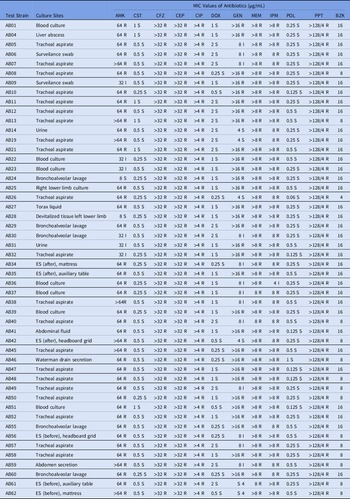
The gene qacEΔ1 was identified in 47 samples (93.2% for isolates clinical and 100% for environmental isolates) (Supplementary Material 4 online). The amplified product was placed on an agarose gel for end-point PCR. The extreme cycle thresholds showed visible bands and were positive for the presence of the gene in these CRAB isolates (Supplementary Material 5 online). Moreover, 70% of the CRAB isolates had a BZK MIC of 16 μg mL−1, 28% had an MIC of 8 μg mL−1, and 2% had an MIC of 4 μg mL−1 (Table 1).
Culture Sites and Minimum Inhibitory Concentration (MIC) Values of Antibiotics/Biocide Tested Against Isolates of Acinetobacter baumannii

Note. R, resistant; I, intermediary; S, susceptible (according to Clinical and Laboratory Standards Institute criteria); AMK, amikacin; CST, colistin; CFZ, ceftazidime; CEP, cefepime; CIP, ciprofloxacin; DOX, doxycycline; GEN, gentamicin; MEM, meropenem; IPM, imipenem; POL, polymyxin B; PPT, piperacillin/tazobactam; BZK; benzalkonium chloride; ES, environmental surveillance.
We correlated the presence of the qacEΔ1 gene and quaternary ammonium resistance. The bacterial isolates without the qacEΔ1 gene (AB07, AB08, AB30) presented MICs of 16, 8, and 16 μg mL−1. However, in the isolate AB26, with a MIC of 4 μg mL−1, the gene was detected.
A. baumannii is first in the list of pathogens with few therapeutic options in the hospital environment,Reference Meyer and Cookson2 and the infection often exhibits complex epidemiological profiles and the coexistence of multiple clones. Notably, the correlation between the susceptibility of CRAB to BZK occurs in parallel with the presence of qacEΔ1 gene, which can lead to ways to manage and prevent the spread of CRAB in the hospital environment. In the 6 environmental samples analyzed, all showed the same resistance profiles found in the clinical samples.Reference Kramer, Schwebke and Kampf6–Reference Ling, Ching, Widitaputra, Stewart, Sirijindadirat and Thu8 A previous study with 21 gram-negative and gram-positive isolates reported that 38% showed resistance to these compounds, suggesting a probable intrinsic resistance together with plasmids.Reference Zmantar, Kouidhi, Miladi and Bakhrouf9
The CRAB isolates showed 94% presence of the qacEΔ1 gene, indicating a possible relationship between MIC values found in the BZK in vitro study, similar to a study that demonstrated the presence of the gene in 96% of A. baumannii strains.Reference Liu, Fu and Huang7 This gene-conferring resistance to biocides has been described previously, suggesting concerns about gene expression related to quaternary ammonium.Reference Gomaa, Helal and Khan10 Benzalkonium MICs suggestive of resistance were found in 3 isolates without the presence of the gene. These data suggest a possible lack of gene expression in some of the bacterial isolates of CRAB, or there is the presence of other genes that may be responsible for resistance to the biocide. Benzalkonium values between 16 and 32 μg mL−1 were considered to indicated high resistance, values between 4 and 8 μg mL−1 indicated resistance, and values of 2 μg mL−1 indicated susceptibility.Reference Zmantar, Kouidhi, Miladi and Bakhrouf9
The presence of the qacEΔ1 gene and the benzalkonium chloride MIC are linked. Incorrect disinfection of surfaces can lead to the selection of resistant pathogens; however, further in vitro studies are needed to determine the relationship between the time of inhibition of growth of the pathogen and the minimum inhibitory concentration of sufficient BZK to be used. This information can contribute to improved resistance tracking and management as well as rational and correct use of quaternary ammonium products for disinfection.
Supplementary material
To view supplementary material for this article, please visit https://doi.org/10.1017/ice.2021.418
Acknowledgments
We thank CAPES, Fundação Araucária, and Assosiação Paranaense de Cultura (APC grant no. CP 10/2019) for their support. The Ethics Committee of Pontifícia Universidade Católica do Paraná approved the project (no. CAAE: 21789719.5.0000.0020).
Financial support
No financial support was provided relevant to this article.
Conflicts of interest
All authors report no conflicts of interest relevant to this article.