INTRODUCTION
Damselfish of the family Pomacentridae are common circumglobal inhabitants of rock and coral reefs (Allen, Reference Allen1991). There are 29 genera (Froese & Pauly, Reference Froese and Pauly2014) and 394 valid species in the family, distributed mainly on reefs of the Indo-Pacific Ocean, but also well represented in Atlantic marine waters and over the past decade there were 27 new descriptions of pomacentrids from world oceans (Eschmayer & Fong, Reference Eschmeyer and Fong2014). The genus Stegastes which includes 37 species is the third largest after the genera Pomacentrus and Chromis. The genus Stegastes is morphologically conservative and its classification is highly dependent upon colour patterns (Allen, Reference Allen1991). The species of this genus are bottom-dwelling, territorial damselfish, generally not exceeding a total length of 14 cm.
Stegastes fasciolatus is an omnivorous damselfish that feeds primarily on benthic filamentous algae (Losey, Reference Losey1982). It is highly aggressive towards both conspecifics and heterospecifics (Rasa, Reference Rasa1969; Losey, Reference Losey1982). It defends both for food and space within its territory (Losey, Reference Losey1982; Chiou, Reference Chiou1984). Because of this strong territoriality, its presence is an important factor in determining the distribution and abundance of potential competitors, including not only fish but other animals (Hourigan, Reference Hourigan1986). The species was first described as Pomacentrus fasciolatus by Ogilby (Reference Ogilby1889) based on a specimen collected from Lord Howe Island, Australia. The validity of P. fasciolatus was confirmed based on scientific evidence for its separate genetic status and this fish was placed under a separate genus Stegastes (Emery & Allen, Reference Emery and Allen1980). Allen & Emery (Reference Allen and Emery1985) have reported the occurrence of S. fasciolatus from the Andaman Islands and Randall & Anderson (Reference Randall and Anderson1993) have reported its occurrence from the Maldive Islands. Historically, more than four decades ago, S. fasciolatus was also reported from the Gulf of Mannar of the south-east coast of India (Murthy, Reference Murthy1969), but there are no such recent reports. Moreover, the report from the Gulf of Mannar had no morphometric and meristic details of the specimen landed. Hence this is the first description of the species from the east coast of India.
MATERIALS AND METHODS
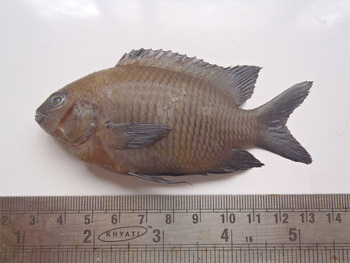
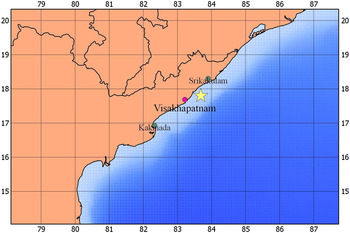
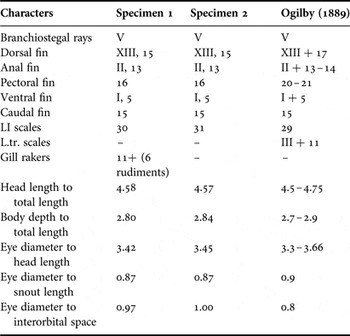
On 5 January 2013, two specimens (Figure 1) were collected from a gillnet operated at a depth of 50 to 60 m (17°48′04.63′′N 83°41′12.63′′E) about 22 km north of Visakhapatnam fishing harbour (Figure 3). The specimen was identified as Stegastes fasciolatus based on diagnostic characters described by Allen (Reference Allen, Smith and Heemstra1986). Measurements were taken with digital Vernier calliper to the nearest 0.1 mm and expressed as percentage of total length. Morphometric and meristic data of the recorded species were compared with type specimens (Table 2). The identified specimen was initially fixed in 10% formaldehyde and later preserved in 70% ethanol after thorough washing. The specimen was deposited in the National Marine Biodiversity Referral Museum at the Central Marine Fisheries Research Institute, Kochi (Accession No. GB.31.122.24.7).
Pacific Gregory, Stegastes fasciolatus (110.1 mm total length).

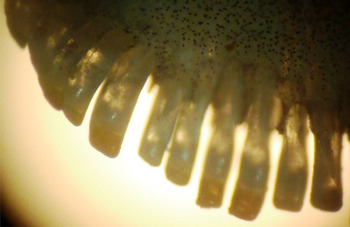
Teeth pattern in upper jaw (magnification 40 ×).

North-east coast of India: the yellow star shows the fishing location of Stegastes fasciolatus.

RESULTS AND DISCUSSION
SYSTEMATICS
Order PERCIFORMES, Bleeker, 1939
Family POMACENTRIDAE
Genus Stegastes Jenyns, 1840
Species Stegastes fasciolatus (Ogilby Reference Ogilby1889)
(Figure 1)
MATERIAL EXAMINED
Two specimens of Pacific Gregory (gill net, Visakhapatnam, 17°48′04.63′′N 83°41′12.63′′E; depth 50–60 m), coll. P.R. Behera, 5 January 2013.
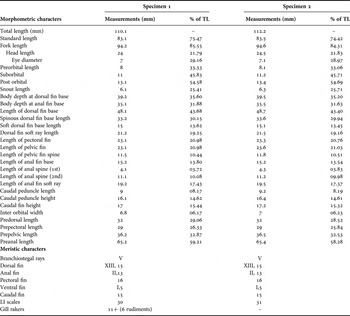
Fin formula: B V, D XII + 15, A II + 13, P 16, V I + 5, C 15, LI scales 30-31,GR 11 + 6 (rudiments).
Body is deep in shape and laterally compressed. Mouth small, jaws equal and oblique. Preopercle is serrated. Single opercular spine. Preorbital and snout scaleless and suborbital is scaly. Interorbital up to snout is scaly. Single opercular spine. Both jaws with uniserial teeth. Subopercular edge is smooth. The upper profile from tip of snout to the origin of dorsal fin is a regular and gentle curve. The maxilla extends almost to the anterior margin of the eye. The dorsal spines are of moderate length and strong. Both soft dorsal and anal fin rays are pointed in shape. The first ventral ray is produced into filament which reaches to the vent and is slightly less in length to the head and almost equal in length to the pectoral fin. Caudal fin is emarginate and obtusely rounded. Lateral line is incomplete. Body covered with large ctenoids scales. The inferior half of dorsal and anal fins is covered with scales which are much smaller than those on the body. Body is dark brown in colour on upper side and light brown in colour towards ventral sides. Black spot present between 2nd, 3rd and 4th spine of dorsal fin. All fins are black. The details of morphometric and meristic characters of species are given in Table 1.
Morphometric and meristic characters of the Pacific Gregory at Visakhapatnam.

TL, total length.
The species under genus Stegastes can be differentiated from all species of the closely related genus Pomacentrus based on uniserial pattern of teeth in jaw (Figure 2). The species can be differentiated from the congeners by having uniserial pattern of teeth in jaw, dorsal fin with 13 spines and presence of black spots between 2nd, 3rd and 4th spine. The morphometric and meristic characters of the specimens collected agree well with the description of the specimen examined by the previous authors with slight variations in characters (pectoral fin count, LI scales and eye diameter to inter orbital spaces) which may be due to different geographical locations (see Table 2).
Comparative morphomeristic characters of the Pacific Gregory at Visakhapatnam.

The occurrence of S. fasciolatus has earlier been reported from the Andaman Islands off the east coast of India (Allen & Emery, Reference Allen and Emery1985) and the Maldive Islands off the west coast of India (Randall & Anderson, Reference Randall and Anderson1993). There are also stray historical reports on the occurrence of this species from the Gulf of Mannar, south-eastern coast of India (Murthy, Reference Murthy1969), albeit without any morphometric and meristic details. Henceforth this is the first detailed description of the species from the east coast of India. The occurrence of this species along the waters of Visakhapatnam could indicate northward range extension of distribution of the Pacific Gregory from the Gulf of Mannar to Visakhapatnam. However, additional records are needed to confirm true range extension. Similar increase in the distribution ranges from the southern to the northern latitudes along the east and west coasts of India in the last couple of decades has been recorded for Indian oil sardine and Indian mackerel (Vivekanandan et al., Reference Vivekanandan, Rajagopalan, Pillai and Aggarwal2009). This broadening in their distribution could be attributed to the increasing water temperatures along the east coast of India, to the tune of 0.04°C in each decade (Vivekanandan et al., Reference Vivekanandan, Rajagopalan, Pillai and Aggarwal2009). Sea surface temperature has shown a progressive increase in the Bay of Bengal since the 1950s resulting in changes/shifts in fish communities of the area (Vivekanandan et al., Reference Vivekanandan, Rajagopalan, Pillai and Aggarwal2009). Because fish are poikilotherms, even a difference of 1°C in seawater may affect their distribution and life processes. At shorter time scales of a few years, increasing temperatures may have negative impacts on the physiology of fish because oxygen transport to tissues will be limited at higher temperatures resulting in changes in distributions, recruitment and abundance (Perry et al., Reference Perry, Low, Ellis and Reynolds2005; Nye et al., Reference Nye, Link, Hare and Overholtz2009; Brander, Reference Brander2010; Last et al., Reference Last, White, Gledhill, Hobday, Brown, Edgar and Pecl2011).
The record of this species off Visakhapatnam increases the list of pomacentrids from the north-east coast of India. This addition could be induced by climate variability, which is known to affect the spatial and temporal distribution, patterns of migration, diversity and abundance, reproduction and recruitment of economically important species (Murawski, Reference Murawski1993; Jacobson & Maccall, Reference Jacobson and Maccall1995; Finney et al., Reference Finney, Gregory-Eaves, Sweetman, Dougas and Smol2000). However, it is feasible that the species could be resident of Indian waters, but because of its non-commercial nature, its existence was ignored.
ACKNOWLEDGEMENTS
The authors are grateful to the Director of Central Marine Fisheries Research Institute, Kochi for his encouragement and support. They also thank Dr John Ernest Randall, Senior Ichthyologist, Bishop Museum, Hawaii for help with the identification of species.