The straw itch mite, Pyemotes tritici Lagrèze-Fossat and Montané (Acari: Pyemotidae), a common ectoparasitoid of Coleoptera, Lepidoptera, and Hymenoptera, was found parasitising the goldspotted oak borer, Agrilus auroguttatus Schaeffer (Coleoptera: Buprestidae), in southern California and southeastern Arizona, United States of America and a congener, the Mexican goldspotted oak borer, Agrilus coxalis Waterhouse, in southern Mexico. Agrilus auroguttatus and A. coxalis were described in 1905 and 1889, respectively (Waterhouse Reference Waterhouse1889; Schaeffer Reference Schaeffer1905); synonymised by Hespenheide (Reference Hespenheide1979); but then restored to species status by Hespenheide et al. (Reference Hespenheide, Westcott and Bellamy2011). Analyses of mitochrondrial DNA from populations in Arizona, California, and Mexico supported the species status of A. auroguttatus and A. coxalis (Coleman et al. Reference Coleman, Lopez, Rugman–Jones, Stouthamer, Seybold and Reardon2012b). Agrilus auroguttatus is a flatheaded phloem and wood borer that has been linked to continuing southern California oak (Quercus Linnaeus (Fagaceae)) mortality (Coleman and Seybold Reference Coleman and Seybold2008). The beetle was hypothesised to have been introduced to California from southeastern Arizona on infested firewood (Coleman and Seybold Reference Coleman and Seybold2011; Coleman et al. Reference Coleman, Lopez, Rugman–Jones, Stouthamer, Seybold and Reardon2012b). The movement of infested firewood within California has also likely led to satellite infestations elsewhere in San Diego County as well as in Riverside County (Idyllwild) (Coleman et al. Reference Coleman, Graves, Hoddle, Heath, Flint and Chen2012a; Jones et al. Reference Jones, Coleman, Graves, Flint and Seybold2013).
Agrilus auroguttatus aggressively attacks large diameter red oak trees (>45.7 cm diameter at breast height, Section Lobatae) and has caused elevated levels of oak mortality in southern California for more than a decade (Coleman et al. Reference Coleman, Graves, Hoddle, Heath, Flint and Chen2012a). Since 2002, ~25 000 dead coast live oaks, Quercus agrifolia Née (Fagaceae), and California black oaks, Quercus kelloggii Newberry (Fagaceae), were attributed to A. auroguttatus-caused injury during aerial surveys in eastern San Diego County (United States Department of Agriculture Forest Health Monitoring 2013). Classical biological control was proposed as a potential long-term management option for this new invasive species in California (Coleman et al. Reference Coleman, Lopez, Rugman–Jones, Stouthamer, Seybold and Reardon2012b). To determine candidates for a biological control programme, surveys for natural enemies of A. auroguttatus and A. coxalis were conducted in southeastern Arizona and southern Mexico, as well as in the habitat invaded by A. auroguttatus in southern California.
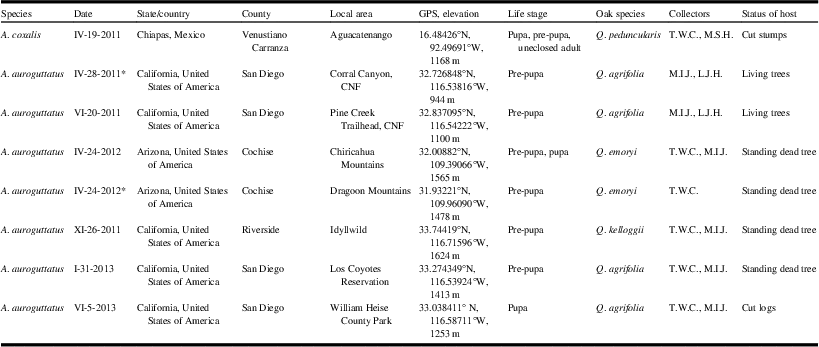
On 19 April 2011, we discovered P. tritici parasitising A. coxalis pre-pupae (mature larvae in a hair-pin configuration, Flint et al. Reference Flint, Jones, Coleman and Seybold2013) while we destructively sampled the bark of Quercus peduncularis Née (Fagaceae) in Chiapas, Mexico (Table 1). The distended opisthosoma of the females (Fig. 1A) were observed on A. coxalis pre-pupae, pupae, and uneclosed adults. All samples of P. tritici were collected on A. coxalis infesting the phloem of eight Q. peduncularis stumps (Fig. 1B). Mites were collected from 23 (10 pre-pupae, eight pupae, and five adults) of 208 A. coxalis samples, representing an infestation rate of 11% (Coleman and Hoddle Reference Coleman and Hoddle2011). Similarly, a 15% parasitism rate for Calosota elongata Gibson (Hymenoptera: Eupelmidae) was observed on A. auroguttatus in southeastern Arizona (Coleman and Seybold Reference Coleman and Seybold2011; Coleman et al. Reference Coleman, Lopez, Rugman–Jones, Stouthamer, Seybold and Reardon2012b). Calosota elongata is a larval ectoparasitoid that has been associated with A. auroguttatus in southeastern Arizona (Gibson Reference Gibson2010; Coleman and Seybold Reference Coleman and Seybold2011) and southern California (Haavik et al. Reference Haavik, Coleman, Chen, Jones, Venette and Flint2012), but not with A. coxalis. Besides P. tritici, no additional ectoparasitoids or predators were found associated with A. coxalis in Chiapas and Oaxaca, Mexico. Subsequently, P. tritici has been widely collected parasitising A. auroguttatus in Arizona and California (Table 1).
The distended opisthosoma of the female straw itch mite, Pyemotes tritici, are easily observed on a pre-pupa (mature larva) of the goldspotted oak borer, Agrilus auroguttatus, collected from Quercus agrifolia in San Diego County, California, United States of America (A). Pyemotes tritici parasitised two Mexican goldspotted oak borer, Agrilus coxalis, pre-pupae in the outer phloem of Quercus peduncularis from Chiapas, Mexico (B) (T.W.C., photographs).

Collections of the straw itch mite, Pyemotes tritici, were discovered parasitising the Mexican goldspotted oak borer, Agrilus coxalis, in southern Mexico and the goldspotted oak borer, Agrilus auroguttatus, in Arizona and California, United States of America in bark samples of oak, Quercus species.
* Voucher specimens were deposited at the Bohart Museum of Entomology, University of California, Davis, California, United States of America.
CNF, Cleveland National Forest.
Although, P. tritici has been found throughout much of the A. auroguttatus-infested area (including satellite infestations) in California, it was likely already present at these sites before the arrival of A. auroguttatus because is not phoretic and has a cosmopolitan distribution (Moser Reference Moser1975). The discovery of infestations of P. tritici was facilitated in the field by the highly obvious gravid females (Fig. 1A). Estimates of parasitism rates were not determined for the Arizona and California A. auroguttatus collections because of inadequate sample sizes (< 20) from individual trees and the low number of infested trees found at some sites. A limited number of P. tritici males were collected with each sample and used to identify the species (identified by J.C.M.).
Pyemotes tritici has been evaluated as a biological control agent for the red imported fire ant, Solenopsis invicta Buren (Hymenoptera: Formicidae), bark beetles (Coleoptera: Scolytidae, sensu Bright Reference Bright2014), and stored-products insects (Bruce and LeCato Reference Bruce and LeCato1980; Li et al. Reference Li, Bao, Chun and Qing2009). Some advantageous features for biological control include its short developmental cycle (five to seven days); females represent 95% of the population, have a high reproductive potential (~250 adult offspring/gravid female), and ovoviviparity gives rise to adult progeny; no intermediate hosts are required; and populations can be reared easily in the laboratory (Bruce and LeCato Reference Bruce and LeCato1980; Li et al. Reference Li, Bao, Chun and Qing2009). To our knowledge, mites have not figured prominently in the development of the biological control programme for the emerald ash borer, Agrilus planipennis Fairmaire (Coleoptera: Buprestidae). However, P. tritici was found infesting A. lecontei Saunders in Georgia, United States of America (Cross and Moser Reference Cross and Moser1975), whereas Wang et al. (Reference Wang, Yang, Gould, Zhang, Liu and Liu2010) found a Pyemotes Amerling species parasitising A. planipennis in China, but these latter mites were not identified to species.
We hypothesise that P. tritici feeds opportunistically on A. auroguttatus and A. coxalis. Because the mite is a generalist parasitoid; causes low-levels of parasitism; and can cause deleterious health effects to humans (e.g., dermatitis) (Moser Reference Moser1975; Walker and Landis Reference Walker and Landis1994), it is not likely that P. tritici will be a successful candidate for an augmentative biological control programme for A. auroguttatus in California. However, entire laboratory colonies of A. auroguttatus pre-pupae have been lost to infestations of P. tritici during our research in California and in other quarantine facilities in the United States of America because the nascent populations are easily overlooked in the absence of the distended females. The parasitic mite may contribute to mortality of A. auroguttatus in southern California along with C. elongata, generalist insect predators (e.g., Temnochila Westwood (Coleoptera: Trogossitidae) species, other parasitoids (Coleman and Seybold Reference Coleman and Seybold2011; Haavik et al. Reference Haavik, Coleman, Chen, Jones, Venette and Flint2012; Lopez and Hoddle Reference Lopez and Hoddle2013)), and the acorn woodpecker, Melanerpes formicivorus (Swainson) (Aves: Picidae) (Coleman et al. Reference Coleman, Grulke, Daly, Godinez, Schilling and Riggan2011). However, the levels of mortality from these biotic agents vary greatly among sites and do not appear to be adequately regulating populations of the invasive beetle (Coleman et al. Reference Coleman, Lopez, Rugman–Jones, Stouthamer, Seybold and Reardon2012b).
Acknowledgements
The authors would like to thank United States Department of Agriculture (USDA) Forest Service, Forest Health Protection, Region 5; USDA Forest Service Pacific Southwest Research Station Invasive Species Program and Southern Research Station; USDA Forest Service, Forest Health Protection-International Activities Team; and the University of California, Riverside and Davis for funding this work.