At first sight, there is a seductive attraction to preferential voting as opposed to categorical party or candidate choice in divided societies. For many observers, the pursuit of the ‘middle ground’, promotion of ‘moderation’ and advocacy of ‘compromise’ are values to which priority should be given. If this is the case, electoral systems should at best promote support for parties of the centre, and at worst they should at least not hinder such support. This has implications for the choice of electoral system. It has been strongly argued that systems based on categorical choice (such as the party list system or the plurality system) tend to encourage voters in divided societies to opt unambiguously for parties standing for the values of their ethnic groups. By contrast, preferential voting systems (such as the single transferable vote and the alternative vote) have been seen as permitting the expression of lower preference support outside ethnic communities, whether for parties of the centre or for parties associated with other communities, potentially encouraging alliances that might underpin formation of centrist governments. This approach has been recommended, with varying degrees of success, for South Africa, Bosnia, Fiji, Northern Ireland and Iraq.
Empirical testing of the assumptions that underlie this approach to electoral mechanics has been frustrated by difficulties that commonly confront the researcher: limited data and absence of a robust methodology. The richest data on preferential voting come from countries where ethnic divisions are not the primary influence on party cleavages: the Republic of Ireland, Malta and Australia. By contrast, even if they do use preferential voting, countries where electoral allegiances follow communal boundaries tend to enjoy less constitutional continuity and to be prone to frequent changes in electoral arrangements.
We also need to consider methodological challenges in establishing causal links between the electoral system and voting patterns. Parties and candidates appealing across ethnic lines can be found in many democratic states, representing virtually all electoral systems, without the causal link to institutional design necessarily being decisive. In India and Indonesia, for example, centripetal pressures in party systems have been driven by factors quite unrelated to the choice of electoral system (Chandra Reference Chandra2005; Mietzner Reference Mietzner2008). Conversely, it is often easy to exclude as legitimate test cases those where electoral outcomes are strongly polarized, for example because centripetal mechanisms are combined with consociational institutions in hybrid arrangements, or because minorities boycott elections, or because preferential voting is used at only one or two elections and a longer time-span is deemed necessary before firm conclusions can be drawn. Unfortunately, given the small number of relevant cases, such reasoning can be used to exclude all potentially applicable country cases.
Although there exist many country-specific investigations of the working of preferential electoral systems, little research has been undertaken at the broader comparative level. One important exception is Benjamin Reilly’s study of electoral engineering in divided societies, which reported ‘clear evidence for centripetal outcomes … apparently in response to the incentives presented by the electoral system’ in Papua New Guinea (1964–72), Fiji (1999) and Northern Ireland (1998) (Reilly Reference Reilly2001: 169). In these three cases, assessment of the preferential voting system merits some reconsideration in the light of developments since the turn of the century. In this article, we also examine the scantier evidence from four other cases (Sri Lanka, Southern Rhodesia, Estonia and Bosnia-Herzegovina), to offer a comprehensive assessment of the working of preferential voting systems in diverse societies.Footnote 1
THE WORLD OF PREFERENTIAL VOTING
Before analysing the real-world cases, we need to examine three issues: the evolution of electoral systems, their mechanics and the debate that surrounds their potential as conflict-mediating devices.
The Development of Preferential Voting
We may envisage preferential voting as a response to some of the more obvious weaknesses of traditional categorical voting systems, under which ‘victors’ often fail to win a majority of votes. The first response, already widely in evidence in continental Europe in the nineteenth century, is the two-ballot system. This is designed to ensure that a winning candidate has an overall majority, and not merely a plurality, of votes cast in a single-member district. Two elections are held if necessary – an initial one to establish voters’ primary preferences, and a run-off ballot some time later in constituencies where no candidate has won an overall majority (50 per cent or more of valid votes). The run-off is normally between the two candidates who head the poll in the first round. Where more candidates are allowed, a plurality may be sufficient for election in the second round. This system survives in French parliamentary elections, and is widely used for presidential elections around the world.
Rather than bringing the voters back to the polling station on a second occasion, information can be collected as to how voters would cast a second ballot at the same time as they express their initial voting choice. In the supplementary or contingent vote system, any candidate who wins a majority of first votes is elected. If no candidate achieves a majority, all except the top two are eliminated, and lower preferences are used to redistribute ballots to the two front-runners to determine the victor. This system is used for election of the mayor of London and the president of Sri Lanka.
In more sophisticated preferential voting systems, voters are permitted to rank all candidates. Here, several different counting systems are possible. In the Condorcet system, the winning candidate is the one who would be capable of defeating each of the other candidates in a two-way contest, entailing an elaborate sequence of run-offs (a complication which explains why there is no contemporary example in a national-level political election). Alternatively, under the Borda system, points are attached to voter rankings of candidates, and the one with the highest score wins, a system used for two seats reserved for the Hungarian and Italian minorities in the Slovenian parliament (a modified version is used by the tiny Micronesian state of Nauru – see Fraenkel and Grofman Reference Fraenkel and Grofman2014). A simpler and more widely used ranking system is the alternative vote (AV or ‘instant run-off’) system. If no candidate wins a majority of first preference votes, candidates are eliminated in inverse order and their lower preferences are redistributed among continuing candidates until one candidate reaches a majority. This system is used in elections to the Australian House of Representatives, for the president of Ireland, and (since 2002) for legislative elections in Papua New Guinea. At the subfederal level, it is used for lower house elections in New South Wales, Queensland, South Australia, Victoria and Western Australia.Footnote 2
The electoral systems so far discussed are not designed to achieve proportionality between party vote and seat shares. A straightforward adjustment converts the AV system into one that can attain a relatively high degree of proportionality. This is achieved by enlarging constituency size from single- to multi-member status, redefining the manner in which the quota for election is computed, and amending the rules for counting votes to take account of not just elimination of candidates but also distribution of the surplus votes arising when elected candidates exceed the quota. This is the single transferable vote (STV) system. The Droop quota, the number of valid votes divided by one more than the number of vacancies (truncated, and with the addition of one), defines the minimum number of votes necessary to secure election. Where no candidate reaches the quota at the first count, the lowest polling candidate is eliminated, and his or her votes are transferred in accordance with the next preferences marked on the ballot papers. Candidates who reach the quota are deemed elected, and any surplus votes over and above the quota are redistributed to other candidates in accordance with voter preferences. This process of recycling surpluses and eliminating lowest polling candidates is continued until all vacancies have been filled or until a further elimination or surplus distribution could not change the final result.
In important respects, STV is the ‘British’ form of proportional representation, attractive to conservative theorists because it does not require (though it does permit) the formal recognition of political parties. It has been applied mainly in countries that have been under British influence, beginning with the colony of Tasmania at the end of the nineteenth century (for a summary, see Endersby and Towle Reference Endersby and Towle2014: 145). At the level of the ‘first’ or ‘lower’ house of parliament of a sovereign state, the only two continuous examples of its use are the Republics of Ireland and Malta. Among second chambers, we may add the Australian Senate. Other examples exist mainly at subnational level – including the state legislature of Tasmania and the Australian Capital Territory; localities within the US; elections at most levels in Northern Ireland; and local elections in Scotland and New Zealand. STV was used in a short-lived experiment for elections to the Supreme Soviet of Estonia in 1990, but then abandoned. The STV system is also used in indirect elections – to the Irish Senate, for example, and to the Indian second chamber, the Council of States (Rajya Sabha).
When we restrict the universe of cases to those that have used preferential voting (whether AV or STV) and which are also deeply ethnically divided or highly ethnically diverse, we get a much smaller number of cases: for parliamentary elections, Northern Ireland and Estonia (STV), and Fiji, Southern Rhodesia and Papua New Guinea (AV); and for presidential elections, Sri Lanka and the (Bosnian) Republika Srpska (2000). We return to a discussion of these cases below.
The Mechanics of Preferential Voting
Several features of ballot design have a considerable impact on voter behaviour in preferential voting systems, but three have particular importance for what may be called the ‘manipulative propensity’ of such systems. The first is the number of members to be elected from a constituency. As Giovanni Sartori (Reference Sartori1968: 278–9) pointed out, ‘from a manipulative point of view, electoral systems can be divided into strong and weak systems’. He found the ‘general rule’ to be that ‘the progression from maximal manipulative impact to sheer ineffectiveness follows, more than anything else, the size of the constituency’ (Sartori Reference Sartori1968: 278–9).
With preferential voting systems, we can add two other influences. Second, the ranking of candidates can be either optional or compulsory, and, where it is compulsory, the degree of compulsion can vary. While Papua New Guinea, Fiji and the Australian Senate have compulsory ranking systems, countries using preferential voting in the northern hemisphere – including the Republic of Ireland, Northern Ireland and Malta – all have optional ranking systems. If they choose to do so, voters can ‘plump’ only for a single candidate or allocate preferences only to candidates from a single party. Some advocates of preferential voting have favoured use of a compulsory ranking system because it can be used to require voters from one group to pass lower preferences to candidates or parties identified with the other group (Horowitz Reference Horowitz1991: 190).
Third, use of a ‘ticket’ voting system in preferential voting systems, whether under AV or STV, potentially grants political parties considerable control over preference transfers. In elections to the Australian Senate, in Fiji (1999–2006) and in New South Wales, Victoria, Western Australia and South Australia, a ‘split format’ ballot paper is used, with a line separating two alternatives for voters.Footnote 3 One part (usually the top part) refers to a preference order predetermined by parties; the other (below this) offers full choice to voters. Voters completing the ballot ‘above-the-line’ simply tick next to a party name. Such ballots, if transferred, are routed in accordance with party-specified preference lists submitted for each constituency shortly before the election. Those completing the ballot paper ‘below-the-line’ order candidates numerically. This has a major impact on the operation of preferential voting systems and gives party officials a degree of power over ballot reallocations that would otherwise be absent or reduced to the level of persuasion.Footnote 4 Some advocates of preferential voting have blamed the use of ticket voting for difficulties experienced after the 1999 elections in Fiji (Reilly Reference Reilly2001: 109–10). Certainly, ticket voting made it more likely that strategic considerations would influence the pattern of ballot transfers.
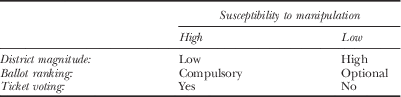
Table 1 shows the cumulative impact of these mechanisms, running from those most open to manipulation (single-member districts, ticket voting permitted, mandatory ranking) to those least open (multi-member districts, no ticket voting, optional ranking). Electoral systems with a higher susceptibility to manipulation potentially allow outcomes that diverge from votes–seats proportionality; in so doing they may encourage ‘moderates’ but they may simply assist larger or geographically concentrated parties.
Trade-offs in Susceptibility to Manipulation of Preferential Voting Systems

The Debate on Preferential Voting in Divided Societies
Among mid-twentieth-century theorists of electoral system design, STV was commonly advocated as particularly appropriate for securing minority representation in divided societies (Mackenzie Reference Mackenzie1954: 660; Mansergh Reference Mansergh1936: 126, 143–4; Lakeman Reference Lakeman1955: 128–31; Laponce Reference Laponce1957: 328). When a new wave of Western involvement in state-building and constitutional law arose in the 1990s and 2000s, focusing on Bosnia and Iraq, STV once again found strong supporters. In addition to securing minority representation, STV is widely believed to strengthen the position of the political centre, and thus to contribute to a more ‘centripetal’ or ‘accommodationist’ form of politics in divided societies (Reilly Reference Reilly2001: 146–8; Reilly and Reynolds Reference Reilly and Reynolds2000: 36; Reynolds et al. Reference Reynolds, Reilly and Ellis2006: 76).
Other theorists of constitutional design in divided societies have instead advocated AV rather than STV due to the higher threshold involved. Drawing on the Southern Rhodesian experience, Palley (Reference Palley1978: 16–17) concluded that the AV system had assisted a ‘moderate’ white settler party in its competition with a more conservative party. Claims that AV would give an advantage to the more moderate of two competing parties within the same ethnic group were more forcefully endorsed by Donald Horowitz. He argued that STV in Northern Ireland in the 1970s had used too low a quota to promote meaningful cross-ethnic vote-pooling (Horowitz Reference Horowitz1991: 174; Reference Horowitz2001: 93; 2002b: 213–14). By contrast, AV’s quota of 50 per cent, he suggested, would provide ‘a stronger dose of incentives for pooling votes’ (Horowitz Reference Horowitz1991: 188–95; 173–4; Reference Horowitz2001, 2002a). This argument has encouraged some support for AV in Northern Ireland (Wilford Reference Wilford2010) and in Bosnia and Iraq (Belloni Reference Belloni2007; ICG 1998; Salamey and Pearson Reference Salamey and Pearson2005; Wimmer 2003–Reference Wimmer4).
While there has been some disagreement over the relative merits of the STV and party list forms of proportional representation, it is the AV system that has aroused the most sustained controversy as a conflict-moderating device. Lijphart (Reference Lijphart1991) concluded that this system was ‘not a realistic alternative’ for South Africa and other divided societies, a view echoed by McGarry and O’Leary (Reference McGarry and O’Leary2006, Reference McGarry and O’Leary2009) as regards Northern Ireland. The most intense debate centred around the case of Fiji, where AV was introduced in 1997 with a view to moderating conflict between the indigenous Fijian and Indian populations. Horowitz, who had himself been influential in urging the adoption of this system, defended its capacity to secure cross-ethnic electoral compromise as illustrated by the outcome of the general election of 1999 (Horowitz Reference Horowitz2002a, Reference Horowitz2004, Reference Horowitz2006). This was, however, strongly disputed by other specialists in the area, who on theoretical grounds queried the capacity of AV to deliver ethnic peace and used the 1999 and 2001 election results to offer empirical support for their argument (Fraenkel Reference Fraenkel2001; Fraenkel and Grofman Reference Fraenkel and Grofman2004, Reference Fraenkel and Grofman2006a, Reference Fraenkel and Grofman2006b, Reference Fraenkel and Grofman2007). In these debates, a central issue was whether – if the radical parties were sufficiently large – AV might generate a centrifugal anti-moderation impetus rather than a centripetal pro-centrist influence.
For those sympathetic to the consociational approach (which seeks not to build up the political centre, but to recognize division and create overarching institutional structures to manage it), the list system of proportional representation has often been advocated, not only because it secures equitable representation of groups (particularly minorities) but also on the grounds that it reinforces the autonomy of political elites, thus freeing the party leadership to engage in power-sharing deals. STV, by contrast, ‘maximises the voter’s choice and consequently diminishes the power and flexibility of segmental leaders’ (Lijphart Reference Lijphart1977: 137). Other supporters of consociation have been more sympathetic to STV, advocating it as a moderating device while vigorously rejecting the centripetalist position (McGarry and O’Leary Reference McGarry and O’Leary2006, Reference McGarry and O’Leary2009).
The widely used plurality system has few supporters among specialists in electoral design for divided societies. Its advocates are usually driven by hostility to the alleged complexity and propensity for coalition government associated with proportional representation (Barkan Reference Barkan1995; Lardeyret Reference Lardeyret1991). Some believe that the plurality system encourages a two-party polarization around efforts to secure the support of the median voter and therefore discourages support for extremist parties. In the Northern Ireland context, AV has likewise been advocated because it will generate ‘multi-ethnic government without sacrificing the principle of majority rule’ (see Horowitz Reference Horowitz2002b: 194). Arend Lijphart, however, has argued that AV is no better than the plurality system in encouraging compromise: under the latter small parties stand aside to avoid splitting the vote, whereas under AV they transfer lower preferences to the larger parties (see Lijphart Reference Lijphart1991: 94).
PREFERENTIAL VOTING IN ETHNICALLY DIVIDED SOCIETIES
The literature on electoral systems has for long recognized that the consequences of majoritarian and proportional systems in relatively homogeneous democracies are different from those in deeply divided societies. The early debates about the respective merits of AV and STV between Lijphart (Reference Lijphart1985, Reference Lijphart1991) and Horowitz (Reference Horowitz1991) focused on issues of minority exclusion in South Africa (Reynolds Reference Reynolds1995) and Sri Lanka (Horowitz Reference Horowitz1989). Subsequent debates have been about more evenly balanced bi-communal settings, such as Northern Ireland and Fiji, and about highly ethno-linguistically diverse settings, such as Papua New Guinea.
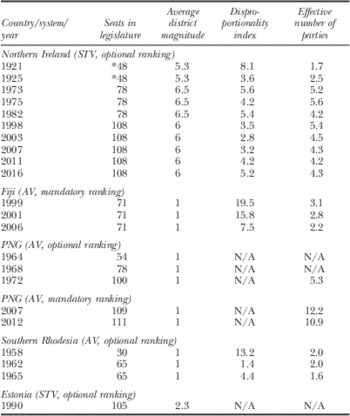
Table 2 shows the range of divided polities that have used STV or AV for legislative elections at the national level (excluding coverage of presidential elections in Sri Lanka and Republika Srpska, for which seats and district magnitude would each be 1). Northern Ireland offers by far the largest sample, with 870 seats contested over 10 elections. Fiji’s 1999 and 2001 elections indicate the potential for AV to deliver highly disproportionate results where the effective number of parties is close to three. When there were only two large parties (Fiji in 2006, Southern Rhodesia in 1958–65), disproportionality under AV tended to be lower. Papua New Guinea’s 1964 and 1968 elections were contested without parties, and even thereafter a fluid party system survived, with many independents contesting elections, so that no meaningful vote–seat shares figure can be calculated. Similarly, the Estonian 2000 election was ‘extremely fluid’ with many ‘multiply endorsed candidates’ (Taagepera Reference Taagepera1990: 307–8). Let us commence our analysis with Northern Ireland.
Legislative Elections in Ethnically Divided Societies under Preferential Voting Systems

Sources: Computed from Elliott (Reference Elliott1973), ARK (2016), Fiji Elections Office (1999, 2001, 2006), Territory of Papua and New Guinea (1964, 1968), Papua New Guinea Electoral Office (1973), May (Reference May2006: 85), Stone (Reference Stone1976: 536), unpublished electoral data for PNG for 2007 and 2012, Taagepera (Reference Taagepera1990: 304), Passmore & Mitchell (Reference Passmore and Mitchell1963), Rhodesia Herald (10 May 1965).
Notes: *Not including university seats.
AV=alternative vote, STV=single transferable vote, N/A=not applicable.
For disproportionality calculation, vote tallies relate to contested constituencies only; uncontested seats are included in seat tallies. Indices are sensitive to the method of grouping of small parties and independents as ‘others’ (particularly as regards rival wings of the Unionist Party in the early 1970s); the data here should be seen as indicating order of magnitude only.
Northern Ireland
Northern Ireland (with a 2011 population of 1.8 million) became a self-governing part of the United Kingdom following the partition of Ireland in 1921. Like Fiji, it was marked by a bipolar form of politics, with a Protestant population of mainly Scottish and English origin (65 per cent of the population, dropping to 48 per cent by 2011) exercising political dominance over a Catholic population of mainly Gaelic Irish origin (35 per cent of the population, rising to 45 per cent by 2011).
Northern Ireland has used STV in three separate phases. In 1921, it was adopted for the Northern Ireland House of Commons, but in 1929 the Northern Ireland government reintroduced the plurality system. This had the effect of consolidating support around the two main parties, the Unionist Party representing the Protestant population and the Nationalist Party representing Catholics. Devolved institutions collapsed in 1972 following three years of civil unrest, and were replaced by direct rule from London. British government efforts to restore devolution were accompanied by the election of assemblies and a constitutional convention by STV at the height of the civil unrest in 1973, 1975 and 1982. The third phase followed the Good Friday Agreement of 1998, which provided for a new assembly elected by STV, with a requirement that elected members self-designate as ‘nationalist’ or ‘unionist’ (though they could opt out, as ‘other’), a consociational device designed to facilitate group vetoes by the two ethnic blocs, and to ensure that the first minister and deputy first minister would come from different blocs. The government was to be selected in exact proportion to party strength in the Assembly, using the d’Hondt formula. Elections to the new Assembly took place in 1998, 2003, 2007, 2011 and 2016, but stable governments date only from 2007, following further refinement of the agreement.
In the 1920s elections were highly polarized, with memories of armed conflict and the dispute over the partition of Ireland in 1921 still determining voting patterns. The centre, represented at that time by the Northern Ireland Labour Party, attracted both first preference votes and some transferred votes from both communities, but there were almost no cross-community transfers. A similar pattern was witnessed in 1973–82. By now, the Nationalist Party had been replaced by the Social Democratic and Labour Party (SDLP), and a divided Ulster Unionist Party was threatened by the more militant Democratic Unionist Party. Analysis of the 1973 election suggested that contests tended to be within communal groups, with negligible inter-ethnic exchanges of lower preferences (Lawrence et al. Reference Lawrence, Elliott and Laver1975: 72–9). Similar verdicts were reached as regards the 1975 elections (McAllister Reference McAllister1975: 17–20). This pattern was repeated in the election of 1982, with few transfers from the nationalist bloc to any unionist party, even fewer from the unionist bloc to any nationalist party, and the party of the centre, the cross-confessional Alliance Party, failing to make much headway (Elliott and Wilford Reference Elliott and Wilford1983: 56).Footnote 5
STV may have induced some moderation in party strategy, even if it did not favour the parties of the centre. In 1982, Sinn Féin, a new militant nationalist party with links to the IRA, appeared. Isolated from the other parties, Sinn Féin’s inability to capture lower preference votes in the early 1980s, particularly in local elections, has been seen as encouraging the party to moderate its stance, and to embrace the peace process (McGarry and O’Leary Reference McGarry and O’Leary2006: 269). However, no such influences were evident at this time in respect of the Democratic Unionist Party, which opposed the 1998 agreement until minor amendments were adopted in 2006.
The five elections since the Good Friday Agreement of 1998 have been critical to the debates about the ethnic implications of STV. In the initial election in 1998, some observers suggested that ‘STV did appear to play a modest but important vote-pooling role, allowing pro-agreement votes to transfer across party and group lines to the advantage of non-sectarian middle parties’ (Reilly Reference Reilly2001: 132; see also Evans and O’Leary Reference Evans and O’Leary2000: 79). Mitchell (Reference Mitchell2014: 252–5) finds, on the basis of analysis of ‘terminal’ transfer patterns (votes transferred when no other candidate of the party whose votes are being passed on is available) that in 1998 there was increased cross-bloc vote pooling. This relies on a comparison with the 1982 election, one of several polarized elections at the height of the unrest, but it is also subject to a health warning: terminal transfers include ballots whose true ‘source’ may be impossible to discern from the published data, leading to ‘contamination’ or ‘pollution’ of the transfer data (see Gallagher Reference Gallagher1978: 2). In any case, the 1998 pattern was not sustained at elections for 2003, 2007, 2011 and 2016, which offer little evidence of cross-bloc vote pooling.
The overall bias in Northern Ireland’s STV system can be more straightforwardly investigated, avoiding the thorny methodological questions of measuring terminal transfers, by examining overall variations in vote–seat shares. The Ulster Unionist Party’s 1998 seat–vote advantage was largely at the expense of the centrist parties rather than the more radical Democratic Unionists (who also tended to obtain a seat share bonus). Neither of Northern Ireland’s nationalist parties had a similar seat–vote share advantage. Overall, the SDLP gained far more lower preferences from radical nationalists than it transferred to them over the period 1973–2011, though the position in the unionist camp was more mixed. Since the 1998 agreement, the more radical parties – the militant nationalist Sinn Féin and the Democratic Unionist Party – were able to increase their first preference vote shares, and allocation of seats in the Assembly. Growing support for the more radical parties may also be explained by the new rules regarding executive formation, which encouraged voters to back so-called ‘tribune parties’: Sinn Féin and the Democratic Unionists appealed to nationalist and unionist voters for homogeneous support to avoid the first minister’s position falling to the other group (Mitchell et al. Reference Mitchell, Evans and O’Leary2009).
Fiji
The Pacific island state of Fiji, with a 2007 population of around 837,000, has long had political parties organized around the cleavage between indigenous Fijians (around 57 per cent in 2007) and Fiji Indians (around 37 per cent). After independence in 1970, election outcomes under single-member plurality often exacerbated polarization. A military coup in May 1987 ousted a largely Indian-backed government, leaving the Fiji Indian community deeply alienated from the state. Yet, in 1997, a new constitution was agreed by the leader of the 1987 coup turned reformist prime minister, Sitiveni Rabuka, and the major Fiji Indian opposition leader, Jai Ram Reddy. Fiji replaced the plurality system by AV, to be used both in 46 communal constituencies (23 reserved for ethnic Fijians, 19 for Fiji Indians and four for others) and in 25 ‘open’ constituencies, where all of Fiji’s citizens voted together. Ranking was compulsory. There was also a ticket voting option, enabling voters simply to tick the ballot paper in favour of a single party and so endorse that party’s preferences. The post-election process of government formation was to be constrained by use of a power-sharing formula, requiring all parties with 10 per cent of seats to be invited into cabinet.
Fiji’s first AV election was held in 1999 and was characterized by the emergence of two broad multi-ethnic coalitions, each of which relied upon interparty exchange of preference votes. The government that came into office after the 1999 election was led by Fiji’s first-ever prime minister of Indian descent, Mahendra Chaudhry, and drew its support largely from Fiji Indian voters. Chaudhry’s ‘People’s Coalition’ also included three small largely ethnic Fijian-backed parties, each of which took ministerial portfolios. With 52 seats out of 71 in the new parliament, the People’s Coalition seemed to have laid to rest the bitter polarization of the post-1987 coup years.
Closer analysis, however, suggested a different verdict. First, the parties defeated in 1999 included those of the two leading architects of the new constitution and voting system, Rabuka’s Soqosoqo ni Vakavulewa ni Taukei (SVT) and Reddy’s National Federation Party. This had been the intended ‘government of the moderate middle’; Chaudhry’s platform had been to criticize the new constitutional arrangements as unfair to Indian voters and as a distraction from more pressing ‘bread and butter’ issues. The Labour Party had a multi-ethnic leadership and ideology, but its support base had become predominantly Fiji Indian. At the 1999 election, the Labour Party obtained only 1.9 per cent of the first preference ethnic Fijian vote. Its 37-seat majority in the 71-member house arose due to strategic use of the new AV system, drawing on advice from officials from the Australian Labor Party. Three small Fijian parties made tactical arrangements to try to oust Rabuka’s governing SVT party. Due to the ticket-based ‘above-the-line’ voting system, which around 92–95 per cent of voters used, party officials had acquired control of critical preference transfers and delivered 14 marginal seats to the Labour Party. With its absolute majority, the Labour Party was not vulnerable to a ‘no confidence’ vote from these Fijian allies. All three allied parties took ministerial portfolios, but all had split within months, with rank-and-file dissidents challenging party leaders who clung to office.
Exactly a year after the election, the Labour-led government was ousted in a coup by ethnic Fijian extremists. The coup instigators were eventually defeated and arrested by the Fiji military forces, but the Chaudhry government was not reinstated. Instead, fresh elections in August 2001 reversed the 1999 result. A new predominantly ethnic Fijian-backed party, the Soqosoqo Duavata ni Lewenivanua (SDL), emerged with the largest number of seats, drawing on preferences from a grouping of centrist parties called the ‘moderates forum’. The SDL won 32 seats in the 71-member parliament, 14 dependent on party official-controlled preference transfers, and entered a coalition with a small hard-line ethnic Fijian party (the Conservative Alliance–Matanitu Vanua). In 2001, AV helped to obliterate the centrist parties and assisted consolidation of a Fijian ethno-nationalist coalition.
The new predominantly indigenous Fijian government survived a full but troubled five-year term, characterized by confrontations not only with the main Fiji Indian party, Chaudhry’s Labour Party, but also with military commander Frank Bainimarama, who was angered by the inclusion in cabinet of supporters of the 2000 coup. Fresh elections in May Reference May2006 took place in a yet more polarized atmosphere. The major Fijian party, the SDL, obtained 80 per cent of the indigenous vote, while the main Fiji Indian party, the Labour Party, secured 81 per cent of the Indian vote. Lower preferences decided outcomes in only nine cases. At 7.5 per cent, disproportionality was less than in 1999 or 2001 (see Table 2), but this was largely because the vote share of the small moderate parties had collapsed. As in 2001, the major Fijian party, the SDL, emerged victorious with 36 seats to the Labour Party’s 31. This outcome was unacceptable to military commander Frank Bainimarama, who seized power in yet another coup in December 2006 and eventually abrogated the constitution. A key element in Bainimarama’s case for the coup was hostility to Fiji’s electoral system, in part because of its use of communal seats but also because of the AV system. A new constitution in 2013 replaced AV by open list proportional representation, and this system was used in 2014 elections which were won by Bainimarama’s FijiFirst Party (see Fraenkel Reference Fraenkel2015a).
Papua New Guinea
Papua New Guinea (PNG) has 7.7 million people (2013) speaking an estimated 840 languages. Political parties seldom articulate ‘ethnic’ divisions, distinguishing PNG from deeply divided settings such as Fiji, Northern Ireland or Bosnia. In the run-up to independence in 1975, the Australian colonial authorities put in place an AV system with optional ranking that was used at three general elections, but then dropped it in favour of the plurality system. Reilly (Reference Reilly2001: 68, 86, 93) argued that AV fostered accommodation in 1964–72, whereas the shift to the plurality system ‘led to a very different kind of electoral competition, with little incentive for cross-ethnic voting and increasingly high levels of dummy candidature, vote splitting and electoral violence’, a change that undermined a ‘nascent party system that appeared to be developing under AV’.
Yet the prevalence of vote-splitting and electoral violence and the weakness of PNG’s political parties can be explained by factors unrelated to the electoral system. It was the looming issue of independence that divided Michael Somare’s pro-independence Papua and Niugini Union Pati from the more conservative highlands-based United Party (May Reference May2006). Political parties remained mostly personalized vehicles for ambitious ‘big men’ with little ideological differentiation and negligible on-the-ground organizational machinery. Without robust parties, restraints on candidate proliferation were absent even under AV in 1968 and 1972, and growth in candidate numbers continued inexorably thereafter under the plurality system. A substantial increase in the nomination fee in the early 1990s had little effect; in 2002 there were on average 26 candidates per constituency. Vote splintering was not necessarily along ‘ethnic’ or ‘tribal’ lines, although in some parts of the country communal block voting did occur. Split candidacies within ‘clan’ groups were also frequent. Most importantly, the three initial AV elections occurred while PNG was still under colonial rule, when contests over parliamentary representation did not offer an avenue for control over the government.Footnote 6
The reintroduction of AV after the 2002 elections provided a stronger test of preferential voting than the pre-independence experiment. The new system, known locally as ‘limited preferential voting’, required voters to record preferences for at least three candidates. It was designed to raise victors’ average share of the vote, lower the number of candidates and reduce electoral violence (Reilly Reference Reilly2001, Reference Reilly2002). Victors’ average vote shares on the final count were predictably higher under the new system, due to the elimination of the lowest polling candidates and aggregation of their ballots. The average victors’ vote share rose from 20.5 per cent of valid ballots at the 2002 elections under the plurality system to around 33 per cent in both 2007 and 2012.Footnote 7 Yet the earlier tendencies towards vote-splintering and candidate proliferation were still visible. In 2007, the number of candidates remained roughly the same as in 2002, but in 2012 it rose by 17 per cent (to an average of 29.5 per constituency). Since so many candidates contest elections, all three voters’ choices are regularly eliminated prior to the final count. Around 40 per cent of total ballots became exhausted in this way at the 2007 and 2012 elections.
The impact of the reintroduction of AV on electoral violence is more difficult to assess. The revival of tribal fighting in the highlands after independence was connected with the end of the kiap system of colonial policing by foot patrol, not the shift in the electoral system (Dinnen Reference Dinnen1998: 49; Ketan Reference Ketan2004: 60–1; Standish Reference Standish1978: 19; Strathern Reference Strathern1993: 44). Electoral violence intensified as a result of the proliferation of high-powered weaponry. Around 19 fatalities were reported in 2007 – lower than the 25 reported in 2002 – but the figure was higher again for 2012. Neither the 2007 nor the 2012 outcome can be seen as entailing victory for a ‘moderate’ party or coalition. PNG’s weakly institutionalized political parties are not organized around ethnic polarities in such a way as to identify any coalition as occupying ‘the centre’, thus limiting the relevance of findings from PNG for debates about the centrifugal or centripetal impact of preferential voting systems in divided societies.
Southern Rhodesia, Estonia, Sri Lanka and Bosnia-Herzegovina
There are four further cases where preferential voting was used in legislative or presidential elections in divided societies, though for different reasons these offer strictly limited evidence. Two are to collective bodies: the 1958–65 parliamentary elections in Southern Rhodesia, and the last election of the Supreme Soviet of Estonia in 1990. Another two cases entailed elections to a single office: to the state presidency of Sri Lanka since 1978, and to the Serb presidency in the Federation of Bosnia-Herzegovina.
An interesting finding emerges from a little-known colonial experiment: the use of AV in the self-governing British territory of Southern Rhodesia, which in 1956 had a population of 2.5 million (93 per cent African). The Southern Rhodesian government extended the franchise in 1957 to include a limited number of African voters (based on property and educational qualifications), leaving Europeans still comprising 86 per cent of eligible voters, and introduced an optional AV system aimed at ensuring the election of white ‘moderates’. The incumbent centrist government, Sir Edgar Whitehead’s United Federal Party, won the 1958 election, despite obtaining fewer first preference votes than the conservative Dominion Party; it drew on transferred votes from a minor party, some of which must have come from African voters, for six of its 17 seats in the 30-member legislature (see Fraenkel Reference Fraenkel2015b). At the next election in 1962, it was unable to repeat that performance, primarily because of an African boycott. Instead, the Rhodesia Front obtained office, declared independence from the United Kingdom and – freed of restraints from London – dismantled electoral devices aimed at encouraging ethnic accommodation. Universal suffrage was conceded in 1979, resulting in the end of white minority rule, and the birth of the new state of Zimbabwe in 1980. The Southern Rhodesia experience, then, shows a marginalized group boycotting elections rather than backing the more ‘moderate’ of the dominant elite’s parties.
In other cases, ethnic solidarity has trumped inter-communal vote transfers. In the final years before the re-establishment of its independence, Estonia (population 1.6 million in 1989) included a sizable Russian minority of 31 per cent. Because of concerns that a majoritarian system would aggravate inter-ethnic tensions, STV was introduced for local elections in 1989. It was also used for what turned out to be the last election to the Supreme Soviet of the Estonian Soviet Socialist Republic in 1990, mostly in three-member districts but with the Soviet army electing four of the 105 members (Taagepera Reference Taagepera1990). Available evidence suggests that voters restricted their preferences to their own ethnic blocs. As Rein Taagepera reported, ‘ethnicity overrode other concerns in ranking of candidates’; Russian electors who voted for the liberal Democratic Party gave their second preferences ‘overwhelmingly to the reactionary imperialist Russian candidates rather than liberal but ethnically Estonian ones. Likewise, voters with Estonian first preferences continued with Estonian names’ (Taagepera Reference Taagepera1996: 31).
In Sri Lanka (2012 population just over 20 million), the dominant Sinhalese population (74 per cent of the total) has been confronted by an active and militant ‘Ceylon Tamil’ minority of 13 per cent, whose Tamil Tiger activists fought a military campaign against the government until their decisive defeat in 2009. The supplementary vote system was introduced in 1978 for presidential elections, enabling voters to indicate up to three preferences, a mechanism which could potentially encourage the Sinhalese parties to appeal to the Tamil population (Reilly Reference Reilly2001: 119). Yet there was little subsequent evidence of any centripetal shift among the Sinhalese parties. At all presidential elections between 1982 and 2015, the victor has always had an absolute majority of first preference votes, and lower preferences have therefore not been counted. Tamil electoral boycotts limit the usefulness of Sri Lanka as a test case for preferential voting in divided societies (Horowitz Reference Horowitz1985, Reference Horowitz1991; Reilly Reference Reilly2001). Yet non-participation is itself a verdict of sorts: as was the case with Africans in Southern Rhodesia in 1958 and 1962, Tamils mostly chose to abstain rather than give support to any of the Sinhalese candidates. When Tamils did participate in presidential elections in 2015, most of their first preference votes were cast not for a Tamil candidate but for the opposition candidate Maithripala Sirisena, with a view to ousting the incumbent Mahinda Rajapaksa, whose government was held responsible for the plight of the Tamils.
As in Estonia, the political turmoil associated with the demise of communist government led to the creation of a deeply divided state in Bosnia-Herzegovina. The population of 4.4 million in 1991 was divided between Bosniaks (44 per cent), Serbs (31 per cent) and Croats (17 per cent), but the 1995 Dayton Peace Accord resulted in the creation of a loose federation linking two entities: an overwhelmingly Serbian Republika Srpska, and a Bosniak-Croat federation. Initial post-Dayton triumphs of the wartime nationalist parties in elections held in 1996 and 1997 kicked off a period of experimentation in electoral law. In the Republika Srpska, provision was made for the use of AV in the presidential election of 2000 to assist moderate candidates favoured by the intervening powers over ultra-nationalist candidates (Belloni Reference Belloni2004: 342; Bose Reference Bose2002: 231; Manning and Antić Reference Manning and Antić2003). The strategy failed: Serb voters adopted a harder line in the AV presidential elections than in the simultaneous parliamentary elections. This popularity of the Serb Democratic Party reflected Serb suspicion of international efforts to promote a more ‘moderate’ candidate. Thus, ‘the deployment of an AV system actually precipitated a much higher degree of consolidation of the ethnic Serb electorate behind the [Serb Democratic Party], an “extremist” party in the standard international (particularly American) view, than might otherwise have been the case’ (Bose Reference Bose2002: 232; see also Belloni Reference Belloni2007: 83).
The strongly nationalist Serb Democratic Party’s presidential ticket obtained 49.8 per cent of first preference votes, and crossed the 50 per cent threshold at the first distribution of lower preferences. That first redistribution covered ballots of those who supported the small Bosnian Party (supported mainly by the absentee Bosniak minority): 70 per cent of these recorded a second preference, and of these 97 per cent backed other Bosniak parties, with only 2 per cent transferring to the ‘moderate’ Serb ticket (Bose Reference Bose2002: 233). As in other highly polarized settings under optional preferential voting, the minority community preferred to exhaust ballots rather than transferring these to a ‘moderate’ alternative in the majority community.
CONCLUSION
Around the turn of the century, experiments in two settings encouraged support for the ‘centripetalist’ perspective regarding preferential voting, but viewed over the longer run this verdict merits reappraisal. In Northern Ireland in 1998 the moderate SDLP and the Ulster Unionist Party fared reasonably well in an STV election, and benefited from vote transfers. The following year, an election in Fiji using an AV system saw an inter-ethnic coalition emerge victorious and ushered in the first ever prime minister from the Fiji Indian minority. Yet in Northern Ireland the expected ‘coalition of the moderate middle’ did not ultimately triumph. Instead the power-sharing arrangement came eventually to be dominated by the more radical parties. Electoral outcomes in 2003, 2007, 2011 and 2016 indicate a more centrifugal pattern than 1998, though the previously ‘radical’ parties moderated their objectives, and in 2016 the ‘moderate’ parties went into opposition, leaving government to their militant rivals. In Fiji, there was a coup only a year after the first AV election, followed by two highly polarized AV elections and then a military takeover. After the third coup in 2006, moderate politicians, frustrated by the failure of the AV electoral experiment, embraced military rule in the hope that this would prove a more effective way of resolving ethnic antagonisms.
We have examined above all cases of preferential voting systems used for national legislatures, as well as the two cases of its use in direct presidential elections, in ethnically diverse societies. We found that appreciation of the character of underlying ethnic divisions was critical for an analysis of the pattern of transfers. We detect three patterns: hegemony, balance and fragmentation. First, where one group forms the vast majority, as in Sri Lanka, Estonia and the Republika Srpska, divisions among dominant group parties may in principle make minority group preference transfers decisive for victory. Yet, in the cases we surveyed, there was little sign of any of the dominant group parties framing their political platforms to secure minority preferences. Nor were minorities, in such settings, likely to assist in delivering victory to a ‘moderate’ majority party. Second, when the two groups are of roughly even size, as in Fiji and Northern Ireland, the level of ethnic bloc solidarity also tends to be high, unless other mechanisms intervene to promote inter-communal power-sharing. Third, where the degree of ethno-linguistic fragmentation is high and where a robust party system is lacking, as in Papua New Guinea, preferential voting may promote local-level ballot transfers, but since there is no nation-wide ethnic cleavage structuring the party system this does not promote ‘moderate’ candidates or parties.
As regards institutional arrangements, three important dimensions of preferential voting are of critical significance for inter-ethnic electoral competition.
-
∙ Constituency size: STV’s capacity to achieve a reasonable degree of proportionality, particularly where district size is high, prevents substantial seat bonuses for any party, or communal bloc, whether moderate or not; AV is much more likely to deliver significant seat–vote divergences.
-
∙ Ranking: mandatory ranking encourages preference votes to transfer across blocs, but it also generates the possibility that intermediate preferences will be deliberately squandered on no-hope candidates; with optional ranking, first count leaders are rarely dislodged, as studies of outcomes in the Canadian provinces and Irish by-elections have shown (Jansen Reference Jansen2004; Punnett Reference Punnett1987).
-
∙ Ticket voting: in preferential voting systems this offers a powerful strategic instrument to party elites, as in Fiji in 1999, where it assisted an inter-ethnic coalition of ‘outs’ in defeating a moderate coalition of ‘ins’ (Fraenkel and Grofman Reference Fraenkel and Grofman2006a); without ticket voting, ranking would have been more strongly along ethnic lines.Footnote 8
In theory, transfers under preferential voting systems might promote ‘moderation’ in at least three distinct ways. They might give an advantage to centrist parties, favour moderates over radicals in the respective ethnic camps, or traverse inter-communal divisions.
In bicommunal settings, centrist parties might expect to receive ballot transfers when parties representing one or other communal group are eliminated. But this requires such parties to have critical mass: in none of the cases we surveyed, aside from Southern Rhodesia in 1958, did a centrist party have sufficient first preference support to gain significantly in this way. Fiji’s centrist parties fared poorly at all three AV elections, and their defeat encouraged those seeking to bridge the ethnic divide to look to military rule as a solution. Northern Ireland’s Alliance Party has kept its seat share close to its first preference vote share, but never gained major advantages from STV; aggregate transfers from centrists to communally identified parties tend to be much higher than those from the nationalist or unionist parties to the centre.
Evidence of transfers within communal groups towards more moderate parties is stronger. Logically, where communal politics dominates voting loyalties and where ranking continues outside communal blocs, elimination of flank parties is likely to generate transfers towards the more moderate parties within the same communal camp. Yet much depends on the respective size of the blocs and the pattern of party allegiances. Where transfers within communal blocs do favour the more moderate alternatives, this does not necessarily confirm claims of preferential voting imparting a ‘centripetal spin’ to electoral politics. Both STV and AV enable voters to rank radical or other minority parties first, even where they have little chance of winning. Had electoral systems based on categorical choice been in place, it is likely that at least some of these voters would have indicated primary allegiance for the more ‘realistic’ mainstream or moderate party identified with their own communal group.
There is little evidence of sizable intercommunal transfers, particularly in contexts where the ranking of preferences is optional, as in Northern Ireland. In Southern Rhodesia and Sri Lanka marginalized communities boycotted the polls. In Fiji, under compulsory ranking, there were significant intercommunal transfers, but these were encouraged by the party ticket option on the ballot paper, which enabled the parties to control vote transfers and use inter-ethnic alliances for strategic purposes.
We have shown in this article that preferential voting systems vary in their manipulative propensity, which increases with single-member districts, compulsory ranking and ticket voting. With STV, particularly where used with large district magnitudes, a propensity to deliver close seat–vote proportionality sets limits on the system’s capacity to encourage any particular bloc or political party, whether moderate or not. With AV, seat–vote disproportionality may be high, generating scope for much more sizable seat–vote share advantages. Instead of asking, then, whether or not these electoral systems ‘favour moderation’, we should first ask whether they are accompanied by arrangements that permit pulling seat–vote proportionality away from zero, and only thereafter ask whether or not this favours radical or moderate parties, or big as against small parties, or regionally concentrated as against dispersed parties. As a formula for the pursuit of peace in divided societies, STV may be more likely to yield minority representation than AV, but neither system in and of itself promotes cross-bloc electoral collaboration. In both Northern Ireland and Fiji, those seeking to encourage compromise across blocs have therefore had to look to other mechanisms, such as mandatory power-sharing.