I. INTRODUCTION
The attractive physical and mechanical properties that can be obtained with metal matrix composites (MMCs) such as high specific modulus, strength, and thermal stability have been documented extensively.Reference Maruyama1–Reference Cui, Wang and Ren4 The MMCs have higher strength in shear and compression and higher temperature capability because they are a combination of metallic properties (ductility and toughness) and ceramic properties (high strength and modulus). Interest in MMCs for aerospace, automobiles, and other structural applications has grown over the last few years.Reference Rawal5,Reference Surappa6
In composites produced by the powder metallurgy (PM) technique, the spatial distribution of the reinforcements is much more uniform although clustering still occurs on a smaller scale and especially in the case of finer reinforcements. In PM composites, clustering can occur either because of static charges present on reinforcement particle surfacesReference Hund and Pickens7 or due to geometrical reasons when there is a difference between the particle sizes of the matrix and reinforcement.Reference Prasad, Bhat, Mahajan and Ramakrishnan8 This can be controlled by optimizing the relative particle size (RPS) ratio, which can be defined as the ratio between the average size of the matrix particles and that of the reinforcement particles. RPS ratio optimization may lead to an improvement in the uniformity of reinforcement distribution in MMCs and in turn improve the mechanical properties.Reference Jamaati, Amirkhanlou, Toroghinejad and Niroumand9,Reference Diler and Ipek10
RPS ratio can be varied by changing the particle size of either the reinforcement or the matrix, separately or simultaneously. While the mechanical properties are very much dependent not only on the RPS ratio but also on the method by which a certain RPS ratio has been achieved, clustering tendency is expected to be independent of the latter.Reference Diler and Ipek10 Lewandowski et al.Reference Lewandowski, Liu, Hunt, Kumar and Vedula11 observed improvement in the reinforcement distribution and better combination of mechanical properties when RPS ratio was varied from 3.3:1 to 1.4:1 in the Al–7Zn–2Mg–2Cu–0.14Zr/20% SiCp composite. However, change of SiC particle size from 5 to 16 μm for changing the RPS ratio overshadowed the real effect of changing the RPS ratio. Stone et al.Reference Stone and Tsakirroponlos12,Reference Stone and Tsakirroponlos13 and Yoshimura et al.Reference Yoshimura, Goncalves and Goldenstein14 also studied the effect of RPS ratio on the properties of the MMCs in rolled and extruded conditions, respectively. Their study could not establish any correlation between RPS ratio and the mechanical properties as both the matrix and reinforcement sizes were varied simultaneously. Donnell et al.Reference O'donnell and Looney2 studied the effect of RPS ratio on the compressive strength of sintered 6061 Al/SiCp composites. The observed results did not follow any particular trend and the same may be due to the stronger influence of porosity as a result of incomplete densification during sintering. Prasad et al.Reference Prasad, Bhat, Mahajan and Ramakrishnan15 studied the clustering tendency in 2124 Al/30% SiCp composites as a function of RPS ratio, and the results showed a decrease in the RPS ratio resulting in an increase in strength as well as ductility, as a result of improved distribution of the SiCp. Slipenyuk et al.Reference Slipenyuk, Kuprin, Milman, Spowart and Miracle16 studied the effect of the RPS ratio on the reinforcement spatial distribution, fabric ability, and resulting mechanical properties of a PM processed AlCuMn/SiC/15p composite. It was shown that increasing the RPS ratio results in a less-uniform reinforcement distribution, which in turn leads to a decrease in the material fabric ability and a general worsening of the mechanical properties. Hence, there is a need to carry out a systematic study in which the matrix particle size is kept constant and properties of the fully dense composites are studied as a function of the RPS ratio, which is altered by changing the reinforcement particle size.
This paper deals with the variation of RPS ratio by changing only the reinforcement particle size, while keeping the matrix particle size constant. Effects of RPS ratio on the micro structural uniformity and its relation with the mechanical properties of 2024 Al/30% SiCp composite have been discussed.
II. EXPERIMENTAL PROCEDURE
The 2024 aluminum alloy powder was produced by inert gas atomization of the aluminum alloy ingot having the nominal composition of Al–4.5Cu–1.2Mg and the powder was used as the matrix material for making the composites. The Al–4.5Cu–1.2Mg powders, with an average size of about 10 μm after sieving, was dry mixed thoroughly with 30 vol% of 3, 8, 15, 25, and 40-μm-sized SiC particles to attain the RPS ratios of 10:3, 10:8, 10:15, 10:25, and 10:40, respectively. The mixed powders were consolidated at 580 °C using a vacuum hot pressing (VHP) technique. Samples with different RPS ratios were solution heat-treated at 495 °C for 1.5 h, followed by water quenching. The solution-treated samples were aged at 190 °C for 8 h. The tensile properties of the heat-treated samples were evaluated.
The relative density of the composites with varying RPS ratios was measured by means of Archimedes water immersion method. Samples made of these dense VHP billets were polished using standard metallographic techniques and distribution of the constituents was studied under an optical microscope. The microstructures of these composites were analyzed by a scanning electron microscope (SEM, JSW-5610LV, JEOL Ltd., Tokyo, Japan). A couple of tensile test samples were machined from all the as-VHP and heat-treated billets tested for ultimate tensile strength (UTS). Tensile samples having 27 mm gauge length and 5 mm gauge diameter were tested using a Shimadzu AG-1250kN universal testing machine (Shimadzu Corp., Tokyo, Japan) at room temperature, and the strain rate is 6.67 × 10⁻²/s. The fracture surfaces were also examined with a SEM.
III. RESULTS AND DISCUSSIONS
A. SiC particles distribution
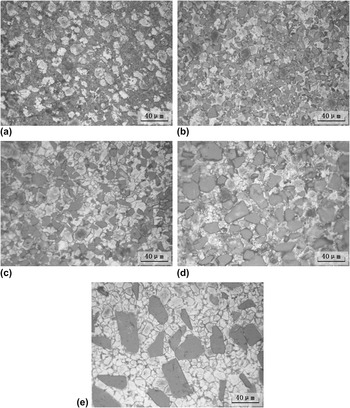
Optical micrographs of the vacuum hot-pressed 2024 Al/30% SiCp composite specimens with different RPS ratios are shown in Fig. 1. In all the optical micrographs, the phase with bright contrast represents the matrix aluminum and the phase with dark contrast represents unresolved SiC network, respectively.
Optical micrographs of hot-pressed 2024 Al/30% SiCp composite with RPS ratio of (a) 10:3, (b) 10:8, (c) 10:15, (d) 10:25, and (e) 10:40.

In 2024 Al/SiCp composite powder mixture, if the matrix powder particles are large in size relative to that of the reinforcement, the reinforcing particles will cluster in the interstices of the coarse matrix particles and this would result in inhomogeneous distribution of reinforcement. The resultant clustered microstructure of the composites is often called as the “necklace structure.”Reference Wang, Song, Sun and He17 It is very clear from the microstructures in Fig. 1(a) that at higher RPS ratio, SiC particle tends to cluster.
There is a theoretical limit for the reinforcement volume fraction for particulate reinforced composites fabricated by powder metallurgy method, and below the limit, the reinforcements can distribute uniformly. Slipenyuk et al.Reference Slipenyuk, Kuprin, Milman, Goncharuk and Eckert18 put forward a method to evaluate the maximum (critical) volume fraction of reinforcements (W crit) to guarantee the best possible uniform distribution of the reinforcements in the matrix powders as follows:
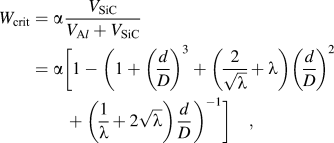 $$\eqalignb{ W_{{\rm{crit}}} = {\rm{\alpha }}{{V_{{\rm{SiC}}} } \over {V_{{\rm{A}}l} + V_{{\rm{SiC}}} }} \cr = {\rm{\alpha }}[ {{\rm{1}} - ( {{\rm{1}} + ( {{d \over D}} )^3 + ( {{2 \over {\sqrt \lambda }} + \lambda } )( {{d \over D}} )^2 + ( {{1 \over \lambda } + 2\sqrt \lambda } ){d \over D} )^{ - 1} ]\quad , \cr} $$
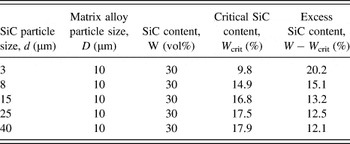
where α = 0.18 is a parameter, V SiC and V Al are the volume fractions of the SiC and Al particles, d/D is the ratio of the reinforcement/matrix particle sizes, and λ is the extrusion ratio. Note that the extrusion ratio λ is 1 in this study. Table I shows the calculated values using Eq. (1). It can be seen from Table I that when the composite is reinforced by 3-μm- and 40-μm-sized SiC powders, the critical reinforcement volume fractions are 9.8 and 17.9%, respectively. This is in agreement with the microstructural observation in Fig. 1, in which the larger SiC particles (40 μm) dispersed much more uniformly in the matrix compared with the smaller SiC particles (3 μm) that cluster in the interstices of the coarse matrix particles.
Critical volume fraction to obtain a uniform distribution of the reinforcements in the composites.

B. Microstructure
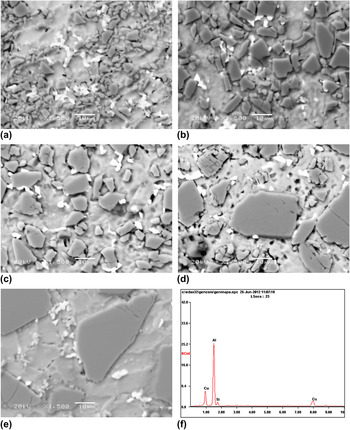
Figure 2 shows the microstructure of the composite with different RPS ratios and the EDS pattern of white particulate. As seen from the figure, the addition of SiC particles, the aluminum matrix, the white particles in the sharp corners of SiC particles, and the base body are shown. EDS analysis showed that the white particles are due to AlCu alloy phase, as shown in Fig. 2(f). The figure also showed that the SiC particles and the matrix have a good adhesive state.
SEM micrographs of the composite with varying RPS ratios of (a) 10:3, (b) 10:8, (c) 10:15, (d) 10:25, and (e) 10:40. (f) EDS pattern of white particulate.

The pores can be observed in the sharp corners and aggregation of SiC particles from Figs. 2(a), 2(b), and 2(e). There are no particle fragmentation in the SiC particle (3 μm)-reinforced composite material morphology, as shown in Fig. 2(a); only a few of the larger size broken SiC particles was observed in the SiC particle (15 μm)-reinforced composite material morphology, as shown in Fig. 2(c); 25 and 40 μm SiC particle-reinforced composites have a large number of SiC particles due to the cracking and breaking, as shown in Figs. 2(d) and 2(e). As the SiC particle size increases, a larger proportion of SiC particles fragmentation appears.
C. Mechanical properties and density
1. Relative density
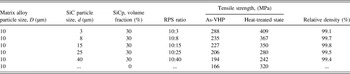
Table II shows the average UTS and the relative density of the as-vacuum hot-pressed 2024 Al/30% SiCp composites with different RPS ratios. When SiC particle size d increases from 3 to 15 μm, the relative density of the material significantly increases; when d increases from 15 to 40 μm, the relative density of the material decreases slowly. The 15-μm SiC particle-reinforced composite has the largest relative density; however, 3-μm SiC particle-reinforced composite has the lowest relative density. When the RPS ratio is slightly less than 1, the composite get the maximum relative density.
Effect of RPS ratios on average tensile properties and relative density of 2024Al/SiCp composites processed by powder metallurgy.

The relative density of the composite material prepared by powder metallurgy process is determined by the amount of pores inside. The amount of pores is mainly associated with particle reinforcement clusters which increase with the increase in difference between reinforcement size and matrix size.Reference Yoshimura, Goncalves and Goldenstein14 In our experiment, due to moderate volume fraction of particle reinforcement, the distribution of particle reinforcement is rather homogeneous and there is no significant particle cluster with the exception of 3-μm SiC particle-reinforced composite, in which there are many SiC particle clusters. Micrographs of the composites with varying SiC sizes have been observed. Since the relative density of the reinforced composite in 3 μm is much lower than that of other composites, it is reasonable to conclude that the reinforcement cluster plays a more important role in the density of the composites than the reinforcement size.
2. Mechanical properties
A maximum scatter of ±5 MPa in the strength values was observed. As seen clearly in Table II, the tensile strength decreases as the RPS ratio decreases. On increasing the RPS ratio from 10:40 to 10:3, the UTS improved by about 19 and 73%, respectively. Improvement in the tensile strength, on increasing the RPS ratio, can be attributed to the strengthening of matrix microstructure from the small SiC particle and its effect on the associated fracture process, discussed as follows.
On heat treatment, it is expected that the coarse Cu rich precipitates formed during VHP get dissolved into the matrix and redistributed in the form of fine precipitates during aging.Reference Prasad, Bhat, Mahajan and Ramakrishnan15 From the tensile data of the heat-treated composites shown in Table II, it is clear that the improvement (25%) in the strength of the sample having 10:40 RPS ratio is marginal compared with the dramatic improvement (42%) in the case of the composite with 10:3 RPS ratio. Liquid metal having higher Cu content than the nominal composition squeezes into the SiC particle rich network during hot pressing under the influence of the imposed pressure.Reference Prasad, Bhat, Mahajan and Ramakrishnan15,Reference Shin, Chung and Lee19
In the as-hot-pressed composites with high RPS ratios, large numbers of precipitates have been observed in the network region compared with those observed in lower RPS ratio composites. In the composites with lower RPS ratios, the large network width results in segregation of large volume fraction of Cu within the network and diffusion of Cu back into matrix when heat treat is incomplete. On the other hand, in the case of high RPS ratio composites, redistribution is complete probably due to smaller diffusion path length. It is worth noting the dependence of strength of the samples on the RPS ratio even after heat treatment.
It is also known that the density of quenched-in dislocations (generated due to CTE mismatch between reinforcement and matrix) is maximum at the interface compared with the rest of the matrix. The contribution from dislocation strengthening is probably much smaller in the case of samples with lower RPS ratio compared with that of the sample with higher RPS ratio as the matrix particle size is smaller and interfacial area (between the matrix and network regions) is higher in the latter case.Reference Prasad, Bhat, Mahajan and Ramakrishnan15
D. Fracture studies
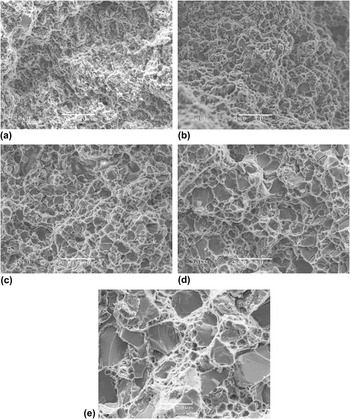
Fractured fractographs of the tensile samples for the composites having different RPS ratios have been examined using a SEM at a higher magnification (500x) illustrated in Fig. 3. Even though the fractographs indicate brittle fracture at the macro level, some ductile features in the form of dimples are evident in both the cases due to the localized deformation at the fracture surface. Three characteristics were observed in the study of fracture surfaces: (i) fracture surfaces have a dimple morphology; (ii) there are two dimple populations: the first, which is associated with SiC particles, and increases in size as the size of the SiC particles increases, and a second type consisting of very small dimples located in the space between the SiC related dimples; and (iii) cleavage of SiC particles becomes more evident as their size increases (seen in Fig. 2). The shape of the dimples is rather equiaxial.
Fractographs of as-hot-pressed 2124 Al/30% SiCp composites with RPS ratio of (a) 10:3, (b) 10:8, (c) 10:15, (d) 10:25, and (e) 10:40.

Despite the correlation between the coarse dimples and SiC particles on the fracture surfaces of SiC/Al composites, not all the SiC particles were completely exposed. This corresponds to the earlier observations of the fracture surfaces of SiC/Al composites,Reference Flom and Arsenault20 which indicate good bonding between SiC and Al matrix.
As shown in Figs. 2 and 3, 8-μm SiCp-reinforced composite hardly crack, although many cracked SiC particles appear in 25- and 40-μm size. The sample with lower RPS ratio showed flat facets of the fractured SiC particle and uniformly distributed dimples around the reinforcement particles, and the failure mode of the composites is predominantly brittle fracture through SiC particle. The sample with higher RPS ratio showed deep dimples in some regions and very shallow dimples in other regions, and the ductile surfaces were largely comprised of fine shallow dimples. The failure mode of the composites was predominantly the ductile failure through the matrix. SiC particle fracture has been observed in larger SiC or SiC with higher aspect ratios, whereas the composites reinforced with smaller SiC particle are more likely to suffer the interfacial debonding between reinforcement and matrix. Because of larger load and more surface flaws and defects in larger SiC, the probability of a defect of critical flaw size being present increases, which coarse SiC to fracture more likely at a given stress level. The larger the SiC particle size, the higher the percentage of cracked SiC particle during deformation. The phenomenon is consistent with previous investigations.Reference Leroy, Embury and Edwards21
IV. DISCUSSION
A. The relationship between tensile strength and RPS ratio
Prasad et al.Reference Prasad, Bhat, Mahajan and Ramakrishnan15 proposed an empirical equation to evaluate the relation between UTS of the hot-pressed composite and the RPS ratio (X:1):
 $${\alpha _{{\rm{UTS}}}} = A{\rm{[358}} - {\rm{32}}{\rm{.5 \,\,ln(}}X{\rm{)]}}\quad {\rm{,}}$$
where A = 0.9724 is the correlation coefficient.
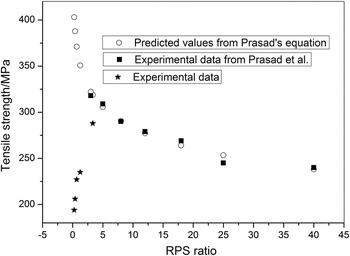
Figure 4 shows the effect of RPS ratio on UTS of fully dense as-hot-pressed 2024Al/30 SiCp composites, from which we can see that the experimentally determined UTSs of the composites with a large RPS ratio (10:3, SiC particle size of 3 μm) are close to the theoretical values. The UTS experimental data deviate Prasad's theoretical values when RPS ratio is less than 3.3:1. The composites with smaller RPS ratios have lower UTSs since the size of the SiC particles is too large, resulting in particle cracking during hot pressing. It is widely known that the cracked particles cannot transfer any load from the matrix to the reinforcements, but they can act as microcrack initiators, which substantially decreases the strength.
Effect of RPS ratio on UTS of fully dense as-hot-pressed 2024Al/30% SiCp composites.

Prasad's empirical equation does not apply when the RPS ratio is less than 3.3:1. Together with Prasad's results, our study revealed that the optimal RPS ratio is about 3:1. The studies showed that we cannot establish any relationship between strength and RPS ratio as RPS ratio can be changed by varying the particle sizes of both reinforcement and matrix particles, simultaneously.
B. Strengthening mechanisms
1. Several influencing factors
The mechanical properties of composites reinforced with particles are controlled by a complex interaction between the matrix and the reinforcement, such as interfacial bonding strength, deformation compatibility when load is applied, thermal expansion mismatch due to the different expansion coefficients between SiC and Al alloy at changing temperatures, etc. Some factors can be considered to determine the failure of the composites, such as pore density, SiC cracking, interfacial debonding of SiC/Al alloy, the distribution of SiC particles, etc. For 2024Al/30% SiCp composite, the room temperature bonding between 2024Al alloy matrix and SiC is good because the interfacial bond between SiC and Al alloy is about 1.7 GPa and is much higher than the expected strength of both the Al alloy matrix and SiC.Reference Flom and Arsenault22
It is known that SiC particle is much more brittle than Al alloy matrix, so some SiC particles crack with the increase of the tensile load. The cracks propagate and extend into the matrix and finally lead to the composite fracture. For the composites reinforced by a small SiCp, cracks usually initiated at the interface of SiC/Al alloy and located at the end of SiC particle along the applied force direction. With the increase in the applied force, the voids and cracks propagated, extended, and connected one another in the interface at first, then in the matrix, and finally led to the composite fracture. When the SiC particle size is 3 μm, the relative density of the composite is very low and the distribution of SiC is very inhomogeneous, and the composite has the largest tensile properties.
Comprehensive analysis on several factors, the relative density of the composite, and the distribution of SiC are not the most critical factors. Fracture of SiC particles has a greater effect on the mechanical properties of the composite. Reinforced particles above 20 μm are easily broken and not suitable for reinforcing particles.
2. Incorporation of dislocation plasticity
The addition of SiC with different elastic and plastic properties from Al alloy matrix induces stress concentration in the interface between SiC and Al alloy matrix during tensile deformation. To maintain the displacement compatibility across the SiC/Al alloy interface when a stress is applied, the dislocations are generated at the interface. In face, it is the interaction of the dislocations in Al alloy matrix with SiC, which determines the mechanical behavior of the composites.
In the dislocation description of deformation in two-phase composites, four distinct contributions to the flow stress can be identified. The first is the Orowan stress ( $\Delta \sigma _{\rm{OR}}^{\rm{m}}$), the stress to pass a dislocation through an array of impeding particles of average spacing, λ,
 $$\Delta \sigma _{\rm{OR}}^{\rm{m}} = \alpha Gb{\rm{/}}\lambda \quad ,$$
where α is a constant of the order of 1. G is the elastic shear modulus of the matrix and b is the Burgers vector of the matrix metal. The mean particle spacing λ is related to the particle size and volume fraction by the usual equation,
 $$\lambda = {(\pi {d^2}/4f)^{1/2}}\quad ,$$
where d is the particle diameter and f is the volume fraction. The second and third contributions are those due to the strain gradient effects associated with geometrically necessary distributions of dislocations required to accommodate the plastic strain mismatch between the particles and the surrounding matrix.Reference Fleck, Muller, Ashby and Hutchinson23 The isotropic form of the strain gradient contribution to the flow stress ( $\Delta \sigma _{{\rm{ISO}}}^{\rm{m}}$) can be written, following Brown,Reference Brown and Stobbs24 as
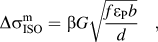 $$\Delta \sigma _{{\rm{ISO}}}^{\rm{m}} = \beta G\sqrt {{{f{\varepsilon _{\rm{P}}}b} \over d}} \quad ,$$
where β is a geometric factor, which according to Brown, has a numerical value of ∼0.4, εP is the plastic strain in the matrix metal. The kinematic strain gradient contribution ( $\Delta \sigma _{{\rm{KIN}}}^{\rm{m}}$) has the form,
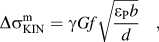 $$\Delta \sigma _{{\rm{KIN}}}^{\rm{m}} = {\rm{\gamma }}Gf\sqrt {{{{\varepsilon _{\rm{P}}}b} \over d}} \quad ,$$
where γ is another geometric factor with a numerical value of ∼2.0.
The fourth possible contribution ( $\Delta \sigma _{{\rm{CTE}}}^{\rm{m}}$) is the strengthening due to the statistically stored density, ρ, of dislocations, introduced for instance as a result of processing and thermal expansion mismatch on cooling. This may be written quite generally asReference Hansen and Jensen25
 $$\Delta \sigma _{{\rm{CTE}}}^{\rm{m}} = \eta Gb\sqrt \rho \quad ,$$
where η is another constant of order unity. For the particular case in which the dislocations are created by thermal expansion mismatch, Δα, and the particles are again spherical, the dislocation density (ρ) can be expressedReference Arsenault and Shi26,Reference Arsenault, Wang and Feng27 as
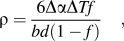 $$\rho = {{6\Delta \alpha \Delta Tf} \over {bd(1 - f)}}\quad ,$$
where ΔT is the temperature change from the heat treatment temperature of the matrix to room temperature. It should be noted that the form of the thermal expansion contribution has the same functional dependence on particle size and volume fraction as does the isotropic strain gradient term. These four contributions to the overall dislocation flow stress can be incorporated into the effective medium calculations by modifying the yield stress used in the Ramburg–Osgood equation. Thus,  $\sigma _{\rm{o}}^{\rm{m}*}$ becomes:
 $$\sigma _{\rm{o}}^{\rm{m}*} = \sigma _{\rm{o}}^{\rm{m}} + \Delta {\sigma ^{\rm{m}}}\quad ,$$
where  $\sigma _{\rm{o}}^{\rm{m}}$ is the original yield strength of the unreinforced matrix and Δσm is the net dislocation strengthening effect due to the presence of the particulates. The question arises, as in other areas of dislocation plasticity, of how to appropriately combine the individual flow stresses in Eqs. (3)–(7). We have chosen to add them in quadrature.Reference Clyne and Withers28
 $${(\Delta {\sigma ^{\rm{m}}})^2} = {(\Delta \sigma _{\rm{OR}}^{\rm{m}} + \Delta \sigma _{\rm{KIN}}^{\rm{m}})^2} + {(\Delta \sigma _{\rm{iso}}^{\rm{m}})^2} + {(\Delta \sigma _{\rm{CTE}}^{\rm{m}})^2}\quad ,$$
Replacing the matrix yield stress  $\sigma _{\rm{o}}^{\rm{m}}$ with the modified yield stress
 $\sigma _{\rm{o}}^{\rm{m}*}$ to account for dislocation plasticity effects in the matrix therefore provides a particle size dependence for the mechanical behavior of the composite. The smaller the SiC particle size (d), the stronger the dislocation strengthening effect (Δσm), the strengthening of matrix microstructure come from small particle effects.
V. CONCLUSION
The following major conclusions can be drawn from this study:
(1) The composite material obtains the highest relative density when RPS ratio is slightly less than 1.
(2) Reduction in the RPS ratio resulted in homogenous distribution of SiC particle and decrease in tensile strength. In the hot-pressed condition, 2024Al/30% SiCp composite corresponding to a higher RPS ratio (10:3) results in a higher tensile strength. The main reasons were due to the few fracture for small SiCp and the strengthening of matrix microstructure from small particle effects.
(3) Solution treatment plus aging of the composites with a RPS ratio 10:40 resulted in a modest improvement (25%) in the strength as compared with the significant increase (42%) in strength in the case of the composite with a 10:3 RPS ratio, due to the smaller diffusion path length in the latter case.
(4) When particulate sizes are 3 μm, the breakage is due to tearing of matrix near the interface. The failure of composites with particulate sizes of 25 and 40 μm mainly results from crack of SiCp. When SiCp sizes are 8 and 15 μm, the fracture of composites is due to the tearing of matrix near interface and crack of SiCp.
ACKNOWLEDGMENT
This work was supported by National Natural Science Foundation of China (Grant No. 51175151) and International Cooperation Foundation of Henan Province (Grant No. 084300510006).