A select group of verbs in Portuguese have competing forms for their past participle, giving speakers the choice between a regular and an irregular form. Together, these forms are called particípios duplos ‘double participles’ or “short-form” participles (Lobato, Reference Lobato1999) when using these verbos abundantes (‘abundant verbs’). The regular past participle simply adds -do to the verb stem as in pagar ‘to pay’ > pagado ‘paid’ or entregar ‘to deliver’ > entregado ‘delivered.’ By contrast, the irregular participle in many cases is equivalent to the first person singular (hereafter referred to as 1SG) present indicative form of the verb as in pagar > pago (which is the same form as the 1SG present indicative Eu pago ‘I pay’). Alternatively, it may be a form that is the same as another verb form, such as the first person singular and third person singular present subjunctive form as in entregar > entregue.
Although there is general agreement among grammarians regarding the existence of these verbs and their competing participles (Lima, Reference Lima1972; Mateus, Reference Mateus2003; Perini, Reference Perini2002, Reference Perini2010; Raposo, Bacelar do Nascimento, Coelho da Mota, Segura, & Mendes, Reference Raposo, Bacelar do Nascimento, Coelho da Mota, Segura and Mendes2013), there is little consensus about exactly which verbs constitute the group of verbos abundantes, that is, those which provide the option of particípios duplos. Additionally, not all authors agree on the distribution of participles by auxiliary. Most scholars claim that the morphologically regular -do forms are used strictly or primarily to form the perfect tenses, combining with the perfect auxiliaries ter and haver (both meaning ‘to have’), while the irregular forms are used in the passive and as adjectives that can be inflected for gender and number with the copulas ser and estar (both meaning ‘to be’) (Carvalho & Bagno, Reference Carvalho and Bagno2015; Cunha & Cintra, Reference Cunha and Cintra2001; Ganho & McGovern, Reference Ganho and McGovern2004; Prista, Reference Prista1966; Thomas, Reference Thomas1969; inter alia).Footnote 1 Typical statements to this effect can be found in the classic grammars by Lima (Reference Lima1972:171): “the regular participle is only used with the verb ter; and the irregular, either with isolated adjective value, or with the verb ser”Footnote 2; or Bechara (Reference Bechara2006:230): “In general the regular form is employed, which remains invariable with the auxiliaries ter and haver, in the active voice, and the irregular form … with the auxiliaries ser, estar and ficar, in the passive voice.”Footnote 3 Other authors recognize, however, that the situation is considerably more nuanced. Simões (Reference Simões2008:356) and Perini (Reference Perini2002:153–4), for example, documented the possibility of using the irregular forms with ter and haver in modern Brazilian Portuguese.Footnote 4 They also implied that the form of the irregular verb itself plays an important role in participle selection, namely, that higher rates of irregular forms occur if the irregulars match the 1SG present indicative form (presumably via an analogical process), even following ter and haver. Perini (Reference Perini2010:178) simply stated that, “It is … a tendency, with great variation” without providing any further explanation for the variable patterns.Footnote 5 Although the perspectives of these grammars provide a valuable starting point for further research, a comprehensive description of the variation in or explanation(s) for participle selection have yet to be proposed.
In this study, our goal is to reconcile via empirical means the differing views that both grammarians and linguists hold on the use of particípios duplos by looking at naturally-occurring corpus data from both Brazilian and European Portuguese. We assess these descriptions of participle selection with a primary focus on the linguistic factors governing speaker choice of regular versus irregular forms. Furthermore, we examine both dialectal and diachronic effects on these constraints, both of which have been overlooked in prior scholarship on this topic. Our study is inspired in part by Poplack and associates (e.g., Poplack & Dion, Reference Poplack and Dion2009; Poplack, Lealess, & Dion, Reference Poplack, Lealess and Dion2013), whose recent work on French has shown that real usage of grammatical structures, or what they call “praxis,” bears only a slight resemblance, if any, to the representation of such structures in grammars, that is, in “prescription.” As Poplack, Lealess, and Dion (Reference Poplack, Lealess and Dion2013) pointed out, even grammars and linguistic analyses that purport to be “descriptive” in nature evince this fatal flaw, at least for variable grammatical phenomena. Poplack and Malvar (Reference Poplack and Malvar2007) have already shown this to hold true for one particular phenomenon in Brazilian Portuguese, the choice between synthetic and analytic (ir ‘go’ + infinitive) futures. While grammars still promote the synthetic form as the standard and most frequently-used form, Poplack and Malvar (Reference Poplack and Malvar2007) showed that it has been replaced by the analytic form in both speech and non-formal written styles. In this paper, we show decisively that a similar conclusion can be drawn for the choice of past participle form in perfect constructions in Portuguese. Furthermore, we demonstrate that there is evidence of analogical change toward an even greater use of the “non-standard” irregular participle in such constructions.
PREVIOUS LITERATURE
In an attempt to better understand the diachronic trajectory of Portuguese past participles, Chagas de Souza (Reference Chagas de Souza2007, Reference Chagas de Souza2011, Reference Chagas de Souza, Alves and Ribeiro de Jesus2015) traced the development of the thematic (regular) and athematic (irregular) participles from Latin to modern Portuguese. He claimed that a three-phase evolution has occurred, yielding the present forms. First, Portuguese inherited and maintained the doublets already found in Latin, such as aceitado - aceito (‘accepted’). Second, this pattern was extended, via analogy, to other first conjugation verbs where the 1SG present indicative form was adopted as the irregular participle form (and as an adjective with copular ser/estar), as, for example, chegado - chego (‘arrived’). Finally, innovative forms such as pedido - peço (‘requested’) have appeared recently with other verbs that normatively are not considered to be members of the class of verbos abundantes. Footnote 6 Simões (Reference Simões2008:356) also recognized, at least implicitly, the importance of the 1SG present indicative form to the formation of the irregular participle.
Nevins and Rodrigues (Reference Nevins and Rodrigues2014; see also Nevins, Reference Nevins, Aboh, Schaeffer and Sleeman2015) conducted several “wug” (cf., Berko Gleason, Reference Berko Gleason1958) experiments to test how argument structure affected participle choice. In order to avoid “token frequency in the language or other ungodly factors,” they invented Portuguese nonce verbs, as well as their corresponding nonce regular and irregular participles, and created contexts that would make each verb unambiguously unaccusative, transitive, or ditransitive (Nevins, Reference Nevins, Aboh, Schaeffer and Sleeman2015:193). Participants were presented with a discourse context and given a sentence with the option of inserting a regular or irregular participle of the nonce verb. The authors found that regular participles are greatly preferred overall, but the 1SG present indicative irregulars are used slightly more with unaccusatives as opposed to the other verb types. It is difficult to know, however, which specific properties of the verb the participants were reacting to in the experiment: the type of verb, as the authors intended, the form that the irregular took, or other factors such as unintended similarity to existing verbs/participles in the language. In the present paper, we therefore have chosen to confront the “ungodly factors” head-on with corpus data.
Powers (Reference Powers1985) investigated the variation between regular and irregular participles via a questionnaire study with 16 native Brazilian Portuguese speakers. With respect to perfect constructions specifically, he found that his respondents chose the irregular forms a mere 18% of the time. Crucially, however, Powers included morphologically irregular participles that do not have a regular counterpart (e.g., aberto, escrito); only four of the irregular verbs in perfect constructions that respondents deemed acceptable (eleito, entregue, pago, gasto) had a regular counterpart found in the language. Powers concluded, much like we do here, that existing prescriptive and descriptive characterizations of participle choice are inaccurate and unreflective of actual usage, despite the fact that he did not investigate naturally-occurring data. Below, we show that the rate of irregular participles in naturally-occurring spoken/written Portuguese is much higher than reflected in the results of Powers’ questionnaire study, and shows clear constraints on variation that it left unexplored.
Additionally, several previous variationist studies have examined naturally-occurring usage of these different participle forms and the factors governing their selection. Miara (Reference Miara2013) examined newspaper articles from the Diário Catarinense in Florianópolis in southern Brazil, extracting 843 total tokens. However, in her analysis, Miara included verbs showing no variation between regular and irregular participle forms. Once these invariant tokens are removed from her dataset, 566 tokens showing variation remain, coming from seven different verbs. From these verbs, Miara found a very high percentage (83%) of irregular participle use. Throughout her study, she suggested possible explanations for differences in usage from participle to participle, claiming that the alternation among different auxiliaries is gradient. Our results below confirm this view but with a larger dataset and more comprehensive multivariate analysis.
In another variationist study, Teixeira da Silva (Reference Teixeira da Silva2008) analyzed approximately 670 tokens from a corpus of spoken southern Brazilian Portuguese. Her results show that the regular participle is favored over the irregular form; however, only eight of these tokens, coming from only two verbs, displayed variation between regular and irregular participles with ter/haver. As a result, it is impossible to draw any firm conclusions from this study. Lastly, Mendes (Reference Mendes2005, Reference Mendes and Walker2010) analyzed the overlap between perfect versus progressive forms from a variationist perspective. Looking at synchronic and diachronic use in two corpora of spoken Portuguese from São Paulo and Rio de Janeiro, he found that the perfect form (ter + participle) is becoming more restricted both linguistically and socially when compared to the progressive (estar + present participle). Mendes did not, however, look at variation between regular and irregular participles within the perfect construction.
The most recent study of variability between regular and irregular participles is Thomas (Reference Thomas2018), who focused on European Portuguese. Analyzing the rate of irregular use in 10 different verbs in a corpus of written internet data, she found that seven favor the irregular form compared to three that favor the regular participle. More importantly, however, she also conducted a study of acceptability judgments and found that speakers heavily prefer the irregular forms over the regular forms for six verbos abundantes. Our results below suggest that this preference for the irregular forms may also play a role in the analogical spread of the irregulars, based specifically on the 1SG present indicative form.
RESEARCH QUESTIONS AND HYPOTHESES
Based on the findings of previous research on participles in Brazilian Portuguese, we formulated a number of research questions to guide our analysis. The overarching questions posed in this study are as follows: (1) What is the distribution of irregular/regular participles in constructions with ter/haver + past participle?, and (2) What are the factors that condition the variation between these two participle variants? In this light, we put to the test the normative rule—found in both prescriptive and descriptive grammars, including some authored by linguists—which claims that only regular participles ending in -do should occur in perfect constructions with the auxiliaries ter or haver (and the irregular form appearing exclusively in passive constructions and as adjectives).
We also hope to shed light on possible dialectal differences between Brazil and Portugal, as well as on diachronic differences to see whether there has been a shift toward more irregular participle use. We expect to see dialectal differences between Brazil and Portugal in light of the finding from Thomas’ (Reference Thomas2018) acceptability questionnaire that speakers of European Portuguese consistently preferred irregular over regular forms, as well as the prescriptive promotion of irregulars in school (Patrícia Amaral, personal communication). Additionally, we predict diachronic shift toward more irregular usage, especially when the irregular is identical to the 1SG present indicative form, given Chagas de Souza's (Reference Chagas de Souza2007, Reference Chagas de Souza2011, Reference Chagas de Souza, Alves and Ribeiro de Jesus2015) discussion of innovative irregular forms recently attested in Brazilian Portuguese, which found that these new forms are created via analogy with the morphological basis of the 1SG present indicative, even when the indicative forms themselves are irregular (see also Thomas, Reference Thomas1969:223). In view of the prior linguistic accounts summarized in the previous section, the results of our quantitative analysis of the data lead us to side with Chagas de Souza's qualitative arguments that analogy with the 1SG present indicative best explains the variation. We conclude more generally that probabilistic constraints are operating on analogical processes in grammar in both synchrony and diachrony (cf., Albright, Reference Albright, Blevins and Blevins2009).
METHODS
To investigate the variability between past participle forms, we utilized Davies and Ferreira's (Reference Davies and Ferreira2006) Corpus do Português (www.corpusdoportugues.org). The Corpus do Português is an online corpus consisting of 45 million words from almost 57,000 texts from the Portuguese-speaking world, ranging from the 1300s to the 1900s and containing sources from different genres or registers (spoken, fiction, newspaper, academic) and dialects (European and Brazilian Portuguese). The envelope of variation for the study was determined inductively (cf., Poplack, Lealess, & Dion [Reference Poplack, Lealess and Dion2013] who used a similar method to investigate the French subjunctive). We first compiled a master list of verbos abundantes, using multiple existing lists taken from Portuguese grammars, textbooks, and websites. Among these different sources, there was widespread disagreement about which participles should be included in such a list.Footnote 7 In the end, we conducted an exhaustive search for every verb that showed variation between regular/irregular participles when occurring with the auxiliaries ter and haver in twentieth century data (Portugal and Brazil). Additionally, we searched for the same verbs in the nineteenth century for purposes of diachronic comparison within the data from Portugal (quite unfortunately, the Brazilian data in the corpus is limited to the twentieth century).Footnote 8 These verbs were then searched for using both auxiliary verbs (ter/haver) and both forms of the participle (e.g., salvado, salvo ‘saved’), and tokens were extracted from the corpus for coding and analysis. Examples (1–6) below show the use of both regular and irregular participles (CdP = Corpus do Português; year provided where available in the CdP).
(1) Era Alcoforado quem me tinha salvado a vida.
‘It was Alcoforado who had saved my life.’
(CdP, Title: Leonor de Mendonça, Author: Gonçalves Dias)
(2) Esfreguei por fim os olhos e verifiquei que o Sanches me tinha salvo.
‘I finally rubbed my eyes and saw that Sanches had saved me.’
(CdP, Title: O Ateneu, Author: Raul Pompéia)
(3) Este homem deve ter gastado muito dinheiro.
‘This man must have spent a lot of money.’
(CdP, Title: Fritzmac, Author: Aluísio Azevedo)
(4) Lá continua. Tem gasto tudo em remédios.
‘He's still there. He's spent everything on medicine.’
(CdP, Title: A Criação do Mundo: O Terceiro Dia (1948), Author: Miguel Torga)
(5) Minutos depois, arrependeu-se, devia ter entregado a carta, sentiu remorsos, pensou em mandá-la à casa do médico.
‘Minutes later, he changed his mind, he should've delivered the letter, he felt remorse, he considered sending it to the doctor's house.’
(CdP, Title: Quincas Borba, Author: Machado de Assis)
(6) Após ter entregue a carteira e mais algum objeto pessoal, o executivo tenta reagir e é baleado.
‘After having handed over the wallet and some other personal object, the executive tries to fight back and is shot.’
(CdP, Title: O Silêncio da Chuva (1996), Author: Luiz Alfredo Garcia-Roza)
Following the variationist method (Tagliamonte, Reference Tagliamonte2006, Reference Tagliamonte2011), the tokens were then extracted and coded for the following linguistic and extralinguistic predictors in order to examine the constraints on the variation in participle selection:
• Lexeme (lexical verb)
• Type of irregular participle (same as 1SG present indicative or different)
• Auxiliary verb (ter, haver)
• Person (1st, 2nd, 3rd)
• Number (singular, plural)
• Polarity (positive, negative)
• Dialect (Brazil, Portugal)
• Century (19th, 20th)
We coded for lexical verb because preliminary observations showed appreciable variation regarding rates of irregular participle usage from one verb to another. Our consideration of type of irregular participle was motivated by Chagas de Souza's (Reference Chagas de Souza2007, Reference Chagas de Souza2011, Reference Chagas de Souza, Alves and Ribeiro de Jesus2015) discussion of innovative forms in Brazil, which, together with Amaral's (personal communication) comments on irregulars in Portugal (cf., also Thomas, Reference Thomas2018), also highlighted the need to account for possible dialectal differences. The inclusion of the auxiliary verb was intended to capture possible diachronic and stylistic differences since haver seems to be increasingly relegated to formal/written language. Finally, given that participles appear in verb constructions that could presumably be affected by frequency, clause type, or the discourse function of the verb, we coded for the person and number of the auxiliary, as well as polarity.Footnote 9 Mixed-effects logistic regression was carried out using the lme4 package (Bates, Maechler, Bolker, & Walker Reference Bates, Maechler, Bolker and Walker2015) in R, with the predictor lexeme included in the model as a random effect.Footnote 10
OVERALL RESULTS: BRAZIL AND PORTUGAL
A total of 1077 tokens were included in the analysis, with all of them coming from verb lemmas showing variability with regard to participle form in the Corpus do Português. The initial results are contrary to the claim made in most grammars that the auxiliaries ter and haver combine with regular participles only. In fact, more than half of the examples in our data contain irregular participle forms in perfect constructions, as shown in Table 1.
Furthermore, dialectal differences show that there is an even greater preference for irregular participles in Portugal than in Brazil, as illustrated in Table 2. The use of irregular participles in Portugal is 15% higher than that found in Brazil, a difference that is significant by a chi-square test.
Overall frequencies of Portuguese participle form

Frequencies of participle form across dialects in the 20th century data (n = 711)

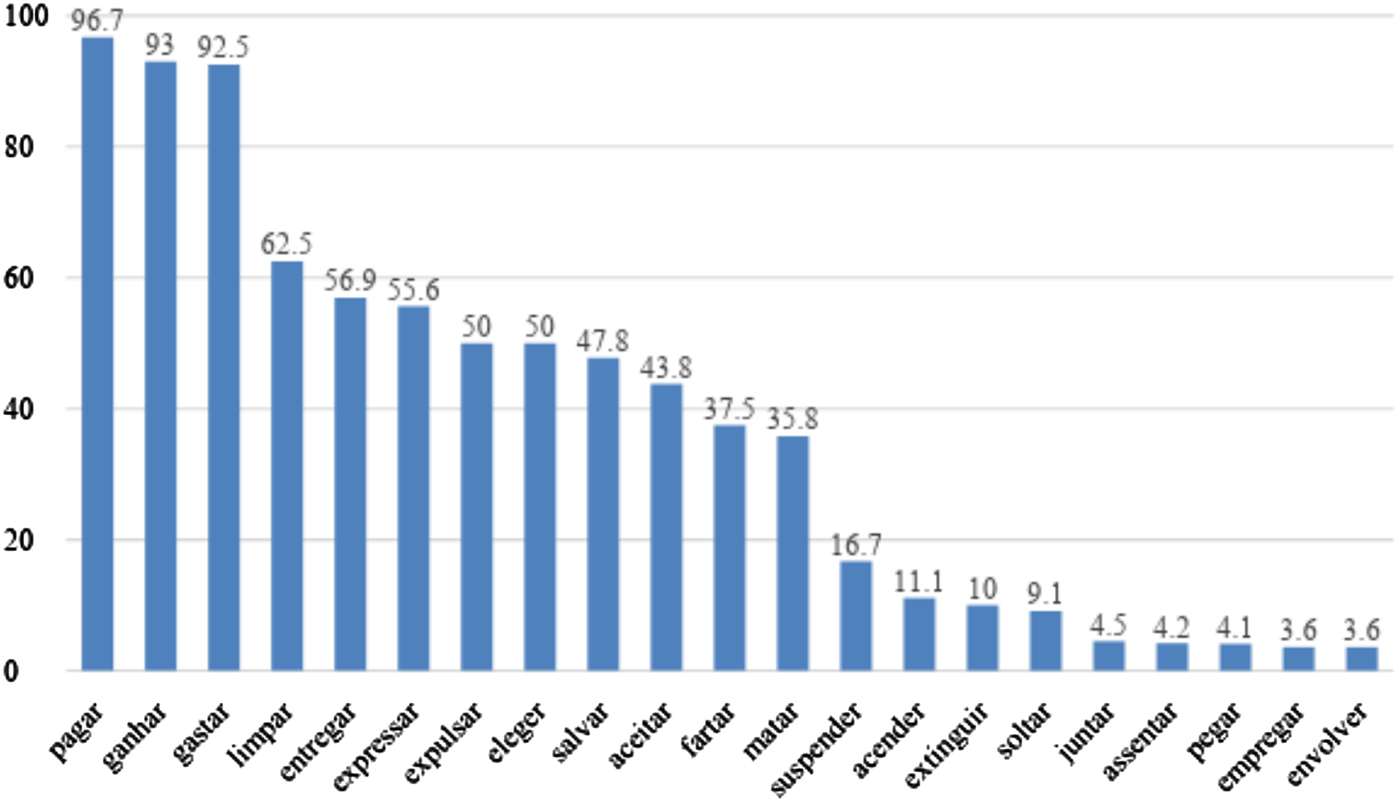
Figure 1 below shows the 21 verbs (of the grand total of 58 that we searched for, based on lists from grammars and language textbooks) that showed variation in participle form within the twentieth century data in the Corpus do Português.
The 21 variable verbs in data set (listed by infinitive) with rates of irregular participle selection, from highest to lowest.

As Figure 1 illustrates, there are enormous differences in the relative frequencies of irregular participle choice depending on the particular verb in question. Indeed, the rates of irregular participles span nearly the whole range of possibilities from a mere 4% for empregar ‘to employ’ and envolver ‘to wrap’ to a near-categorical 97% in the case of pagar ‘to pay.’ Perhaps most notable is that the three verbs with the highest percentage of irregular participles, pagar, ganhar, and gastar, display a combined rate of 94% irregular participles (377/401). Moreover, these three verbs actually provide 64% (377/584) of all of the irregular tokens in the full dataset. This means that the other 36% (207/584) of the total set of irregular tokens are distributed over 18 different verbs. But even in this latter set of tokens there is a decided lack of balance, inasmuch as three other verbs (entregar, salvar, matar) account for 57% (119/207) of the remaining irregular participles, and therefore 15 verbs account for the remaining 88 tokens. A grand total of six verbs (i.e., 28% of the 21 verb types showing variation), therefore, account for 85% (496/584) of all the irregular participles in the dataset. Such large disparities in the overall frequencies of verbs—not only in terms of irregular versus regular participle choice, but also of the widely varying frequencies with which they occur in perfect constructions—have gone essentially unnoticed in the prior literature on participle choice.Footnote 11 Another point to notice about the three verbs with the highest rate of irregular participle usage is that each has an irregular participle that is identical in form to the 1SG present indicative form of the same verb. This coincidence in form will prove important in the analysis below and for our argument that analogical processes are at work in regulating the variation.
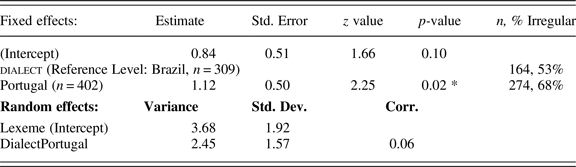
In order to see beyond the strong dominating effect of the individual verb in the variation, we performed a mixed-effects regression analysis in R (Bates, Reference Bates2010), including a random slope for lexeme by dialect.Footnote 12 The best-fitting model of the twentieth century data (as determined by a log likelihood comparison of nested models), is presented in Table 3 below.
Results from the mixed-effects logistic regression model (20th century data, both dialects) predicting irregular Portuguese participle forms (n = 711). Also included: Auxiliary verb, Person, Number, Polarity

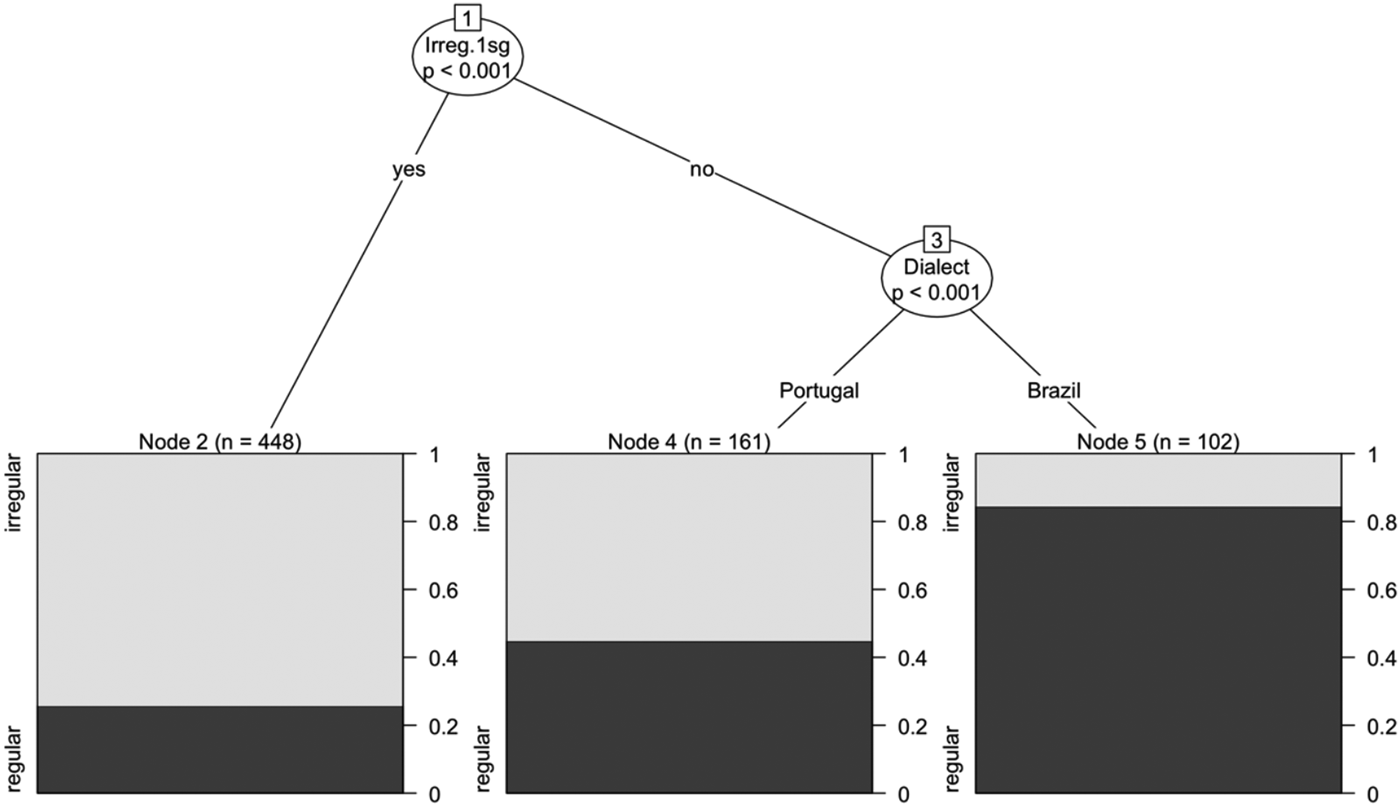
There is a significant difference between Brazil and Portugal, with Portuguese speakers/writers selecting significantly more irregular participles, as expected given the statistically significant difference between the two dialects reported in Table 2. No other fixed effect was significant. In order to more closely examine the hierarchical rankings of constraints on participle choice, as well as the interactions between those constraints, we generated a conditional inference tree (Figure 2). Here, we follow Tagliamonte and Baayen (Reference Tagliamonte and Baayen2012:164), who argue that “conditional inference tree[s] offer an ideal tool to be used in tandem with the mixed-effects logistic model to come to a full understanding of the quantitative structure of a dataset and, as a result, an optimal interpretation of the variation.”
Conditional inference tree showing the constraint hierarchy for participle choice (20th century data) (n = 711).

As Figure 2 shows, the form of the irregular participle emerges as the top-ranked constraint: irregular participles are significantly more probable when they match the form of the 1SG present indicative form of the verb. Note that, in Figure 2, we include type of irregular participle rather than lexeme for ease of presentation, since the former is binary whereas the latter consists of 21 different verbs. In the mixed-effects regression reported in Table 3, however, lexeme was included as a random effect and therefore type of irregular participle could not be included without issues of collinearity.
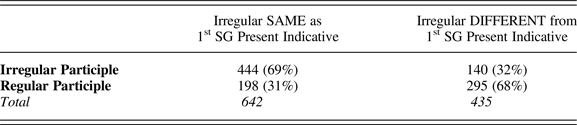
On the right-hand first branch of the conditional inference tree, where the verb's irregular participle form is distinct from the 1SG present indicative, dialect emerges as a significant predictor, with significantly higher rates of regular participles in Brazil than in Portugal. Put another way, Portugal shows greater use of irregular participles even when the form of the irregular participle is not identical to that of the 1SG present indicative. Regarding the selection of regular or irregular participle forms based on the irregular participle form's shape (i.e., whether or not the participle coincides with the 1SG present indicative), the data are distributed as follows (Table 4):
Distribution of Portuguese irregular and regular participles based on the irregular participle's shape

These results reveal that, when the form of the irregular matches that of the 1SG present indicative, the distribution of irregular and regular participles is the exact opposite of when the irregular form's shape is of some other type. Thus, when the irregular form shares the shape of the 1SG present indicative, it has an overall usage rate of 69%, but when it is does not share that shape it only occurs 32% of the time. The actual morphological shape of the participle, then, exerts a strong influence on whether speakers/writers will choose the irregular form.
DIACHRONIC RESULTS: PORTUGAL
Turning to our diachronic analysis of European Portuguese across the nineteenth and twentieth centuries, we provide the results for the overall distribution of the regular and irregular participles in Table 5. Here we only examined the participles that occurred variably in the twentieth century data (see Figure 1) and compared them with their rates in the nineteenth century.Footnote 13
Distribution of irregular and regular participles across the 19th and 20th centuries (European Portuguese)

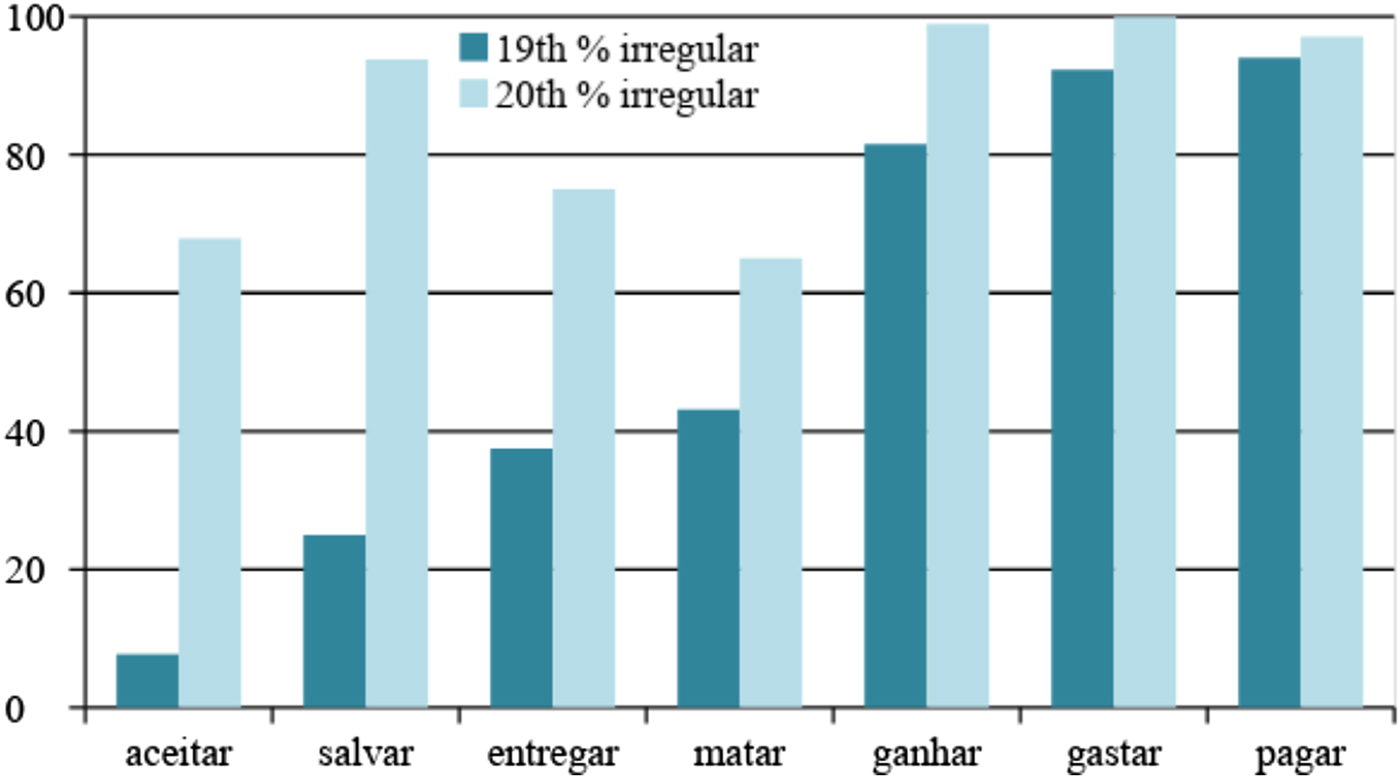
As these numbers show, there is a clear and statistically significant shift toward higher rates (28% higher) of irregular participle use from the nineteenth to the twentieth century. We see a more fine-grained reflection of this change when we examine the individual verbs, as illustrated in Figure 3, which shows the seven most frequent variable verbs in the European Portuguese data.
Rates of irregular participle usage in 19th and 20th centuries among the seven most frequent verbs.

As Figure 3 shows, some of the verbs remained essentially unchanged from the nineteenth to the twentieth centuries, as in, for example, gastar ‘to spend’ and pagar ‘to pay,’ both of which already displayed high rates of irregular participles in the nineteenth century. Other verbs, however, showed drastic increases in the overall usage of the irregular form (e.g., aceitar ‘to accept’ and salvar ‘to save’). Just as impressively, none of the verbs showed an increase in the use of the regular participle across the two centuries. There was either an increase in the irregular and corresponding decrease in the regular form, or there was little to no change, as in the case of those verbs which already had high relative rates of the irregular participle in the nineteenth century. The overall trend, then, is clearly toward greater use of the irregular form no matter which verb is being employed.Footnote 14
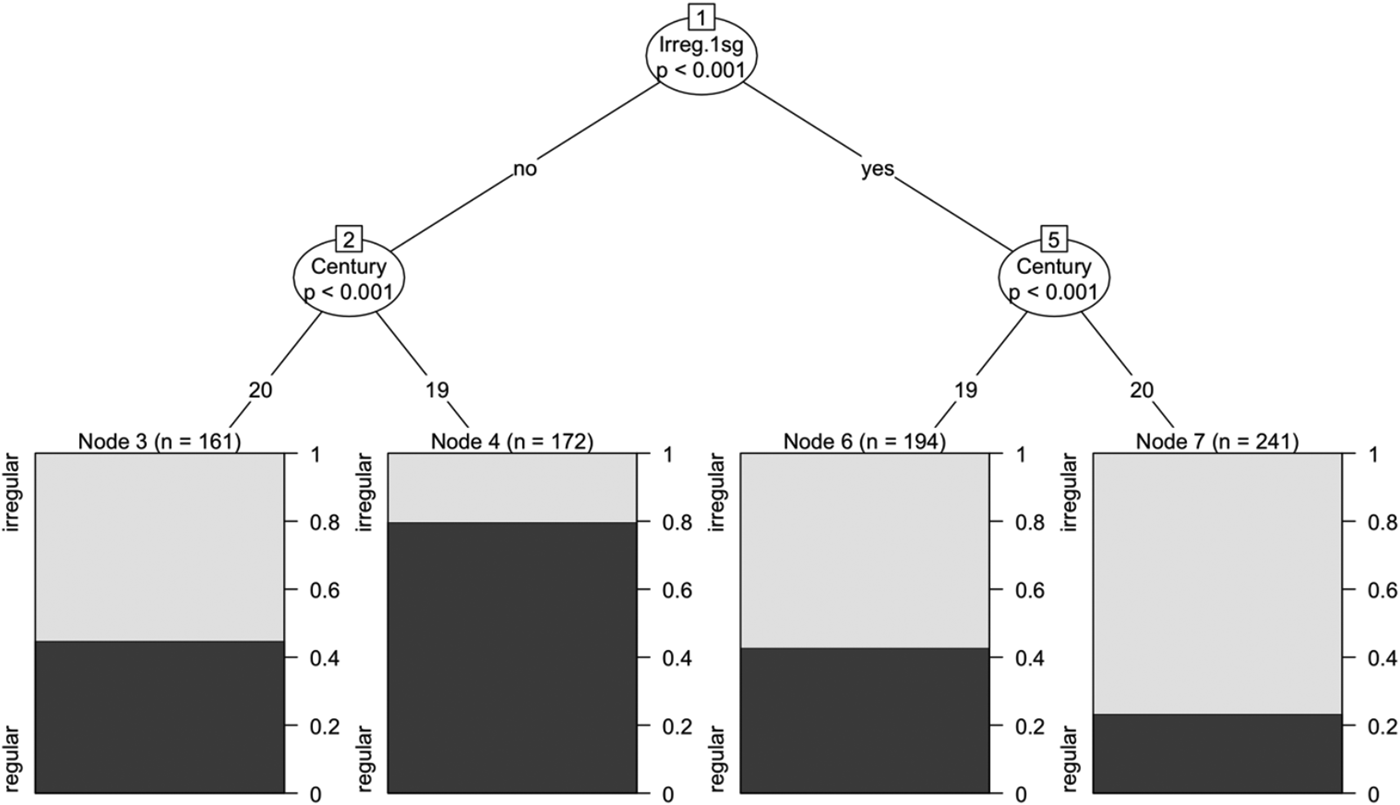
When we included these predictors in the fixed-effects model (see Table 6 in the appendix), we found that both century and type of irregular participle were significant predictors of choice between regular and irregular participles in the European Portuguese data.Footnote 15 The conditional inference tree (Figure 4) provides a visual representation of the hierarchical relationship among these independent variables.
Conditional inference tree showing 19th and 20th century participle choice results for Portugal (n = 768).

Just as in the overall dataset above, when the irregular participle shares its form with the 1SG present indicative, there are significantly more irregular participles in the twentieth century than in the nineteenth. However, when the irregular participle shape is of some other type, there are significantly fewer irregular participles used in the nineteenth century.
Taken as a whole, the results presented in this section evince a clear change across the nineteenth and twentieth centuries in Portugal toward greater use of irregular participles in perfect constructions with ter and haver. Additionally, a comparison of those participles identical in form to the 1SG present indicative with those that are not shows that the increase in use of irregular participles was faster for the latter group; that is, irregulars identical to 1SG increased by only about 20% (comparing the light gray areas in nodes 6 and 7 of Figure 4) from the nineteenth to twentieth centuries, while irregulars not identical to 1SG increased appreciably more (nodes 3 and 4). This could indicate that irregular participles began with forms identical to 1SG and then spread quickly to other verbs without this formal overlap, a typical pattern for actualization/analogical generalization (Malte Rosemeyer, personal communication). More detailed diachronic analysis would be necessary, however, to corroborate this process.
DISCUSSION
As demonstrated in the previous sections, descriptions of Portuguese participle use offered in grammars and usage guides of the language are highly inaccurate when confronted with naturally-occurring corpus data. The present study thus represents a contribution to the literature on Portuguese grammar by showing that normative and even descriptive claims are not borne out in actual usage, while, at the same time, providing the distributional details necessary to refine previous linguistic descriptions. The first example of this comes from the comparison of overall frequencies of regular and irregular participles. Though the majority of grammars postulate that the auxiliaries ter and haver require or at the very least strongly prefer regular participles, in reality these auxiliaries appear with irregular participles of verbos abundantes more than half of the time. This discrepancy between prescription and practice is even more accented in the data from Portugal, where irregular participle use with ter or haver is shown to reach nearly 70%. Though the majority of grammars relegate irregular participles to the domain of passives with ser or estar, the data presented here underscore how problematic such a generalization is in light of actual usage.Footnote 16
In addition to responding to problematic elements in grammarians’ descriptions, the present study also employed multivariate statistical analysis to uncover constraints on participle use not included in previous accounts. For example, the considerably distinct behavior of individual verbs (coded as lexeme in our analysis), which was found here to be the most important predictor of the variation observed, goes unreported in nearly all of the grammars we consulted. No distinction is made between, say, eleger and envolver or limpar and pegar, when, in fact, these verbs have clearly differing preferences of participle choice.Footnote 17 Similarly absent from most accounts (with the exception of the work of Chagas de Souza [Reference Chagas de Souza2007, Reference Chagas de Souza2011, Reference Chagas de Souza, Alves and Ribeiro de Jesus2015]) is any discussion of the critical importance of a participle's shape, that is, whether the irregular form is identical to that of the 1SG present indicative (e.g., tinha ganho ‘I had won,’ eu ganho ‘I win’) or not (tinha extinto ‘I had extinguished,’ eu extingo ‘I extinguish’). As we have shown, the coincidence (via analogical process) between the 1SG form and irregular participles is the strongest factor leading to more selection of the irregular form.
The lexical differences between verbs, as well as the verb-type distinction just described, are especially interesting because of their implications for acquisition and, indirectly, diachrony. Indeed, the fact that individual verb tendencies are by far the most important predictor overall of regular or irregular participle choice suggests that, during the acquisition process, children must learn participles on a verb-by-verb basis rather than as an overarching rule with several frequent exceptions. Given the decreasing frequency of the perfect construction overall, at least in Brazil (Mendes, Reference Mendes2005, Reference Mendes and Walker2010), this is also to be expected.
Regarding verb type, we emphasize again that the vast majority of irregular participles are identical to the 1SG present indicative form. While we have no evidence that the regular -do forms are dying out, and indeed novel verbs are overwhelmingly formed this way (cf., tenho googleado ‘I've been googling’), our results show that participles have a competing analogical formation based on the 1SG form. This analogy is most strongly instantiated by pagar, ganhar, and gastar, the three highly frequent variable verbs with the highest rates of irregular participle use (all over 90% in Figure 1), whose irregulars are all identical to their 1SG form, thereby providing a robust model for less frequent verbs (cf. Bybee, Reference Bybee2010:57–75, Reference Bybee2015:93–116). It is therefore not surprising that when speakers create innovative participles in Brazilian Portuguese they nearly always base their analogical innovations on this same form (Chagas de Souza, Reference Chagas de Souza2007, Reference Chagas de Souza2011, Reference Chagas de Souza, Alves and Ribeiro de Jesus2015).Footnote 18 Examples (7–14), consisting of naturally-occurring tokens taken from Twitter users in Brazil, evidence the use of the innovative participles chego (normatively chegado), falo (falado), passo (passado), peço (pedido), penso (pensado), perco (perdido), and trago (trazido). These forms have already become the subject of much prescriptive commentary online. For example, the use of chego and trago as participles is labeled a common error on language usage-related websites such as Guia do Estudante, Brasil Escola, and Ciberdúvidas da Língua Portuguesa, among many others. Scher, Lunguinho, and Takahira (Reference Scher, Lunguinho and Takahira2013, Reference Scher, Lunguinho and Takahira2014) also documented the existence of the innovative participles falto (faltado), levo (levado), quebro (quebrado), and subo (subido) with ter/haver as well as forms such as compros (comprados), fechos (fechados), and mando (mandado) in adjectival/passive constructions. All of these innovative forms are identical to the 1SG present indicative form of the same verb and are suggestive of a strong analogical process at work. In addition, the forms peço (11), perco (13), and trago (14) are all irregular in the 1SG present indicative and conserve this irregularity as participles. If speakers were not basing their innovations on the 1SG form, then there would be no reason why they would choose these irregular forms as the basis for innovative irregular past participles. Instead, they would presumably create unattested forms consisting of the verb stem plus -o (e.g., *pedo and *trazo).Footnote 19
(7) Ultimamente as coisas tem chego até mim muito fácil.
‘Lately things have come to me really easily.’Footnote 20
(8) Se eu não tivesse falo aquilo hoje, seria bem diferente.
‘If I hadn't said that today, it would be much different.’
(9) Se eu soubesse teria fico em casa limpando o côco do cachorro.
‘If I knew, I would've stayed at home cleaning up the dog's poop.’
(10) Me sinto como se um caminhão tivesse passo por cima de mim.
‘I feel as if a truck had run over me.’
(11) Cheguei em casa e meus pais tinham peço hamburger pra mim.
‘I got home and my parents had ordered me hamburgers.’
(12) Às vezes eu tenho penso em fazer faculdade de astrologia tb.
‘Sometimes I've thought about going to school for astrology, too.’
(13) Sonhei que tinha perco a hora pro teste de matemática e acordei surtando.
‘I dreamt that I'd missed my math test and I woke up freaking out.’
(14) Se eu soubesse, teria trago meu caderno pra disenhar.
‘If I'd known, I would've brought my notebook to draw.’
It is possible, in light of this trend in Brazil, that this same analogical pattern was responsible for the diachronic increase in irregular use in Portugal as well, though empirical confirmation of this claim would require diachronic data from colloquial speech that is currently unavailable to us. Another possible explanation for the notable increase (over 25%) in irregular participle use in Portugal from the nineteenth to twentieth centuries is the normative view espoused in the school system that irregular participles are preferable to their regular counterparts (Thomas, Reference Thomas2018; Patrícia Amaral, personal communication). Indeed, the perceived prestige of irregulars could work in tandem with the preference for participles to match the 1SG present indicative form, thus explaining the notable increase in irregular participle selection from the nineteenth to the twentieth century.
In addition to the linguistic factors just described, the data presented here highlight the importance of dialectal variation to participle choice. No grammars or prior studies have discussed differences in regular versus irregular participle use between Brazilian and European Portuguese (aside from passing qualitative mentions that forms such as aceite ‘accepted’ exist in Portugal but not Brazil, which uses aceito). Still, we identified clearly different distributional behaviors between these dialects. The Brazilian data show higher rates of selection of regular forms while Portugal exhibits significantly greater use of the irregulars.
CONCLUSION
The results of the quantitative analysis of participle alternation have provided empirical evidence for the strong effect of analogy in the choice of the irregular participle forms in both Brazilian and European Portuguese. By operationalizing the analogical target as the participle form that is equivalent to the 1SG present indicative form, we have been able to demonstrate statistically significant correlations between the perfect participles and these targets, thereby corroborating in some cases (Chagas de Souza, Reference Chagas de Souza2007, Reference Chagas de Souza2011, Reference Chagas de Souza, Alves and Ribeiro de Jesus2015) and refuting in others (Scher, Lunguinho, & Takahira, Reference Scher, Lunguinho and Takahira2013; Scher, Reference Scher, Lunguinho and Takahira2014) prior qualitative analyses of the structural motivations for participle form choice. Arguments that innovative irregular participles do not always equate in form to the 1SG (e.g., Scher, Lunguinho, & Takahira, Reference Scher, Lunguinho and Takahira2013; Scher, Reference Scher, Lunguinho and Takahira2014), while perhaps interesting from a qualitative point of view, are actually exceptions to the robust patterns found in the data analyzed here. Although these exceptions are interesting in their own right and deserve further research, they should not overshadow the probabilistic grammar of participle choice revealed in our analysis, which is clearly driven by the 1SG present indicative target. The point of greatest theoretical interest here is that we have been able to corroborate the hypothesis of analogical matching using a large dataset and shown how this particular factor interacts with others, but at the same time dominates them. Moreover, this dominant effect of analogy spans both European and Brazilian varieties of Portuguese. The effect of analogy also applies to innovative types in synchrony, such as those found on Twitter, and to the diachronic increase of the irregulars in the data from the nineteenth to twentieth centuries, thereby solidifying the pattern based on the 1SG present indicative form to more and more instances of verbs with particípios duplos, and the subsequent reduction of the purported regular pattern with -do (cf., Bagno & Casseb-Galvão, Reference Bagno, Casseb-Galvão, Rios de Oliveira and Cezario2016). Whether this spread of the 1SG pattern will continue, and result in a reversal of markedness such that -do becomes the irregular formation, is a possibility that will only be determined with time.
The present study makes it clear that neither modern grammars (whether prescriptive or descriptive) nor linguists have fully or accurately described how speakers alternate between the regular and irregular past participles in Portuguese. Our quantitative analysis reveals that dialect is an important factor determining participle choice across varieties of Portuguese (cf., Thomas, Reference Thomas2018). European Portuguese uses significantly more irregular participles than does Brazilian Portuguese, and these results conform to EP speakers’ positive evaluations of irregular forms (Thomas, Reference Thomas2018). Moreover, the linguistic divide between the participles does not boil down to auxiliary verb choice or sentence/construction type, as most grammars and linguists claim, but is instead determined by linguistic constraints that could not have been uncovered without the statistical analysis performed in this paper. Given how much of the alternation between participles occurs on a verb-by-verb basis, and the degree to which it is sensitive to participle form and its analogical similarity or lack thereof to the 1SG present indicative, it is also clear that choice of past participle in Portuguese is not a strictly grammatical phenomenon, but rather one where both lexical and grammatical constraints interact to create the patterns of variability uncovered in our study.
As noted by Poplack and Dion (Reference Poplack and Dion2009) and Poplack, Lealess, and Dion (Reference Poplack, Lealess and Dion2013) for different phenomena in French, there is more generally a clear disconnect between “prescription” by grammars (even those purporting to be “descriptive” in nature) and “praxis” or usage by speakers/writers. Grammars, grammar writers, and even many linguists appear to do their best to follow what Poplack and Dion (Reference Poplack and Dion2009:557) have called the “doctrine of form-function symmetry,” whereby differences between distinct forms are purported to correspond to differences in function/meaning. The examination and analysis of Portuguese past participle data in this paper has shown that the same disconnect holds for this language, where mention is rarely if ever made of lexical differences or of the role of the form of the irregular participle in the variability. Even recent linguistic research on participles has focused more on the creation of innovative irregular participles from verbs that are not considered to form part of the group of verbos abundantes and ignored the widespread real-life usage of (established) irregular participles in perfect constructions that runs contrary to prescriptive dictates (cf., Chagas de Souza, Reference Chagas de Souza2007, Reference Chagas de Souza2011, Reference Chagas de Souza, Alves and Ribeiro de Jesus2015; Scher, Lunguinho, & Takahira Reference Scher, Lunguinho and Takahira2013, Scher, Reference Scher, Lunguinho and Takahira2014). The prescription that allocates regular and irregular participles to distinct grammatical structures is one that has little basis in the empirical reality of how Portuguese is actually used, just as Poplack and Malvar (Reference Poplack and Malvar2007) already found for the variation between competing future forms in Brazilian Portuguese. We believe that modern-day descriptions of Portuguese should be updated in order to reflect this reality more accurately, and that we linguists should play a role in promoting this correction.
APPENDIX
Results from the fixed-effects logistic regression model (Portugal data) predicting irregular participle forms (n = 768). Also included: Auxiliary verb, Person, Number, Polarity