Introduction
Dung beetles are taxonomically and functionally diverse in all biogeographical regions except Antarctica (Hanski & Cambefort Reference Hanski and Cambefort1991). They forage vertebrate dung and render two major ecosystem functions: nutrient cycling and nitrogen mineralization, and secondary dispersal of seeds, particularly in tropical parts of the world. They are excellent indicators of habitat quality, degradation and fragmentation of forests, land-use change, wildlife hunting, grazing, and climate change (Davis & Scholtz, Reference Davis and Scholtz2020, Davis et al. Reference Davis, Scholtz, Dooley, Bham and Kryger2004, Nichols et al. Reference Nichols, Spector, Louzada, Larsen, Amezquita and Favila2008, Salomao et al. Reference Salomão, Alvarado, Baena-Díaz, Favila, Iannuzz, Santos, Vaz-de-Mello and González-Tokman2019).
Dung beetles are functionally diverse and efficient in using and sharing ephemeral dung (Halffter & Edmonds Reference Halffter and Edmonds1982). The telocoprids or rollers scoop dung balls and roll them away from the source. The paracoprids or tunnellers make vertical tunnels below the dung source and store dung balls in subterranean galleries. The endocoprids or dwellers harbour in the dung itself. Dung beetles of different functional groups are also known to have different diel periods of activities to share ephemeral dung (Hanski & Cambefort Reference Hanski and Cambefort1991, Krell-Westerwalbesloh et al. Reference Krell-Westerwalbesloh, Krell and Linsenmair2004, Feer & Pincebourde Reference Feer and Pincebourde2005). The daily activity of dung beetles is predicted by the thermoregulatory requirements of the beetles (Gimenez Gomez et al. Reference Giménez Gómez, Lomáscolo, Zurita and Ocampo2017). The diurnal beetles are relatively smaller and brighter than the nocturnal beetles (Hernandez Reference Hernandez2002). Roller beetles, at least in tropical climates, prefer dry season and day period for foraging (Bartholomew & Heinrich, Reference Bartholomew and Heinrich1978, Chao et al. Reference Chao, Simon-Freeman and Grether2013, Asha et al. Reference Asha, Manoj, Megha and Sinu2021).
To monitor changes in environment, researchers rely on indicator taxa that are abundant in nature, respond to changes in climate or microclimate quickly, and can be sampled efficiently (Salomão et al. Reference Salomão, Favila and González-Tokman2020). Dung beetles meet all these criteria; however, the method of sampling dung beetles can inform the changes in environment differently. Two methods are prevalent for sampling dung beetles. First, baited pitfall traps with dung bait suspended above a preservative-filled pitfall trap (Amell-Caez et al. Reference Amell-Caez, Decastro-Arrazola and Noriega2019, Davis et al. Reference Davis, Scholtz, Dooley, Bham and Kryger2004, Jay-Robert et al. Reference Jay-Robert, Lumaret and Lebreton2008, Raine et al. Reference Raine, Mikich, Lewis and Slade2019, Ros et al. Reference Rös, Escobar and Halffter2012, Tocco et al. Reference Tocco, Quinn, Midgley and Villet2017, Woodcock Reference Woodcock2005). Second, simulating the natural dung fall, i.e. exposing dung piles on bare ground (Doube & Giller Reference Doube and Giller1990, Krell et al. Reference Krell, Krell-Westerwalbesloh, Weiß, Eggleton and Linsenmair2003, Reference Krell, Mahiva, Kouakou, N’goran, Krell-Westerwalbesloh, Newman, Weiß, Doumbia, Huber, Sinclair and Lampe2007). While the former method is useful for a rapid survey of dung beetle species richness (Krell Reference Krell2007, Lobo et al. Reference Lobo, Martín Piera and Veiga1988), it is not an efficient method for studying ecology of dung beetles in ephemeral dung sources. For instance, it has limitation to give information on a) dung managing behaviour of tunnellers, dwellers, and rollers, and b) the efficiency of rollers and tunnellers in redistributing dung and the likely trapped seeds from the source. It may also collect ‘tourists’, which in natural conditions reject a dung pile after initial inspection (Raine et al. Reference Raine, Mikich, Lewis and Slade2019). The soil texture and other microhabitat characteristics, where the natural dung is falling, influence which tunneller and roller species remain in the dung pile (Beiroz et al. Reference Beiroz, Slade, Barlow, Silveira, Louzada and Sayer2017, Hanski & Cambefort Reference Hanski and Cambefort1991). Dung beetles also compete and fight for dung in dung piles (Scholtz et al. Reference Scholtz, Davis and Kryger2009). It is hard to get such fine information on dung beetle behaviour if we use pitfall traps for sampling dung beetles. In the latter method, because the dung piles are kept on a bare ground for sampling dung beetles, it simulates a natural and non-invasive method for sampling dung beetles. This, therefore, can generate information on all that the baited pitfall trap method fails to generate. But, if the dung piles are not under our direct surveillance, it would be difficult to track the rollers in this method, and provides information of only a subset of the dung beetle species in a given habitat. The ground birds, such as chicken, pheasants, peacocks etc, also could give a predation pressure for the dung-inhabiting beetles in dung piles (Young Reference Young2015).
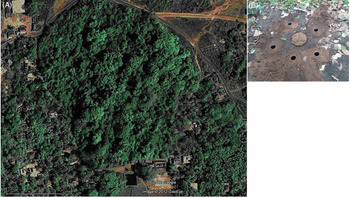
In this study, we tested the efficiency of an improved dung pile method for sampling dung beetles, in particular the rollers. We used dung piles on a bare ground and guarded them with pitfall traps in a radial distance from the pile (Fig. 1). We experimented this in three types of habitats—a closed protected semi-evergreen forest of a wildlife sanctuary (WLS), the relics of evergreen forest patches of sacred groves (SG), and the relatively open home gardens (HG) in the vicinity of SGs—and two diurnal periods—day and night—to examine the plausible effect of habitat and diel activity period on the sampling efficiency of this method. We asked whether the habitat type, diel period, and sampling method predict the roller beetles’ catches.
A) A paired SG–HG site in Cheemeni 1; the closed forests in the centre is the SG and the palm fronds on bottom left and right of SG are HGs; B) a representative sampling layout shows fresh cow dung guarded by five pitfall traps.

Material and methods
Study site
The study was carried out in north Malabar part of the state of Kerala in peninsular tropical India. We selected Aralam wildlife sanctuary (11°54′N 75°47′E and 11° 59′ N 75° 57′E) for sampling beetles of a continuous stretch of semi-evergreen lowland forests. It has a total area of 55 km2, and is part of one of the major elephant corridors in Kerala and Karnataka. Elephants and other browsing ungulates are the sources of natural dung in Aralam WLS. The SGs of this study are small cultural forests seen in a mosaic of home gardens, agricultural lands, and human settlements in the rural and urban landscapes of Kannur and Kasaragod districts of Kerala (Fig. 1). Small vertebrates, macaques, bats, and birds are the natural source of dung in SGs. Cattle grazing is limited inside SGs. So, they have fewer number of natural dung piles either from cattle or wild animals. The HGs selected in this study are the multi-storied crop systems under the top story of coconut palms (Fig. 1). They have cattle and other livestock to supply natural dung. The sampling was carried out during February–April 2019.
We selected 4 sites in the Chavachi section of Aralam WLS and 11 paired sites for SG and HG pairs for this investigation. The 11 SG–HG paired sites stood at an average distance of about 40 km from each other. The closest SG–HG pair was about 40 km from the Aralam WLS.
Methods
The beetles were sampled using fresh cow dung collected from the cattle farm of a house closest to the study site. We used one dung pile of 1000 g to sample beetles from each habitat and site. We used five pitfall traps—plastic container of 7 cm diameter and 13 cm depth—around each dung pile at a radius of about 50 cm from the edge of cow dung to sample rollers. We used 90% ethanol in the pitfall traps to preserve the rollers. The inter-pitfall distance was about 30 cm. One dung pile with five guarding pitfall traps make up one sampling unit. We sampled in day and night. For diurnal sampling, we laid the dung pile at 6 h and retrieved at 18 h. For nocturnal sampling, we laid the dung piles at 18 h and retrieved at 6 h next day. Together, we had 260 pitfall traps and 52 dung samples in the entire study (Table 1). The dung pile along with 1-foot soil beneath the dung pile and the guarding pitfall traps were retrieved after 12 hours of sampling. The second sampling units, for nocturnal sampling of dung beetles, were installed 10 m away from the place of first sampling unit. The dung piles along with the soil were immediately soaked in a bucket full of water and allowed the beetles to float on water. All beetles were collected, preserved in 90% ethanol, and identified the species using Arrow (Reference Arrow and Stephenson1931). In this study, only roller beetles were used.
Sampling effort (Dung=dung piles; PF=guarding pitfall traps) and summary results of roller dung beetles sampled in Aralam Wildlife Sanctuary and paired SGs and HGs in and along the Western Ghats biodiversity hotspot

* 50% of the total effort was made each for diurnal and nocturnal sampling.
** Calculated on combined diurnal and nocturnal traps.
P=Paragymnopleurus sinuatus; Sn=Sisyphus neglectus; Sl=Sisyphus longipes.
Data analysis
We pooled the catches of five guarding pitfall traps of respective dung piles to find out the number of rollers sampled in pitfall traps. The rollers trapped in dung piles and pitfall traps were recorded separately. We considered the abundance of roller beetles trapped in dung pile alone as one sample and the number of rollers trapped in guarding pitfall traps augmented to the number of rollers sampled in dung pile as another sample. We modelled roller dung beetles’ abundance on habitat, diel period, and sampling method (dung pile and dung pile plus guarding pitfall trap) using a Generalized Linear Model with negative binomial distribution as the error type. The significance of the model was tested using three-way ANOVA test available in the R-package, car. All analyses were performed using the program R 4.0.5 (R Development Core Team, 2016).
Results
We collected a total of 160 roller beetles in the entire study; 156 rollers (98%) each were sampled during day and from pitfall traps and 4 rollers (2%) each were sampled during night and from dung piles (Table 1). The WLS, SG, and HG sampled 116 (73%), 39 (24%), and 5 (3%) rollers, respectively. When all the four sites of WLS sampled rollers, only one and two sites out of the 11 sites each for SG and HG, respectively, sampled the rollers. When 50% (N=20) of the pitfall traps installed in WLS sampled rollers during the day, only 3% (N=55) and 5% (N=55) of the pitfall traps that operated in SG and HG, respectively, sampled rollers. One each roller beetle was collected from WLS and SG; from HG, two rollers were collected.
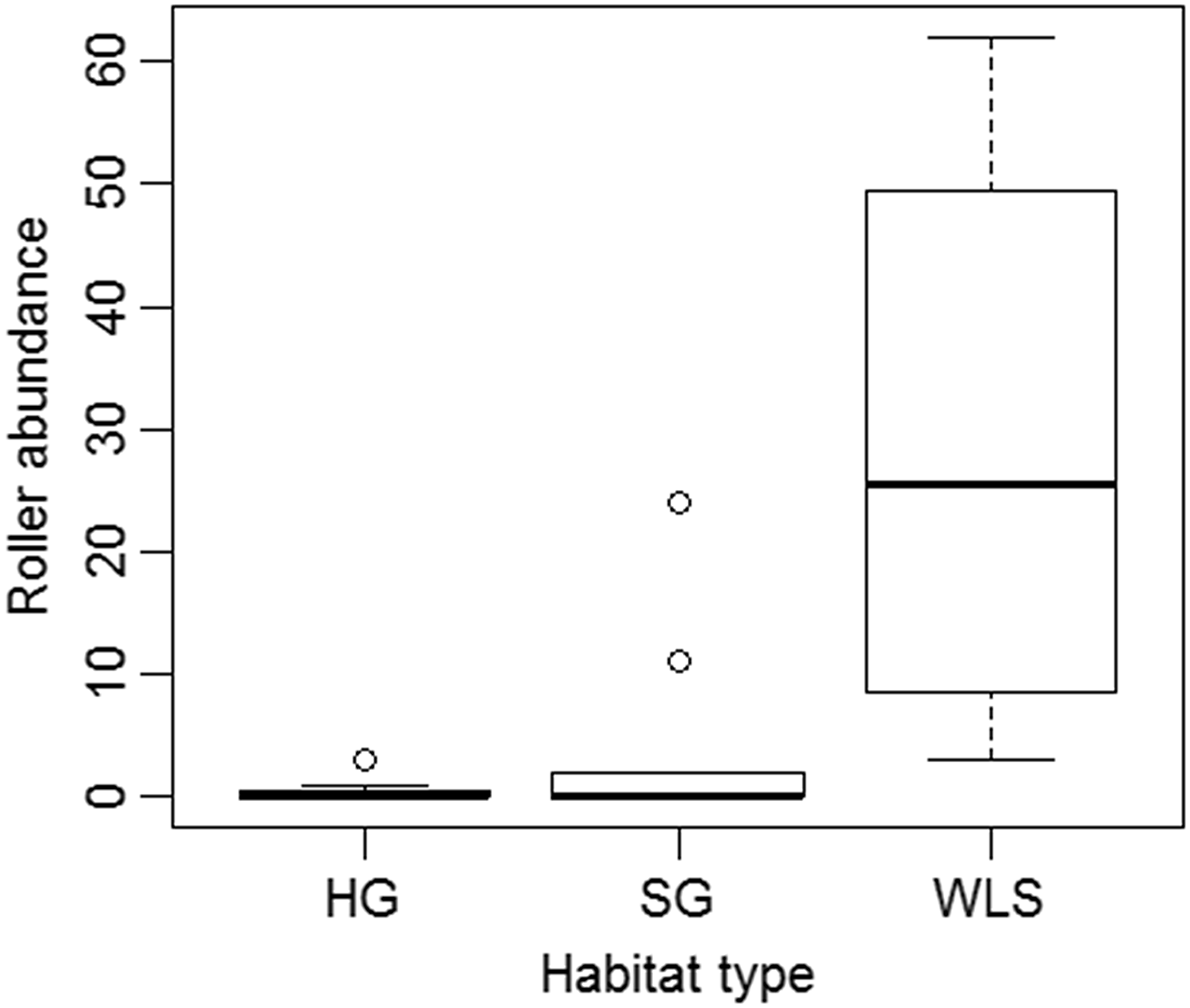
The abundance of roller dung beetles in the sites of three habitats varied considerably (Fig. 2). Paragymnopleurus sinuatus (Oliver 1789) was the only roller species sampled in the sites of WLS. But 95% and 100% of all rollers sampled in SG and HG sites, respectively, were belonging to two species of smaller roller beetles, Sisyphus longipes (Oliver 1789) and S. neglectus (Gory 1833) (Table 1). They were sampled from three SG–HG paired sites (Cheemeni1, Cheemeni 2, and Koyithatta) closest to the WLS (approx. distance about 40 km). This suggests that rollers are rare in fragmented and modified habitats.
Roller abundance in pooled dung pile–pitfall traps and diurnal periods suggest that closed contiguous forests (WLS; 4 sites) contain more rollers than forest fragments (SG; 11 sites) and used lands (HG; 11 sites).

The habitats were alike when the roller catches of only dung piles were compared (χ2=0.5, df=2, p=0.77), but the habitats were entirely different when the catches of guarding pitfall traps were augmented to the sample of the corresponding dung piles and used in the analysis (χ2=121.29, df=2, p<0.0000005). When the samples of pitfall traps and dung piles were pooled, the model clearly showed that the roller abundance was predicted by the habitat (F2,23=13.4, p=0.0001).
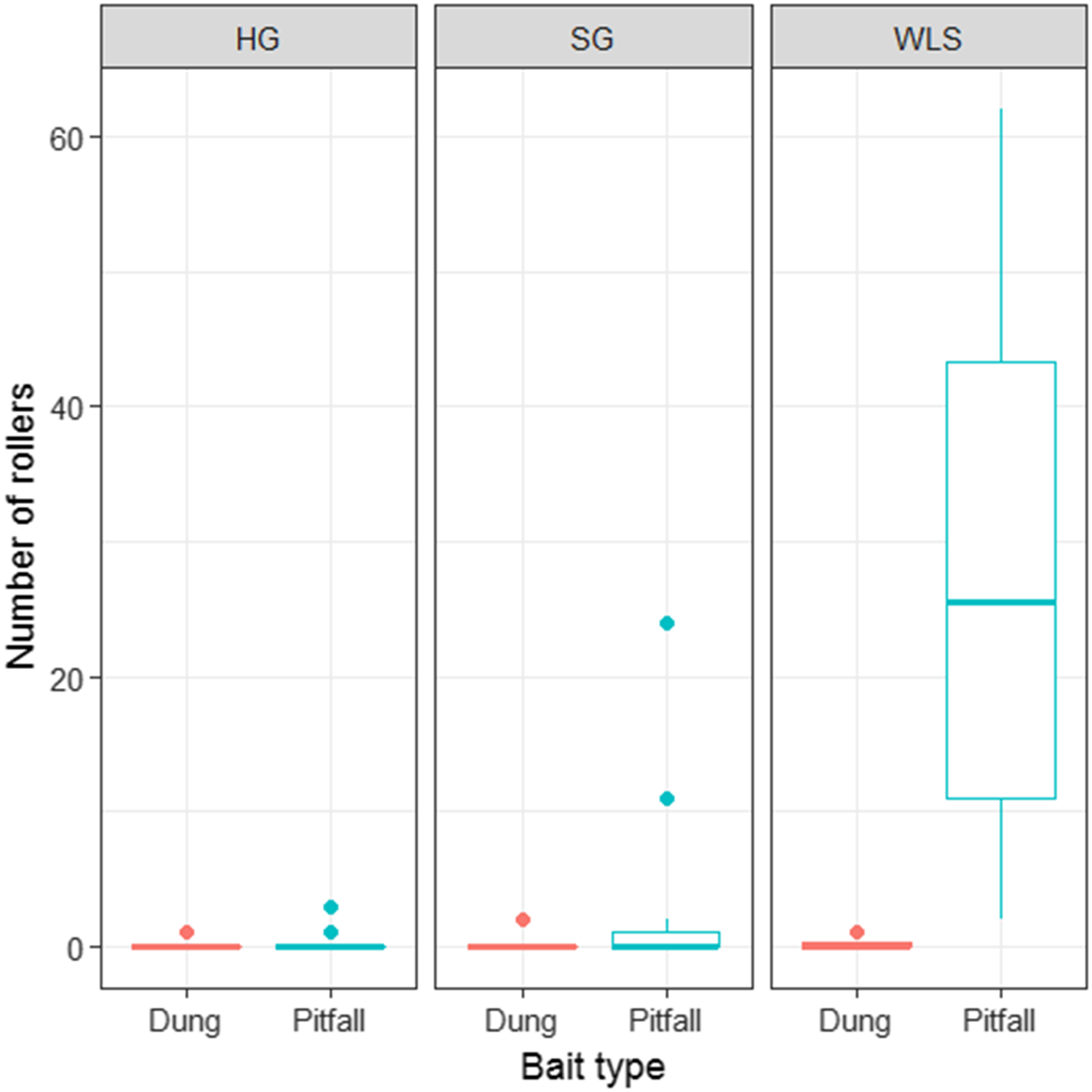
The study shows that the rollers also have a clear diel period of foraging activity (Fig. 3). Regardless of the species and habitat type, 98% of all roller beetles were sampled during day period. The mixed interactive model suggests that the roller catches were predicted by habitat (F2,92=11.28, p=0.00004), trap type (F1,92=12.58, p=0.0006), diurnal period (F1,92=12.58, p=0.0006), and an interaction of all the three factors (F2,92=13.91, p=0.000005) (Fig. 3).
Boxplots show that the habitats are not different on roller abundance of dung pile samples, but are different on the abundance of rollers of guarding pitfall traps, and suggest that dung pile alone produce a partial estimate of dung beetle diversity and abundance in continuous forest habitats. Diel periods-pooled data was used in the analysis (WLS: Ndung=4, NPF=20; SG and HG: Ndung=11, NPF=55); PF=guarding pitfall traps around dung piles.

Discussion
Studies that sample dung beetles use either dung-baited pitfall traps (Davis et al. Reference Davis, Scholtz, Dooley, Bham and Kryger2004, Jay-Amell-Caez et al. Reference Amell-Caez, Decastro-Arrazola and Noriega2019, Raine et al. Reference Raine, Mikich, Lewis and Slade2019) or dung piles or dung heaps on bare ground (Krell et al. Reference Krell, Krell-Westerwalbesloh, Weiß, Eggleton and Linsenmair2003, Reference Krell, Mahiva, Kouakou, N’goran, Krell-Westerwalbesloh, Newman, Weiß, Doumbia, Huber, Sinclair and Lampe2007). Although the former method is efficient for generating information on dung beetle species diversity rapidly (Lobo et al. Reference Lobo, Martín Piera and Veiga1988), they return both the genuine habitat specialists and ‘tourists’ (Raine et al. Reference Raine, Mikich, Lewis and Slade2019). However, the latter method can provide additional information on the ecology and behaviour of dung beetles in ephemeral dung, such as competition and partitioning of resource among dwellers, rollers and tunnellers, predictors of tunnelling behaviour among tunnellers, secondary seed dispersal efficiency of rollers, dung utilization by different functional groups of dung beetles, and so on. But, the probability of losing rollers is high when a dung pile is used without a proper surveillance system.
In this study, we suggested a new method to sample dung beetles, in particular the roller beetles. The results were promising and clearly suggested the following: 1) dung piles alone on ground may underestimate the diversity of dung beetles and dung beetle activities across space and time due to the likely missing of roller dung beetles; 2) in the study area, roller beetles prefer contiguous closed forests than the forest fragments and modified used lands; 3) rollers are active during day period; and 4) the habitat type predicts the roller species assemblage and abundance.
The dung pile dung beetle samples misinformed that the habitats were not different on the abundance of dung beetles. When the data of guarding pitfall traps were augmented and considered in the analyses, the three habitats stood different on roller species assemblage and abundance. On average, the dung piles of WLS sampled only one roller beetle, but the guarding pitfall traps of the corresponding dung piles sampled 115 rollers. The study, therefore, suggests that the results based on dung beetle samples of dung piles can misled the studies, particularly the ones happen in continuous forest habitats.
Among the three functional groups of dung beetles—tunneller, roller, and dweller, rollers are highly sensitive to habitat type and forest fragmentation (Carvalho et al. Reference Carvalho, Andersen, Anjos, Pacheco, Chagas and Vasconcelos2020, Escobar Reference Escobar2004). Our results agree that the WLS sampled highest number of rollers and the used HGs sampled lowest number of rollers. The species that were sampled in WLS are different from those were sampled on SG–HG pairs. This study collected three species of rollers, Paragymnopleurus sinuatus, Sisyphus longipes, and S. neglectus. Among them, P. sinuatus was collected exclusively from the WLS, and the two species of Sisyphus were predominantly collected from SGs; the highly disturbed HGs sampled very low number of rollers. Interestingly, the WLS sampled no species of Sisyphus. The three species are also different in terms of their body size; P. sinuatus has a body length of 16–19 mm and a width of 11–14 mm; S. longipes has a size of 4–6 mm length and 2.5–4 mm width; and S. neglectus has a length of 5.5–7 mm and a width of 3.5–4 mm. This suggests that the present method is efficient for capturing rollers of different sizes and habitat affinities (Nielsen Reference Nielsen2007). The WLS is a contiguous forest, and SGs are small islets of natural vegetation. Aralam is a wildlife protected area and has a large population of wild elephants and wild gaurs. The dung piles of these animals are large compared to the size of cow and buffalo, the natural sources of dung in SGs and HGs. The study suggests that the difference in the quality of habitat and source of dung might explain the roller species assemblage, species traits (for instance, the body size), and their abundance (Errouissi et al. Reference Errouissi, Haloti, Jay-Robert, Janati-Idrissi and Lumaret2004, Finn & Giller Reference Finn and Giller2000).
The rollers were mostly collected during day in all three habitats. This result is in agreement with other studies (Bartholomew & Heinrich, Reference Bartholomew and Heinrich1978, Chao et al. Reference Chao, Simon-Freeman and Grether2013, da Silva et al. Reference da Silva, Lobo and Hernandez2018, Krell-Westerwalbesloh et al. Reference Krell-Westerwalbesloh, Krell and Linsenmair2004, Iannuzzi et al. Reference Iannuzzi, Salomão, Costa and Liberal2016, Nichols et al. Reference Nichols, Spector, Louzada, Larsen, Amezquita and Favila2008, Sowig, Reference Sowig1995, Reference Sowig1996), that found that rollers prefer high temperatures and active during day and around noon. Studies also reported high larval mortality in moist and wet dung balls (Nichols et al. Reference Nichols, Spector, Louzada, Larsen, Amezquita and Favila2008, Sowig Reference Sowig1995, Reference Sowig1996). Studies also suggest that the day temperature is ideal for rolling dung balls (Bartholomew & Heinrich, Reference Bartholomew and Heinrich1978, Chao et al. Reference Chao, Simon-Freeman and Grether2013). Although we have not investigated the seasonality of roller beetles by comparing the samples of dry and wet seasons in this study, one of our other studies in SGs (Asha et al. Reference Asha, Manoj, Megha and Sinu2021) sampled no rollers during wet season, when the tunnellers and dwellers were sampled abundantly.
The method we suggested is promising and returns a reliable data of dung beetles of all three functional groups, but is bit more laborious than using the dung pile alone method for sampling dung beetles. The ground, where the dung piles are kept for sampling beetles, because is undisturbed in this method, can generate a reliable information on the behaviour and population characteristics of tunnelling beetles. Since the guarding pitfall traps in our experiments were spaced out, a few rollers might have been escaped through the inter-pitfall gaps. Customization in the number of guarding pitfall traps or using a circular pitfall around dung piles can further improve the efficiency of this method. The fresh dung piles on bare ground are also susceptible to insectivorous birds (Young, Reference Young2015). That risk is still present in this method. However, we did not lose any of our dung piles to such birds neither in this study nor in any of our other studies in the Western Ghats biodiversity hotspot (Asha & Sinu Reference Asha and Sinu2020, Asha et al. Reference Asha, Manoj, Megha and Sinu2021). Wherever the birds are a threat for the dung beetles in dung piles, a wire-fenced enclosure can keep the dung piles safe from such birds. The study suggests that adopting this method is essential when dung piles or heaps are opted for sampling dung beetles in contiguous forests, because the activity of rollers is higher in continuous forests than fragmented forests and used lands.
Acknowledgements
PAS thanks SERB Core Program and Western Ghats cell of Kerala State Economic and Planning Affairs for funding this research. GA thanks Kerala State Council for Science Technology and Environment for the Ph.D. fellowship. We thank the Kerala Forest Department for the permission to use Aralam Wildlife Sanctuary for our study. We thank the reviewer for constructive comments on the previous version of the MS.
Conflict of Interest
The authors report no conflict of interest