Introduction
Processing speed is the most impaired neuropsychological domain in schizophrenia and a robust correlate of social and vocational functioning (Dickinson, Ramsey, & Gold, Reference Dickinson, Ramsey and Gold2007; August, Kiwanuka, McMahon, & Gold, Reference August, Kiwanuka, McMahon and Gold2012; Nuechterlein et al., Reference Nuechterlein, Subotnik, Green, Ventura, Asarnow, Gitlin and Mintz2011; Sanchez et al., Reference Sanchez, Ojeda, Pena, Elizagarate, Yoller, Gutierrez and Ezcurra2009). Interventions that ameliorate processing speed impairment may improve functional outcome in schizophrenia. Commonly used neuropsychological measures of processing speed, such as the digit–symbol coding and symbol search tests that make up the Wechsler Adult Intelligence Scales (WAIS) Processing Speed Index (PSI), tap a wide array of cognitive operations, including perception, sustained attention, and fine motor skill. Not surprisingly, neuroimaging investigations have linked performance on neuropsychological measures of processing speed to several brain areas, including the prefrontal cortex (PFC) (Glascher et al., Reference Glascher, Tranel, Paul, Rudrauf, Rorden, Hornaday and Adolphs2009; Rypma et al., Reference Rypma, Berger, Prabhakaran, Bly, Kimberg, Biswal and D'Esposito2006). Thus, while exquisitely sensitive to brain dysfunction, neuropsychological tests of processing speed lack the precision to determine which specific cognitive operation(s) are impaired in schizophrenia. This limitation has hampered efforts to elucidate the neural basis of processing speed impairment in schizophrenia and is a barrier to the development and application of pro-cognitive interventions.
This barrier may be overcome by using cognitive neuroscience-based approaches to investigate processing speed impairment in schizophrenia. One influential cognitive model derived from experimental psychology posits that processing speed reflects the sum total of three stages: perceptual analysis and categorization, response selection, and response execution (Pashler, Reference Pashler1994). The available evidence, while limited, suggests that response selection, the process of mapping stimuli to specific responses and decision making, is impaired in schizophrenia (Krieger, Lis, & Gallhofer, Reference Krieger, Lis and Gallhofer2001; Krieger et al., Reference Krieger, Lis, Janik, Cetin, Gallhofer and Meyer-Lindenberg2005; Pellizzer & Stephane, Reference Pellizzer and Stephane2007). For instance, by comparing two-choice reaction time (RT) to four-choice RT, Pellizzer and Stephane (Reference Pellizzer and Stephane2007) found that RT slowing between the two conditions was increased in schizophrenia compared to healthy subjects. Since perceptual processing and motor demands were consistent across conditions, greater RT slowing between conditions implicates dysfunction at the response selection stage of information processing. Using a similar approach, Krieger and colleagues found greater choice RT slowing, compared to simple RT, in both chronic and antipsychotic naïve first-episode patient groups, indicating that response selection impairment is present early in the course of the illness and is not a side effect of antipsychotic medications (Krieger et al., Reference Krieger, Lis and Gallhofer2001, Reference Krieger, Lis, Janik, Cetin, Gallhofer and Meyer-Lindenberg2005). Prolonged choice RT and increased dual-task costs in unaffected relatives further argue against a medication effect in patients and suggest that impaired response selection is related to genetic vulnerability for schizophrenia (Cannon et al., Reference Cannon, Huttunen, Lonnqvist, Tuulio-Henriksson, Pirkola, Glahn and Koskennvuo2000; Woodward et al., Reference Woodward, Waldie, Rogers, Tibbo, Seres and Purdon2009).
Choice RT correlates with neuropsychological tests of processing speed (e.g., Deary, Liewald, & Nissan, Reference Deary, Liewald and Nissan2011), suggesting that response selection dysfunction may account for at least some of the deficit on neuropsychological tests of processing speed in schizophrenia. If this is the case, then investigating the neural basis of response selection may illuminate the neural basis of processing speed impairment in schizophrenia. Taking advantage of the excellent temporal resolution of electroencephalography (EEG), Luck and colleagues (Reference Luck, Kappenman, Fuller, Robinson, Summerfelt and Gold2009) found that the lateralized readiness potential (LRP), an electrophysiological index of stimulus–response translation, is reduced in amplitude and delayed in onset in schizophrenia. While informative, the poor spatial resolution of EEG limits the extent to which it can be used to inform the anatomical basis of response selection dysfunction. Functional neuroimaging studies indicate that response selection relies upon a distributed network of brain regions that includes the PFC (i.e., dorsolateral PFC, inferior frontal junction, anterior insula, and dorsomedial PFC), posterior parietal cortex, and sub-cortical structures, especially the thalamus (Dux, Ivanoff, Asplund, & Marois, Reference Dux, Ivanoff, Asplund and Marois2006; Marois, Larson, Chun, & Shima, Reference Marois, Larson, Chun and Shima2006; Schumacher, Elston, & D'Esposito, Reference Schumacher, Elston and D'Esposito2003; Tombu et al., Reference Tombu, Asplund, Dux, Godwin, Martin and Marois2011). A prior fMRI investigation of response selection revealed increased blood-oxygenation-level-dependent (BOLD) response in the right dorsolateral PFC during performance of a four-choice RT task in chronic schizophrenia, unmedicated first-episode patients, and unaffected relatives of patients (Woodward et al., Reference Woodward, Waldie, Rogers, Tibbo, Seres and Purdon2009). Unfortunately, the experimental paradigm could not isolate brain regions involved in response selection from perceptual processing, motor responses, and general attention, nor was the relationship between neural activity and neuropsychological functioning examined.
With the limitations of prior studies in mind, the goals of the current investigation were three-fold. The first goal was to confirm that response selection is impaired in schizophrenia and determine if response selection is related to a neuropsychological measure of processing speed, the WAIS PSI. The second goal was to examine the relationship between response selection related brain activity in the dorsolateral PFC measured using fMRI, a behavioral index of response selection, and performance on a neuropsychological index of processing speed, the WAIS PSI. Behaviorally, response selection was defined as the difference in RT between two- and four-choice RT, while brain activity related to response selection was defined as those brain regions that demonstrated greater BOLD response during four-choice RT compared to two-choice RT. Given evidence from lesion mapping and fMRI studies linking the dorsolateral PFC to neuropsychological tests of processing speed, and the prior finding of right dorsolateral PFC hyper-activation during response selection in schizophrenia and unaffected relatives of patients, we tested the hypothesis that there is a relationship between dorsolateral PFC activity and WAIS PSI, and that this relationship would be mediated by response selection (i.e., RT slowing between two- and four-choice RT). The final goal was to confirm that exaggerated dorsolateral PFC hyperactivity observed in a prior study of schizophrenia patients and unaffected relatives is related to response selection and not perceptual processing and/or response execution.
Methods
Participants and Study Procedures
Twenty-two healthy subjects and 31 individuals with schizophrenia/schizoaffective disorder were recruited into the study. This study was approved by the Vanderbilt University Institutional Review Board and all subjects provided written informed consent before participation. Patients were recruited from the Vanderbilt Psychotic Disorders Program at the Vanderbilt Psychiatric Hospital located in Nashville, Tennessee, and healthy subjects were recruited from Nashville and surrounding area via print/internet advertisement and word-of-mouth. Subjects were administered the Structured Clinical Interview for Diagnosing DSM-IV Disorders (SCID: First, Spitzer, Gibbon, & Williams, Reference First, Spitzer, Gibbon and Williams1996) to confirm diagnoses in patients and rule out current or past psychiatric illness in healthy subjects. Clinical symptoms in patients were assessed using the Positive and Negative Syndrome Scale (PANSS: Kay, Fiszbein, & Opler, Reference Kay, Fiszbein and Opler1987). The Simpson-Angus Scale (SAS: Simpson & Angus, Reference Simpson and Angus1970) was administered to patients to asses extrapyramidal symptoms (EPS). Subjects completed the Wechsler Test of Adult Reading (WTAR: Wechsler, Reference Wechsler2001), which served as an estimate of premorbid intellectual functioning, and the Digit-symbol coding and Symbol Search subtests of the Wechsler Adult Intelligence Scale 3rd Edition (WAIS), which together comprise the WAIS PSI. Subjects also completed versions of the Auditory Consonant Trigrams test of working memory, phonemic verbal fluency, and word list learning tests included in the Screen for Cognitive Impairment in Psychiatry (SCIP: Purdon, Reference Purdon2005). Exclusion criteria included age less than 18 or greater than 60; estimated pre-morbid intellect less than 70; presence of a systemic medical illness or neurological disorder that would affect study results; reported pregnancy or lactation; history of significant head trauma; psychotropic drug use (healthy subjects only); substance abuse within the past 3 months (patients); or lifetime history of substance abuse/dependence (healthy controls); and MRI contra-indicators (e.g., metal implants, claustrophobia).
Response Selection Behavioral Paradigm
Subjects performed a visual-manual RT paradigm that included two-choice RT (i.e., low response selection load) and four-choice RT (i.e., high response selection load) conditions. The logic of the experiment is based on the premise that: (1) response selection impairment in schizophrenia will manifest itself as greater RT slowing between low and high load conditions (e.g., Pellizzer & Stephane, Reference Pellizzer and Stephane2007); and (2) brain regions involved in response selection will demonstrate greater activity during the high compared to the low response selection load conditions (e.g., Dux et al., Reference Dux, Ivanoff, Asplund and Marois2006; Marois et al., Reference Marois, Larson, Chun and Shima2006). Stimuli consisted of six differently colored disks presented one at a time in the center of a computer monitor (red, blue, green, brown, yellow, purple). Each color disk was paired with a different motor response (index, middle, and ring fingers of the left and right hands). Stimulus-response pairings and assignment of fingers to stimuli was counterbalanced across such that subjects performed the two-choice RT condition with either the index finger or ring finger of their left and right hands. Each trial began with the presentation of a stimulus cue for 750 ms and was followed by a 3-s fixation period. Subjects were instructed to respond as quickly and accurately as possible. Trials were presented in blocks of 12. Each block of trials began with a cue, presented for 3 seconds, indicating that the upcoming trials were either two- or four-choice RT trials. Blocks were presented in an AB/BA manner interleaved with fixation periods. There were four blocks of each condition per run, and subjects completed 1–3 runs. To ensure subjects performed the tasks accurately during fMRI scanning, subjects learned the six stimulus-response pairings before entering the scanner. The practice session consisted of three “training” blocks (30 trials/block) during which the stimulus-response mapping was present at the top of the screen on each trial. Each training block was followed by a “test” block (18 trials/block) during which the stimulus-response mapping diagram was removed. Subjects completed another brief practice session in the scanner consisting of two training blocks interleaved with two test blocks immediately before the functional runs.
fMRI Data Acquisition
All imaging data was collected on a research dedicated 3 Tesla (T) Philips Intera Achieva scanner. The functional echo-planar imaging scans had the following parameters: 28 axial slices, matrix 80 × 80, 3.0 mm × 3.0 mm in-plane resolution, 4.0 mm thick slices, 203 volumes, TR/TE = 2000/35 ms. A high resolution T1-weighted fast field echo (FFE) structural scan with 170 sagittal slices. 1.0 mm isovoxel resolution, was also collected. Preprocessing and statistical analysis of the functional imaging data was performed in SPM8 (http://www.fil.ion.ucl.ac.uk/spm/software/spm8/). Preprocessing steps included head motion and slice-timing correction, coregistration of the functional data to the T1-weighted anatomical scan, spatial normalization to MNI space, and spatial smoothing with an 8-mm kernel. Voxel-wise statistical analysis proceeded by modeling each subject's time series functional data as a boxcar function, convolved with a gamma function to account for lag in the hemodynamic response, with two- and four-choice RT conditions entered as predictors in a first level analysis. Brain regions involved in response selection were isolated by contrasting the low and high response selection load conditions (i.e., four-choice RT > two-choice RT).
Statistical Analyses
Response selection impairment and psychometric processing speed in schizophrenia
To determine if response selection is impaired in schizophrenia, each subject's median RT, correct trials only, for the two- and four-choice RT conditions was entered into a repeated measures analysis of variance with condition and diagnosis entered as within and between group predictors, respectively. Accuracy data were analyzed in a similar manner. To test the hypothesis that response selection is related to WAIS PSI, irrespective of diagnosis, a linear regression analysis was performed with WAIS PSI entered as the dependent variable, and diagnosis and RT slowing (four-choice RT minus two-choice RT) entered as predictors.
Relationship between psychometric processing speed, response selection, and dorsolateral prefrontal cortex function
In light of our previous finding of right dorsolateral PFC hyperactivity during response selection in schizophrenia (Woodward et al., Reference Woodward, Waldie, Rogers, Tibbo, Seres and Purdon2009), and to avoid bias associated with post hoc voxel-wise brain–behavior correlations (e.g., Vul, Harris, Winkielman, & Pashler, Reference Vul, Harris, Winkielman and Pashler2009), we focused our analyses of the relationship between neural activity, response selection, and WAIS PSI to an a priori defined region of the right dorsolateral PFC. Specifically, response selection brain activity (i.e., four-choice > two-choice RT), was extracted from a 6-mm sphere located in the right dorsolateral PFC (MNI coordinates 40 44 28) using the same coordinates from our previous study (Woodward et al., Reference Woodward, Waldie, Rogers, Tibbo, Seres and Purdon2009). Based on evidence that hyperactivity of the dorsolateral PFC correlates with worse performance on a modified digit-symbol coding task (Rypma et al., Reference Rypma, Berger, Prabhakaran, Bly, Kimberg, Biswal and D'Esposito2006), we first tested the hypothesis that BOLD response in the dorsolateral PFC is inversely correlated with WAIS PSI scores. Once this relationship was confirmed, we then tested the hypothesis that the association between dorsolateral PFC activity and WAIS PSI is mediated by response selection. That is, the inverse relationship between dorsolateral PFC activity and WAIS PSI would be at least partially mediated by greater reaction time slowing between the two- and four-choice RT conditions. Mediation was tested using the approach outlined by Baron and Kenny (Reference Baron and Kenny1986).
Group differences in BOLD response during response selection
Group differences in response selection related brain activity were examined by entering each subject's statistical parametric map (SPM) derived from the first level four-choice > two-choice RT contrast into a second level, random effects between groups t test. Group differences were first examined within an a priori defined region-of-interest (ROI) that was restricted to the Laboratory of Neuroimaging (LONI) right middle frontal gyrus probabilistic atlas (Shattuck et al., Reference Shattuck, Mirza, Adisetiyo, Hojatkashani, Salamon, Narr and Toga2008) edited to include voxels 2.0 cm in the anterior–posterior and inferior–superior directions of MNI coordinate 40 44 28 obtained from a previous study (Woodward et al., Reference Woodward, Waldie, Rogers, Tibbo, Seres and Purdon2009). Results of the voxel-wise ROI analysis were thresholded at t = 2.50 with minimum cluster size of 84 voxels to control for Type I error rate at p = .05 (cluster-wise corrected). A whole-brain analysis was also undertaken, restricted to voxels that showed a main effect of condition across the combined group of healthy subjects and patients with schizophrenia, thresholded at whole-brain cluster-level corrected p = .05 for voxel-wise p = .001 (minimum cluster size = 245 voxels). We did not examine the two-choice > four-choice RT contrast (i.e., relative “de-activation” in activity during response selection) as we had no hypotheses concerning this contrast. The whole brain between groups contrast was thresholded at t = 2.50 with minimum cluster size = 360 voxels which corresponded to p = .05, cluster-level corrected (Poline, Worsley, Evans, & Friston, Reference Poline, Worsley, Evans and Friston1997). Minimum cluster sizes were calculated based on 5000 Monte-Carlo simulations, as implemented in the AlphaSim program, adjusted for the estimated smoothness of the images (Forman et al., Reference Forman, Cohen, Fitzgerald, Eddy, Mintun and Noll1995).
RESULTS
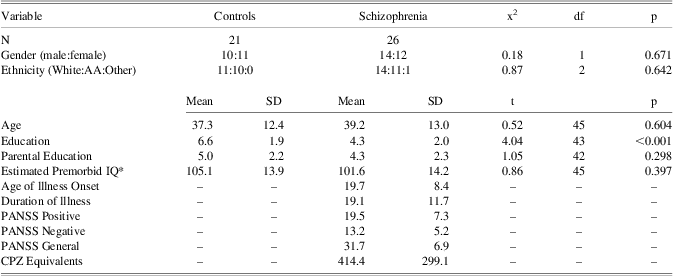
Five participants from our original sample of 53 subjects were excluded due to technical problems during scanning (healthy subjects: n = 1; schizophrenia: n = 1) or an inability to learn or adequately perform the response selection paradigm during scanning (patients: n = 3). Additionally, one patient was excluded because they were later found to not meet study criteria. Thus, the final sample consisted of 21 healthy subjects and 26 individuals with schizophrenia (schizoaffective disorder: n = 8). Demographics of the healthy subjects and schizophrenia groups are presented in Table 1. With the exception of schizophrenia patients having fewer years of education (t(43) = 4.04; p < .001), the groups did not differ on any demographic variable. Most patients (n = 16) were taking one atypical antipsychotic medication. Antipsychotic medication status for the remaining patients included two atypical antipsychotics (n = 2), one atypical antipsychotic (n = 2), unmedicated (n = 3), and unknown (n = 3). Average antipsychotic dosage, calculated in chlorpromazine equivalents using the guidelines established by Gardner, Murphy, O'Donnell, Centorrino, and Baldessarini (Reference Gardner, Murphy, O'Donnell, Centorrino and Baldessarini2010), was 414 ± 299 mg/day. There was very little EPS in the patient group. The highest SAS score was 3/40 (n = 3). 4 patients each scored 2/40 and 1/40. Eleven patients exhibited no EPS (i.e., SAS scores 0/40). The SAS was not administered to four patients. With respect to the functional imaging data, there were no group differences in the six motion correction parameters (i.e., translation and rotation in the x, y, and z planes) across all functional data runs (all t values < 1.58; p values > .121).
Means and standard deviations (SDs) of demographics of study participants
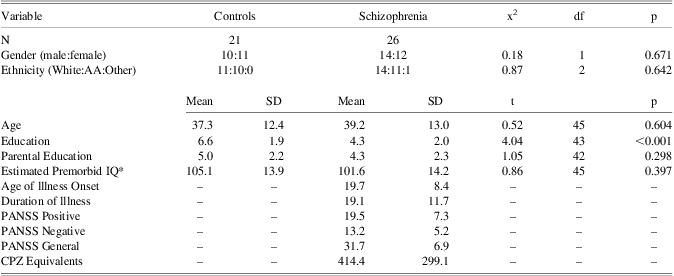
*Wechsler Test of Adult Reading standard score.
Abbreviations: CPZ=Chlorpromazine; PANSS=Positive and Negative Syndrome Scale.
Response Selection Impairment and Psychometric Processing Speed in Schizophrenia
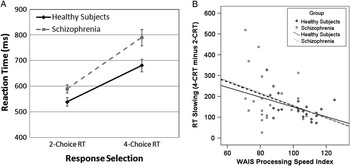
Two- and four-choice RT for each group are shown in Figure 1. A main effect of choice RT condition (four-choice RT > two-choice RT: F(1,45) = 157.39; p < .001) was observed which is consistent with the greater demands placed on response selection in the four-choice condition. Consistent with our hypothesis that response selection is impaired in schizophrenia, the group by choice-RT condition interaction term was significant (F(1,45) = 4.57; p = .038) due to the fact that patients with schizophrenia demonstrated greater RT slowing between two- and four-choice RT conditions (see Figure 1A). The main effect of group was also significant (F(1,45) = 6.78; p = .012) due to the fact that mean RT across choice RT tasks was greater in schizophrenia compared to healthy subjects. Given that the two-choice RT condition also involves response selection, the main effect of group on RT is not surprising. However, it raises the possibility that the interaction was due to generalized slowing in schizophrenia. Ideally, this possibility could be ruled out by including simple RT (SRT), which involves perceptual and motor processing, but not response selection. However, in the absence of empirical data, SRT can still be estimated using Hick's law (Jensen, Reference Jensen2006). Briefly, it is well known that there is a linear relationship between the number of response alternatives and RT. According to Hick's law, this relationship can be mathematically formulated as RT = a + b log2(n + 1), where a = SRT, b = RT slope, and n = the number of response selection alternatives. Thus, SRT = RT-b log2(n = 1). Using this formula, estimated SRT for the control and schizophrenia groups is 410 ms (SD = 71 ms) and 408 ms (SD = 104 ms), respectively. Importantly, estimated SRT did not differ between groups (t(45) = 0.08; p = .940. Thus, it seems unlikely that generalized slowing accounted for choice RT slowing in schizophrenia.
Response selection is impaired in schizophrenia and correlated with Wechsler Adult Intelligence Scale-III (WAIS) Processing Speed Index. A: Individuals with schizophrenia demonstrated greater reaction time (RT) slowing between two- and four-choice RT conditions: group by condition interaction F(1,45) = 4.57, p = .038. B: Greater RT slowing between two- and four-choice RT inversely correlated with WAIS Processing Speed index scores across all subjects; r = −.33, p = .026 (hatched line). Correlation between RT slowing and WAIS Processing Speed index was similar in healthy subjects (black line) and schizophrenia (gray line).

As shown in Figure 1B, regression analysis confirmed our hypothesis that response selection (i.e., four-choice RT minus two-choice RT) is related to worse performance on the WAIS PSI, irrespective of diagnostic group (partial correlation=−.33; p = .026). Moreover, when added as an additional predictor, the interaction term was not significant (t(45) = 1.46; p = .151) as the relationship between choice RT slowing and WAIS PSI was similar in healthy subjects and patients with schizophrenia (r = −.48 and r = −.30, respectively). To ensure that the regression analyses were not affected by heteroscedasticity, the data were analyzed using the Breusch-Pagan and Koenker tests of homoscedasticity. Neither test reached significance across the entire sample of subjects and within each diagnostic group (all χ2 values < 2.92; p > .233). To determine the specificity of the correlation between response selection and WAIS PSI, we repeated the regression analysis with the working memory, verbal fluency, and word-list learning tests from the SCIP entered as dependent variables, and group and RT slowing entered as predictors. None of the partial correlations was significant (all r values < |.24|; p > .11). Within the schizophrenia group, antipsychotic medication dosage was not related to WAIS PSI and RT slowing between choice-RT conditions (r values < |.31|; p > .125).
Accuracy was very high in healthy subjects and schizophrenia patients for both choice-RT conditions (two-choice RT: healthy subjects = 97.8 ± 1.7%, schizophrenia = 91.6 ± 1.5%; four-choice RT: healthy subjects = 96.3 ± 2.6%, schizophrenia = 87.7 ± 2.4%). Main effects of choice RT condition (F(1,45) = 5.68; p = .021) and group (F(1,45) = 7.21; p = .010) were observed reflecting the fact that subjects were more accurate in the two-choice RT condition and that overall accuracy was higher in healthy subjects than patients. However, the group by task interaction was not significant (F(1,45) = 1.08; p = .304).
Relationship between Dorsolateral Prefrontal Cortex Function, Response Selection, and Psychometric Processing Speed
Consistent with expectations, dorsolateral PFC BOLD response inversely correlated with WAIS PSI (r = −.35; p = .017). However, dorsolateral PFC BOLD response did not correlate with RT slowing between two- and four-choice RT conditions (r = −.05; p = .766). Thus, our hypothesis that the relationship between dorsolateral PFC activity and WAIS PSI is mediated by response selection was not confirmed. Rather, the correlations suggested that BOLD response and response selection were independent predictors of WAIS PSI. To confirm this, we performed a multiple regression analysis with group, RT slowing between conditions, and dorsolateral PFC activity entered simultaneously as predictors of WAIS PSI. Overall, this model was highly significant (F(3,42) = 15.83; p < .001), with group (t(42) = 4.27; p < .001), RT slowing between choice-RT conditions (t(42) = 2.77; p = .008), and dorsolateral PFC BOLD response (t(42) = 2.87; p = .006) each significantly predicting WAIS PSI.
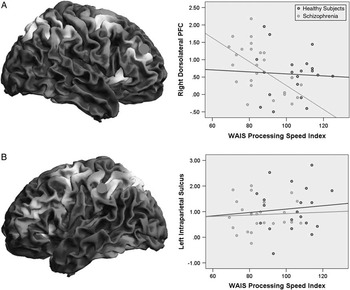
To determine if the relationship between dorsolateral PFC function and WAIS PSI differed between healthy subjects and schizophrenia, we repeated the regression analysis including the group by BOLD response interaction term. Overall, this model was highly significant (F(4,41) = 14.73; p < .001), with reaction time slowing (t(41) = 3.26; p = .002), BOLD response (t(41) = 2.64; p = .012), and the group by BOLD response interaction term (t(41) = 2.43; p = .020) all significantly predicting WAIS PSI. However, the group effect no longer remained significant in this model (t(41) = 1.45; p = .154), indicating that group differences in WAIS PSI scores was largely accounted for by impaired response selection and dorsolateral PFC hyper-activation. As shown in Figure 2A, the significant group by BOLD response was due to the fact that BOLD response and WAIS PSI scores inversely correlated in schizophrenia (r = −.58; p = .003), but not in healthy subjects (r = −.05; p = .821). The correlation between BOLD response and WAIS PSI was virtually unchanged when medication dosage was partialed out (r = −.57; p = .004).
The relationship between blood-oxygenation-level-dependent (BOLD) response during response selection and psychometric processing speed in schizophrenia and healthy subjects. BOLD response in an a priori defined region of the right dorsolateral prefrontal cortex (blue sphere) inversely correlates with Wechsler Adult Intelligence Scale-III (WAIS) Processing Speed index scores in schizophrenia (r = −.58; p = .003), but not healthy subjects (r = −.05; p = .821) (A). No relationship between BOLD response in the left intraparietal sulcus (blue sphere) and WAIS Processing Speed index scores was observed in either schizophrenia or healthy subjects (B). The activations map overlaid on lateral surface renderings represents the four-choice > two-choice reaction time (RT) contrast derived from all subjects and thresholded at p(FWE) = .05 cluster level corrected for voxel-wise p = .001.

To test the spatial specificity of this relationship, we extracted BOLD response from a 6 mm sphere centered on a coordinate in the left intraparietal sulcus (MNI −44 −36 44) that corresponded to the region most strongly activated by our task (t(46) = 10.30; p << .001) and repeated the same regression analysis performed for the dorsolateral PFC. As shown in Figure 2B, BOLD response in the intraparietal sulcus was unrelated to WAIS PSI scores (t(41) = 0.63; p = .532) and there was no indication of a group by BOLD response interaction (interaction term: t(41) = 0.20; p = .842).
Finally, to determine if the relationship between dorsolateral PFC BOLD response and WAIS PSI was specific to processing speed, we repeated the model with working memory, verbal fluency, and word list learning entered as dependent variables. The overall fit of the models was significant for working memory (F(4,41) = 3.37; p = .018) and word list learning (F(4,41) = 2.81; p = .038) due to the presence of a significant (or trend significant) group effect (t values > 1.73; p < .091); however, dorsolateral PFC BOLD response and group by dorsolateral PFC BOLD response did not significantly predict performance on any of these cognitive measures (t values < 0.71; p > .481).
Group Differences in BOLD Response during Response Selection
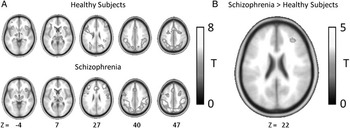
Random effects analysis of the four-choice RT > two-choice RT contrast revealed several brain areas commonly implicated in response selection, including bilateral prefrontal cortex, left inferior frontal junction, bilateral superior parietal cortex, intraparietal sulcus in particular, and, bilateral thalamus in both healthy subjects and patients with schizophrenia (see Figure 3A). Consistent with our hypothesis, a single cluster located at MNI 30 38 20 within the right dorsolateral PFC ROI mask demonstrated greater activity in schizophrenia compared to healthy controls (peak t(45) = 3.44; p(FWE cluster-level corrected) = .040, cluster size = 92 voxels) (see Figure 3B). Of interest, BOLD response in this cluster did not correlate with WAIS PSI in either healthy subjects (r = .13; p = .568) or schizophrenia patients (r = −.28; p = .169). There were no additional group differences observed in the whole-brain analysis for either the schizophrenia > healthy subjects or reverse contrasts.
Neural correlates of response selection in healthy subjects and schizophrenia. Response selection was associated with activity in a distributed set of brain regions, including dorsolateral prefrontal cortex, inferior frontal gyrus/anterior insula, superior parietal cortex, and thalamus in both healthy subjects and individuals with schizophrenia (A). Individuals with schizophrenia demonstrated greater activity than healthy subjects in a cluster located at MNI coordinates 30 38 20 (B). Statistical parametric maps thresholded at cluster-level corrected p(FWE) = .05 with small volume correction restricted to an a priori defined search region of the dorsolateral prefrontal cortex for the between group contrast shown in Panel B.

Discussion
The present study was undertaken to better understand the cognitive and neural basis of processing speed impairment in schizophrenia. Based on prior investigations in schizophrenia and evidence that response selection correlates with neuropsychological tests of processing speed, we hypothesized that response selection would be impaired in schizophrenia and that response selection would correlate with WAIS PSI, a well-known psychometric measure of processing speed. Both of these hypotheses were confirmed. Specifically, schizophrenia patients demonstrated greater RT slowing between two- and four-choice RT than healthy subjects and the degree of RT slowing inversely correlated with WAIS PSI. This finding suggests that at least some of the impairment observed on neuropsychological tests of processing speed in schizophrenia is related to response selection dysfunction. This relationship was relatively specific to processing speed as response selection was unrelated to verbal learning, working memory, and verbal fluency.
We also investigated the relationship between the neural correlates of response selection and psychometric processing speed. Evidence from prior imaging investigations indicates that the structure and function of the dorsolateral PFC correlates with neuropsychological measures of processing speed (Glascher et al., Reference Glascher, Tranel, Paul, Rudrauf, Rorden, Hornaday and Adolphs2009; Rypma et al., Reference Rypma, Berger, Prabhakaran, Bly, Kimberg, Biswal and D'Esposito2006). For instance, hyperactivation of the dorsolateral PFC correlates with longer reaction times on a modified version of the digit symbol coding task (Rypma et al., Reference Rypma, Berger, Prabhakaran, Bly, Kimberg, Biswal and D'Esposito2006). Consequently, we hypothesized that greater response selection related activity in the dorsolateral PFC would correlate with poorer performance on the WAIS PSI. We further hypothesized that this relationship would be mediated by RT slowing between choice-RT conditions (i.e., slowed response selection processing). These hypotheses were partially confirmed. As predicted, greater activation of the dorsolateral PFC was inversely related to WAIS PSI. However, contrary to expectations, the relationship between dorsolateral PFC hyperactivation and WAIS PSI was not mediated by response selection, which remained an independent predictor of WAIS PSI when dorsolateral PFC activation was included as a predictor in our model.
The relationship between PFC activity and processing speed should be interpreted cautiously as there are several caveats to our investigation. First, block design fMRI experiments are less than ideal for examining brain–behavior correlations involving information processing stages. Features of the BOLD response measured using event-related fMRI, including onset and peak latency, may be more sensitive biomarkers of response selection slowing given that they are more closely linked to the timing of behaviors than the amplitude of the BOLD response derived from a block design experiment (Dux et al., Reference Dux, Ivanoff, Asplund and Marois2006, Reference Dux, Tombu, Harrison, Rogers, Tong and Marois2009; Tombu et al., Reference Tombu, Asplund, Dux, Godwin, Martin and Marois2011). Thus, it is possible that our mediation model might have been confirmed if these features of the BOLD signal were available. Second, other cognitive processes might mediate the relationship between PFC activity and processing speed. None of the other cognitive domains we examined correlated with PFC activity during response selection. However, other cognitive processes involved in response selection, or that covary with response selection load, such as sustained attention and response inhibition, might mediate the relationship between PFC activity and WAIS PSI. Similarly, the relationship between dorsolateral PFC dysfunction and WAIS PSI may not be specific to response selection. Abnormal PFC function is observed during performance of a wide range of tasks in schizophrenia, including working memory, selective attention, and response inhibition (Minzenberg, Laird, Thelen, Carter, & Glahn, Reference Minzenberg, Laird, Thelen, Carter and Glahn2009). Thus, while our analyses suggest that the correlation between response selection related brain activity and processing speed is spatially circumscribed to the dorsolateral PFC, it may be the case that dorsolateral PFC activation under a variety of tasks co-varies with processing speed. Indeed, a diverse array of executive cognitive tasks activate a distributed fronto-cingulo-parietal network very similar to the one associated with response selection (Niendam et al., Reference Niendam, Laird, Ray, Dean, Glahn and Carter2012). Moreover, there is considerable overlap in the neural architecture underlying response selection and working memory encoding suggesting dysfunction within a distributed fronto-parietal network may underlie the diverse array of cognitive deficits in schizophrenia (Tombu et al., Reference Tombu, Asplund, Dux, Godwin, Martin and Marois2011; Lesh, Niendam, Minzenberg, & Carter, Reference Lesh, Niendam, Minzenberg and Carter2011). Studies that include functional scanning of more than one paradigm may be helpful in teasing apart the specificity, or lack thereof, of brain function–cognition relationships in schizophrenia. Finally, the fact that the correlation between brain activity and WAIS PSI was observed in schizophrenia, but not healthy subjects may relate, at least in part, to the greater range of WAIS PSI scores observed in patients.
The lack of simple reaction time (SRT) condition is an additional caveat of this study. Our inference that response selection is impaired in schizophrenia is based on the group by response selection load interaction. However, as noted by Chapman and colleagues (Chapman, Chapman, Curran, & Miller, Reference Chapman, Chapman, Curran and Miller1994), such interactions can arise from generalized slowing rather than a selective deficit in a specific cognitive function. The best method for controlling for generalized slowing effects is to include an SRT condition as SRT requires both perceptual processing and motor responses, but not response selection. Greater RT slowing across choice conditions, in the context of equivalent SRT, would provide compelling evidence for a specific deficit in response selection. Conversely, longer SRT in schizophrenia would indicate that generalized slowing might account for choice RT slowing. Unfortunately, we did not include an SRT condition. However, we were able to estimate SRT using Hick's law (Jensen, Reference Jensen2006). According to Hick's law, RT increases by a constant amount as a function of response uncertainty. Importantly, estimated SRT did not differ between groups. Nonetheless, we cannot definitively rule out the possibility that CRT slowing in schizophrenia is a consequence of generalized slowing, although it seems unlikely.
The parametric design of the current paradigm allowed us to confirm that our prior finding of exaggerated dorsolateral PFC activity in schizophrenia is related to response selection, and not perception or motor responding (Woodward et al., Reference Woodward, Waldie, Rogers, Tibbo, Seres and Purdon2009). Patients demonstrated greater response selection activity in a cluster located in the right dorsolateral PFC. Interestingly, although adjacent to our a priori defined ROI which correlated with WAIS PSI, this cluster did not correlate with WAIS PSI. This indicates that abnormal dorsolateral PFC activity in schizophrenia varies as a function of both diagnosis and degree of cognitive impairment. This may have implications for categorical Versus dimensional views of psychopathology. However, it is also possible that the categorical component to dorsolateral PFC hyperactivity varies with an alternative cognitive domain other than processing speed. For instance, response inhibition has been linked to right dorsolateral PFC activity (Niendam et al., Reference Niendam, Laird, Ray, Dean, Glahn and Carter2012). It is unlikely that response inhibition plays a prominent role in the current paradigm as there is no pre-potent response to inhibit or perceptual conflict to resolve. Nonetheless, we did not include a test of response inhibition and, therefore, cannot rule out the possibility that response inhibition contributed to the current results.
The current findings have important implications for the treatment of processing speed impairment in schizophrenia. As stated earlier, processing speed correlates with several dimensions of functional outcome in schizophrenia, including vocational and social functioning (Sanchez et al., Reference Sanchez, Ojeda, Pena, Elizagarate, Yoller, Gutierrez and Ezcurra2009). Our finding that response selection correlates with processing speed suggests that interventions that improve response selection may lead to gains in processing speed and, ultimately, enhance functional outcome. Of interest, there is growing evidence that response selection can be improved with training (Dux et al., Reference Dux, Tombu, Harrison, Rogers, Tong and Marois2009). For instance, Dux and colleagues (2009) found that training improves multi-tasking performance by reducing the duration of response selection stage processing. Moreover, training also increases the speed of information processing in the PFC (Dux et al., Reference Dux, Tombu, Harrison, Rogers, Tong and Marois2009). Consequently, training may also improve PFC physiology in schizophrenia. Finally, the overlap in the neural architecture underlying response selection and other cognitive abilities, such as working memory encoding, further suggests that interventions that improve response selection and PFC physiology may transfer to other cognitive functions (Tombu et al., Reference Tombu, Asplund, Dux, Godwin, Martin and Marois2011).
In conclusion, the current investigation examined response selection, response selection related brain activity, and psychometric processing speed in schizophrenia. As expected, response selection was impaired in schizophrenia. Moreover, impaired response selection correlated with worse performance on the WAIS PSI and greater activation of the dorsolateral PFC during response selection predicted worse WAIS PSI scores in patients. Combined, the findings indicate that impaired response selection and hyper-activation of the dorsolateral PFC during response selection contributes to poor performance on neuropsychological tests of processing speed in schizophrenia. Interventions targeting response selection may improve processing speed, dorsolateral PFC physiology, and functional outcome in schizophrenia.
Acknowledgments
The information in this manuscript has never been published either electronically or in print. No commercial support was received for the preparation of this manuscript and the authors have no conflicts of interest to report. This work was supported by a NARSAD Young Investigator Award and Luton Society Pilot grant, awarded to NDW; the Vanderbilt Psychiatric Genotype/Phenotype Project; and the Vanderbilt Institute for Clinical and Translational Research (1-UL1-RR024975 NCRR/NIH). The authors are indebted to the individuals who participated in the study. We thank Stephan Heckers, Kristan Armstrong, Julia Sheffield and Austin Woolard for their assistance in recruiting subjects for participation in the study.