

1. INTRODUCTION
This paper concerns women in the economy of mid-eighteenth-century Portugal. It assesses the role of marital status and location in women's economic participation and its effects on the capacities in which they were able to do so. It aims to contribute to the economic history of women in general and more specifically to the continuing debate on the role of marriage patterns and the position of women in the transfer of property. The article considers too the effect of women's life-cycles on female participation in the labour markets and, consequently, on their contributions to overall economic growth.
We shall argue from new evidence that marriage and widowhood did not prevent women from economic activity nor from participating in the labour market in mid-eighteenth-century Portugal. Our view therefore challenges the opinion currently dominant in mainstream international scholarship on women's participation in the labour markets and economies of southern Europe.
Our results suggest that:
(a) marriage was not an obstacle to women wishing to participate in the economy of mid-eighteenth-century Portugal. In fact, it was rather the opposite, as marriage seems to have provided women with the resources they needed to work in the tertiary sector, more often than not as self-employed people in commercial operations;
(b) and that a good number of single Portuguese women not only worked but that most of them were wage earners. These findings question the belief that the dowry system at the time meant that single women in southern Europe had neither need nor incentive to work.
Our findings suggest too that further revision is needed to the idea, so greatly emphasised in the international literature on women's participation in the European economies over the last sixty years, of a contrast between north-western and southern Europe.
The roots of this debate lie in earlier research done by Hajnal and Laslett on variations in European family structures and marriage patterns (Hajnal Reference Hajnal, Glass and Eversley1965; Laslett and Wall Reference Laslett and Wall1972; Laslett Reference Laslett and Laslett1977, Reference Laslett, Wall, Robin and Laslett1983). Their findings became the starting point for the development of a new analytical model put forward by Tine de Moor and Jan Luiten van Zanden in 2009 and 2010. Their aim was to explain the difference—also known as the ‘Little Divergence’—between the long-term economic growth experienced by north western Europe and the economic stagnation and decline seen in southern Europe (De Moor and Van Zanden Reference De Moor and Van Zanden2010; Van Zanden Reference Van Zanden2009, pp. 101–141).
De Moor and Van Zanden (Reference De Moor and Van Zanden2010, pp. 8–9) argued that in southern Europe the «dowry system created incentives for both parents and girls to arrange for an early marriage» and encouraged women to stay out of the labour market, because «regardless of the economic activities they undertook» their economic situation and position would remain more or less the same as set by the dowry they received at wedlock. Additionally, De Moor and Van Zanden argued that married women and widows had neither the interest nor the opportunity to «take over their deceased husband's business because they did not necessarily receive the share of the inheritance» (De Moor and Van Zanden Reference De Moor and Van Zanden2010, p. 10). In north-western Europe by contrast, in the absence of a dowry system unmarried young women needed to gather enough resources to marry, and therefore did have an incentive to enter the labour market. Additionally, once women were married, with their husbands they would create a conjugal fund, which women were permitted to inherit from their partners. Consequently, greater female participation rates in the north-western labour markets, in combination with other explanatory factors, must have contributed to greater economic growth in north-western Europe than in the rest of the Old Continent.
Since its publication, De Moor's and Van Zanden model has received a great deal of criticism for its failure to take into account regional variations and differences between rural and urban areas within southern Europe, where marriage patterns, family structures and systems of inheritance differed with consequent implications for female participation in the various economic regions of the vast Mediterranean Basin (Zucca Micheletto Reference Zucca Micheletto2011, Reference Zucca Micheletto2013; Bellavitis and Zucca Micheletto Reference Bellavitis and Zucca Micheletto2018; Sarasúa Reference Sarasúa2019; among others).
In Portugal, the argument of De Moor and Van Zanden that in southern Europe women married at a younger age does not seem to be true, as national and regional studies have shown that the average age of women at first marriage was found between 23.8 and 27.5 years old (Amorim Reference Amorim2004). These values suggest that the average age of first marriage among Portuguese women did not differ dramatically from north-western Europe where women married mostly around the age of 25 years (Flinn Reference Flinn1981). Portugal contradicts the De Moor's and Van Zanden model too in their assertions about women's property, inheritance rights and the non-existence of a conjugal fund to which women could access and would have interest in enlarging. In fact, according to late medieval and early modern Portuguese legal codes, women had property rights over half of all assets of the couple, whether they had been acquired prior or after wedlock—the so-called direito de meação (dos Sá Reference dos Sá2018). Additionally, women had always a say in all decisions concerning those assets, and could inherit them too. In case there were no children, women could effectively inherit all the assets of the couple (Ordenações Filipinas, Livro 1, titulo XCIV and XCV). Thus, in Portugal married couples seemed to had a sort of conjugal fund to which both members had access and which both had a common interest in expanding. Again, this evidence suggests that the situation of women in Portugal in terms of access and participation in the management of the couple's goods did not differ dramatically from north-western Europe.
According to the De Moor's and Van Zanden analytical model, given the patriarchal family structures of southern Europe we might also expect to find few women as Heads of Households (hereafter HoH). Furthermore, women's participation in the economy might be expected to be represented consistently across all marital statuses, since single women had no need to work because they could expect to receive a dowry, while married women and widows had no apparent incentive to work to enlarge conjugal wealth which they could not inherit.
The evidence presented and analysed in this article tends to confirm the first assumption, at least in part as only approximately 14 per cent of women appeared as HoH. That is indeed a relatively low percentage when compared with that for other European countries during the same period. In the Netherlands for example, Van Nederveen Meerkerk (Reference Van Nederveen Meerkerk, Van der Linden and Lucassen2012) has recorded a figure for HoH of more than 37 per cent in 1750. However, a comparison of regional variations in both cases presents a far more nuanced picture. While in mid-eighteenth-century Portugal women headed between 2.9 and 21.5 per cent of households, in the Netherlands the figures varied between 8 and 24 per cent.
Regarding the second presumption of the model, the data here discussed show that more married women and widows participated in the economy than did single women, suggesting that neither wedlock nor widowhood deterred women from participating in the labour market. That finding indeed leads us to question the validity of De Moor's and Van Zanden analytical model for Portugal. Similar results have been contributed to other regions of southern Europe (Zucca Micheletto Reference Zucca Micheletto2011, Reference Zucca Micheletto2013; Sarasúa Reference Sarasúa2019). Moreover, more widows and married women than single women are recorded in our sources as having occupations. That suggests that there must have been an advantage or perhaps even necessity for married women and widows to work. The results for Portugal seem to be in line with the research findings presented for Britain by Horrel and Humphries (Reference Horrel and Humphries1995) who showed that from 1787–1815 there were high numbers of married women participating in the economy. Meanwhile, Schmidt and Van Nederveen Meerkerk (Reference Schmidt and Van Nederveen Meerkerk2012) obtained similar results for the Netherlands in the period 1600–1900, where at least until the eighteenth century most working women were self-employed.
Additionally, the findings presented and discussed here clearly show that women too were active in the mid-eighteenth century Portuguese economy, although in smaller numbers than were married women and widows. There might have been two reasons for that. On the one hand, most probably it was because women could expect to receive dowries at marriage. On the other hand, and as argued by Zucca Micheletto (Reference Zucca Micheletto2011) for the case of Turin, it might equally have been to do with the question of women's social reputation. In any case, many single women were still being recorded as having an occupation.
We will also contend here that the marital status of women influenced both their occupations and labour relations, particularly so for married women and widows. Those two groups of women appear often in our data as self-employed and sometimes even as employers, whereas single women are recorded mainly as wage-earners. That evidence suggests that marriage and inheritance after widowhood could provide women with resources which might enable them to engage in certain forms of work less easily accessible to single women.
Furthermore and in terms of the specific literature on women's work in early modern Portugal—a still rather «neglected field» of study—this paper aims to begin the bridging of an important gap in the scholarship. We provide here a summary of the types of occupations women were involved in and assess whether or not there were any economic sectors of activity especially favoured by womenFootnote 1. In addition, we provide an overview of the capacities in which women developed their work, in other words, the types of labour relations they engaged in. The ultimate aim was to examine how married women and widows on the one hand and single women on the other hand faced the labour market, and to what extent and how work was accessible to them.
The results given here were based on a dataset of more than 15,500 nominal entries for HoH with occupational information for a selected number of localities across the six provinces of Portugal. The data encompass coastal and inland areas in the north, centre and south of the country to ensure representation of all its economic regions as well as of urban and rural areas. The data, extracted from fiscal registers from the mid-eighteenth century, can offer the first thorough, quantitative, gendered labour study of early modern Portugal. We present here too a contribution to the wider debate about the importance of gendered labour within a number of different regions of Europe.
2. SOURCES: PROBLEMS AND SOLUTIONS
Historical sources containing information about women's labour during the early modern period are difficult to find. More often than not women were seen as some combination of daughters, wives or widows and, therefore, remained either under-registered or hidden beneath the umbrella of the—generally male—HoH. Nominal records of individual women are therefore rare and often appear only if such women found themselves in social situations considered outside any of those three categories. That is especially evident in censuses and registrations for tax purposes. It appears that more often than not women were mentioned only if they were HoH or if they had a publicly known—and socially acceptable—occupation which generated sufficient income to come to the attention of the authorities. In most other situations, women remained «off the record» as Humphries and Sarasúa (Reference Humphries and Sarasúa2012) put it.
Portugal is no exception so we experienced similar difficulties to those faced by any of our European colleagues wishing to study women's labour and economic activities in the early modern period (Van Nederveen Meerkerk Reference Van Nederveen Meerkerk2006, Reference Van Nederveen Meerkerk, Van der Linden and Lucassen2012; Zucca Micheletto Reference Zucca Micheletto2011, Reference Zucca Micheletto2013, Reference Zucca Micheletto2014; Sarasúa Reference Sarasúa2019; among others).
The first difficulty we faced was the absence of a comprehensive census for the entire country with reliable figures on the male and female populations, and their respective occupations. To overcome that first challenge we decided to build our own data sample of the Portuguese population using information from tax record books of the so-called décima do maneio.
The décima do maneio was a universal levy implemented in 1641 to fund the War of Independence against Habsburg Spain from 1640–1668. Taxes of 4.5 and 10 per cent imposed on wages, salaries and other forms of income obtained through economic activity carried out by members of each household anywhere in the kingdom. With very few exceptions the tax was paid by almost all social strata, despite the strict social hierarchy of the early modern period (Magalhães Reference Magalhães2004). The tax continued to be collected into the eighteenth and nineteenth centuries and after the fiscal reforms of the Marquis of Pombal in 1761–1762 it was imposed on all social groups, including temporary workers, who had not been included in the earlier décimas of the 1640s-1650s, nor in their 1800s counterparts (Esperança et al., Reference Esperança, Polónia, Osswald and Amorim2002, p. 275–276; da Silva Reference da Silva, Lains and da Silva2005, p. 256). Registration was done by royal officials in each town and city of the kingdom, including urban and rural parishes many of which lay outside the walls of towns and cities (referred to as extra muros in Portuguese). Such parishes were often designated in the Portuguese sources as termo to refer to an area outside the walls of a city or town but under its jurisdiction. Royal officials collected information on a «door-to-door» basis for every street in each parish, to include the names of residents, their professions and the value of tax to be paid. In principle, all residents with income from economic activities were supposed to be recorded, but in practice registration focused on HoH and on the tax that would be generated by his or her occupation. Registration of the occupation and taxable income of other members of the household, either partners (mainly wives), youngsters, children, siblings or other relatives or co-habitants was not done systematically.
As a result, the majority of the individuals registered in the tax records were men, and their occupations were therefore also the majority of those recorded. Women appear in only two circumstances. Single women, widows or wives whose husbands were absent might be recorded as HoH, and the other case was of women who were pursuing economic activity that they were required to report. Consequently, the data sample we built and used as the basis of this study is much more representative of the labour, occupational structure and labour relations of women HoH than of women who were not HoH. However, we shall return to this point in the following sections of this paper.
The under-representation and under-counting of women in population counts and tax records is a problem shared by other researchers investigating women's labour whether in north-western or southern Europe. As a large number of authors working on gender and household economy have noted, more often than not source materials provide little information of poor quality about the type of work done by women and other dependent members of a household. The sources similarly reveal little of the relevance or value of that labour to the household's whole economy (Devos et al., Reference Devos, Schmidt and De Groot2016, p. 6). To overcome that difficulty we adopted a number of new methodological approaches. Among them, and to cite just a few of the solutions we found, were cross-referencing and comparative analysis of different types of sources to assess women's participation in the economy (Van Nederveen Meerkerk Reference Van Nederveen Meerkerk2006, Reference Van Nederveen Meerkerk, Van der Linden and Lucassen2012; Zucca Micheletto Reference Zucca Micheletto2011, Reference Zucca Micheletto2013). For this study, we opted to do that with the results obtained for HoH women and non-HoH women registered in the same source. We shall demonstrate outcomes and discuss conclusions in the following sections of this paper, showing that they are very similar—close to identical, in fact.
The second main problem commonly encountered in the demographic sources of the early modern period is the large proportion of women with no recorded occupation. The Portuguese source materials are no exception, so to address the problem we adopted a methodological approach similar to the one proposed by Schmidt and Van Nederveen Meerkerk (Reference Schmidt and Van Nederveen Meerkerk2012). We estimated the amount of unpaid ancillary work done by women and girls in family businesses to complement the data provided by the population counts. We presumed in fact that at least 50 per cent of the women (married or not and without any recorded occupation) could reasonably be expected to have been busy performing unpaid work assisting the male HoH, be they the women's husbands, fathers, or other male relation.
The third main problem concerns the recording of marital status. Data on marital status is usually provided in the source only if an HoH was in some unusual situation and therefore fell outside the normal family structure. Most references are therefore to single women and to widows or widowers. Concerning marital status then, the main source we used—the décima do maneio––was in most cases rich enough to provide us with information on any uncommon or abnormal marital situation. In the social context of the early modern period that would have amounted to the same thing as «not married» or «unmarried» referring to single people some of whom were widows. Indeed, other studies have argued similarly. To overcome that limitation in the source we opted to include in the data sample a number of localities known in the secondary literature for their high levels of temporary or permanent male migration and the roles consequently assumed by women as HoH in that circumstance. Unfortunately, however, we could not find information on marital status for all the HoH and individuals included in our sample. In the cases for which no information was provided, we therefore assumed that the marital status of individuals in question was «normal» for the social context of the early modern period, in other words, we assumed they were married.
For a more comprehensive appraisal of the marital status of all individuals it would be necessary to cross-reference this information with another type of source, namely parish records. However, although correct possible distortions in the sample, it would be extremely time-consuming and the results would further depend on the availability of parish records for the localities included in our sample and might well turn out to be somewhat uneven. In view of that, we finally decided to use marital status information provided in the fiscal sources.
3. DATA: STRUCTURE, DEMOGRAPHICAL AND GEOGRAPHICAL REPRESENTATIVENESS, RELIABILITY AND COMPARABILITY
3.1 The Core Dataset
Based on the information available in the sources we built a dataset with the following variables: (a) name; (b) gender; (c) residence, including place, street and house number, whenever that information was available; (d) professions or occupations, including professional categories such as «apprentice», «master,» and so on; (e) the sum paid in tax on income from economic activity; (f) the main economic sector of activity, which we derived from the PSTI system of classification; (g) the main labour relationship, which we derived from the Taxonomy of Labour Relations developed by the Global Collaboratory on the History of Labour Relations, based at the International Institute of Social History in Amsterdam and (h) marital status. The dataset contains a total of 15,602 observations for HoH, approximately 14 per cent of whom were women. It further includes information on women non-HoH for 2 per cent of the households sampled (see Appendix A1 online). Further details on this cohort will be provided later in this section.
To ensure that the dataset was representative of the geographical and economic diversity of the entire country we collected data from all provinces for small and medium localities.
In selecting each place we took into account the following criteria: (a) the demographic weight of each centre in relation to the population of the province and the whole country; (b) the type of economic activities developed; (c) the importance of those activities in the locality, province and in the overall country; (d) the importance of the population centre in the local, regional, national and international economies—especially in the case of port cities or inland cities boarding with Spain and (e) the availability of data.
Using those criteria, we hoped to avoid overrepresentation of urban spaces and coastal and riverside areas relatively to rural and inland areas. In certain provinces where there was (and still is) a considerable economic division between coastal and inland areas or between northern and southern areas of a province, we decided to collect data on two localities. Examples of that are the provinces Entre-Douro-e-Minho and the Estremadura. Given the greater economic uniformity of the remaining provinces, we sampled only one locality for them. Overall, the dataset includes information on the following eight localities: Vila do Conde and Couto de Tibães, both in Entre-Douro-e-Minho; Miranda do Douro, in Trás-os-Montes; Viseu, in Beira; Ílhavo and Setúbal, both in Estremadura; Serpa in Alentejo; Loulé in Algarve.
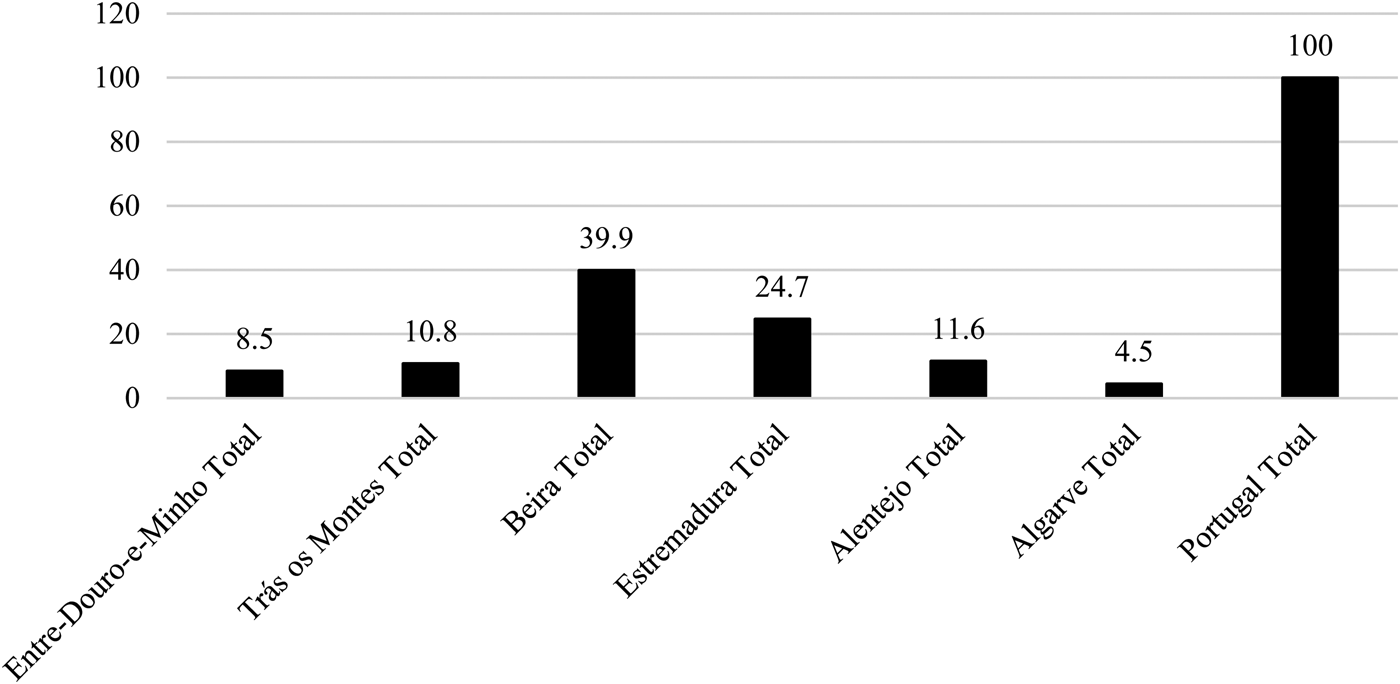
To assess the demographic robustness of the sample, we carried out a number of checks against demographic sources. To do that we multiplied the figures in the evidence provided by the décimas do maneio by a coefficient of 4, assuming four individuals per householdFootnote 2. We then compared those results with the population estimates advanced by various historical demographers (Ferro Reference Ferro1995, pp. 31–42; Serrão Reference Serrão and Oliveira1996; Guardado Reference Guardado and Rodrigues2009). Finally, in preparing the sample we took account of the overall population density of the six provinces of Portugal as it was in the second half of the eighteenth century. According to available scholarship, figures for about 1760 were these: Entre-Douro-e-Minho 26.3 per cent; Trás-os-Montes 9.8 per cent; Beira 28.3 per cent; Estremadura 21.6 per cent; Alentejo 10.2 per cent and Algarve 3.8 per cent (Palma et al., Reference Palma, Reis and Zhang2017, p. 18).
Figure 1 clearly shows that our sample is broadly in line with the aforementioned figures for the majority of the provinces, although with Entre-Douro-e-Minho and Beira as exceptions. Difficulties in accessing equivalent source materials for Entre-Douro-e-Minho mean that it is under-represented in our current sample, while Beira is slightly over-represented as a result of the sizes of the parishes in the town of Viseu which we selected to represent the region. Nevertheless, the sample overall is reasonably well balanced and provides a representative picture of the Portuguese situation as it was by the mid-eighteenth century (see also Appendix A1 online).
DEMOGRAPHICAL AND GEOGRAPHICAL REPRESENTATIVENESS OF THE DATA SAMPLE AT PROVINCIAL LEVEL, 1762–1765 (PER CENT).

3.2 The Cohort of non-HoH Women
Like most early modern source material, the décimas do maneio only rarely represents a wide range of the dependent members of a household, such as women, children, servants or slaves. However, for comparative purposes we gathered all information available on women non-HoH from the above mentioned sources.
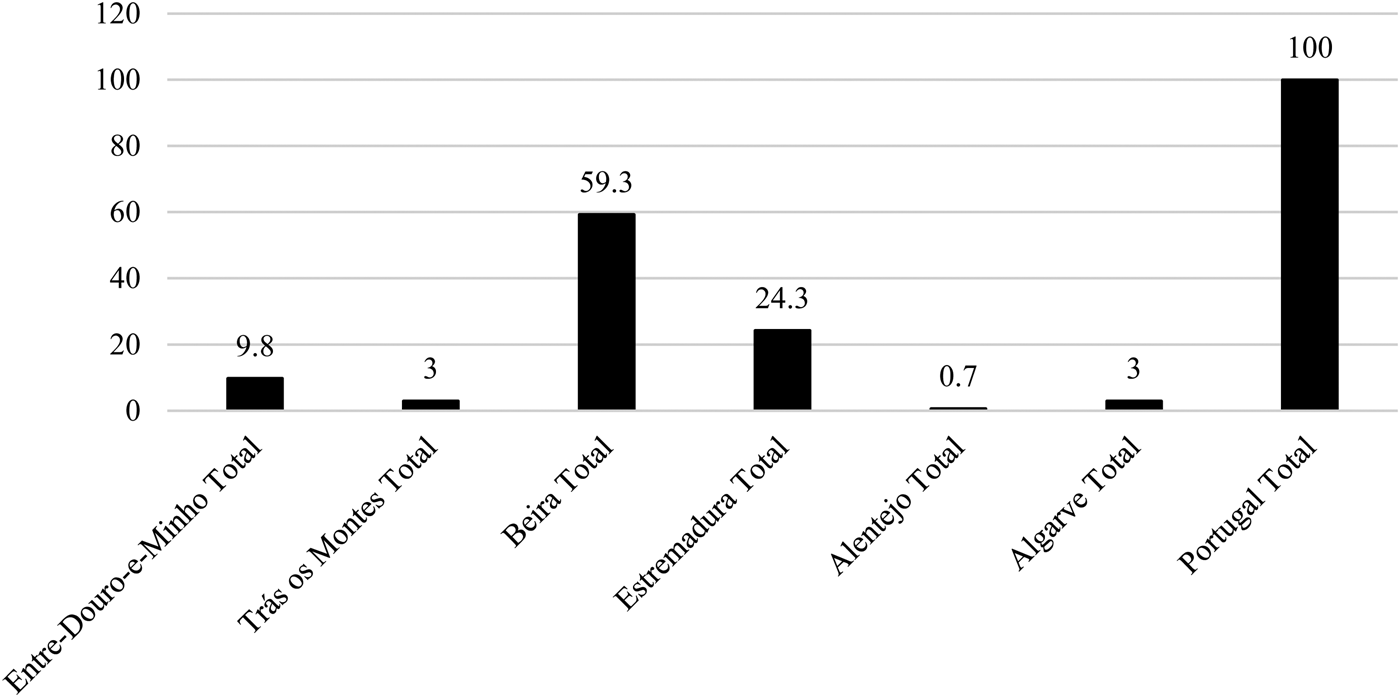
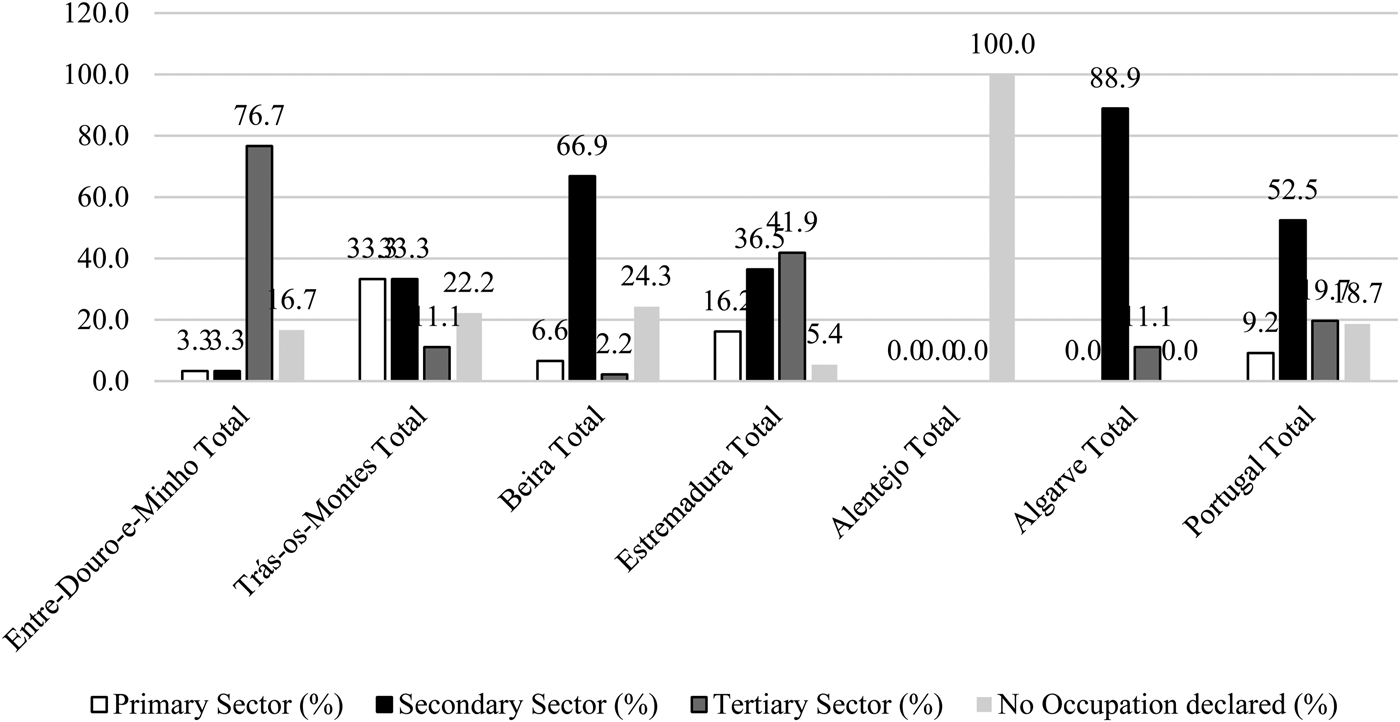
The set of data available is reduced, encompassing only 305 cases for all six provinces of the country, but for comparative purposes gives us an indication of whether or not the results obtained for women HoH are at all similar to those obtained for women non-HoH. However, from both the demographic and geographical points of view this data cohort is less balanced than the core dataset (Figure 2 and Appendixes E1-E7 and F1-F7 online).
DEMOGRAPHICAL AND GEOGRAPHICAL REPRESENTATIVENESS OF THE WOMEN NON-HoH COHORT, AT PROVINCIAL LEVEL, 1762–1765 (PER CENT).

The province of Beira is overrepresented with 59.3 per cent of cases, as is Estremadura with 24.3 per cent, whereas Trás-os-Montes, Algarve, each with 3 per cent and Alentejo with 0.7 per cent appeared to be under-represented. However, from the demographic and economic points of view Beira and Estremadura, as two of the three most important regions of the country, are well represented. Despite the low total number of cases identified, analysis of this evidence would allow us to identify trends in the occupations and labour relations of women who were not HoH. That would in turn foster comparisons with women who were HoH in Portugal, as well in other European contexts.
4. MARITAL STATUS AND WOMEN'S OCCUPATIONAL STRUCTURE
But, what does the information gathered tell us about women's roles as HoH, or their occupations and labour relationships in connection with their marital status? Were women in early modern Portugal less likely to work after marriage? Did location affect their occupational structure? Did marital status influence women's occupations in early modern Portugal?
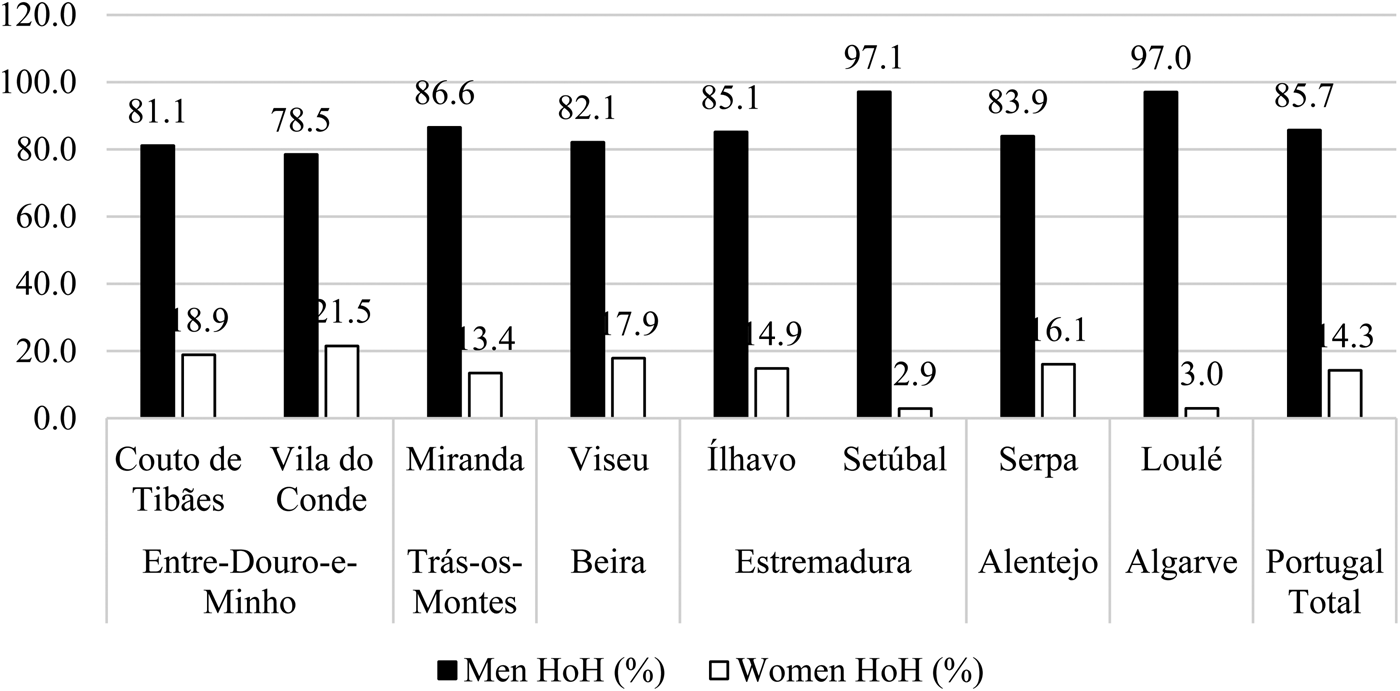
The sample evidence shows that in mid-eighteenth century Portugal women headed only 14.3 per cent of all households (Figure 3, and Appendix A1 online) but if we take into account local and provincial level they headed between 2.9 and 21.5 per cent of the households sampled. Of that proportion more than two thirds of the women HoH declared occupations in the fiscal records. For their part, men were the heads of more than 85 per cent of the sampled households, and in most cases declared occupations.
GENDER DISTRIBUTION OF HoH AT LOCAL, PROVINCIAL AND COUNTRY LEVEL, 1762–1765 (PER CENT).

In a society dominated by patriarchal models and values, women HoH may be considered a sizable percentage. Comparison with other north-western European countries not only confirms that but suggests too that perhaps after all Portugal was not as patriarchal as it has been depicted in international scholarship. In the Netherlands for example, Schmidt and Van Nederveen Meerkerk (Reference Schmidt and Van Nederveen Meerkerk2012) suggested that the percentage of women HoH with registered occupations in 1750 was between 8 and 24 per cent, with more in urban areas. In Leiden, for instance, women headed more than 82 per cent of the households registered in the census of 1749, while in the proto-industrial village of Tilburg in 1810 that figure was 93 per cent. The same holds true for Portugal, especially in coastal urban centres like Vila do Conde where women headed approximately 21.5 per cent of households, or Viseu, another proto-industrial centre where women headed 17.9 per cent of households. However, in Portugal's case that appears to be the result of a localised phenomenon in fishing towns and port-cities and in inland urban centres where men were often temporarily or permanently absent because of some permutation of their economic activities, migration or death.
In fact, regional analysis of the Portuguese data suggests important differences between the north, centre and south of the country. The proportion of women HoH in the northern provinces of Entre-Douro-e-Minho, Trás-os-Montes and Beira was considerably greater than in the central and southern provinces of Estremadura and Algarve. In the northern three provinces women HoH accounted for approximately 13 to 20 per cent of the households sampled, while in the centre and southern provinces the proportion did not exceed 3 to 17 per centFootnote 3. That evidence tends to confirm the thesis put forward by earlier studies pointing to the existence of considerable differences between the northern, central and southern provinces of Portugal. In the centre and south, household work was a more prominent feature than in the north, where women enjoyed more freedom to circulate within the public sphere, which in turn made it easier for them to engage in economic activities (dos Sá Reference dos Sá, Lains and da Silva2005, p. 108; Polónia Reference Polónia and Cavacicochi2009).
The results obtained from the analysis of the official fiscal records therefore suggest that only relatively few women participated in the labour market. However, it is likely that many of them, including both HoH and non-HoH, engaged in economic activities, the former to guarantee their own survival and that of their dependents, and the latter to complement their husbands' incomesFootnote 4. The absence of women from the historical records could be because women themselves might for various reasons have chosen not to declare their employment to the royal tax collectors, perhaps because they had no specific profession, or because they combined different activities; or it might have been that they regarded declaring an occupation simply as a threat to their social reputations. Alternatively, the under-registration of women's work in our sources might have been the choice of the tax collectors who conceivably regarded such women's work as essentially trivial and therefore negligible from a fiscal point of view.
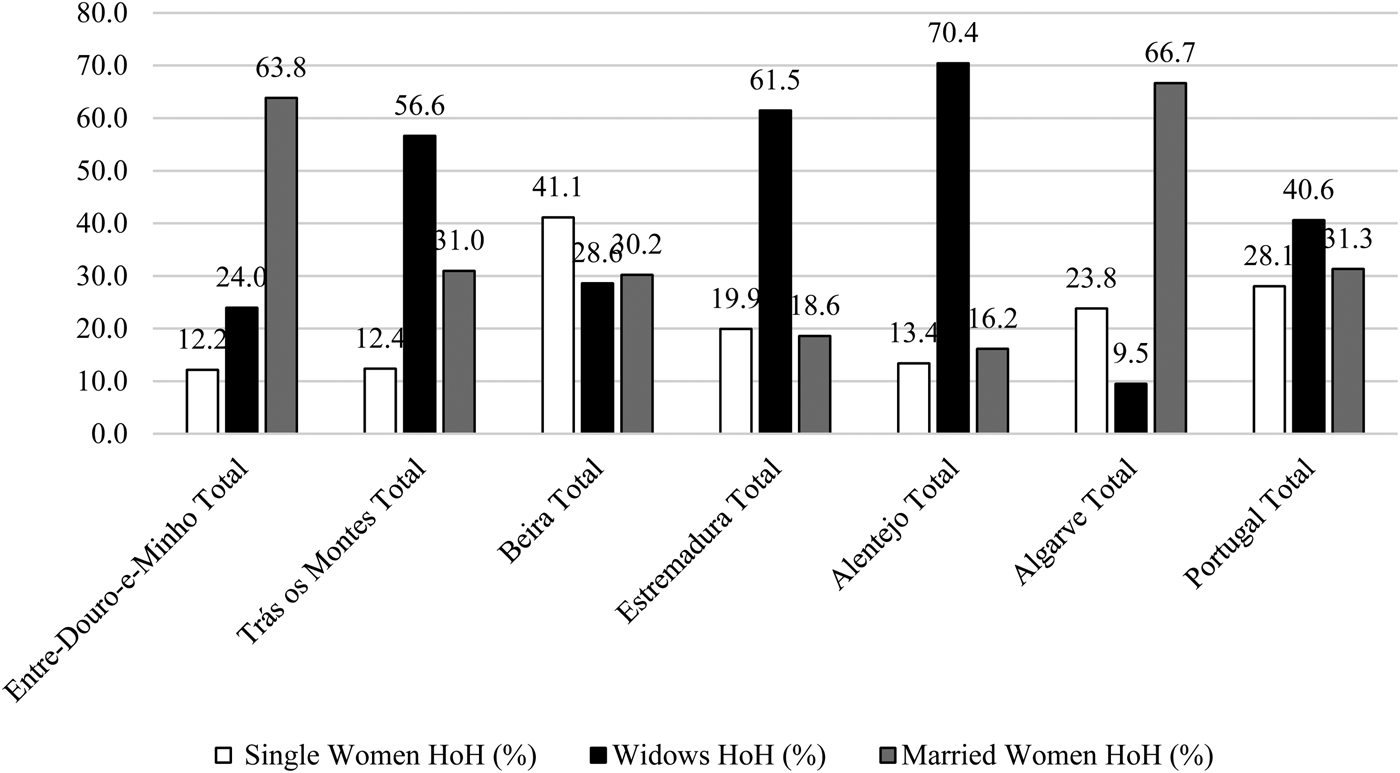
In our sample, more than 70 per cent of women HoH were or had been married, with widows accounting for 40.6 per cent and married women for 31.3 per cent (Figure 4 and Appendixes B1-B2 online). Approximately 60 per cent of the widows declared an occupation, while more than 70 per cent of the married women did so (Figure 5 and Appendix C3 online). We may therefore suggest and will show later in this study that in mid-eighteenth century Portugal marriage and widowhood did not prevent women from becoming HoH, nor from having occupations or participating in the economy. Data gathered on women non-HoH reinforce our argument, for more than 45 per cent of the women registered were married, and among those approximately 93 per cent declared an occupation (Appendixes E2 and E5 online).
MARITAL STATUS OF WOMEN HoH IN PORTUGAL, AT A PROVINCIAL AND COUNTRY LEVELS, 1762–1765 (PER CENT).

DISTRIBUTION OF WOMEN HoH PER ECONOMIC SECTORS, ACCORDING TO THEIR MARITAL STATUS, AT NATIONAL LEVEL, 1762–1765 (PER CENT).

Those results seem to be similar to findings for other European countries. For example, Sheilagh Ogilvie (Reference Ogilvie2003, pp. 26–30) has demonstrated that in early modern Germany approximately 42 per cent of married women and 18 per cent of widows worked; together they represented more than 60 per cent of the workforce in the German communities Ogilvie studied.
By contrast, single Portuguese women headed only about 28 per cent of the households sampled (see Figure 4), but they declared occupations in more than 64 per cent of those cases (see Appendix C3 online). Those results suggest that although single women were less likely to become HoH, if they were they would be likely to undertake some sort of economic activity. The reasons for that were probably that single women received no dowry.
Among non-HoH women registered in the fiscal records, more than 53 per cent were single, of whom approximately 70 per cent declared occupations. That suggests that in mid-eighteenth-century Portugal many single women had occupations through which they participated in the economy (see Appendixes E2 and E5 online). The figures for Portugal do not diverge substantially from trends found in other parts of southern Europe regarding the declaration of occupations among single women. In eighteenth-century Turin, for instance, more than 55 per cent of unmarried women aged 25 or over declared occupations in the Napoleonic Census of 1802 (Zucca Micheletto Reference Zucca Micheletto2013, p. 206).
The regional breakdown of the data confirms the trends identified above. In most provinces of the country between approximately 75 and 87 per cent of women HoH were or had been married (see Appendix B2 online). An analysis of the data collected for non-HoH women shows similar findings of between 27 and 89 per cent who declared that they were married or widowed (see Appendix E2 online).
However, there were regional differences across the country in the proportion of households headed by widows and married women. In inland and rural provinces such as Trás-os-Montes and Alentejo most women HoH were widows, while in the matter of declaring their occupations for tax purposes women behaved quite differently. While more than 93 per cent of widows in Trás-os-Montes declared occupations, in Alentejo only approximately 8 per cent did so (see Appendix C2 online). Those results tend to support the thesis that in northern Portugal women enjoyed more freedom and engaged in public life and economic activities to a greater extent than did women in southern Portugal.
More married women appeared as HoH in the north-western and southern provinces of Portugal—Entre-Douro-e-Minho and Algarve—with significantly higher percentages in coastal urban centres or towns relatively close to the coast, such as Vila do Conde with 81.5 per cent of women HoH, Setúbal with 52.2 per cent and Loulé with 53 per cent (see Appendix B2 online). More than 18 and 98 per cent respectively of the women HoH in those urban centres declared that they had an occupation (see Appendix C2 online). The absence of men—whether temporary or permanent—because of economic activity and migration from those urban centres seems to have prompted married women to assume the position of HoH and take up some occupation. That is discernible in the case of the commercial and fishing port of Vila do Conde (Polónia Reference Polónia and Cavacicochi2009), where men were often absent; and to a lesser extent in Setúbal which like Vila do Conde was an important fishing and commercial harbour; or the town of Loulé. Analysis of the data collected for non-HoH women shows similar findings of more than 62 and 97 per cent of the women registered in Vila do Conde and Setúbal recorded as married, with more from 83 and even up to 100 per cent declaring occupations (see Appendixes E2 and E7 online).
In most provinces of Portugal, single women headed only a small percentage of the households sampled, usually below 25 per cent, with more than 64 per cent of those women declaring occupations for tax purposes (see Figure 4 and Appendixes B2 and C3 online)Footnote 5. Similar results were found among non-HoH women registered in the tax records. In Beira, they accounted for 72.9 per cent of the women in the records, of whom more than 75 per cent declared occupations. It must be noted here, however, that more than 27 per cent of married women who were not HoH were registered in Beira, with more than 84 per cent of them declaring themselves as having occupations (see Figure 6 and Appendix E2 and E7 online).
ECONOMIC SECTORS OF NON-HoH WOMEN IN PORTUGAL, AT PROVINCIAL AND COUNTRY LEVEL, 1762–1765 (PER CENT).

Overall, these data suggest that most of the women registered in the fiscal books of the different provinces of Portugal were either married or widowed and that the majority declared occupations. It is therefore clear that marriage did not of itself prevent women from participating in the economy.
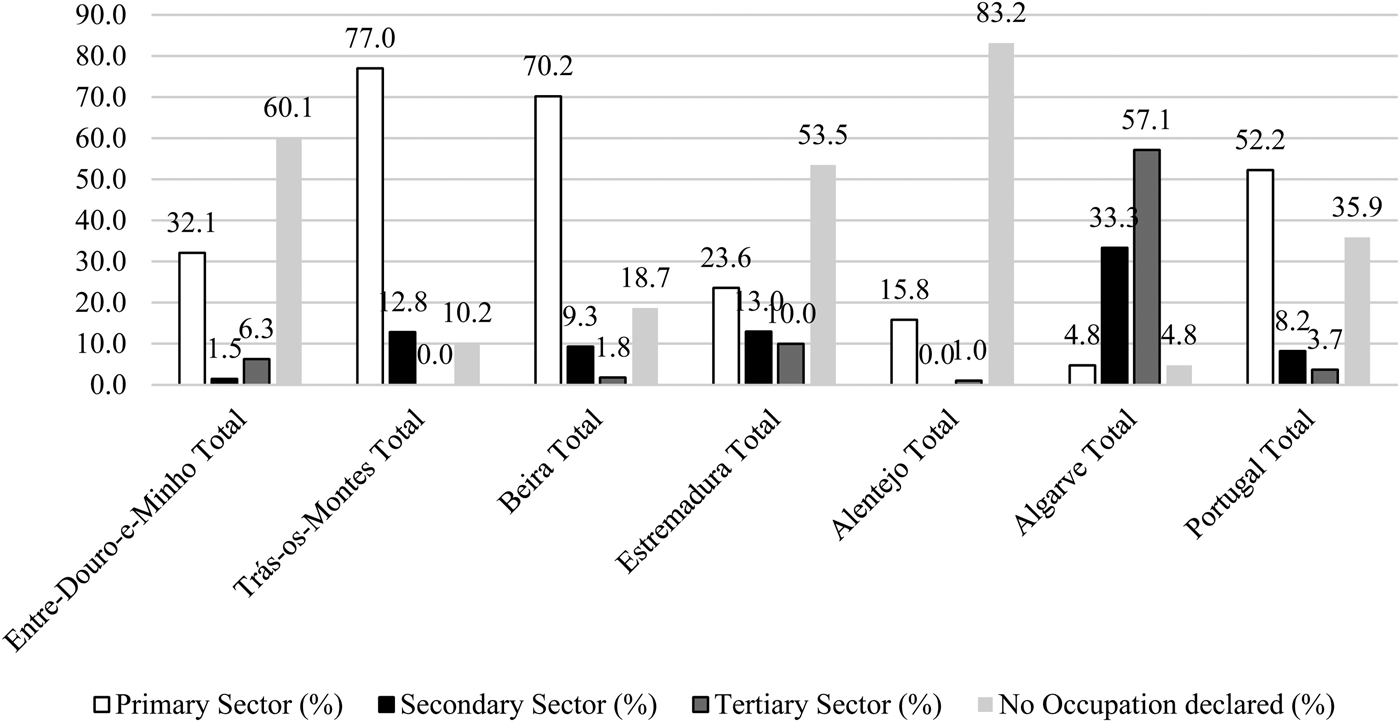
Approximately 52 per cent of women HoH were busy in the primary sector, as most occupations listed in our source were related to agriculture or fishing. That percentage might have been higher if we assume that women HoH who declared no occupation were similarly engaged in activities associated with household shores (Figure 7 and Appendixes C1-C5 online).
ECONOMIC SECTORS OF WOMEN HoH IN PORTUGAL, REGIONAL AND NATIONAL LEVELS, 1762–1765 (PER CENT).

Our results suggest that most work women did in agriculture was probably for family-run businesses rather than as wage-earners, and more often than not was combined with household work. Our hypothesis is confirmed by the regional breakdown of the results, for it was in the rural areas of the northern provinces of Entre-Douro-e-Minho, Trás-os-Montes and Beira that most women HoH are found working in the primary sector, because in those localities small and medium-sized agricultural estates predominated, which were dependent on family labour. Ranging between 48 and 23.6 per cent, the proportions were relatively lower in the central and southern provinces where seasonal agricultural labour predominated, especially of men from the northern inland provinces of Beira and Trás-os-Montes (see Appendix B3 online)Footnote 6. Recent research on women's labour and occupational structures in the central and southern regions of Spain also identified low participation of women in the primary sector, although in the Spanish case women appeared heavily engaged in the secondary sector (Sarasúa Reference Sarasúa2019, pp. 15–16).
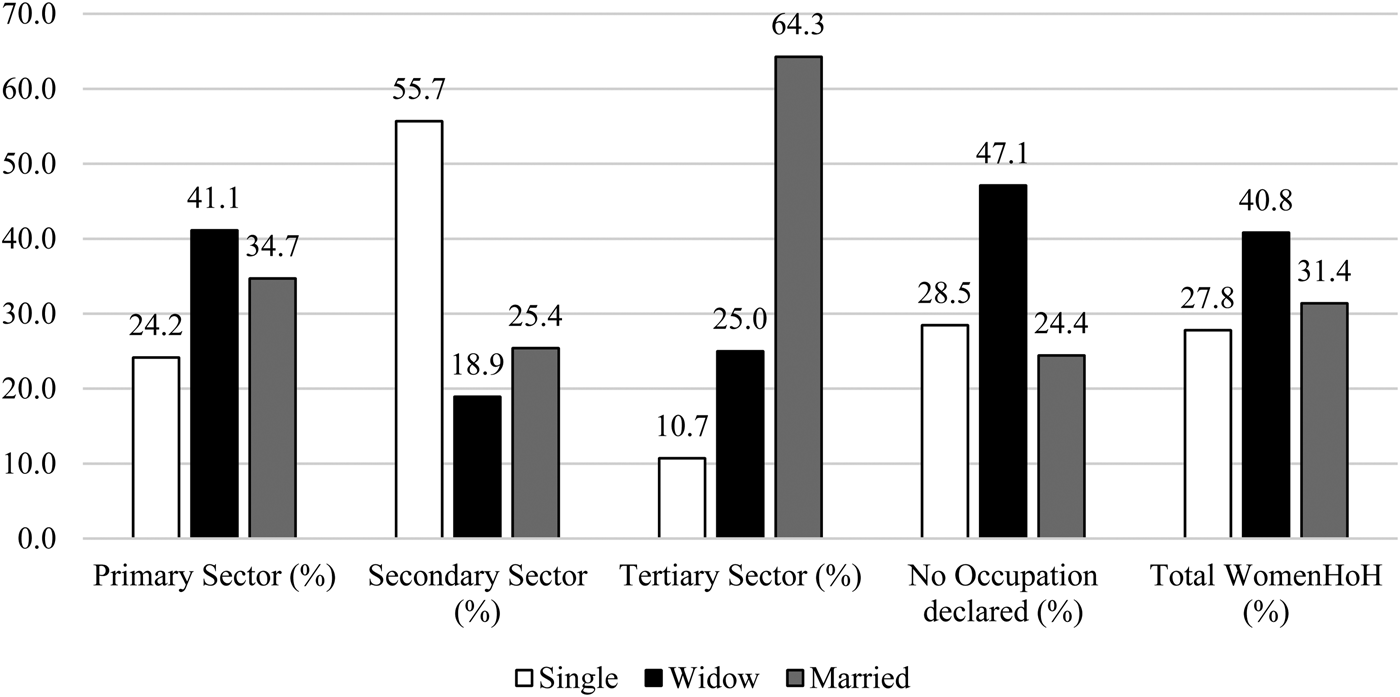
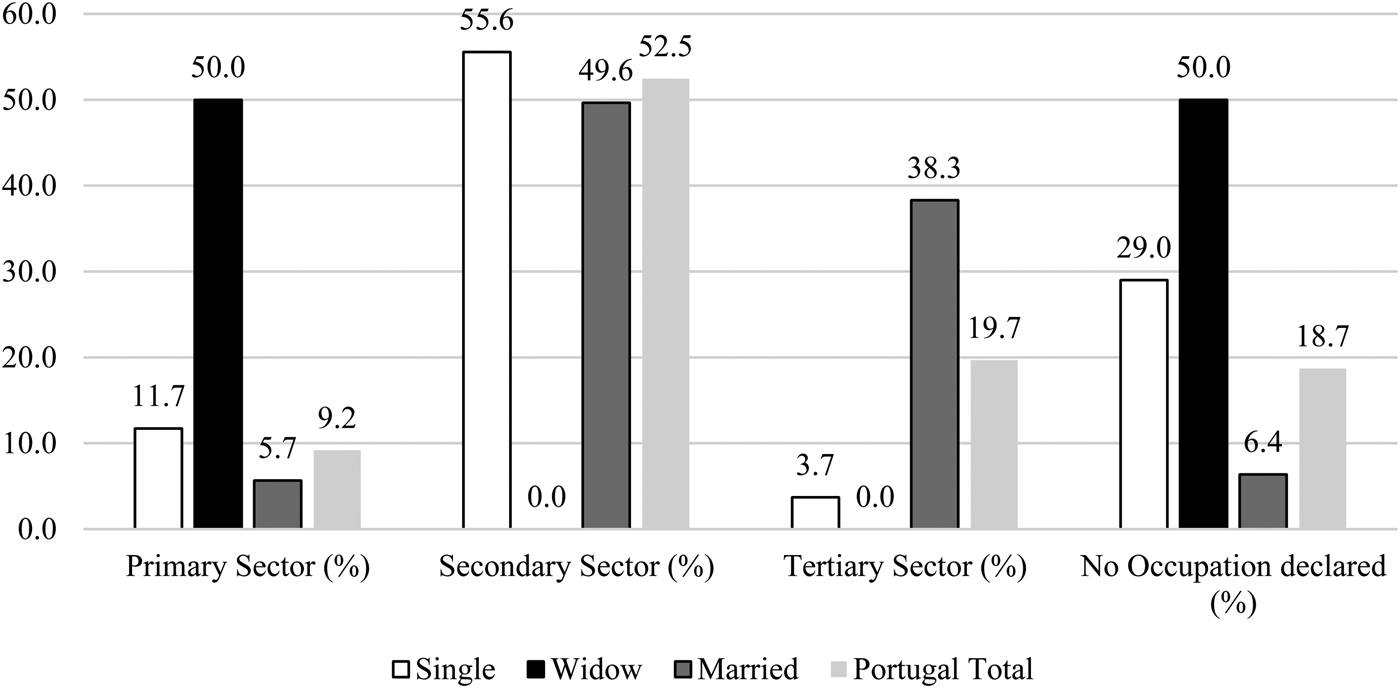
More than 75 per cent of the women HoH who were employed in the primary sector were or had been married, with widows accounting for 41.1 per cent and married women for 34.7 per cent (see Figure 7 and Appendixes C2 and C4 online). Given that most of those women worked in the primary sector in the northern provinces where small and medium sized family-run agricultural estates dominated it is very probable that they gained access to the land they worked on through marriage or by inheritance from their absent or deceased husbands. We would therefore argue that, via inheritance, marriage and widowhood gave women in those regions access to land and a chance to participate in the economy. Hence, marriage and widowhood seem not to have discouraged women from engaging in economic activities—indeed quite the opposite. The same seems to be true for widows who were not HoH, as 50 per cent of them too worked in the primary sector (see Figure 8 and Appendix E5 online).
ECONOMIC SECTORS OF WOMEN NON-HoH IN PORTUGAL ACCORDING TO THEIR MARITAL STATUS, AT NATIONAL LEVEL, 1762–1765 (PER CENT).

By contrast, only 8.2 per cent of the women sampled who were HoH worked in the secondary sector (see Figure 7, and Appendix C2 online), with single women HoH accounting for more than 55 per cent and married women representing only 25.4 per cent, while 18.9 per cent were widows (see Figure 5 and Appendixes C1-C5 online). Findings are similar for non-HoH women, of whom single women appear to have been employed mainly in the secondary sector (55.6 per cent) (see Figure 8 and Appendix E5 online).
The regional breakdown of the data shows that most women HoH who worked in the secondary sector were concentrated in the provinces of Algarve, at 33.3 per cent, Estremadura at 13.9 per cent, Trás-os-Montes with 13.2 per cent and Beira with 9.0 per cent (see Appendix C2 online). In most cases sampled, single women HoH strongly tended to dominate in the coastal towns. For example, in Vila do Conde they accounted for 16.7 per cent, in Ílhavo for 18.2 per cent and in Loulé for 60 per cent. Single women dominated the secondary sector in Viseu too, with 19.2 per cent (see Appendix C5 online)Footnote 7. The only exceptions we found were Miranda in Trás-os-Montes where married women HoH accounted for more than 24 per cent, and in Setúbal where they represented more than 34 per cent with widows an additional 37.5 per cent (see Appendix C5 online). Those regional divergences might have been specific to those two towns and the areas under their jurisdiction (termo), as the former is known for its production of linen and silk in combination with the production of other agricultural products which were usually processed by married women within the context of family economic units.
That evidence suggests that single women who worked did so mainly in the secondary sector as wage-earners, followed by 24.2 per cent in the primary sector who worked in small family businesses; only a somewhat meagre 10.7 per cent worked in the tertiary sector. The low percentage of single women in the tertiary sector, seen alike in single women HoH and non-HoH, might have been linked to the risks of the damage that might be caused to a single young woman's reputation if she should be employed in a commercial business or the service sector (see Figures 5 and 8, and Appendixes E1-E5 online)Footnote 8.
The percentage of women HoH employed in the tertiary sector was relatively small at fewer than 4 per cent (see Figure 7). However, that sector appeared to have been dominated by married women at 64.3 per cent and widows at 25 per cent, together accounting for 89.3 per cent of the total (see Figure 5). More than 38 per cent of the married non-HoH women too were found to have been working in the tertiary sector (see Figure 8 and Appendix E5 online).
Those women, including both HoH and non-HoH, were mainly concentrated in the provinces of Estremadura and Algarve, and in the coastal or seaboard urban centres of Vila do Conde where they made up 33.3 per cent, Setúbal where they were 57.1 per cent, and Loulé where they were 64.3 per cent (see Appendix C5 online). Recent research on women's labour and occupational structures in the central and southern regions of Spain has disclosed that more than 30 per cent of women worked in the tertiary sector (Sarasúa Reference Sarasúa2019, pp. 15–16).
Those results too suggest that marriage was no obstacle to mid-eighteenth-century Portuguese women wishing or needing to participate in the economy. Indeed, if anything it was rather the opposite, as marriage seems to have provided them with the resources needed to work in the tertiary sector, which they did generally as self-employed in commercial activities, as shown later in this paper. The necessary resources might have been either some urban property such as a shop, an amount of capital or inheritance of an existing business previously run by a husband. Ignoring societal and geographical differences, the trade seems to have been an economic activity in which women were commonly found in other regions throughout Europe, as for example in Scandinavia (Ågren Reference Ågren and Ågren2017, pp. 208–209).
Overall, widows and married women appear to have dominated in the Portuguese primary sector, in the secondary sector single women dominated, while married women were more numerous in the tertiary sector. Access to resources of land, urban property or capital through marriage or inheritance from husbands seems to have given married women and widows an advantage on their entry to the labour market. As will be demonstrated later in this article, many such women appeared in our sources as self-employed, while most single women were wage-earners. That evidence rather tends to undermine the belief that single women in southern Europe had neither need for work, nor opportunity nor incentive for it. Our data challenges as well the idea that the same was true after marriage or widowhood. In fact, the sources we sampled strongly suggest that all those three groups of women were notably active, so our results indeed question the general idea dominant in international scholarship that at least in the matter of their participation in the economy women in southern Europe were more discriminated against than were women in north-western Europe.
Our findings seem then to be in line with the results put forward by Horrel and Humphries in their study of married women's participation in the British economy in the eighteenth and nineteenth centuries. For example, from 1787–1815 more than 74.4 per cent of married women in Britain worked in the primary sector, including high and low-wage agriculture and mining, whereas only 20.9 per cent were occupied in the secondary sector, either in factory work or outwork, while only 4.5 per cent were found to have been employed in the tertiary sector (Horrel and Humphries Reference Horrel and Humphries1995, p. 98)Footnote 9. All the same, there is a significant difference between Britain and Portugal, in that most working women in Britain were wage-earners while the vast majority of working Portuguese women were self-employed.
5. MARITAL STATUS AND WOMEN'S LABOUR RELATIONS
Let us turn now to the capacities in which HoH and non-HoH women participated in the economy; in other words, what were their labour relations? And what effect did marital status have? Is it correct to say that in early modern Portugal women were less likely to work for the market, especially after they were married or widowed? Did marital status matter to women's labour relations? Was there any relationship among location, marital status and the capacities in which women worked for the market?
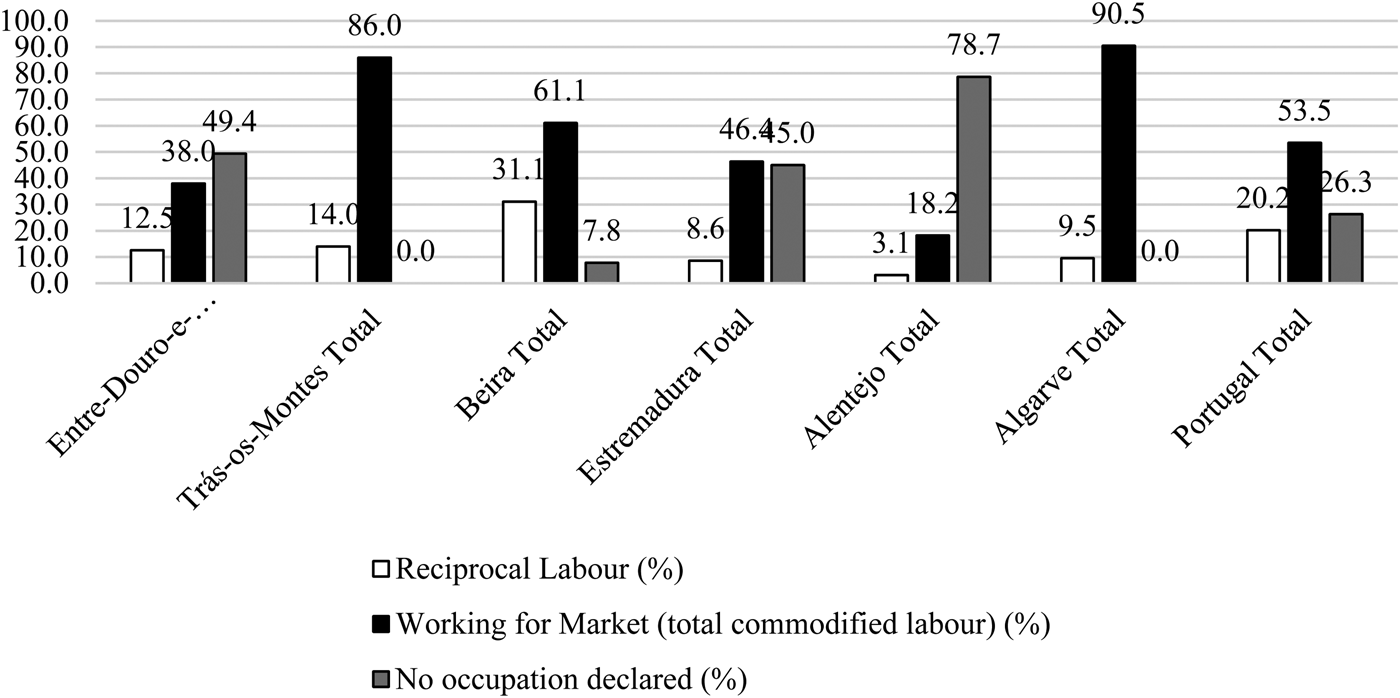
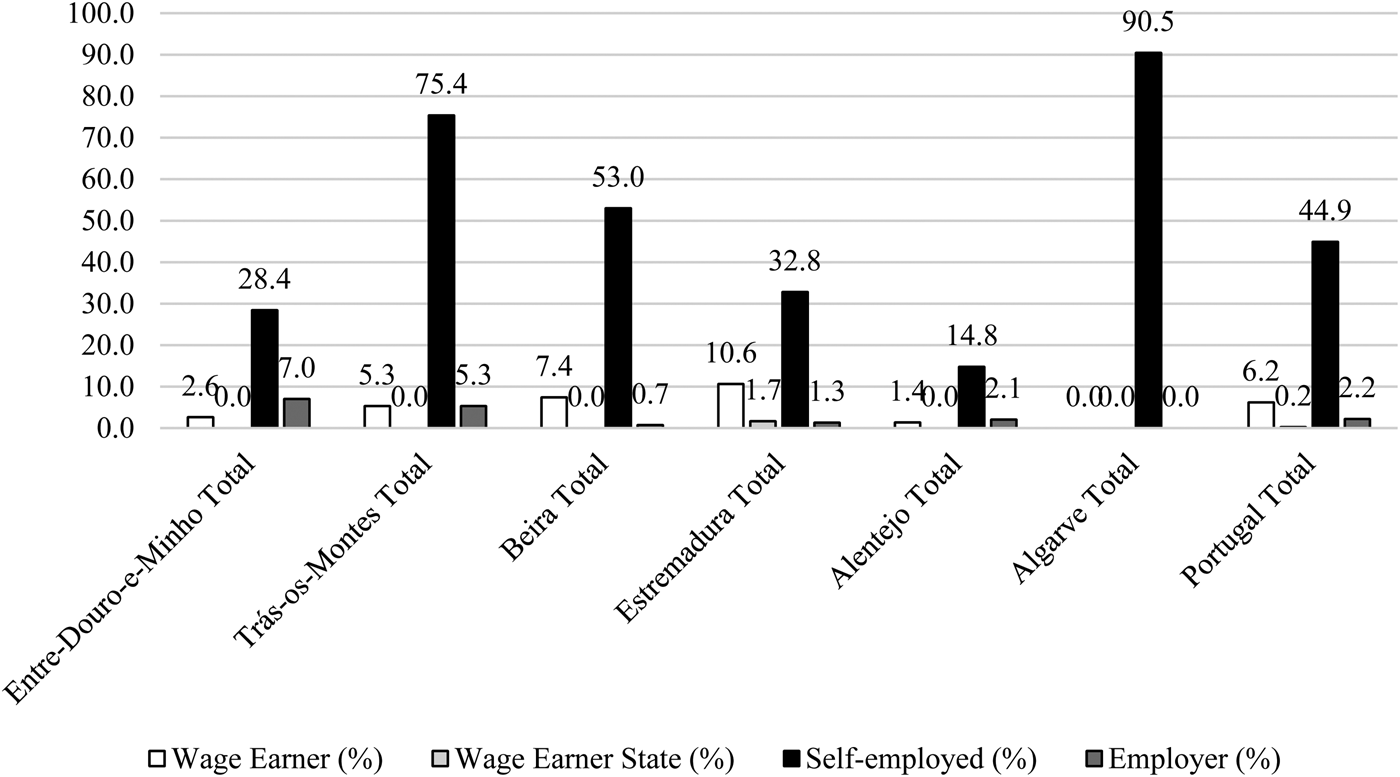
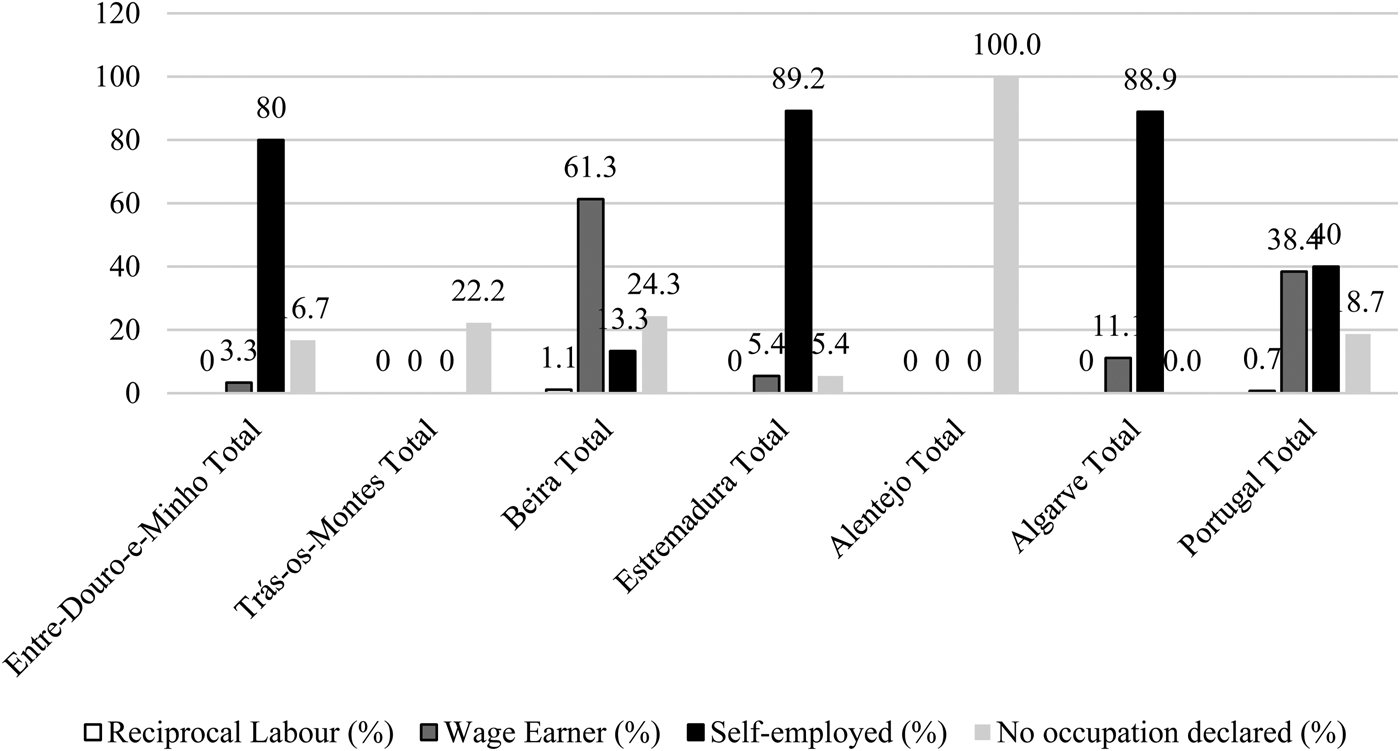
Evidence shows that more than 53 per cent of women HoH worked for the market, most of them as self-employed (44.9 per cent). Wage earners accounted for only 6.2 per cent and employers for 2.2 per cent. Work for the market dominated too among non-HoH women at 80.7 per cent, with 40 per cent self-employed and the other 38.4 in wage labour (38.4 of them worked for the private sector and 2.3 per cent for the State; see Figures 9 and 10, and Appendixes D1-D7 and F2 online). That evidence suggests that paid labour was more common among non-HoH, than among HoH.
MAIN LABOUR RELATIONS OF WOMEN HoH IN PORTUGAL, AT PROVINCIAL AND COUNTRY LEVEL, 1762–1765 (PER CENT).

MAIN COMMODIFIED LABOUR RELATIONS OF WOMEN HoH IN PORTUGAL, AT PROVINCIAL AND COUNTRY LEVEL, 1762–1765 (PER CENT).

These results seem to be in line with the research findings presented by Schmidt and Van Nederveen Meerkerk for the Netherlands between 1600 and 1900. In Leiden in 1581 more than 60 per cent of women were self-employed and only 35 per cent were wage-workers. However, by 1749 there had been a reversal of that situation, in part a result of the proletarianization of the local economy (Schmidt and Van Nederveen Meerkerk Reference Schmidt and Van Nederveen Meerkerk2012, pp. 75–76). Similar shifts appear to have taken place in late eighteenth- and early nineteenth-century Britain, where more than 70 per cent of married women appear to have been wage-earners in agriculture and approximately 20 per cent in the secondary sector (Horrel and Humphries Reference Horrel and Humphries1995, p. 98)Footnote 10. In Portugal meanwhile, the shift of women from self-employment to wage labour seems to have taken place later.
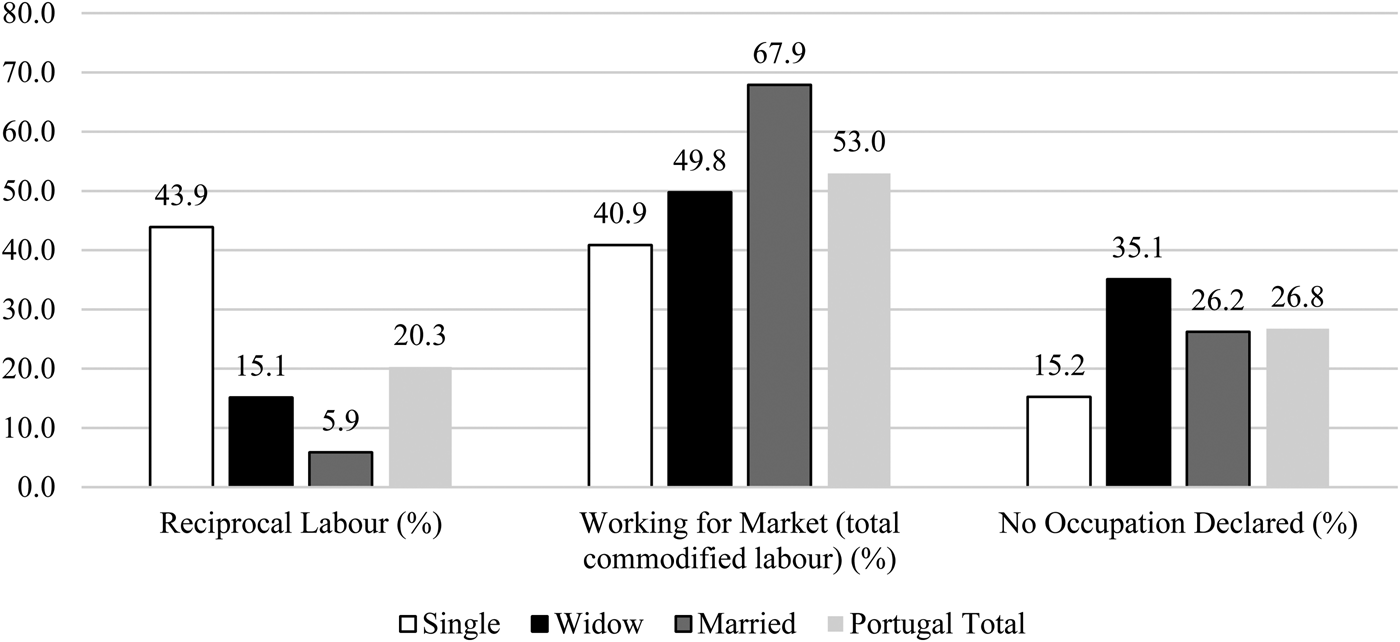
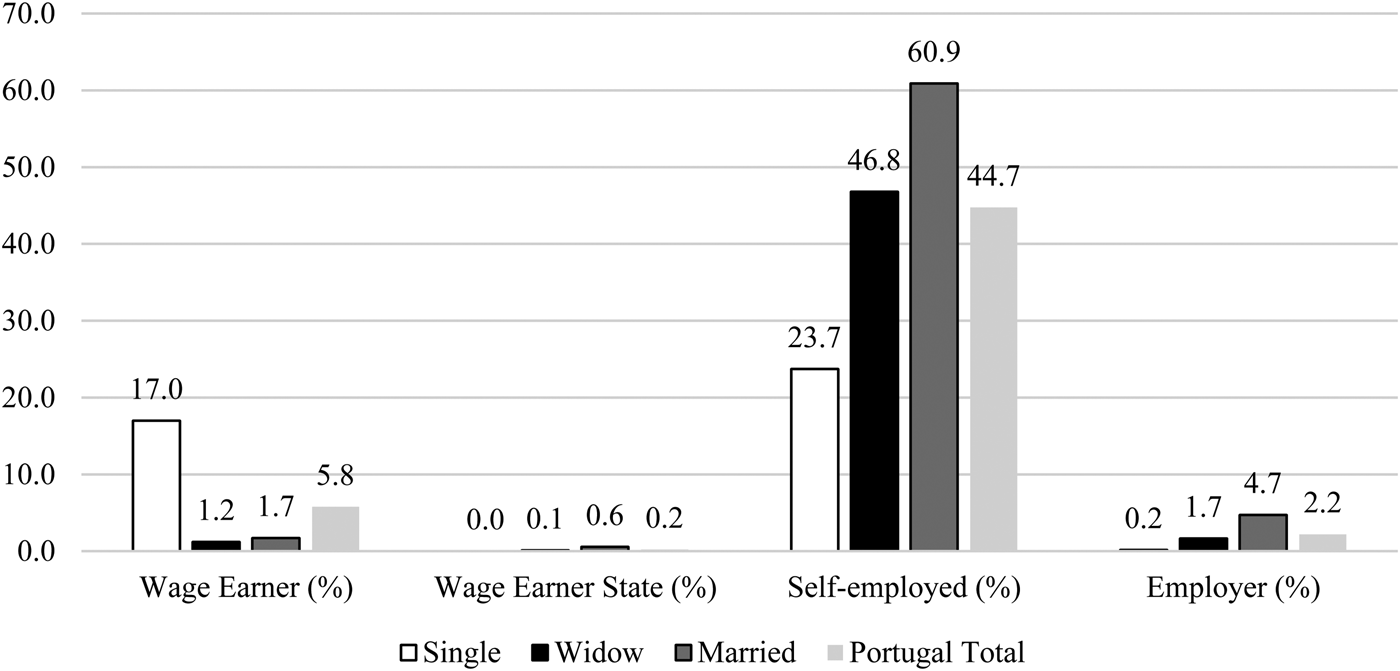
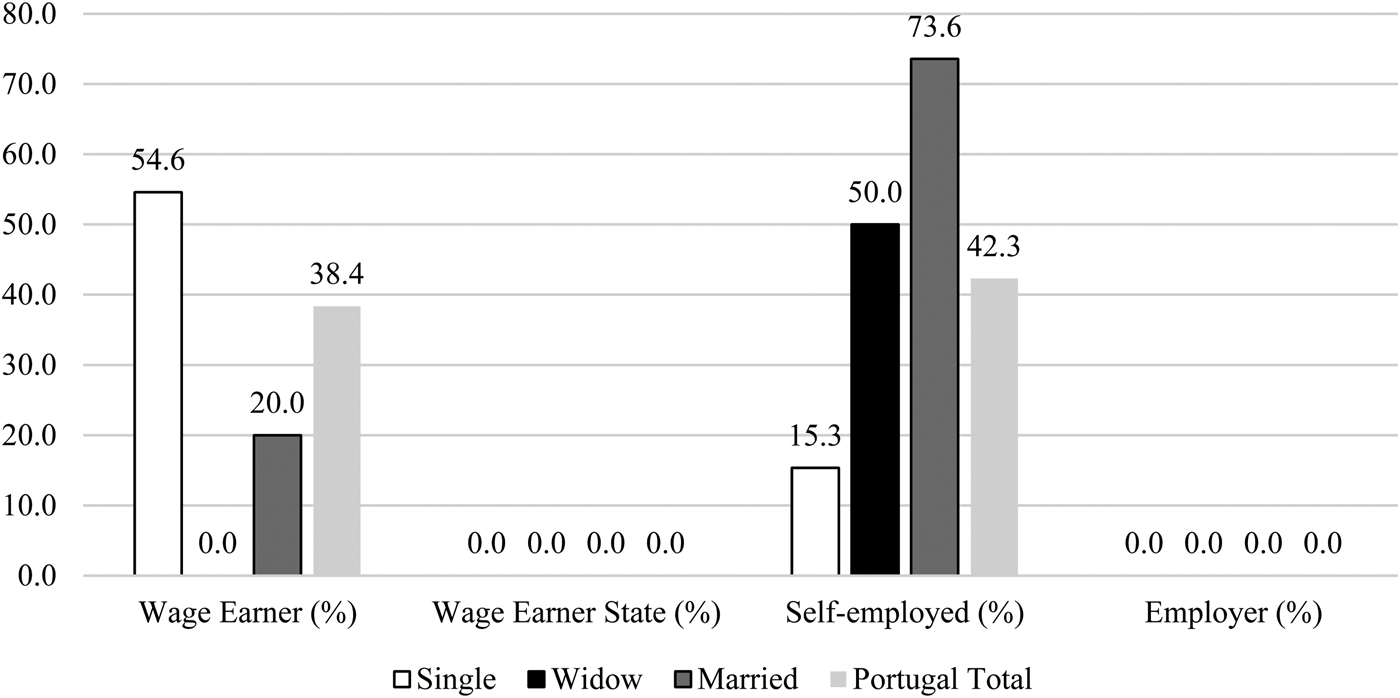
Commodified labour percentages, i.e. labour for the market, were particularly high among married and widowed women HoH at 67.9 and 49.8 per cent respectively, while single women accounted for 40.9 per cent––which is still a considerable value (see Figure 11 and Appendix D4 online). Findings for non-HoH women suggest the same trend, with 50 per cent of all widows recorded in the fiscal sources as working in the market, and 93.6 per cent of all married women registered in the same source also as working in the market (see Appendix F4 online).
MAIN TYPES OF LABOUR RELATIONS OF WOMEN HoH ACCORDING TO THEIR MARITAL STATUS, AT COUNTRY LEVEL, 1762–1765 (PER CENT).

Most married women and widowed HoH were self-employed in the market, accounting for 60.9 and 46.8 of all self-employed women HoH (see Figure 10 and Appendix D4 online). Similar results were found for non-HoH women, with more than 73 per cent of married women and 50 per cent of widows recorded as self-employed (see Appendix F4 online). To a certain extent those figures might reflect ownership of land or accumulation of some other types of resources or wealth which tended to occur more commonly at later ages and stages in women's life-cycles, not least after marriage and possible widowhood. Again, comparative analysis of women's labour relations and marital status seems to suggest that marriage and widowhood did not hinder married women and widows from participating in the economy. In fact, we see again that marriage and eventual widowhood seem to have provided them with resources, either material or financial, to develop their own businesses, either in their own name or that of their absent or deceased husbands. Such opportunities were perhaps naturally therefore much less likely to be available to single women.
More than 20 per cent of single women HoH too were found to have been in self-employed work in the market, but another 17 per cent were wage-earners (see Figures 11 and 12, and Appendix D4 online). The findings obtained for Beira support those figures, for more than half the women there working in the market were wage-earners. More single HoH women in Beira worked in the market—63.6 per cent in fact (see Appendix F7 online) again suggesting the importance to single women of paid work.
MAIN TYPES OF COMMODIFIED LABOUR RELATIONS OF WOMEN HoH ACCORDING TO THEIR MARITAL STATUS, 1762–1765 (PER CENT).

This evidence challenges the thesis usually advanced for southern Europe that after marriage women would become less active in the labour market, when compared with north-western European countries (Van Zanden Reference Van Zanden2009, pp. 110–114). Our dissenting point is corroborated by three other aspects: (a) relatively fewer married or widowed HoH were wage earners, at 1.7 per cent and 1.2 per cent as against 17 per cent of singles; (b) fewer of them, in comparison with single women, did reciprocal labour, at 15.1 per cent and 5.9 per cent as against 43.9 per cent and (c) relatively few married or widowed HoH who were also employers, at 1.7 per cent and 4.7 per cent, contrasting with the absence of single women who were employers. This point further suggests the importance of the role played by the accumulation of capital and other resources (see Figures 11 and 12).
Here again we see notable similarities with Scandinavia where, as in Portugal, unmarried women and especially single women tended to have different work patterns. For example, they were rarely recorded as managing others, meaning that they did not qualify as «employers» (Ågren Reference Ågren and Ågren2017, pp. 211–212).
The regional breakdown of the data shows clear differences between the coastal and inland provinces. Most women HoH working in the market were found in two northern provinces where self-employment prevailed, that of Trás-os-Montes where the figure was 86 per cent, and Beira with 61.1 per cent. In Trás-os-Montes more than 75 per cent of women HoH were self-employed while in Beira the figure was 53 per cent. Self-employed work for the market predominated also in localities with rural characteristics, such as Miranda with 86 and 75 per cent, respectively, Couto de Tibães with 63.4 and 49.5, respectively; and Viseu with 61.1 and 53 per cent, respectively. Similarly, working for the market and self-employment was the norm for women in important fishing and commercial centres like Setúbal where the relevant figures were 100 per cent and 47.8 per cent, respectively (see Figures 9 and 10, and Appendix D2 and D7 online). This evidence clearly suggests that women HoH were engaged in the economy mainly through agricultural production intended for local markets, or through commerce.
Similar results were obtained for the cohort of non-HoH women. The largest percentages of non-HoH women working in the market were found in the provinces of Estremadura and Beira and in important coastal towns such as Vila do Conde and Ílhavo (see Figure 13 and Appendix F1 and F2 online) pointing to their involvement in agricultural and textile production in Beira, and in the other three in commercial activities, sometimes in combination with agriculture. In Beira, most non-HoH women worked for the market as wage-earners, but in the other three towns self-employment prevailed, often with the development of activities that complemented the women's husbands' occupations, the husbands being naturally HoH. It was common to find in the source combinations of a male fisherman as HoH with his wife as a fishmonger, or a male HoH as the owner of a shop with his wife as the shopkeeper. Similar combinations have been identified in other European countries (see Figure 13 and Appendix F1 and F2 online) (Ogilvie Reference Ogilvie2003, pp. 140–149).
MAIN LABOUR RELATIONS OF NON-HoH WOMEN IN PORTUGAL, REGIONAL AND NATIONAL LEVELS, 1762–1765 (PER CENT).

Regardless of regional differences like those, it is worth noting that in the correlation between marital status and labour relations married women and widows formed the largest percentage of women HoH working for the market, with most of them being self-employed (see Figures 11 and 12). In Trás-os-Montes and Beira between 53 and 75 per cent of the HoH women worked as self-employed in production for the market. In Trás-os-Montes and Algarve 70 per cent or more of women HoH found working for the market as self-employed were or had been married. In Beira their percentage exceeded 40 per cent, in Estremadura 30 per cent, whereas in Alentejo only approximately 12 per cent (see Appendix D6 and D7 online). Analysis of the cohort of non-HoH women shows similar results although with Beira the sole exception, for in Beira more than 55 per cent of married women worked as wage-earners in the region's textile proto-industry (see Figures 11 and 12, and Appendix F6 and F7 online).
By contrast, in overall Portugal fewer than 25 per cent of women HoH working for the market were single, and the largest percentages of them were found in the provinces of Algarve (19 per cent), Beira (16.2 per cent) and Estremadura (11.6 per cent) (see Figures 11 and 12, and Appendix D6, D7 and D8 online). Similar results were found among women non-HoH, although values were higher in the case of Beira (69.9 per cent), and Entre-Douro-e-Minho (32 per cent) (see Figure 14 and Appendixes F6 and F7 online).
MAIN TYPES OF COMMODIFIED LABOUR RELATIONS OF WOMEN NON-HoH ACCORDING TO THEIR MARITAL STATUS, AT NATIONAL LEVEL, 1762–1765 (PER CENT).

Important differences were found in the types of labour relations of single women HoH working for the market in those provinces. While in northern province of Entre-Douro-e-Minho more than 20 per cent of single women were self-employed and approximately 18 per cent were wage-earners, in the central province of Estremadura we found the reverse situation, with more than 45 per cent working as wage-earners and only 12 per cent as self-employed (see Figures 11 and 12, and Appendixes D6, D7 and D8 online). Analysis of the cohort of women HoH shows similar results only for the province of Entre-Douro-e-Minho, as in Beira the vast majority were wage-earners while in Estremadura, they were self-employed (see Appendixes F6 and F7 online). In the case of Beira the results were probably influenced by the nature of industrial work which younger women did too, regardless of whether it was outside the household or in the context of the putting-out system.
While there is a lack of regional studies which can help us explain the trends, as a number of authors have already pointed out the regional differences and rural/urban split identified are probably linked to the greater level of autonomy enjoyed by women in northern Portugal, and in urban centres (Abreu-Ferreira Reference Abreu-Ferreira2000, Reference Abreu-Ferreira2002; Polónia Reference Polónia and Cavacicochi2009). Greater freedom to operate within the public sphere might have presented women with more opportunities to develop their own businesses, as well as to accumulate resources and capital. That suggestion is strongly supported by the greater percentage of women HoH found to have been operating as employers in the northern provinces of Entre-Douro-e-Minho and Trás-os-Montes (7 per cent and 5.3 per cent, respectively), as well as by the results obtained for single women HoH.
Overall, our analysis of women's labour relations and marital status shows that married women and widows accounted for the majority of the women working in the market. Most did so as self-employed, suggesting that marriage and widowhood did not discourage women from being economically active. Those two marital statuses seem, in fact, to have granted women access to material and financial resources, which made it possible for them to develop their own businesses, either in their own names or on behalf of absent or deceased husbands.
The participation of women in the mid-eighteenth century Portuguese economy and in particular of self-employed married women and widows cannot be dissociated from the fact that in Portugal the period under examination was rather prosperous (Palma and Reis Reference Palma and Reis2019).
6. CONCLUSIONS
Briefly then, by the mid-eighteenth century Portugal appears to have been a country where more than 14 per cent of households were led by women, with regional figures ranging from 3 to 21 per cent. These values were not greatly different from those in other north-western European countries. That suggests that despite the presence of patriarchal family structures, in the absence of a male figure due to death, migration or other reasons women would take a leading role in households and ended up participating actively in the economy of the country. In fact, more than two thirds of these women declared an occupation. More than 70 per cent of women HoH were or had been married, evidence that in mid-eighteenth century Portugal marriage and widowhood did not prevent women from becoming HoH, nor did it stop them having occupations and participating in the economy.
Our results for Portugal suggest too that most women worked in agriculture, usually self-employed in family businesses rather than as wage-earners. That is in clear contrast with how things were in other regions of Europe. Again in Portugal, more than 70 per cent of the women HoH who were employed in the primary sector were or had been married, with widows accounting for 41 per cent and still-married women for 33 per cent. Access to resources of land, urban property or capital, whether through marriage or inheritance from absent or deceased husbands seems to have been advantageous for married women and widows needing or wanting to enter the labour market. Only very few appear to have been employed in the secondary and tertiary sectors as wage-earners, in clear contrast with the situation found in early modern north-western Europe during the same period.
The evidence shows too that more than 50 per cent of women HoH worked in the market, most of them self-employed. Again married women and widows dominated, accounting for 60.9 and 46.8 per cent of all self-employed women HoH. Once again, the comparative analysis of women's labour relations and marital status seems to suggest that marriage and widowhood did not deter married women and widows from participating in the economy—quite the opposite. Marriage and widowhood seem instead to have provided them with material and financial opportunities which allowed them to develop their own businesses.
Overall, the evidence analysed for this article challenges the theses usually advanced, that after marriage women in southern Europe would be less active in the labour market than were women in northern Europe, and that most single women were economically inactive.
ACKNOWLEDGEMENTS
The research presented in this article was developed within the framework of two projects: (i) the «Global Collaboratory for the History of Labour Relations, 1500–2000» led by Karin Hofmeester at the International Institute of Social History (IISH) (Amsterdam, The Netherlands) and (ii) the project «Population, Labour and Wealth: a Databank for the Economic and Social History of Early Modern Portugal» under the leadership of Filipa Ribeiro da Silva also at the IISH. The former project counted with the financial support of the Netherlands Organization for Research (NWO) and the Gerda Henkel Foundation in Germany; whereas the later project was sponsored by the Calouste Gulbenkian Foundation, in Portugal. We would therefore like to thank these institutions for their financial support. We would also like to thank the chief-editor of the RHE-JILAEH, the guest-editors of this Special Issue, the anonymous reviewers and the participants in the Panel organised by the RHE-JILAEH at the Annual Meeting of the Portuguese Association of Economic and Social History in November 2018 for reading earlier versions of this study and provide us with very useful feedback, comments and suggestions of revisions.
SUPPLEMENTARY MATERIAL
The supplementary material for this article can be found at https://doi.org/10.1017/S0212610919000338.
SOURCES AND OFFICIAL PUBLICATIONS
Arquivo Nacional Torre do Tombo (ANTT) (Lisbon, Portugal), Erário Régio, Impostos, books 2700 [Couto de Tibães], 2744 [Ílhavo], 4243 [Loulé], 4456, [Miranda do Douro], 6058 [Serpa], 6092 [Nossa Senhora da Anunciada, Setúbal], 6105 [Santa Maria da Graça, Setúbal], 6122 [São Julião, Setúbal], 6155 [São Sebastião, Setúbal], 7190–7191 [Viseu], 6903, 6904, 6905 [Vila do Conde].
Ordenações Filipinas. Lisbon: Fundação Calouste Gulbenkian, 1985, 3 vols.