Introduction
Veterans of the Gulf War of 1990–1991 have been reporting a wide range of symptoms including fatigue, headache, sleep disturbance, low mood and memory loss two to three times more frequently than non-Gulf-deployed military personnel (The Iowa Persian Gulf Study Group, 1997; Fukuda et al. Reference Fukuda, Nisenbaum, Stewart, Thompson, Robin, Washko, Noah, Barrett, Randall, Herwaldt, Mawle and Reeves1998; Unwin et al. Reference Unwin, Blatchley, Coker, Ferry, Hotopf, Hull, Ismail, Palmer, David and Wessely1999; Steele, Reference Steele2000; Gray et al. Reference Gray, Reed, Kaiser, Smith and Gastanaga2002). Yet the evidence for a unique ‘Gulf War Syndrome’ is limited (Ismail et al. Reference Ismail, Kent, Brugha, Hotopf, Hull, Seed, Palmer, Reid, Unwin, David and Wessely2002; Stimpson et al. Reference Stimpson, Thomas, Weightman, Dunstan and Lewis2003; Black et al. Reference Black, Carney, Peloso, Woolson, Schwartz, Voelker, Barrett and Doebbeling2004; Gray et al. Reference Gray, Gackstetter, Kang, Graham and Scott2004; Eisen et al. Reference Eisen, Kang, Murphy, Blanchard, Reda, Henderson, Toomey, Jackson, Alpern, Parks, Klimas, Hall, Pak, Hunter, Karlinsky, Battistone and Lyons2005; Fiedler et al. Reference Fiedler, Ozakinci, Hallman, Wartenberg, Brewer, Barrett and Kipen2006). One alternative is to consider whether the increased symptom reporting is more akin to medically unexplained symptoms (Ismail & Lewis, Reference Ismail and Lewis2006; Thomas et al. Reference Thomas, Stimpson, Weightman, Dunstan and Lewis2006).
Medically unexplained symptoms are disproportionate to identifiable physical disease and are associated with disorders of function in the presence of normal physiology (Barsky & Borus, Reference Barsky and Borus1999). Multiple medically unexplained symptoms are often labelled a syndrome and the most common are chronic fatigue syndrome (CFS), fibromyalgia and irritable bowel syndrome (Fukuda et al. Reference Fukuda, Straus, Hickie, Sharpe, Dobbins and Komareff1994; Wessely et al. Reference Wessely, Hotopf and Sharpe1998).
Several population-based cross-sectional surveys have found increased rates of self-report chronic fatigue and CFS in Gulf veterans compared with non-Gulf veterans (The Iowa Persian Gulf Study Group, 1997; Fukuda et al. Reference Fukuda, Nisenbaum, Stewart, Thompson, Robin, Washko, Noah, Barrett, Randall, Herwaldt, Mawle and Reeves1998; Goss Gilroy Inc., 1998; Bourdette et al. Reference Bourdette, McCauley, Johnston, Wynn, Joos, Storzbach, Shuell and Sticker2001; Reid et al. Reference Reid, Hotopf, Hull, Ismail, Unwin and Wessely2001b; Gray et al. Reference Gray, Reed, Kaiser, Smith and Gastanaga2002; Kang et al. Reference Kang, Natelson, Mahan, Lee and Murphy2003). A similar increase in fibromyalgia in Gulf veterans has also been reported (The Iowa Persian Gulf Study Group, 1997; Goss Gilroy Inc., 1998; Bourdette et al. Reference Bourdette, McCauley, Johnston, Wynn, Joos, Storzbach, Shuell and Sticker2001) and for multiple chemical sensitivity (MCS) (Fukuda et al. Reference Fukuda, Nisenbaum, Stewart, Thompson, Robin, Washko, Noah, Barrett, Randall, Herwaldt, Mawle and Reeves1998; Black et al. Reference Black, Doebbeling, Voelker, Clarke, Woolson, Barrett and Schwartz2000; Gray et al. Reference Gray, Reed, Kaiser, Smith and Gastanaga2002). In phase 1 of the Health Survey of UK Military personnel, which was a self-report postal survey, the prevalence of CFS was three times greater in Gulf veterans (2.1%) compared with Bosnia (0.7%) but not much greater than Era veterans (1.8%) (Reid et al. Reference Reid, Hotopf, Hull, Ismail, Unwin and Wessely2001a).
The few studies using objective standardized clinical assessments of medically unexplained symptoms have been inconclusive. In a study of Gulf veterans at a single US fort, the rates of CFS and MCS were not significantly greater in a random subsample of 180 Gulf veterans than those who had been deployed to Germany (n=46) during the Gulf War 1990–1991 (Proctor et al. Reference Proctor, Heaton, White and Wolfe2001). In a Danish study, clinical examination of all peacekeeping Gulf veterans (n=686) revealed increased rates of medically unexplained symptoms compared with age- and gender-matched controls (n=231) (Ishoy et al. Reference Ishoy, Suadicani, Guldager, Appleyard, Hein and Gyntelberg1999). In a population-based sample of active duty US Navy mobile construction battalion personnel (the ‘Seabees’) who had (n=527) or had not (n=970) been deployed to the Gulf War 1990–1991, no respondent met the symptom criteria for CFS (Gray et al. Reference Gray, Kaiser, Hawksworth, Hall and Barrett-Connor1999). A nested case–control study of a population-based study of US Gulf veterans estimated a prevalence rate of CFS at 2.2% (Bourdette et al. Reference Bourdette, McCauley, Johnston, Wynn, Joos, Storzbach, Shuell and Sticker2001). A prevalence of CFS of 0.8% was reported in population-based Australian Gulf veterans compared with 0.1% in military personnel who were on active duty at time of the Gulf War 1990–1991, which when adjusted for confounding represented a five-fold increase (Kelsall et al. Reference Kelsall, Sim, McKenzie, Forbes, Leder, Glass, Ikin and McFarlane2006).
The main aim of this study was to test whether subjective ill health was more likely to be associated with CFS and related disorders in Gulf veterans compared with non-Gulf veterans. This study is based on a random sample nested within the Health of UK Military Personnel cohort. We used a clinical observer-based assessment of somatic complaints to assess whether they were medically explained.
Method
Design, setting and participants
We used a two-phase study design; phases 1 and 2 have been described fully (Unwin et al. Reference Unwin, Blatchley, Coker, Ferry, Hotopf, Hull, Ismail, Palmer, David and Wessely1999; Ismail et al. Reference Ismail, Kent, Brugha, Hotopf, Hull, Seed, Palmer, Reid, Unwin, David and Wessely2002). Briefly, phase 1 was a population-based cross-sectional postal health survey comparing self-reported health indices in three randomly selected cohorts of the UK Armed Forces from August 1997 to November 1998. Any personnel who were on active duty for more than 1 day at the time of the Gulf War 1990–1991 were termed a veteran (Dandeker et al. Reference Dandeker, Iversen, Ross and Wessely2006). The cohort of interest was those deployed to the Gulf War between 1 September 1990 and 30 June 1991 and defined as Gulf veterans (n=5046). We chose two cohorts as controls: those who had served in Bosnia (Bosnia veterans) as part of the United Nations peacekeeping forces between 1 April 1992 and 6 February 1997 (n=3450) to match for the experience of deployment and the other were those in active service in the UK armed forces at the time of the Gulf War 1990–1991 but not deployed to the Gulf (Era veterans) (n=4248) to match for being in the military.
For phase 2, a random sample of Gulf, Bosnia and Era veterans who screened positive at phase 1 for physical disability [defined as a score of ⩽72.2 on the Medical Outcomes Study Short-Form-36 physical functioning subscale (SF-36 PF)] (Ware & Sherbourne, Reference Ware and Sherbourne1992) were selected. In the absence of a clear definition of Gulf-related ill health, we used self-report disability based on the SF-36 PF subscale. The value at the first decentile of the SF-36 PF subscale in the Era cohort (72.2) was used as the cut-off in all three cohorts, as below this value represented those who perceived themselves as severely disabled. The rationale for using physical disability as a screening measure was as follows: to avoid overselecting cases of fatigue; to reduce the risk of fatigue being attributed differently in a military population compared with a civilian population; we were interested in measuring other medically unexplained syndromes such as fibromyalgia; and it was not practical to medically examine all phase 1 participants (over n=12 000) to exclude medical explanations for fatigue. The number of Gulf cases and Bosnia and Era control veterans eligible to participate and from which random samples using simple computerized random lists were drawn was 406, 138 and 278 veterans respectively. Veterans who gave written informed consent attended the Gulf War Illnesses Research Unit (King's College Hospital, London) for a 1-day medical assessment. The recruitment time frame was January 1999 to September 2000. If, after random selection, the subject reported a current serious physical illness defined as life threatening or on active treatment, he/she was excluded. Our study was approved by the ethics committee of the study hospital and the UK Ministry of Defence.
Outcome measures
We used the Centers for Disease Control (CDC) 1994 criteria for CFS as the case definition (Fukuda et al. Reference Fukuda, Straus, Hickie, Sharpe, Dobbins and Komareff1994) as follows: for criterion A, chronic fatigue was present if during direct inquiry in a clinical interview, the fatigue was medically unexplained, persistent or relapsing, of new or definite onset, not due to ongoing exertion, not relieved by rest and resulted in a substantial reduction in previous levels of activity, defined in this study as a score of ⩽72.2 on the SF-36 PF subscale. We used standardized questions from section 2 of the Schedules for Clinical Assessment in Neuropsychiatry 2.1 (SCAN 2.1) to assess the presence of medically unexplained fatigue for criterion B, for which four or more of the following symptoms had to be present: impaired memory or concentration severe enough to reduce occupational, social and personal activities; sore throat; tender cervical or axillary lymph nodes; muscle pain; multiple joint pains without swelling or redness; new headaches; unrefreshing sleep; or post-exertional malaise lasting more than 24 h. A subsidiary measure of chronic fatigue was defined if only criterion A was fulfilled. The assessment of all symptoms was made by a trained medical nurse or medical doctor who also conducted a physical examination, had access to the available medical records and to the results of laboratory tests to exclude medical causes of fatigue.
Fibromyalgia was defined according to the American College of Rheumatology 1990 criteria as follows: (a) History of widespread pain in all the following areas: pain in the left side and right side of the body; pain above and below the waist; and axial skeletal (cervical spine, anterior chest, thoracic spine or low back) pain and (b) Pain, on digital palpation, must be present in at least 11 of the 18 sites for tender points (occiput, low cervical, trapezius, supraspinatus, second rib, lateral epicondyle, gluteal, greater trochanter and knee) (Wolfe, Reference Wolfe1997). Digital palpation was defined as applying pressure with an approximate force of 4 kg. We selected digital palpation rather than a dolorimeter as the former has a stronger association with rheumatological (musculoskeletal) disorders than the latter (Wolfe et al. Reference Wolfe, Ha, Yunus, Bennett, Bombardier, Goldenberg, Tugwell, Campbell, Abeles, Clark, Fam, Farber, Fiechtner, Franklin, Gatter, Hamaty, Lessard, Lichtbroun, Masi, McCain, Reynolds, Romano, Russell and Sheon1990).
Clinical assessment
To exclude potential medically explainable and reversible causes of fatigue a standardized clinical assessment was conducted by a medical doctor (K.I.) or trained research nurse (K.K.). Obesity was measured by the body mass index (BMI) (weight (kg)/square of the height (m2). A BMI over 30 kg/m2 was defined as obese (WHO, 2000). Cardiovascular diseases were screened for as follows: resting pulse was measured as beats per min (bpm) at the right radial pulse (normal between 60 and 100 bpm); blood pressure (mmHg) was measured in the right arm using a manual mercury sphygmomanometer. Systolic or diastolic values of greater than ⩾160 or ⩾90 mmHg respectively were defined as potentially hypertensive (Ramsay et al. Reference Ramsay, Williams, Johnston, MacGregor, Poston, Potter, Poulter and Russell1999). Neurological diseases were assessed using the Quantitative Neurological Examination (Folstein et al. Reference Folstein, Jensen, Leigh and Folstein1983). Laboratory tests were those recommended by the CDC to exclude common, treatable and serious medical causes of chronic fatigue. Full blood count and the erythrocyte sedimentation rate were measured using the Sysmex SE 9000 system (Sysmex, Milton Keynes, UK) and the Sedimatic 100 (Analys Instruments, Stockholm, Sweden) respectively. Sodium, potassium, creatinine, markers of liver function, (aspartate aminotransferase, alkaline phosphatase, albumin, γ-glutamyl transferase), calcium, phosphate and random blood glucose [greater than 11.1 mmol/l was defined as evidence for possible diabetes (WHO, 1999)] were measured using the Bayer DAX Analyzer (Bayer Diagnostics, Newbury, UK). Thyroid-stimulating hormone was measured on the Immuno-1 Analyzer (Bayer Diagnostics, Newbury, UK).
Depression, anxiety and alcohol-related disorders were assessed using the SCAN 2.1 and diagnoses were generated from computer algorithms based on the Diagnostic and Statistical Manual of Mental Disorders IV (DSM-IV) according to a previously reported protocol (Ismail et al. Reference Ismail, Kent, Brugha, Hotopf, Hull, Seed, Palmer, Reid, Unwin, David and Wessely2002).
All laboratory assays were conducted at King's College Hospital and the cut-offs for the normal range were based on the calibration of their assays. The diagnosis of CFS or chronic fatigue was only made if the clinical examination and investigations confirmed that there was no substantive medical explanation for fatigue.
Statistical analysis
The data were analysed using stata 7 (StataCorp, College Station, TX, USA). For the purposes of this study any value outside the normal range was defined as abnormal. Clinical markers with a Gaussian and non-Gaussian continuous distribution were reported as means (±s.d.) and as medians (and interquartile ranges) respectively. The laboratory defined the normal range for variables with a Gaussian distribution as ±2 s.d. of the mean of the population that the assay was standardized against. The mean difference (95% confidence interval; CI) of each clinical marker between disabled Gulf and non-Gulf veterans was calculated and for non-parametric variables the Mann–Whitney two-sample statistic was used to generate a Z statistic. The proportion of cases with abnormal clinical markers was reported as percentages and the association between abnormal clinical markers and disabled Gulf veterans versus disabled non-Gulf veterans was reported as the odds ratio (OR) with its 95% CI. Logistic regression was used to calculate the OR and this took account of probability weightings from the sampling strategy (Ismail et al. Reference Ismail, Kent, Brugha, Hotopf, Hull, Seed, Palmer, Reid, Unwin, David and Wessely2002) adjusting first for confounding by age, rank, sex, marital status and alcohol-related disorder and second repeating the adjusted regression model but this time including the presence of any DSM-IV depressive or anxiety disorder.
The rates of medically unexplained conditions [CFS (based on the 1994 CDC criteria), chronic fatigue, fibromyalgia and widespread pain] were reported as a percentage proportion of the sample. The proportion of veterans with CFS and co-morbid depressive or anxiety disorder that was not sufficiently severe to exclude the diagnosis of CFS was also reported.
Results
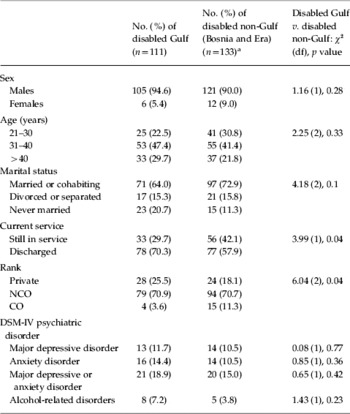
Two hundred and forty-four individuals participated in phase 2, of which 111 were disabled Gulf and 133 were disabled non-Gulf veterans (Bosnia n=54 and Era n=79). The sociodemographic, military and psychiatric characteristics of the sample are shown in Table 1.
Distribution of sociodemographic and military characteristics of phase II of the Health Survey of UK Military Personnel

NCO, Non-commissioned officer; CO, commissioned officer.
a Disabled Bosnia and Era veterans combined.
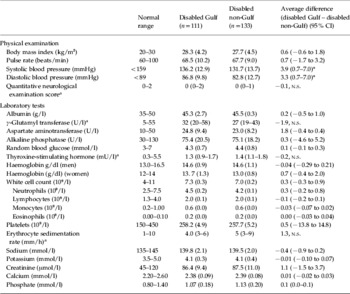
The distribution of the clinical markers for physical conditions is reported in Table 2. Both groups were on average overweight. Systolic blood pressure was significantly increased in disabled Gulf compared with disabled non-Gulf veterans. Diastolic blood pressure in disabled Gulf veterans was slightly increased (by around 3 mmHg). There was no difference in the biochemical, haematological and neurological scores.
Average scores (interquartile range or±s.d.) of screening markers of medical conditions in disabled Gulf and disabled non-Gulf (Bosnia and Era) veterans

s.d., Standard deviation; CI, confidence interval; n.s., not significant.
a Median score and interquartile range and non-parametric test of association using the Mann–Whitney two-sample Z statistic.
* p<0.01.
When the proportions of participants in the two groups with values above the normal range were compared, there were no differences in any of the health indices except that a quarter of disabled Gulf veterans (26.1%) had γ-glutamyl transferase levels above the normal range compared with disabled non-Gulf veterans (14.5%) and this represented a 2-fold increase which was statistically significant (adjusted OR 2.2, 95% CI 1.1–4.7).
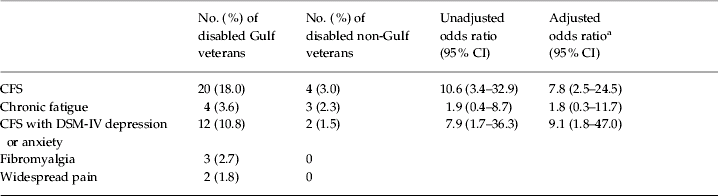
The distribution of medically unexplained conditions in each group is summarized in Table 3. A fifth of disabled Gulf veterans fulfilled the criteria for CFS compared with 3% in the disabled non-Gulf (Bosnia and Era combined) group. Of participants with CFS, 54% were suffering from concurrent depression and/or anxiety.
Proportion of medically unexplained conditions and their association with Gulf (n=111) versus non-Gulf (n=133) status in disabled veterans
CI, Confidence interval; CFS, chronic fatigue syndrome.
a Adjusted for age, sex, rank, marital status, alcohol-related disorders and selection bias using probability weights.
The likelihood of suffering from CFS in the disabled Gulf group was statistically significant compared with disabled non-Gulf veterans (Table 3). The adjusted odds of disabled Gulf veterans fulfilling the criteria for CFS was eight times greater than for disabled non-Gulf veterans but there were no similar associations with chronic fatigue or fibromyalgia (where associations could be calculated). Allowing for depressive or anxiety disorders had little impact on the association between CFS and Gulf status; they slightly increased the likelihood of disabled Gulf veterans having CFS (adjusted OR 9.0, 95% CI 2.5–32.1) compared with disabled non-Gulf veterans.
Discussion
In this two-phase survey of the distribution of common medically unexplained syndromes in UK military personnel we found that disabled Gulf veterans had very high rates for CFS compared with disabled non-Gulf veterans with a similar level of physical disability. The rates of subthreshold chronic fatigue, fibromyalgia and subthreshold fibromyalgia were increased in disabled Gulf veterans but this was not significant. Being deployed to the Gulf and having concurrent depression or anxiety disorder increased the risk of CFS further to around 10-fold in military personnel with self-report physical disability.
The validity of previous research into the nature of ill health of Gulf veterans has been questioned because of the lack of appropriate controls, the use of self-report measures or small samples. The advantage of using a two-phase design (Vazquez-Barquero et al. Reference Vazquez-Barquero, Diez-Manrique, Pena, Aldama, Rodgriguez, Arango and Mirapeix1987; Ustun & Sartorius, Reference Ustun and Sartorius1995; Merikangas et al. Reference Merikangas, Zhang, Avenevoli, Acharyya, Neuenschwander and Angst2003) is that overcomes the expense, personnel and time required to conduct detailed clinical interviews on thousands of individuals, the majority of whom will not be suffering from any disorder and reduces the selection bias by using sampling weights. Most studies that had conducted clinical assessments for medically unexplained syndromes were in selected samples or the sampling strategy had not been accounted for (Gray et al. Reference Gray, Kaiser, Hawksworth, Hall and Barrett-Connor1999; Ishoy et al. Reference Ishoy, Suadicani, Guldager, Appleyard, Hein and Gyntelberg1999; Proctor et al. Reference Proctor, Heaton, White and Wolfe2001; Kelsall et al. Reference Kelsall, Sim, Forbes, Glass, McKenzie, Ikin, Abramson, Blizzard and Ittak2004).
The SF-36 PF subscale is strongly correlated with physical health (Hemingway et al. Reference Hemingway, Stafford, Stansfeld, Shipley and Marmot1997), and it was destigmatising and informative when communicating to potential participants compared with psychological measures. Different case-finding measures and definitions for CFS can result in different results (Jason et al. Reference Jason, Helgerson, Torres-Harding, Carrico and Taylor2003). Other studies have reported higher rates (The Iowa Persian Gulf Study Group, 1997; Fukuda et al. Reference Fukuda, Nisenbaum, Stewart, Thompson, Robin, Washko, Noah, Barrett, Randall, Herwaldt, Mawle and Reeves1998; Goss Gilroy Inc., 1998; Bourdette et al. Reference Bourdette, McCauley, Johnston, Wynn, Joos, Storzbach, Shuell and Sticker2001; Reid et al. Reference Reid, Hotopf, Hull, Ismail, Unwin and Wessely2001b; Gray et al. Reference Gray, Reed, Kaiser, Smith and Gastanaga2002; Kang et al. Reference Kang, Natelson, Mahan, Lee and Murphy2003) but these were based on self-report measures. Random sampling was used but it is likely that there was still some participation bias and overestimation in Gulf veterans who were more likely to participate as they had a vested interest in the outcome of the research. We used a control group that combined those deployed to Bosnia and those not deployed to either Bosnia or the Gulf conflict 1990–1991. It is unlikely that the control group was a biased group as there was no evidence of a healthy warrior effect of Bosnia versus Era veterans in the phase 1 population-based cross-sectional survey (Unwin et al. Reference Unwin, Blatchley, Coker, Ferry, Hotopf, Hull, Ismail, Palmer, David and Wessely1999).
It was surprising that the rates of other medically unexplained conditions were not significantly increased as there is an overlap in these conditions both in civilian populations (Buchwald & Garrity, Reference Buchwald and Garrity1994; Wessely et al. Reference Wessely, Nimnuan and Sharpe1999; Aaron et al. Reference Aaron, Burke and Buchwald2000) and in studies of Gulf veterans (Reid et al. Reference Reid, Hotopf, Hull, Ismail, Unwin and Wessely2001a).
There were no differences in the distribution of clinical markers of medical conditions except that disabled Gulf veterans were more likely to have increased levels of γ-glutamyl transferase than disabled non-Gulf veterans. One of the commonest causes for increased γ-glutamyl transferase is now steatosis secondary to obesity (Salvaggio et al. Reference Salvaggio, Periti, Miano, Tavanelli and Marzorati1991) although the latter cannot be excluded in military populations that have a tradition of heavy drinking. The increase in BMI and screening positive for possible hypertension are markers of the metabolic syndrome (Klein et al. Reference Klein, Burke, Bray, Blair, Allison, Pi-Sunyer, Hong and Eckel2004; International Diabetes Federation, 2005). This may simply reflect the background epidemic of obesity worldwide but the possibility that long-term stressor exposure even in healthy individuals, of which deployment stress would be an example, may be linked to the onset of early stages of the metabolic syndrome may be a future line of enquiry (Branth et al. Reference Branth, Ronquist, Stridsberg, Hambraeus, Kindgren, Olsson, Carlander and Arnetz2007).
The relatively high rates of CFS in our study could account for the excess symptom reporting in Gulf veterans. This would imply that ill health in Gulf veterans is the same as CFS in civilian populations. The difficulty with this interpretatsion is that the reverse could also apply; in other words, civilians with CFS have Gulf-related ill health. It also follows that the aetiology of CFS in Gulf veterans should be similar to the aetiology of CFS in civilian population which is clearly not entirely the case as civilians with CFS did not go to the Gulf theatre and do not tend to experience the threat of life-threatening events such as biological or chemical weapons, immunisations against anthrax or depleted uranium unlike military personnel on deployment to war zones.
A more careful examination does suggest some similarities between ill health in Gulf veterans and CFS. Over half of the cases of CFS in disabled Gulf and disabled non-Gulf veterans had a concurrent depressive or anxiety disorder, which is similar to the rates of comorbid psychiatric morbidity in the civilian and military populations (Wessely et al. Reference Wessely, Chalder, Hirsch, Wallace and Wright1996; Kelsall et al. Reference Kelsall, Sim, McKenzie, Forbes, Leder, Glass, Ikin and McFarlane2006). Similar patterns of different attributions for different syndromes which have extensive symptom overlap have been observed in the civilian population (Stewart, Reference Stewart1990) and it is speculative whether this may also apply to ill health in Gulf veterans.
It is more likely that CFS and ill health in Gulf veterans are overlapping concepts. They appear to have similar clinical profiles as with other medically unexplained syndromes such as fibromyalgia, temperomandibular disorder, irritable bowel syndrome and MCS. They also share a similar sociocultural territory in that sufferers have fearful cognitions about the cause(s) of their illnesses which as yet have not been scientifically verified. CFS as a more general construct for medically unexplained syndrome may help to understand the nature of ill health in Gulf veterans. Psychological interventions for the management of chronic fatigue and fibromyalgia have been suggested to be helpful in improving physical functioning in medically unexplained disability in Gulf veterans (Donta et al. Reference Donta, Clauw, Engel, Guarino, Peduzzi, Williams, Skinner, Barkhuizen, Taylor, Kazis, Sogg, Hunt, Dougherty, Richardson, Kunkel, Rodriguez, Alicea, Chiliade, Ryan, Gray, Lutwick, Norwoo, Smith, Everson, Blackburn, Martin, Griffiss, Cooper, Renner, Schmitt, McMurtry, Thakore, Mori, Kerns, Park, Pullman-Mooar, Bernstein, Hershberger, Salisbury and Feussner2003). It may be more useful to consider CFS as a generic construct for medically unexplained syndromes and that ill health in Gulf veterans falls within this construct. The search for a biological explanation for fatiguing symptoms has not been very successful in understanding or treating the disability (Wessely et al. Reference Wessely, Hotopf and Sharpe1998). In contrast, examination of perpetuating factors such as avoidance behaviours, illness beliefs and catastrophic cognitions has improved our understanding of the psychological mechanisms involved in CFS and helped develop treatments. Our study suggests that there is an association between being deployed to the Gulf War 1990–1991 and CFS.
Acknowledgements
This study was funded by the US Department of Defense. The funding body had no part in the design, analysis and reporting of this study. We thank the veterans who participated in this study for their time and Dr Selwyn Richards, Rheumatologist, who gave training for the fibromyalgia assessment.
Declaration of Interest
S.W. is honorary consultant advisor to the Ministry of Defence, UK.