Introduction
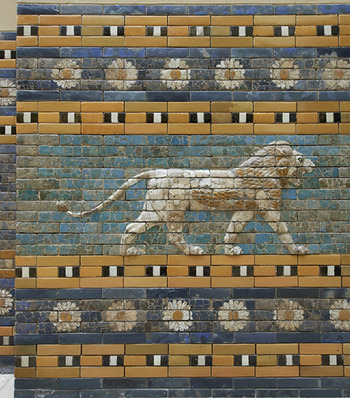
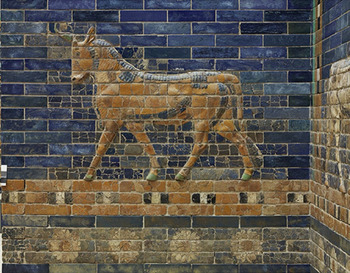
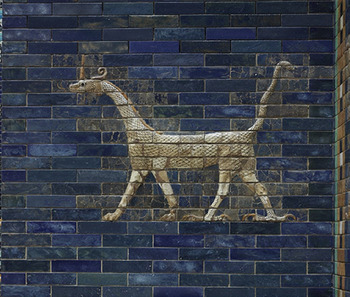
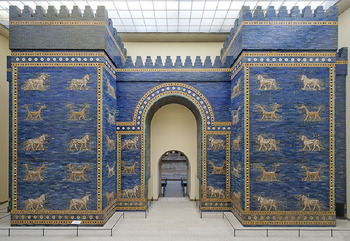
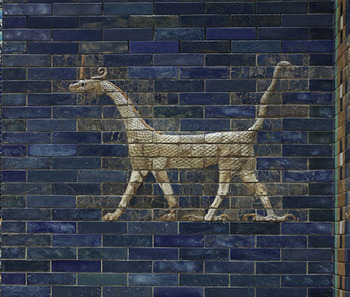
Among the most famous structures that Nebuchadnezzar II (605–562 b.c.) erected at Babylon are the Ishtar Gate and walls lining the so-called Processional Way. These were decorated with images of three very significant animals: the lion, the bull, and the mythological mušḫuššu-dragon.Footnote 2 Approximately 120 striding lions were represented on the walls of the Processional Way that ran in a straight line from the centre of the city from south to north along the eastern side of the Southern Palace to the Ishtar Gate, from where it led to the Akītu temple (bīt akītu) beyond the city wall. These lions are made of moulded and coloured glazed bricks: their bodies are either coloured white with dark orange manes (Fig. 1) or dark orange with blue mains. They are placed against either a light or dark blue background. Their mouths are gaping, so that the fangs are visible to emphasise their fierce nature. Glazed bricks are also used to cover both the inner and outer faces of walls of the Ishtar Gate, located in the north of the inner city wall adjacent to the north-east corner of the Southern Palace. The gateway is adorned with pairs of striding bulls (Fig. 2) and mušḫuššu-dragons (Fig. 3), alternating up the height of the gate. The bodies of these animals are coloured in either a dark orange or white, against a background of ultramarine blue, the colour of lapis lazuli. The mušḫuššu, a name which derives from the creature's Sumerian term, MUŠ.ḪUŠ, is a composite animal consisting of a scaled body with leonine forepaws and bird's hind legs; the tail, neck and head, with protruding tongue, are formed from a snake. The creature strides forward with raised head and tail. The bull lowers slightly his head, as if he is about to gore an adversary. This part of the gate, which is reconstructed partially in the Pergamon Museum, Berlin, represents the latest phase of the building constructed by Nebuchadnezzar II. The earlier phase of the gate—which was left entirely underground when the king constructed the later glazed structure—was also adorned with some 150 bulls and mušḫuššu in plain moulded brick.
Glazed brick relief showing a lion, reign of Nebuchadnezzar (605–562 b.c.), from Babylon, Vorderasiatisches Museum, Berlin, VA 1392. Courtesy of Vorderasiatisches Museum, Berlin

Glazed brick relief showing a bull, reign of Nebuchadnezzar (605–562 b.c.), from Babylon, Vorderasiatisches Museum, Berlin, VA1410. Courtesy of Vorderasiatisches Museum, Berlin

Glazed brick relief showing a mušḫuššu, reign of Nebuchadnezzar (605–562 b.c.), from Babylon, Vorderasiatisches Museum, Berlin, VA1436. Courtesy of Vorderasiatisches Museum, Berlin
Other forms of these same creatures, but of bronze, were also associated with the city gates as revealed by Nebuchadnezzar's inscriptions:
a-na sí-ip-pi KÁ.GAL-šu AM.AM ZABAR e-ek-du-u-tì ù MUŠ.HUŠ še-zu-zu-ú-tì ú-uš-zi-iz
I set up at the doorway of its (Babylon's) gates fierce wild bulls of bronze and raging mušḫuššu-dragonsFootnote 3
The king also states proudly that the combination of these animals was depicted on the walls of his palace:
i-na a-gur-ri na4ZA.GÍN KÙtì šá AM.AM ù MUŠ.ḪUŠ ba-nu-ú qer-bu-uš-šá na-ak-li-iš ú-še-pi-iš
I embellished the palace with bright blue bricks on which bulls and mušḫuššu were depictedFootnote 4
A common interpretation of these animals is that they are associated with or symbolise specific deities: the mušḫuššu is connected with Marduk, the chief god of Babylon, the bull with the storm god Adad, and the lion with the goddess Ishtar.Footnote 5 The animals are closely linked with these deities both in texts and iconography, most obviously when they are depicted in the company of anthropomorphic representations of their respective god or goddess. Previous studies have also demonstrated that even when shown alone, these animals can symbolize these deities (Seidl Reference Seidl1989: 138–56; Ornan Reference Ornan2005: 109–32). The animals have the potential to convey and encompass multiple values and symbolic notions, but what distinguishes their specific meanings is their “context”. Context creates the frame in which a specific aspect is selected and evoked. The representation of divine power in the form of a lion, bull and mušḫuššu would have been sensed strongly in Babylon considering that these images occur adjacent to the temples of a wide variety of deities. Moreover, there is a broken passage in Nebuchadnezzar's Brisa inscriptions that suggests that the statues of these three gods were on occasion carried along the Processional Way:
˹tam-le-e É˺.SIS[KUR] ˹maš˺-da-ḫu EN GAL dAMAR.[UTU] ki-˹ma giš˺TIR EREN KÙ ti [o] ˹i-ri-is˺-sa
uš-ṭi-[ib] dIŠKUR dINN[IN] ša it-ti dAMAR.[UTU] dEN.LÍL ˹DINGIR.DINGIR˺ [o] i-šá-di-ḫu-ma ˹qé-[reb ŠU.AN.NAki]
The platform of Esiskur, the (end-point of the) processional street of the great lord Marduk, I made its smell as sweet as a grove of pure cedars. Adad and Ishtar, who go in procession [in Babylon] with Marduk, the Enlil of the gods …Footnote 6
Although the exact meaning of this text is unclear, it may simply be highlighting the importance of the three deities. It should also be noted that the three animals that appear on the glazed-brick walls never accompany divine figures but—as demonstrated below—occur consistently on their own at a gateway. My intention is to highlight their symbolic role as evoked by their place in an architectural context of gateways, which attributes a protective function to the animals.
Contextual approach
We face difficulties when we try to establish the meaning of these ancient representations. There is a natural tendency to interpret them by applying criteria that reflect our own values and assumptions about cultural phenomena. This clearly brings with it the risk of imposing externally derived concepts of rationality onto objects that belong to a totally different cultural context. In order to minimize such a risk, it is important that any interpretation of cultural phenomena should be based primarily on an assessment of the internal relationships revealed by their original contexts. Hodder has defined the term “contextual” as the placing of items “with their texts” (con-text).Footnote 7 The approach adopted here is that “context” refers to those parts of a written text that come immediately before and after a particular passage. They are so closely connected that the meaning of the passage cannot be entirely understood without them. Archaeologists use the term “context” in a variety of ways. It usually refers to the place where an object was found and its relation to other objects and structures. The interpretation of artefacts can only be established by analysing the archaeological context in which they were found. This context then provides clues to an object's meaning and function, thus the object is “empowered” to communicate with us, and is no longer mute. Marcus (Reference Marcus1996: 285–91) has argued the importance of “context” in interpreting figurines. He stresses that archaeological context is crucial and texts provide an invaluable guide for their interpretation. In this article the term “context” is used in its wider sense as it is defined in archaeology, so that it refers not only to the functional aspect of the place where the object was found, but also to any other evidence indicated by associated objects or architectural features.
As described above, the original locus of the lions was the walls lining the Processional Way, while bulls and mušḫuššu-dragons adorned the Ishtar Gate. The part of the Processional Way which runs from the bank of the Euphrates to Esagila, the temple precinct that formed the centre of the city, was referred to as “the procession road for the great son, Nabu”, while the northern part, from Esagila to the Ishtar Gate, was called “the Procession Way of Marduk”, and along which images of the gods Nabu and Marduk were carried on the occasion of a festival.Footnote 8 From an architectural point of view, it should be noted that both the Ishtar Gate and the Processional Way occupy an important place of entry to the city for such ritual activity, an area of interaction between the internal and external spheres. The placement of the animals in such a crucial location needs to be closely considered with the particular architectural context, since, as I will now demonstrate, the lion, the bull and mušḫuššu are all attested in similar contexts as early as the late fourth millennium b.c.
Animal statues at doorways
Gudea Cylinder A (around 2150 b.c.), makes reference to all three of our animals in a description of the entrance to the Eninnu Temple at Girsu. The locks of the temple doors had “bisons(?)” (BAD) on them, its door-pivots had “lions” (ur.maḫ), from their bolts “womb snakes” (muš.šà.tùr) and mušḫuššu (muš.ḫuš) hissed at a “wild bull” (am), “young lions and panthers” (ug nemurx <PIRIG.TUR>-TUR.TUR) lay on the door lintels, and the shining nails of roof-beams were like a “dragon” (ušum) placing its claw on someone's chest.Footnote 9
It is not entirely clear whether these animals are actually statues attached to various parts of the doorway, or whether they are mentioned here as metaphoric expressions to describe features of each part of the doorway. If we take this as a literal description of the decoration, the entrance to the temple of Eninnu was extensively adorned with animal images.
Statues of lions
The earliest evidence for a statue of a lion situated at a doorway is found in another text of Gudea of Lagash. It is inscribed on a small stone head of a lion excavated at Telloh and dedicated by Gudea to the goddess Gatumdug:Footnote 10
dgá-tùm-du10 ama-lagaški nin-a-ni gù-dé-a énsi-lagaški-ke4 é-iri-kù-ga-ka-ni mu-na-dù gišig-ka[m]
For Gatumdug, mother of Lagaš, his lady, Gudea, ruler of Lagaš, built her House of the Shining City. It (i.e., this lion) is (part) of the door.Footnote 11
The inscription makes it clear that this lion sculpture was originally located at or attached to the doorway of the temple. Another of Gudea's lion statues, of similar size but found at Uruk, bears an inscription dedicated to the god Ningirsu, the last line of which also claims that “it is of the door” (giš{x}ig.kam).Footnote 12 Thus Gudea's texts clearly identify the locus of the buildings where these lion statues were originally placed.
Numerous sculptures of lions have been excavated at sites in southern Iraq. Among the earliest examples is one from Eridu, where a basalt figure of a seated animal was found in the north-eastern side of the tell, about fifteen metres beyond the city wall and in line with the south-eastern side of the ziggurat.Footnote 13 The statue has been dated to the late fourth millennium b.c.Footnote 14 The lion sits upright on its haunches. The eyes and mouth are carved, the manes take the form of large curls, and the carved tail, on the right side of the body, ends in a curly tip.
At Tell al-‘Ubaid, four large lion heads were found in the sanctuary of the temple of Ninḫursag.Footnote 15 Each of the heads consists of an outer mask of copper, covering a bitumen core. The eyes, teeth and tongue were made of stone and shell and attached to the bitumen. Two of the heads were found with the foreparts of the bodies still attached. These heads were buried in a row along the temple façade,Footnote 16 so the excavators assumed that the lion heads, with the foreparts of their bodies, originally flanked a doorway at the entrance to the temple.Footnote 17 In Susa lion statues made of stone were found at the Inšušinak Temple;Footnote 18 a fragment of a stone lion comes from Aššur;Footnote 19 and three lion heads bearing the inscriptions of Ur-Nanše were found at Lagash.Footnote 20 Although the exact loci of these earlier statues are not known, it is generally assumed, on the basis of the later tradition and function of statues of this type, that they functioned as “gate figures”.
Textual evidence from the second millennium provides the names of a pair of lions installed at the Ulmašītum Temple in the city of Malgium by Takil-ilissu. These statues are inscribed with texts:
[d d]a-an-É ù d ra-šu-ub-É ne-ši na-aš-pa-ri-ša a-li-ku-<ut> i-di-<<x>>-ša a-šar ma-aq-qí-it šar-ri …
(I installed) [D]ān-Bītim and Rašub-Bītim, the lions, her envoys, who go at her side at the place of the maqqītum offerings of the king …Footnote 21
Here the names of a pair of lion statues are mentioned as Dān-Bītim and Rašub-Bītim. The name of the first lion, Dān-Bītim, means “Strong one of the temple (lit. house)” and the second, Rašub-Bītim, means “Terrifying one of the temple”. These names reveal that these animal statues serve the temple with their “strong” and “terrifying” nature.
Further evidence comes from a lion statue of the first millennium found at Tell Ahmar (Til-Barsip). The statue was excavated at the site of an ancient city gate to the north-east of the tell. It bears an inscription that provides the names of the two lions placed at the city gate. The inscription was carved by the Assyrian turtānu Šamši-ilu, who lived at the time of Shalmaneser IV (782–773 b.c.). The text reads:
MU I-en UR.MAḪ šá [maḫ-rat KÁ iz-za-zu UD]-mu ez-zu ti-bu<-šú> la maḫ-ru mu-šam-qit [l]a ma-gi-ri mu-šam-ṣu mal lìb-bi MU-šu MU II-e [UR.MAḪ] ša maḫ-rat KÁ iz-za-zu [mu]-na-kip a-nun-tú sa-pìn KUR nu-kúr-tú mu-še-ṣ[u-ú] ḪUL.MEŠ mu-še-rib [S]IG5.[ME]Š MU-šú
The name of the first lion which stands before the gate is: Furious storm-demon, whose onslaught is irresistible, feller of the insubordinate, who helps to achieve one's desires. The name of the second lion which stands before the gate is: Repulser of battle, overwhelmer of the enemy land, who drives out evil, who brings in good.Footnote 22
These names again reveal the essential nature and function of the lion statues. In both names, the aggressive characteristics of the statues are emphasised by expressions such as “fierce”, “irresistible onslaught”, “feller of the insubordinate”, “repulser” and “overwhelmer of the enemy land”. The animals’ fierce nature effectively determines their function to repel enemies. Furthermore, the statues have a beneficial function, to “help to achieve one's desires” and to “bring in good”. The latter function can be interpreted as a reflection of the desires and wishes attributed by people to these creatures.
Bull statues
The occurrence of the bull at a doorway goes back to the Early Dynastic period.Footnote 23 At Tell al-‘Ubaid, bull statues made of copper were found where the four lion heads, discussed above, were discovered in the sanctuary of the temple of Ninḫursag.Footnote 24 These bulls stand with all four legs on the ground, and their heads looking back over one shoulder. These statues were found piled in front of the wall that once formed the façade of the temple, and it is believed that they were originally placed on the wall near the entrance.Footnote 25 Further bull figures were found in copper reliefs which also decorated the temple façade as a frieze, where the animals are represented as rising from a reclining posture.Footnote 26
In the first millennium, the names of bull statues are recorded in an inscription carved on one of the pair of statues installed by Tiglath-pileser III (744–727 b.c.) at the entrance to a temple at Arslan Tash:
M[U] GUD.A[M] maḫ-re-e šá ina [IM.MAR.T]U [GUB-zu] UD-mu [ez-z]u x[ ] a+a-bi mu-šam-qit lem-nu-ti MAN MU-šú MU II-e GUD.AM šá ina [I]M.KUR GUB-zu ka-šid er-net-ti MAN mu [ ] x x[ ]x x mu x x[ ] mu-še-rib MÍ.SIG5.MEŠ MU-šú
The name of the first bull who stands in the west is: Furious storm-demon, […], feller of the wicked, (of the) enemy of the king. The name of the second bull who stands in the east is: Who gains victory for the king, […], who brings in good.Footnote 27
The names of these two bull statues are very similar to those of the lion statues from Til-Barsip. The name of the first bull emphasises its aggressive characteristics, which are directed against the king's enemies. The name of the second bull, on the other hand, stresses its beneficial role, to bring victory to the king and to let the good things in. The function of these bull statues is almost identical to that of the lions occurring in the same architectural context. The aggressive features of the bull statues are elsewhere specified in terms of “goring” and “trampling”. Ashurbanipal (668–631 b.c.) refers to silver wild bulls, which he set up in the Sin Temple in order to “gore the evil doers, to trample my enemies”, (ana itkup zāmâni dâiš ajābīj[a])Footnote 28 and elsewhere he refers to “two wild bulls made of silver goring my enemies” (2 rīmī kaspi munakkipu gārîja).Footnote 29 In both cases aggression is targeted at “enemies” and “evil doers”.
The statues were thus believed to permit beneficial things to enter the internal space of the city or the building, but to repel things that could be harmful. In other words, the statues stand at the junction between the external and the internal in order to act as a “filter”, to select what is appropriate to enter the internal sphere. Those things which are perceived to be evil or hostile are to be conquered at this point. Significantly, the statues themselves are sometimes described with the divine determinative.Footnote 30 Moreover they are never simply described in texts as the “statue” or “image” (ṣalmu) of animals.Footnote 31 They are referred to explicitly as “lion” (nēšu) or “bull” (rīmu). It has been argued that the relationship between “the represented object” and “its representational subject” is neither direct nor straightforward.Footnote 32 So that while Mesopotamian statues of animals certainly stress their particular natural characteristics, these statues were not regarded as exactly the same as the real animals or merely their substitutes but were perceived as having additional qualities that brought in “good things”.
Statues of mušḫuššu. The mušḫuššu, whose name means “fearsome/savage snake”, occur in the same architectural context as those of lions and bulls as attested in texts from the late third millennium.Footnote 33 In addition to Gudea's reference to mušḫuššu at the entrance to the Eninnu Temple mentioned above, later evidence, from the Old Babylonian period, derives from the Ištaran Temple in DerFootnote 34 and from the “fearsome gate” in Eshnunna.Footnote 35 In the late Neo-Assyrian period, a mušḫuššu was executed in relief on a stone slab adjacent to a doorway leading into Room S: the room that once functioned as a Western Portal of the North Palace at Nineveh.Footnote 36 The creature is depicted in profile facing right and standing upright on its hind legs with its forepaws stretched forward. At the rear of the mušḫuššu stands a bearded figure wearing a rounded head-dress with the hindquarters of a lion; he also faces right, with his arms bent at the elbow and the left hand raised. The original relief slab bearing these images was lost following its excavation and only a drawing by William Boutcher now survives (British Museum, Or. Dr. V 44). The relief was placed on the south-east jamb of a doorway, designated “Entrance (a)” by the excavator, located on the south-west side of the room. Both of the figures represented have been understood to be protective in nature because to their body posture and the location of the relief at a doorway.
Nebuchadnezzar II recorded his architectural achievements at Babylon as follows:
KÁ.GAL.MEŠ ši-na-a-ti ad-ki-e-ma mi-iḫ-ra-at me-e i-šid-si-in i-na ku-up-ri ù a-gur-ri ú-šar-ši-id-ma i-na a-gur-ri na4ZA.GÍN KÙ tì šá AM.AM ù MUŠ.ḪUŠ ba-nu-ú qer-bu-uš-šá na-ak-li-iš ú-še-piš
I pulled down those gates, and next to the water I laid new foundations with pitch and fired bricks. With bright-blue bricks on which bulls and mušḫuššu were depicted I had them skilfully built.Footnote 37
This reference describes the representation of bulls and mušḫuššu in glazed brick on the gate. The same set of creatures was also cast in bronze as statues to be set at the side of the gate as mentioned above. The purpose of placing mušḫuššu statues at the gate is indicated in an inscription of the later king, Neriglissar (560–556 b.c.):
7 MUŠ.ḪUŠ e-ri-i še-zu-zu-ú-ti šá li-im-nim ù a-a-bi i-ṣa-an-nu i-ma-at mu-ú-ti
I cast seven bronze savage mušḫuššu, who spatter enemy and foe with deadly venom.Footnote 38
The creature is regarded as assaulting and expelling enemies by using its deadly poison. This statement clarifies the role of a mušḫuššu in this context as the protector who chases out evil. It is clearly of great significance here that in his study of the history of the mušḫuššu, Lambert (Reference Lambert and Borgeaud1985: 87–88) has argued that it is far from certain that the placement of this creature on the Ishtar Gate was intended to represent the city's chief deity, Marduk, but rather that the mušḫuššu should be interpreted as guarding the gates against enemy attack with its protective powers. Wiggermann too examined various aspects of the mušḫuššu and also understood that its role in relation to the Ishtar Gate at Babylon was apotropaic;Footnote 39 he has also suggested that the creature was counted among “those that repel the evil, of Ea and Marduk” in a ritual text.Footnote 40
Names of the gate and the street
Let us return to and examine the three animals represented on the glazed-brick walls at Babylon in association with their architectural context. It is important to remind ourselves of the name of the Ishtar Gate:
KÁ.GAL d15 sa-ki-pat te-bi-šú KÁ.GAL d15
Gate: “Ishtar overthrows its assailant” the Ishtar Gate.Footnote 41
It should be noted that the animal figures represented on this gate are not lions, with which the goddess is usually associated, but bulls and the mušḫuššu (Fig. 4), which would have been associated with Adad and Marduk/Nabû respectively in the divine context. This is a very important point which has been overlooked so far by scholars who interpreted these animals on the gate as divine symbols. The context suggests instead that these two animals were chosen not because of their divine associations but because of their apotropaic function, protecting the gate. Similarly, the Processional Way—used for the Akītu festival for the procession of divine figures along the wide street between high walls adorned with 120 figures of lions—was named:
SILA a-a-˹i˺-[bur šá-bu]-ú SILA b[a-bi-li]
The Ishtar Gate reconstruction, reign of Nebuchadnezzar (605–562 b.c.), from Babylon, Vorderasiatisches Museum, Berlin, VA1408–1456. Courtesy of Vorderasiatisches Museum, Berlin

Street: “May the Arrogant not Flourish” the Street of Babylon.Footnote 42
This name was intended as a curse laid on enemies. It is important to note that the name of the street has nothing to do with the goddess Ishtar, with whom the lion would have been associated in the divine context. The northern section of this street, stretching from the Ishtar Gate as far as the Esagil temple, was indeed called: “Street: ‘Ishtar is the Guardian Angel of her Troops’ the Street of the Ishtar Gate”Footnote 43 , emphasizing the protective power of the goddess in a military context. It is certainly possible that the images of the lions represented on the walls flanking the Processional Way where it passes in the neighbourhood of the Temple of Ishtar of Agade (E-mašdari of Belet-Akkade)Footnote 44 may have evoked the animal's symbolic association with Ishtar. However, in view of its architectural context, the Processional Way is the extended passage from the city gate and the Ishtar Gate, and the lions represented on the walls of this festival street most likely functioned to reinforce the power of the curse through their fierce nature. The evidence indicates that the presence of these three animals in this particular architectural context in Babylon focuses on their millennia old protective properties. These animals were chosen to evoke their apotropaic powers in order to avert evil in exactly the same way as when they were stationed as statues at doorways. Thus they reinforce the powerful symbolic message embodied in the names of the gate and the street but in a striking visual form. Three animals: the lion, the bull and the mušḫuššu were thus carefully selected for their apotropaic qualities.