Sports, body, and politics: Mao's 1966 historic swim
Mao Zedong's (1893–1976) historic swim in the Yangtze River on 16 July 1966, which heralded a new phase of the Cultural Revolution, was a carefully staged political performance and a notable example of body politics in Communist China. Beginning in the late 1950s, Mao began to broadcast the idea that he was a keen swimmer and to convince the masses to take up swimming. The swim was the climax of those efforts and an integral part of the Mao cult. Swimming in Mao's China offers a useful lens for understanding the close relationship between sports, the body, and politics. Swimming was a means for Mao to mobilize mass support for his political authority and a venue for the masses to practise and perform Maoism. Swimming became a political metaphor for expressing and performing Mao's ideology publicly and in a bodily dimension.
This article provides a new understanding of Maoism in practice through the lens of body politics. It examines the constructive process and meanings of Mao's swimming body, and the extent to which the bodies of the populace were regulated through the mass-swimming craze. In the theory of body politics, the living body is a construction, a symbol, and a contested site of power relations where regulation and resistance are constantly played out. As Bryan Turner argues, the body is ‘crucial to both the micro and macro orders of society’ and ‘the vehicle for self-performances’.Footnote 1 The case of Mao's swimming body exemplifies the ways in which ideologies were disseminated and reproduced through performances, using the body as a vehicle for self-expression under his regime. This study distinguishes itself from the existing literature concerning images and representations of Mao in propaganda materials by demonstrating that Mao's swimming body was his preferred expression of his living body. He used his body to construct propagandist representations of himself. The influence of Mao's swimming body on the mass-swimming craze explains the complex story of the common people's formulation of their survival strategy in an authoritarian state. Drawing on untapped archival materials related to mass swimming in Mao's China, I argue that swimming both solidified and destabilized the Mao cult and became a venue through which political values were shaped, indoctrinated, contested, and repudiated.
Mao's 1966 Yangtze swim was a carefully orchestrated event whose audience included the Chinese people and also overseas visitors. On the morning of 16 July 1966, 5,000 young swimmers gathered on the bank of the Yangtze River in Wuhan to join the eleventh Cross-Yangtze Swimming Contest. The swimmers held red flags and placards that read, amongst other slogans from the Little Red Book, ‘Resolute and unafraid of sacrifice, they will surmount every difficulty to gain victory’. ‘The East is Red’—a song glorifying Mao's greatness—was blasting from loudspeakers installed on both sides of the river. The swimmers knew in advance that this cross-Yangtze swim was no ordinary event. Local officials had informed them that foreign guests who were attending the Afro-Asian Writers’ Emergency Conference would come to see them swim and that the swim was designed to propagate Maoism and to protest imperialism and revisionism. A rehearsal was held on 8 July 1966 to ensure that everything would go smoothly.Footnote 2 Nevertheless, neither the swimmers nor the conference guests had been told that Mao himself would be participating in the contest.
The swimmers were excited on the morning of the contest when they saw their beloved Chairman Mao standing on a motorboat in the river. The historic scene was immortalized by propaganda photographs and later an oil painting (as explained in the next part of this article). The swimmers shouted ‘long live Chairman Mao’ as they swam past the leader. Mao waved back to the crowds and cheered ‘long live the people’. The motorboat headed to the mouth of the Wuchang Dykes near the Yangtze River Bridge shortly afterwards and the 73-year-old Mao entered the water.Footnote 3 He reportedly swam in the river for 65 minutes, covering a distance of about 15 kilometres: ‘[w]hen he boarded the boat he was vigorous and showed no sign of fatigue.’Footnote 4 But, as The Times of London described, Mao ‘did not swim right across as he has on other occasions, but let the current carry him downstream’.Footnote 5 Nonetheless, the vigorous swim was enough to dispel rumours about Mao's poor health and showcase both his physical and political stamina. This sports spectacle conveyed the message that Mao was in complete control of both his ‘body natural’ and the ‘body politic’ of China: with his robust body, indomitable spirit, and mass public support, Mao would always emerge victorious over any challenge, be it natural or political.
Two days after the Yangtze swim, Mao headed back to Beijing. It had been more than eight months since Mao's departure from the capital. On 11 November 1965, one day after Yao Wenyuan (1931–2005) published the article ‘On the New Historical Peking Opera Hai Rui Dismissed from Office’ targeted Wu Han (1909–69) that heralded the beginning of the Cultural Revolution, Mao left Beijing for his so-called southern tour of Shanghai, Hangzhou, Changsha, and Wuhan, and so on. This long trip allowed him to carefully plot the removal of his rivals while avoiding regular contact with them. On 16 May 1966, the Central Political Bureau in Beijing published the ‘May 16th Circular’ under Mao's instruction. The circular warned the people that revisionist counter-revolutionaries in the party were plotting to overthrow the proletariat dictatorship. Its publication marked the outbreak of the Cultural Revolution. On 16 June 1966, the People's Daily published the editorial ‘Unleash the Masses, Thoroughly Crush the Counterrevolutionary Black Gang’ to create a public backlash against the work groups that Mao's rival Liu Xiaoqi (1898–1969) had installed to restrain students’ action against party committees in schools.Footnote 6 Now, the stage for the Cultural Revolution was set and Mao was ready to make a political comeback. His great swimming feat, performed for the applause of 5,000 young swimmers on 16 July, soon dominated the news coverage. It reaffirmed his status as the mighty leader of the people, preparing him to mobilize popular support for his war against the ‘counter-revolutionaries’.
On 25 July 1966, the headlines of the major party newspapers People's Daily and Guangming Daily featured Mao's swim simultaneously, and brought the images of Mao's swimming body into the hearts and minds of the people nationwide. Two photos of Mao—one showing him swimming in the sea and the other of him waving to a crowd—occupied the first half of the front page (Figure 1), with the second half providing written details of the event. Liang Heng (1954–), the author of Son of the Revolution, recalled that, in Changsha, Mao's birthplace, the swimming issue was distributed free of charge. Long lines of people waited to get their own copies of the images. The news of Mao's swim not only caused a great sensation in Changsha, but also transformed the relationship between Mao as a leader and the people. Liang wrote:
Great congratulatory festivities were held in every unit, and the streets shook with drums and firecrackers. Changsha looked just like it did on National Day …. I felt close to this great leader who had always been a little mysterious to me …. At last I knew that Chairman Mao was made of human flesh and blood, and at the same time I was moved with an even greater respect. I resolved once again to serve him with all my heart.Footnote 7
We do not know whether other cities held similar festivities, but the fact that images of Mao's swim functioned as propaganda to support his political agenda was conspicuous.
People's Daily, 25 July 1966, p. 1.

A People's Daily editorial printed on 26 July 1966 entitled ‘Striving Forward in Winds and Tides under the Leadership of Chairman Mao’ detailed the purpose of Mao's swimming performance. The strong winds and high waves in the Yangtze were metaphors for the challenges facing the Communist Party in its revolutionary struggle. According to the editorial, the winds and waves whipped up by the ‘rebel’ Chiang Kai-shek, Japanese militarism, and American imperialism were all defeated under the leadership of the Communist Party and Chairman Mao. The editorial drew a corresponding analogy between swimming and revolution by quoting Mao: ‘There is a law in swimming, and one easily learns how to swim if one understands this … there is also a law in revolutions, and one manages to harness the development and changes of the revolution if one understands its law.’ The editorial further developed the parallel between swimming and revolution: ‘One can never learn swimming without practicing in the water. Making a revolution is just the same. One should practice by joining the class struggle, grasp the law of revolution in the winds and waves of the class struggle, and learn the swimming technique of the class struggle.’Footnote 8
On 5 August, ten days after the publication of the report on Mao's swim, Mao issued ‘Bombard the Headquarters—My Big-Character Poster’ to launch a scathing attack on his enemies. A People's Daily editorial printed on 17 August 1966 entitled ‘Learn to Swim by Swimming’ reiterated the parallel between swimming and revolution. It argued that one learned to make revolution only by making revolution. On the following day, Mao received tens of thousands of Red Guards in a mass meeting celebrating the Cultural Revolution, who vowed to follow Mao's call to join his glorious cause.Footnote 9 The use of athletic imagery as propaganda is not uncommon in national politics.Footnote 10 Mao stood out as a political leader by creating an athletic image for himself and using his body as a literal embodiment of his revolutionary visions to advance his political agenda.Footnote 11 Mao's unprofessional swim stroke, chubby body, and floppy belly were by no means reminiscent of an ideal athletic figure.Footnote 12 Nonetheless, during the Great Leap Forward and throughout the Cultural Revolution, Mao's swimming body was carefully recreated and presented in propaganda materials. He was portrayed in his sacrosanct role as China's leader and saviour, which was an important element of the Mao cult and was the basis of political mobilization.
Mao's swims exemplified his willpower and mobilized political support for him by creating a swimming craze among the masses nationwide. This seems to confirm Pierre Bourdieu's statement about the importance of sports to authoritarian regimes. Yet Bourdieu also argues that ‘sport—as all disciplines in all total or totalitarian institutions … is a way of obtaining from the body a form of consent that the mind could refuse’.Footnote 13 Bourdieu's argument suggests that mass bodily conformity can hide unruly minds that embrace nonconformist beliefs. The following sections will examine Mao's swimming body as represented in propaganda materials and then evidence about the organization and reception of mass-swimming events at the local level. Mao's promotion of swimming not only helped would-be escapees to appear to be conforming to Mao's thoughts while practising in the water, but it also supplied them with the necessary knowledge and techniques to battle the tides and currents to Hong Kong and Macau. Swimming refugees endured great personal risk to reclaim their own bodies. They destabilized the official discourse of swimming in Mao's China as well.
Construction and representation of Mao's swimming body
Several studies have briefly noted the importance of Mao's swimming body in understanding the politics of the People's Republic of China (PRC). Lucian Pye remarks that ‘[t]hroughout his life, Mao has made much over his prowess as a swimmer and several times in his old age when faced with severe challenges he has dramatically taken to public swimming’.Footnote 14 Geremie Barmé describes the symbolic meaning of Mao's body as ‘the incarnation of mass will’, ‘the physical representation of Revolution, History, the Fate of China, and the People's Aspirations’, and ‘the embodiment of China’. Barmé argues that, through swimming, Mao displayed ‘revolutionary physical strength’ and a spirit of ‘confronting the dangers of untamed nature’.Footnote 15 Roderick MacFarquhar and Michael Schoenhals argue that the People's Daily coverage of ‘Mao's triumphal swim’ was designed to underscore the idea that Mao was ‘fighting fit and ready to resume command’.Footnote 16 However, these studies stop short of revealing the process of constructing the image of Mao's swimming body and its role in mobilizing the masses from a long-term perspective.
From his youth, Mao attached great importance to improving his body through physical exercise. In April 1917, at the age of 24, he published an article entitled ‘A Study of Physical Education’ in the highly influential magazine New Youth. He argued that sports was a character- and nation-building tool. He contended that physical exercise was conducive to a strong mind and that a healthy body was the foundation of moral and intellectual development and the cornerstone of a strong nation.Footnote 17 Mao's thinking echoed the ideas of his time. To eliminate China's newfound image as ‘the sick man of Asia’, he believed that ordinary citizens should first strengthen their bodies through physical exercise. Mao had a genuine love for swimming from his adolescence onwards, and he would swim in freezing river water during the winter as a form of physical training. However, he did not mention swimming in his 1917 article.Footnote 18
To Mao, swimming in the Yangtze River—the largest river in China and the third largest river in the world—was a political act filled with symbolism.Footnote 19 But Mao was not the first person to attach political meaning to swimming in the Yangtze. On 25 October 1933, Shi Xingzhi (1914–69), a 19-year-old swimmer from Dairen, Liaoning (who had won the gold medal in the 1,500-metre long-distance race in the National Games held in the national capital of Nanjing), swam across the Yangtze River with his brothers. The Shi brothers proclaimed that their historic swim was meant to raise the Chinese people's awareness of the plight of their hometown in the northeast, which had fallen to the Japanese in 1931. The swim, which took place in Nanjing, started at Pukou on the west coast of the Yangtze River at 3:27 p.m. and finished at Xiaguan on the east coast of the river at 3:49 p.m. However, the Shi brothers’ unprecedented act of conquering the Yangtze River was neither encouraged nor welcomed by the nationalist government, which might have felt that the brothers’ attempt to use the swim as a patriotic statement was an embarrassing reminder of China's national weakness and the government's failure to resist Japanese encroachment. Therefore, the Shi brothers’ historic but not well-publicized act of swimming across the Yangtze River did not become an important part of the Chinese people's national memory.Footnote 20
To understand the political significance of swimming, we cannot evade the question as to when Mao consciously began to use swimming in the Yangtze and his swimming body to convey his political ideology and build up his charisma. Between 1956 and 1966, Mao swam in the Yangtze River 12 times: 1956 (31 May; 2 and 3 June); 1957 (5 September), 1958 (10, 11, 12, 13, and 14 September); 1961 (24 September), 1962 (24 June), and 1966 (16 July). Other than his last swim on 16 July, there is no direct evidence to determine the timing of Mao's various swims and his political career. However, it is undeniable that, through these swims, and, more importantly, through the representations of these swims, Mao's body was gradually transformed into a symbol of the body politic. Instead of making speculative connections between the timing of Mao's swims and his political situation, this article will focus on the timing of and the ways in which Mao's swims were presented in the state media so as to explain the construction process of Mao's swimming body.
Mao's 1956 Yangtze swims took place about one month after he delivered two important speeches—‘On the Ten Great Relationships’ (25 April) and ‘Let a Hundred Flowers Blossom, a Hundred Schools of Thought Contend’ (2 May)—to advocate his political visions amid criticism from all sides. According to the diary of Wang Renzhong (1917–92), the First Party Secretary of Hubei who accompanied Mao in the water (and whom Mao's doctor Li Zhisui described as ‘Mao's great sycophant’), tens of thousands of people gathered on both sides of the river on 3 June, cheering ‘long live Chairman Mao’ as they watched him swim. Wang did not mention any people watching Mao swim on 31 May or 2 June.Footnote 21 We can postulate that the large crowds of people gathering along the river cheering Mao during the 3 June swim were organized by Wang to gratify Mao. It seems likely that this episode had a formative influence on the combination of Mao's swimming and Mao's personality cult soon after.
Mao's Yangtze River swims in May and June 1956 were not covered in the People's Daily. Footnote 22 Interestingly, on 3 June 1956, the People's Daily published an article about the first female athlete swimming across the Yangtze River on 26 May. And, on 25 June 1956, it was reported that 694 swimmers swam across the Yangtze on 24 June 1956. It is not known whether it was because Mao did not see his 1956 Yangtze swim as a propaganda act or that Deng Tuo (1912–66), the editor-in-chief of this top official newspaper, did not consider Mao's swim to have any greater significance than the other two swimming events. However, Mao strongly criticized the People's Daily in 1956 and 1957 for its failure to propagate his policies correctly and in a timely manner. In August 1958, Deng Tuo was dismissed and replaced by Wu Lengxi (1919–2002), who had been serving as the Director of the New China News Agency since 1952.Footnote 23 Deng's misfortune did not end there. On 17 May 1966, one day after the ‘May 16 Circular’ was issued, Deng committed suicide.Footnote 24
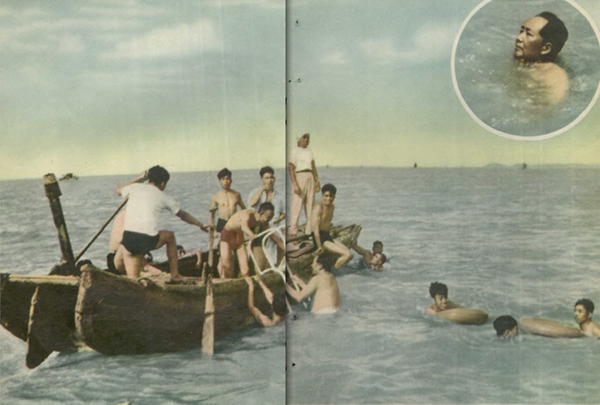
The first picture of Mao's 1956 swim was printed in July 1957 in a sports magazine called New Sports (Xin Tiyu). First published in July 1950, New Sports was placed under the supervision of the Physical Culture and Sports Commission (tiyu yundong weiyuanhui) in 1952 when the State Council founded the commission to oversee sports affairs at the state level.Footnote 25 The 1957 picture, with the caption ‘Chairman Mao swimming across the Yangtze’, showed Mao climbing up the ladder of a wooden boat after finishing his swim; a small circular photo of Mao's head sticking out of the water appears in the upper left corner (Figure 2). Because the viewers can only see the side and back of Mao's body, and there are also several swimmers in the boat and some in the water, the image of Mao as a political leader did not stand out.Footnote 26 New Sports’ publication of this photo coincided with the anti-rightist movement. An editorial in the same issue, entitled ‘Draw a Clear Line, Stand Firm, and Counter-Attack the Rightists’, urged people to follow Chairman Mao's instructions to differentiate between right and wrong, and ended with the line: ‘Let us bravely engage in the struggle, and make ourselves strong in great winds and waves.’Footnote 27 Mao's picture was presumably an illustration of the spirit the editorial meant to create in the people. Nonetheless, the quality of the photo was too poor to serve as a propaganda tool to glorify Mao and this photo was not used again in official publications.
Xin Tiyu, 21 July 1957 (vol. 108), centre page.

Beginning in 1958, the year when Mao launched the Great Leap Forward, his swimming stories were increasingly advertised in New Sports as well as through other media.Footnote 28 New Sports published an article in July 1958 with details of Mao's four swims in the Yangtze in 1956 and 1957. The magazine also published a series of articles under the title ‘Stories of Mao's Body Training’, in which Mao was portrayed as a sports lover who had been a keen swimmer since his youth.Footnote 29 The number of articles echoing Mao's call for mass swims and swimming in the rivers and the seas also increased significantly in this period. One of the articles stated that Mao loved practising swimming as a child in the two lotus ponds in front of his home in Shaoshan, Hunan, his birthplace. It was accompanied by a photo that showed a pond with a sign next to it that said: ‘The place where Comrade Mao Zedong swam when he was young.’Footnote 30 Books that told the stories of Mao swimming across the Yangtze were also published.Footnote 31 Mao's physical body was gradually transformed into a symbol of strong will and a source of inspiration for young people to emulate.
Besides the articles in New Sports, Mao's poems and personal remarks about his swims attached both philosophical and anti-imperialist meaning to his swimming body. After his 1956 Yangtze swim, Mao composed a poem in which he praised his own fearlessness as he swam in the mighty river: ‘Wind batters me, waves hit me—I don't care. Better than walking lazily on the patio.’Footnote 32 In the poem, Mao used his relaxed way of swimming in great waves as an allegory for his resilient attitude towards challenges in politics and in life. After his swim in September 1957, Mao made this later oft-quoted analogy between the Yangtze and US imperialism:
People say that the Yangtze is a very big river, actually there is nothing to be afraid of about its size …. Isn't US imperialism very big? It turned out to be nothing when we rebuffed it once. So, there are actually some big things in the world that are not to be feared.Footnote 33
Mao's poem and his remarks about US imperialism were frequently quoted in propaganda materials about his Yangtze swims and on banners at mass-swimming events. Mao's swims in the Yangtze alluded to his own fate as well as the fate of the country; they were a metaphor for his war against nature, life's challenges, and China's external threats.
In addition to written sources, Mao's swimming body and stories about his impressive swimming skills were propagated nationwide in visual forms. For example, from 1949 to 1961, Mao's official photographer Hou Bo (b. 1924) recorded footage of Mao swimming in an artificial lake on Mt Lushan during the famous Lushan Conference in 1959. She added the footage to a documentary film on the Second National Games held in 1959, entitled ‘Long Live Youth’ (Qingchun wansui). Hou recalled that, when the documentary was played in theatres, Mao's swimming scenes drew thunderous applause from audiences.Footnote 34 Renowned swimmer Mu Xiangxiong (b. 1935) told People's Daily in 1960 that when ‘our great Chairman Mao appeared on the screen swimming in waves, my emotion was so intense that I almost cried out loud’. A skydiver said that ‘our beloved Chairman Mao not only cares about the development of sports of the country, but also is a practitioner of sports’.Footnote 35 The footage disseminated Mao's image to general audiences as a persistent swimmer and a robust and caring leader who was close to the people. To young people, Mao was not a super athlete, but a living exemplar that anyone could emulate.
Mao's swims in the late 1950s impressed his own people and caught the attention of his rivals in the outside world. Mao's Yangtze swims quickly caught the attention of the American journalist Tillman Durdin (1907–98), who remarked in a New York Times article in 1957 that Mao's Yangtze swims were ‘merely an exercise in ideology’.Footnote 36 Recalling his four-day visit (from 31 July to 3 August) to China in 1958, Soviet leader Nikita Khrushchev (1894–1971) observed that he spent most of the trip at the swimming pool in the Zhongnanhai compound in Beijing with Mao and other political leaders such as Deng Xiaoping. ‘Most of the time we lay around like seals on warm sand or on a rug and talked. Then we would go into the water, come out again, and let the sun warm us,’ Khrushchev wrote in his memoirs. Khrushchev was impressed by Mao's extraordinary aquatic skill and was aware of Mao's cross-Yangtze swims. He noted: ‘Of course we could not compete with him when it came to long-distance swimming. After all, Mao had broken some sort of record [in swimming the Yangtze, now Chang, River].’Footnote 37 What Khrushchev's memoirs fail to mention is that, according to Mao's Russian interpreter Li Yueran (1927–2003), Khrushchev was such a poor swimmer that he paddled frantically when he entered the water and had to exit the water and ask for a life ring before returning. Historian Lorenz M. Lüthi sees this diplomatic swimming episode as Mao's ‘deliberate insult’ to the Soviet leader.Footnote 38 Mao might have seen his superiority to Khrushchev in the swimming pool as a metaphor for China surpassing the Soviet Union in political terms.
Although Mao's image as a competent swimmer began to take shape and spread in 1957, his Yangtze swim in 1966 was particularly significant. First, as aforementioned, the swim created an indomitable leadership image for Mao that prepared him to stage a comeback to Beijing and take centre stage in the Cultural Revolution. Second, the 1966 swim immortalized Mao's swimming body in a visual form, including photographs and oil paintings. The importance of visual images in the creation of the Mao cult is beyond doubt. Two photos of Mao's swim appeared in People's Daily on 25 July 1966. One showed Mao swimming in the water with his head bobbing above the water and the other showed Mao standing on a motorboat and waving to the crowd with the landmark Wuhan Yangtze Bridge in the background. The photo of Mao in the boat later became an iconic image of him and was reprinted on propaganda posters nationwide during the Cultural Revolution. In this highly successful propaganda picture (particularly when compared with the 1956 picture), Mao's image was carefully crafted and presented. Facing the camera, Mao is waving his right hand and smiling. At the time, viewers of the picture could easily imagine that their beloved and revered chairman was waving to and smiling at them.
An account from the memoirs of Qian Sijie (b. 1928), Mao's photographer from 1964 to 1969 and the individual who took these photos, seems to suggest that this highly propagandistic swimming event was not premeditated. Qian recalls that, in the beginning, the swimmers were unaware of Mao's presence. After a few of them recognized Mao on the motorboat and started chanting ‘long live Chairman Mao’, Mao waved back to the crowd—Qian, positioned on a small wooden boat, captured this moment with his camera. Despite Qian's account, as pointed out at the beginning of this article, the swimming contest was carefully designed and rehearsed so that it could glorify Mao. An archival document has clearly shown that the swimmers, about 5,000 in number, were instructed to act energetically and think of themselves ‘not only as a swimming team but also as a propaganda team to propagate the greatness of Maoism’. Some swimmers were even instructed to sing revolutionary songs while swimming in the water.Footnote 39 The directions to the swimmers would have invested the riverscape with a powerful revolutionary aura and amplified Mao's legendary qualities when he made a surprise appearance and staged his historic swimming performance. According to Qian, the Director of the New China News Agency, Wu Lengxi, was excited to learn that Qian had taken numerous pictures of Mao at the swimming event and asked him to send them to Beijing immediately. Qian emphasized that Mao himself was also satisfied with the photos.Footnote 40 Was Mao the mastermind of this propaganda campaign? No written sources yield a definite answer. What is certain is that the propaganda campaign could not have happened without Mao's consent and support.Footnote 41
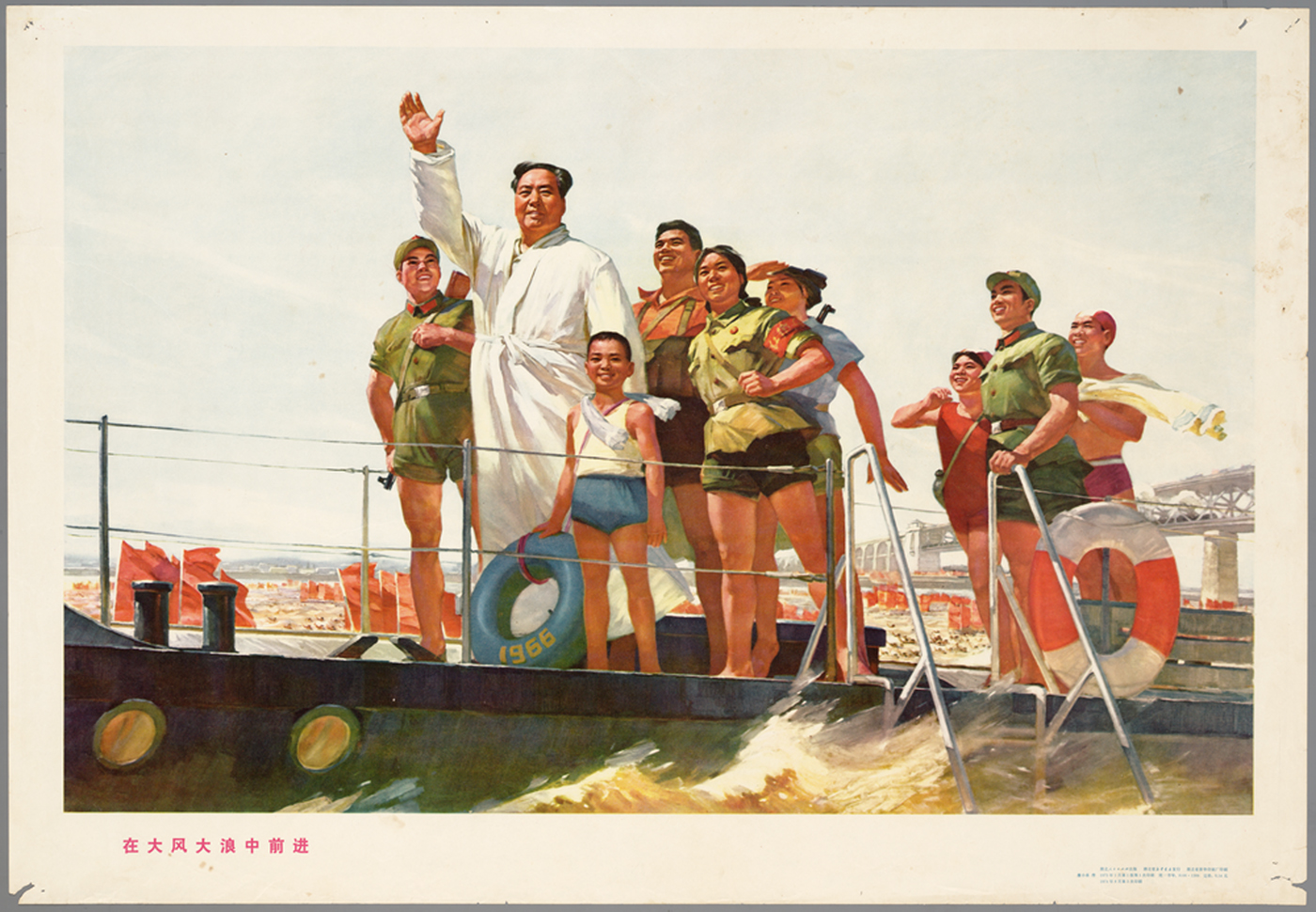
Based on the photo printed in People's Daily on 25 July 1966, a propaganda oil painting entitled ‘Strive Forward in Winds and Tides’ was created in 1971 by painter Tang Xiaohe (b. 1941) to become part of the national art exhibition held in Beijing in 1972. The exhibit commemorated the 30th anniversary of Mao's ‘Talks at the Yan'an Forum on Literature and Art’ (Figure 3).Footnote 42 This iconic painting, which was reprinted in various official publications on sports and as a propaganda poster, was one of the model artworks championed by Mao's wife, Jiang Qing (1914–91) during the Cultural Revolution.Footnote 43 In the painting, Mao is waving and standing amid the young men and women who symbolized the successors of the revolution. Mao was photographed from below to make him look taller and more imposing. Hung Chang-tai aptly pointed out that oil paintings functioned as the Chinese Communist Party's ‘hegemonic representations of the nation's memory’. Artists were obliged to toe the party line when creating art and to revise their work as required to serve the ultimate purpose of legitimating political authority. Dong Xiwen's (1914–73) ‘The Founding Ceremony of the Nation’ is a notable example.Footnote 44 Tang's painting was no exception.
Hubei remin chubanshe, 1974.

Tang's painting closely followed Jiang Qing's guidelines for artistic work—that it should be ‘red, bright, and shining’ (hong, guang, liang).Footnote 45 The work is colourful and bright, and all nine people depicted in the painting (Mao, seven youths and one small child) look joyful and have glowing red complexions. All of the youths are standing behind Mao, symbolizing his role as their leader. Only the child holding a blue life ring is standing in front of Mao. According to Tang, Mao appeared barefoot in the sketch, but Jiang Qing objected to capturing this in the work, since she thought that showing Mao's feet would undermine his solemn image as a great leader.Footnote 46 Therefore, the child's function in the painting is to hold the life ring in a way that covers Mao's feet. Mao did not mind appearing in front of the masses in a swimsuit, showing his partially naked body and flabby belly. However, in this painting, he is wrapped in a long-sleeved white robe and all of the other figures have bare legs and arms. According to Julia Andrew, in the propaganda works glorifying Mao during the Cultural Revolution, ‘the entire composition should be bright, and should be illuminated in such a way as to imply that Mao himself was the primary source of light’ so that ‘slogans such as “Mao is the sun in our hearts” could be made tangible’.Footnote 47 In this painting, Mao's luminous white robe served the function of showing that Mao was a source of light.
During the Cultural Revolution, both Qian Sijie's photo and Tang's painting of Mao were made into propaganda posters that served to immortalize Mao's image as a swimmer. The production and circulation figures for those posters are unknown. Although the total numbers of propaganda posters published and sold in certain years by certain publishing houses are available, production figures for individual propaganda posters in Communist China do not exist.Footnote 48 Nevertheless, since these two posters frequently appeared in official publications and as props at mass-swimming events, their significance is beyond doubt.
Performing Maoism: mass swimming and its political pitfalls
Mao's attempts to turn his swimming body into a symbol of resilience against all odds beginning in 1957 went hand in hand with his advocacy of mass swimming. He wanted to transform the masses, by having them follow his exercise regime, into a collective body that exemplified his thoughts. Although the transformation of swimming into a mass sport was a part of the Mao cult, the concept of a ‘mass sport’ had been very much in line with the government's physical culture policy ever since 1949. The PRC adopted the Union of Soviet Socialist Republics’ mass sport philosophy, which saw creating a physical culture as a way to prepare the masses for labour and defence. For example, the ‘Preparation for Labour and Defence’ (laoweizhi) sport programme adopted in 1954 was modelled on that of the Union of Soviet Socialist Republics. The programme, which encouraged people to participate in sports such as track and field, gymnastics, and weightlifting, was initially promoted in schools and then extended to factories and government sectors. In February 1956, the Sports Ministry announced the ‘Ten-Year Guidelines for Sports Development’, which were designed to promote mass sports and boost the performance of athletes to put them on par with Western athletes within 10 years.Footnote 49
Mao's swims were significant to the development of mass swimming, for two reasons. First, his swimming performance inspired millions of emulators and gave the concept of ‘mass sport’ a concrete shape and form. During his swim with young people in the Yangtze in 1958, Mao promoted mass swimming in a concrete verbal form by suggesting that the numerous rivers in China should be used for swimming to the greatest extent possible. He also proclaimed that ideally half the Chinese population should be able to swim.Footnote 50 Following Mao's call, local government officials started organizing mass-swimming events, turning rivers and seas into training and testing grounds for people's will and physical power. As a result, splashing around in the water was transformed from a leisure activity into a political duty and an integral part of the Mao cult. Swimmers venerated and glorified Mao by carrying portraits of him and chanting his quotations while swimming. Mass-swimming events have been held across the nation every year on 16 July ever since 1966 as an annual reminder of Mao's historic swim.
Second, Mao established the idea that swimming was an important part of the Chinese character. In the early 1950s, Chinese people were instructed to learn swimming from the Soviet Union—a socialist brother state highly commended in 1954 in New Sports for its ‘progressive sport theories and experiences’.Footnote 51 When the Soviet Union's swimming team was invited to visit China that same year, the PRC's national swimming athletes practised with the team; this learning experience was recounted in a book entitled Learning from the Swimming Team of the Soviet Union in 1955.Footnote 52 After his public swimming performances, Mao became the premier swimming role model for the Chinese people, supplanting the Russian athletes. One athlete published an article after having the honour of swimming with Mao in the Yangtze in September 1958 and wrote the following: ‘Why am I afraid of the Yangtze? Chairman Mao, despite his old age, is not afraid of the strong currents of the Yangtze. How can I, a young athlete, be afraid?’ He concluded that Mao was a ‘shining and heroic example’. In another article published in 1965, Mao's swim was glorified as a ‘heroic epic’ and the ‘spirit and rhythm of the age’.Footnote 53
The whole country fell into a swimming frenzy in the late 1950s, marking a ‘Great Leap Forward in swimming’, as described in an article published in New Sports in June 1958.Footnote 54 In the early 1960s, with the rise of ‘sports militarism’ in China, swimming was further integrated with productive labour and national defence. The trend towards combining sports and military training was not necessarily a consequence of the actual or perceived increase in external threats, although the Sino-Indian border conflict and the Vietnam War probably cast a shadow on China's national security. First, the combination of sport, labour, and defence modelled in the Union of Soviet Socialist Republics began to inform the PRC's sport policies in the 1950s. Second, Lin Biao (1907–71), who became the Minister of National Defence at the Lushan Conference in 1959 and was a key architect of the Mao cult, was eager to spearhead the promotion of Maoism in the army. Third, by combining swimming (literally Mao's sport) and national defence, defending the nation and emulating Mao's thoughts and behaviour through swimming became a well-integrated practice.
In mid-1964, Mao required all troops to learn to swim in the river and in the sea. Lin Biao responded with enthusiasm and announced that the Chinese Army must be equipped with ‘freedom of movement in watery regions’.Footnote 55 Less than a month later, the Physical Culture and Sports Commission created a policy that promoted four types of mass sports, namely swimming, shooting, signal communication, and mountain climbing, in order to transform all citizens into soldiers.Footnote 56 It was followed by another government statement issued in May 1965 entitled ‘A Notice on Massive Promotion of Mass Swimming’. This statement proclaimed that ‘swimming can help the masses strengthen their bodies and cultivate strong determination, and is also important to national defence’. Government and military units, schools, factories, and communes were instructed to organize swimming classes and cross-river swims to ‘enable military men and civilians, young people and children in particular, to learn to swim’.Footnote 57
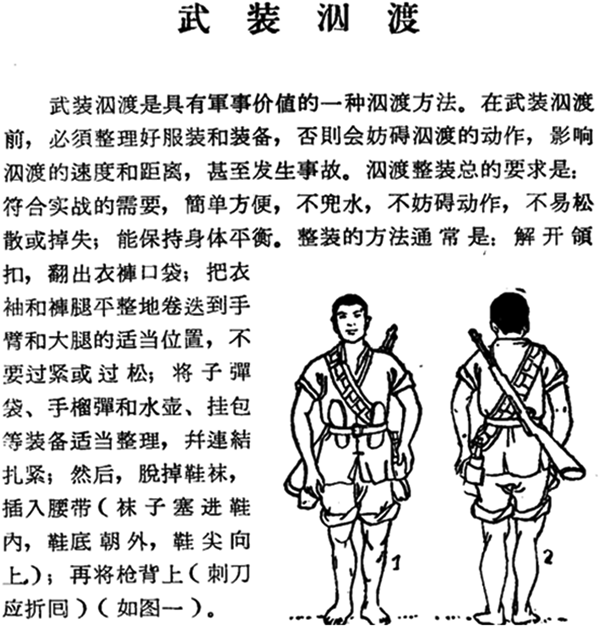
The trend of militarization, interwoven with the rise of the Mao cult, resulted in the emergence of military swimming (wuzhuang qiudu). Swimming was used to prepare people to engage in military defence against invaders. The military element of swimming is clearly shown in a book entitled Swimming for the Revolution (Wei geming er youyong), published by the Physical Culture and Sports Commission of Henan Province in July 1967. In the book, the editor describes swimming as a way to train the revolutionary will, increase production, strengthen military preparation, and militarize the masses. It was also a measure to put into practice Mao's ideas of the people's war. The book introduced not only regular swimming styles like freestyle, breaststroke, and butterfly, but also military swimming, which is a swimming style used in military combat that was not introduced in swimming manuals published before 1958. The purpose of military swimming was to train outstanding swimmers to serve military needs with their swimming skills. Training included swimming across rivers while carrying military weapons such as rifles (Figure 4).Footnote 58
Henansheng Nanyang zhuanshu tiyu yundong weiyuanhui (ed.), Wei geming er youyong, n.p.: 1967, p. 36.

Taking part in mass swimming was interpreted as an outward expression of a person's inner belief in Mao Zedong Thought. China Pictorial (Renmin huabao)—a pictorial magazine published by the State Council Information Office—included features on mass swims in 1964 and 1965. They showed images of people of different ages, sexes, and ethnic backgrounds taking part in mass and cross-river swimming events. The articles described the swimmers as practitioners of the perseverant spirit advocated by Chairman Mao.Footnote 59 During the mass-swimming events, the collective body of the masses was emphasized and individuality was homogenized and suppressed. The practice of military swimming was not confined to men either. Female fighters carrying rifles on their backs while swimming in the sea were also shown in propaganda materials as testimony that women had been liberated from their enslaving fetters and were now able to ‘hold up half the sky’.Footnote 60 The desexualized female body thus played an essential role in the making of China's socialist collectivity. Mass swimming epitomized Mao's vision of socialist China as an egalitarian collective made up of healthy, patriotic, and disciplined individuals who were well prepared to fight for the country.
It seems inevitable that there was some kind of gap between ideological propaganda and reality that begs the question: to what extent did mass swimming convey Mao's ideology to the masses? To understand this, we must determine how these swimming events were organized at the local level and the challenges faced by local officials. Numerous examples show that mass swimming helped promote the Mao cult. Yet they generated political pitfalls for government officials as well. I illustrate these points based on official reports preserved at the Hubei Provincial Archives and Shanghai Municipal Archives.
Not surprisingly, swimming in Wuhan developed a distinct meaning after Mao's historic 1966 swim there. Many students from different parts of China headed to the city to emulate Mao by swimming across the Yangtze River. Two fatal swimming accidents in September and October of that same year put local officials on high alert. To avoid further tragedies that could hamper the Mao cult, the Wuhan government was left with no choice but to take contradictory stances on cross-river swims. Ostensibly, the officials continued to promote swimming. But, at the same time, staff members were sent to stand guard along the river to prevent people from swimming in and crossing the river. An official internal report on swimming dated 2 November 1966 vividly shows the predicament facing the local officials. It read in part:
the number of students coming to Wuhan keeps increasing. Due to the relatively high temperature, an increasing number of the public will want to swim. To ensure that the students can accomplish their revolutionary tasks and that their lives are safe … it is an important political mission to persuade the students not to swim.
The report further noted that spreading the message of abstaining from swimming in the river should be one of the duties of the reception centres that had been set up to take care of the ‘revolutionary students’ who came to Wuhan to ‘link up’ (chuanlian) with each other.Footnote 61
Despite the potential danger posed to human lives, the Wuhan officials were still obliged to organize the annual cross-Yangtze swim in July 1967. They found themselves facing an even more challenging task: how to organize a mass-swimming event to enshrine unity under Mao's leadership when the people in Wuhan had become heavily divided due to a series of armed confrontations in the city earlier in June. In a letter written to the Central Cultural Revolution Small Group, Wuhan officials confessed that ‘due to the intense confrontational feelings among the masses organizations, it is impossible to hold a unified cross-Yangtze swim. To avoid armed confrontations and ensure safety, the masses organizations will hold the event separately’. As a result, the annual cross-Yangtze swim in 1967 was scheduled over the course of three days (from 14 to 16 July) to keep the rebel groups separate.Footnote 62 In other words, Mao's swim successfully strengthened the personality cult of Mao among some of the young people, but this was inadvertently done at the expense of human lives and social unity.
Shanghai, like other cities in China, witnessed a swimming boom in the 1950s. Twelve swimming pools were in operation in 1956 and the number of users totalled 707,724. To implement mass swimming and increase the number of swimmers, the existing swimming pools were kept open for as long as possible each day and new swimming venues were created. Factories and schools made use of whatever materials they could find to build makeshift swimming pools. Some work units even turned fish ponds and catch basins into swimming pools. The Shanghai government continuously boasted about the increasing number of swimmers and the efforts it had put into organizing mass-swimming events and building new swimming venues (for instance, more than 150 new swimming venues were built in 1965 alone). Military swimming was also propagated in Shanghai as a strategy to fight against Western imperialism and to prepare for reunification with Taiwan. Swimmers chanted slogans such as ‘swimming to Taiwan to capture Chiang Kai-shek’.Footnote 63
Officials in Shanghai faced a similar dilemma between promoting swimming and ensuring stability and people's safety. In spite of the authorities’ desire for strict monitoring, mass-swimming events occasionally spun out of control. The mission of promoting mass swimming (particularly in the rivers) was by no means easy and occasionally resulted in serious and even deadly blunders. To answer Mao's call to brave the winds and waves, the Shanghai government built the Baoshan seaside swimming site at the estuary of the Yangtze River in 1965. Ensuring the safety of the swimmers became the prime concern of local officials. Lifeguards were instructed to study Mao's works and apply his ideas to the task of saving swimmers in danger. Government reports acknowledge that there were unorganized swimming events that resulted in fatal drowning cases (with 121 casualties in Shanghai in August 1965 alone).Footnote 64 These documents certainly support the impression that local officials found themselves in a difficult situation, wrestling with obeying Mao's directive to promote mass swimming while also ensuring swimmers’ safety.
The most daunting task for local officials was to organize mass cross-river and long-distance swims, which required extraordinary organization, resources, and caution. One of the ideals of Maoist sport was to combine sports with labour. However, the harmony between the two appeared to work only on paper. In fact, mass swimming disrupted production. In Shanghai, the local government called off some mass-swimming events to minimize the negative effect of the swimming craze on economic production. Local officials noted that, for the sake of safety and to avoid disrupting daily production, swimming events should neither involve too many swimmers (no more than 1,000) nor be held too frequently (no more than three times a year).Footnote 65
Striking a balance between adhering to the political doctrine of letting the masses handle their own affairs and ensuring swimmers’ safety through careful top-down organization was also a thorny issue. During the three days from 30 May to 1 June 1965, the Shanghai government organized 25,000 people to swim across the Huangpu River—the major river in Shanghai. Although propaganda portrayed the event as a great success, an official report admitted that the swim in the Huangpu River was costly, inconvenient, and dangerous. In fact, Huangpu River was murky and, before Mao's promotion of mass swimming in the 1950s, it had never been considered a suitable location for swimming. In the long swim in 1965, over 1,000 swimmers failed to make it to the destination and had to be rescued from the river; two swimmers drowned. During a cross-river swim in 1967 from Changxing Island (one of the alluvial islands in the Yangtze Delta Region) to the Baoshan seaside swimming site, the officials realized the dangers facing the swimmers and made a decision on the spot to shorten the route by allowing swimmers to start halfway through the planned course. Officials admitted in a report that the failure of the event was a ‘lesson’ and that ‘due to a lack of further investigation on tides and currents, [the event] showed a certain extent of recklessness (mengmu xing) … shortening the distance of the swim turned the swim from a cross-river swim into a long swim’, which negated the original political intention of the event.Footnote 66 The officials’ cautionary approach showed that they were striving hard to strike a delicate balance between the swimmers’ safety and ideological conformity. In addition to the ever-changing tides and life-threatening currents, the government also expressed worries that swimmers could become infected by blood flukes—a type of parasitic worm residing in snails not uncommon in China.Footnote 67
The Shanghai government also found instances of misbehaviour during the mass swims, which defeated the original purpose of imposing bodily discipline on the people. Although women were encouraged to swim, some of them fell victim to sexual harassment. Some swimmers were accused of interrupting navigation and engaging in illegal activities such as theft and robbery under the cover of following Mao's call to swim in the rivers. This was a particularly serious problem on the Huangpu River—a busy river with heavy traffic where swimming was allowed only after Mao's advocacy of mass swimming in the rivers and seas. A 1968 report cited several instances of swimmers deliberately disrupting the navigation of ships. On one occasion, ‘about a dozen swimmers swam from Puxi to Pudong [across the Huangpu River]. It was difficult for the ship to avoid the swimmers and to proceed. The ship had to sound five short blasts [a warning signal indicating the danger of collision] and created chaos’.Footnote 68 The reckless swimmers’ behaviour was in great contrast to the disciplined bodies presented in propaganda material. They could hardly be considered an embodiment of the Mao cult, but they were undeniably a by-product of the swimming craze advocated by Mao.
Appropriating swimming: exodus to the capitalist world
In a New York Times article entitled ‘When Chairman Mao Jumps’ published on 18 August 1966, satirical commentator Russell Baker showed great sympathy for the Chinese people. He observed that they were obliged ‘to emulate the most bizarre idiosyncrasies of Chairman Mao’ such as ‘when Chairman Mao swims, everybody swims’. The article ended with a fictional conversation between a husband and wife in China: ‘When Chairman Mao jumps, everybody jumps,’ the wife observed. ‘That's the trouble with this country,’ the husband responded.Footnote 69 To Baker, the swimming craze in China was both a source of black humour and a microcosm of China's tyrannical leadership.
Baker failed to realize that the surveillance and disciplinary power of the Chinese state did not always function as seamlessly as originally intended. There was a constant contestation between top-down control and ordinary people's determination to pursue their autonomy. Although the authorities tried to turn swimming into a mass sport to nurture and express the collectivist spirit of the country and political allegiance to Mao, the swimming culture took on a life of its own and led to unintended consequences at the local level. Apart from the reckless swimmers’ deliberate disruption of navigation in Shanghai, as explained in the previous section, tens of thousands of people in Guangdong province (mainly youngsters in their teens or early twenties) found the courage to brave the tides and currents not for Mao's revolution, but for their own freedom. As Wang Shaoguang points out in his study of the Cultural Revolution in Wuhan, despite the influence of the Mao cult, the Chinese people were ‘rational’ believers who placed their personal interests above all other interests.Footnote 70 In the 1960s and 1970s, empowered by swimming techniques and the determination to tame nature acquired from the national swimming craze, numerous young people in South China swam miles to Macau (a colony of Portugal) and later to Hong Kong (a colony of Britain). Dubbed ‘freedom swimmers’ by the Western media, some reached their destinations successfully and others did not. In any case, both the survivors and the dead served as testaments to the failure of Mao's revolution.
Refugees sneaked across the border of mainland China to Macau and Hong Kong in three ways: by land, boat, and swimming. In Hong Kong, the 22-mile-long land border was heavily guarded by troops and fearsome guard dogs, so swimming across the Shenzhen River separating Hong Kong and mainland China may have been a better option. Although escaping by boat seemed the safest choice, boats were hard to come by and could easily be detected by sea-patrol units. Swimming was a difficult and dangerous choice that appealed to young people who swam well and those who were determined to learn to do so through arduous practice. In the 1950s, parents in Guangdong province began to strongly encourage their children to learn to swim as a means of leaving China and having a better life.Footnote 71 Mao's call for swimming for the revolution ironically provided good justification for would-be deserters to take to the water. The swimming craze held appeal for party officials and the common people but not always for the same reasons.
Before 1967, most of the fugitives who chose to escape by swimming aimed for Macau rather than Hong Kong mainly due to the shorter swimming distance (about a mile). After the Macau leftist riots of December 1966 (which greatly undermined, if not ended, the authority of the Portuguese Administration in Macau), Hong Kong became the major destination for ‘freedom swimmers’.Footnote 72 Swimmers generally chose to swim four miles across the Deep Bay from the Shekou Region in Shenzhen to Yuen Long in the northwestern part of Hong Kong's New Territories. Swimming nonstop across the Deep Bay, which took four to eight hours, was undoubtedly much more treacherous than Mao's celebrated swim across the Yangtze River. Some swimmers were interrupted or even shot at by Chinese gunboats patrolling the bay. Some were attacked by sharks, and some drowned after suffering fatigue and cramps. Some chose to swim during the winter season to try and avoid shark attacks, but many of these people unfortunately succumbed to the freezing water and died. Other obstacles facing the refugees were the oyster beds they had to crawl across to get to the shore in Yuen Long—an ordeal that left their arms and legs cut and bleeding.Footnote 73
Ironically enough, ordinary people managed to harness the state's disciplinary knowledge and techniques to renounce the state. In fact, as early as September 1965, one Chinese newspaper in Hong Kong had already pointed out that young people were using Maoist rhetoric regarding swimming as a cover to engage in swimming practices in preparation for escape. The newspaper reported that the mass swimming activities had a backlash effect in the Guangdong region adjacent to Hong Kong and Macau. Many young people have learned how to swim and they seized the opportunity of practising swimming and taking part in long-distance swimming competitions to escape from China. A considerable number of refugees who managed to swim to Macau were said to have taken part in mass-swimming events organized by the government. Although the growing number of fugitives alarmed Chinese officials, banning swimming was not a viable option because it had become a revered national sport. The Pearl River in Guangzhou was a popular and legitimate swimming site. It was of particular importance to Wang Kainan (pen name Lie Fu, b. 1949)—a refugee who swam across the Shenzhen River to Hong Kong in 1973, where he later became a well-known film critic. He recalled that, after he had made up his mind to escape to Hong Kong, he went to the Pearl River to practise swimming. When he arrived, he found thousands of people in the river, but ‘no one would tell anybody that their purpose of swimming there is to escape to Hong Kong’.Footnote 74
Facing this mass exodus from China, local officials resorted to imposing stringent regulations on the use of flotation devices and confined swimming to designated areas. To swim to either Hong Kong or Macau, the deserters had to make do with whatever objects could help them stay afloat through their long struggles in the water—the most destitute could hardly afford flotation devices. The most popular alternate flotation devices were the inner bladders of basketballs, which were made of rubber. Most of the refugees were found with one or two basketball bladders tied to their shoulders or backs and it was reported that, on one occasion, the largest basketballs sold out in Guangdong. Some swimmers used plastic pillows and bicycle tires. A set of official regulations was issued in 1968 to forbid people from bringing the following items into the water when swimming at seaside sites: swimming rings, vehicle tires, all types of balls and plastic goods, rafts, plastic dinghies, inflatable sofas, sun glasses, and life jackets. The regulations explained that people should swim for revolution, not for amusement. However, because seaside swimming sites and not swimming pools were targeted, it was clear that the true intention was to stem the exodus of escapees.Footnote 75 The PRC government was trapped in a predicament of promoting swimming on the one hand and stemming the tide of escapees to the capitalist world on the other.
Conclusion
This article adds a bodily dimension to our understanding of the political culture of modern China through the lens of swimming—a modern sport laden with various ideological and symbolic meanings. In the 1950s, Mao himself began swimming and turned the activity into an arena where he could assert his political authority. His swimming body, promoted by propaganda materials such as photos, paintings, film footage, and his own poems, was imbued with his revolutionary visions and personal statements about indomitable struggles. Although mass swimming created a picture (or illusion) of the collectivist spirit of all Chinese citizens, significant numbers of young people swimming en masse to Hong Kong and Macau defied and redefined the official narrative.
A close study of the national swimming craze in Mao's China sheds new light on the relationship between sports, the Mao cult, and body politics. During the Cultural Revolution, sports were invested with the strongest political significance ever in Chinese history. In his autobiography, Son of the Revolution, Liang Heng remarks that the culture of the masses, such as ‘sports, music, and dance’, gained unprecedented importance during the Cultural Revolution and he chose basketball to be his ‘route to glory’.Footnote 76 People's sporting bodies became visible expressions of political mobilization and activism. Sports became a ritual but it was participation rather than beliefs that mattered. In their studies, Daniel Leese and Xing Lu explain the populace's physical demonstrations of loyalty through rituals. Leese describes the so-called ‘quotation gymnastics’, in which practitioners acted out Mao's quotations through gymnastic movements, and the ‘loyalty dance’, in which dancers danced in front of a portrait of Mao while positioning their arms and legs to show the Chinese character for ‘loyalty’ (zhong).Footnote 77 Swimming was a more significant form of embodiment and expression of the Mao cult when compared to the loyalty dance and quotation gymnastics, for two reasons. First, Mao himself participated in mass swimming and used his swimming body as a means of political mobilization. Second, due to Mao's active promotion, far more people participated in mass swimming than in the loyalty dance or quotation gymnastics.
Recent studies have pointed out the unpredictable nature of the Cultural Revolution. Joseph Esherick, Paul Pickowicz, and Andrew Walder see it as an ‘unscripted and unpredictable interplay between state and society’.Footnote 78 Leese writes that it lacked a ‘master plan’ and ‘developed in directions unplanned for by the party leadership’. According to Leese, the Mao cult was initially a means of mobilization but, when participation in the Mao cult spiralled out of control, its emphasis shifted to discipline and control.Footnote 79 This article complicates this view by examining political mobilization at the local level. Local officials followed Mao's instructions and mobilized the masses to participate in mass-swimming events. However, they also adopted a very cautious approach and tried to keep the scale of these events under control to minimize accidents. At the local level, mobilization and discipline coexisted in an understandably uneasy manner from the very beginning of the Mao cult.
The role of swimming in the making of the Mao cult problematizes the question of the effectiveness of political propaganda in Mao's China. Effectiveness and failure were so interwoven that we need to consider how the various layers of meaning of swimming coexisted and were contested in its national and local histories. For Mao and his followers, swimming was a collective ritual intended to show bodily consent and conformity to Maoism. For local officials, it represented a difficult political assignment where they managed the duty of organizing mass-swimming events to boost Maoism without putting people at risk and disrupting economic production. For many individuals, swimming was an expression of defiance to Mao's revolution as well as a literal life-and-death struggle for freedom and a better life. Many of those fortunate enough to survive the ordeal of swimming to freedom settled in Hong Kong and became citizens. Their stories became an important part of Hong Kong's history and left traces in the form of a Cantonese phrase, ‘yau sui lok lai’, which literally means ‘coming down by swimming’ in reference to the act of fleeing to Hong Kong by means of swimming in the 1960s and 1970s. The phrase is a constant reminder of the historical period when numerous ‘freedom swimmers’ braved the winds and tides to escape from Mao's rule. Swimming became an ambiguous political symbol that represented both individuals’ bodily conformity to and repudiation of Mao's vision of the revolution.
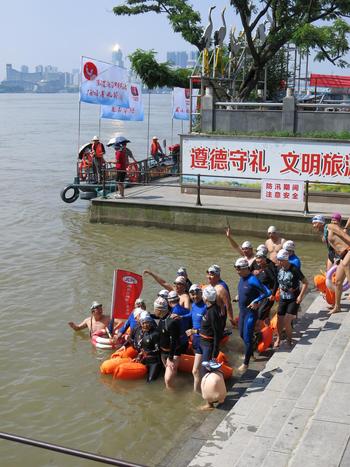
Although the day of the Mao cult is long gone, Mao's swimming body and the annual mass-swimming ritual of crossing the Yangtze River still exert a lingering influence on modern China's sporting and social milieu. In Wuhan, a mass cross-Yangtze swim has been held annually on 16 July in commemoration of Mao's historic Yangtze swim in 1966. On the afternoon of 16 July 2016, despite a government ban on swimming in the Yangtze due to flooding, hundreds of swimmers in Wuhan entered the water at the same location where Mao did 50 years ago. Although the swimmers did not chant any slogans in honour of Mao before taking to the water, some were holding banners bearing the words ‘in commemoration of the fiftieth anniversary of Chairman Mao's cross-Yangtze swim’. Flags with Mao's iconic photo taken on 16 July 1966 and his swimming poem were fluttering at the scene (Figure 5).Footnote 80 The meaning of Mao's swimming body in today's China is beyond the scope of this article. However, it is safe to say that the commemorative swimming event is as much about physical fitness as it is a reminiscence of an idealized past.
Photo taken by the author on 16 July 2016.

As a country whose cultural development is still very much influenced by the likes and dislikes of its political leaders, it is unsurprising that swimming is no longer considered China's national sport. The current Communist Party General Secretary Xi Jinping (b. 1953) shares Mao's propensity for inter-party purging but not his passion for swimming. A football fan, Xi exhibited his skills in front of the media during a visit to Dublin, Ireland, in February 2012. Linking football to national glory, Xi has pushed to make football an integral part of China's national education programme and an option on the high-school entrance examination. Wang Dengfeng, Director of the Physical Education, Health and Art Department at the Ministry of Education, projected that ‘100,000 students will become football players after two to three years of the program's development’.Footnote 81 The upcoming Great Leap Forward in football in Xi's China will be an intriguing topic for academic research in the future.