Despite advances in surgical and medical care for patients with hypoplastic left heart syndrome, morbidity and mortality remain high for this population. The interstage period, defined as the time between hospital discharge following the Norwood procedure and the Stage 2 Glenn or hemi-Fontan operation, remains a high-risk period with a mortality of ∼10% in recent years.Reference Cross, Harahsheh and McCarter 1 – Reference Ohye, Sleeper and Mahony 4 Infants are also at risk for other morbidities during the interstage period, including issues related to feeding and growth. Growth is an important factor, as it has been shown to be associated with Stage 2 hospital length of stay and with later developmental outcomes.Reference Daymont, Neal and Prosnitz 5 – Reference Menon, McCandless and Mack 7
Although current quality improvement initiatives focus on optimising interstage outcomes,Reference Ghanayem, Hoffman and Mussatto 8 including weight gain, the impact of the site of interstage care on growth is unclear. During the interstage period, patients may receive outpatient cardiology care at the surgical centre and affiliated satellite clinics or at referring non-surgical outpatient clinics. Although previous studies suggest wide variation in growth rates among centres, it is not known whether this is related to the type of centre at which care is provided.Reference Anderson, Iyer and Schidlow 9 , Reference Schidlow, Anderson and Klitzner 10 Several identified practices associated with improved weight over the interstage period include standardised feeding evaluations, use of home weight scales, and use of “red flag” weight criteria.Reference Anderson, Iyer and Schidlow 9 , Reference Hehir, Rudd and Slicker 11 , Reference Anderson, Beekman and Eghtesady 12 It has been hypothesised that care at the surgical site may be beneficial due to greater access to resources to implement these practices, such as feeding evaluation and frequent nutrition consultation.
The purpose of this study was to evaluate the relationship between the site of interstage care and weight gain in a large multicentre cohort participating in the National Paediatric Cardiology Quality Improvement Collaborative.
Methods
Patient population
A retrospective review was performed of all the patients enrolled in the National Paediatric Cardiology Quality Improvement Collaborative single ventricle registry from 2008 to 2013. The local institutional review board’s approval and patient consent were obtained by the centres participating in the National Paediatric Cardiology Quality Improvement Collaborative registry. In addition, approval from the University of Michigan institutional review board was obtained for conducting this study. The National Paediatric Cardiology Quality Improvement Collaborative is a national quality improvement collaborative network of multidisciplinary clinical teams and families collecting longitudinal data on these patients and conducting quality improvement activities.Reference Kugler, Beekman and Rosenthal 13 At the time of this study, the collaborative was comprised of 47 paediatric cardiology centres in North America.
Infants diagnosed with hypoplastic left heart syndrome or other single-ventricle malformations who underwent a Norwood or Norwood-variant procedure and were discharged alive were eligible for enrollment in the registry and were included in the study. Exclusion criteria were as follows: patients who had a Norwood procedure at greater than 3 months of age, patients who did not complete the Stage 2 procedure due to cardiac transplantation, non-candidate for surgery, or death before Stage 2, and patients with missing weight data or patients with weight data collected greater than 3 days before the Stage 2 procedure. The patient cohort was categorised into the following two groups based on the site of follow-up care designated at time of discharge after the Norwood procedure: the surgical site group, who had all interstage care given at the same centre where the Norwood procedure was performed; and the non-surgical site group, who had interstage care given at another centre distinct from the primary surgical centre or at a combination of both.
Data collection and outcomes
Data collection included demographic and clinical data at birth, during the Norwood hospitalisation, and at Stage 2 admission – that is, at the end of the interstage period. The primary outcome was change in weight-for-age z-score from Norwood discharge to admission for Stage 2 surgery. Secondary outcome variables included average daily weight gain and change in the proportion of patients with weight-for-age z-score <–2 from Norwood discharge to admission for Stage 2 surgery. Weight-for-age z-scores were derived from the World Health Organization Multicentre Growth Reference Study Group. 14
Statistical analysis
Data are presented as frequency (percentage) for categorical variables and median (interquartile range) or mean±standard deviation, based on the distributional assumption of normality, for continuous variables. Univariate comparisons between the surgical site group and the non-surgical site group were performed, including comparisons of baseline demographics, clinical characteristics, weight data, and interstage data, using the χ2-test or Fisher’s exact test for categorical variables and Wilcoxon rank sum test or t-test for continuous variables, wherever appropriate. Variables with p-value <0.1 in univariate comparisons between the two groups were included in multivariable linear regression to determine independent association between site of interstage care and change in weight-for-age z-score. The variables included in the final multivariable model were as follows: duration of the interstage period, primary cardiac diagnosis, age at Norwood surgery, type of Norwood procedure, such as Blalock–Taussig shunt, right ventricle–pulmonary artery conduit, or other, Norwood hospital length of stay, home healthcare, and home surveillance strategy. Age at Norwood discharge and age at Stage 2 surgery were not included in the multivariable model due to a high correlation (correlation coefficient >0.8) with Norwood hospital length of stay and duration of interstage, respectively. We also performed a sensitivity analysis to evaluate the impact of era on our results, and re-ran the same multivariable models for the primary outcome as described above, but with the addition of era (2008–2010 versus 2011–2012) to the models. Finally, Poisson regression with robust error variance was used to evaluate change in the proportion of patients with weight-for-age z-score <−2 between groups. All statistical analyses were performed using SAS, Version 9.3 (SAS Institute Inc., Cary, NC, USA). A p-value <0.05 was considered statistically significant.
Results
Patient population and clinical data
A total of 689 patients from 47 sites were enrolled in the registry; 84 of these patients did not undergo Stage 2 surgery and were excluded. An additional 118 patients were excluded due to incomplete weight data in the registry, resulting in a final study population of 487 patients. There were no significant differences in baseline characteristics including location of interstage care for these excluded patients (n=118) and study patients (n=487), except for small but statistically significant differences in birth weight – excluded patients 3.1 kg versus study patients 3.2 kg, p=0.02 – birth weight z-score – excluded patients −0.7 versus study patients −0.5, p=0.02 – and primary cardiac diagnosis – excluded patients 73.7% hypoplastic left heart syndrome versus study patients 74.9%, p=0.004.
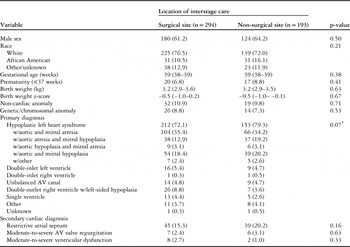
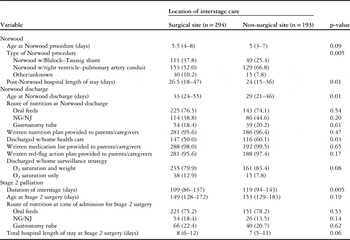
Of the study population, 60% – that is, 294 patients – was classified in the surgical site group, and 40% – that is, 193 patients, of whom 91 were coded in the database as exclusively non-surgical site and 102 were coded as a combination of surgical and non-surgical site – was classified in the non-surgical site group. There were no significant differences between the groups in pre-operative characteristics including gender, gestational age, birth weight, or presence of non-cardiac anomalies (Table 1). Patients in the surgical site group were less likely to have a diagnosis of hypoplastic left heart syndrome (p=0.07). As shown in Table 2, the groups were also similar with regard to most characteristics at the time of Norwood procedure and during the interstage period, including age at Norwood procedure, route of nutrition at discharge, and use of a home surveillance strategy; however, more patients in the surgical site group received a Blalock–Taussig shunt than those in the non-surgical site group (38 versus 25%, p=0.005). The non-surgical site patients were younger at Norwood discharge compared with the surgical site patients – 29 versus 33 days (p=0.01) – and the non-surgical site group had a shorter length of Norwood hospitalisation – 24 versus 26.5 days (p=0.01). More non-surgical site patients received home healthcare services at discharge – 60 versus 50% (p=0.03). Patients in the non-surgical site group had a longer interstage period – 119 versus 109 days (p=0.005); however, the chronological age at Stage 2 surgery was not significantly different between these two groups due to the younger age of the non-surgical site patients at Norwood discharge.
Baseline patient characteristics.

AV=atrioventricular
* Comparison of primary diagnosis was made as HLHS versus all others and p-value is from the χ2-test
Patient characteristics at Norwood and at Stage 2.

NG=nasogastric; NJ=nasojejunal; O2=oxygen
Growth during the interstage period
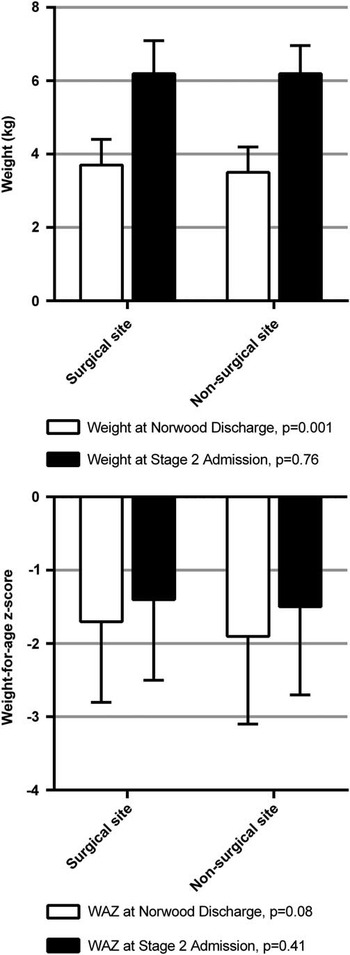
At the time of Norwood discharge, patients in the non-surgical site group weighed less – 3.5 versus 3.7 kg (p=0.001) – but both groups had similar weight-for-age z-scores at Norwood discharge (Fig 1). At Stage 2 surgery, mean weight of the two groups – surgical site group 6.2 kg versus non-surgical site group 6.2 kg (p=0.76) – and weight-for-age z-scores – surgical site group −1.4 versus non-surgical site group −1.5 (p=0.41) – were similar (Fig 1).
Weight data at Norwood discharge and at Stage 2 admission. Mean (bar) and standard deviation (line) are shown in the plots. WAZ=weight-for-age z-score.

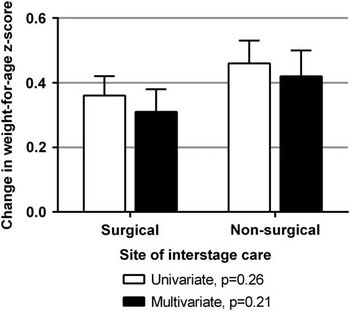
Data regarding change in weight-for-age z-score for each group are shown in Figure 2. Both groups had an increase in weight-for-age z-score over the interstage period; however, there was no significant difference between groups in magnitude of that change, with a change in weight-for-age z-score of +0.36±0.96 for the surgical site group versus +0.46±1.02 for the non-surgical site group, p=0.3. In multivariable analyses, adjusting for differences in important patient characteristics, results were similar with a change in weight-for-age z-score of +0.31±0.07 in the surgical site group versus +0.42±0.08 in the non-surgical site group, p=0.21 (Fig 2). In a sensitivity analysis evaluating potential era effects, we added era to our models and the results were unchanged with no significant difference in change in weight-for-age z-score between groups – 0.31±0.07 in the surgical site group versus 0.43±0.08 in the non-surgical site group (p=0.20). Finally, average daily weight gain during the interstage period was also not different between the two groups – 22.4±6.4 g/day in the surgical site group versus 22.7±6.3 g/day in the non-surgical site group (p=0.61).
Change in weight-for-age z-score in the interstage period. White bars represent change and standard error with univariate analysis, and black bars represent change and standard error with multivariate analysis.

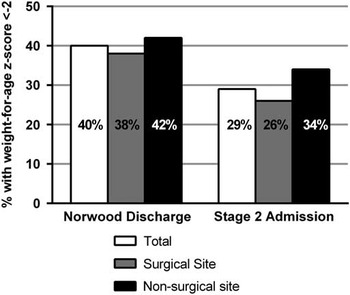
In both groups, a large proportion of patients had weight-for-age z-score <−2 both at Norwood discharge and at Stage 2 admission, as shown in Figure 3. There was no significant difference in the proportion of patients with weight-for-age z-score <−2 in the surgical site and non-surgical site groups at Norwood discharge (p=0.39) and at Stage 2 admission (p=0.06). Overall, the proportion of all patients with weight-for-age z-score <−2 decreased from 40% at Norwood discharge to 29% at Stage 2 – 38 to 26% in the surgical site group versus 42 to 34% in the non-surgical site group (p=0.1).
The proportion of patients with weight-for-age z-score <−2 at Norwood discharge and Stage 2 admission. White bars represent the total study population, grey bars represent the surgical site group, and black bars represent the non-surgical site group. There was no significant difference in the proportion of patients with weight-for-age z-score <−2 in the surgical site and non-surgical site groups at Stage 2 admission (p=0.06).

Discussion
Our study found no association between surgical versus non-surgical site of outpatient interstage care and weight gain in single ventricle patients undergoing the Norwood operation. These results were unchanged in multivariable analysis adjusting for differences in pre-Norwood, Norwood hospitalisation, and discharge characteristics. An improvement in weight-for-age z-score over the interstage period was seen in patients followed both by the surgical and non-surgical sites; however, although both study groups had similar growth characteristics, a significant proportion of patients remained underweight at Norwood discharge and at Stage 2 surgery admission, with nearly one-third of patients having a weight-for-age z-score <−2 at the end of the interstage period.
These findings are consistent with the rates of poor growth demonstrated in other studies of the single ventricle interstage population.Reference Daymont, Neal and Prosnitz 5 , Reference Anderson, Beekman and Border 6 , Reference Anderson, Iyer and Schidlow 9 , Reference Anderson, Beekman and Eghtesady 12 , Reference Petit, Fraser and Mattamal 15 , Reference Kelleher, Laussen and Teixeira-Pinto 16 These infants have higher caloric needs with significant volume load on a single functioning ventricle.Reference Kelleher, Laussen and Teixeira-Pinto 16 , Reference Menon and Poskitt 17 Post-Norwood operation recovery can be of variable length, and acute postoperative nutrition is often inadequate to meet the caloric needs.Reference Hong, Moffett and Payne 18 Furthermore, these patients are at higher risk for feeding difficulties including swallowing dysfunction and vocal cord paralysis.Reference Golbus, Wojcik and Charpie 19 , Reference Uzark, Wang and Rudd 20 Recent studies have shown an association with lower weight-for-age z-scores and increased Stage 2 surgery hospitalisation days and postoperative complications, linking interstage weight gain and clinical outcomes.Reference Anderson, Beekman and Border 6 , Reference Menon, McCandless and Mack 7 These findings have brought focus on interstage weight gain as a modifiable factor to improve other clinical outcomes.
In addition, it has also been shown that there can be variation in clinical careReference Pasquali, Ohye and Lu 21 and weight gain across centres. A retrospective analysis by Anderson et alReference Anderson, Iyer and Schidlow 9 of sites participating in the National Paediatric Cardiology Quality Improvement Collaborative registry used in this study found significant variation in interstage weight gain across surgical centres. Some sites were found to have median weight-for-age z-score changes that were negative over the interstage period; sites that used more specific nutritional practices were associated with greater median weight-for-age z-score changes that were positive. Given the limited growth of these infants, and evidence demonstrating variation in growth across sites, multiple studies have investigated strategies associated with improved growth. Previous analyses have demonstrated that improved interstage weight gain is associated with interstage weight monitoring and home monitoring programmes.Reference Hehir, Rudd and Slicker 11 , Reference Petit, Fraser and Mattamal 15 In our study, ∼80% of the patients were discharged with a home surveillance strategy, which included weight monitoring, with no significant difference between the study groups. Thus, our findings suggest that site of outpatient interstage care is not associated with differences in this practice at Norwood discharge.
Other specific practices identified with improved interstage weight gain in previous studies include the following: use of home weight scales, monitoring for interstage growth “red flags”, standard inpatient post-Norwood feeding evaluation, interstage phone contact by cardiology providers, availability of outpatient dieticians,Reference Anderson, Iyer and Schidlow 9 , Reference Schidlow, Anderson and Klitzner 10 , Reference Petit, Fraser and Mattamal 15 intensity of nutritional monitoring, dietary interventions, and recording actual caloric intake.Reference Uzark, Wang and Rudd 20 , Reference Williams, Zak and Ravishankar 22 , Reference McCrary, Clabby and Mahle 23 It is known that utilisation of these practices varies considerably across the surgical sitesReference Anderson, Iyer and Schidlow 9 and likely across the non-surgical sites as well, although this has not been studied in detail. Our study found no difference in utilisation of home weight scales and monitoring for interstage growth “red flags”; however, we could not evaluate use of post-Norwood feeding evaluation, interstage phone contact, use of outpatient dieticians, intensity of nutritional monitoring, dietary interventions, or recording actual caloric intake, as these data are not captured in the registry. Among these practices that are associated with improved growth, none absolutely required patients to return to the surgical site for outpatient follow-up. All could occur either before Norwood discharge or via telephone contact by the cardiology care providers and dieticians from either the surgical centre and/or the local cardiology site. Taken together, data from the present study and previous investigations suggest that utilisation of specific practices during interstage care may be more important for optimising interstage weight gain, rather than the site of interstage care alone.
Therefore, collaborative quality improvement efforts focused on optimising these specific practices across the surgical and non-surgical sites may hold the potential to significantly improve growth for this population as a whole. In fact, quality improvement efforts are currently underway by the National Paediatric Cardiology Quality Improvement Collaborative to reduce unnecessary variation in practices and improve weight gain across surgical centres.Reference Anderson, Beekman and Kugler 24 This potential opportunity for improvement is highlighted by this study’s secondary finding that a substantial proportion, nearly one-third, of all patients were underweight at Stage 2 admission with a weight-for-age z-score <−2. These results underscore the continued impaired growth of this population and the need for further studies evaluating interventions to optimise practices associated with improved growth.
Limitations
Our study limitations are primarily related to the nature of the National Paediatric Cardiology Quality Improvement Collaborative registry. Due to missing data, 20% of patients otherwise eligible for our analysis were excluded. Nonetheless, analysis of patient characteristics in the included versus excluded cohort did not suggest any important differences. In addition, although our study population consisted of a large multicentre cohort, the centres in this study represent approximately one-third of all US centres performing heart surgery, and therefore may not be applicable to all programmes.Reference Jacobs, Daniel and Mavroudis 25 In our study, patients who received some interstage care at both the surgical and non-surgical sites were classified in the non-surgical site group due to lack of further specifications within the database. These patients, and those classified with interstage care given only at non-surgical sites, likely had variable involvement of the surgical centre team and its resources; we could not further evaluate this variability in this study. Finally, there could be potential significant variation with use of specific nutritional practices listed above at multiple levels within an individual cardiac centre, between cardiologists, and between individual cardiac surgical centres and non-surgical centres. This individual variation could not be evaluated in the present study.
Conclusions
In this large multicentre study, the site of interstage outpatient care was not associated with weight gain during the interstage period for single ventricle patients. Although weight-for-age z-score improved for all patients over the interstage period, nearly one-third of all patients remained underweight at Stage 2, with a weight-for-age z-score <−2. Further efforts are needed to increase the utilisation of practices known to improve growth in this population across sites in order to optimise clinical outcomes in this patient population.
Acknowledgements
None.
Financial Support
Dr Pasquali received support from the National Heart, Lung, and Blood Institute (grant number K08HL103631). Dr Schidlow is supported by the National Institutes of Health (T32-HL007572).
Conflicts of Interest
None.
Ethical Standards
The authors assert that all procedures contributing to this work comply with the ethical standards of the U.S. Department of Health and Human Services, and with the Helsinki Declaration of 1975, as revised in 2008, and has been approved by the Institutional Review Boards of the participating centers.