





Impact statement
By identifying advanced hybrid materials that lower energy requirements and enhance recyclability, this review paves the way for highly efficient post-combustion carbon capture. The findings will assist environmental policymakers and climate scientists in scaling up technologies to achieve net-zero emission targets.
Introduction
Greenhouse gas emissions have been the main contributor to climate change, with the greenhouse effect becoming more serious in recent years and significantly impacting the ecological balance (Song et al., Reference Song, Liu, Ji, Deng, Zhao, Li, Song and Li2018). Carbon dioxide (CO2) emissions, the main component of greenhouse gases, have increased rapidly (Yu et al., Reference Yu, Bai, Moioli, Tontiwachwuthikul, Plisko, Bildyukevich, Feng and Liu2023). This necessitates the development of CO2 capture technologies (i.e., pre-combustion capture, post-combustion capture, oxy-fuel combustion capture and chemical looping combustion) to mitigate climate change and reduce CO2 emissions (Spigarelli and Kawatra, Reference Spigarelli and Kawatra2013). Post-combustion capture technology is one of the widely used methods for CO2 capture (Spigarelli and Kawatra, Reference Spigarelli and Kawatra2013; Yu et al., Reference Yu, Bai, Moioli, Tontiwachwuthikul, Plisko, Bildyukevich, Feng and Liu2023). Conventional post-combustion CO2 capture processes include chemical absorption, adsorption, membrane separation and cryogenic distillation (Spigarelli and Kawatra, Reference Spigarelli and Kawatra2013). So far, the development of CO2 capture processes has extensively focused on standalone conventional post-combustion CO2 capture methods.
Chemical absorption predominantly captures CO2 via reaction with the solvent to form carbonate or bicarbonate (Yu et al., Reference Yu, Bai, Moioli, Tontiwachwuthikul, Plisko, Bildyukevich, Feng and Liu2023). A bulk phenomenon occurs when CO2 absorbate is separated using a liquid or solid material as the solvent or absorbent (Ben-Mansour et al., Reference Ben-Mansour, Habib, Bamidele, Basha, Qasem, Peedikakkal, Laoui and Ali2016). During absorption, the CO2 molecules come into contact with the absorbent and are absorbed through diffusion or dissolved entirely from the gas phase into the liquid phase to form a solution (Ben-Mansour et al., Reference Ben-Mansour, Habib, Bamidele, Basha, Qasem, Peedikakkal, Laoui and Ali2016). CO2 can be desorbed from the solvent by heating (Zhang et al., Reference Zhang, Shen, Wang, Chen and Lu2019).
Chemical absorption is the preferred and established approach to capture CO2 from post-combustion flue gas streams (Ben-Mansour et al., Reference Ben-Mansour, Habib, Bamidele, Basha, Qasem, Peedikakkal, Laoui and Ali2016). An absorbent must be soluble, able to dissolve acidic CO2 gas easily and chemically reactive with CO2 in the absorption process (Ben-Mansour et al., Reference Ben-Mansour, Habib, Bamidele, Basha, Qasem, Peedikakkal, Laoui and Ali2016). Amine-based solvents (e.g., monoethanolamine (MEA), N-methyl diethanolamine (MDEA) and piperazine) are the most widely used absorbents (Oh et al., Reference Oh, Binns, Cho and Kim2016; Ye et al., Reference Ye, Jiang, Chen, Shen, Zhang, Wang and Chen2019) due to their mature absorption process and ability to chemically react with CO2-containing gas stream at low CO2 partial pressure (3%–20%) (Spigarelli and Kawatra, Reference Spigarelli and Kawatra2013). However, the thermal energy required for regenerating the solvent results in high regeneration energy consumption, exceeding 3 GJ per ton of CO2 (Bravo et al., Reference Bravo, Drapanauskaite, Sarunac, Romero, Jesikiewicz and Baltrusaitis2021) during high-temperature stripping or regeneration of the absorbent (Spigarelli and Kawatra, Reference Spigarelli and Kawatra2013). High regeneration energy accounts for about 80% of the total operating cost in chemical absorption (Shen et al., Reference Shen, Tong, Yin, Liu, Wang, Feng and Ding2022). Additionally, chemical absorption is uneconomical for low CO2 concentrations, has poor solvent degradation and oxidation and suffers from solvent degradation by by-products and gaseous components (e.g., nitrogen oxides (NOx), sulfur oxides (SOx), oxygen (O2) and particulate matter) (Spigarelli and Kawatra, Reference Spigarelli and Kawatra2013). Moreover, the reclaimer stage is energy-intensive, the waste stream is hazardous and the equipment suffers corrosion at high temperatures (Spigarelli and Kawatra, Reference Spigarelli and Kawatra2013; Gilassi et al., Reference Gilassi, Taghavi, Rodrigue and Kaliaguine2021).
Adsorption is a well-known CO2 capture technology that reduces the energy penalty for regeneration and overcomes the limitations of the state-of-the-art amine-based absorption process (Zhao et al., Reference Zhao, Liu, Zhao, Deng, Li and Zhang2019; Raganati et al., Reference Raganati, Miccio and Ammendola2021). The separation of CO2 is performed through adsorption and desorption on a solid surface (Yu et al., Reference Yu, Bai, Moioli, Tontiwachwuthikul, Plisko, Bildyukevich, Feng and Liu2023). It is a surface phenomenon where CO2 adsorbate preferentially adheres to the surface of an adsorbent (Lai et al., Reference Lai, Ngu, Hashim, Chew and Sunarso2021). Conventional adsorbents such as zeolite, silica materials, metal–organic frameworks (MOFs) and activated carbon are extensively investigated for CO2 adsorption (Lai et al., Reference Lai, Ngu and Hashim2021). This process is classified into two types: physical and chemical adsorption. Physical adsorption typically occurs when CO2 molecules attach to the adsorbent surface through weak Van der Waals forces (Ben-Mansour et al., Reference Ben-Mansour, Habib, Bamidele, Basha, Qasem, Peedikakkal, Laoui and Ali2016; Tsuchiya, Reference Tsuchiya, White, Casey, Marty and Yurimoto2018). The pore sizes and surface area of adsorbents play an essential role in physical adsorption (Ben-Mansour et al., Reference Ben-Mansour, Habib, Bamidele, Basha, Qasem, Peedikakkal, Laoui and Ali2016). Chemical adsorption occurs when CO2 molecules interact chemically with the surface functional groups of the adsorbent via the spontaneous formation of covalent bonds by sharing electrons (Lodish et al., Reference Lodish, Berk, Zipursky, Matsudaira, Baltimore and Darnell2000; Ben-Mansour et al., Reference Ben-Mansour, Habib, Bamidele, Basha, Qasem, Peedikakkal, Laoui and Ali2016). Surface modification (e.g., impregnation and grafting with amine groups or metal nanoparticles) is carried out to introduce chemical groups or surface charges on the surface of non-modified adsorbents to promote further adhesion of CO2 adsorbate (Houshmand et al., Reference Houshmand, Daud, Lee and Shafeeyan2012; Khalil et al., Reference Khalil, Aroua and Daud2012; Hidayu and Muda, Reference Hidayu and Muda2016, Reference Hidayu and Muda2017).
Pressure swing adsorption (PSA) and temperature swing adsorption (TSA) are the two most common methods in the adsorption process (Hasan et al., Reference Hasan, Baliban, Elia and Floudas2012). In PSA, CO2 is adsorbed on the solid adsorbent surface at high pressure and desorbed at low pressure (Riboldi and Bolland, Reference Riboldi and Bolland2017). In TSA, CO2 adsorption occurs at low temperatures, followed by desorption at high temperatures (Chen et al., Reference Chen, Deng, Zhao, Zhu, Zhao and Li2021). Compared to chemical absorption, adsorption is cost-effective for capturing CO2 due to its minimal energy requirement for regeneration through thermal or pressure regulation and the absence of water. It is a potential candidate for dilute gas mixture, offering a large CO2 carrying capacity, ease of operation at various temperatures and pressures, rapid reaction rates and low-pressure drop (Xu et al., Reference Xu, Song, Miller and Scaroni2005; Shafeeyan et al., Reference Shafeeyan, Daud, Houshmand and Shamiri2010; Saxena et al., Reference Saxena, Singh and Kumar2014). However, high operating and capital costs, along with complex process control, hinder the widespread use of adsorption for CO2 capture (Jiang et al., Reference Jiang, Shen, Liu, Zhang, Tang, Li and Fu2020). The performance of CO2 adsorption is significantly influenced by various operating conditions and the properties of the adsorbent, including replacement cost, surface area, pore size, adsorption capacity, CO2 selectivity, cyclic adsorption–desorption stability and tolerance to impurities such as NOx, SOx and water vapour (H2O) (Plaza et al., Reference Plaza, Pevida, Arias, Fermoso, Rubiera and Pis2009; Ben-Mansour et al., Reference Ben-Mansour, Habib, Bamidele, Basha, Qasem, Peedikakkal, Laoui and Ali2016; Mukherjee et al., Reference Mukherjee, Okolie, Abdelrasoul, Niu and Dalai2019).
To overcome the challenges of standalone CO2 capture processes, the hybrid process presents a promising strategy. This approach leverages each absorbent’s strengths to mitigate the paired adsorbent’s weaknesses. For example, a true absorption–adsorption hybrid process is generally defined as a system that combines a liquid absorbent and a solid adsorbent, enabling efficient heat integration and substantial heat recovery in a continuous process (Liu et al., Reference Liu, Liu, Lin, Chen, Wu, Wang, Gao, Lv, Pan, Zhang, Zhang, Yang, Sun, Smit and Wang2014). In this hybrid system, the solid adsorbent can be either suspended in the liquid absorbent or the aqueous absorbent can be impregnated onto the solid adsorbent’s surface to capture CO2 (Gargiulo et al., Reference Gargiulo, Pepe and Caputo2014; Liu et al., Reference Liu, Liu, Lin, Chen, Wu, Wang, Gao, Lv, Pan, Zhang, Zhang, Yang, Sun, Smit and Wang2014; Ma and Banerjee, Reference Ma, Banerjee and Balasubramanian2018; Aghel et al., Reference Aghel, Janati, Alobaid, Almoslh and Epple2022). The use of a solid adsorbent is crucial for reducing the energy required to regenerate the liquid absorbent. It takes advantage of the adsorbent’s textural characteristics (such as surface area and pore distribution) for CO2 adsorption (Medek et al., Reference Medek, Weishauptová and Kovář2006).
In addition to these liquid–solid hybrids, several fixed-bed amine-functionalised adsorbent systems, such as the CO2 capture systems reported by Fujiki et al. (Reference Fujiki, Chowdhury, Yamada and Yogo2017) and Breault et al. (Reference Breault, Spenik, Shadle, Hoffman, Gray, Panday and Stehle2016), integrate amine-based chemisorption (absorption-like chemical binding) with adsorption on a porous solid support. While these systems are sometimes described as absorption–adsorption hybrid processes due to their dual mechanism, they do not involve liquid-phase absorption unit operations and are therefore more accurately classified as adsorption processes employing chemically active adsorbents. This clarification ensures consistent terminology while recognising the mechanistic similarities that motivated their initial categorisation.
CO2 recovery and purity were significantly influenced by adjusting various material properties in the absorption–adsorption process (Song et al., Reference Song, Liu, Ji, Deng, Zhao, Li, Song and Li2018). Fujiki et al. (Reference Fujiki, Chowdhury, Yamada and Yogo2017) demonstrated that a novel amine-impregnated mesoporous Michigan State University (MSU-F) silica adsorbent (Research Institute of Innovative Technology for the Earth (RITE)-amine/MSU-F) functions as an absorption–adsorption hybrid system for CO2 capture. In this configuration, the amine groups chemically absorb CO2 while the mesoporous silica provides adsorption sites. Both mechanisms are integrated with the steam-aided vacuum swing adsorption (SA-VSA) process using a lab-scale three-column fixed-bed system. This hybridisation achieved a CO2 recovery rate of over 93% and a CO2 purity exceeding 98%. The hybridisation of absorption and adsorption processes results in a slight increase in the CO2 recovery to 90% (Ho et al., Reference Ho, Allinson and Wiley2008) while maintaining comparable CO2 purity levels of over 99% (Ho et al., Reference Ho, Allinson and Wiley2008) found in standalone MEA solvent absorption. Additionally, the regeneration heat of RITE-amine/MSU-F, calculated based on the supplied steam and recovered CO2, is significantly lower at 1.47 GJ per ton of CO2 (Fujiki et al., Reference Fujiki, Chowdhury, Yamada and Yogo2017), compared to 3 GJ per ton of CO2 (Bravo et al., Reference Bravo, Drapanauskaite, Sarunac, Romero, Jesikiewicz and Baltrusaitis2021) for the MEA solvent. Breault et al. (Reference Breault, Spenik, Shadle, Hoffman, Gray, Panday and Stehle2016) confirmed that polyethyleneimine (PEI) immobilised on mesoporous silica (AX) adsorbent operates as an absorption–adsorption hybrid process for post-combustion CO2 capture of a binary feed gas mixture (15% CO2 and 85% N2). The PEI phase provides chemical absorption through amine–CO2 interactions, while the silica support enables physical adsorption. This hybrid system achieved CO2 recovery rates between 50.4% and 98.5%, with CO2 purity levels ranging from 85% to 100%. The energy consumption for this process was between 1.6 and 2.0 GJ per ton of CO2 captured. The impregnation of PEI onto the mesoporous silica AX adsorbent enhanced the CO2 recovery rate while maintaining comparable purity, and it also reduced the regeneration heat of the adsorbent compared to standalone MEA solvent absorption.
Although several hybrid CO₂ capture processes have been proposed – absorption-based, adsorption-based, membrane-based, cryogenic-based and hybrid chemical looping – this review narrows its scope to the absorption–adsorption hybrid system at the material level. Specifically, it focuses on composites where liquid absorbents (e.g., ionic liquids) are impregnated into porous solids or solid adsorbents are dispersed in liquids, thereby combining chemical absorption with physical adsorption. Within this framework, this review presents an overview of various CO2-porous absorbents, their synthesis methods and the reaction mechanisms with CO2 in hybrid absorption–adsorption processes. The CO2 capture performance of these CO2-porous absorbents is evaluated in detail, and the challenges and future research directions of absorption–adsorption hybrids are discussed to guide their potential engineering development.
Hybrid CO2 absorbent adsorbent group
Amine-functionalised silica composites, carbon-based nanoparticles/liquid amine nano-fluids and IL-functionalised adsorbent composites are the primary groups of hybrid CO2 absorbent-adsorbent materials. This section discusses these three major groups, focusing on their preparation techniques, textural characteristics, key advantages and CO2 capture performance.
Amine-functionalised silica composites
The functionalisation of amine species onto mesoporous silica, a support material, for CO2 capture has garnered significant attention (Gargiulo et al., Reference Gargiulo, Pepe and Caputo2014). This amine-functionalised silica composite leverages the high CO2 affinity of amine species and mesoporous silica’s large surface area and pore volume, ensuring uniform distribution of amine species within its porous structure (Chen et al., Reference Chen, Zhang, Row and Ahn2017). Among various porous support materials, mesoporous silica stands out for its suitability in surface functionalisation of amine species due to its large surface area, substantial pore volume, uniform pore size and the ease of surface chemical modification to accommodate the steric hindrance of amine species (Impens et al., Reference Impens, van der Voort and Vansant1999; Asefa and Tao, Reference Asefa and Tao2012).
Mesoporous silica is commonly functionalised with amine species using two primary methods: post-synthetic (wet impregnation or chemical grafting) and direct synthesis (one-pot synthesis) (Chen et al., Reference Chen, Zhang, Row and Ahn2017). Commonly used amines for this purpose include tetraethylenepentamine (TEPA), triethylenetramine (TETA), pentaethylenehexamine (PEHA), branched PEI (BPEI) and linear PEI (LPEI). Wet impregnation is a straightforward and mild synthesis method. In this process, porous silica is first prepared and then soaked in an alcohol solvent containing the desired amount of amine. After soaking, the solvent is dried, resulting in an amine-impregnated silica composite (Xu et al., Reference Xu, Song, Andrésen, Miller and Scaroni2003). Figure 1 illustrates the schematic diagram of the wet impregnation method used to produce an amine-impregnated silica composite. This method is advantageous because it allows a large amount of amine to be incorporated into the silica’s large pore volume (Chen et al., Reference Chen, Zhang, Row and Ahn2017). However, the lack of chemical bonding between the amine and silica support can affect the stability of the composite, potentially hindering its practical application (Chen et al., Reference Chen, Zhang, Row and Ahn2017).
Schematic diagram of the wet impregnation process for producing amine-impregnated mesoporous silica. Reproduced from brgfx (2024).

Figure 1. Long description
The flowchart consists of three main stages connected by green arrows.
1. Top-left stage: Wet impregnation of amine. A glass beaker contains an amine-containing alcohol solvent. Submerged at the bottom are three hexagonal mesoporous silica particles, each containing a grid of white circular pores.
2. Top-right stage: Drying of residual amine-containing alcohol solvent. The beaker is placed inside a blue heating chamber. Two brown heating elements on the left and right sides emit horizontal arrows labeled Heat toward the beaker. Three vertical arrows point upward from the liquid surface, labeled Evaporation of solvent.
3. Bottom-right stage: Amine-impregnated mesoporous silica. A large-scale view of a single hexagonal mesoporous silica particle. The internal circular pores are now filled with red shapes representing amine functional groups. A circular magnifying glass callout highlights a cluster of these red functional groups within the pores.
Chemical grafting anchors amine species onto the surface of silica support through the formation of covalent bonds, achieved by heating under reflux or using a sonication-assisted method (Knowles et al., Reference Knowles, Chaffee and Chaffee2016; Chen et al., Reference Chen, Zhang, Row and Ahn2017; Hack et al., Reference Hack, Maeda and Meier2022). There are two approaches reported in the literature for preparing amine-grafted silica adsorbents. The first approach involves attaching amine species to the silica surface via a condensation reaction with hydroxyl groups on the silica support (Figure 2) (Chen et al., Reference Chen, Zhang, Row and Ahn2017). The amount of amine incorporated depends on the number of hydroxyl groups on the silica surface (Chen et al., Reference Chen, Zhang, Row and Ahn2017). The second approach involves soaking silica in anhydrous toluene and adding an amino silane to the solution (Huang et al., Reference Huang, Yang, Chinn and Munson2003; Chen et al., Reference Chen, Zhang, Row and Ahn2017). The mixture is then heated under reflux to form an amine-functionalised silica composite (Huang et al., Reference Huang, Yang, Chinn and Munson2003; Chen et al., Reference Chen, Zhang, Row and Ahn2017). The composite is washed several times to remove unreacted amino silane before application (Huang et al., Reference Huang, Yang, Chinn and Munson2003). Unlike the first approach, this method incorporates amine species through siloxane (Si-O-Si) bridges to other grafted amino silane (Chen et al., Reference Chen, Zhang, Row and Ahn2017). In addition to amino silane, other grafting agents such as aziridine (C2H5N), PEI, ammonium hydroxide (NH4OH) and polyacrylic acid (PAA) can be used for amine functionalisation within mesoporous silica (Hicks et al., Reference Hicks, Drese, Fauth, Gray, Qi and Jones2008; Du et al., Reference Du, Du, Zou, Li, Mi and Zhang2013; Ullah et al., Reference Ullah, Atilhan, Aparicio, Canlier and Yavuz2015).
Schematic diagram of the anhydrous grafting of amine species onto the silica surface through a condensation reaction with hydroxyl groups on the silica support. (R group = triamine chains). Reproduced from Chen et al. (Reference Chen, Zhang, Row and Ahn2017).

Figure 2. Long description
The schematic is organised into three main vertical stages within a rounded frame, with a structural reference to the right.
* At the top left, a box labeled Aminosilane contains a chemical structure with a central S i atom bonded to an R group at the top and three C H sub 3 O groups at the bottom. A thick red L-shaped arrow points from this box down toward the silica surface, with text stating Attached to silica surface via anhydrous grafting.
* In the middle, a horizontal rectangle represents the Pore wall of Hydrated mesoporous silica. The top surface of this wall is lined with twelve O H hydroxyl groups.
* A red downward arrow indicates the transition to the bottom stage, labeled Amine-grafted mesoporous silica. Here, the Pore wall now has four aminosilane molecules grafted to it. The grafting occurs through oxygen atoms. Some sites show the S i atom bonded to two oxygen atoms on the surface, while others show one oxygen bond and remaining C H sub 3 O groups, with occasional residual O H groups on the surface.
* To the right of the main frame, a blue hexagonal icon with white circular pores is labeled Mesoporous silica. A small gray triangle points from one of these pores into the main reaction diagram, indicating that the schematic represents a microscopic view of a single pore wall.
On the other hand, amine-functionalised silica composites (also known as amine-modified silica composites) can be prepared through a one-pot synthesis. The synthesis involves the hydrolysis and co-condensation reaction between an organosilane and an amino silane, using an acid or base catalyst with an organic template (Gunathilake and Jaroniec, Reference Gunathilake and Jaroniec2014; Kong et al., Reference Kong, Jiang, Fan, Shen, Cui and Russell2014; Chen et al., Reference Chen, Zhang, Row and Ahn2017), as illustrated in Figure 3. Furthermore, some studies employ a double-functionalisation method to synthesise amine-modified silica composites. This involves first chemically grafting amine onto the silica surface, followed by incorporating additional amine species via the wet impregnation method to fill the remaining pore volume in the silica support (Fujiki et al., Reference Fujiki, Yamada and Yogo2015; Sanz et al., Reference Sanz, Calleja, Arencibia and Sanz-Pérez2015; Wang et al., Reference Wang, Chen and Guo2015; Jung et al., Reference Jung, Lee, Jeon, Jo, Huh and Kim2016).
Schematic diagram illustrating the one-pot synthesis of amine-modified silica composite. Reproduced from Xie et al. (Reference Xie, Hill, Xiao, Militz and Mai2010) and Hubbe et al. (Reference Hubbe, Rojas and Lucia2015) [From “Green modification of surface characteristics of cellulosic materials at the molecular or nano scale: A review,” by M A Hubbe, O J Rojas and L A Lucia, 2015, BioResources, 10(3), p. 6095-6206 (10.15376/biores.10.3.Hubbe). Copyright 2015 by the Author(s).].

Figure 3. Long description
The diagram is organized into three vertical stages.
1. Top Section: Two chemical equations enclosed in a red box.
- The first equation shows Hydrolysis: R prime S i (O R) sub 3 plus 3 H sub 2 O, with an arrow labeled Acid or Base Catalyst, yields R prime S i (O H) sub 3 plus 3 R O H.
- The second equation shows Self-condensation: R prime Si(OH)3 plus O H S i R double prime (O H) sub 2 yields R prime S i O S i R double prime (O H) sub 2 plus H sub 2 O.
2. Middle Section: A green arrow points from the equations to a blue hexagonal structure labeled As-synthesized mesoporous silica. This hexagon is filled with dark circular clusters. A circular inset to the right shows an Organic template represented by a dark circle with a wavy tail, with an arrow pointing into the hexagonal structure.
3. Bottom Section: A green arrow points down to a final blue hexagonal structure labeled Mesoporous silica, which contains empty white circular pores. A circular inset to the left, labeled Solvent extraction of organic template, shows the dark wavy-tailed clusters being removed from the structure, indicated by a red arrow pointing away from the hexagon.
Min et al. (Reference Min, Choi and Choi2017) investigated the CO2 adsorption capabilities of various PEI-functionalised mesoporous silicas. At 40 °C and 0.15 atm, PEI/macroporous silica (MacS) exhibited a higher CO2 adsorption capacity of 3.84 mmol g−1 compared to PEI/mesocellular silica foam (MCF) (2.96 mmol g−1), PEI/ Santa Barbara Amorphous-15 (SBA-15) (2.53 mmol g−1) and PEI/ Mobil Composition of Matter No. 41 (MCM-41) (0.91 mmol g−1). The extra-large pore diameter (56 nm) and three-dimensional porous structure of MacS minimise pore obstruction by the functionalised PEI, enhancing amine utilisation for CO2 adsorption. PEI/MacS demonstrated excellent stability, maintaining 90% of its CO2 adsorption capacity (3.46 mmol g−1) after a 14-day steam treatment at 120 °C.
Fayaz and Sayari (Reference Fayaz and Sayari2017) synthesised 3-[2-(2-aminoethylamino)ethyl amino] propyltrimethoxysilane (triamine)-grafted commercial-grade silica (CARiACT, P10) under optimal grafting conditions using 1.5 cm3 amino silane per g silica and 0.2 cm3 water. This achieved maximum CO2 adsorption capacities of 1.41 mmol g−1 at 25 °C, 1.93 mmol g−1 at 50 °C and 1.23 mmol g−1 at 75 °C before steam treatment. Increasing steam exposure duration from 3 to 24 h reduced the CO2 adsorption capacity of triamine-grafted P10 by 56% at 25 °C (0.61 mmol g−1), 21% at 50 °C (1.47 mmol g−1) and 4% at 75 °C (1.18 mmol g−1). Extending steam exposure to 360 h further decreased the CO2 adsorption capacity by 83% (0.21 mmol g−1), 61% (0.70 mmol g−1) and 26% (0.87 mmol g−1) at 25 °C, 50 °C and 75 °C, respectively. The reduction in CO2 adsorption capacity with increasing steam exposure time at these temperatures was attributed to decreased average pore width of triamine-grafted P10 and increased diffusional mass transfer resistance.
Supplementary Tables S1(a)–(c) tabulate the CO2 adsorption performance of amine-impregnated silica composites, amine-grafted silica composites and amine-modified silica composites under various operating conditions. Table 1 provides a detailed comparison of these three groups in terms of their maximum CO2 adsorption capacity, as summarised in Supplementary Tables S1(a)–(c). As shown in Table 1, the amine-grafted silica composite exhibits a wide adsorption capacity range (0.18–110.64 mmol g−1), while the amine-impregnated silica composite demonstrates a narrower but generally higher overall CO2 adsorption capacity (1.85–6.10 mmol g−1). The amine-modified silica composite shows a range of 0.80–3.98 mmol g−1. Notably, the reported maximum uptake of 110.64 mmol g−1 for ammonium hydroxide (NH4OH)-modified SBA-15 (MSBA-15) was measured under 200 atm pressure at 45 °C (Ullah et al., Reference Ullah, Atilhan, Aparicio, Canlier and Yavuz2015). This exceptionally high value reflects a high-pressure special case and should not be interpreted as representative of post-combustion CO2 capture conditions. The increase from 2.02 to 110.64 mmol g−1 under elevated pressure highlights the strong CO2 affinity of NH2 groups and enhanced accessibility of CO2 to attractive sites within the pores of MSBA-15 (Ullah et al., Reference Ullah, Atilhan, Aparicio, Canlier and Yavuz2015).
Comparative analysis of CO2 capture performance in hybrid absorption–adsorption systems using amine-impregnated, amine-grafted and amine-modified silica

Table 1. Long description
The table consists of seven columns: Absorbent material matrix, Operating temperature in degrees Celsius, Total pressure Ptotal in atm, CO2 partial pressure Ptotal CO2 in atm or feed, Minimum CO2 adsorption capacity in mmol g super minus 1, Maximum CO2 adsorption capacity in mmol g super minus 1, and References.
* Amine-impregnated silica composite section: Includes 12 materials. Notable entries include TEPA-modified hydrophilic silica aerogel sorbent (S A-I) with a maximum capacity of 6.10 mmol g super minus 1 at 75 degrees Celsius, and T E P A-D E A impregnated M S U-F with a minimum capacity of 4.42 mmol g super minus 1.
* Amine-grafted silica composite section: Includes 12 materials. The highest recorded capacity in the entire table is found here: Ammonium hydroxide modified S B A-15 (M S B A-15) with a maximum capacity of 110.64 mmol g super minus 1 at a pressure range up to 197.4 atm. Other materials like M C M-41-N H sub 2 and A 2-B P M O show lower capacities ranging from 0.18 to 3.86 mmol g super minus 1.
* Amine-modified silica composite section: Includes 5 materials. P E I-functionalised mesoporous silica powders (P E I-M S P-0.32) show a maximum capacity of 3.98 mmol g super minus 1 at temperatures between 35 and 95 degrees Celsius. P S A and S G A adsorbents show lower maximum capacities around 0.80 to 1.02 mmol g super minus 1.
Data marked as n/a indicates values not available or not explicitly reported in the cited literature.
Note : n/a: Data not available or not explicitly reported in the cited literature.
The CO2 adsorption performance of amine-functionalised silica composite is influenced by multiple factors, including adsorption temperature, moisture content, CO2 concentration, CO2 flow rate and adsorption pressure. As shown in Supplementary Tables S1(a)–(c), moisture content, CO2 concentration and adsorption pressure generally enhance the adsorption capacity of amine-grafted and amine-modified silica composites. In contrast, CO2 flow rate and adsorption temperature improve adsorption capacity of amine-grafted and amine-modified silica composites only up to a threshold, beyond which further increases in these parameters may lead to a decrease in capacity as contrary to the behaviour observed in amine-impregnated silica composites.
Comparative analysis of CO2 adsorption metrics
To ensure a rigorous evaluation across varying material classes, all CO2 adsorption data compiled in Supplementary Tables S1(a–c) are contextualised within a standardised framework specifying amine loading, humidity, operating temperature and CO2 partial pressure (PCO2). In discussions of dynamic breakthrough tests, flow rates and residence times are explicitly distinguished from those in static equilibrium measurements.
(A) Performance under dilute/low partial pressure conditions (PCO2 = 0.05–0.15 atm)
Adsorption under dilute conditions (typically 5–15 vol.% CO2, simulating flue gas streams at a total pressure of 1 atm) highlights the competitive role of amine functionalisation relative to mass-transfer limitations.
-
• Amine Loading and Dispersion Effects: For tetraethylenepentamine (TEPA)-functionalised SBA-15 [PCO2 = 1 atm; see Supplementary Table S1(a)], increasing the TEPA loading from 30 to 60 wt.% at 75 °C drives the equilibrium uptake from 2.84 to 5.39 mmol g−1 (Zhang et al., Reference Zhang, Zhao, Hao and Xu2018). Compared to a 30 wt.% TEPA content, a 60 wt.% loading allows TEPA to achieve an optimal, more uniform distribution across both the internal and external surfaces of the SBA-15 pore networks, maximising CO2 interaction with amine active sites and consequently increasing the adsorption capacity (Zhang et al., Reference Zhang, Zhao, Hao and Xu2018). Furthermore, increasing the DAEAPTS loading from 28.21 to 39.64 wt.% enhances the CO2 adsorption capacity of DAEAPTS-grafted mesoporous SBA-15, reaching 0.93–1.74 mmol g−1 at 8.8% CO2 concentration at 75 °C. However, as demonstrated by DAEAPTS-grafted mesoporous SBA-15 under a dilute 8.8% CO2 stream (PCO2 ≈ 0.088 atm), exceeding an optimal amine threshold (39.64 wt.%) causes a sharp decline in equilibrium capacity to 0.93 mmol g−1. This is attributed to the bulk deposition of DAEAPTS onto the surface of SBA-15, which blocks the interior pores of the mesoporous channels (Mittal et al., Reference Mittal, Samanta, Sarkar and Gupta2015). The entanglement of large DAEAPTS molecules and the increased proximity of amino groups reduce the availability of amino groups for CO2 interaction, leading to increased diffusional resistance and decreased adsorption capacity (Mittal et al., Reference Mittal, Samanta, Sarkar and Gupta2015).
-
• Dynamic Flow and Breakthrough Capacity: As Supplementary Table S1(a) summarises, under dynamic conditions, the breakthrough capacity is highly sensitive to gas flow rates due to residence time constraints. For instance, the equilibrium capacity of 60 wt.% TEPA-functionalised SBA-15 remains relatively stable (4.98–5.14 mmol g−1) when the inlet flow rate is maintained between 20 and 80 mL min−1 (Zhang et al., Reference Zhang, Zhao, Hao and Xu2018). However, increasing the flow rate to 100 mL min−1 causes the dynamic working capacity to drop to 4.96 mmol g−1 because the shortened residence time prevents full CO2–amine interaction (Zhang et al., Reference Zhang, Zhao, Hao and Xu2018). Similarly, for amine hybrid silsesquioxane aerogels (AHSA) under a highly dilute stream (1% CO2, PCO2 = 0.01 atm), increasing the flow rate from 300 to 400 mL min−1 initially optimises gas–solid contact, boosting capacity by 84.4% (from 1.54 to 2.84 mmol g−1); however, a further increase to 700 mL min−1 induces a drop to 2.42 mmol g−1 due to severe kinetic limitations (Kong et al., Reference Kong, Shen, Fan, Yang and Cui2016).
-
• The Influence of Moisture: In the low PCO2 bin, moisture consistently acts as a performance enhancer. Under a 15% CO2 feed (PCO2 ≈ 0.15 atm), the presence of 74% relative humidity yields a modest 2.1% increase in the capacity of PEI-functionalised mesoporous silica powders (PEI-MSP-0.32), rising from 3.34 to 3.41 mmol g−1 (Klinthong et al., Reference Klinthong, Huang and Tan2016). This promotional effect is even more pronounced in AHSA aerogels under a 1% CO2 stream, where moisture induction triggers a 58.7% increase in CO2 uptake (Kong et al., Reference Kong, Shen, Fan, Yang and Cui2016), driven by the thermodynamically favoured formation of bicarbonates and co-adsorption phenomena (Serna-Guerrero et al., Reference Serna-Guerrero, Belmabkhout and Sayari2010; Mittal et al., Reference Mittal, Samanta, Sarkar and Gupta2015).
(B) Performance under high partial pressure to pure conditions (PCO2 ≥ 0.85 atm)
As the CO2 partial pressure shifts toward near-pure or pure streams (PCO2 → 1 atm), the thermodynamic driving force alters the transport kinetics within the polymeric amine phases.
-
• Polymer Molecular Weight and Viscosity Effects: At PCO2 = 1 atm (dry conditions), the molecular weight (MW) of branched PEI impregnated into KIT-6 silica significantly dictates equilibrium uptake. At a low operating temperature of 30 °C, increasing the PEI MW from 800 to 1200 Da and 25,000 Da reduces the equilibrium capacity from 1.33 to 0.93 mmol g−1 and 0.88 mmol g−1, respectively. This trend highlights the severe steric hindrance and high viscosity characteristic of high-MW polymers, which restricts CO2 diffusion to the outermost boundary layer (von Harpe et al., Reference von Harpe, Petersen, Li and Kissel2000; Kishor and Ghoshal, Reference Kishor and Ghoshal2016).
-
• Temperature-Dependent Diffusion versus Thermodynamics: This kinetic barrier is highly temperature-dependent. For the PEI-functionalised KIT-6 series, elevating the temperature from 30 °C to 120 °C drastically enhances the adsorption capacity across all molecular weights. Thermal energy reduces PEI viscosity and lowers internal diffusion resistance, unlocking buried amine sites (Sanz et al., Reference Sanz, Calleja, Arencibia and Sanz-Pérez2010; Yan et al., Reference Yan, Zhang, Zhang, Qiao, Yan and Komarneni2011).
Conversely, when materials are evaluated across a wider temperature window, they reveal a transition from kinetic control to thermodynamic control. As summarised in Supplementary Table S1(a) and (b), this dual-regime behaviour is consistent across TEPA-functionalised SBA-15 (60 wt.%), DAEAPTS-grafted SBA-15 (SBA-15/D-4) and PEI-MSP-0.32, which is tabulated in Table 2.
Table 2.Comparison of absorption performance of amine-functionalised absorbent materials under varying temperature and pressure conditions

Table 2. Long description
The table consists of six columns: Absorbent-adsorbent material, P CO2 condition, Kinematic regime (capacity increase), Thermodynamic threshold, Over-threshold decline, and References.
* Row 1: T E P A - S B A - 15 (60 weight percent) at 1.0 atm (Pure). Capacity increases from 4.40 to 5.39 mmol g super -1 between 50 and 75 degrees Celsius. Thermodynamic threshold is 75 degrees Celsius. Decline to 4.95 mmol g super -1 at 90 degrees Celsius.
* Row 2: S B A - 15 / D - 4 at 0.088 atm (8.8 percent). Capacity increases from 1.00 to 1.74 mmol g super -1 between 25 and 75 degrees Celsius. Thermodynamic threshold is 75 degrees Celsius. Decline to 0.61 mmol g super -1 at 105 degrees Celsius.
* Row 3: S B A - 15 / D - 4 at 0.882 atm (88.2 percent). Capacity increases from 1.20 to 2.36 mmol g super -1 between 25 and 75 degrees Celsius. Thermodynamic threshold is 75 degrees Celsius. Decline to 1.94 mmol g super -1 at 105 degrees Celsius.
* Row 4: P E I - M S P - 0.32 at Not stated (Pure/High). Capacity increases from 1.61 to 3.34 mmol g super -1 between 35 and 95 degrees Celsius. Thermodynamic threshold is 95 degrees Celsius. Decline to 1.76 mmol g super -1 at 115 degrees Celsius.
Initial temperature increases promote polymer chain mobility and a more uniform distribution within pore networks, mitigating dispersion resistance. Once equilibrium dynamics surpass the optimal threshold temperature, the exothermic nature of CO2 chemisorption dominates, causing a systematic drop in equilibrium uptake as temperature rises further (Zhang et al., Reference Zhang, Zhao, Hao and Xu2018).

(C) Key advantages and material improvements
The advantages of amine-functionalised silica composite as CO2 absorbent–adsorbents are their excellent CO2 recovery rate, adsorption capacity, adaptability towards CO2 adsorption under moisture conditions and reduction of energy consumption for regeneration of absorbent-adsorbents (Xu et al., Reference Xu, Song, Andresen, Miller and Scaroni2002; Xu et al., Reference Xu, Song, Miller and Scaroni2005; Chen et al., Reference Chen, Zhang, Row and Ahn2017; Fujiki et al., Reference Fujiki, Chowdhury, Yamada and Yogo2017). Table 3 highlights the advantages of amine-functionalised silica composite as a CO2 absorbent–adsorbents compared to a traditional single absorbent. As detailed in Table 3, the summary of improvements is as follows:
-
1. CO 2 Recovery: The amine-functionalised silica composite demonstrates a modest to comparable improvement in CO2 recovery rate by 1.3%–3.0%, increasing from 90% in a standalone absorption system using amine absorbents and from 40% to 97% in a standalone adsorption system using silica materials, to over 93% in the hybrid absorption–adsorption system.
-
2. CO 2 Adsorption Capacity: The capacity for CO2 adsorption is enhanced from 1.75 to 3.90 mmol g−1 in a standalone absorption system using amine solvent, and 0.017–14.29 mmol g−1 in a standalone adsorption system with silica materials, to 3.98–110.64 mmol g−1 in the hybrid absorption–adsorption system, representing a 2.0%–127.4% increase. Since the percentage improvement calculated using the minimum CO2 adsorption capacity of the silica materials to determine the percentage improvement in the minimum adsorption capacity of amine-functionalised silica composites exceeds 100%, it suggests an idealised performance that is not practical in real-world applications. Therefore, the minimum CO2 adsorption capacity of the amine absorbents was used to calculate the percentage improvement of the minimum adsorption capacity.
-
3. Energy Consumption for Regeneration: The energy required for regeneration is reduced from 3.00 to 4.20 GJ per ton of CO2 in a standalone absorption system and from 0.57 to 4.20 GJ per ton of CO2 in a standalone adsorption system, to 1.47–2.00 GJ per ton of CO2 in the hybrid absorption–adsorption system, demonstrating a 51.0%–52.4% decrease. The standalone physical adsorption shows a lower energy consumption of 0.57–1.14 GJ per ton of CO2 compared to the hybrid process. This is because chemical adsorption also occurs in amine-functionalised silica composites, resulting in slightly higher energy consumption.
-
4. The Enhancement of Amine Functionalisation onto Silica Materials: The incorporation of amine onto silica materials, producing the amine-functionalised silica composite, exhibits the properties of both the amine and silica materials, such as amine groups on the surface, as well as the surface area and pores of the silica materials. This enhances CO2 adsorption of the silica materials through interactions between the amine groups and CO2 molecules, in addition to physical adsorption via the surface area and pores of the silica materials.
-
5. Addressing Disadvantages: The hybrid approach enhances the CO2 recovery rate by improving the physisorption of silica adsorbents functionalised with amine, incorporating additional CO2 interaction with amine groups on the silica adsorbents’ surface. It also reduces energy consumption and provides excellent tolerance to moisture in CO2 compared to the standalone absorption and adsorption methods.
Table 3.Comparison of amine-functionalised silica composite as a CO2 absorbent-adsorbent versus a traditional single absorbent
Table 3. Long description
The table evaluates four criteria across three material types and notes the percentage improvement.
* CO2 recovery rate (percent): Single absorbents achieve approximately 90 percent. Single adsorbents range from 40 to 97 percent. Amine-functionalised silica composites achieve greater than 93 percent, representing a 1.3 to 3.0 percent improvement.
* CO2 adsorption capacity (m mol g super minus 1): Single absorbents range from 1.75 to 3.90. Single adsorbents range from 0.017 to 14.29. Amine-functionalised silica composites range from 3.98 to 110.64, showing a 2.0 to 127.4 percent improvement.
* Moisture tolerance: Single absorbents are rated as Poor. Both single adsorbents and amine-functionalised silica composites are rated as Excellent.
* Energy consumption for regeneration (G J t CO2 super minus 1): Single absorbents require 3.00 to 4.20. Single adsorbents require 0.57 to 4.20. Amine-functionalised silica composites require 1.47 to 2.00, resulting in a reduction of 51.0 to 52.4 percent.
* Enhancement effects: Functionalising amine onto silica enhances performance by adding chemical interaction between CO2 and amine groups on the silica surface, complementing the existing surface area and pore adsorption.
* Disadvantages addressed: The composite material addresses the poor moisture tolerance and high energy use of solvents, and the low capacity of pure silica, though it notes that high amine loading can cause pore blockage.
Note: aThe minimum CO2 adsorption capacity of the amine absorbents is used to calculate the percentage improvement of minimum adsorption capacity.

Carbon-based nanoparticles/liquid amine nano-fluids
Nano-fluid is a novel material synthesised through the dispersion of nanometre-sized materials, with length, diameter or thickness ranging from 1–100 nm, into a base fluid, which can be water-soluble or non-water-soluble liquids (Ma and Banerjee, Reference Ma, Banerjee and Balasubramanian2018; Aghel et al., Reference Aghel, Janati, Alobaid, Almoslh and Epple2022). This review focuses on the preparation of carbon-based nanoparticles/liquid amine nano-fluids, as illustrated in Figure 4, for hybrid CO2 absorption–adsorption. The addition of carbon-based materials such as carbon nanotubes (CNTs) and graphene oxide (GO) as nanoparticles into aqueous amine solvents (e.g., MDEA and diethanolamine [DEA]) has been extensively investigated to increase the liquid absorbents CO2 absorption efficiency. The unique characteristics of carbon-based nanoparticles – modifiable physical and chemical properties for specialised applications, high specific surface area and high porosity – enhance the CO2 absorption efficiency of the liquid amine via four mechanisms: grazing effect, hydrodynamic effect, coalescence inhibition and Brownian motion of nanometre adsorbents. These mechanisms facilitate the adsorption of CO2 and reduce energy consumption in the regeneration process (Pineda et al., Reference Pineda, Choi and Kang2014; Yu et al., Reference Yu, Wang, Park and Fang2019; Aghel et al., Reference Aghel, Janati, Alobaid, Almoslh and Epple2022).
Schematic diagram of preparation of carbon-based nanoparticles/liquid amine nanofluid. Reproduced from Zunita et al. (Reference Zunita, Makertiharta, Irawanti, Prasetya and Wenten2018) and brgfx (2024). From “Graphene Oxide-Inorganic Composite Membrane: A Review,” by M Zunita, I G B N Makertiharta, R Irawanti, N Prasetya, I G Wenten, 2018, IOP Conference Series : Materials Science & Engineering, 395, p. 1-14 (10.1088/1757-899X/395/1/012005). Copyright 2018 by the Author(s). This work is licensed under CC BY 3.0.

Figure 4. Long description
The diagram is organized into three main stages.
1. Top Section: A rounded rectangular box labeled Carbon-based nanoparticles contains two molecular structures. On the left is a spherical lattice model labeled Carbon nanotubes. On the right is a chemical structure of Graphene oxide G O, showing a hexagonal carbon lattice with various functional groups including O H, O, and C O O H.
2. Middle Section: A red downward-pointing arrow labeled Dispersion process connects the top box to a beaker. The beaker contains a clear blue liquid labeled Base fluid Amine solvent.
3. Bottom-Right Section: A green horizontal arrow points from the first beaker to a second beaker. This final beaker contains the same blue liquid but now features numerous yellow circular dots suspended throughout the fluid. This is labeled Carbon-based nanoparticles forward slash liquid amine nanofluid.
In the absorption of CO2 using carbon-based nanoparticles (such as CNTs or GO) dispersed in liquid amine nano-fluids, four primary mechanisms have been proposed to explain the observed performance enhancements. To rigorously evaluate these phenomena, it is critical to separate kinetic mass-transfer enhancements (absorption rates) from thermodynamic equilibrium loading (ultimate capacity). Experimental data from the primary literature indicate that the incorporation of carbon-based nanoparticles predominantly drives gas–liquid transport and absorption kinetics rather than changing the baseline chemical equilibrium of the host amine solvent (Cheng et al., Reference Cheng, Liu and Qi2020).
(i) Boundary layer disruption (hydrodynamic kinetic effect)
The hydrodynamic effect of dispersed carbon-based nanoparticles alters the local fluid motion exclusively near the gas–liquid interface, acting purely as a kinetic enhancer (Cheng et al., Reference Cheng, Liu and Qi2020). Frequent physical collisions between the nanoparticles and the gas–liquid interface disrupt the liquid film, reducing the effective thickness of the mass transfer boundary layer and increasing the overall mass transfer coefficient (kL) (Cheng et al., Reference Cheng, Liu and Qi2020). This mechanism influences the absorption rate without altering the thermodynamic equilibrium of the system, and it is inferred empirically from dynamic absorption rate measurements under varying nanoparticle concentrations.
(ii) Interfacial adsorption (the grazing effect)
Due to their nanoscale size relative to the mass transfer boundary layer thickness, carbon-based nanoparticles can physically penetrate the mass transfer film. The nanoparticles transiently adsorb CO2 gas onto their active surface sites at the interface and subsequently shuttle it into the liquid bulk, a kinetic phenomenon widely known as the “grazing effect” (Cheng et al., Reference Cheng, Liu and Qi2020). While this mechanism temporarily accelerates the initial uptake rate by providing alternative physical transport pathways, it does not significantly increase the true thermodynamic equilibrium CO2 loading of the solvent, as the chemical capacity remains governed by the bulk amine concentration (Cheng et al., Reference Cheng, Liu and Qi2020). This pathway is verified via surface characterisation techniques such as Brunauer–Emmett–Teller (BET) surface area mapping and spectroscopic methods.
(iii) Bubble dynamics modification (interfacial area enhancement)
Within the liquid bulk, carbon-based nanoparticles actively interact with gas bubbles to alter fluid hydrodynamics rather than chemical thermodynamics. Collisions between the nanoparticles and the gas–liquid interface inhibit bubble coalescence, effectively shearing larger CO2 bubbles into smaller, more stable bubbles (Cheng et al., Reference Cheng, Liu and Qi2020). This significantly increases the specific gas–liquid interfacial area (a), thereby multiplying the overall volumetric mass transfer coefficient (kLa) and accelerating the kinetics of capture (Cheng et al., Reference Cheng, Liu and Qi2020). This phenomenon is confirmed through visual observation and analyses of bubble size distributions. Additionally, nanoparticles adhering to bubble surfaces increase bubble rigidity and lower the rate of bubble coalescence, optimising gas dispersion without shifting the chemical equilibrium threshold (Cheng et al., Reference Cheng, Liu and Qi2020).
(iv) Brownian motion-induced micro-turbulence (micro-mixing kinetics)
The intrinsic Brownian motion of carbon-based nanoparticles induces micro-scale localised turbulence within the liquid phase (Cheng et al., Reference Cheng, Liu and Qi2020). This random, continuous motion acts as a micro-mixer, promoting the continuous breakup of CO2 bubbles into smaller fragments, further expanding the gas–liquid interfacial area while reducing bubble collisions (Cheng et al., Reference Cheng, Liu and Qi2020). The kinetic contribution of Brownian motion is most pronounced at smaller particle diameters and moderate operating temperatures. This is indirectly supported by correlations between particle size and mass transfer rate enhancements (Cheng et al., Reference Cheng, Liu and Qi2020), which exert no measurable impact on the final equilibrium uptake capacity.
Among the four mechanisms, bubble coalescence inhibition and Brownian motion are considered the dominant drivers under typical operating conditions. Both explicitly maximise the active gas–liquid interfacial area and lower mass transfer resistance (kinetic parameters). Conversely, boundary-layer disruption and interfacial adsorption function as supplementary kinetic mechanisms, becoming pronounced primarily at elevated nanoparticle loadings.
Characterisation profiles – ranging from dynamic absorption rate measurements and bubble visualisation to size distribution studies – confirm that the observed performance boost is fundamentally a kinetic and transport-rate enhancement (Cheng et al., Reference Cheng, Liu and Qi2020). Because these nanoparticles function as physical transport promoters rather than chemical reactants, they lower the time required to reach saturation without altering the intrinsic equilibrium CO2 loading of the underlying amine solvent. Given that this systematic framework is currently supported by limited literature (Cheng et al., Reference Cheng, Liu and Qi2020), further independent validation is required to isolate these transport phenomena and map their kinetic boundaries under broader operating limits.
The two-step approach is the most common method used to prepare carbon-based nanoparticles/liquid amine nano-fluids for CO2 absorption (Tavakoli et al., Reference Tavakoli, Rahimi, Saghandali, Scott and Lovell2022). Dispersion of carbon-based nanoparticles into the liquid amines is performed after the synthesis process using chemical (sol–gel method), physical (vapour phase method) or mechanical (grinding and ball milling) methods (Shen et al., Reference Shen, Shih and Tung2008; Joni et al., Reference Joni, Purwanto, Iskandar and Okuyama2009; Elsalamony et al., Reference Elsalamony, Morsi and Alsabagh2015). Techniques such as ultrasonic vibration, ultrasonication, ultrasonic agitation, microwave irradiation, ultrasonic bath, piezo-actuated and solenoid-actuated baths and a static bath with an immersed sonic horn are employed (Peyravi et al., Reference Peyravi, Keshavarz and Mowla2015; Aghel et al., Reference Aghel, Janati, Alobaid, Almoslh and Epple2022).
Despite the advantages of the two-step method (i.e., low cost, simple preparation process, large-scale production of nanoparticles and suitability for industrial production) (Sarkar et al., Reference Sarkar, Ghosh and Adil2015), this approach has disadvantages due to rapid nano-fluid agglomeration caused by the large and active surface area of the nanoparticles. This agglomeration leads to clumping and subsequent sedimentation, which reduces the stability of the prepared nano-fluids and results in weak physicochemical characteristics (Drzazga et al., Reference Drzazga, Lemanowicz, Dzido and Gierczycki2012). To achieve better dispersion performance of nanoparticles, some works combine dispersing methods such as ultrasonication, magnetic stirring, ultrasound vibration, pH adjustment of the base fluid and high-pressure homogenisers in the two-step preparation method (Zhang et al., Reference Zhang, Cai, Chen, Li, Zhang and Qi2018; Tavakoli et al., Reference Tavakoli, Rahimi, Saghandali, Scott and Lovell2022).
Irani et al. (Reference Irani, Maleki and Tavasoli2019) reported that dispersing 0.1 and 0.2 mg mL−1 of GO in 40% MDEA via ultrasonication increased CO2 absorption capacity by 9.4% and 10.1%, respectively, achieving 4.27 and 4.30 mmol g−1 compared to 3.90 mmol g−1 for 40% MDEA without GO at 30 °C. The collision of GO with the gas–liquid interface reduced the gap between the phases, enhancing the diffusion coefficient through hydrodynamic effects. GO nanoparticles adhered to the CO2 bubble surface, preventing bubble coalescence and promoting Brownian motion collisions with the gas–liquid interface and other GO nanoparticles (Cheng et al., Reference Cheng, Liu and Qi2020). These mechanisms broke CO2 bubbles into smaller ones, increasing the gas–liquid interface area and promoting CO2 diffusion into the MDEA solution, thereby enhancing its CO2 absorption capacity (Cheng et al., Reference Cheng, Liu and Qi2020). During absorption, GO penetrated the mass transfer membrane, adsorbing CO2 onto its active sites and transporting CO2 gas into the liquid bulk via the grazing effect, resulting in higher gas absorption (Cheng et al., Reference Cheng, Liu and Qi2020).
Khumalo et al. (Reference Khumalo, Mahlangu, Mamba and Motsa2024) found that the CO2 absorption rate constant increased by 49% and 34% for nano-fluids containing 0.2 mg mL−1 GO in 30% MEA (0.17 [1/min^0.5]) and 30% EDA (0.18 [1/min^0.5]) solutions, respectively, compared to MEA (0.11 [1/min^0.5]) and EDA (0.13 [1/min^0.5]) solutions without GO. This enhancement was attributed to the Brownian motion of GO nanoparticles, which improved hydrodynamic effects and prevented bubble coalescence, thereby increasing the CO2 absorption rate (Khumalo et al., Reference Khumalo, Mahlangu, Mamba and Motsa2024). The regeneration of 30% MEA-0.2 mg mL−1 GO nano-fluid showed a minimal decrease in the CO2 absorption rate due to applied heat, with a reduction of 1.4% in the first and second cycles and 2.8% in the third cycle (Khumalo et al., Reference Khumalo, Mahlangu, Mamba and Motsa2024). The GO nanoparticles in the 30% MEA solution significantly improved the stability of the nano-fluid, maintaining a similar CO2 absorption rate constant over three regeneration cycles, compared to 30% EDA-0.2 mg mL−1 GO nano-fluid, MEA and EDA solutions. The absorption rate constant for 30% EDA-0.2 mg mL−1 GO nano-fluid, MEA and EDA solutions decreased by 7.7%, 2.2% and 2.9% in the first cycle, 5.7%, 2.7% and 1.7% in the second cycle and 4.6%, 5.8% and 5.6% in the third cycle, which were slightly higher than that of 30% MEA-0.2 mg mL−1 GO nano-fluid (Khumalo et al., Reference Khumalo, Mahlangu, Mamba and Motsa2024).
The CO2 capture performance of carbon-based nanoparticles/liquid amine nano-fluids via an absorption–adsorption hybrid process is detailed in Supplementary Table S2. Table 4 provides an overview of various types of carbon-based nanoparticles/liquid amine nano-fluids, highlighting their highest CO2 absorption capacities, recyclability and regeneration costs. Functionalising GO with amine involves the attachment of amine groups (absorption) onto the GO surface (adsorption), followed by their dispersion within the amine matrix (absorption), enhancing the overall functional integration. According to Table 4, functionalising GO with amine resulted in a higher CO2 absorption capacity (4.50 mmol g−1) compared to pristine GO (4.07 mmol g−1) at a 0.1 wt.% nanoparticle concentration. The amine functional groups chemically interact with CO2 via adsorption, creating intermediates that produce protonated groups and carbamate on the NH2-mGO surface (Lashgarinejad et al., Reference Lashgarinejad, Hosseini, Irani, Ghasemi, Mohammadpour and Tavasoli2023). This stabilises CO2 on the NH2-mGO surface, facilitating its transport into the liquid bulk (Lashgarinejad et al., Reference Lashgarinejad, Hosseini, Irani, Ghasemi, Mohammadpour and Tavasoli2023). Adsorption and desorption of CO2 on the NH2-mGO surface occur in the diffusion layer and liquid bulk, respectively (Lashgarinejad et al., Reference Lashgarinejad, Hosseini, Irani, Ghasemi, Mohammadpour and Tavasoli2023). NH2-mGO effectively recovers and retains its active sites over repeated absorption cycles. It can be recovered using a magnet, followed by thermal regeneration at 150 °C under vacuum overnight. The CO2 absorption of 40 wt.% aqueous MDEA nano-fluid was enhanced with the addition of NH2-mGO by 19.0% in the first cycle, 18.9% in the second cycle, 18.6% in the third cycle, 18.4% in the fourth cycle and 18.3% in the fifth cycle. The 0.1 wt.% NH2-mGO/40 wt.% aqueous MDEA nano-fluid demonstrated good recyclability, maintaining a CO2 absorption capacity of 4.47–4.50 mmol g−1 over five absorption cycles, as evidenced in Table 4. Furthermore, the CO2 absorption capacity of 0.1 wt.% NH2-mGO/40 wt.% aqueous MDEA nano-fluid decreased with increasing absorption temperature but increased with higher CO2 partial pressure. Higher temperatures reduced CO2 solubility, while increased CO2 partial pressure enhanced CO2 solubility in the nano-fluid, thereby decreasing the CO2 absorption rate of the nano-fluid (Irani et al., Reference Irani, Maleki and Tavasoli2019).
Comparative analysis of CO2 capture performance in hybrid absorption–adsorption systems using carbon nanotube (CNT) nanoparticles/liquid amine nano-fluid and GO nanoparticles/liquid amine nano-fluid

Table 4. Long description
The table consists of 9 columns: Carbon-based nanoparticles/liquid amine nano-fluids, Operating temperature in degrees Celsius, Total pressure Ptotal total in atm, CO2 partial pressure Ptotal CO2 in atm / feed, Minimum CO2 absorption capacity in mmol g super minus 1, Maximum CO2 absorption capacity in mmol g super minus 1, CO2 absorption capacity over multiple cycles in mmol g super minus 1, and Reference.
Key data points include:
* 0.02 wt. % CNT solution with 5 wt. % D E A solution at 35 degrees Celsius: Max capacity of 0.83 mmol g super minus 1.
* 0.02 wt. % CNT solution with 10 wt. % M D E A solution at 35 degrees Celsius: Max capacity of 0.88 mmol g super minus 1.
* 0.1 wt. % G O with 40 wt. % aqueous M D E A solution at 30 degrees Celsius: Max capacity of 4.07 mmol g super minus 1.
* 0.1 % N H sub 2-m G O with 40 wt. % aqueous M D E A solution at 30 degrees Celsius: Shows a maximum capacity of 4.50 mmol g super minus 1, which remains stable over 5 cycles (4.50, 4.49, 4.48, 4.48, 4.47).
* As temperature increases from 30 to 60 degrees Celsius for the 0.1 % N H sub 2-m G O / 40 wt. % M D E A system, the maximum capacity decreases from 4.50 to 3.70 mmol g super minus 1.
* Pure 40 wt. % M D E A solution at 30 degrees Celsius shows a lower maximum capacity of 3.90 mmol g super minus 1 compared to the nano-fluid versions.
Note: n/a: Data not available or not explicitly reported in the cited literature.
By using GO nanoparticles to prepare GO-based MDEA nano-fluids, it was observed that increasing the concentration of GO nanoparticles to 0.2 wt.% did not significantly enhance the CO2 absorption capacity compared to using 0.1 wt.% GO nanoparticles. However, a slight increase in CO2 absorption capacity was noted with 0.2 wt.% GO/40 wt.% aqueous MDEA nano-fluid, the effect was minimal. The increase in GO nanoparticle loading marginally enhanced the mass transfer surface due to the inherent hydrophobic nature of GO nanoparticles (Rahmatmand et al., Reference Rahmatmand, Keshavarz and Ayatollahi2016). Consequently, the stability of the hydrophobic GO nanoparticles in the nano-fluid slightly improved with the increase of the particle concentration up to 0.2 wt.% (Rahmatmand et al., Reference Rahmatmand, Keshavarz and Ayatollahi2016).
Comparing the CO2 absorption performance of 0.02 wt.% CNT nanoparticles dispersed in MDEA and DEA as base fluids, listed in Table 4, the same amine concentration of 10 wt.%, the 0.02 wt.% CNT nanoparticles/10 wt.% DEA nano-fluid exhibited a higher CO2 absorption capacity of 0.90 mmol g−1 compared to 0.02 wt.% CNT nanoparticles/10 wt.% MDEA, which had an absorption capacity of 0.88 mmol g−1. MDEA solvent is less selective for CO2 compared to the DEA solvent, which is a very strong chemical absorbent of CO2. The CO2 absorption capacity of CNT nanoparticles decreased to 0.53–0.83 mmol g−1 when the concentration of MDEA and DEA solutions was reduced to 5 wt.%. A high concentration of amine solution improves the mass transfer coefficient, thereby increasing the CO2 absorption rate of the amine solution through the zwitterion mechanism (Irani et al., Reference Irani, Maleki and Tavasoli2019). Also, the CO2 absorption capacity of both 0.02 wt.% CNT nanoparticles/5 wt.% DEA nano-fluid and 0.02 wt.% CNT nanoparticles/5 wt.% MDEA nano-fluid increased with rising partial pressure of CO2.
Nonetheless, the use of carbon-based nanoparticles/liquid amine nano-fluids in CO2 capture applications remains scarce and impractical due to their high regeneration cost and complicated synthesis process. A noticeable effect was observed when CNTs were incorporated into the amine-based nano-fluids, showing an increase of 69.7%–76.9% compared to the regeneration cost of a 40 wt.% MDEA solvent. Future studies are necessary to evaluate the techno-economic feasibility of hybrid CO2 absorption–adsorption using carbon-based nanoparticles/liquid amine nano-fluids and to develop a simplified, low-cost nano-fluid synthesis method.
Overall, the benefits of using carbon-based nanoparticles/liquid amine nano-fluids in a hybrid absorption–adsorption system compared to amine-based absorbents and functionalised adsorbents, presented in Table 5, are discussed below. Limited research has studied CO2 adsorption of pristine GO or CNT. Therefore, the adsorption capacities of GO and CNT composites functionalised with amine or metal oxides were used for comparative analysis. As detailed in Table 5, the summary of improvements is as follows:
-
1. CO 2 Absorption Performance: The hybrid absorption–adsorption system utilising carbon-based nanoparticles/liquid amine nano-fluids shows a 15.4%–36.4% increase in CO2 absorption capacity. This surpasses the amine solvents and functionalised adsorption systems due to synergistic effects.
-
2. Recyclability: The recyclability of carbon-based nanoparticles/liquid amine nano-fluids, such as GO nanoparticles/liquid amine nano-fluids, is enhanced through improved thermal and mass transfer (Lashgarinejad et al., Reference Lashgarinejad, Hosseini, Irani, Ghasemi, Mohammadpour and Tavasoli2023), maintaining performance over five absorption cycles.
-
3. Nano-fluid Enhancement: Using carbon-based nanoparticles/liquid amine nano-fluids in the hybrid system significantly improves mass transfer by facilitating CO2 transport through adsorption onto its carbon-based nanoparticles (Lashgarinejad et al., Reference Lashgarinejad, Hosseini, Irani, Ghasemi, Mohammadpour and Tavasoli2023). This addresses the standalone amine absorption system’s mass transfer and absorption limitations while also utilising physisorption on the surface and within the pores of CNT and GO particles to boost overall capture efficiency.
-
4. Addressing Disadvantages: The hybrid approach enhances CO2 capture efficiency by improving the recyclability of amine solvents incorporated with carbon-based nanoparticles over multiple absorption cycles. Similarly, adsorbents such as amine/metal oxide functionalised GO composites also exhibit limited adsorption capacity. However, in hybrid systems, energy consumption is lower because both physical and chemical bonding mechanisms govern absorption–adsorption interactions, reducing reliance on thermal regeneration and improving overall efficiency.
Table 5.Comparison of carbon-based nanoparticles/liquid amine nano-fluids as a CO2 absorbent–adsorbent versus single traditional absorbent
Table 5. Long description
The table consists of five columns: Criteria, Single absorbent (amine based), Functionalised adsorbents, Carbon-based nanoparticles/liquid amine nano-fluids, and Improvement.
* CO2 absorption or adsorption capacity (m mol g super -1): Single absorbents range from 1.75 to 3.90. Functionalised adsorbents range from 0.66 to 3.82 for G O composites and 2.01 to 2.52 for C N T composites. Carbon-based nano-fluids range from 0.90 to 4.50, showing an improvement of +15.4% to 36.4%.
* Recyclability: Single absorbents have poor recyclability. Functionalised adsorbents are moderate to good. Carbon-based nano-fluids show good recyclability over 5 cycles due to high regenerability of the nanoparticles.
* Nano-fluid enhancement: Single absorbents provide good mass transfer. Functionalised adsorbents involve moderate to good physisorption. Carbon-based nano-fluids provide enhanced mass transfer, boosting overall capture efficiency.
* Disadvantages addressed: Single absorbents suffer from poor recyclability and high cost. Functionalised adsorbents suffer from low capacity. Carbon-based nano-fluids, particularly those using G O nanoparticles, mitigate these low absorption capacities.
Note: aLimited research has studied CO2 adsorption of pristine GO or CNT. Therefore, the adsorption capacities of GO and CNT composites functionalised with amine or metal oxides are used for comparative analysis.

Ionic liquid (IL)-functionalised adsorbent composites
Figure 5 depicts the schematic diagram of functionalising ionic liquids (ILs) onto a porous adsorbent, such as MCM-41 or activated carbon. IL-functionalised adsorbent composites as hybrid absorbent-adsorbents enhance absorption rate by incorporating IL onto a porous material (e.g., mesoporous silica [commonly MCM-41], zeolite, activated carbon and GO) through a simple moisture-controlled impregnation-evaporation method (Wan et al., Reference Wan, Zhu, Li, Ma, Liu and Zhu2014; Xue et al., Reference Xue, Zhu, Du, An, Wang, Duan, Shi, Hao, Xiao and Peng2017; An et al., Reference An, Wang, Ma, Du, Hao, Yang and Guan2023). These supported IL-functionalised adsorbent composites combine the properties of IL and the porous material support, offering lower costs as they require only a small amount of IL for functionalisation (An et al., Reference An, Wang, Ma, Du, Hao, Yang and Guan2023). The porous support not only adsorbs CO2 but also disperses the ILs effectively, enhancing the absorption and adsorption rates and the mass transfer rate (An et al., Reference An, Wang, Ma, Du, Hao, Yang and Guan2023). Additionally, IL-functionalised adsorbent composites reduce the amount of ILs required for synthesis, thereby lowering overall synthesis costs (An et al., Reference An, Wang, Ma, Du, Hao, Yang and Guan2023). Integrating ILs onto solid porous adsorbents mitigates the slow absorption rate of ILs caused by insufficient gas–liquid contact and slow mass transfer rates (An et al., Reference An, Wang, Ma, Du, Hao, Yang and Guan2023).
Schematic diagram of functionalising ionic liquids (ILs) onto porous adsorbents, such as MCM-41 or activated carbon. Reproduced from Fellinger (Reference Fellinger2017). From “Sol–gel carbons from ionothermal syntheses,” by T-P Fellinger, 2017, BioResources, 81(1), p. 52–58 (10.1007/s10971-016-4115-z). Copyright 2017 by the Author(s).

Figure 5. Long description
At the bottom is a rounded rectangular box labeled Porous solid adsorbents containing two circular icons. The left icon shows a hexagonal honeycomb lattice labeled M C M 41. The right icon shows a chaotic porous network labeled Activated carbon. Attached to the top surface of this box are five blue circles labeled I L. A red circle highlights two of these I L spheres, with lines connecting them to two large upper panels separated by the word O R.
The top-left panel is labeled Cation I L s and contains six chemical structures.
- Imidazolium: a five-membered ring with two nitrogen atoms.
- Pyridinium: a six-membered aromatic ring with one nitrogen atom.
- Pyrrolidinium: a five-membered saturated ring with one nitrogen atom.
- Phosphonium: a central phosphorus atom bonded to four R groups.
- Ammonium: a central nitrogen atom bonded to four R groups.
- Sulfonium: a central sulfur atom bonded to three R groups.
The top-right panel is labeled Anion I L s and contains seven chemical structures.
- Alkylsulfate: an SO4 group with one R chain.
- Hexafluorophosphate: a central phosphorus atom surrounded by six fluorine atoms.
- Bis(trifluoromethylsulfonyl)imide: a central nitrogen atom between two sulfonyl groups with CF3 ends.
- Tetrafluoroborate: a central boron atom with four fluorine atoms.
- Amino acid: a structure with an NH2 group and a carboxylate group.
- Carboxylate: an R group attached to a COO minus group.
- Halide: a circle labeled X with a negative charge.
Avila et al. (Reference Avila, Lepre, Santini, Tiano, Denis-Quanquin, Szeto, Padua and Costa Gomes2021) synthesised a porous IL on the ZIF-8 MOF support using phosphonium acetate or levulinate salts. At 30 °C and 5 bar, the absorbent prepared with pure tetrabutylphosphonium levulinate, [P4444][Lev], on ZIF-8 MOF (PoIL3-Z5) and pure trihexyltetradecylphosphonium bis(trifluoromethyl sulfonyl amide), [P66614][NTf2], on ZIF-8 MOF (PoIL1-Z5) exhibited higher CO2 adsorption capacities of 0.14 and 0.10 mmol g−1, respectively (Avila et al., Reference Avila, Lepre, Santini, Tiano, Denis-Quanquin, Szeto, Padua and Costa Gomes2021). These values are higher compared to adsorbents prepared by mixing ILs [P66614][NTf2] and tetrabutylphosphonium acetate, [P4444][OAc], at varying composition ratios (0.25, 0.50 and 0.75) on ZIF-8 MOF, which showed adsorption capacities ranging from 0.017 to 0.064 mmol g−1 (Avila et al., Reference Avila, Lepre, Santini, Tiano, Denis-Quanquin, Szeto, Padua and Costa Gomes2021).
Cheng et al. (Reference Cheng, Li, Hu, Zhou and Cen2016) found that an anion-functionalised IL, trihexy(tetradecyl)phosphonium 2-hydroxypyridinate ([P66614][2-Op]), loaded onto MCM-41 (MCM-41–50% IL) exhibited a higher CO2 adsorption rate of 1.17 mmol CO2 g−1 MCM-41–50% IL min−1, which is 2.1 times higher than that of pure [P66614][2-Op] (0.56 mmol CO2 g−1 IL min−1) during the initial 1 minute under a pure CO2 atmosphere. MCM-41-50% IL has more exposed IL compared to pure [P66614][2-Op] (Cheng et al., Reference Cheng, Li, Hu, Zhou and Cen2016). CO2 molecules rapidly diffused throughout the reactor and contacted the surface of [P66614][2-Op] after CO2 was introduced into the reactor (Cheng et al., Reference Cheng, Li, Hu, Zhou and Cen2016). This resulted in a higher CO2 adsorption rate by MCM-41-50% IL than pure [P66614][2-Op] in the initial 1 minute (Cheng et al., Reference Cheng, Li, Hu, Zhou and Cen2016).
The CO2 capture performance of the IL-functionalised adsorbent composites using the absorption–adsorption hybrid process is tabulated in Supplementary Table S3. Table 6 highlights IL-functionalised adsorbent composite’s highest CO2 adsorption capacities, operating conditions and recyclability. According to the data in Supplementary Table S3, increasing the adsorption temperature from 120 °C to 180 °C reduces the CO2 adsorption capacity by 50 wt.% PAP (Tetrabutylphosphonium bromide ([P4444]Br) prepared using an anion-exchange resin and neutralised with 3-aminopyrazole) modified MCM-41 (50PAP/M41) from 1.45 to 0.23 mmol g−1, 50 wt.% PAP modified mesoporous alumina (50PAP/pA) from 1.20 to 0.25 mmol g−1, 50 wt.% PI ([P4444]Br prepared using an anion-exchange resin and neutralised with imidazole) modified MCM-41 (50PI/M41) from 0.64 to 0.098 mmol g−1 and 50PI/pA from 1.16 to 0.17 mmol g−1 (Wan et al., Reference Wan, Zhu, Li, Ma, Liu and Zhu2014). Higher temperatures induce the deactivation of IL for CO2 capture (Wan et al., Reference Wan, Zhu, Li, Ma, Liu and Zhu2014).
Comparative analysis of CO2 capture performance in hybrid absorption–adsorption systems using IL-functionalised adsorbent composites

Table 6. Long description
The table contains 10 columns: I L-functionalised adsorbent composites, Operating temperature in degrees Celsius, Total pressure Ptotal in atm, CO2 partial pressure Ptotal CO2 in atm or feed, Minimum CO2 adsorption capacity in mmol g sub negative 1, Maximum CO2 adsorption capacity in mmol g sub negative 1, Relative adsorption capacity over multiple cycles in percent, CO2 adsorption capacity over multiple cycles in mmol g sub negative 1, and Reference.
Key data rows include:
* 67 wt. percent P A P modified M C M 41: At 120 degrees Celsius and 1 atm, capacity drops from 100 percent (1.91 mmol g sub negative 1) in the 1st cycle to 34 percent (0.65 mmol g sub negative 1) by the 7th cycle.
* 50 wt. percent P I modified mesoporous alumina: At 120 to 180 degrees Celsius, capacity drops from 100 percent (1.35 mmol g sub negative 1) in the 1st cycle to 83 percent (1.12 mmol g sub negative 1) by the 7th cycle.
* M C M 41 50 percent [P sub 6 6 6 14] [2 O p]: Operating at 19 degrees Celsius with a maximum capacity of 2.03 mmol g sub negative 1.
* Activated carbon supported composites (v b t m a with glycine, L-arginine, or L-lysine): Show high maximum capacities ranging from 24.70 to 30.90 mmol g sub negative 1 at 25 to 60 degrees Celsius.
* Activated carbon impregnated with 20 wt. percent [d m e d a h] [propanoate]: Maintains 90 percent capacity (15.15 mmol g sub negative 1) by the 4th cycle.
Note: n/a: Data not available or not explicitly reported in the cited literature.
As the IL loading on MCM-41 increases from 15 to 67 wt.%, the CO2 adsorption capacity at 120 °C rises, ranging from 0.17 to 0.91 mmol g−1 for nPAP/M41 and 0.21–1.84 mmol g−1 for nPI/M41 (Wan et al., Reference Wan, Zhu, Li, Ma, Liu and Zhu2014). Similarly, at 120 °C, the CO2 adsorption capacity of PAP and PI-functionalised mesoporous alumina (p-Al2O3) increases with IL loading from 15 to 50 wt.%, ranging from 0.49–1.20 mmol g−1 for nPAP/pA and 0.65–1.16 mmol g−1 for nPI/pA (Wan et al., Reference Wan, Zhu, Li, Ma, Liu and Zhu2014). The same amount of PAP or PI functionalised onto p-Al2O3 adsorbs more CO2 than MCM-41, except for 50PAP/pA, due to the less reduced surface area in nPAP/pA and nPI/pA (Wan et al., Reference Wan, Zhu, Li, Ma, Liu and Zhu2014). This provides more surface area for CO2 molecules to interact with PAP or PI during adsorption.
In addition, the surface roughness and types of materials affect IL immobilisation. For example, functionalising 15 wt.% IL on SBA-15 leads to micropore plugging and mesopore surface smoothing, preventing some active sites from adsorbing CO2, resulting in a lower adsorption capacity of 0.12 mmol g−1 compared to 15PAP/M41 (0.21 mmol g−1) (Wan et al., Reference Wan, Zhu, Li, Ma, Liu and Zhu2014). Zeolite NaY, GO and activated carbon also failed to enhance the CO2 adsorption capability of PAP, achieving lower adsorption capacities of 0.21–0.73 mmol g−1 (Wan et al., Reference Wan, Zhu, Li, Ma, Liu and Zhu2014).
CO2 concentration, flow rate, weight percentage of IL and adsorption time influence the adsorption performance of molecular sieve MCM-41 loaded with 50 wt.% [P66614][2-Op] (MCM-41-50% [P66614][2-Op]). As evidenced in Supplementary Table S3, under a constant 100% CO2 concentration, increasing the adsorption time from 1 to 400 min increases the adsorption capacity of MCM-41-50% [P66614][2-Op] from 1.17 to 2.03 mmol g−1 at 10 mL min−1 CO2 flow rate, 19 °C and 1 atm (Cheng et al., Reference Cheng, Li, Hu, Zhou and Cen2016). Similarly, in a 40% CO2/CH4/H2 mixture, the CO2 adsorption capacity of MCM-41-50% [P66614][2-Op] was enhanced from 0.56 to 1.43 mmol g−1 as the adsorption time increased from 2 to 240 min (Cheng et al., Reference Cheng, Li, Hu, Zhou and Cen2016). The CO2 adsorption at 240 min also showed comparable adsorption capacities of 1.43 mmol g−1 in a 40% CO2/30% CH4/30% H2 mixture and 1.49 mmol g−1 in a 40% CO2/60% CH4 mixture at 19 °C and 1 atm (Cheng et al., Reference Cheng, Li, Hu, Zhou and Cen2016). MCM-41-50% [P66614][2-Op] exhibits higher CO2 adsorption capacity in a pure CO2 (100%) atmosphere than in biohythane (40% CO2/30% CH4/30% H2 mixture) and biogas (40% CO2/60% CH4 mixture) atmospheres. This indicates that H2 and CH4 have slight effects on CO2 adsorption of MCM-41-50% [P66614][2-Op] in biohythane and biogas atmospheres (Cheng et al., Reference Cheng, Li, Hu, Zhou and Cen2016).
On top of that, at 19 °C and 1 atm, the CO2 adsorption capacity increases from 0.98 to 1.16 mmol g−1 for adsorption at 30 min and from 1.43 to 1.70 mmol g−1 at 240 min when increasing the biohythane flow rate from 10 to 40 mL min−1 (Cheng et al., Reference Cheng, Li, Hu, Zhou and Cen2016). The CO2 adsorption rate of MCM-41-50% [P66614][2-Op] was enhanced 1.1 times with increasing flow rates. Under a biohythane atmosphere using a 10 mL min−1 flow rate, increasing the weight percentage of [P66614][2-Op] from 30 to 50 wt.% enhances the CO2 adsorption capacity of MCM-41-w[P66614][2-Op] from 0.32 to 0.56 mmol g−1 at 2 min of adsorption, from 0.73 to 0.96 mmol g−1 at 25 min of adsorption and from 1.37 to 1.43 mmol g−1 at 240 min of adsorption at 19 °C and 1 atm (Cheng et al., Reference Cheng, Li, Hu, Zhou and Cen2016). More exposed IL within MCM-41-50% [P66614][2-Op] facilitates faster diffusion of CO2 molecules and interaction with the IL surface during the initial 2 min of adsorption compared to MCM-41-30% [P66614][2-Op] and MCM-41-40% [P66614][2-Op] (Cheng et al., Reference Cheng, Li, Hu, Zhou and Cen2016). As the adsorption continues for 25 and 240 min, the viscosity of IL rises and generates a protective film, slowing CO2 diffusion into the IL located within inner pores (Cheng et al., Reference Cheng, Li, Hu, Zhou and Cen2016). This resulted in the slowly increasing MCM-41-w[P66614][2-Op] CO2 adsorption rate after 25 min (Cheng et al., Reference Cheng, Li, Hu, Zhou and Cen2016).
The loading percentage influences the CO2 adsorption performance of IL-impregnated activated carbon at 25 °C and pressure of 0.99, 4.93, 9.87, 14.80 and 19.74 atm. Supplementary Table S3 shows that the CO2 adsorption capacity for all IL-impregnated activated carbons initially increases with IL loading and then decreases, indicating the presence of an optimal condition (Raja Shahrom et al., Reference Raja Shahrom, Nordin and Wilfred2019). Each IL exhibits a different optimal loading, influenced by the amine functionalities supported on the activated carbon (Raja Shahrom et al., Reference Raja Shahrom, Nordin and Wilfred2019). At the optimal loading, ILs are well impregnated into the activated carbon, achieving higher CO2 adsorption capacity (Raja Shahrom et al., Reference Raja Shahrom, Nordin and Wilfred2019). However, the CO2 adsorption capacity significantly reduces when ILs oversaturate the activated carbon, blocking its pores (Md Nurul et al., Reference Md Nurul, Bustam Mohammad, Yunus and Man2014; Raja Shahrom et al., Reference Raja Shahrom, Nordin and Wilfred2019). This reduction occurs regardless of the type of IL used, as the blocked pores hinder the physical adsorption of CO2 (Md Nurul et al., Reference Md Nurul, Bustam Mohammad, Yunus and Man2014; Gholidoust et al., Reference Gholidoust, Atkinson and Hashisho2017).
For all activated carbons impregnated with mono-functionalised amine-based ILs, including unsym-dimethylethylenediamine formate ([dmedah][formate]), unsym-dimethylethylenediamine acetate ([dmedah][acetate]), unsym-dimethylethylenediamine propanoate ([dmedah][propanoate]) and (vinyl benzyl)trimethylammonium chloride glycine ([vbtma][gly]), at 25 °C and 19.74 atm, they achieved optimum CO2 adsorption capacities ranging from 25.44 to 30.90 mmol g−1 at 20 wt.% IL loading (Raja Shahrom et al., Reference Raja Shahrom, Nordin and Wilfred2019). Higher loading of these ILs onto the activated carbon surfaces enhances the CO2 adsorption capacity due to the acidic role in CO2 adsorption (Raja Shahrom et al., Reference Raja Shahrom, Nordin and Wilfred2019). However, higher IL loadings of 30 and 40 wt.% are required to achieve the optimum CO2 adsorption capacity when activated carbon is impregnated with multifunctionalised amines such as (vinyl benzyl)trimethylammonium chloride L-arginine ([vbtma][arg]) and (vinyl benzyl)trimethylammonium chloride L-lysine ([vbtma][lys]) (Raja Shahrom et al., Reference Raja Shahrom, Nordin and Wilfred2019). At 25 °C and 19.74 atm, the optimum adsorption capacities of these two IL-impregnated activated carbons are 24.70 mmol g−1 at 30 wt.% [vbtma][arg] loading and 25.81 mmol g−1 at 40 wt.% [vbtma][lys] loading (Raja Shahrom et al., Reference Raja Shahrom, Nordin and Wilfred2019). The higher number of active sites on the basic amino acids, argininate ([arg]) and lysinate ([lys]), provides more CO2 attraction to the activated carbon, thereby enhancing adsorption (Raja Shahrom et al., Reference Raja Shahrom, Nordin and Wilfred2019).
Table 6 indicates the optimum activated carbon supported with 20 wt.% (vinyl benzyl)trimethylammonium chloride glycine (AC-20 wt.%[vbtma][gly]) achieved a higher CO2 adsorption capacity compared to activated carbon supported with 30 wt.% (vinyl benzyl)trimethylammonium chloride L-arginine (AC-30 wt.%[vbtma][arg]) and 40 wt.% (vinyl benzyl)trimethylammonium chloride L-lysine (AC-40 wt.%[vbtma][lys]). This is due to the steric hindrance effect of the four functionalised amine molecules in [arg] and the two primary amines in [lys] structure (Raja Shahrom et al., Reference Raja Shahrom, Nordin and Wilfred2019). The isolation of amine groups by secondary and tertiary carbons in their respective structures’ limits CO2 diffusion to the amine molecules in activated carbon, thereby reducing CO2 adsorption (Gholidoust et al., Reference Gholidoust, Atkinson and Hashisho2017; Raja Shahrom et al., Reference Raja Shahrom, Nordin and Wilfred2019). For protic ILs (e.g., [dmedah][formate], [dmedah][acetate] and [dmedah][propanoate]), the CO2 adsorption capacity increased with the increasing alkyl chain length in the anion, which enhances the hydrophobicity of the protic IL molecules (Raja Shahrom et al., Reference Raja Shahrom, Nordin and Wilfred2019). The increase in hydrophobicity raises the number of amine active sites on the activated carbon, leading to higher CO2 adsorption (Hassan et al., Reference Hassan, Duclaux, Lévêque, Reinert, Farooq and Yasin2014). Furthermore, increasing the alkyl chain length also increases the IL polarity, resulting in a stronger CO2 interaction with the impregnated activated carbon (Raja Shahrom et al., Reference Raja Shahrom, Nordin and Wilfred2019). On top of that, Supplementary Table S3 data illustrate that the CO2 adsorption capacity of all IL-impregnated activated carbons increased with rising pressure. This is because the increasing pressure forces more CO2 gas into the impregnated activated carbon (Md Nurul et al., Reference Md Nurul, Bustam Mohammad, Yunus and Man2014).
The effect of temperature on CO2 adsorption by AC-20 wt.%[vbtma][gly] and activated carbon impregnated with 20 wt.% unsym-dimethylethylenediamine propanoate (AC-20 wt.%[dmedah][propanoate]) is observed in Supplementary Table S3. The CO2 adsorption capacity of these two IL-impregnated activated carbons is higher at lower temperatures (25 °C) and decreases at higher temperatures (40 °C and 60 °C). As demonstrated in Supplementary Table S3, a significant reduction in CO2 adsorption capacity is noted for AC-20 wt.%[vbtma][gly], from 1.51–30.90 to 0.82–20.22 mmol g−1, and for AC-20 wt.%[dmedah][propanoate], from 1.06–28.31 mmol g−1 to 0.99–12.85 mmol g−1, when temperature increase from 25 °C to 40 °C (Raja Shahrom et al., Reference Raja Shahrom, Nordin and Wilfred2019). At 60 °C, the CO2 adsorption capacity is slightly lower than at 40 °C, ranging from 0.93 to 9.77 mmol g−1 for AC-20 wt.%[vbtma][gly] and 0.91–11.75 mmol g−1 for AC-20 wt.%[dmedah][propanoate] (Raja Shahrom et al., Reference Raja Shahrom, Nordin and Wilfred2019). The higher CO2 adsorption capacity at 25 °C is due to increased CO2 diffusion to the reactive amine sites, facilitated by the exothermic physisorption process (Lee et al., Reference Lee, Jin, Jung, Lee, Lee, Jeong and Jeon2011; Gholidoust et al., Reference Gholidoust, Atkinson and Hashisho2017). The lower CO2 adsorption capacity at 60 °C was due to the adsorption shifts towards the endothermic desorption process, and full desorption has not been achieved at this temperature (Gholidoust et al., Reference Gholidoust, Atkinson and Hashisho2017; Raja Shahrom et al., Reference Raja Shahrom, Nordin and Wilfred2019).
The integration of ionic liquids (ILs) with porous adsorbents, such as MCM-41 and activated carbon, in hybrid absorption–adsorption systems delivers significant performance improvements over standalone ILs or adsorbents. These improvements can be understood in terms of both measured outcomes (Table 7) and key design criteria for material selection, including mass transfer efficiency, thermodynamic regeneration properties and material stability across adsorption cycles, as summarised below. By explicitly linking adsorption capacity to mass transfer, regeneration costs to thermodynamics and recyclability to stability, Section “Ionic liquid (IL)-functionalised adsorbent composites” now provides a framework for evaluating IL-functionalised adsorbent composites not only by their measured outcomes but also by the underlying design principles that guide material selection. Building on these design criteria, the performance outcomes of IL-functionalised adsorbent composites can be summarised as follows:
-
1. CO2 Adsorption Performance and Mass Transfer Considerations:
-
• The hybrid IL-functionalised adsorbent composites achieve a 4.50%–99.70% increase in CO2 adsorption capacity. This surpasses standalone ILs absorption and single MCM-41 or activated carbon adsorption.
-
• This improvement arises from synergistic mass transfer effects: the porous adsorbent provides high surface area and rapid diffusion pathways, while ILs contribute reactive amine groups for chemical absorption (Raja Shahrom et al., Reference Raja Shahrom, Nordin and Wilfred2019).
-
• Design criterion: Materials should balance pore size distribution [6–15 nm] (to minimise diffusion resistance) with IL loading [10–25 wt.%] (to maximise reactive site density without blocking pores).
-
2. Recyclability and Material Stability:
-
• IL-functionalised adsorbent composites maintain performance over four to seven adsorption cycles, outperforming standalone ILs, which degrade rapidly due to chemical instability under repeated regeneration (Wan et al., Reference Wan, Zhu, Li, Ma, Liu and Zhu2014; Raja Shahrom et al., Reference Raja Shahrom, Nordin and Wilfred2019).
-
• This stability is comparable to the recyclability of traditional adsorbents (MCM-41 and activated carbon), which show variable recyclability depending on the structural stability and surface chemistry.
-
• Design criterion: Selection should prioritise adsorbents with high mechanical and thermal stability to resist oxidative or thermal degradation at ~600 °C and > 900 °C during regeneration, hence maximising functional operation time.
-
3. Enhancement of Functionalised Ionic Liquids (ILs) and Physisorption Limitations:
-
• The use of IL-functionalised adsorbent composites in the hybrid system significantly improves the physical adsorption of CO2 onto the adsorbent surface, in addition to interacting with the reactive amine groups of IL, complementing the chemical absorption of ILs (Raja Shahrom et al., Reference Raja Shahrom, Nordin and Wilfred2019).
-
• This dual mechanism addresses the physisorption limitations of CO2 in the standalone absorption and adsorption systems, particularly at higher operating temperatures.
-
• Design criterion: Functionalisation strategies should optimise IL-adsorbent interactions to maximise both physisorption (surface affinity) and chemisorption (reactive binding).
-
4. Addressing Disadvantages and Overall Efficiency:
-
• The hybrid approach enhances CO2 capture efficiency by improving the physisorption of adsorbents functionalised with IL at higher temperatures and with moderate to good recyclability.
-
• This efficiency is particularly notable in comparison to the typically high costs and the low adsorption capacity of both the ILs and MCM-41 and activated carbon adsorbents.
-
• Design criterion: Materials must be selected to balance adsorption kinetics, regeneration energy and long-term stability, ensuring that operational efficiency is maintained across multiple cycles.
Table 7.Comparison of IL-functionalised adsorbent composites as a CO2 absorbent-adsorbent versus single traditional adsorbent
Table 7. Long description
The table consists of five columns: Criteria, Single absorbent (pure ionic liquid I L), Single adsorbent (M C M 41 and activated carbon), I L functionalised adsorbent composites, and Improvement.
* Row 1: CO2 adsorption capacity (m mol g super minus 1). Single absorbent: 0.25 to 2.20. Single adsorbent: Activated carbon 0.078 to 15.47; M C M 41 0.017 to 0.63. I L functionalised composites: 0.43 to 30.90. Improvement: plus 4.50 percent to 99.7 percent.
* Row 2: Recyclability. Single absorbent: Poor, as I L degrades. Single adsorbent: Moderate to good. I L functionalised composites: Moderate to good over 4 to 7 cycles. Improvement: Maintains capacity over repeated cycles comparable to traditional adsorbents.
* Row 3: Enhancement of functionalised I L s. Single absorbent: Good mass transfer. Single adsorbent: Good CO2 physisorption. I L functionalised composites: Enhanced physisorption. Improvement: Enhances interaction between support and CO2 while facilitating reaction with amine groups.
* Row 4: Disadvantages addressed. Single absorbent: Low reaction surface area. Single adsorbent: Low adsorption capacity. I L functionalised composites: Potential pore oversaturation at high loadings and slow adsorption rates over long durations. Improvement: Optimal loading enhances uptake and mitigates pore blockage.

Future insights and limitations
Amine-silica composites emerge as promising adsorbents for post-combustion CO2 capture due to their high adsorption capacity at low CO2 concentrations, excellent CO2 capture selectivity, tolerance to moisture and lower regeneration energy compared to liquid amines (Chen et al., Reference Chen, Zhang, Row and Ahn2017; Zhang et al., Reference Zhang, Chen and Ahn2019). Importantly, the exceptionally high uptake of 110.64 mmol g−1 reported for NH₄OH-modified SBA-15 at 200 atm is treated here as a high-pressure special case and is not included in post-combustion comparisons. Between amine-impregnated and amine-grafted silica composites, the amine-impregnated silica composite features a more straightforward preparation procedure and higher initial capacity due to its elevated amine loading (Chen et al., Reference Chen, Zhang, Row and Ahn2017; Zhang et al., Reference Zhang, Chen and Ahn2019). However, volatilisation, leaching and oxidative degradation cause amine-impregnated variants to exhibit poor, unstable cyclic performance in consecutive CO2 adsorption–desorption runs compared to their chemically grafted counterparts (Chen et al., Reference Chen, Zhang, Row and Ahn2017; Zhang et al., Reference Zhang, Chen and Ahn2019). Strategies such as incorporating amines with elevated boiling points, utilising direct co-condensation synthesis, or executing adsorption at lower temperatures reduce leaching penalties (Zhang et al., Reference Zhang, Chen and Ahn2019). For amine-grafted silica composites, secondary wet-grafting methods can be utilised to systematically enhance active nitrogen density without sacrificing structural integrity (Zhang et al., Reference Zhang, Chen and Ahn2019).
The architectural features of the porous silica support (surface area, pore volume, silanol density) and the basicity of the tethered amines dictate overall performance (Chen et al., Reference Chen, Zhang, Row and Ahn2017; Zhang et al., Reference Zhang, Chen and Ahn2019). An optimal support requires a large, interconnected pore matrix to accelerate internal mass transport, maximise active site distribution and bypass severe pore-choking limitations (Chen et al., Reference Chen, Zhang, Row and Ahn2017). Concurrently, adding nanometre-sized materials into a liquid absorbent can enhance mass transfer coefficients by over 70% (Tavakoli et al., Reference Tavakoli, Rahimi, Saghandali, Scott and Lovell2022). Factors such as nanoparticle type, size, loading fractions, base fluid properties (pH, viscosity) and gas–liquid flow rates heavily govern transport boundaries (Zhang et al., Reference Zhang, Cai, Chen, Li, Zhang and Qi2018; Tavakoli et al., Reference Tavakoli, Rahimi, Saghandali, Scott and Lovell2022). However, higher particulate loadings up to 10 wt.% risk increasing pumping penalties, friction factors, hydraulic pressure drops and erosion within processing equipment (Saidur et al., Reference Saidur, Leong and Mohammed2011; Abbas et al., Reference Abbas, Ali, Shah, Babar, Janjua, Sajjad and Amer2020). Utilising environmentally benign, low-toxicity nanoparticle parent matrices represents a vital pathway to mitigate systemic lifecycle burdens (Elsaid et al., Reference Elsaid, Olabi, Wilberforce, Abdelkareem and Sayed2021).
Similarly, immobilising ionic liquids (ILs) onto porous hosts circumvents bulk viscous mass-transfer limitations while preserving the unique physical–chemical affinity of the IL for CO2 (An et al., Reference An, Wang, Ma, Du, Hao, Yang and Guan2023;Faisal Elmobarak et al., Reference Faisal Elmobarak, Almomani, Tawalbeh, Al-Othman, Martis and Rasool2023 ; Hussain Solangi et al., Reference Hussain Solangi, Hussin, Anjum, Sabzoi, Ali Mazari, Mubarak, Kheireddine Aroua, Siddiqui and Saeed Qureshi2023). Despite these advantages, fundamental gaps persist regarding the precise thermodynamic profiles, spatial diffusion coefficients, cyclic chemical durability and localised corrosion characteristics of IL composites under multi-component configurations (Faisal Elmobarak et al., Reference Faisal Elmobarak, Almomani, Tawalbeh, Al-Othman, Martis and Rasool2023; Hussain Solangi et al., Reference Hussain Solangi, Hussin, Anjum, Sabzoi, Ali Mazari, Mubarak, Kheireddine Aroua, Siddiqui and Saeed Qureshi2023). Resolving these mechanistic ambiguities requires a combination of quantum chemical simulations and targeted in situ characterisation techniques, as systematically mapped in Table 8.
Mapping of mechanistic study to characterisation techniques and the insights they provide

Table 8. Long description
The table consists of three columns: Mechanistic study, Characterisation technique, and Insight gained.
Row 1: Mechanistic study focuses on functional groups or reaction sites binding CO2. Techniques include F T I R and solid-state N M R. Insights gained include identifying reactive amine groups, cation-anion interactions, and chemical bonding environments.
Row 2: Mechanistic study focuses on material structure change during CO2 capture. Techniques include in situ X R D and T E M. Insights gained reveal framework stability, pore structure evolution, and possible structural degradation.
Row 3: Mechanistic study focuses on reversible CO2 capture reaction. Techniques include T G A and cyclic adsorption-desorption tests. Insights gained determine reversibility of adsorption, regeneration efficiency, and cycle stability.
Row 4: Mechanistic study focuses on the contribution of interfacial interactions to capture. Techniques include Raman spectroscopy and molecular simulations. Insights gained provide evidence of electrostatic, hydrogen bonding, and van der Waals contributions.
While this study establishes the fundamental thermodynamic and kinetic superiority of hybrid silica adsorbents over standalone baselines, future work must transition these materials into practical process engineering frameworks. Specifically, the material’s lowered inner-layer diffusion resistance and structural stability must be evaluated within specific contactor configurations, such as packed beds, fluidised systems or structured packings, where dynamic pressure drops, macro-scale heat management and automated thermal/vacuum swing adsorption (TSA/VSA) cycling will dictate real-world feasibility.
To transition from abstract material metrics to real-world deployment, future studies must move away from idealised, single-component testing conditions and adopt standardised evaluation metrics. Table 9 establishes a concrete development roadmap, outlining priority measurements, mandatory reporting baselines and performance targets necessary for post-combustion deployment.
Strategic roadmap: Priority testing metrics, reporting standards and targets for practical post-combustion deployment

Table 9. Long description
The table consists of four columns: Evaluation phase, Priority measurement, Minimum reporting standard, and Practical performance target.
Row 1: Dynamic kinetics and capacity. Priority measurement is multi-component cyclic working capacity under humid flue gas. Reporting standards include absolute P CO2 (0.05 to 0.15 bar), water vapor fraction (5 to 15 vol. percent), and co-pollutants S O sub x / N O sub x. Target is working capacity greater than or equal to 1.5 mmol g super minus 1.
Row 2: Material durability. Priority measurement is long-term thermal and oxidative degradation mapping. Reporting standard is fractional capacity loss over 1000 or more continuous cycles. Target is less than 5 percent absolute capacity degradation over 1,000 cycles.
Row 3: Regeneration and energetics. Priority measurement is parasitic energy penalty and physical desorption temperatures. Reporting standards include complete thermal regeneration profile in degrees Celsius and total parasitic energy input in G J t CO2 super minus 1. Target is thermal regeneration threshold less than or equal to 110 degrees Celsius and total parasitic heat duty less than or equal to 2.0 G J t CO2 super minus 1.
Row 4: Process scale-up. Priority measurement is fluid hydrodynamics and contactor pressure drop. Reporting standards include dynamic bed pressure drop in k P a m super minus 1, fluidisation velocity, and attrition rate. Target is attrition loss less than or equal to 0.1 wt. percent per day.
Row 5: System sustainability. Priority measurement is cradle-to-grave Life Cycle L C A and Techno-Economic Assessments T E A. Reporting standards include standardized system boundaries for raw material synthesis, chemical solvents, recycling, and capital expenses. Target is a documented net-positive environmental index.
Ultimately, scaling these configurations from pilot-scale systems to industrial deployment requires a broader evaluation of their systemic environmental and economic footprints. On top of these engineering factors, assessments of the toxicity and biodegradability of functionalised ILs onto porous adsorbents through life cycle assessments (LCAs) are needed to determine their suitability for large-scale applications and to prevent environmental pollution (Faisal Elmobarak et al., Reference Faisal Elmobarak, Almomani, Tawalbeh, Al-Othman, Martis and Rasool2023; Hussain Solangi et al., Reference Hussain Solangi, Hussin, Anjum, Sabzoi, Ali Mazari, Mubarak, Kheireddine Aroua, Siddiqui and Saeed Qureshi2023). The LCA should investigate the environmental impacts at all stages, including raw material sourcing, production processes, application and recycling (Hussain Solangi et al., Reference Hussain Solangi, Hussin, Anjum, Sabzoi, Ali Mazari, Mubarak, Kheireddine Aroua, Siddiqui and Saeed Qureshi2023). Paralleling these environmental metrics, understanding the localised performance and baseline cost of CO2 capture, along with the raw manufacturing expenses of IL-functionalised adsorbent composites, remains vital for obtaining a comprehensive techno-economic assessment (TEA) of their overall production and commercial application (Hussain Solangi et al., Reference Hussain Solangi, Hussin, Anjum, Sabzoi, Ali Mazari, Mubarak, Kheireddine Aroua, Siddiqui and Saeed Qureshi2023).
Conclusion
The integration of advanced chemical and material modifications into hybrid carbon capture frameworks optimises the performance boundaries of standalone configurations. Hybrid systems demonstrate verifiable advantages, including reduced thermal regeneration penalties, enhanced dilute-stream kinetics and high moisture tolerance. Looking forward, the development trajectories of the three core hybrid archetypes – amine-functionalised absorbents, carbon-based nanoparticles/nano-fluids and IL-functionalised absorbents – must be distinguished based on technological readiness, operational complexity and scale-up risks:
-
• Amine-functionalised absorbents: Currently exhibit the highest short-term deployment potential. These systems leverage mature, scalable support scaffolds (e.g., mesoporous silica) and advanced chemical anchoring to achieve low-temperature desorption and minimised volatile losses. Future progression demands that these systems be validated against the standardised milestones outlined in the Table 9 roadmap – specifically prioritising dynamic cycling under multi-component streams H2O, SOx, NOx) and precise parasitic energy accounting.
-
• Nanoparticle and ionic liquid-based hybrids (carbon-based nanoparticles/nano-fluids and ionic liquid-functionalised absorbents): Offer high continuous separation intensity and superior thermodynamic properties but are constrained by significant long-term operational risks. These systems require targeted validation frameworks focusing heavily on long-term suspension stability, particle agglomeration/fouling prevention, phase-binding integrity and viscosity control under high-pressure fields.
Therefore, while carbon-nanoparticle and ionic-liquid configurations warrant sustained material-level research to establish future feasibility, prioritising amine-functionalised absorbents represents the fastest and most industrially viable pathway toward fulfilling practical post-combustion carbon capture mandates.
Open peer review
To view the open peer review materials for this article, please visit http://doi.org/10.1017/cat.2026.10012.
Supplementary material
The supplementary material for this article can be found at http://doi.org/10.1017/cat.2026.10012.
Declaration of interest
On behalf of all authors, the corresponding author declares that there are no competing interests of a financial or personal nature.
Data availability statement
The datasets generated during and/or analysed during the current study are available in the Supplementary Materials and in the main manuscript.
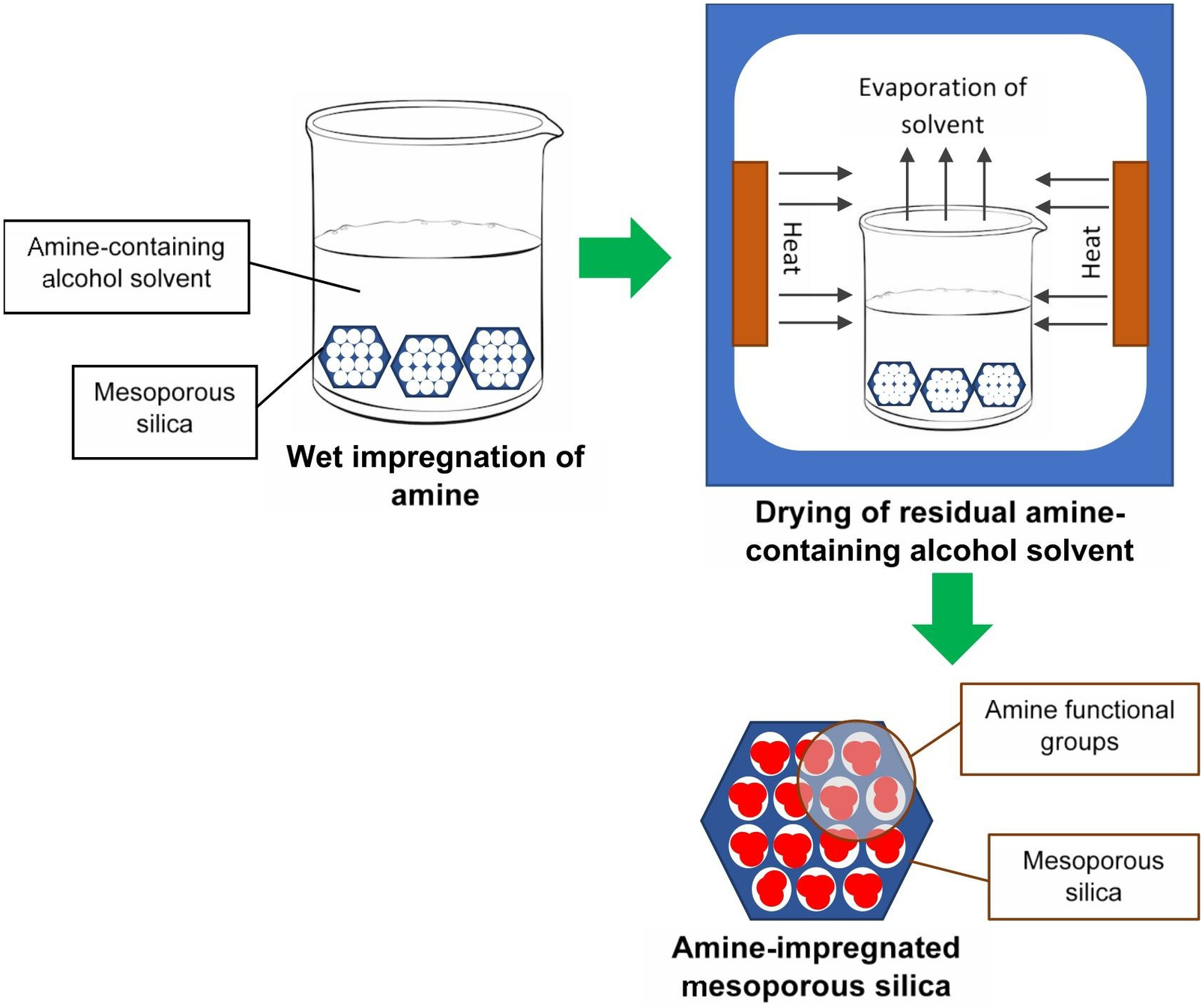
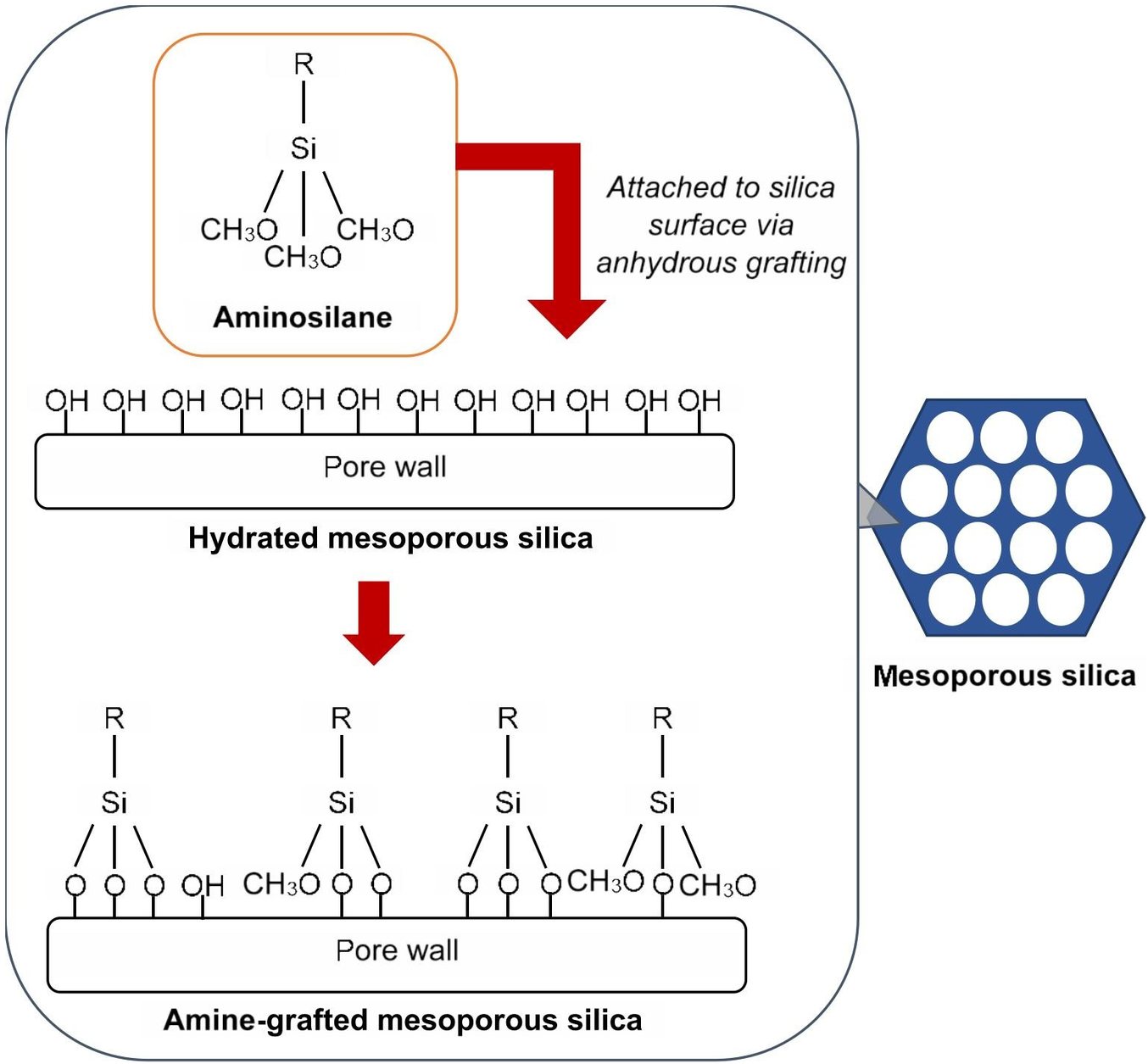
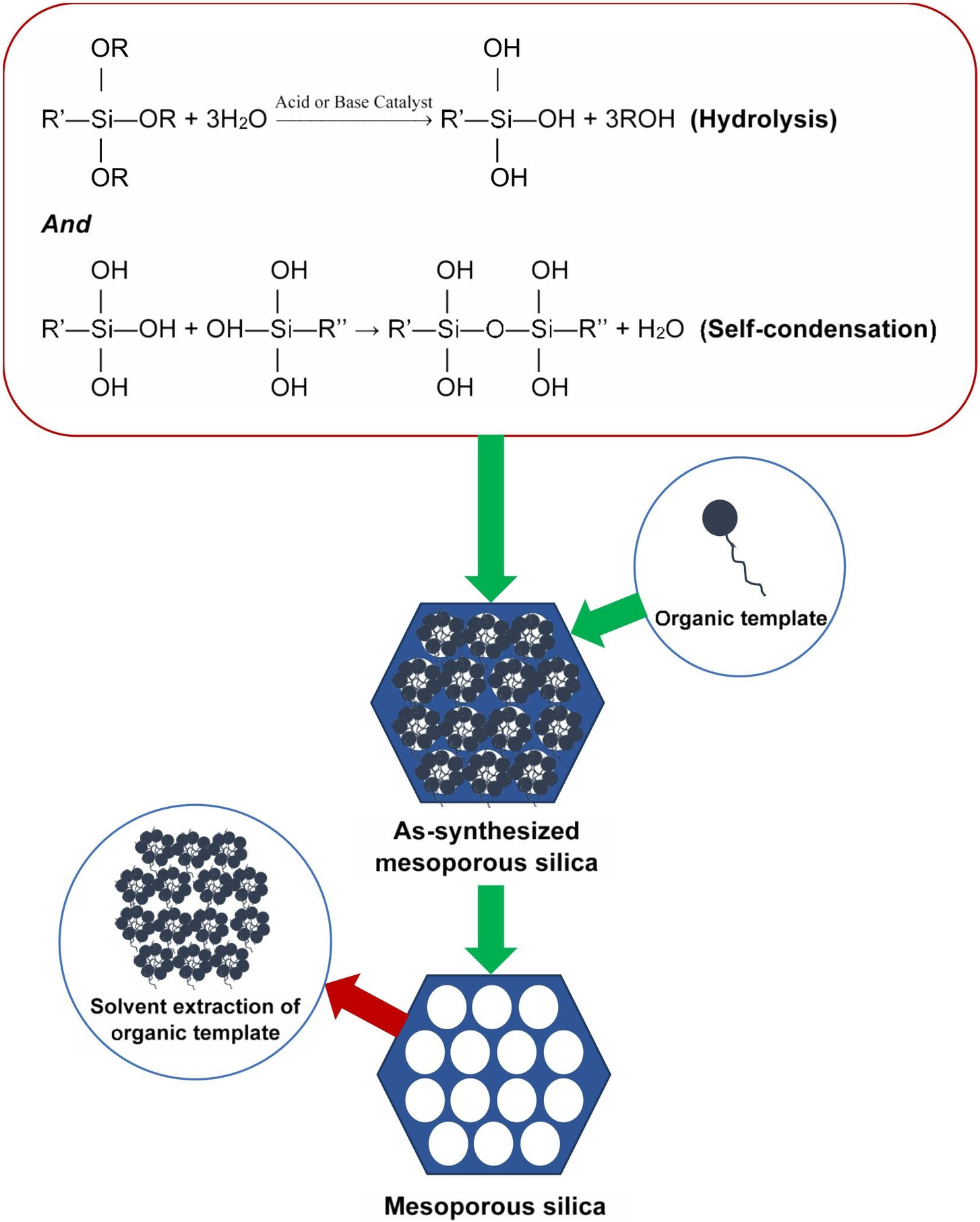
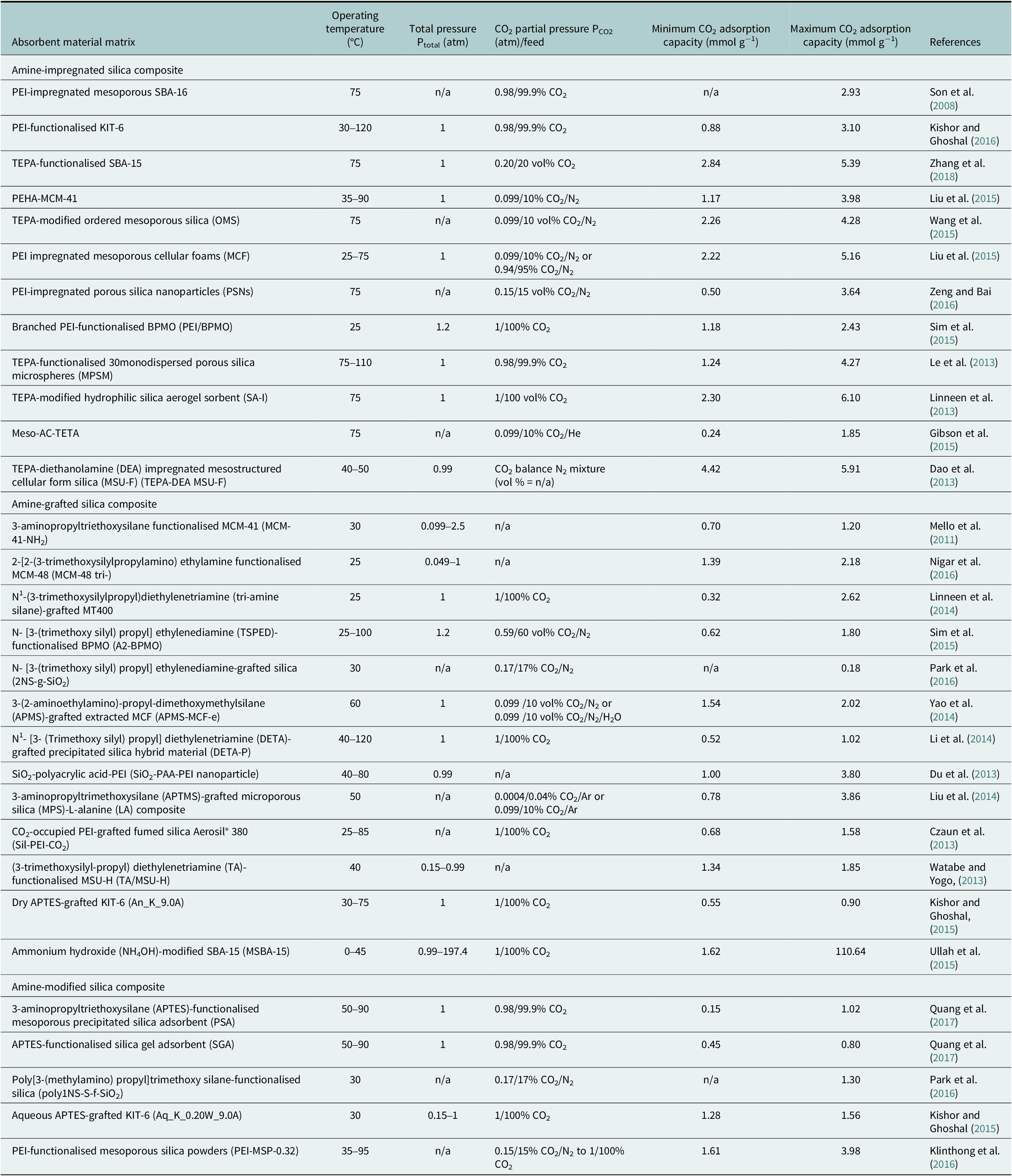
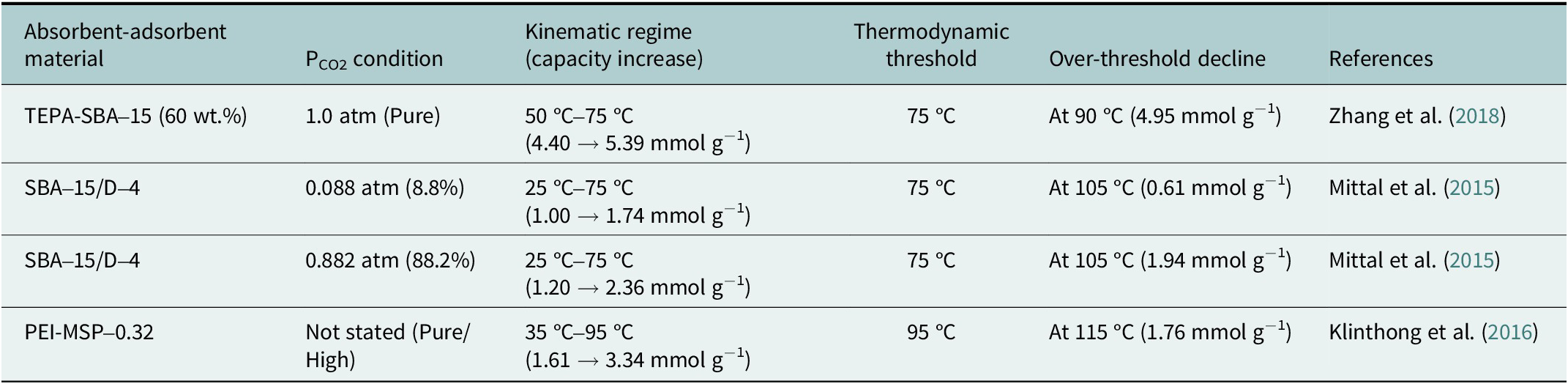
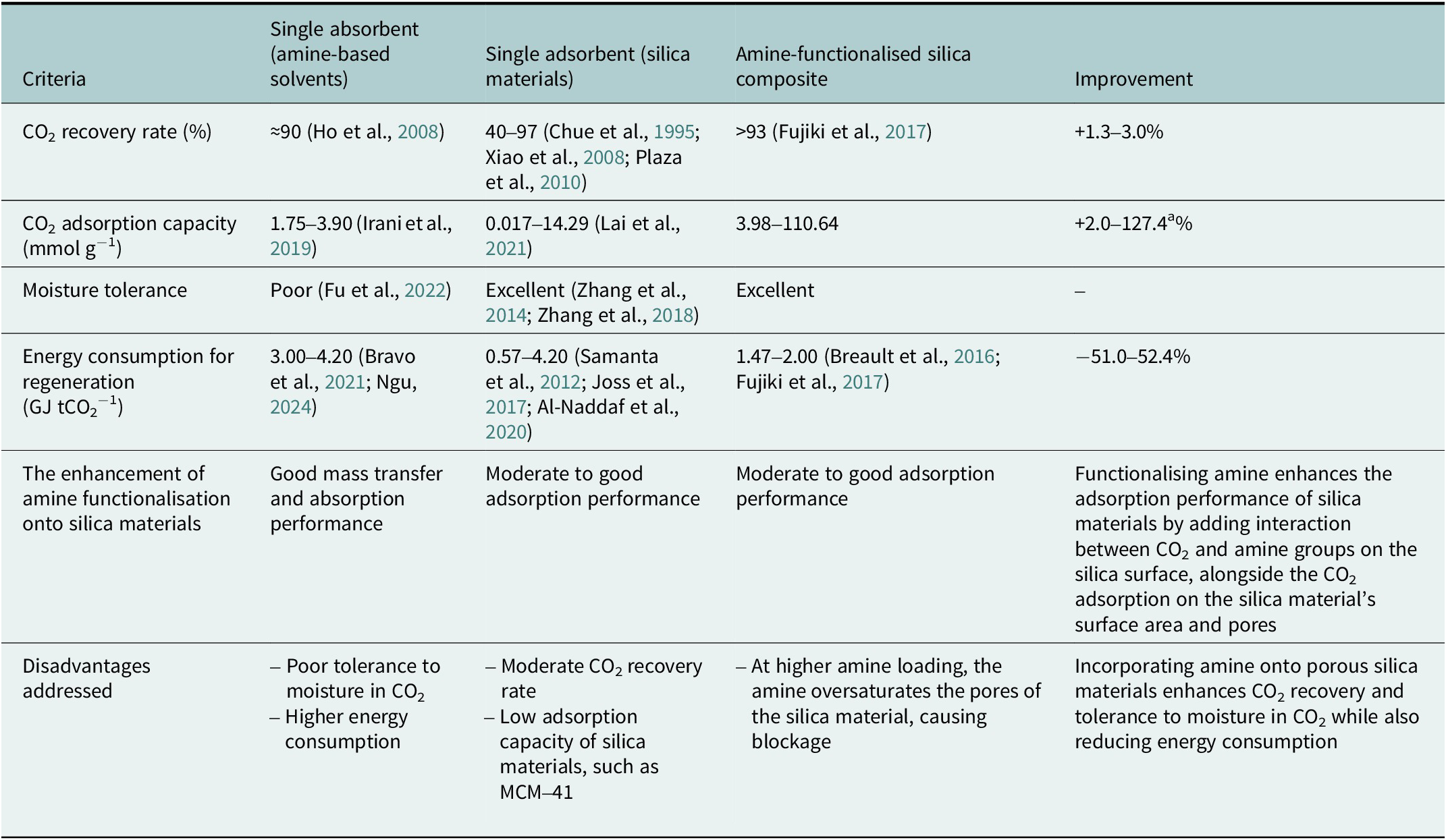
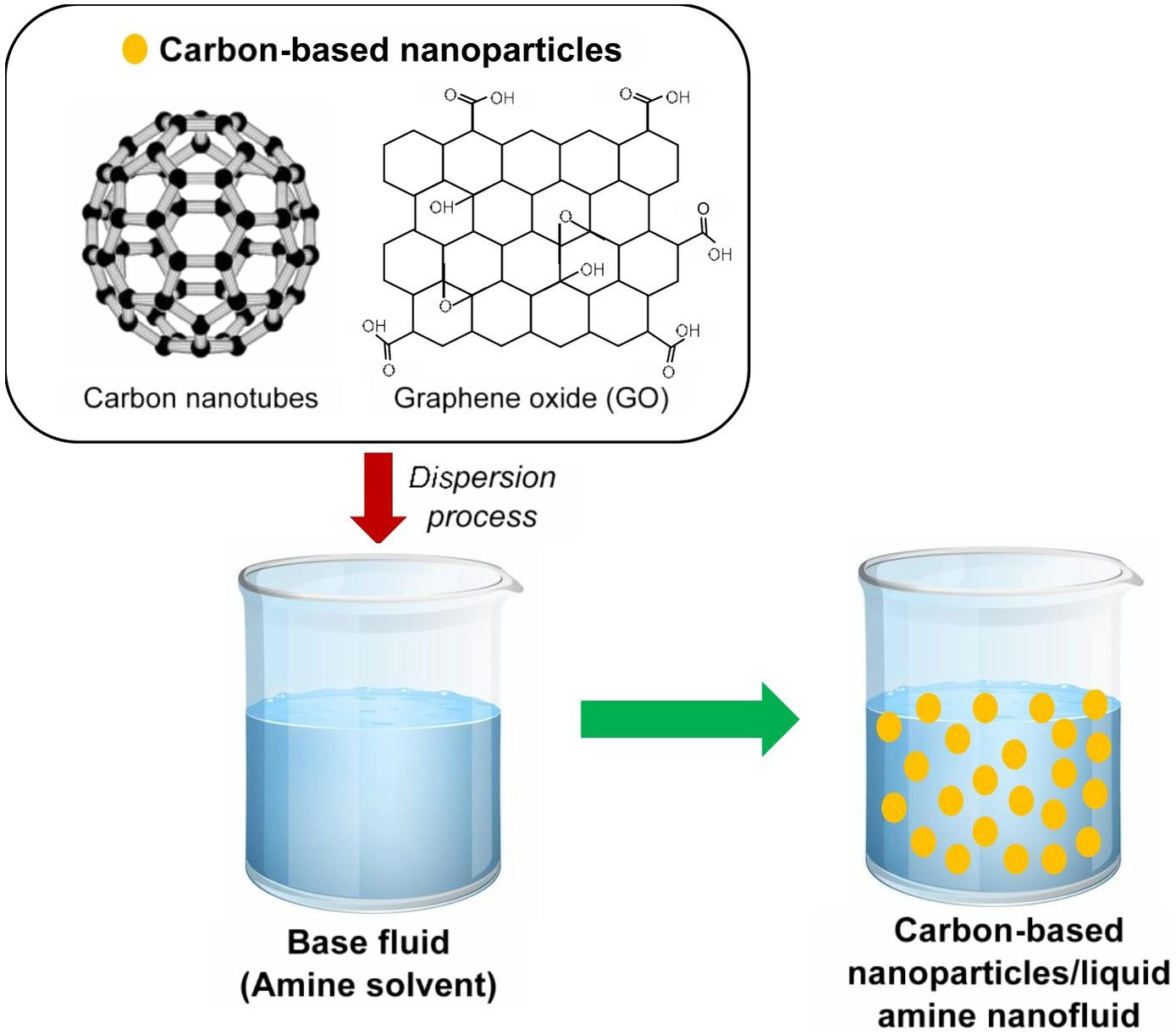
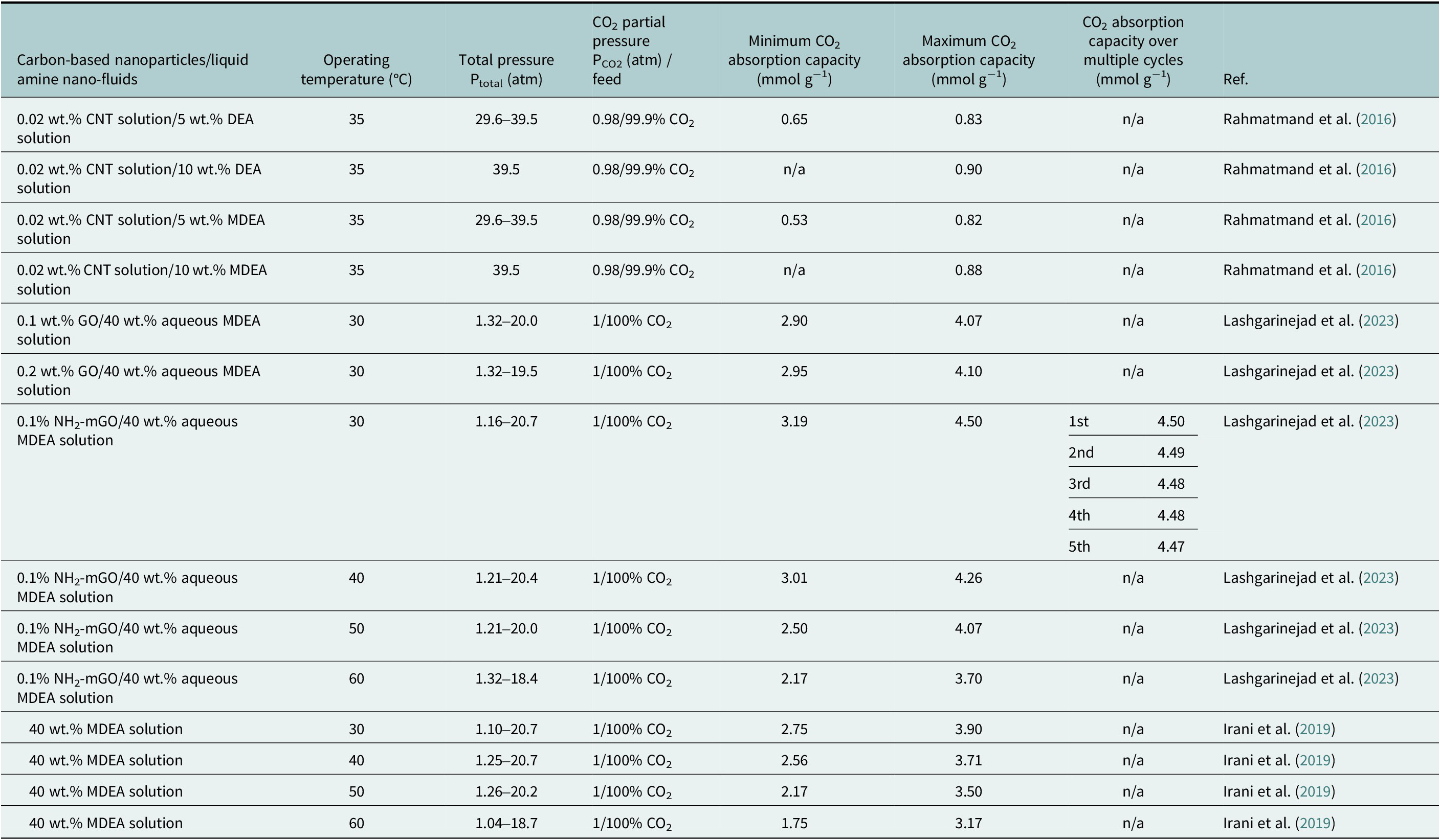
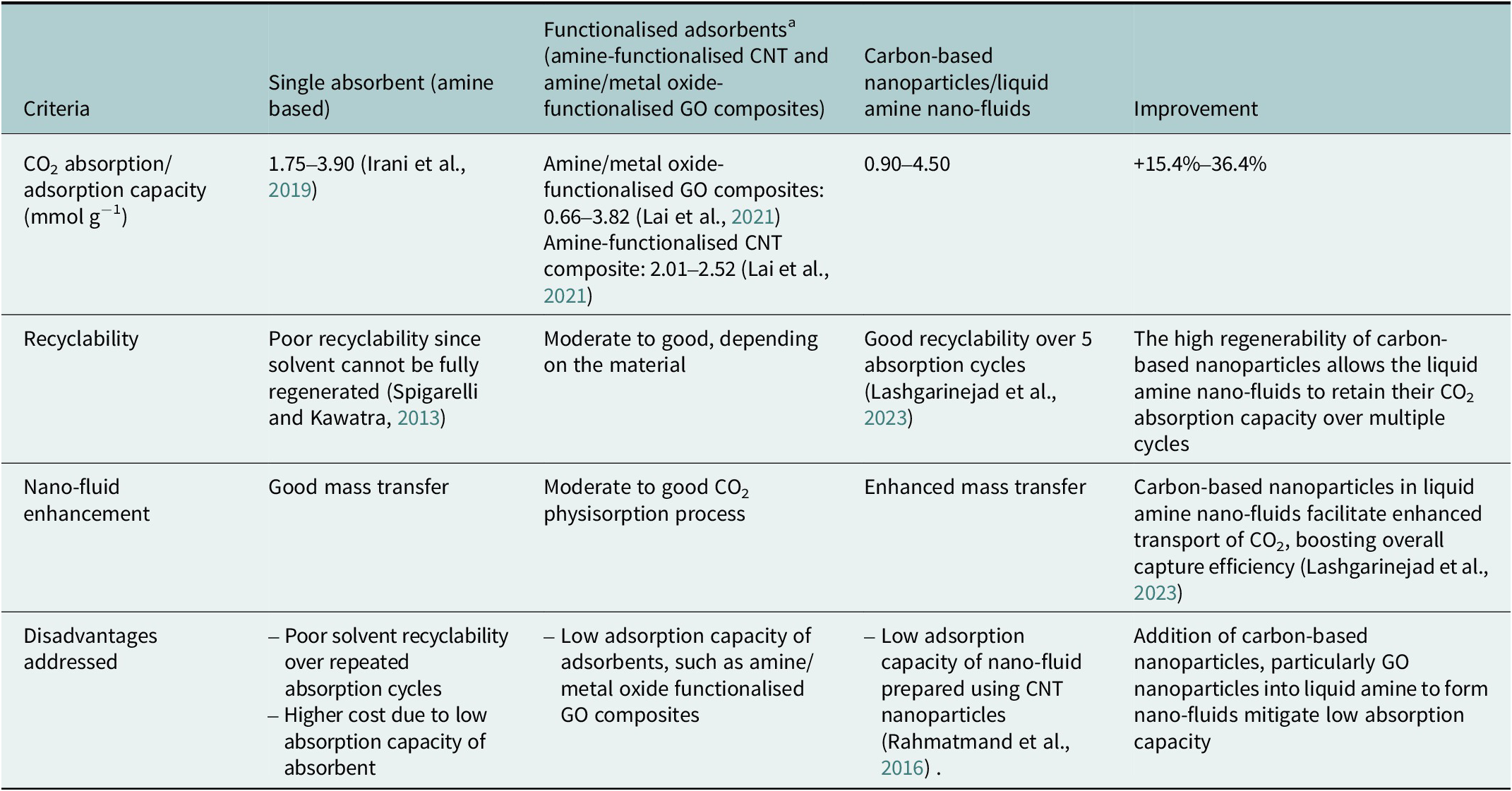
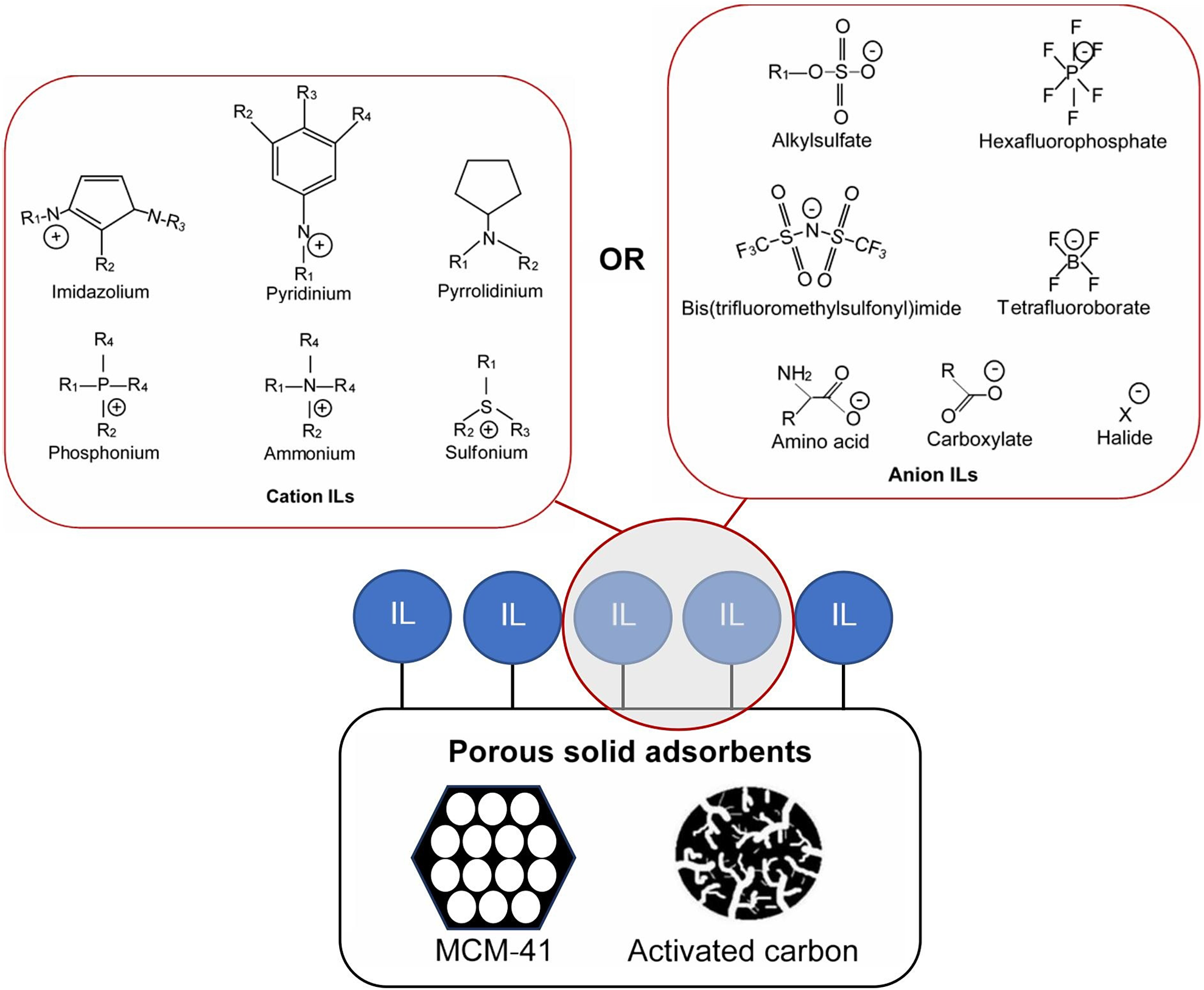
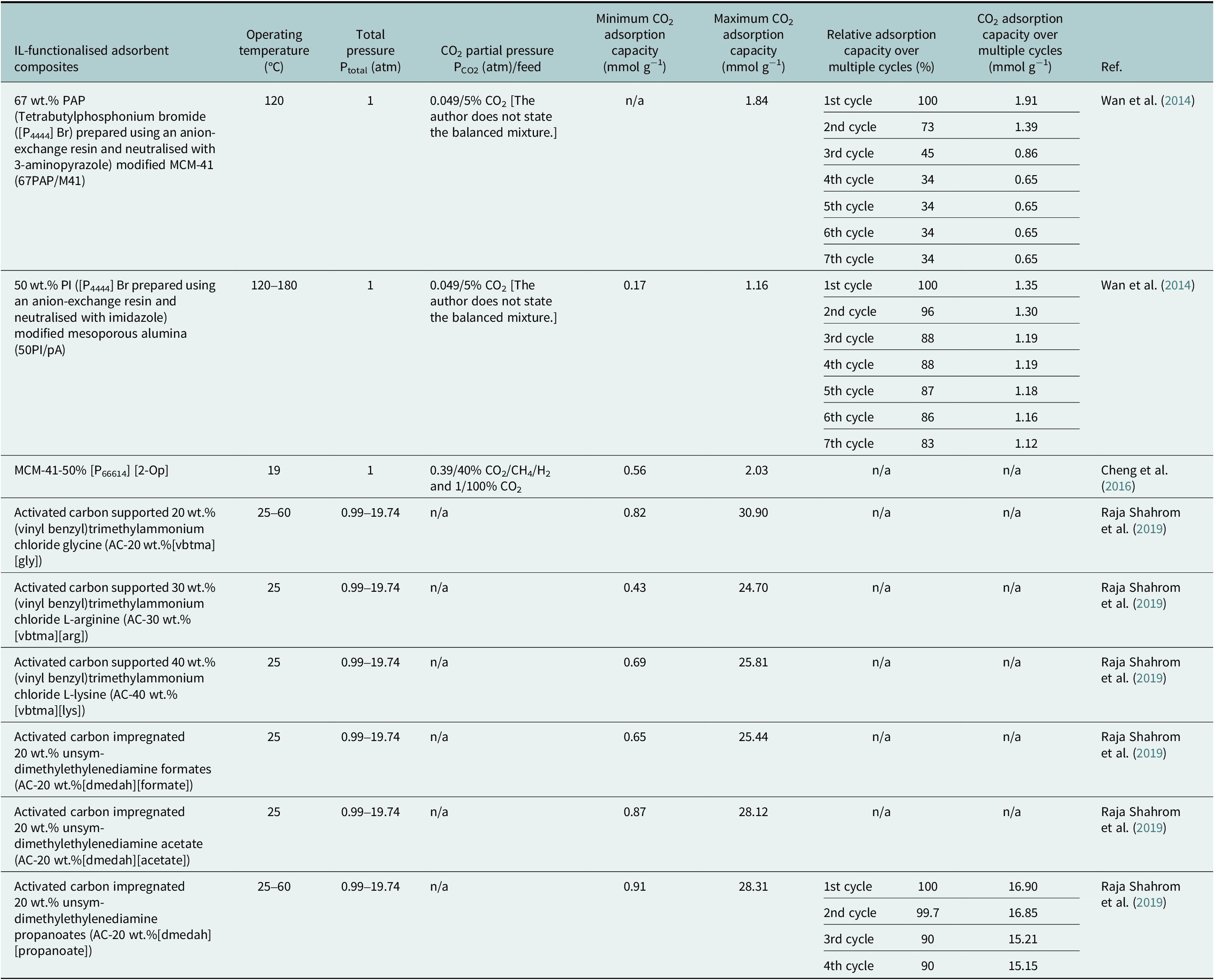
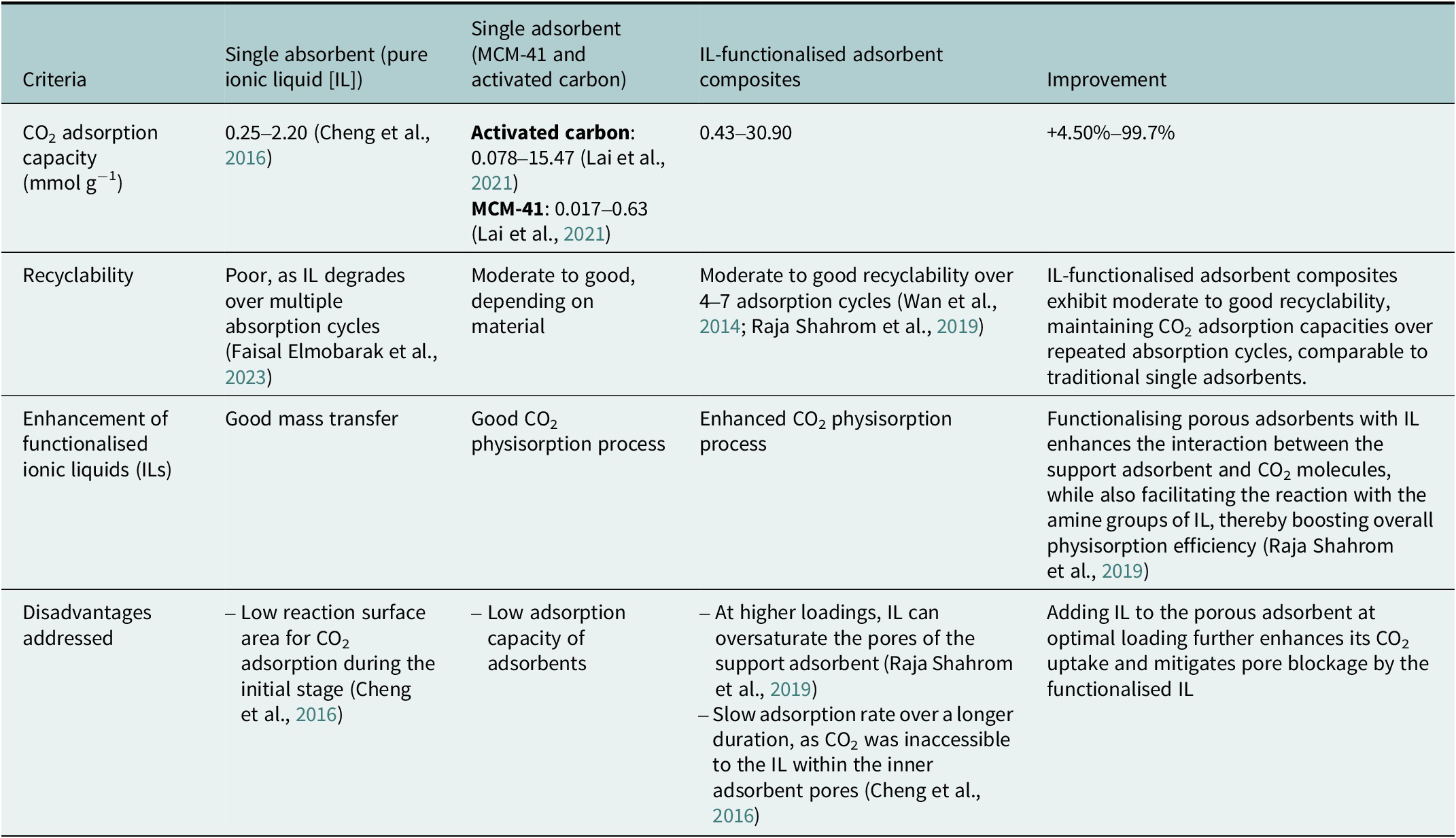
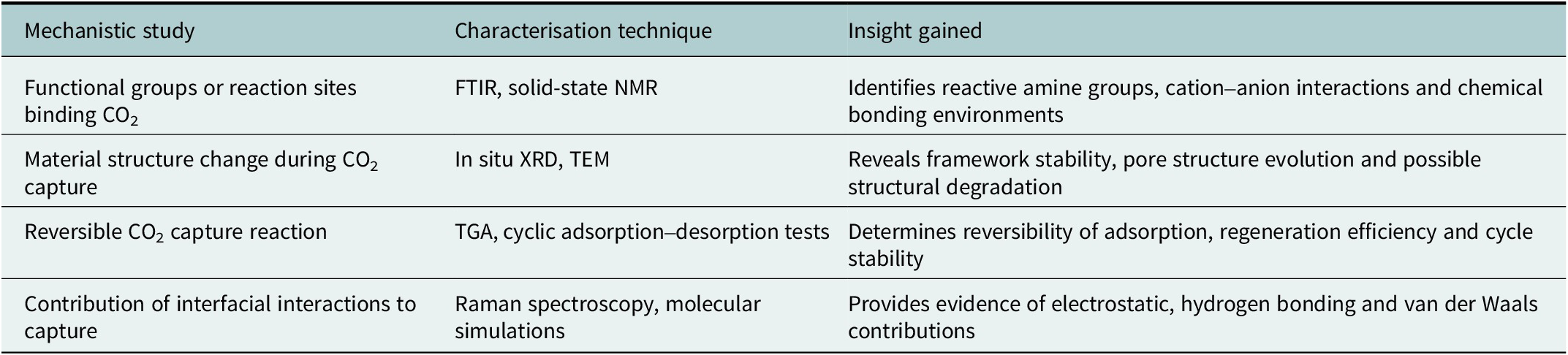
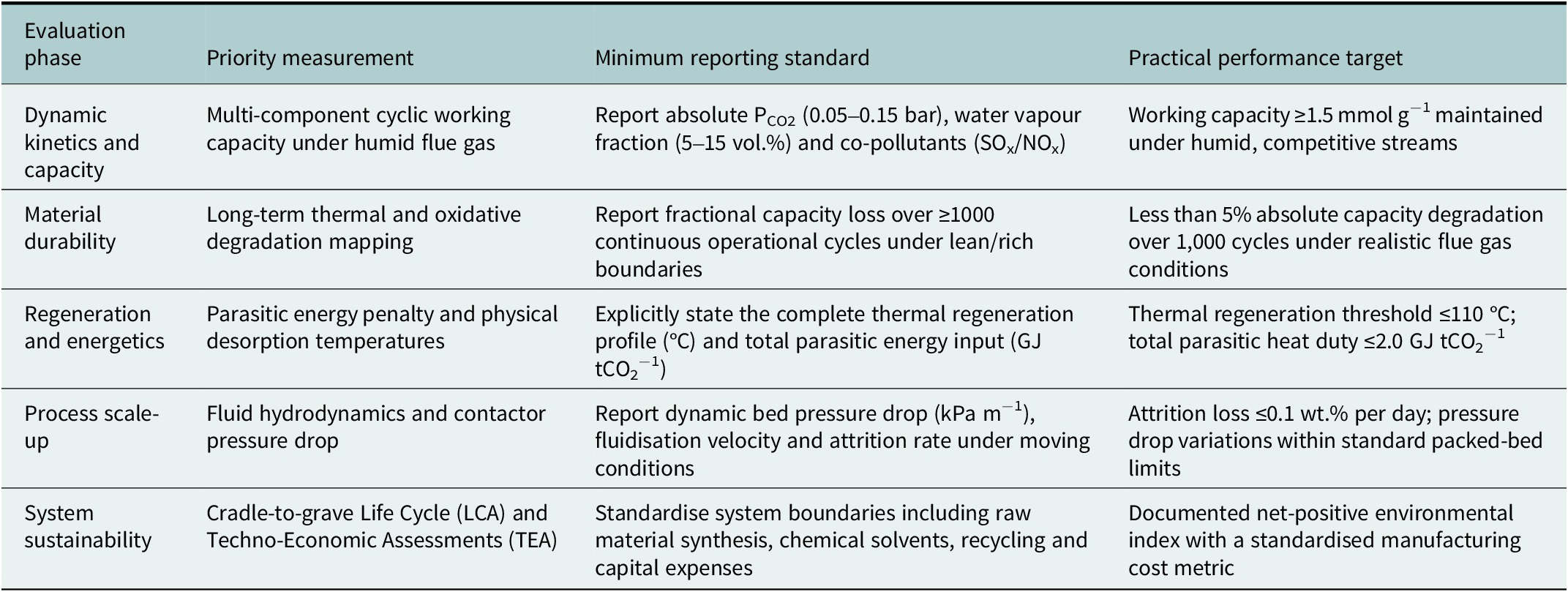


 Open access


Comments
No accompanying comment.