Introduction
Although pregnancy should be a period of happiness and excitement, 10–20% of pregnant women experience psychological distress.Reference Gavin, Gaynes and Lohr 1 – Reference Woods, Melville, Guo, Fan and Gavin 5 Psychological distress can be described as general stress, depressive symptoms, anxiety or experiencing an adverse life event.Reference Skodol and Shrout 6 – Reference Ruiz and Fullerton 8 Poverty, low socio-economic status and single status are some of the risk factors for psychological distress during pregnancy.Reference Lancaster, Gold and Flynn 9 Studies suggest that maternal psychological distress during pregnancy can have adverse consequences on the development of their child.Reference Entringer, Buss and Swanson 10 – Reference Barker 17 Maternal psychological distress during pregnancy may lead to fetal and postnatal adaptations through intrauterine mechanisms.Reference Entringer, Buss and Wadhwa 18 – Reference Edwards, Benediktsson, Lindsay and Seckl 20
Experiencing psychological distress by the mother could attribute to a suboptimal fetal environment and may co-occur or interact with adverse lifestyle factors including smoking, alcohol and under- or overnutrition.Reference Barker and Godfrey 14 , Reference Popova, Lange, Probst, Gmel and Rehm 21 – Reference Monk, Georgieff and Osterholm 25 The developing fetus adapts to suboptimal conditions during critical periods of pregnancy by structural and functional changes in cells, organs and tissues.Reference Entringer, Buss and Swanson 10 These developmental alterations may have long-term consequences and affect health throughout life. Optimizing maternal and pregnancy health is thus of great importance to improve the well-being of their children throughout life.
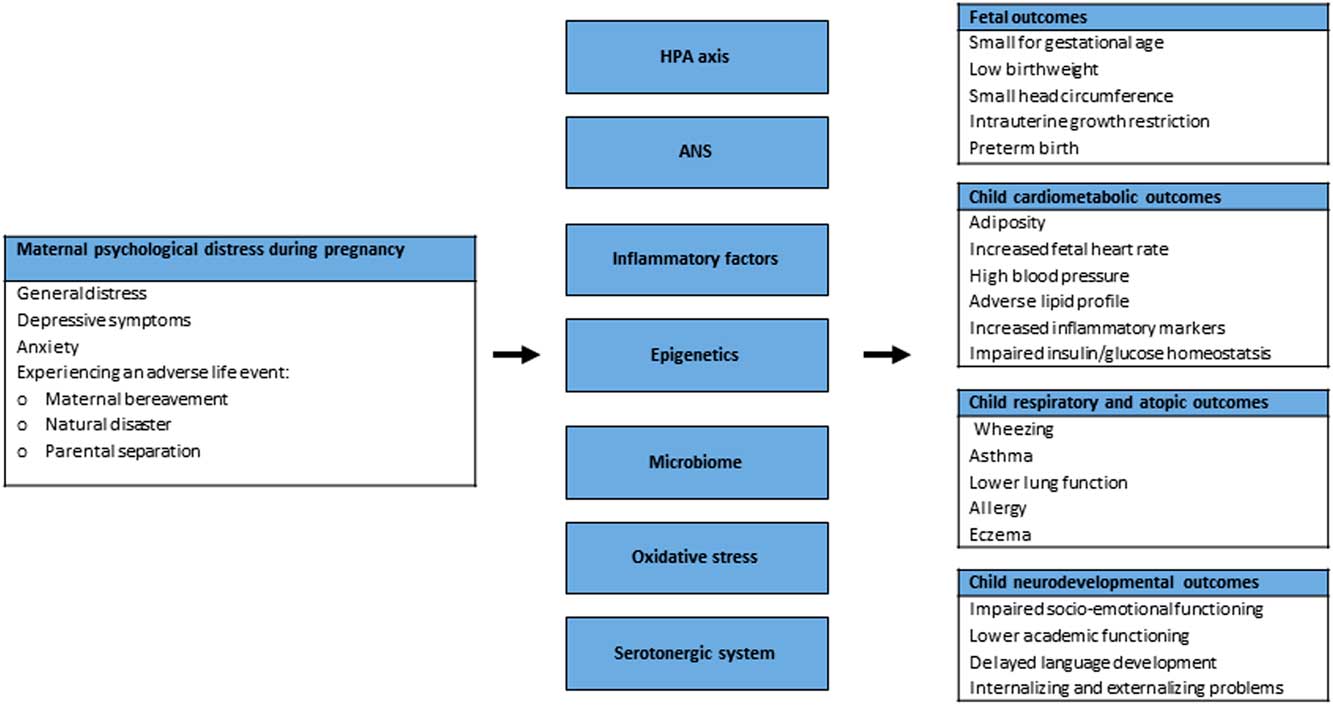
In this narrative review, we provide an update of the findings from recent observational studies and meta-analyses focused on the associations of maternal psychological distress during pregnancy including general stress, depressive symptoms, anxiety or experiencing an adverse life event with fetal outcomes and cardiometabolic, respiratory, allergy and neurodevelopmental outcomes throughout childhood, Fig. 1. These health outcomes are known risk factors for NCDs in later life.Reference Tai, Tran and Roberts 26 – Reference Danese, Moffitt and Harrington 31 We searched for relevant articles per outcome in the online databases Google Scholar and PubMed using Medical Subject Headings (MeSH) terms of the National Library of Medicine (NLM). We also discuss potential mechanisms underlying the observed associations, causality and challenges for future research. Insight into maternal psychological distress during pregnancy and adverse child outcomes is of great importance, as maternal mental health could be a modifiable target for prevention to improve both maternal and offspring well-being.
Conceptual framework of exposures, mechanisms and outcomes in the maternal psychological distress during pregnancy and fetal/child outcomes associations. ANS, autonomic nervous system; HPA axis, hypothalamic–pituitary–adrenal axis.

Fetal and birth outcomes
Maternal psychological distress has repeatedly been related to fetal growth using ultrasound measures.Reference Lewis, Austin and Galbally 32 In an explorative study of 91 pregnant women, maternal depressive symptoms during pregnancy were associated with a smaller fetal head circumference in the third trimester, but anxiety symptoms were not.Reference Hompes, Vrieze and Fieuws 33 In a case–control study, it was shown that maternal depressive and anxiety symptoms during pregnancy were related to intrauterine growth restriction (IUGR) of the child.Reference Uguz, Gezginc and Yazici 34 Further, in a study that used ultrasound measures in pregnancy, no differences in ultrasound measures at 20 and 34 weeks of gestation (including abdominal circumference, head circumference and femur length) were found, but this study did show that children exposed to maternal depression and/or anxiety had a lower mean birthweight.Reference Maina, Saracco and Giolito 35 Another case–control study examined fetal growth rates by using estimated fetal weight at 18–20 weeks and birthweight and reported a lower estimated fetal weight in mid-gestation and slower fetal growth rate during the second half of pregnancy in fetuses exposed to maternal depressive symptoms.Reference Diego, Field and Hernandez-Reif 36 Likewise, in the Generation R study, a prospective population-based multi-ethnic cohort study, ultrasound measures during pregnancy were collected repeatedly, and growth trajectories were used in a very large sample of pregnant women. In this study, maternal psychological distress during pregnancy was associated with decreased fetal growth.Reference Henrichs, Schenk and Roza 37 , Reference El Marroun, Jaddoe and Hudziak 38 However, studies are not always consistent. Some studies reported no association of prenatal maternal psychological distress with fetal growth or birth outcomes. For example, in a prospective observational study prenatal maternal depression was associated with preterm birth but not with birthweight.Reference Wisner, Sit and Hanusa 39 Interestingly, a meta-analysis on this topic showed that women with depression during pregnancy are at increased risk for children born preterm born and with a low birthweight, but the results should be interpreted with caution because of different magnitudes of effect, ethnicities and socio-economic status per study.Reference Grote, Bridge and Gavin 40 Further, another meta-analysis of 15 studies on maternal anxiety during pregnancy and birth outcomes found that maternal anxiety is associated with a1.5 increased risk of low birthweight as well as an increased risk of 1.8 of preterm birth.Reference Ding, Wu and Xu 41 Thus, the current literature suggests that exposure to maternal psychological stress affects fetal growth and birth outcomes, but remains inconsistent, see Table S1.
Child outcomes
Cardiometabolic outcomes
The cardiometabolic health of children might be affected by maternal psychological distress during pregnancy. Maternal psychological distress during pregnancy has been associated with an increased risk of child’s adiposity.Reference Milgrom, Skouteris, Worotniuk, Henwood and Bruce 42 A potential pathway might be that maternal psychological distress during pregnancy is associated with the birthweight of children and subsequent catch-up growth during infancy. High levels of birth weight and catch-up growth are both strong risk factors for overweight and obesity in later life.Reference Qiao, Ma and Wang 43 In a study among 65,212 mother–child pairs, 10–13-year-old children exposed to prenatal stress, defined by being born to mothers who were bereaved by death of a close family member, had an increased risk of overweight.Reference Li, Olsen and Vestergaard 44 In addition, a prospective cohort study among 838 mothers and their children showed that depression of the mother during pregnancy was associated with adiposity but a lower body mass index (BMI) at the age of 3 years.Reference Ertel, Koenen, Rich-Edwards and Gillman 45 Several studies found that women exposed to an adverse life event, either maternal bereavement or a natural disaster, had a significantly increased risk of children with adiposity.Reference Dancause, Laplante and Fraser 46 – Reference Hohwü, Li, Olsen, Sørensen and Obel 48 Furthermore, parental separation before childbirth has been associated with an increased risk of overweight and obesity at the age of 9–11 years.Reference Hohwü, Zhu and Graversen 49 However, large population studies did not find consistent associations between prenatal maternal stress and adiposity measurements in childhood.Reference Guxens, Tiemeier and Jansen 50 – Reference Wu, Gennings and Wright 53 For example, in the Generation R study, we observed no association between prenatal maternal depression and child BMI at several measurements between the age of 3 months and the age of 4 years.Reference Guxens, Tiemeier and Jansen 50 Furthermore, in a large study among 37,764 Danish women and child pairs, self-reported stress, depressive or anxiety symptoms at around 30 weeks of gestation were not associated with childhood overweight at 7 years of age.Reference Ingstrup, Andersen and Ajslev 51 Interestingly, two large prospective cohort studies found no consistent associations between antenatal maternal depression and child growth but suggested child sex-specific effects of prenatal maternal stress.Reference Park, Sundaram and Gilman 52 , Reference Van Dijk, Van Eijsden, Stronks, Gemke and Vrijkotte 54
Moreover, an association between maternal psychopathology during pregnancy and increased fetal heart rate (HR) has been reported.Reference Allister, Lester, Carr and Liu 55 , Reference Monk, Fifer and Myers 56 However, this association, along with other cardiovascular outcome factors in childhood, was not found in two large prospective cohort studies.Reference van Dijk, van Eijsden, Stronks, Gemke and Vrijkotte 57 , Reference Taal, de Jonge and Tiemeier 58 Although fetal exposure to increased glucocorticoid levels has been linked to adult hypertension, studies do not find an association between maternal psychological distress and child hypertension.Reference Edwards, Benediktsson, Lindsay and Seckl 20 , Reference Taal, de Jonge and Tiemeier 58 – Reference van Dijk, van Eijsden and Stronks 60 However, one of these studies observed a positive, non-significant association between prenatal stress and higher systolic and diastolic blood pressure in children.Reference van Dijk, van Eijsden and Stronks 60 Thus, it might be that these altered blood pressures precede hypertension in later life.
Further, both low-grade chronic inflammation and insulin resistance are known to precede type 2 diabetes.Reference Sjöholm and Nyström 61 A relation between maternal psychological distress and increased inflammatory markers during pregnancy, such as C-reactive protein and interleukins, was shown.Reference Coussons-Read, Okun and Nettles 62 – Reference Howren, Lamkin and Suls 64 Animal studies suggest that prenatal maternal psychological stress has lasting effects on the immune system of offspring, but little is known about this effect on human offspring.Reference Plant, Pawlby, Sharp, Zunszain and Pariante 65 Only one study reported increased interleukin-4 levels in children exposed to prenatal maternal anxiety.Reference O’Connor, Winter and Hunn 66 Studies on prenatal maternal psychological distress in relation to child glucose metabolism are also scarce. Both in young adults and adolescents at the average age of 13.5 years, prenatal psychosocial stress exposure was positively associated with insulin secretion and resistance.Reference Entringer, Wüst and Kumsta 67 , Reference Dancause, Veru, Andersen, Laplante and King 68 On the contrary, in 5–6-year-old children, no association of prenatal stress and glucose, C-peptide or insulin resistance were found potentially because the relation was examined early in life.Reference van Dijk, van Eijsden, Stronks, Gemke and Vrijkotte 69 Further, young adults exposed to maternal prenatal stress had higher very low-density lipoprotein and lower high-density lipoproteins, suggesting differences in fat storage processes.Reference Entringer, Wüst and Kumsta 67 To our knowledge, no studies on the association between prenatal stress and lipid profile in childhood have been performed.
Most reviewed studies report that prenatal maternal distress is associated with increased risk for adverse cardiometabolic child outcomes, see Table S2. However, results are often inconclusive and need further investigation.
Respiratory and atopic outcomes
Prenatal exposure to psychological distress has been linked to respiratory and atopic outcomes in children. A meta-analysis found that children whose mothers experienced psychological distress during pregnancy had higher risks of childhood wheezing, asthma or other respiratory morbidity.Reference van de Loo, van Gelder and Roukema 70 Thereafter, a large number of cohort studies have been published with more detailed data.Reference Rusconi and Gagliardi 71 Some studies assessed maternal anxiety and depression symptoms during pregnancy separately,Reference Lefevre, Moreau and Sémon 72 – Reference Zhou, Ibanez and Miramont 81 while others examined overall psychological distress of the pregnant women, which also included hostility, somatic problems or poor self-esteem among others besides anxiety and depression.Reference Guxens, Sonnenschein-van der Voort and Tiemeier 75 , Reference Beijers, Jansen, Riksen-Walraven and de Weerth 82 – Reference Magnus, Wright and Røysamb 87 Mixed results were observed when maternal anxiety or depression symptoms during pregnancy were examined separately in relation to child wheezing and asthma. However, overall psychological distress during pregnancy was consistently associated with wheezing and asthma. Other studies examined maternal psychological distress during pregnancy as bereavement or adverse life events, self-reported perceived stress, psychological job strain or community violence with respiratory outcomes and showed an association of these exposures with an increased risk of child wheezing, asthma or lower lung function.Reference Wood, Bloomberg and Kattan 73 , Reference Turcotte-Tremblay, Lim and Laplante 76 , Reference Bandoli, von Ehrenstein and Ghosh 78 – Reference Ramratnam, Visness and Jaffee 80 , Reference Magnus, Wright and Røysamb 87 – Reference Smejda, Polanska and Merecz-Kot 103
Maternal psychological distress during pregnancy may also influence the risk of allergy and eczema in children.Reference Hartwig, Sly and Schmidt 93 Birth cohort studies observed no associations of maternal psychological distress during pregnancy with childhood allergic sensitization (measured with skin prick tests) or physician-diagnosed food allergy.Reference Hartwig, Sly and Schmidt 93 , Reference Elbert, Duijts and den Dekker 104 However, maternal psychological distress during pregnancy were associated with an increased risk of physician-diagnosed inhalant allergy in children.Reference Elbert, Duijts and den Dekker 104 These results were independent of maternal psychiatric symptoms after delivery and of paternal psychiatric symptoms during pregnancy and after delivery. Other birth cohort studies used immunoglobulin E (IgE) levels to identify allergic sensitization.Reference Reyes, Perzanowski and Whyatt 83 , Reference Hartwig, Sly and Schmidt 93 , Reference Chang, Suh and Yang 105 – Reference Sternthal, Enlow and Cohen 108 Some studies showed that maternal psychological distress during pregnancy was associated with increased umbilical cord blood IgE levels or serum allergen-specific IgE levels,Reference Chang, Suh and Yang 105 – Reference Sternthal, Enlow and Cohen 108 while other studies observed no associations.Reference Reyes, Perzanowski and Whyatt 83 , Reference Hartwig, Sly and Schmidt 93 One birth cohort study combined data on food-specific serum IgE levels and questionnaire obtained food allergy and observed no association of maternal psychological distress during pregnancy with food allergy.Reference Reyes, Perzanowski and Whyatt 83 , Reference McGowan, Bloomberg and Gergen 109 Furthermore, previous birth cohort studies have reported inconsistent results on the association of children of mothers with psychological distress during pregnancy with eczema.Reference Hartwig, Sly and Schmidt 93 , Reference Larsen, Schlünssen and Christensen 94 , Reference Chang, Suh and Yang 105 , Reference Lin, Wen, Lee and Guo 106 , Reference Sausenthaler, Rzehak and Chen 110 – Reference Wen, Wang and Lin 112 However, most studies showed that children who were prenatally exposed to maternal psychological distress had an up to the four-fold increased risk of eczema, compared with those unexposed. Reference Larsen, Schlünssen and Christensen 94 , Reference Chang, Suh and Yang 105 , Reference Wang, Wen and Chiang 111 , Reference Wen, Wang and Lin 112
Overall, maternal psychological distress during pregnancy appears to be associated with childhood respiratory and atopic health, see Tables S3 and S4. However, it is unclear which specific respiratory and atopic outcome might be more affected, at what age and what the long-term effects into adulthood are.
Neurodevelopmental outcomes
A number of studies have focused on maternal psychological distress and neurodevelopmental outcomes from birth onwards. Newborns of depressed mothers show less responsiveness to stimulation.Reference Field, Diego and Hernandez-Reif 113 , Reference Field, Hernandez-Reif and Diego 114 Children exposed to maternal psychological distress during pregnancy are more likely to show negative affectivity,Reference Henrichs, Schenk and Schmidt 115 , Reference Davis, Snidman and Wadhwa 116 and more excessive crying.Reference van der Wal, van Eijsden and Bonsel 117 Maternal psychological distress is also significantly related to attachment security. Reference Atkinson, Paglia and Coolbear 118 On the cognitive domain, children exposed to psychological distress in pregnancy have less advanced or delayed language development,Reference Laplante, Brunet, Schmitz, Ciampi and King 119 , Reference Laplante, Barr and Brunet 120 and lower academic skills.Reference Niederhofer and Reiter 121 Furthermore, children exposed prenatally to maternal psychological distress display altered stress reactivity in early childhood Reference Yong Ping, Laplante and Elgbeili 122 and increased sleep disturbances.Reference O’Connor, Caprariello and Blackmore 123 Moreover, children exposed to maternal psychological distress during pregnancy are at increased risk to develop internalizing, such as depressive symptoms and being withdrawn.Reference O’Connor, Heron and Glover 124 Finally, externalizing problems, such as aggressive behavior and attention deficit hyperactivity disorder symptoms are also more prominent in children exposed to maternal psychological distress during pregnancy.Reference Deave, Heron, Evans and Emond 125 – Reference O’Connor, Heron, Golding, Beveridge and Glover 128 The underlying neurobiology of the reported associations is unclear, but the evidence is accumulating. Several studies have shown that prenatal exposure to maternal depressive symptoms is related to differences in volumes and white matter microstructure of the limbic system in preschoolers and children aged 6 and 10 years.Reference Wen, Poh and Ni 129 – Reference Rifkin-Graboi, Bai and Chen 132 In addition, prenatal maternal depression has been shown to alter the functional connectivity of the amygdala in early postnatal life.Reference Qiu, Anh and Li 131 Further, using an exploratory approach rather than only the limbic system exposure to maternal depressive symptoms in pregnancy has been linked to cortical thinning of the frontal and temporal cortex of the brain in three recent studies.Reference Sandman, Buss, Head and Davis 133 – Reference Lebel, Walton, Letourneau, Giesbrecht and Kaplan 135 However, other studies found no or even positive associations of prenatal maternal psychological distress and child neurodevelopmental outcomes (e.g., school achievement, motor and language development).Reference DiPietro, Novak, Costigan, Atella and Reusing 136 – Reference Li, Robinson and Malacova 138 , and thus, these results must be interpreted with caution.
Finally, overall there is a consensus that maternal psychological distress is associated with developmental problems in children and adolescents, including impaired socio-emotional, cognitive and behavioral functioning; however, the underlying neurobiology needs further examination, also see table S5.Reference Field 139 – Reference Goodman, Rouse and Connell 141
Underlying mechanisms
The pathways through which maternal psychological distress during pregnancy may lead to adverse fetal and child outcomes are various and multifactorial, Fig. 1.Reference Ding, Wu and Xu 41 One of the most described underlying mechanisms includes fetal exposure to increased cortisol levels due to altered activation of the maternal hypothalamic–pituitary–adrenal (HPA) axis in response to both physiological and psychological distress.Reference Reynolds 142 , Reference Hohwü, Henriksen and Grønborg 146 Fetal exposure to excess cortisol may lead to altered programming of the fetal HPA axis, which, in turn, may be associated with adverse birth outcomes and could have long-term child health consequences. Reference Glover 19 , Reference Reynolds 142 – Reference Zijlmans, Riksen-Walraven and de Weerth 150 A linear relation was shown between fetal and maternal cortisol concentrations.Reference Van den Bergh, Mulder, Mennes and Glover 151 Cortisol stimulates corticotropin-releasing hormone secretion and production, resulting in positive maternal and fetal feedback loops and increased cortisol concentrations, potentially further amplifying the effect.Reference Mulder, de Medina and Huizink 152 – Reference Abbott, Gumusoglu, Bittle, Beversdorf and Stevens 154 Subsequently, the uteroplacental blood flow may be reduced in response to increased secretion of maternal cortisol and catecholamines,Reference Teixeira, Fisk and Glover 155 which may lead to fetal growth restriction and other adverse child health outcomes.Reference Mulder, de Medina and Huizink 152 , Reference Huizink, Mulder and Buitelaar 153 Animal studies on the association between excess catecholamines and fetal or child outcomes are conflicting,Reference Bassett and Hanson 156 – Reference Dong, Liu and Wang 158 and human studies are scarce. Only one study reported high maternal catecholamine concentration to be associated with an increased risk of spontaneous preterm birth.Reference Holzman, Senagore and Tian 159 However, studies are inconsistent about the relation between maternal psychological distress during pregnancy and maternal cortisol levels which needs further investigation.Reference Bleker, Roseboom, Vrijkotte, Reynolds and de Rooij 160 – Reference Goedhart, Vrijkotte and Roseboom 163 A related mechanism is the functioning of 11ß-hydroxysteroid dehydrogenase type 2 (11ß-HSD-2), a placental enzyme that inactivates 50–90% of maternal cortisol.Reference Benediktsson, Calder, Edwards and Seckl 164 , Reference Murphy, Smith, Giles and Clifton 165 Reduction in 11ß-HSD-2 levels exposes the fetus to higher levels of maternal cortisol. Clinical studies showed reduced placental 11ß-HSD-2 gene expression in pregnancies with IUGR and preterm birth.Reference O’Donnell, Jensen and Freeman 166 , Reference Mairesse, Lesage and Breton 167 Also, both clinical and animal studies have shown reduced gene expression and/or activity of placental 11ß-HSD-2 in association with maternal anxiety.Reference O’Donnell, Jensen and Freeman 166 , Reference Mairesse, Lesage and Breton 167
Next to the HPA axis as an underlying mechanism, the autonomic nervous system (ANS) is another physiological mechanism by which organisms react to stress.Reference Sgoifo, Koolhaas and De Boer 168 The ANS is responsible for regulation of several processes in the body such as respiration, digestion, body temperature and metabolism.Reference Cacioppo 169 In contrast to the role of the HPA axis, the ANS as a possible mechanism is less extensively examined. However, ANS functioning has been described as a mediator in the association of prenatal maternal psychological distress and child health outcomes. For example, HR and heart rate variability are regulated through ANS functioning and have been studied in relation to maternal prenatal distress.Reference Van den Bergh, van den Heuvel and Lahti 144 Maternal depression and anxiety have been associated with both a higher and a reduced baseline fetal HR.Reference Allister, Masakowski, Carr, Andreozzi and Lester 170 – Reference DiPietro, Kivlighan and Costigan 173 Results on the ANS are not conclusive and need clarification.
Further, another possible mechanism underlying maternal stress during pregnancy and adverse child outcomes are epigenetic changes.Reference Garfield, Mathews and Witek Janusek 174 Epigenetic changes are chemical modifications to chromatin that regulate genomic transcription.Reference Cao-Lei, de Rooij and King 175 Studies showed that prenatal psychological distress could lead to changes in DNA methylation which subsequently may have a mediation effect on the association between prenatal maternal psychological distress and child health outcomes.Reference Cao-Lei, de Rooij and King 175 – Reference Monk, Feng and Lee 183 Epigenetic changes of DNA methylation of the glucocorticoid receptor gene NR3C1 in cord blood and infant salivary samples are associated with maternal stress and could be responsible for the increase in the sensitivity of the fetal HPA axis.Reference Nemoda, Massart and Suderman 179 , Reference Oberlander, Weinberg and Papsdorf 184
Another potential mechanism involves inflammatory responses to psychological distress during pregnancy.Reference Christian 185 In animal studies, prenatal maternal stress has been shown to program postnatal immunity.Reference Veru, Laplante, Luheshi and King 186 Interestingly, higher circulating levels of pro-inflammatory cytokines in pregnant women with psychological distress or depression have been reported.Reference Coussons-Read, Okun and Nettles 62 , Reference Christian, Franco, Glaser and Iams 187 Further, elevations of inflammatory cytokines, including interleukin-6, tumor necrosis factor-α and interleukin-1β in maternal serum, are associated with increased risk of fetal outcomes such as prematurity.Reference Raghupathy and Kalinka 188
In addition, the potential role of the maternal microbiome as a mechanism through which maternal psychological distress during pregnancy can affect the fetus and children should be considered.Reference O’Mahony, Clarke, Dinan and Cryan 189 , Reference Jašarević, Rodgers and Bale 190 The microbiome could be defined as the community of microorganisms living in or on the human body.Reference Ipci, Altıntoprak, Muluk, Senturk and Cingi 191 Studies found that the gut microbiome is essential for early development.Reference O’Mahony, Clarke, Borre, Dinan and Cryan 192 , Reference Sherman, Zaghouani and Niklas 193 The HPA axis and the central nervous system regulatory areas affect the gut microbiota composition, which may influence the pathogenesis of diseases.Reference O’Mahony, Clarke, Dinan and Cryan 189 The bidirectional signaling pathways between the gut and brain, the so-called gut-brain axis, have been suggested to underlie neurodevelopmental and psychiatric disorders.Reference O’Mahony, Clarke, Dinan and Cryan 189 , Reference Sherman, Zaghouani and Niklas 193 Development of the gut microbiome, begins when the infant encounters the maternal vaginal and fecal bacteria during birth.Reference Cilieborg, Boye and Sangild 194 Studies examining the association of maternal psychological distress during pregnancy and child microbiome are scarce. One recent study found an association between maternal stress and the infant intestinal microbiome.Reference Zijlmans, Korpela, Riksen-Walraven, de Vos and de Weerth 195
Recently proposed mechanisms are exposure to oxidative stress and the serotonergic system as well. Excessive oxidative stress exposure during human pregnancy has been associated with spontaneous abortion, IUGR, preterm delivery and allergic diseases in the offspring.Reference Entringer, Buss and Rasmussen 147 , Reference Gupta, Agarwal, Banerjee and Alvarez 196 – Reference Suh, Chang, Lee, Yang and Hong 199 Evidence, especially in humans, for the involvement of serotonin and tryptophan in the maternal-fetal stress transfer is limited. Animal studies, however, provide preliminary evidence of a potential role for serotonin and tryptophan in fetal programming.Reference Entringer, Buss and Rasmussen 147 In addition, meta-analyses have shown that women with antenatal depression treated with selective serotonin reuptake inhibitors (SSRIs), medications that increase serotonin levels by blocking reuptake, have a significantly increased risk for preterm birth and low birthweight, Reference Källén 200 , Reference Lattimore, Donn and Kaciroti 201 and thus support the hypothesis of the involvement of the serotonergic system.
In conclusion, the most described underlying mechanism of the association between maternal psychological distress and adverse outcomes in the offspring includes altered HPA axis functioning, but there is emerging evidence that other mechanisms also play a role.
Limitations
This review suggests that exposure to maternal psychological distress during pregnancy may be associated with long-term health and developmental outcomes from fetal life onwards. Nevertheless, there are several limitations that have to be considered. One of the difficulties with studies on maternal psychological distress during pregnancy and child outcomes is that (pregnancy-related) psychological distress is a very broad concept of which no specific scales are available.Reference Brunton 202 Maternal psychological distress during pregnancy refers to the mental or emotional strain resulting from adverse circumstances that pregnant women experience. Maternal psychological distress during pregnancy can be chronic or acute. Maternal psychological distress during pregnancy can be categorized in two types; objective stress (e.g., lack of food and water following a natural disaster) and subjective distress (i.e., an individual’s response to an event). There are many ways to assess psychological distress ranging from questionnaires, like the perceived stress scale,Reference Cohen, Kamarck and Mermelstein 203 screening tools of psychopathology including depression and anxiety (e.g., Hospital Anxiety and Depression Scale, State-Trait Anxiety Inventory, Edinburgh Postnatal Depression Scale, Beck’s Depression Inventory or the Center for Epidemiological Studies-Depression Scale), experiencing adverse life events and exposure to natural disasters.Reference Brunton, Dryer, Saliba and Kohlhoff 204 Existing psychological distress scales differ and are not pregnancy-specific.Reference Brunton 202 , Reference Matthey and Ross-Hamid 205 Moreover, some scales include somatic symptoms experienced by many pregnant women, such as nausea and vomiting, which could potentially lead to overestimation of the number of women with psychological distress.Reference Brunton, Dryer, Saliba and Kohlhoff 204
It is possible to assess a number of biological markers in response to stress, including cortisol, adrenalin or cardiovascular measures such as HR and blood pressure.Reference Allen, Kennedy, Cryan, Dinan and Clarke 206 Combining psychological distress with biological stress markers will be useful approaches to define psychological distress during pregnancy. For example, studies report associations between maternal cortisol during pregnancy and adverse child outcomes, but the interpretation is difficult as study designs and cortisol assessment methods differ.
Further, because studies had different study designs; sample sizes and different age groups, we should interpret the results with caution. The timing and degree of both exposure and outcome also need to be considered. Often studies have only assessed psychological distress once during pregnancy and no assessment before or after pregnancy are available, which makes interpretation and comparison of findings difficult. Studies are inconsistent with regard to the gestational age at which the effects of psychological distress during pregnancy are most pronounced.Reference Alder, Fink, Bitzer, Hösli and Holzgreve 16 , Reference Van den Bergh, Mulder, Mennes and Glover 151
Finally, bias due to confounding can never be excluded in cohort studies. In the general population maternal psychological distress often co-occurs with risk behavior such as alcohol consumption, unhealthy diet and tobacco smoking, but also with poverty and separation.Reference Deasy, Coughlan, Pironom, Jourdan and McNamara 207 – Reference Ertel, Rich-Edwards and Koenen 211 Psychological distress during pregnancy contributes to adverse maternal health behavior.Reference Rich-Edwards 23 – Reference Monk, Georgieff and Osterholm 25 , Reference Hauge, Torgersen and Vollrath 212 , Reference Michels, Sioen and Boone 213 If psychological distress continues to be present after birth, this risk behavior may still affect the development of the child through, for example, parenting and dietary habits.Reference Sleddens, Gerards, Thijs, de Vries and Kremers 214 – Reference Rondó, Rezende, Lemos and Pereira 217 Most reviewed studies take into account available confounders; however, residual confounding cannot be ruled out.
Recommendations for future research
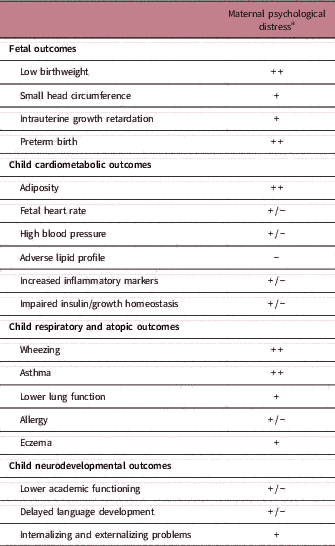
This review shows that the literature on maternal psychological distress during pregnancy and offspring health outcomes is accumulating. Table 1 shows that children exposed to maternal psychological distress are more likely to have a lower birthweight and increased risk for asthma; however, the evidence is insufficient for several cardiometabolic and neurodevelopmental outcomes, see Table 1. Although many of the studies were longitudinal, had a relatively large sample size and took many confounding factors into account, the question whether these associations are causal or are confounded by related genetic and environmental factors remains not fully clear. It is important to know the causal nature of the associations to develop evidence-based guidelines for effective intervention and prevention programs. To address the issue of causality and to move forward in the field, we need innovative designs and strategies. A comparison of the effects of maternal and paternal depressive symptoms during pregnancy could uncover potential causal relationships between intrauterine and extrauterine exposures and offspring health.Reference Smith 218 An intrauterine causal relationship should be detectable by a stronger association of maternal than paternal depressive symptoms during pregnancy with health outcomes in children. An equal association of maternal and paternal depressive symptoms during pregnancy with health outcomes might be explained by residual confounding of unmeasured factors. This approach has been used in a few recent studies,Reference Cookson, Granell, Joinson, Ben-Shlomo and Henderson 74 , Reference Guxens, Sonnenschein-van der Voort and Tiemeier 75 , Reference Brew, Gong, Williams, Larsson and Almqvist 85 , Reference Magnus, Wright and Røysamb 87 , Reference El Marroun, Zou and Muetzel 130 , Reference El Marroun, Tiemeier and Muetzel 134 but should be utilized more often. For example, in four studies with wheezing and asthma as an outcome, the investigators reported an association between maternal anxiety symptoms or overall psychological distress during pregnancy and wheezing or asthma, while no association was observed of paternal psychological distress during pregnancy with child respiratory morbidity.Reference Cookson, Granell, Joinson, Ben-Shlomo and Henderson 74 , Reference Guxens, Sonnenschein-van der Voort and Tiemeier 75 , Reference Brew, Gong, Williams, Larsson and Almqvist 85 , Reference Magnus, Wright and Røysamb 87 However, assortative mating for psychiatric disorders – the tendency for women with the psychological disorder to pair with men with a psychological disorder and vice versa – is well known and a possible limitation.Reference Merikangas 219 , Reference Mathews and Reus 220
Summary findings of discussed literature

Quality of evidence: ++, good evidence for an association based on consistent results from multiple studies and meta-analyses; +, moderate evidence for an association based on multiple studies, but with some inconsistencies; +/−, insufficient evidence for an association based on only a few studies, or with substantial inconsistencies; −, no or very few studies on the association.
a General stress, depression, anxiety or experiencing an adverse life event during pregnancy.
Another possibility would be to use Mendelian randomization, a method that uses genetic variants as instrumental variables. These genetic variants are robustly associated with the exposure,Reference Davey Smith and Hemani 221 and generate more reliable evidence regarding the causal relationship of maternal psychological distress during pregnancy and child health outcomes. Mendelian randomization relies on the assumption that any association between the genetic instrument(s) and the health outcome is entirely mediated by the exposure (i.e., vertical pleiotropy).Reference Swerdlow, Kuchenbaecker and Shah 222 , Reference Paaby and Rockman 223 However, the polygenic nature of complex traits, such as psychological distress, increases the probability of existing biological links between exposure-associated variants and the outcome not mediated by the exposure itself (i.e., horizontal pleiotropy).Reference Swerdlow, Kuchenbaecker and Shah 222 , Reference Paaby and Rockman 223
Further, little is known about the role of developmental timing – the idea that certain periods in fetal and child development exist when the child is particularly vulnerable to the impact of maternal psychological distress. A strong correlation between prenatal and postpartum maternal depression exists, which may have different effects on child development.Reference Ertel, Koenen, Rich-Edwards and Gillman 45 , Reference Field 139 , Reference O’Hara and Swain 224 Large longitudinal studies, preferably starting preconception, with repeated measures of psychological distress and repeated measures of child health and development, are needed.
Randomized controlled trials (RCTs) of prenatal stress, which allows total control of the type, severity and timing of the stressor in utero, are unethical. However, RCTs of (non-pharmacological) treatment of prenatal psychological distress may give insight on the causal nature of psychological distress during pregnancy and child health outcomes. A recent RCT showed that weekly exercise sessions during pregnancy reduce the level of depressive symptoms.Reference Perales, Refoyo, Coteron, Bacchi and Barakat 225 The next step in such studies should focus on long follow-up of child health. Another type of design is studying women who experience natural disasters during pregnancy, as this may approximate the random assignment similar to randomization in animal studies. Several of these studies are ongoing and show an increased risk for adverse child outcomes for women exposed to a natural disaster, for example the Project Ice Storm, Iowa Flood Study and Queensland Flood Study.Reference King and Laplante 226 However, such studies have logistical challenges to face when initiating a study of pregnant women in the immediate aftermath of a natural disaster.
Another interesting design is adopted from prenatal cross-fostering animal studies, which allow the maternally provided prenatal environment and inherited factors to be disentangled. Previously, it has not been possible to study human children whose prenatal environment is provided by a biologically unrelated mother. This is now feasible, because of increased use of in vitro fertilization (IVF) as a mean of conception. Children conceived via IVF can be related to both parents (homologous IVF), the mother only (IVF with sperm donation), the father only (IVF with egg donation) or to neither parent (IVF with embryo donation). With egg and embryo donation, the mother provides the intrauterine environment but is not related to the child.Reference Thapar, Harold and Rice 227 These alternative designs can be useful in addressing the question of causality and mechanisms in the association of psychological distress during pregnancy and offspring health, although sample size might be an issue.Reference Thapar, Harold and Rice 227 , Reference Rice, Harold and Boivin 228
Finally, the combination of human studies together with animal studies could provide more insight into underlying mechanisms. Such studies could focus on a variety of aspects like epigenetic changes. As summarized, to address the issue of causality and to move forward in the field, innovative designs and strategies can be useful. However, these designs all have their own strengths and limitations, which must be kept in mind.
Conclusion
In this narrative review, we described that in many studies maternal psychological distress during pregnancy is associated with an increased risk for adverse fetal and child health outcomes. The most described underlying mechanism of these associations is fetal exposure to increased maternal cortisol levels, but there is emerging evidence that other mechanisms involving the maternal microbiome, epigenetics and inflammatory factors may also play a role. More detailed population-based prospective cohort studies, as well as intervention RCTs and Mendelian randomization studies, are needed to further investigate the causal effect of maternal psychological distress during pregnancy on fetal and child outcomes. Maternal mental health during pregnancy could be a modifiable target for prevention strategies in order to improve both maternal and child well-being.
Supplementary material
To view supplementary material for this article, please visit https://doi.org/10.1017/S2040174418000557
Acknowledgments
None.
Financial Support
The study was made possible by financial support from the Erasmus Medical Centre, the European Union’s Horizon 2020 research and innovation program under grant agreement No.633595 (DynaHEALTH), No.733206 (LifeCycle) and No. 696295 (ALPHABET; co-funded by ZonMW The Netherlands ZonMW no. 529051014). L.D. received additional funding from Galderma S.A. Dermatology. M.G. is funded by a Miguel Servet fellowship (MS13/00054) awarded by the Spanish Institute of Health Carlos III (Ministry of Economy and Competitiveness). The funding agencies had no role in the preparation, review or approval of the manuscript.
Conflicts of Interest
None.