Introduction
Adult size is perhaps the proximate trait most closely correlated with reproductive output and fitness in insects (Roff Reference Roff1992; Stearns Reference Stearns1992; Honěk Reference Honěk1993). In longhorn beetles (Coleoptera: Cerambycidae), female size typically shows a positive relationship with fecundity and male size often correlates with longevity and lifetime mating number, although the shape of the body size-fitness functions may be quite variable (Kato et al. Reference Kato, Yamada and Shibata2000; Keena Reference Keena2002; Smith et al. Reference Smith, Bancroft and Tropp2002; Hanks et al. Reference Hanks, Paine and Millar2005; Togashi Reference Togashi2007; Togashi et al. Reference Togashi, Appleby, Oloumi-Sadeghi and Malek2009; Torres-Vila et al. Reference Torres-Vila, Mendiola-Diaz, Conejo-Rodríguez and Sánchez-González2016; Torres-Vila Reference Torres-Vila2017). Adult size may also have major selective implications beyond direct reproductive output itself. Female body size may act as an honest display for males of the potential number of mature eggs that females carry, and females with fat abdomens also are more likely to be virgin (Bonduriansky Reference Bonduriansky2001; Lu et al. Reference Lu, Wang, Tian, Xu, Lv and Qin2013). It follows that female size may act as a phenotypic trait directly assessed by mate-searching males through visual or tactile mechanisms, acting as a reliable indicator of female potential fecundity. Larger males in turn provide larger ejaculates and male size may operate as a straightforward signal of “good genes”, so females selecting larger males may have sons and daughters with superior alleles (Keller and Reeve Reference Keller and Reeve1995; Lu et al. Reference Lu, Wang, Tian, Xu, Lv and Qin2013). In a number of cerambycid species, females choose larger males for mating (Hughes and Hughes Reference Hughes and Hughes1985; Fukaya Reference Fukaya2004; Lu et al. Reference Lu, Wang, Tian, Xu, Lv and Qin2013) and also males prefer larger females as mates (Hughes and Hughes Reference Hughes and Hughes1982; Wang Reference Wang2002), although this tenet is not universal (Goldsmith et al. Reference Goldsmith, Stewart, Adams and Trimble1996; Hanks et al. Reference Hanks, Millar and Paine1996a).
Additional ultimate benefits may also select for large adult size in cerambycids as they determine significant fitness gains. For instance, large males have longer antennae, which improves spread width and the rate at which large males search and locate females by antennal contact (Hanks et al. Reference Hanks, Millar and Paine1996a, Reference Hanks, Millar and Paine1996b). Large males are also often more successful than smaller males in fighting and mounting during aggressive competition for females, in grasping and guarding mates during prolonged pair-bondings, and in monopolising both mating and oviposition sites (Linsley Reference Linsley1959; Hughes and Hughes Reference Hughes and Hughes1985; Goldsmith and Alcock Reference Goldsmith and Alcock1993; Hanks et al. Reference Hanks, Millar and Paine1996a; Wang and Zeng Reference Wang and Zeng2004; Lu et al. Reference Lu, Wang, Tian, Xu, Lv and Qin2013), although a male size-dependent advantage does not always translate into mating success (Wang Reference Wang2002; Ray et al. Reference Ray, Ginzel and Hanks2009; Larsson Reference Larsson2010). Other reproductive fitness-related factors may also be either directly or indirectly dependent on adult size, including sperm competition and female cryptic choice (Eberhard Reference Eberhard1996), flight dispersal behaviour (Lawrence Reference Lawrence1987; Hanks et al. Reference Hanks, Millar and Paine1998), predation risk, parasitism rate, and the need for food or endurance in the face of abiotic factors (Nylin and Gotthard Reference Nylin and Gotthard1998; Torres-Vila et al. Reference Torres-Vila, Mendiola-Diaz and Sánchez-González2017a). The described scenario strongly suggests that assortative mating by size (regulated by either mate choice, mate availability, or mating constraints) must be widespread in cerambycid populations, with crucial implications of both natural and sexual selection in the evolution of adult size (Crespi Reference Crespi1989; Walczyńska et al. Reference Walczyńska, Dańko and Kozłowski2010).
Despite being closely related to reproductive fitness, adult size in insects is weakly canalised and highly responsive to environmental conditions (Stearns and Kawecki Reference Stearns and Kawecki1994; Nylin and Gotthard Reference Nylin and Gotthard1998; Chown and Gaston Reference Chown and Gaston2010). Wood-boring insects in general, and xylophagous cerambycids in particular, are specially sensitive to environmental factors impacting on larval development, and therefore adult size variation is huge in this functional group (Starzyk and Strojny Reference Starzyk and Strojny1985; Strojny and Starzyk Reference Strojny and Starzyk1986; Lupi et al. Reference Lupi, Jucker, Rocco, Harrison and Colombo2015). As a general rule in insects and other ectotherms (Atkinson Reference Atkinson1994; Chown and Gaston Reference Chown and Gaston2010), higher temperature results in faster larval growth, shorter development, and smaller final adult size in cerambycids (Hanks et al. Reference Hanks, Millar and Paine1991; Torres-Vila et al. Reference Torres-Vila, Zugasti, De-Juan, Oliva, Montero and Mendiola2015). Host tree-related factors (mainly determining larval food quality and quantity) also play a crucial role in shaping cerambycid size, including host species (Hanks et al. Reference Hanks, Paine and Millar1993; Shibata Reference Shibata1998; Togashi et al. Reference Togashi, Kasuga, Yamashita and Iguchi2008), host age (Hanks et al. Reference Hanks, Paine and Millar2005), host physiological condition (Shibata Reference Shibata1998; Hanks Reference Hanks1999; Flaherty et al. Reference Flaherty, Sweeney, Pureswaran and Quiring2011), and host size/bolt diameter (Starzyk and Strojny Reference Starzyk and Strojny1985; Kato et al. Reference Kato, Yamada and Shibata2000; Hanks et al. Reference Hanks, Paine and Millar2005; Reagel et al. Reference Reagel, Smith and Hanks2012). Xylophagous larvae live concealed within their woody host, which offers a food supply and provides a relatively good protection against predators, parasitoids, and adverse environment (Walczyńska Reference Walczyńska2009). However, larvae (especially in large cerambycid species) may be critically constrained by wood volume limitation (Grove Reference Grove2002; Hanks et al. Reference Hanks, Paine and Millar2005; Torres-Vila et al. Reference Torres-Vila, Zugasti-Martínez, Mendiola-Diaz, De-Juan-Murillo, Sánchez-González and Conejo-Rodríguez2017b) as they have restricted mobility within hosts and are unable to move between hosts to improve their own nutritional status when food supply or other life conditions deteriorate. In addition, digestion of low-quality woody tissues is costly, which as a rule decreases larval growth rate and extends development time – two major determinants of adult size (Mirth and Riddiford Reference Mirth and Riddiford2007). The trade-off between growth rate and development time may become decisive in low-quality (or even starvation) feeding conditions, because wood borers (with high plasticity in moult number and often multiseasonal life cycle) must “decide” in order to achieve an optimal adult size (or at least reach a critical weight) between two divergent alternatives: (1) to complete development in the current reproductive season at a smaller size (decreasing potential fitness), or, (2) to prolong larval development one more season to gather additional reproductive resources and attain larger adult size (increasing death risk before reproducing) – a decisive choice with huge selective implications (Kozłowski and Wiegert Reference Kozłowski and Wiegert1987; Walczyńska et al. Reference Walczyńska, Dańko and Kozłowski2010).
All the above biological features result in large intra-specific size variation as, if adverse ecological factors arise, cerambycid larvae typically produce smaller adults, rather than fail to attain adulthood (Nagamine et al. Reference Nagamine, Ishikawa and Hoshizaki2016). As a result, tree-boring insects experience higher intrapopulation size variation than free-living insects (Andersen and Nilssen Reference Andersen and Nilssen1983). Such a plastic response has been viewed as adaptive in cerambycid species (Torres-Vila Reference Torres-Vila2017), even if plastic effects of poor diets could in extreme cases override natural selection (Nylin and Gotthard Reference Nylin and Gotthard1998). Cerambycid size has also been proposed as a potential indicator of habitat quality (Michalcewicz and Ciach Reference Michalcewicz and Ciach2012) as insect size may be considered a proxy of environmental quality (Teder and Tammaru Reference Teder and Tammaru2005).
A detailed knowledge of mechanisms responsible for adult size in cerambycids and other wood-boring insects is imperative from an evolutionary perspective (Walczyńska et al. Reference Walczyńska, Dańko and Kozłowski2010), but also to understand species-specific processes involved in population dynamics in order to improve management tactics of wild populations when necessary (Tammaru Reference Tammaru1998). Our target species, Cerambyx welensii Küster (Coleoptera: Cerambycidae), is considered an emergent oak (Quercus Linnaeus; Fagaceae) pest in Iberia (see Study species below). Recent research on C. welensii has showed that large adult size provides clear fitness benefits in both sexes. Larger females have greater reproductive output in terms of lifetime fecundity, daily fecundity, extended oviposition period, egg size, and offspring size. Larger males live longer and mate more times because they have more mating opportunities, and male longevity is unaffected by mating history (Torres-Vila et al. Reference Torres-Vila, Mendiola-Diaz, Conejo-Rodríguez and Sánchez-González2016). Adults of C. welensii captured on baited traps or reared in the laboratory vary considerably in body size, with the largest individuals being almost three times longer than the smallest (L.M.T.-V. unpublished data). Such a variation range in adult size is quite similar to that reported in the eucalyptus longhorned borer Phoracantha semipunctata Fabricius (Coleoptera: Cerambycidae) (Hanks et al. Reference Hanks, Paine and Millar2005) and represents an extreme variability even for a cerambycid species (Andersen and Nilssen Reference Andersen and Nilssen1983). However, little is known about the environmental variables controlling adult size of C. welensii living in oak woodlands.
The goal of this paper was to assess major host tree features that could shape C. welensii adult size in the wild, including tree species, tree size, wood quality, wood diameter, host tree-related larval density, elevation, and aspect, with the last two factors being closely linked to seasonal temperature. The potential effect of these factors on sex ratio, as well as allometric relationships between elytral length, adult length, and adult weight were also collaterally explored.
Material and methods
Study species
Cerambyx welensii is a univoltine species, flying in the summer season from late May to early August, with flight peaks occurring in late June. Adults are large (about 25–60 mm), blackish brown, and show sexual size dimorphism with females slightly larger than males and antennae longer in males. Larvae are xylophagous mainly on Quercus species, while adults feed mainly on tree sap and exudates. Mated females lay eggs into bark crevices, pruning cuts and cork stripping wounds. After hatching, neonate larvae bore into the inner bark and initiate feeding subcortically. Larvae then tunnel increasingly wider and longer galleries into sapwood and heartwood along the tree trunk and main branches. Multiple galleries may extend along the entire trunk, causing huge physiological, mechanical, and structural damage, and even tree death. Larval development usually lasts two to four years and pupation occurs in late summer within a pupal cell in the sapwood. Pupation lasts about one month. After emergence, adults remain in the pupal cell and overwinter in a pre-reproductive stage until the following year. Colonised trees can be identified by adult exit holes on the trunk and main branches, with abundant frass presence evidencing larval activity. Daily activity of adults (feeding, flight, mating, and egg-laying) occurs typically at dusk and early evening (Duffy Reference Duffy1953; Vives Reference Vives2000; Torres-Vila et al. Reference Torres-Vila, Sánchez-González, Merino-Martínez, Ponce-Escudero, Conejo-Rodríguez, Martín-Vertedor and Ferrero-García2013, Reference Torres-Vila, Mendiola-Diaz, Conejo-Rodríguez and Sánchez-González2016).
Study area and insect sampling
The study area was the entire region of Extremadura (southwestern Spain), which extends over 41 634 km2 and contains more than one million ha of oak forests, most of them open woodlands (the so-called dehesa ecosystem). Climate is typically Mediterranean with dry and hot summers (up to 40 °C). Insect samples were collected taking advantage of a recent study on the larval ecology of large longhorns living on oaks (Torres-Vila et al. Reference Torres-Vila, Zugasti-Martínez, Mendiola-Diaz, De-Juan-Murillo, Sánchez-González and Conejo-Rodríguez2017b). Individuals of C. welensii (adults and larvae) were collected over seven consecutive years (2011–2017) in oak tree species, both evergreen (holm oak, Quercus ilex Linnaeus and cork oak, Quercus suber Linnaeus) and marcescent/deciduous (pyrenean oak, Quercus pyrenaica Willdenow and gall oak, Quercus faginea Lamarck). Elevation ranged between about 150 m (Guadiana and Tajo river valleys) to 1350 m (mountains of the Central System in the northern region). Geographical coordinates were taken for each sampled tree with a sub-metric global positioning system (Trimble Geoexplorer 6000, Westminster, Colorado, United States of America). Elevation and aspect were obtained from geographical coordinates using the MDT05-LIDAR Digital Elevation Model (Centro Nacional de Información Geográfica, Instituto Geográfico Nacional 2016). Insect sampling was standardised as far as possible to adequately cover either geographical, elevational, aspect, or host ranges.
Candidate trees/branches were selected based on the presence of adult exit holes and larval frass. We mostly sampled main branches (most of them recently fallen as a result of wind), but occasionally we also cut down and processed entire trees. Some samples were also taken from woodsheds and firewood piles when the log source was known (15.6% of wood samples, 8.4% of overwintering adults). Selected trees/branches were cut with a chainsaw into 30–50-cm long sections (depending on diameter) and the resulting bolts were measured (length and diameter) and carefully opened and dissected to look for overwintering adults and larvae using metal wedges and a sledgehammer (Torres-Vila et al. Reference Torres-Vila, Mendiola-Diaz, Conejo-Rodríguez and Sánchez-González2016). The diameter of trees (diameter at breast height) from which bolts were obtained was also recorded for subsequent analyses. Insect samples were taken in autumn, winter, or early spring during the annual period in which C. welensii adults overwinter inside the host tree. Note that collecting adults inside host wood is the only way to ensure that the entire larval development was completed in a given host tree species.
Wood quality in each sampled bolt was visually estimated taking advantage of cut wood sections according to a five-class scale: (1) healthy wood in good vegetative condition, (2) decayed wood: fresh wood in poor physiological condition, (3) degraded wood: appearance and consistency of wood visibly altered, (4) dying wood: wood degradation extreme but wood still living, and (5) dead wood (see Torres-Vila et al. Reference Torres-Vila, Zugasti-Martínez, Mendiola-Diaz, De-Juan-Murillo, Sánchez-González and Conejo-Rodríguez2017b for additional details). Note that several (or all) of these five wood quality stages may occur simultaneously in a single veteran tree and even in the same tree bolt. When wood quality was heterogeneous in a single bolt, special care was taken in recording the wood class in which C. welensii adults and larvae were found.
All insects within each sampled bolt were collected, individually arranged in aerated plastic containers, referenced, and taken to the laboratory. Adults were sexed, measured to the nearest mm (both elytral length and adult body length), and weighed with a precision electrobalance to the nearest 0.01 g. Larvae were individually reared until adulthood at room temperature in the laboratory (22–28 °C and 50–70% relative humidity) in aerated 140-mL plastic containers on an agar-based artificial diet (Morales-Rodríguez et al. Reference Morales-Rodríguez, Sánchez-González, Conejo-Rodríguez and Torres-Vila2015). At emergence, a subset of laboratory-reared adults was also sexed and measured. Population density was calculated for each wood sample as the ratio between insect number (larvae and adults) and wood volume (assuming a bolt being a cylinder) and expressed as individuals/m3 of wood. Six voucher specimens of Cerambyx welensii (three males and three females) were deposited in the entomological collection at the Servicio de Sanidad Vegetal, Consejería de Medio Ambiente y Rural Políticas Agrarias y Territorio, Junta de Extremadura, Mérida, Badajoz, Spain.
Data analysis
A preliminary two-way analysis of variance was first computed to explore the effect on adult length (as a proxy of adult size) of larval feeding regime, both tree wood in the wild (holm oak, cork oak, deciduous oak) and artificial diet in the laboratory, controlling for sex. Then, the effects on adult length of sex, host tree species, wood quality, and aspect (and their double interactions) were assessed through successive multiple-way Model I analysis of variance considering all factors with fixed effects. Independent variables were scored in classes as follows: sex (two levels, males and females), host tree (three levels, holm oak, cork oak, and oak (deciduous oak species pooled)), wood quality (three levels, either healthy, decayed, or degraded-dying-dead wood (these latter wood quality classes were pooled as sample sizes were relatively small)), and aspect (two levels depending on ground slope orientation with respect to north (0°), either “cold” (0–67.5° and 270–360°) or “warm” (90.0–247.5°), with indistinct aspects (67.5–90.0° and 247.5–270.0°) being included in the cold class. The effects on adult length of tree diameter, wood (bolt) diameter, population density, and elevation were explored through linear regression analysis. All variables were tested for a departure from normality using probability plots before statistical computation, and just population density was log10(x+1) transformed to normalise data. The regressions between elytral length, adult length, and adult fresh weight were assessed for each sex by using the allometric (power law) function y=bx a, and scaling differences tested through analysis of variance.
The sex ratio (% males) frequency distribution lacked normality due to the excess of either 0 or 100 values from wood samples in which only one adult was collected, so analysis of variance and linear regression were not applicable to the entire data set. Therefore, we explored the effect on sex ratio of the studied independent variables in two ways. First, we computed G tests on contingency tables between the sex ratio (males versus females) and each variable using the entire data sample. The three qualitative independent variables (host, wood quality, and aspect) were scored in classes as indicated above. The four quantitative independent variables were categorised as follows: tree diameter (four levels, <30 cm, 30–60 cm, 60–90 cm, and>90 cm), wood diameter (three levels,<30 cm, 30–60 cm, and>60 cm), population density (three levels, <50, 50–100, or >100 individuals/m3 of wood, either in larval or adult stage), and elevation (three levels, <400 m, 400–600 m, and>600 m). Second, we used analysis of variance and linear regression on the subsample of bolts (n=20) in which 12 or more C. welensii individuals were collected, as in this sample subset sex ratios were normally distributed. Most statistical tests were computed with Systat (2000) software in accordance with Scherrer (Reference Scherrer1984) and Sokal and Rohlf (Reference Sokal and Rohlf1995).
Results
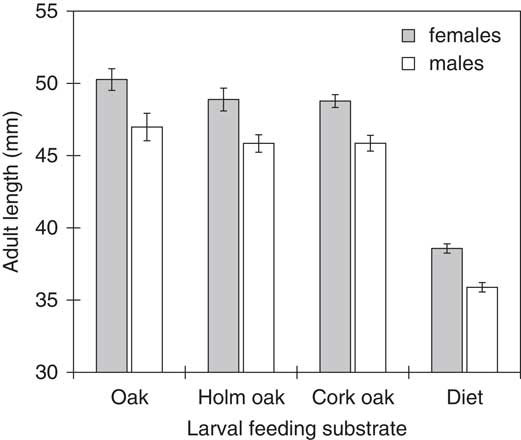
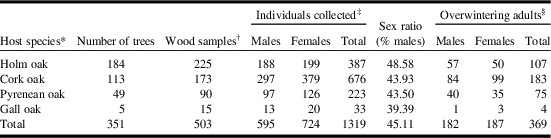
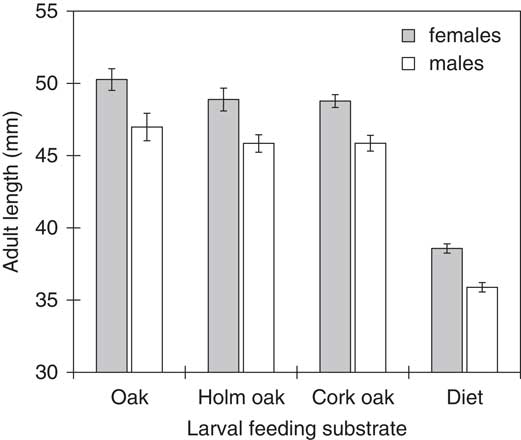
A summary of the inspected wood samples and insects collected (by sex and host tree species) is given in Table 1. The preliminary two-way analysis of variance showed significant feeding substrate (F(3,717)=298.01, P<0.001) and sex effects (F(1,717)=53.99, P<0.001) on adult length, with no feeding×sex interaction (F(3,717)=0.11, P=0.95). Females were always larger than males (Fig. 1), and a post-hoc test (Tukey honest significant difference test, sexes pooled) classified feeding regimes in two homogeneous groups (P<0.001), with no differences among host tree species (P>0.16 in all pairwise contrasts).
Effect of sex and larval feeding (either oak species in the wild or artificial diet in the laboratory) on Cerambyx welensii adult length. Tree species were: oak (deciduous species pooled: pyrenean oak (Quercus pyrenaica) and gall oak (Quercus faginea)), holm oak (Quercus ilex), and cork oak (Quercus suber). Vertical lines are the standard error of the means. See text for a detailed statistical analysis.
Summary of the number of wood samples and individuals of Cerambyx welensii (scored by host species and sex) collected during seven consecutive years (2011–2017) in Extremadura (southwestern Spain).

* Elevational ranges for each host species were: 162–746 m (holm oak, Quercus ilex), 180–770 m (cork oak, Quercus suber), 348–1342 m (pyrenean oak, Quercus pyrenaica), and 263–628 m (gall oak, Quercus faginea).
† A standard wood sample is a bolt 30–50 cm in length (depending on the diameter of the branch or trunk).
‡ Data include both overwintering adults and larvae whose sex was determined by laboratory rearing until adulthood.
§ Only those individuals collected in adult stage inside the host wood (overwintering adults) were considered for adult size comparisons in order to ensure full preimaginal development in the wild.
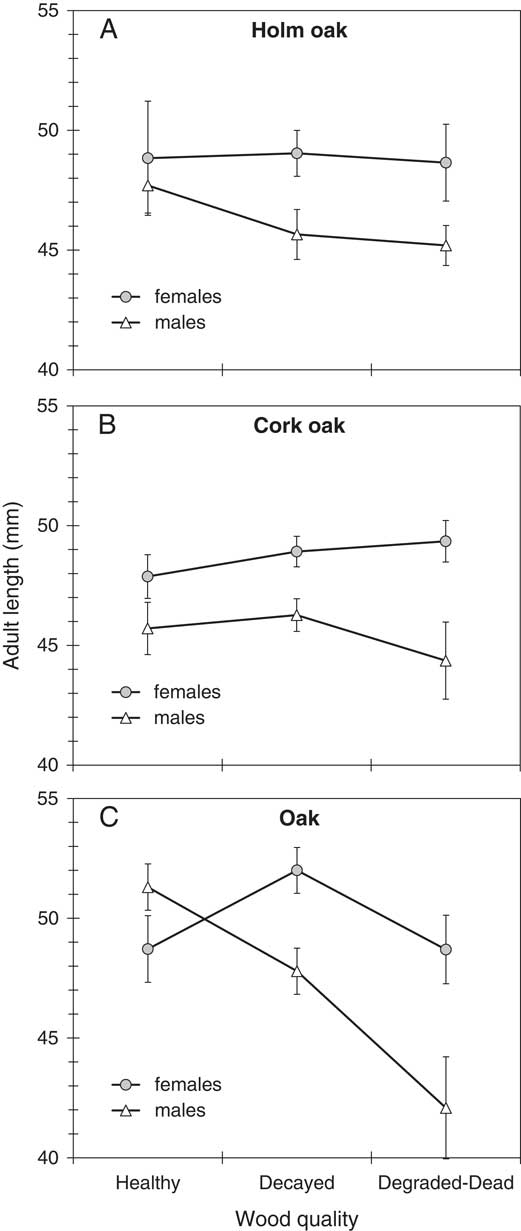
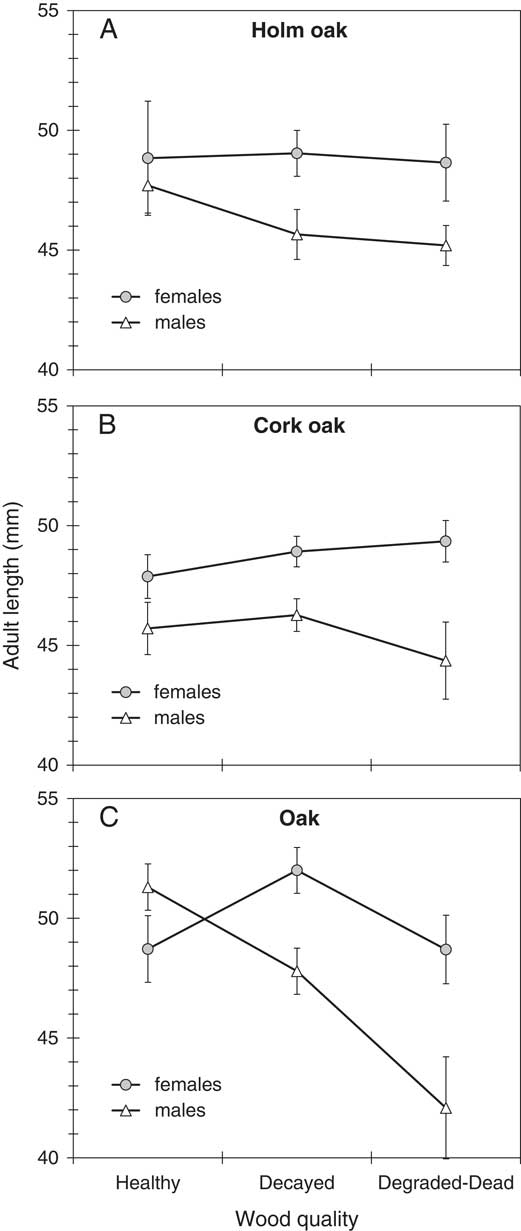
A four-way analysis of variance was then computed to assess the effects on adult length of sex, host species, wood quality, and aspect. Results showed no significant effect of aspect (F(1,349)=2.41, P=0.12) with all double interactions between aspect and either sex (F(1,349)=0.24, P=0.62), host (F(2,349)=0.27, P=0.77), or wood quality (F(2,349)=0.56, P=0.57) being non-significant. The same results were obtained when adults collected in firewood piles were excluded from the analysis of variance; we took this statistical precaution to ensure that uncontrolled aspect differences between the sites where trees grew and firewood piles were stored did not bias results. Thus, the factor aspect was randomised and a three-way analysis of variance was performed to assess the effects of sex, host, and wood quality on adult length. Results showed a significant effect of sex (F(1,355)=27.25, P<0.001) and wood quality (F(2,355)=5.13, P<0.01) with no host effect (F(2,355)=2.20, P=0.11), but both sex×wood quality (F(2,355)=3.33, P<0.05) and host×wood quality (F(4,355)=2.60, P<0.05) interactions were significant effects. Therefore, we computed successive two-way analysis of variance to define the effects on adult length of sex and wood quality within hosts. In the case of holm oak (F(1,101)=5.43, P<0.05) (Fig. 2A) and cork oak (F(1,177)=17.05, P<0.001) (Fig. 2B) adult length was only affected by sex (females being larger than males as expected). However, in the case of deciduous oak, adult length was not only dependent on sex (F(1,73)=5.77, P<0.05) but also on wood quality (F(2,73)=7.64, P<0.001) and sex×wood quality interaction (F(2,73)=4.73, P<0.05) (Fig. 2C). A set of homologous analysis of variance to define the effects on adult length of sex and host within wood qualities showed that: (1) in healthy wood there was only host effect (F(2,75)=3.15, P<0.05), (2) in decayed wood there were sex (F(1,182)=21.31, P<0.001) and host effects (F(2,182)=3.91, P<0.05) with no sex×host interaction (F(2,182)=0.39, P=0.68), and (3) in degraded wood there was only sex effect (F(1,94)=20.04, P<0.001) (Fig. 2).
Effect of oak species, wood quality, sex, and their interactions on Cerambyx welensii adult length. A, Holm oak (Quercus ilex); B, cork oak (Quercus suber); and C, oak (deciduous oak species pooled: pyrenean oak (Quercus pyrenaica) and gall oak (Quercus faginea)). Vertical lines are the standard error of the means. See text for a detailed statistical analysis.
Linear regression analysis showed that adult length (sexes pooled) was not related to elevation (F(1,367)=0.05, P=0.83, R 2<0.01) or population density [log10(x+1) transformed] (F(1,367)=0.31, P=0.58, R 2<0.01). By contrast, adult length was positively correlated with both tree diameter (F(1,336)=4.76, P<0.05, R 2=0.014) and wood diameter (F(1,360)=3.88, P<0.05, R 2=0.011), while both regressions were weak. Therefore, adults collected in older trees (larger diameter) and wider branches tended to be significantly larger.
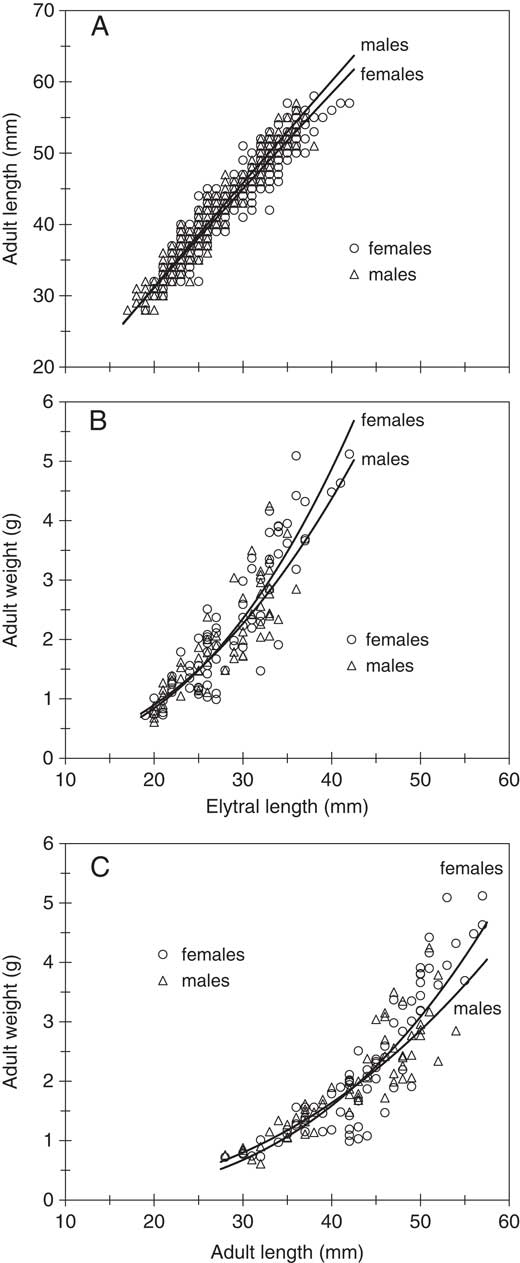
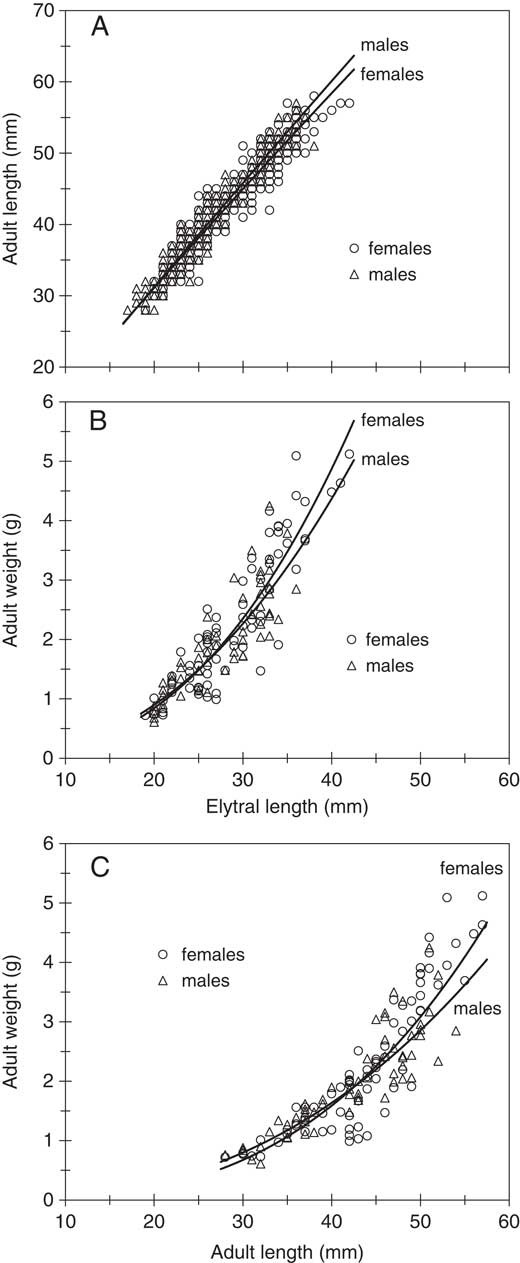
As expected, there was a robust allometric scaling between adult length and elytral length (Fig. 3A), as well as between adult weight and either elytral length (Fig. 3B) or adult length (Fig. 3C) both in males and females. An analysis of variance computed on the elytral-adult length allometric functions showed significant effects on adult length of sex (F(1,721)=5.83, P<0.05) and elytral length (F(1,721)=7.64, P<0.001), with sex×elytral length interaction being significant (F(1,721)=10.71, P<0.01). These results indicate that when adults are large, males tend to be slightly (but significantly) longer than females (Fig. 3A). An analysis of variance computed on the adult weight-length allometric functions showed significant effects on adult weight of sex (F(1,132)=12.02, P<0.001), adult length (F(1,132)=431.82, P<0.001) and sex×adult length interaction (F(1,132)=13.54, P<0.001). Quite similar results were obtained when elytral length was used in lieu of adult length in the analysis of variance. Results showed significant effects on adult weight of sex (F(1,132)=5.71, P<0.05), elytral length (F(1,132)=427.87, P<0.001), and sex×elytral length interaction (F(1,132)=7.14, P<0.01). These two allometric tradeoffs clearly show that as adult size increases, females are proportionally heavier than males (Fig. 3B–C).
Allometric relationships in Cerambyx welensii males and females between either A, adult length and elytral length; B, adult weight and elytral length; or C, adult weight and adult length. Regression equations and statistics were: A, females: y=2.0472x 0.9085, R 2=0.92; males: y=1.8440x 0.9446, R 2=0.95; B, females: y=0.0004x 2.5308, R 2=0.81; males: y=0.001x 2.2833, R 2=0.80; and C, females: y=0.00003x 2.9744, R 2=0.82; males: y=0.0002x 2.4958, R 2=0.85. See text for a detailed statistical analysis.
Sex ratio was unaffected by any of the independent variables studied when the entire sample was analysed, either host species (G 2=2.73, P=0.26), wood quality (G 2=3.06, P=0.22), tree diameter (G 3=3.01, P=0.39), wood diameter (G 2=0.12, P=0.94), population density (G 2=2.40, P=0.30), aspect (G 1=0.70, P=0.40), or elevation (G 2=0.80, P=0.67). However, linear regression analysis (on the subset of 20 wood samples with 12 or more collected adults per sample) revealed a weak but significant negative trend between the proportion of males and both tree diameter (F(1,18)=4.42, P<0.05, R 2=0.18) and population density (F(1,18)=4.51, P<0.05, R 2=0.19). By contrast, linear regression showed no relationship between the proportion of males and either wood diameter (F(1,18)=0.04, P=0.85, R 2<0.01) or elevation (F(1,18)=2.39, P=0.14, R 2=0.12). Analysis of variance computed on the 20-sample subset showed no effect on sex ratio of host tree (F(2,17)=0.37, P=0.69), wood quality (F(2,17)=1.29, P=0.30), or aspect (F(1,18)=0.81, P=0.38).
Discussion
Results confirmed the significant effect of sex and showed the impact of feeding substrate on C. welensii adult size. Females were overall larger than males irrespective of the host tree in the wild or diet in laboratory. The smaller adults were obtained when larval development of field-derived larvae was completed on artificial diet. A smaller adult size of laboratory-reared individuals was surely linked to a much faster pre-imaginal development due to the high diet nutritional quality (relative to wood in natural conditions) as reported in other cerambycids (Ivanović et al. Reference Ivanović, Janković-Hladni, Stanić, Nenadović and Frušić1989; Hanks et al. Reference Hanks, Paine and Millar2005). In fact, some C. welensii larvae reared from L1 on artificial diet in the laboratory are able to reach pupal stage in just one year (12–14 months) and to complete the entire cycle in two years, at the cost of producing minute adults (L.M.T.-V., unpublished data). This fact exemplifies how developmental trade-offs associated to high growth rates may often lead insects to grow below their physiological optimum (Nylin and Gotthard Reference Nylin and Gotthard1998).
There was adult size variation among host tree species but differences were weak and even became non significant in degraded wood. Adults obtained from deciduous oak were the largest and those from cork oak the smallest, with those from holm oak occupying an intermediate position. Such differences in adult size suggest at first sight that nutritional quality differs among host tree species and wood degradation stage, affecting preimaginal development. Note, however, that the confounding effect of elevation (inversely tied to temperature) cannot be excluded in our study, even if elevation did not show a direct significant effect on adult size (see below). The studied oak species present quite different thermicity requirements, and therefore their optimal growth elevation is different (higher in deciduous oak than in cork oak, with holm oak occupying an intermediate range). Therefore, between-host adult size differences could arise in part from a greater amount of time (number of seasons) spent by larvae feeding in deciduous oak than in evergreen oak as a result of colder temperatures at higher elevations.
Sexual size dimorphism tended to increase with wood degradation in all host trees, although there were only significant differences in deciduous oak. Interestingly, in this host, male and female adult size of C. welensii depended on wood quality, so sexual size dimorphism reached a maximum when larvae developed on degraded-dead wood. These results evidenced a differential plastic response between sexes when developing in the same woody material triggered by wood degradation stage. This is a finding previously unreported in insects to our knowledge, and specifically in wood-boring cerambycid beetles, with major potential selective implications. Our results also supported that environmental conditions may greatly affect sexual size dimorphism, and suggested that male size was more sensitive to environment than female size in C. welensii, at least when developing on deciduous oak.
Elevation and aspect, two environmental variables closely linked to temperature, did not significantly affect adult size. Thus, thermal variations experienced by host trees (with larvae inside them) either derived from elevation (in the range studied) or aspect (in the latitude of the study) were not sufficient to promote additional differences in adult size. It is well known that higher temperatures increase larval development rate in insects, very often at the cost of decreasing final adult size (Atkinson Reference Atkinson1994), and that species distributed over a broad geographic range often exhibit thermal clines in adult size, adults being larger in colder environments. It has been reported that Cerambyx cerdo Linnaeus larvae tend to be located in the sunniest part of the tree trunk in order to improve heat intake (Buse et al. Reference Buse, Schröder and Assmann2007). However, this sun exposure-related behaviour could be more complex than previously supposed, as in the congeneric species C. welensii (our target longhorn), the higher larval densities occur in trees located in colder aspects (Torres-Vila et al. Reference Torres-Vila, Zugasti-Martínez, Mendiola-Diaz, De-Juan-Murillo, Sánchez-González and Conejo-Rodríguez2017b).
Wood size in which larvae developed affected adult size in C. welensii. Adults found in larger bolts tended to be larger as reported in other cerambycids (Kato et al. Reference Kato, Yamada and Shibata2000; Hanks et al. Reference Hanks, Paine and Millar2005) including the congeneric C. cerdo (Starzyk and Strojny Reference Starzyk and Strojny1985). By contrast, there was no relationship between population density and adult size as observed in other longhorn species (Hanks et al. Reference Hanks, Paine and Millar2005). In the same study site, however, it has been shown that C. welensii population density tends to decrease in larger bolts (Torres-Vila et al. Reference Torres-Vila, Zugasti-Martínez, Mendiola-Diaz, De-Juan-Murillo, Sánchez-González and Conejo-Rodríguez2017b). Such trade-offs are difficult to interpret, but as a whole suggest that the occurrence of larger adults in larger branches/trunks may be attributed to higher larval food quality/availability in these bolts (Kato et al. Reference Kato, Yamada and Shibata2000; Hanks et al. Reference Hanks, Paine and Millar2005), and also that competition between larvae for trophic resources in field assemblages is not intense enough to affect adult size, at least in uncrowded populations. In addition, larger larvae produced in the same season (presumably originated from earlier oviposition), would be more likely to complete development before, contributing to a more uniform adult size among the emerging adults in a given season (Hanks et al. Reference Hanks, Millar and Paine1991). The situation as described could be even more complex if other underlying selective pressures are also involved in regulating adult size. For example, if larger C. welensii females were more choosy and prone to selecting larger woody material for egg-laying (see Hughes and Hughes Reference Hughes and Hughes1982) and their offspring did the same due to this being a behavioural trait with heritable variation, then adult size could be ultimately selected for tree size and not be merely a proximate consequence of food availability.
The adaptive value of adult size has been shown to be very subtle in a number of longhorn species. For instance, in Stenurella melanura Linnaeus (Coleoptera: Cerambycidae), body size of mated males is positively correlated with ambient temperature (Larsson and Kustvall Reference Larsson and Kustvall1990); in Trachyderes mandibularis Dupont (Coleoptera: Cerambycidae), mating chances of small males differ in different environments (Goldsmith and Alcock Reference Goldsmith and Alcock1993); in Megacyllene robiniae Forster (Coleoptera: Cerambycidae), the effectiveness of tactics deployed by challenging males to displace defending males is male size-dependent (Ray et al. Reference Ray, Ginzel and Hanks2009); in Nadezhdiella cantori Hope (Coleoptera: Cerambycidae), female mating success is unaffected by female size but the female antennal-body length allometric relationship does affect male choice (Wang and Zeng Reference Wang and Zeng2004); and in Psacothea hilaris Pascoe (Coleoptera: Cerambycidae), small males are more sensitive to female sex pheromones and more active in pre-copulatory behaviour, so small males compensate for the disadvantage of lower female choice (Fukaya Reference Fukaya2004). These examples illustrate that adult size is a key trait in male–female interactions, but also reveal that the actual target of sexual selection may not be adult size per se, but other characters closely correlated with adult size, so the direct target of sexual selection may remain masked by natural selection (Thornhill and Alcock Reference Thornhill and Alcock1983; Crespi Reference Crespi1990; Bertin and Cezilly Reference Bertin and Cezilly2003).
As expected, there were strong allometric relations between elytral length, adult length, and adult weight in C. welensii. A greater slope for the elytral length-adult length allometric curve in males than females suggests that males are subject to a higher sexual selection pressure than females on the pronotum-head length (Wang and Zeng Reference Wang and Zeng2004). Therefore, when adults are large, the pronotum-head portion is significantly longer in males than females. This allometric relationship helps to explain why C. welensii males tend to exhibit a more stylised look than females as reported in other cerambycids (Starzyk and Lessaer Reference Starzyk and Lessaer1984; Rodríguez-González et al. Reference Rodríguez-González, Peláez, Mayo, González-López and Casquero2016). The dissimilar adult size-adult weight allometric scaling between sexes also arises because females are wider than males to increase their abdominal capacity and thus store ovarian mass and fat body reproductive reserves (Starzyk and Lessaer Reference Starzyk and Lessaer1984). Hence, a greater slope for the length-weight allometric relationship in females than males suggests that body weight is a major phenotypic trait selected in females, an expected consequence of the positive relationship between female body weight and reproductive output. Our results with C. welensii also support the argument that sexual size dimorphism increases with adult size in species in which females are larger than males (Teder and Tammaru Reference Teder and Tammaru2005).
Host tree species did not affect C. welensii sex ratio as observed in other cerambycids (Hanks et al. Reference Hanks, Paine and Millar1993), but there was a negative relationship between sex ratio (% males) and either tree diameter or population density. Sex ratio in C. welensii tended to be balanced (close to 50%) in relatively young or mature trees (tree diameter <50 cm) and with low/medium population densities. However, females largely outnumbered males in old/veteran trees and in dense/crowded larval populations (>150 individuals/m3 of wood). That sex ratio positively correlates with host size has long been known in many parasitoids (Godfray and Werren Reference Godfray and Werren1996), but a dependence of sex ratio on host tree size has been rarely reported in wood-boring beetles (Starzyk and Witkowski Reference Starzyk and Witkowski1986). Although these authors suggested that parental manipulation of sex ratio could occur in cerambycids, the unequal larval survival of the two sexes on thin and thick woody material is more likely to be involved in biased sex ratios. Female-biased sex ratios in these situations could arise if in early development stages larger female larvae already have a competitive advantage over smaller male larvae, either in acquiring resources or defending vital space, as female larvae are expected to exhibit a more aggressive size-related behaviour. Such a picture also appears to be consistent with a lower larval density of C. welensii in larger wood material (Torres-Vila et al. Reference Torres-Vila, Zugasti-Martínez, Mendiola-Diaz, De-Juan-Murillo, Sánchez-González and Conejo-Rodríguez2017b).
We conclude that environmental factors regulating C. welensii adult size should be considered, not only from an evolutionary perspective, but also for their potential impact on field population dynamics. Adults arising from older, healthy, deciduous oaks were larger than those produced in other forest scenarios, and hence with more fecund females, longer-living males and larger offspring, all these traits providing potential fitness gains (Torres-Vila et al. Reference Torres-Vila, Mendiola-Diaz, Conejo-Rodríguez and Sánchez-González2016). It follows that adult size-mediated differences in reproductive output may be useful when considered in management tactics of wild populations, especially in those forest contexts in which C. welensii reach a pest status.
Acknowledgements
The authors are grateful to all colleagues who provided assistance in either field or laboratory: Paco Ponce, Félix Fernández, Yolanda Conejo, Rafael López, Juan Gragera, Jesús Merino, Jose M. Fonseca, Pedro Bueno, Guadalupe Espárrago (Servicio de Sanidad Vegetal, Mérida), Jose M. De Juan, Carlos Zugasti, José J. Mareque, Ramón Álvarez, Antonio Vázquez, Lorenzo Castro, Fernando Naveiro (Servicio de Sanidad Vegetal, Cáceres), Juande del Pozo (Servicio de Sanidad Vegetal, Badajoz), Antonio J. Romero, Joaquín Cordero, José Fernández (Servicio de Ordenación y Gestión Forestal, Mérida), Rubén Trenado (Servicio de Sistemas de Información Agraria, Mérida), Mercedes Paniagua (Centro de Investigaciones Científicas y Tecnológicas de Extremadura, La Orden-Valdesequera), Isidro Rodríguez (Centro de Selección y Reproducción Animal, Badajoz), Paco Barrena, Eva Cruces, Pedro Collado, Paco del Pozo, and Laura López (Sociedad de Gestión Pública de Extremadura, Mérida). We thank Dr. Andrew Smith and two anonymous referees for their valuable comments and suggestions. We are also indebted to the owners of dehesas and oak forests for their kind permission to conduct this study. This research was supported by the Servicio de Sanidad Vegetal (Junta de Extremadura) and benefited from funding by the European Regional Development Fund (ERDF/FEDER) of the AGA001 (GR15112) research group.