While the culture of individualism has enhanced freedom of choice, it also encourages selfishness and narcissism. As a result, we face a crisis of lack of meaning, values, ethics, and sense of belonging (Goffee & Jones, Reference Goffee and Jones2006). The counter-reaction to this crisis is characterized by a search for things that are more unique, meaningful, and authentic. Scandals, such as the Enron and Lehman Brothers flagrancies, precipitating the Global Financial Crisis in 2008, have shifted the focus towards the ethical demeanor of leaders and its consequences (Rego, Lopes, & Simpson, Reference Rego, Lopes and Simpson2017). Authenticity, integrity, and reliability are demanded from current business leaders more than ever (Gardner, Cogliser, Davis, & Dickens, Reference Gardner, Cogliser, Davis and Dickens2011). Indeed, a growing body of research shows that a great demand has risen for authentic leaders (Avolio, Reference Avolio2010; Gardner et al., Reference Gardner, Cogliser, Davis and Dickens2011; Rego, Lopes, & Simpson, Reference Rego, Lopes and Simpson2017). The current study investigates the effects of authentic leadership (AL) within the Certified Public Accounting (CPA) profession.
Research (e.g., Maslow, Reference Mathieu, Fabi, Lacoursière and Raymond1965; Aranya, Barak, & Amernic, Reference Aranya, Barak and Amernic1981; Chen, Jones, Scarlata, & Stone, Reference Chen, Jones, Scarlata and Stone2012) has shown that among other traits, skills, and abilities, CPAs, in particular, are considered as ‘numbers and details’ oriented and tend to be categorized as ‘conventional’ personality types, in accordance with Holland’s theory of vocational personalities and work environments (Holland, Reference Holland1973). The conventional personality pattern includes several traits: conservative, unimaginative, inhibited, pragmatic, and methodical (Holland, Powell, & Fritzsche, Reference Holland, Powell and Fritzsche1994). In addition, stress is an ongoing problem accountants have to deal with (Smith, Reference Smith1990). Many stress factors, such as role-conflicts and role-ambiguity, are an integral part of the CPA work climate (Sanders, Fulks, & Knoblett, Reference Sanders, Fulks and Knoblett1995; Fogarty, Singh, Rhoads, & Moore, Reference Fogarty, Singh, Rhoads and Moore2000). It is therefore probable that by eliminating those factors, work can be less stressful for CPAs. Another serious issue CPA firms have to deal with is turnover. CPA’s turnover has regarded as one of the most important issues facing the profession, as audit effectiveness greatly depends on its professionality, and the costs linked to CPAs replacement and training can be very high (Parker, Nouri, & Hayes, Reference Parker, Nouri and Hayes2011; Chong & Monroe, Reference Chong and Monroe2015). Studies within the CPA profession suggest that role-ambiguity, role-conflict, and job-related tension are important antecedents for job burnout and intention to leave the job (Gavin & Dileepan, Reference Gavin and Dileepan2002; Chong & Monroe, Reference Chong and Monroe2015).
Past empirical evidence indicates that AL is related to follower outcomes such as empowerment, job satisfaction, job commitment, task performance, and team performance (e.g., Gardner et al., Reference Gardner, Cogliser, Davis and Dickens2011; Choi & Ahn, Reference Choi and Ahn2016; Lyubovnikova, Legood, Turner, & Mamakouka, Reference Lyubovnikova, Legood, Turner and Mamakouka2017), while negatively related to undesirable follower outcomes such as burnout and intention to leave the job (e.g., Wong & Cummings, Reference Wong and Cummings2009; Fallatah, Laschinger, & Read, Reference Fallatah, Laschinger and Read2017). However, to date, the relationship between AL and role-stressors has not been established in the literature, and the effects of AL was not tested within the CPA profession. The aim of the current study is to explore the effect of managerial leadership style on subordinate attitudes, perceptions, and intentions in a detail-oriented job – in this case, accountancy. The study investigates if CPAs who perceive their managers as authentic leaders experience less role-ambiguity, role-conflicts, and intention to leave the job. It also seeks to confirm if this phenomenon can be explained, to some degree, by an increase in their affective commitment.
Definition of AL
In the last two decades, many different attempts were made to define AL (Gardner et al., Reference Gardner, Cogliser, Davis and Dickens2011). Recently, an effort was made by Walumbwa, Avolio, Gardner, Wernsing, and Peterson (Reference Walumbwa, Avolio, Gardner, Wernsing and Peterson2008) to develop a theory-based instrument for measuring AL (the Authentic Leadership Questionnaire). In this model, which was adopted by the current study, AL is defined as
‘a pattern of leader behavior that draws upon and promotes both positive psychological capacities and a positive ethical climate, to foster greater self-awareness, an internalized moral perspective, balanced processing of information, and relational transparency on the part of leaders working with followers, fostering positive self-development’ (p. 94).
This definition is based on the work of Gardner, Avolio, Luthans, May, and Walumbwa (Reference Gardner, Avolio, Luthans, May and Walumbwa2005) who attempted to integrate the various perspectives and definitions of AL and proposed a comprehensive model of AL. Their model relies mainly on Ryan and Deci’s (Reference Ryan and Deci2003) self-determination theory and on Kernis and Goldman’s (Reference Kernis and Goldman2006) four-dimension definition of authenticity.
The AL conceptualization of Walumbwa et al. (Reference Walumbwa, Avolio, Gardner, Wernsing and Peterson2008) is composed of four dimensions: (a) self-awareness – the ability to perceive oneself according to insights drawn from within, as well as those drawn from the outer world, demonstrating an understanding of one’s strengths and weaknesses; also demonstrating the capacity to stay receptive to learn about oneself, and to be conscious of one’s impact on others; (b) relational transparency – presenting one’s authentic self to others (as opposed to a fake or a distorted self), and facilitating trust, by exposing real thoughts and feelings while maintaining emotional regulation; (c) balanced processing – one’s decision making ability, based on collecting the entire relevant objective information, including views that challenge one’s fundamental assumptions; and (d) internalized moral perspective – internalized and integrated self-regulation, based on internal moral standards and values, which enables acting and making decisions in alignment with these standards, as opposed to being influenced by political pressures or selfish motives.
Despite the extensive theoretical and empirical advances of AL theory to the leadership literature, researchers have expressed concerns regarding its contribution relative to more established leadership constructs (Banks, McCauley, Gardner, & Guler, Reference Batt2016; Hoch, Bommer, Dulebohn, & Wu, Reference Hoch, Bommer, Dulebohn and Wu2018; Rodriguez, Green, Sun, & Baggerly-Hinojosa, Reference Rodriguez, Green, Sun and Baggerly‐Hinojosa2017). Theoretically, AL overlaps transformational, ethical, charismatic, spiritual, or other forms of positive leadership, yet it has unique qualities that cannot be incorporated into any of these theories (Avolio & Gardner, Reference Avolio and Gardner2005). Furthermore, Avolio and Gardner (Reference Avolio and Gardner2005) view AL as a generic type of leadership that represents a root construct, which forms the basis for other forms of positive leadership. According to this perspective, an individual could be perceived, for example, as an authentic charismatic leader or as an inauthentic charismatic leader.
Particularly, AL theory was deeply influenced by the theory of transformational leadership and has a lot in common with it, yet they differ in several major aspects (Luthans & Avolio, Reference Luthans and Avolio2003). On the one hand, transformational leaders are not necessarily authentic. They might manipulate their followers to manifest their vision, and not necessarily show consistency between values, words, and deeds. On the other hand, authentic leaders may or may not be charismatic or inspirational, as transformational leaders, and might not focus on transforming their followers, for example, by developing them into leaders themselves (Avolio & Gardner, Reference Chen, Jones, Scarlata and Stone2005).
Recently, several attempts were made to empirically compare AL and transformational leadership theories using meta-analytic techniques (Banks et al., Reference Batt2016; Hoch et al., Reference Hoch, Bommer, Dulebohn and Wu2018). These studies reveal that there is a strong correlation between authentic and transformational leadership, which can be interpreted as construct redundancy. However, it was also found that each of the constructs has a unique contribution when they are being used to explore specific outcomes. For example, Banks et al. (Reference Batt2016) reported that compared to AL, transformational leadership better predicts follower satisfaction, follower satisfaction with the leader, task performance, and leader effectiveness, while AL demonstrates dominance over transformational leadership when predicting group or organization performance and organizational citizenship behaviors.
AL and Affective Commitment
One of the essential outcomes of AL is organizational commitment and, particularly, affective commitment (e.g., Gardner et al., Reference Gardner, Cogliser, Davis and Dickens2011; Guerrero, Lapalme, & Séguin, Reference Guerrero, Lapalme and Séguin2015). Affective commitment refers to employee emotional attachment to the organization, their identification with it, and their involvement in it (Allen & Meyer, Reference Allen and Meyer1990). Because authentic leaders recognize the importance of transparency, over time followers come to learn what the leader truly values and desires. Hence, leaders who can speak openly about their weaknesses, blind spots, and vulnerabilities permit others to do the same, and, thus, create deep levels of trust and commitment in their followers (George, McLean, & Craig, Reference George, McLean and Craig2011). Moreover, by acting in accordance with their own words and transparent motives, and by interacting in an open and non-defensive way, leaders help their followers to develop trust in them, even when certain preconditions or expectations are violated (Gardner et al., Reference Gardner, Avolio, Luthans, May and Walumbwa2005). This trusting relationship between leaders and followers sets the stage for follower identification with their leaders (Walumbwa, Wang, Wang, Schaubroeck, & Avolio, Reference Walumbwa, Wang, Wang, Schaubroeck and Avolio2010), which has a strong impact on the follower’s affective commitment (Avolio, Gardner, Walumbwa, Luthans, & May, Reference Avolio, Gardner, Walumbwa, Luthans and May2004). Based on the above, the following hypothesis is suggested:
Hypothesis 1: AL is positively related to affective commitment.
AL, commitment, and intention to leave
When employees are emotionally attached to the organization, they are less likely to intend to leave (Meyer & Allen, Reference Meyer and Allen1991). Intention to leave could be seen as a withdrawal behavior of employees, which is one step farther than low commitment. Employees with low affective commitment might do their job without great enthusiasm but could remain in the same position for many more years. However, employees with high intention to leave are probably already searching for other jobs, and the probability they will actually quit is higher. While motivation and commitment could be improved, it is much harder to convince employees who have already decided to leave, to change their decision. These considerations are vitally important to organizations, as turnover can reduce the organization’s performance or incur undesirable expenses (e.g., Baron, Hannan, & Burton, Reference Baron, Hannan and Burton2001; Batt, Reference Banks, McCauley, Gardner and Guler2002). Organizations can replace employees who leave, but it takes time for a new employee to accumulate similar levels of expertise. Moreover, turnover generates additional resources and expenses for recruitment, selection, and training (Park & Shaw, Reference Park and Shaw2013).
A considerable amount of research has shown a strong relationship between intention to leave the organization and low organizational commitment (e.g., Griffeth, Hom, & Gaertner, Reference Griffeth, Hom and Gaertner2000; Firth, Mellor, Moore, & Loquet, Reference Firth, Mellor, Moore and Loquet2004; Morrison, Reference Morrison2008). Similarly, several studies (e.g., Laschinger, Wong, & Grau, Reference Laschinger, Wong and Grau2012; Laschinger & Fida, Reference Laschinger and Fida2014) showed that AL is negatively related to intention to leave. In addition, it was demonstrated that person-oriented leadership behavior affects intention to leave through job satisfaction and organizational commitment (Mathieu, Fabi, Lacoursière, & Raymond, Reference Maslow2016). In light of the above, we posit that authentic leaders enhance the affective commitment of their followers, which, in turn, reduces their intention to leave the organization. Therefore, the following hypotheses are suggested:
Hypothesis 2a: AL is negatively related to intention to leave.
Hypothesis 2b: Affective commitment mediates the negative relationship between AL and intention to leave.
Role-Stress in Organizations
Role-conflicts and role-ambiguity are major job stressors in organizations (Kahn, Wolfe, Quinn, Snoek, & Rosenthal, Reference Kahn and Byosiere1964; Glowinkowski & Cooper, Reference Glowinkowski and Cooper1987). The term ‘role’ refers to the way individuals who occupy a certain position view themselves, as well as to the way others see them, regarding formal and informal job expectations (Van Sell, Brief, & Schuler, Reference Van Sell, Brief and Schuler1981). These expectations may encompass tasks, compensation, responsibilities, and similar subjective and objective considerations. ‘Role-ambiguity’ refers to vague and unclear expectations from a focal person, such that he or she is uncertain as to what is expected of them (Katz & Kahn, Reference Katz and Kahn1978). ‘Role-conflict’ is experienced when two or more role expectations are perceived simultaneously, and satisfying one of them might increase the difficulty to satisfy others (Katz & Kahn, Reference Katz and Kahn1978). According to role theory, when the behaviors expected from an individual are inconsistent, incongruent, or uncertain, stress will be experienced, dissatisfaction will occur, and performance will suffer (Rizzo, House, & Lirtzman, Reference Rizzo, House and Lirtzman1970). In their meta-analysis, Jackson and Schuler (Reference Jackson and Schuler1985) showed that the more employees experience role-stress, the more likely it is that they will have a low commitment to the organization, feel less job satisfaction, experience anxiety, and intend to quit their job.
Job stressors refer to work environment factors which can cause strain reactions such as negative arousal, physical symptoms, or psychological distress (Kahn & Byosiere, Reference Kahn, Wolfe, Quinn, Snoek and Rosenthal1992). Sonnentag and Frese (Reference Sonnentag and Frese2012) categorize them as physical stressors, task-related stressors, role-stressors, social stressors, career-related stressors, traumatic events, and stressful change processes. A meta-analysis that examined data from 169 samples of 35,265 employees (Gilboa, Shirom, Fried, & Cooper, Reference Gilboa, Shirom, Fried and Cooper2008) found negative relationships between the following stressors and job performance: role-ambiguity, role-conflict, role-overload, job insecurity, work-family conflict, environmental uncertainty, and situational constraints.
Although there is extensive evidence for the negative effects of job stress on individuals’ psychosocial and physical well-being, as well as on organizational outcomes, organizations are having trouble with implementing effective and sustainable stress prevention (Biron & Karanika-Murray, Reference Biron and Karanika-Murray2014). When taking into consideration all the different stressors mentioned above, some of them can be perceived as an essential part of inflexible job characteristics, and some could be seen as factors that can be diminished by adequate management. Hence, the current study focuses on role-ambiguity and role-conflict, because we believe that managers who demonstrate AL can reduce these factors and help their subordinates to better cope with them, as will be explained in detail below. To date, this argument has never been empirically tested and therefore we choose to examine it.
The relationship between AL and role-stressors
There are very few studies that linked AL to stress-related variables. For example, Laschinger and Fida (Reference Laschinger and Fida2014) demonstrated that AL perceived by nurses was negatively correlated to work-related bullying, burnout, and intention to leave the job. Similarly, it was found that the more leaders were perceived to be authentic the less likely nurses were to experience emotional exhaustion and cynicism (Laschinger, Wong, & Grau, Reference Laschinger, Wong and Grau2012). However, to date, the relationship between AL and role-stressors has not been established in the literature. Nevertheless, there is a good reason to believe that AL might have an effect on the quantity of role-conflicts experienced by subordinates, as well as on the degree of role-ambiguity perceived by them. A lack of consideration of employee needs, attitudes, and motivations, characterized as task orientation at the expense of relationships, has been shown to create strain among workers and to enhance the negative outcomes of role-conflicts and role-ambiguity (O’Driscoll & Beehr, Reference O’Driscoll and Beehr1994). In the case of role-ambiguity, for instance, when employees do not know what is expected of them and how they will be judged, they will become indecisive, insecure, and stressed (Rizzo, House, & Lirtzman, Reference Rizzo, House and Lirtzman1970).
By creating transparency and trust in relationships, authentic leaders are building the foundation for social networks based on rich information and knowledge that is accurate, useful, and available (Avolio & Luthans, Reference Avolio and Luthans2005). In addition, by being aware of their deeds and intentions, authentic leaders act consistently in different situations and gain the trust of others (George, Reference George2007: 70). This predictability allows followers to feel more comfortable and secure, and, thus, to accomplish their tasks successfully (Avolio et al., Reference Avolio, Gardner, Walumbwa, Luthans and May2004). In other words, by clearly communicating their views, openly discussing even critical issues, and acting in alignment with their values and words, authentic leaders are likely to be perceived as predictable by their followers, a perception that in turn enhances positive work attitudes such as commitment (Peus, Wesche, Streicher, Braun, & Frey, Reference Peus, Wesche, Streicher, Braun and Frey2012) and most likely reduces feelings of uncertainty and role-ambiguity.
Furthermore, unquestioning self-awareness, belief in oneself, personal sense of mission, and the ability to adapt over time are all part of the authentic leader’s psychological capital (Avolio & Luthans, Reference Avolio and Luthans2005). The more leaders are seen as authentic, the more employees identify with them and feel psychologically empowered (Walumbwa et al., Reference Walumbwa, Wang, Wang, Schaubroeck and Avolio2010). By identifying with the leader, followers tend to develop psychological capital, consisting of self-efficacy, optimism, hope, and resilience, which may assist them to cope effectively with daily challenges and difficulties (Avolio & Luthans, Reference Avolio and Luthans2005) such as role-conflicts. By identifying with the leader, followers become more engaged in their job (Walumbwa et al., Reference Walumbwa, Wang, Wang, Schaubroeck and Avolio2010) and more affectively committed to the organization (Walumbwa et al., Reference Walumbwa, Avolio, Gardner, Wernsing and Peterson2008). Feeling committed to the organization may help them to have more positive attitudes and feelings towards the organization and their particular role, causing them to feel less strained and to cope better with role-stressors.
Indeed, as noted above, a considerable number of studies have found affective commitment to be positively related to positive work attitudes such as satisfaction with the job and negatively related to role-conflicts and role-ambiguity (Meyer, Stanley, Herscovitch, & Topolnytsky, Reference Meyer, Stanley, Herscovitch and Topolnytsky2002). Although most of these studies tend to treat role-stressors as antecedents, and therefore use them as independent variables, there is a good reason to believe from AL theory that AL, along with the effect of affective commitment, may influence them rather than being influenced by them. In other words, it is most likely that by creating a climate of openness, transparency, and trust, as well as by assisting their followers to cope better with challenging situations, authentic leaders enhance their followers’ affective commitment, and thus create a positive climate where there are less ambiguity and less perceived role-conflicts.
There are two contradictory theoretical perspectives for the mediating effect of organizational commitment on perceived work stress (Schmidt, Reference Schmidt2007). According to the first view, presented by Mathieu and Zajac (Reference Mathieu and Zajac1990), highly committed employees suffer more from work stressors because they are more invested and identified with the organization. Therefore, commitment increases the vulnerability of employees to role-stress factors (see Lazarus & Folkman, Reference Lazarus and Folkman1984). In contrast, Antonovsky (Reference Antonovsky1979) claims that organizational commitment is an essential resource that enables individuals to resist the effects of stressful events in their environment and better cope with them. Specifically, affective commitment creates a psychological bond or link of the individual to the organization, which gives employees a sense of stability, security, and belonging that makes them more resistant to all kinds of work stressors (Meyer & Herscovitch, Reference Meyer and Herscovitch2001). In the current study, we adopt the second view. We suggest that by demonstrating an AL style managers enhance the affective commitment of their subordinates, which in turn, improves subordinates’ ability to cope with stress factors, such as role-conflicts and role-ambiguity.
An additional reasoning for this approach is conveyed in Jackson and Schuler’s (Reference Jackson and Schuler1985) meta-analysis. They try to explain the negative correlations they found between commitment and role-ambiguity, as well as between commitment and role-conflicts. One of the explanations they offer is that employees’ commitment partially determines experienced ambiguity and conflict. They suggest that employees who feel committed to staying in an organization may be more concerned about succeeding within the organization and therefore make more effort to find what is expected of them; this may result in reducing role-ambiguity. In the same manner, they proposed that committed employees may also be less likely to question the values and goals of the organization, and therefore there is less chance that they will experience role-conflicts. Based on the above reasoning, the following hypotheses are proposed:
Hypothesis 3a : AL is negatively related to role-conflicts.
Hypothesis 3b : Affective commitment mediates the negative relationship between AL and role-conflicts.
Hypothesis 4a : AL is negatively related to role-ambiguity.
Hypothesis 4b : Affective commitment mediates the negative relationship between AL and role-ambiguity.
Current Study
The positive effect of AL on followers has been observed on different populations in different cultures and different occupations, such as nurses, educators, store vendors, construction workers, entrepreneurs, and many more (e.g., Jensen & Luthans, Reference Jensen and Luthans2006; Walumbwa et al., Reference Walumbwa, Avolio, Gardner, Wernsing and Peterson2008; Shapira-Lishchinsky & Tsemach, Reference Shapira-Lishchinsky and Tsemach2014). Yet, currently, no research has been found to examine the effects of AL on CPA professionals. The CPA profession defines an exemplary representative as ‘a trusted financial advisor who helps individuals, businesses, and other organizations plan and reach their financial goals’ (American Institute of CPA [AICPA], n.d., FAQs, para. 3). Although there are some differences in CPA standards between different countries, the nature of the profession and its characteristics are similar across the globe (Mueller, Reference Mueller2011). Several studies have tried to identify the characteristics of accountants in general, and CPAs in particular (e.g., Segal, Reference Segal1961; Maslow, Reference Mathieu, Fabi, Lacoursière and Raymond1965; Aranya, Barak, & Amernic, Reference Aranya, Barak and Amernic1981). For example, Maslow (Reference Mathieu, Fabi, Lacoursière and Raymond1965) suggested that accountants show a low level of verbal competency, prefer working with numbers, tend to be precise when dealing with details, are uncreative, and prefer not to encounter new things without being well prepared for them. Studies based on psychoanalytic examinations (e.g., Segal, Reference Segal1961) claimed that accountants are very much concerned with social norms, emotionally self-controlled, and have difficulties handling emotional and ambiguous situations.
Based on a significant body of research, Spokane (Reference Spokane1985) presented an empirical evidence to the ‘person-environment fit’ approach (Holland, Reference Holland1973), showing that the more individuals feel congruent with their profession the more they will be reinforced and satisfied, and it is less likely that they will change environments. In line with that, Schneider (Reference Schneider1987) claimed that people behave the way they do because they were attracted to that environment, selected by it, and remained in it. Hence, similar types of people are likely to have similar types of personalities, tend to choose to do similar things and to behave in similar ways. In specific, Chatman (Reference Chatman1989) demonstrated that when accountants’ characteristics were congruent with the organization, their satisfaction and tenure were higher and their intention to leave was lower. Based on this reasoning we believe that the CPAs are most likely to have a solid common base ground in terms of personality prototype.
Stress in the CPA occupation
Another major characteristic of accountancy is its stressful work climate (Gaertner & Ruhe, Reference Gaertner and Ruhe1981). Most CPAs agree that public accounting is a high-stress profession (Fogarty et al., Reference Fogarty, Singh, Rhoads and Moore2000). Carcello, Copeland, Hermanson, and Turner (Reference Carcello, Copeland, Hermanson and Turner1991) found stress to be one of the main characteristics of the CPA profession, and that was what practitioners most disliked about the profession. Studies dating back to the 1950s have identified stress as an ongoing problem accountants in all aspects of the profession have to deal with (Smith, Reference Smith1990).
While some stress is normal and can actually generate positive effects, such as motivation of employees to attain goals (Gavin & Dileepan, Reference Gavin and Dileepan2002), excessive stress can have very negative consequences for both organizations and individuals (Collins & Killough, Reference Collins and Killough1989). From an organizational perspective, stress has been found to contribute to job dissatisfaction, lower job performance, absenteeism, and employee turnover (Gavin & Dileepan, Reference Gavin and Dileepan2002). From the individual point of view, stress can have a negative effect on productivity, effectiveness, and personal health. It was documented that many CPAs have reported heavy smoking and drinking, ulcers, chronic back pain, and headaches, as well as other increasingly damaging responses to stress (Gaertner & Ruhe, Reference Gaertner and Ruhe1981). According to Sanders, Fulks, and Knoblett (Reference Sanders, Fulks and Knoblett1995) studies have revealed that the cholesterol level of accountants increased significantly during the busy season and decreased afterward.
There are several reasons why accountancy, in general, and being a CPA, in particular, is characterized as a very stressful occupation. David, Kantor, and Greenberg (Reference David, Kantor and Greenberg1997) reported on two of them: (a) public accountants find it quite stressful to engage in potentially unethical behavior and (b) they also regularly feel that they receive unfair performance appraisals. Thus, role-stressors, such as role-conflicts and role-ambiguity, were found to be among the major stress causes in the CPA profession, and it was demonstrated that they related to anxiety, burnout, and intention to leave the organization, and negatively related to organizational commitment and job performance (Lui, Ngo, & Wing-Ngar Tsang, Reference Lui, Ngo and Wing-Ngar Tsang2001; Kalbers & Cenker, Reference Kalbers and Cenker2008; Raza, Maksum, & Erlina, Reference Raza, Maksum and Erlina2014). For example, a study of public accountants in Indonesia found that role-conflicts and role-ambiguity predicted intention to leave as well as auditors’ lower performance; these relationships were mediated by organizational commitment (Raza, Maksum, & Erlina, Reference Raza, Maksum and Erlina2014).
The effects of leadership style on CPAs
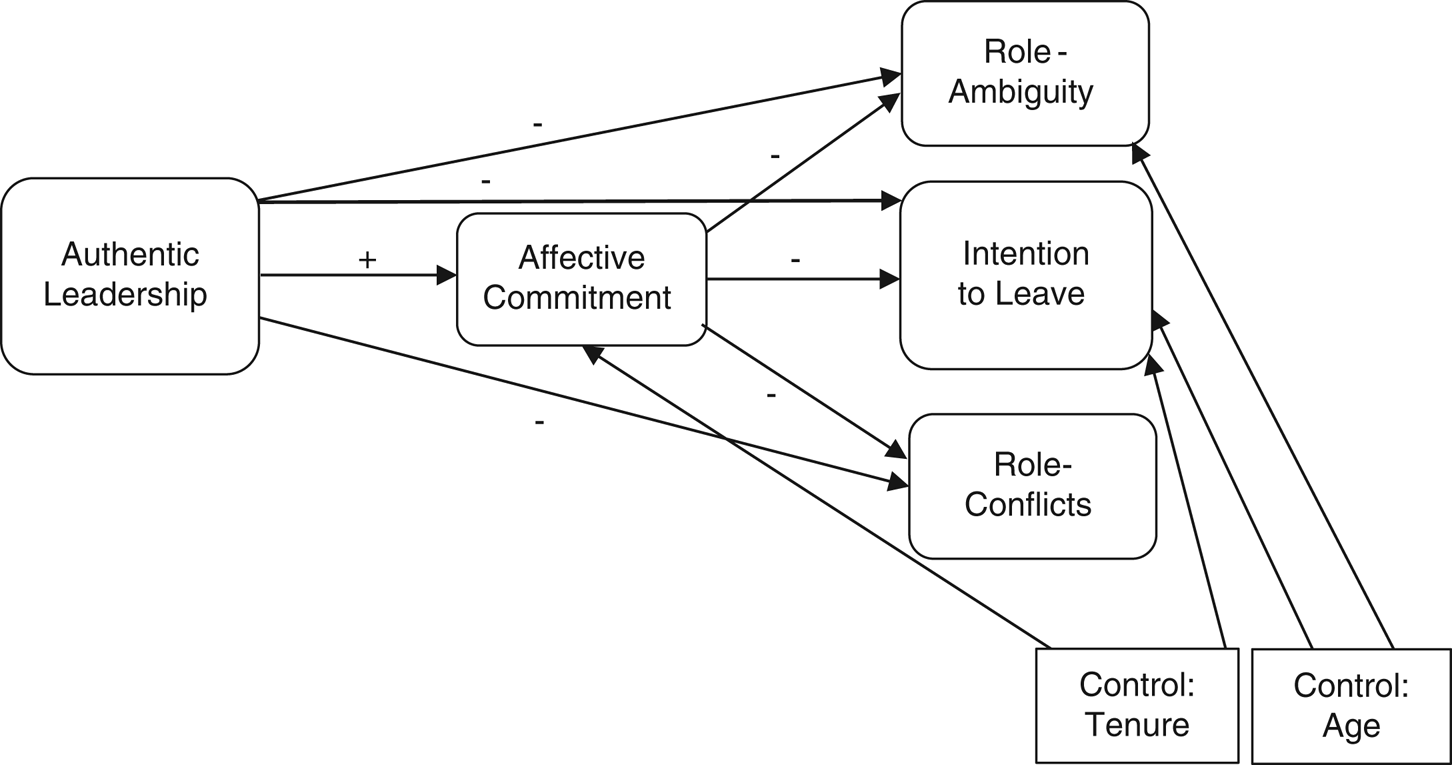
Leadership style was found to affect accountant job attitudes and performance (e.g., Otley & Pierce, Reference Otley and Pierce1995; Burke & Collins, Reference Burke and Collins2001; Chu & Lai, Reference Chu and Lai2011). For example, Chu and Lai (Reference Chu and Lai2011) sampled 546 accountants working for either the city or county government in Taiwan. The results indicate that transformational leadership has a positive influence on job performance through the mediating effect of organizational commitment. Similarly, Otley and Pierce (Reference Otley and Pierce1995) showed that a leadership style of managers in large CPA firms, characterized by low structure and high consideration, was found to be associated with low level of dysfunctional behavior, and vice versa. These studies indicate that when leaders are considerate, supportive, and inspirational, and have idealized influence, accountants tend to feel committed to the organization and promotes better performances and less dysfunctional behaviors. This evidence strengthens our four propositions that by exhibiting an AL style, CPA managers may intensify the commitment of their subordinates and reduce experienced role-stress and intentions to leave. Based on the above discussion, we formulate the study’s theoretical model (Figure 1).
Theoretical model

METHOD
Sample and procedure
The data were collected from CPAs in Israel using questionnaires. Sampling was done using a referral sampling (Sadler, Lee, Lim, & Fullerton, Reference Sadler, Lee, Lim and Fullerton2010). Students for the MA degree in accountancy (all of which are CPAs) helped with collecting data by handing questionnaires to their CPA colleagues. Both, the students and their colleagues filled up the survey and were included in the sample. Participants were asked to rate their direct manager’s leadership style and their attitudes towards their job. Four versions of the questionnaire were used, with the alternating order of measures. This was to rule out any possible bias that could occur as a result of the order effect (Schwarz, Strack, & Mai, Reference Schwarz, Strack and Mai1991). All questionnaire versions included a set of demographic questions at the end.
The original sample included 566 participants. Of this, 54 questionnaires were excluded due to large-scale missing values. The final sample included 512 CPAs, of which 53% were male and 47% female, with an average age of 31.74 years (SD=6.60); 76% of the CPAs work at a CPA firm and 24% work in other companies. Also, 65% of the participants have completed their internship. Several studies reported that junior accountants are more susceptible to occupational stress than any other group (Gaertner & Ruhe, Reference Gaertner and Ruhe1981; Sanders, Fulks, & Knoblett, Reference Sanders, Fulks and Knoblett1995). The tenure average was 44.45 months (SD=51.86).
Data were preliminarily analyzed using SPSS software. After the initial procedures, confirmatory factor analysis (CFA) was performed in order to test the measurement model’s reliability and validity, using AMOS software. The hypothesized model was tested by establishing structural equation model with latent variables while examining its goodness of fit metrics using AMOS software. Finally, the mediation effects were tested using the bootstrapping method.
Measures
AL
Walumbwa et al.’s (Reference Walumbwa, Avolio, Gardner, Wernsing and Peterson2008) original AL 16-item questionnaire (Authentic Leadership Questionnaire) was used to determine to what degree CPAs perceive their manager as an authentic leader. Participants were asked to rate statements regarding their manager on a 4-point Likert scale, ranging from 1=‘not at all’ to 4=‘always’. The Authentic Leadership Questionnaire measures AL as a second-order factor comprised of the four first-order factors: (a) self-awareness; (b) relational transparency; (c) internalized moral perspective; and (d) balanced processing. Based on CFA, two items were omitted due to poor correlation with the rest of the items. The composite reliability (CR) for this scale was 0.91.
Affective commitment
CPA affective commitment to their organization was measured using Meyer, Allen, and Smith’s (Reference Meyer, Allen and Smith1993) 6-items scale. Based on CFA one item was omitted. CR for this scale was 0.87.
Role-conflicts and role-ambiguity
Rizzo, House, and Lirtzman (Reference Rizzo, House and Lirtzman1970) scale was used to measure the level of role-conflicts and role-ambiguity perceived by the participants. The role-conflicts scale includes eight items, which describe several different types of role-conflicts. Based on CFA, one item was omitted. CR for this scale was 0.80. The role-ambiguity scale includes six items. The items reflect participant level of certainty about duties, responsibilities, authority, guides, and policies. CR for this scale was 0.88.
Intention to leave
The instrument that was used for measuring the degree of CPA intention to leave the organization is Walsh, Ashford, and Hill’s (Reference Walsh, Ashford and Hill1985) 5-item scale. The scale consists of statements ranging from thoughts about leaving the job to searching for alternative employment. CR for this scale was 0.95.
Control variables
Age and tenure are held as controls in order to account for their potentially confounding effects.
RESULTS
Data screening and preliminary tests
Collecting data from a relatively large sample enabled eliminating responses with a large scale of missing data. Responses with an inconsiderable amount of missing data were imputed with the serial mean. The standard deviation values of all questioner items were between 0.67 and 2.19, reflecting sufficient heterogeneity. A box plot examination for outliers was performed to negate unacceptable outliers. To ensure that there was no difference between the four versions of the questionnaire, and in order to rule out any possible bias that may occur as a result of the measures order, one-way analysis of variance tests were performed for each measure’s mean. The results indicate that the differences between the versions are insignificant (p>.05). Furthermore, linearity was tested by performing curve estimation regression for all direct effects in the model.
To account for common method bias, we took some procedural remedies before collecting data and applied some statistical remedies afterward. By using different instructions for each measure and different scale endpoints avoiding common scale properties, we aimed to reduce method biases, in line with Podsakoff, MacKenzie, and Podsakoff (Reference Podsakoff, MacKenzie and Podsakoff2012) recommendation. The statistical remedies included two different test. First, Harman’s single factor test was performed (Podsakoff & Organ, Reference Podsakoff and Organ1986). An exploratory factor analysis was carried out while constraining the number of factors to just one. The model’s explained variance was only 29%, indicating that a single factor does not account for the majority of the variance in the model, evidence of low chances for common method bias. Next, the potential effect of common method bias was assessed by performing CFA for alternative model structures (Podsakoff, MacKenzie, Lee, & Podsakoff, Reference Podsakoff, MacKenzie, Lee and Podsakoff2003). The results of the one-factor model yielded a very poor fit with the data. Similarly, two-factor, three-factor, and four-factor models also failed to show a better fit with the data, whereas the hypothesized structure model exhibited a good fit. The ex-ante and ex-post procedures we applied provide some indication that common method variance may not be a severe problem.
CFA
CFA was constructed with each variable modeled as a latent factor comprised of its items with one exception – the AL factor was divided into four sub-factors, creating a second-order model, in accordance with the recommended model of the Authentic Leadership Questionnaire developers (Walumbwa et al., Reference Walumbwa, Avolio, Gardner, Wernsing and Peterson2008). All the regression lines in the model were significant (p<.05) and the model demonstrated good fit (χ2 value [595]=1,058.9 [χ2/df<2, p<.05]; CFI=0.959; TLI=0.955; IFI=0.960; RMSEA=0.039).
CFA validity and reliability
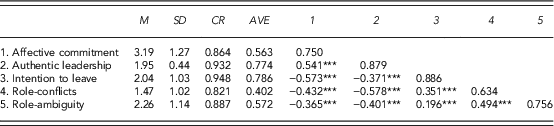
In order to test the convergent validity of the measurement model, average variance extracted (AVE) was calculated, as shown in Table 1. AVE level was above the threshold of 0.50 for all factors, except for role-conflicts, which was 0.402. According to the scale developers (Rizzo, House, & Lirtzman, Reference Rizzo, House and Lirtzman1970), the role-conflicts scale embodies three types of different role-conflicts, and yet has been used as an integrated one factor. The developers did not report an AVE value for the scale. Hence, it was concluded that such a complex scale is not expected to show high convergent validity, and therefore AVE value higher than 0.40 is sufficient. In addition, all factors demonstrated adequate discriminant validity, based on the fact that the square roots of the AVE values (on the diagonal of the matrix in Table 1) were higher than the inter-factor correlations. Finally, CR values were higher than 0.80, as shown in Table 1, indicating that all factors have proper reliability. Means and standard deviations of the variables in the model are displayed in Table 1, along with inter-factor correlations, CR, AVE, and square roots of AVE values.
Correlations, descriptive statistics, reliability and validity tests results for measurement model

Note. Square roots of AVE values are shown (on the diagonal).
AVE=average variance extracted; CR=composite reliability; M=mean.
*p<.001.
Hypotheses testing
Model testing
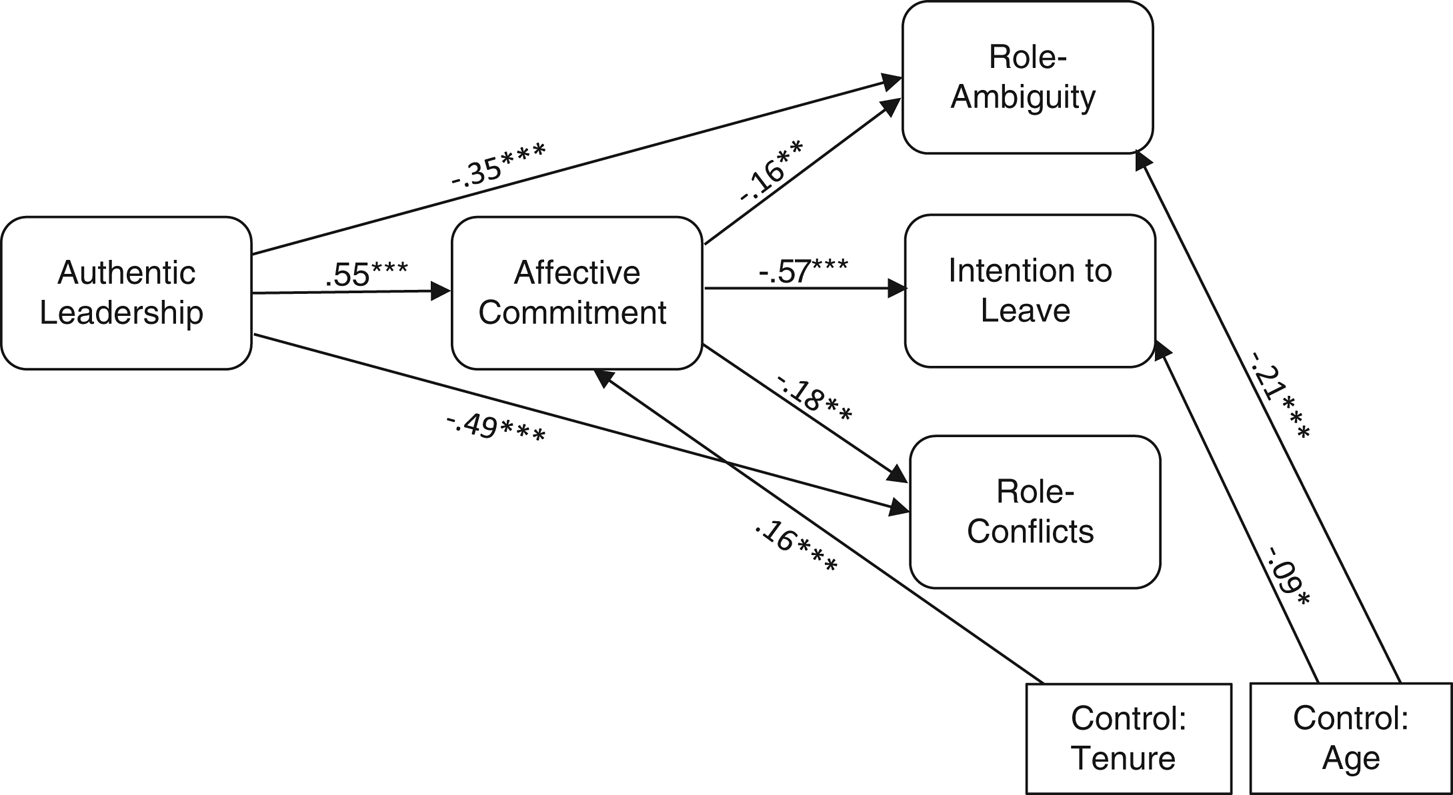
Structural equation model was established using the second-order measurement model, by drawing regression lines between the latent variables, according to the hypothesized theoretical model. The control variables (age and tenure) were added to the model, keeping only the significant regression lines between them and the relevant variables, as shown in Figure 2. In accordance with the hypotheses (Hypotheses 1–4), all the regression lines in the model were significant (p<.05) and the model demonstrated good fit (χ2 value [670]=1,213.9 [χ2/df<2, p<.05]; CFI=0.954; TLI=0.949; IFI=0.954; RMSEA=0.04).
Structural model (N=512, *p<.05, **p<.01, ***p<.001)

As hypothesized (Hypothesis 1, Hypothesis 2), AL positively relates to affective commitment (β=0.55, p<.001) and affective commitment negatively relates to intention to leave (β=0.57, p<.001). In addition, as hypothesized (Hypothesis 3), AL negatively relates to role-conflicts, directly (β=–0.49, p<.001) and through the mediation of affective commitment (β=–0.18, p<.01). Finally, as hypothesized (Hypothesis 4), AL negatively relates to role-ambiguity, directly (β=–0.35, p<.001) and through the mediation of affective commitment (β=–0.16, p<.01).
Mediation effects
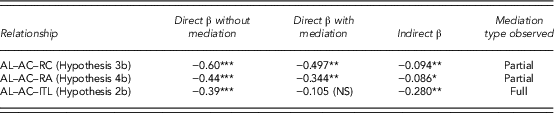
Mediation was tested using 2000 bias-corrected bootstrapping resamples in AMOS. For each relationship, the direct regressions were tested once without the mediator (affective commitment) and once with the mediator, along with the indirect effect. This procedure was done in order to test if the mediation is significant and to determine its type. As shown in Table 2, all the effects of the relationship between AL and role-conflicts (Hypothesis 3) were significant (p<.01). Similarly, the effects of the relationship between AL and role-ambiguity (Hypothesis 4) were found to be significant as well (p<.05). Hence, it was concluded that affective commitment significantly mediates these two relationships and that the mediation is partial, as hypothesized.
Mediation effects (N=512)
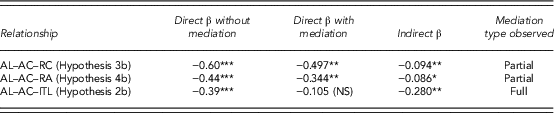
Note. AC=affective commitment; AL=authentic leadership; ITL=intention to leave; RA=role-ambiguity; RC=role-conflicts.
*p<.05; **p<.01; ***p<.001.
Regarding the relationship between AL and intention to leave (Hypothesis 2), the direct effect without the mediator (affective commitment) and the indirect effect were found to be significant (p<.01), while the direct effect with the mediator was found to be insignificant (p>.05). Hence, it was concluded that affective commitment significantly mediates this relationship and that the mediation is full. Therefore, the direct regression line between AL and intention to leave was removed from the model (prior to the model fit examination).
DISCUSSION
The current study aimed to investigate whether AL, demonstrated by CPA managers, has a positive effect on subordinate job attitudes. The study examined whether AL can reduce employee perceived role-stress and intention to leave the organization, through the mediation of affective commitment.
Main findings
The results of the present study indicate that the more CPAs perceive their managers exhibit AL behaviors, they experience greater affective commitment and, in turn, lower levels of perceived role-stress and intentions to leave. Specifically, the results show that managers’ levels of AL negatively relate to perceived role-conflicts and role-ambiguity, directly and through the mediation of affective commitment. In addition, the negative correlation between AL and intention to leave is fully mediated by affective commitment.
These findings contribute greatly to both AL theory and the CPA profession. In recent years there has been growing scholarly interest in AL that yielded a considerable amount of studies in this field (Gardner et al., Reference Gardner, Cogliser, Davis and Dickens2011; Banks et al., Reference Batt2016). However, to our knowledge, this is the first time that the benefits of AL are demonstrated among the CPA profession. The study’s findings support AL theory by giving evidence for its relevance for professions, which are considered to be ‘conventional’ (Holland, Reference Holland1973), numbers and details oriented (Maslow, Reference Mathieu, Fabi, Lacoursière and Raymond1965), and tend to have difficulties handling emotional situations (Segal, Reference Segal1961), such as the CPA profession. This result strengthens the argument that being an authentic leader is valuable in all professions. Organizations, managers, and subordinates could benefit from AL not only in professions which tend to be people oriented by nature (e.g., education, social work, nursing, etc.) but also in professions that are detail oriented.
In addition, a significant number of studies indicated that AL demonstrated by managers is positively related to desirable subordinates’ job attitudes and negatively related to subordinates’ withdrawal behavior (e.g., Laschinger & Fida, Reference Laschinger and Fida2014; Shapira-Lishchinsky & Tsemach, Reference Shapira-Lishchinsky and Tsemach2014; Agote, Aramburu, & Lines, Reference Agote, Aramburu and Lines2016; Xiong, Lin, Li, & Wang, Reference Xiong, Lin, Li and Wang2016). Moreover, previous studies reported on the negative relationships between affective commitment and role-conflicts and role-ambiguity (Jackson & Schuler, Reference Jackson and Schuler1985; Meyer et al., Reference Meyer, Stanley, Herscovitch and Topolnytsky2002). However, to date, the relationship between AL and role-stressors has not been established in the literature. Our results support the claim that by creating a climate of openness, transparency, and trust, and by assisting their followers to cope better with challenging situations, authentic leaders create a positive environment where there are less ambiguity and fewer conflicts. The indirect effect of AL on these variables, mediated by affective commitment, is in line with Meyer and Herscovitch’s (Reference Meyer and Herscovitch2001) point of view. They suggested that employees with affective commitment experience a psychological bond with the organization, which gives them a sense of stability, security, and belonging, and makes them more resistant to any kinds of work stressors.
We suggest that role-conflicts and role-ambiguity can be influenced by affective commitment rather than affecting it, as proposed by previous studies (Meyer et al., Reference Meyer, Stanley, Herscovitch and Topolnytsky2002). The current research design cannot indicate on causality; there is a need for further experimental research to bring a solid evidence for such assumption. However, we believe that there is a good reason to argue that along with the direct effect of AL, affective commitment can alleviate perceived role-ambiguity and role-conflicts. The effect of commitment on role-stressors could be explained in several ways: (a) commitment is an essential resource that enables individuals to resist stress factors and better cope with them (Meyer & Herscovitch, Reference Meyer and Herscovitch2001); (b) commitment can enhance the motivation to learn about one’s role expectations and therefore reduce role-ambiguity (Jackson & Schuler, Reference Jackson and Schuler1985), and (c) it is more likely that a committed person may not question the organization’s goals and values and thus may experience less role-conflicts (Jackson & Schuler, Reference Jackson and Schuler1985).
Moreover, the results show that the more CPAs perceive their managers as authentic leaders the higher is their affective commitment to the organization and the lower is their intention to leave. The positive relationship between AL and affective commitment is in congruence with previous findings (e.g., Jensen & Luthans, Reference Jensen and Luthans2006; Peus et al., Reference Peus, Wesche, Streicher, Braun and Frey2012; Semedo, Coelho, & Ribeiro, Reference Semedo, Coelho and Ribeiro2016), as well as the negative relationship between affective commitment and intention to leave (e.g., Griffeth, Hom, & Gaertner, Reference Griffeth, Hom and Gaertner2000; Firth et al., Reference Firth, Mellor, Moore and Loquet2004). The current study’s results indicate that affective commitment mediates fully the relationship between AL and intention to leave. This finding supports the theoretic reasoning suggesting that authentic leaders enhance the affective commitment of their followers, which in turn reduces their intention to leave the organization.
Implications
The present study’s findings could have significant applications in the organizational field, in general, and in CPA firms, in particular. The finding that AL affects role-stressor perception, directly and through the mediation of affective commitment, carries great importance for organizations characterized by high levels of stress, such as CPA firms. It is very difficult to reduce stress factors, which are often embedded in the job’s characteristics. Yet by training managers to develop AL style, the organization may enhance employee affective commitment and help with coping better with stressful tasks. On top of that, having an authentic leader manager, who is able to listen patiently, to demonstrate understanding and empathy, and who holds relationships based on trust, openness, and transparency (George, Reference George2007), could help with reducing stress. It would be much easier for workers to approach such managers and consult them, without being afraid to be judged, criticized, or being pushed into a corner. Such managers would be able to support, empower, and guide subordinates to better cope with challenging situations.
Moreover, the finding that high levels of AL in managers predict high levels of affective commitment in subordinates, and in turn, low levels of intentions to leave, can help organizations to control undesired turnover. As noted above, turnover can reduce the organization’s performance or cause undesirable expenses (e.g., Baron, Hannan, & Burton, Reference Baron, Hannan and Burton2001; Batt, Reference Banks, McCauley, Gardner and Guler2002). Specifically, excessive turnover has been considered a ‘plague’ in CPA firms, creating extensive damage, and unnecessary high expenses (Chong & Monroe, Reference Chong and Monroe2015). Hence, it can be of great value for organizations, in general, and CPA firms, in particular, to invest in having their managers participate in AL development programs. Developing AL in managers could be carried out in several different ways, using different organizational interventions such as group workshops, individual consultations, mentoring programs, or a combination of the above.
Limitations and future research
The methodological limitations of the present research should be acknowledged. First, testing only subordinate perceptions regarding their managers reveals limited perspective. Having managers rate themselves and subordinate behavior could have produced a larger picture.
Another limitation might stem from the sample’s large size. Large samples may increase the chance of a type one error, namely, finding a significant effect that does not exist in reality. Nevertheless, the current study’s findings indicate that all reported effects had p-values smaller than 0.01, and most of them were even below 0.001. These low p-value levels suggest that the chances of type one errors are very low. Future studies could help with shedding more light on how AL affects subordinate stress. It is recommended to test this effect in other occupations, work climates, and job characteristics, and to determine under which conditions and stress factors AL affects stress. Moreover, it is recommended to measure the actual stress subordinates experience in their work, and how it is affected by manager levels of AL.
Conclusion
The present study offers a broader understanding of AL by presenting an integrative model of AL outcomes. The model can be of great value for organizations in general, and CPA firms, in particular, by enhancing employee affective commitment and dealing with role-stress perceptions, as well as controlling undesired intentions to quit the practice. This study expands the theory of AL by bringing evidence for its relevancy to occupations that tend to be details and numbers oriented by nature and for its effects on reducing perceived role-stress factors.