Introduction
Large-scale mass gatherings (MGs), such as the 2014 Football World Cup in Brazil, the Olympics, and the Haj pilgrimage, all have significant implications for the health of the public. Mass gatherings bring an opportunity to strengthen multisectoral collaboration, to increase capacity in health infrastructure, to raise awareness, and to promote positive health behaviors given the media and public attention focused on such events.Reference Dwivedi and Cariappa 1
The experience of organizing the public health response for the Kumbh Mela in early 2013 in India is highlighted in this report. The Kumbh Mela is considered to be the largest gathering of human beings anywhere in the world. 2 This religious festival, on the banks of the River Ganga in India, is celebrated once every 12 years at each of four different locations, and also once in 144 years at Allahabad, India.
A MG usually is defined as more than a specified number of persons at a specific location for a specific purpose for a defined period of time. 3 During the 2013 edition of the festival, over a duration of 55 days, nearly 120 million pilgrims visited the festival site. 4
Report
The Challenge
The challenges that crop up in handling such a large congregation, as happens every few years at the Kumbh Mela at its various locations in India, have been studied and commented upon by various agencies in the popular press, and nowadays on social media, but they seldom have been reported in the scientific literature. As the scale of organization and the non-commercial nature of such events usually are beyond the scope of the private sector, by default, the local government has to assume responsibility for conduct of such events, whether in Saudi Arabia for the Haj, or the Roman Catholic World Youth Day congregations.
The prolonged interval between festivals of this magnitude ensures that public health managerial skills and the knowledge acquired in handling such mega events rarely are available for subsequent MG events, given the nature of bureaucracy in a developing country, unless records and Standard Operating Procedures are stored in shared online information repositories or published in the scientific literature.
The challenge faced in planning health care (a vital component of public health service delivery) has been covered elsewhere 5 to enable the focus here to be retained on hygiene and sanitation aspects.
In the run up to the 2013 festival, the commitment of the political leadership and devolving there from, the involvement of the bureaucratic machinery, resulted in a well-conceived and professionally planned public health response. 4
Historical Background: A Look Back in Time
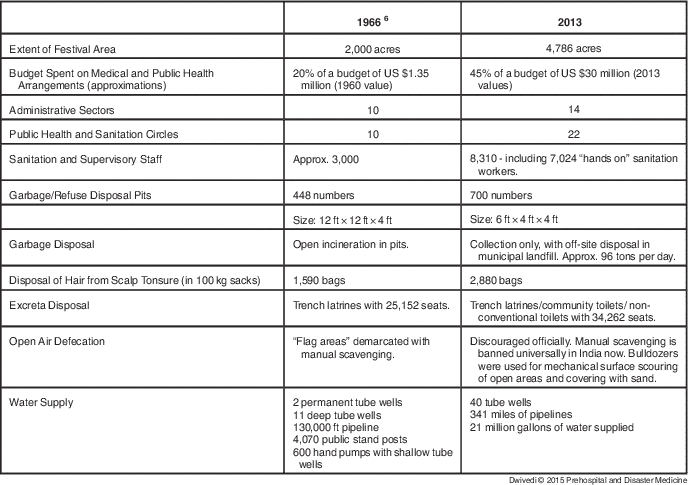
A previous report from 1966 has been contrasted with the modern day approach to public health management (Table 1).Reference Cariappa, Singh, Mahen and Bansal 6 Where earlier, the threat mostly was from cholera and such gastrointestinal diseases, now the threat perception has also been expanded to security breaches and the ever-present spectra of terrorism.Reference Bagchi and Banerjee 7
Kumbh Mela Festival: 1966 vs 2013

Numbers: Do They Matter?
There is no scientific validation of the exact numbers of pilgrims who attended the Kumbh Mela in 2013, owing to the scale of logistics that would have been involved to get a factual number. Hence, “guess-timates” of actual numbers of pilgrims vary, with upwards 120 million people thought to have visited in 2013; however, there are divided views on this too. 8 Proponents of mythological statistics have even come up with an estimated attendance at the festival of nine percent of India’s population of 1.2 billion.Reference Sugden 9
Planning and Preparing for Disease Outbreaks
Diarrheal diseases, including cholera, continue to be a risk at any gathering, despite rapid monitoring and prompt public health interventions. Hence, the organizing agencies were geared up for this contingency and had planned for occurrence of outbreaks of food and water borne illnesses with stockpiles of antibiotics, intravenous fluids, and disinfectants. Expansion capabilities of the various temporary and permanent health care establishments were tested periodically through dry runs. Real-time monitoring of the disease and morbidity patterns was not planned for, due to the technological infrastructure that would have been required; instead, a daily monitoring of the morbidity pattern of illnesses was being done at the central control center through inputs and feedback from the various health care facilities. 5
Hygiene and Sanitation Measures
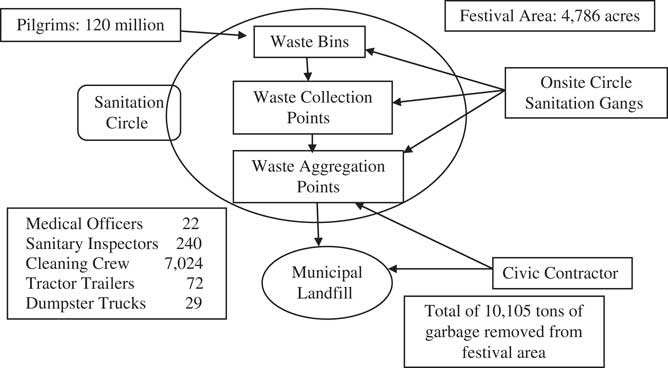
Using geographical information systems mapping, the festival area was demarcated into well-defined Circles/Sectors using satellite maps and ground surveys. There was complete decentralization of control of hygiene and sanitation with autonomy of functioning at the Circle level. Due to shortage of public health professionals, a medical doctor had been placed in charge of each Circle, with dedicated supervisory staff in a hierarchal system (from the supervisor level to field workers) available to help. Outsourcing of solid waste disposal, including biomedical waste from the various health care facilities, had been planned and implemented with an efficient system of area sweeping and sanitation, including garbage collection and movement (Figure 1).
Solid Waste Management.
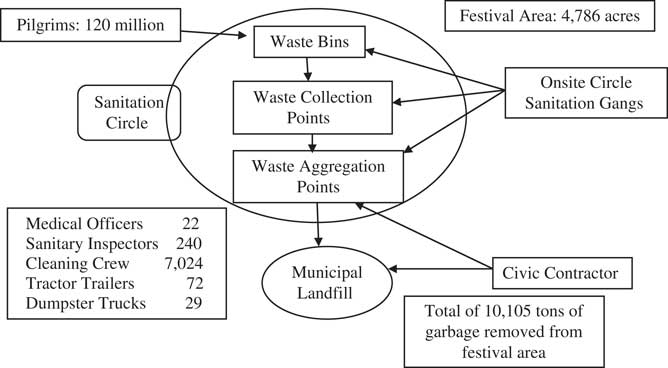
Dedicated manpower for maintenance of hygiene and sanitation was pooled from across the local region, with exclusive tasking for the duration of the festival. Outsourcing was done only at the lowest level of the hierarchy (ie, at the field worker level). Incentivisation of personnel was done through a grant of a special monetary allowance. Hand-picked personnel were placed at key supervisory positions, based on their track record.
There was an ongoing advertisement campaign highlighting the “fly less” Kumbh Mela, and thus, the administration was being challenged constantly to maintain hygiene to actually ensure a “fly less” festival. Western stringent standards of hygiene cannot be applied realistically in conditions where indiscriminate open air defecation is still the norm, based on prevalent cultural and socio economic paradigms, and littering and spitting in public are still not social taboos: 10 “Public health isn’t just about what the government provides; it’s also about how people behave.”Reference Rautela 11
Clockwork garbage and refuse disposal through the streamlined sectoral system, around the clock street sweeping of the damp sandy plains, and lastly, chemical control of fly breeding through intensive chemical spraying operations did result in a relatively “fly less” festival (aided in no small measure by the cool climate).
In 1966,Reference Cariappa, Singh, Mahen and Bansal 6 Gammexane was the chemical of choice for vector control, while in 2013, a variety of organophosphophate pesticides were used and rotated through the different sectors.Reference Koch 12
Discussion
The fears of every public health practitioner when planning for and preparing for a MG event, and especially one of the magnitude of the Kumbh Mela, is the outbreak of gastrointestinal disease, of which cholera is the most dreaded. The fertile Gangetic plains were once the playground of Vibrio Cholerae, 13 and measures to counter this enemy were planned to cover the spectrum from assuring safe water supplies to promoting overall hygiene and sanitation in the festival area.
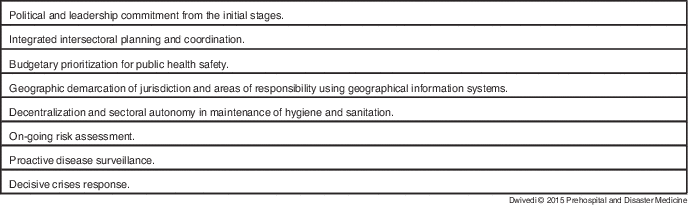
Despite the large numbers of people who attended the festival, there was a relatively low morbidity rate of illnesses and no outbreaks of any disease. This has put paid to the mostly “Developed World” focus on the state of the Ganges and the potential health issues of poor sanitation in this MG of pilgrimsReference Bryceson 14 (the common Indian pilgrim, it appears, prefers to focus more on faith, peace, and inner happiness, and the fervent desire to wash away sins and earn credits for future lives). This does not, however, detract from the fact that the Ganges is in an abysmal stateReference Vortmann 15 and that crises may have been lurking throughout the festival ranging from stampedes to inclement weather.Reference Bhardwaj 16 , Reference Greenough 17 However, what comes to the forefront is the efficient public health planning and response based on teamwork and intersectoral coordination under able administrative leadership, as presented at a recent Harvard University (Cambridge, Massachusetts USA) conclave.Reference Pandey 18 Public health risk assessment in MG events is a continuous process that should occur throughout the period leading up to the event, and should also be sustained during the event itself. Planners need to cater for an ongoing assessment of how their public health system, the local health care system, and the broader community in the region will cope with increases in communicable diseases or disease risk related to the event (Table 2). Risk assessment for public health threats should thus be both strategic and case-based.Reference Dhama 19
Broad Themes for Preparedness for Mass Gatherings

It is a common perception that hygiene and sanitation is accorded a lower priority in developing countries.Reference Abubakar, Gautret and Brunette 20 , Reference Cairncross, Bartram, Cumming and Brocklehurst 21 However, resource estimation and budgetary allocation had been done earlier, taking into consideration the requirements of all stakeholders at the highest level in the local government. Thus, there was no restriction in funding for hygiene and sanitation with an adequate budget allocated based on anticipated population visiting the region (assumed to be an incremental percentage of attendance at the last festival in 2001).
Political directions ensured that the leadership had an attitude of synergy in functioning. The adoption of a “win-win” model in man management, and a “bottom up” approach for obtaining feedback from the peripheries of the system, proved highly successful.
A planning failure noted in the post-event analysis was the need to provide for a sustained mop-up campaign for ensuring complete clearance of the festival sites in the weeks after the encampments had been wound up. This highlights the requirement of planning for post-event environmental impact mitigation.
A system of real-time monitoring of movement of waste disposal vehicles and other sanitation vehicles could be planned for, along with preparation of sanitation quick response teams. Usage of global positioning systems, mobile telephony, and portable monitoring devices could suitably be incorporated for monitoring not just disease and morbidity patterns, but also the hygiene and sanitation situation. This harnessing of low-cost technology alternatives should be planned for at all such future MG events.
The “pop-up-tent city”Reference Bartram and Cairncross 22 that housed millions during its brief existence was a shining example of proactive planning and preparedness that catered to an unimaginable proportion of humanity in developing world context.
The development and maintenance of ad hoc water and sewage treatment systems in a MG event to ensure safe drinking water and safe disposal of sewage for all, apart from keeping contaminated sewage out of water, foods, and the environment, is one of the most essential functions of public health. Diarrheal diseases, especially cholera, can cause calamitous loss of life and incite international panic. These are as much symptoms as diseases. They are a symptom of inadequate attention and insufficient resource allocation in assuring access to safe water and improved sanitation, and hence, are most important to be paid attention to at the planning stage.Reference Koch 23
Earlier efforts too, highlighted decades ago, were successful in managing to prevent outbreaks of disease.Reference Waldman, Mintz and Papowitz 24 The jury is out for sentient introspection on whether success in prevention can be attributed to divine blessings or overall improvements affected in public health, hygiene, and sanitation. The relevance of human will, commitment, and dedication in making past, present, and future Kumbh Mela’s successful conglomerations of religious humanity resonates true as an example of public health in action.Reference Banks 25
Conclusion
Holistic, intersectorally coordinated public health planning and preparedness is key to ensuring the successful conduct of a MG event, be it a football World Cup, a rock music festival, or a religious gathering. Hence, public health practitioners and students alike must seek out opportunities to study similar MG events across the world for lessons to be distilled, and mistakes to be learnt from, to prevent mishaps and outbreaks during future events.