Introduction
It has been suggested that the neurotransmission of both serotonin and dopamine plays a role in personality traits, mood states and neuropsychological functioning. Consequently, dysfunction of the serotonergic and/or dopaminergic system is thought to be implicated in diverse psychopathologies, for example depression, schizophrenia, obsessive–compulsive disorder and impulsivity-related disorders such as attention deficit hyperactivity disorder (ADHD) (Aouizerate et al. Reference Aouizerate, Guehl, Cuny, Rougier, Burbaud, Tignol and Bioulac2005; Hariri & Holmes, Reference Hariri and Holmes2006; Gudelsky & Yamamoto, Reference Gudelsky and Yamamoto2008; Oades, Reference Oades2008; Pattij & Vanderschuren, Reference Pattij and Vanderschuren2008; Zhu & Reith, Reference Zhu and Reith2008; Howes & Kapur, Reference Howes and Kapur2009). Dopamine has been linked to neuropsychological functions such as selective attention, working memory and motivational functions (Robbins & Roberts, Reference Robbins and Roberts2007). Furthermore, antidepressant drugs such as selective serotonin reuptake inhibitors (SSRIs) may enhance cognitive functioning and learning abilities, which points to the involvement of serotonin in learning and memory (Meneses, Reference Meneses1999). Personality traits and neuropsychological abilities refer to functional patterns that differ among individuals. They are thought to be, in part, heritable (Cloninger, Reference Cloninger1987; Edmonds et al. Reference Edmonds, Isaacs, Visscher, Rogers, Lanigan, Singhal, Lucas, Gringras, Denton and Deary2008; Friedman et al. Reference Friedman, Miyake, Young, De Fries, Corley and Hewitt2008), and several associations have been reported with factors related to neurotransmission, for example polymorphisms in the serotonin transporter gene (5-HTTLPR) (Hariri & Holmes, Reference Hariri and Holmes2006; Roiser et al. Reference Roiser, Rogers, Cook and Sahakian2006). The central question emerging from these findings is whether in vivo assessment of neurotransmitter systems allows us to make predictions about cognition, self-reported mood states and personality traits.
The serotonin transporter (SERT) and dopamine transporter (DAT) are expressed exclusively in the membrane of serotonergic and dopaminergic neurons respectively, and regulate intrasynaptic neurotransmitter levels. The homeostatic tone of neurotransmitter systems is reflected by transporter concentration (Stahl, Reference Stahl2000). Positron emission tomography (PET) and single photon emission computed tomography (SPECT) enable us to quantify the in vivo availability of central SERTs and DATs.
So far, only a few studies have investigated the relationship between markers of serotonergic/dopaminergic transmission and cognition, mood and personality in healthy subjects, and have yielded inconsistent results (Mozley et al. Reference Mozley, Gur, Mozley and Gur2001; Suhara et al. Reference Suhara, Yasuno, Sudo, Yamamoto, Inoue, Okubo and Suzuki2001; Takano et al. Reference Takano, Arakawa, Hayashi, Takahashi, Ito and Suhara2007; Borg et al. Reference Borg, Henningsson, Saijo, Inoue, Bah, Westberg, Lundberg, Jovanovic, Andree, Nordstrom, Halldin, Eriksson and Farde2009; Kalbitzer et al. Reference Kalbitzer, Frokjaer, Erritzoe, Svarer, Cumming, Nielsen, Hashemi, Baare, Madsen, Hasselbalch, Kringelbach, Mortensen and Knudsen2009; Tsai et al. Reference Tsai, Yeh, Hsieh, Lee, Chen, Chen, Yang and Yao2009). Takano et al. (Reference Takano, Arakawa, Hayashi, Takahashi, Ito and Suhara2007) demonstrated a positive correlation between the neuroticism personality trait and thalamic SERT binding in healthy subjects. Kalbitzer et al. (Reference Kalbitzer, Frokjaer, Erritzoe, Svarer, Cumming, Nielsen, Hashemi, Baare, Madsen, Hasselbalch, Kringelbach, Mortensen and Knudsen2009) found the personality trait ‘openness to experience’, with high scores being indicative of cognitive flexibility and openness to change, to be associated with lower SERT binding in the midbrain, putamen and thalamus. In another study, ‘novelty seeking’ was correlated negatively with D2 receptors in the right insular cortex (Suhara et al. Reference Suhara, Yasuno, Sudo, Yamamoto, Inoue, Okubo and Suzuki2001). Mozley et al. (Reference Mozley, Gur, Mozley and Gur2001) have provided the only report on significant associations between striatal DAT availability and memory in healthy controls. Conversely, Borg et al. (Reference Borg, Henningsson, Saijo, Inoue, Bah, Westberg, Lundberg, Jovanovic, Andree, Nordstrom, Halldin, Eriksson and Farde2009) did not find any association of neuropsychological test scores and serotonin receptor (5-HT1A) density, but reported a relationship between performance on the Wisconsin Card Sorting Test and the 5-HTTLPR genotype. Finally, a study by McCann et al. (Reference McCann, Szabo, Vranesic, Palermo, Mathews, Ravert, Dannals and Ricaurte2008) compared 2-week-abstinent 3,4-methylenedioxy-N-methamphetamine (MDMA; ‘ecstasy’) users and healthy controls on DAT and SERT availability and the association with performance on neuropsychological tests. In the controls, lower SERT availability in the dorsolateral prefrontal cortex and parietal cortex was associated with poorer performance on several memory tasks and the Digit Span Scale.
Studies that looked at personality traits in cohorts that also included psychiatric patients have consistently shown evidence for associations between DAT/SERT and neuropsychological or personality disturbances, but the direction of association remains conflicting. For example, impulsivity is thought to play a role in several psychopathologies, including ADHD and impulsive suicidal behavior. In some studies, impulsivity was found to be associated with lower SERT binding (Lindström et al. Reference Lindström, Ryding, Bosson, Ahnlide, Rosén and Träskman-Bendz2004; Ryding et al. Reference Ryding, Ahnlide, Lindström, Rosén and Träskman-Bendz2006) and higher DAT availability (Tiihonen et al. Reference Tiihonen, Kuikka, Bergstrom, Karhu, Viinamaki, Lehtonen, Hallikainen, Yang and Hakola1997) whereas another study found associations in the opposite direction (Koch et al. Reference Koch, Schaaff, Pöpperl, Mulert, Juckel, Reicherzer, Ehmer-von Geiso, Moeller, Hegerl, Tatsch and Pogarell2007). Similarly, SERT alterations have often been reported in mood disorders (Ichimiya et al. Reference Ichimiya, Suhara, Sudo, Okubo, Nakayama, Nankai, Inoue, Yasuno, Takano, Maeda and Shibuya2002; Meyer et al. Reference Meyer, Houle, Sagrati, Carella, Hussey, Ginovart, Goulding, Kennedy and Wilson2004; Parsey et al. Reference Parsey, Hastings, Oquendo, Huang, Simpson, Arcement, Huang, Ogden, Van Heertum, Arango and Mann2006). High scores on depression rating scales were associated with low SERT binding in depressed patients (Newberg et al. Reference Newberg, Amsterdam, Wintering, Ploessl, Swanson, Shults and Alavi2005; Joensuu et al. Reference Joensuu, Tolmunen, Saarinen, Tiihonen, Kuikka, Ahola, Vanninen and Lehtonen2007; Lehto et al. Reference Lehto, Tolmunen, Joensuu, Saarinen, Valkonen-Korhonen, Vanninen, Ahola, Tiihonen, Kuikka and Lehtonen2008 a), but others could not replicate these findings (Koch et al. Reference Koch, Schaaff, Pöpperl, Mulert, Juckel, Reicherzer, Ehmer-von Geiso, Moeller, Hegerl, Tatsch and Pogarell2007) or found associations in the opposite direction (Ichimiya et al. Reference Ichimiya, Suhara, Sudo, Okubo, Nakayama, Nankai, Inoue, Yasuno, Takano, Maeda and Shibuya2002; Meyer et al. Reference Meyer, Houle, Sagrati, Carella, Hussey, Ginovart, Goulding, Kennedy and Wilson2004). Finally, neuroimaging studies investigating drug-induced neurotoxic effects on cognition have found correlations between memory task performances and monoamine transporter availability (DAT and vesicular monoamine transporter) in the striatum of current and former MDMA and N-methyl-phenylpropylamine (methamphetamine) users (Johanson et al. Reference Johanson, Frey, Lundahl, Keenan, Lockhart, Roll, Galloway, Koeppe, Kilbourn, Robbins and Schuster2006; Schilt et al. Reference Schilt, de Win, Koeter, Jager, Korf, van den Brink and Schmand2007; de Win et al. Reference de Win, Jager, Booij, Reneman, Schilt, Lavini, Olabarriaga, den Heeten and van den Brink2008; McCann et al. Reference McCann, Szabo, Vranesic, Palermo, Mathews, Ravert, Dannals and Ricaurte2008).
Overall, there are large inconsistencies in, and especially in the direction of, possible associations of central DAT and SERT concentrations and the expression of particular personality traits, mood states and neuropsychological functions. This is especially true for studies in subjects without clinically relevant psychopathology. The aim of this study was therefore to resolve this problem of inconsistent findings by examining a much larger sample of young healthy subjects than those that were studied before, using both neuropsychological tasks and mood and personality self-reports in a study simultaneously looking at SERT and DAT.
Method
Subjects
A group of healthy young adults (aged 18–24 years, 111 females, 77 males) was recruited between 2002 and 2004. These subjects had participated in The Netherlands XTC Toxicity (NeXT) Study, of which a detailed description can be found elsewhere (de Win et al. Reference de Win, Jager, Vervaeke, Schilt, Reneman, Booij, Verhulst, den Heeten, Ramsey, Korf and van den Brink2005 b). Participants were actively recruited (de Win et al. Reference de Win, Jager, Vervaeke, Schilt, Reneman, Booij, Verhulst, den Heeten, Ramsey, Korf and van den Brink2005 b) and they were ecstasy-naive at the time of recruitment. The main criterion for inclusion was intent (probable or certain) to use ecstasy in the near future for the first time. Exclusion criteria were age <18 or >35 years, ecstasy use in the past, severe physical or mental illness, use of psychotropic medications (e.g. SSRIs), pregnancy and intravenous drug use. Subjects had to abstain from psychoactive substances for at least 2 weeks and from alcohol for at least 1 week before examinations. This was checked in urine (enzyme-multiplied immunoassay for amphetamines, MDMA, opioids, cocaine, benzodiazepine, cannabis, and alcohol). The study was approved by the medical ethics committee of the Academic Medical Center, University of Amsterdam. All subjects gave written informed consent and received a reimbursement for their participation.
Neuropsychological tests and personality questionnaires
A detailed description of the tests and questionnaires that were used can be found elsewhere (Schilt et al. Reference Schilt, de Win, Koeter, Jager, Korf, van den Brink and Schmand2007).
Cognition
Attention and working memory
The Paced Auditory Serial Addition Test (PASAT; Gronwall, Reference Gronwall1977) measures working memory and arithmetical skills (maximum score 60). The Digit Span Scale (DSS), a subtest of the Wechsler Adult Intelligent Scale – Revised (WAIS-R; Wechsler, Reference Wechsler1981), measures working memory capacity (maximum score 21). The Rey Auditory Verbal Learning Test (RAVLT; Rey, Reference Rey1964; Van den Burg et al. Reference Van den Burg, Saan and Deelman1985) measures verbal memory in terms of recalling a list of 15 words (maximum score 75, after five trials), delayed recall (maximum score 15, after 20 min), and recognition (maximum score 30).
Visual memory and visuospatial function
A computerized adaptation of the Memory for Designs Test (MFDT; Graham & Kendall, Reference Graham and Kendall1960) was used to test visual memory in terms of number of correctly reproduced elements (maximum score 105, after five trials) and delayed (maximum score 21, after 15 min) reproduction. In the Mental Rotation Test (Shepard & Metzler, Reference Shepard and Metzler1971), subjects must judge whether 20 pairs of block designs, drawn from different perspectives, were identical or different (maximum 40 hits, maximum time 6 min). A computerized adaptation of the Judgment of Line Orientation task (JoLO; Benton et al. Reference Benton, Varney and Hamsher1987) was used to test visuospatial functioning. Subjects are required to identify which two of 11 lines, presented in a semicircular array, have the same orientation in a two-dimensional (2D) space (maximum score 30).
Impulsivity, decision making and risk-taking behavior
A computerized version of the Iowa Gambling Task (IGT; Bechara et al. Reference Bechara, Damasio, Damasio and Anderson1994, Reference Bechara, Damasio, Damasio and Lee1999) was used to measure decision making and risk-taking behavior. The explicit goal of the test is to maximize profit on a loan of play money (Bechara et al. Reference Bechara, Damasio and Damasio2000) (maximum score 60).
Intelligent quotient
Verbal intelligence was estimated with the Dutch Adult Reading Test (DART; Schmand et al. Reference Schmand, Bakker, Saan and Louman1991), a Dutch version of the National Adult Reading Test (NART; Nelson & O'Connell, Reference Nelson and O'Connell1978).
Personality
The 31-item Dutch version of the Barratt Impulsiveness Scale, version 11 (BIS-11), scored on a four-point scale, was used as a measure of self-reported impulsivity (Patton et al. Reference Patton, Stanford and Barratt1995), with subscales representing attentional, motor and non-planning impulsivity. The Spanningsbehoefte lijst (SBL), the 51-item Dutch adaptation of the Sensation Seeking Scale (Zuckerman & Link, Reference Zuckerman and Link1968), was used to measure sensation seeking (Feij et al. Reference Feij, Van Zuilen and Gazendam1982). A general sensation seeking score (scored from 1 to 5), the sum of the subscales ‘thrill and adventure seeking’ (TAS), ‘experience seeking’ (ES), ‘boredom susceptibility’ (BS) and ‘disinhibition’ (DIS), was calculated.
Mood
Depression
Current depressive symptoms were assessed using the 21-item Beck Depression Inventory (BDI; Beck et al. Reference Beck, Ward, Mendelson, Mock and Erbaugh1961), with higher scores indicating more depressive symptoms (maximum score 63).
SPECT and magnetic resonance imaging (MRI)
Acquisition
SPECT was used for quantifying subcortical SERT and striatal DAT availabilities (Reneman et al. Reference Reneman, Booij, de Bruin, Reitsma, de Wolff, Gunning, den Heeten and van den Brink2001 a, Reference Reneman, Lavalaye, Schmand, de Wolff, van den Brink, den Heeten and Booijb). Subjects were intravenously injected with approximately 4 mCi (140 MBq) of [123I]β-CIT. SPECT imaging was performed with a brain-dedicated 12-detector single-slice scanner (Strichman Medical Equipment 810, Inc., USA). Scanning was started 4 h post-injection (p.i.) when specific binding to SERT is stable (Pirker et al. Reference Pirker, Asenbaum, Hauk, Kandlhofer, Tauscher, Willeit, Neumeister, Praschak-Rieder, Angelberger and Brucke2000). A second scan, at 24 h p.i., was accomplished to measure DAT availability. At this time-point stable specific binding to striatal DAT is reached (Laruelle et al. Reference Laruelle, Wallace, Seibyl, Baldwin, Zea-Ponce, Zoghbi, Neumeyer, Charney, Hoffer and Innis1994). Further acquisition parameters were as described previously (de Win et al. Reference de Win, Habraken, Reneman, van den Brink, den Heeten and Booij2005 a).
For anatomic reference, T1-3D MRI was performed using a 1.5-T scanner (Signa Horizon, LX 9.0, General Electric Medical Systems, USA), as described previously (de Win et al. Reference de Win, Reneman, Jager, Vlieger, Olabarriaga, Lavini, Bisschops, Majoie, Booij, den Heeten and van den Brink2007).
Post-processing
On all SPECT images, attenuation correction was performed and all images were reconstructed in 3D mode. Quantitative analyses of SERT availability has been described previously by de Win et al. (Reference de Win, Jager, Booij, Reneman, Schilt, Lavini, Olabarriaga, den Heeten and van den Brink2008) . In brief, each individual SPECT and MRI scan was registered and then co-registered to the 152 MNI brain. For the analysis of SERT availability, regions of interest (ROIs) were drawn on the MNI template in the midbrain and thalamus, and then overlaid over each co-registered SPECT scan. Specific to non-specific binding ratios for SERT were calculated using the following formula: [(activity in ROI) – (cerebellar activity)/(cerebellar activity; non-displaceable binding potential; BPND)] (Innis et al. Reference Innis, Cunningham, Delforge, Fujita, Giedde, Gunn, Holden, Houle, Huang, Ichise, Lida, Ito, Kimura, Koeppe, Knudsen, Knuuti, Lammertsma, Laruelle, Logan, Maguire, Mintun, Morris, Parsey, Price, Slifstein, Sossi, Suhara, Votaw, Wong and Carson2007).
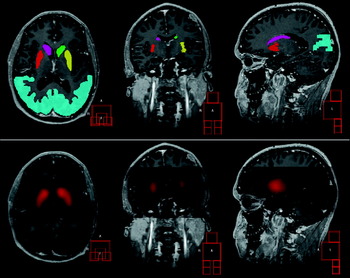
For the analysis of striatal DAT availability, ROIs were drawn on each individual T1-3D MRI scan for the caudate nucleus (bilaterally), the putamen (bilaterally) and the occipital cortex, which was assumed to represent non-displaceable activity (reference region). ROIs were drawn by making use of self-developed software (van Herk et al. Reference van Herk, de Jaeger, de Munck, Hoogeman, Meinders, Zijp, Schlegel and Bortfelt2000). The choice of ROIs was restricted to the subcortical and striatal brain areas because of their dense DAT and SERT innervations. By contrast, cortical brain regions only show low DAT and SERT densities, and were not included in the ROI analysis. Using the same program, we matched the SPECT scans of the subjects with their individual T1-3D MRI scans, and extracted DAT availability of the respective ROIs (Fig. 1). Specific to non-specific binding ratios for DAT were calculated as: [(activity in ROI) – (activity in occipital cortex)/(activity in occipital cortex; BPND)] (Innis et al. Reference Innis, Cunningham, Delforge, Fujita, Giedde, Gunn, Holden, Houle, Huang, Ichise, Lida, Ito, Kimura, Koeppe, Knudsen, Knuuti, Lammertsma, Laruelle, Logan, Maguire, Mintun, Morris, Parsey, Price, Slifstein, Sossi, Suhara, Votaw, Wong and Carson2007).
An example of region of interest (ROI) drawings to analyze dopamine transporter (DAT) availability and match of magnetic resonance imaging (MRI) image with single photon emission computed tomography (SPECT) image. From left to right: axial, coronal, sagittal views. Upper row: five three-dimensional (3D) ROIs drawn on individual MRI scans: caudate nucleus (green, violet), putamen (yellow, red), occipital cortex (light blue). Lower row: individual SPECT scans matched on individual MRI scans; intensity of uptake value indicated by intensity of red scaling.

Statistical analyses
Whether SERT/DAT availability in a specific brain region predicts the performance on a neuropsychological test, personality questionnaire or mood questionnaire was tested by means of linear regression analysis, using SPSS version 16.0 (SPSS Inc., USA). BPND for different regions (midbrain, thalamus, caudate nucleus or putamen) was taken as the independent variable and test scores were chosen as the dependent variables. We corrected for age and gender as these factors are known to influence SERT and DAT availability (van Dyck et al. Reference van Dyck, Malison, Seibyl, Laruelle, Klumpp, Zoghbi, Baldwin and Innis2000; Mozley et al. Reference Mozley, Gur, Mozley and Gur2001). The analyses with neuropsychological test scores as dependent variables were additionally corrected for IQ. As determined by Bonferroni correction, p values were considered statistically significant at a level of p=0.005 to correct for multiple testing for the 10 main tests on neuropsychological functioning, personality and mood. The different ROIs were not included as variables in the Bonferroni correction because regional SERT or DAT expression levels are highly interdependent. Effect sizes were calculated for DAT and SERT separately, with an α level of 0.05, 80% power, and four predictors (one test/questionnaire, IQ, age and gender). The minimal detectable effect size for DAT (n=79) was r 2=0.1388 (r=0.3725), and for SERT (n=188) it was r 2=0.0612 (r=0.2474). From these calculations, it could be expected that even small correlations between the parameters could be detected with the current sample sizes and the applied significant levels. We checked for potential sex differences by means of a t test, and looked for possible age effects by means of correlational analyses. Because study participants were selected on the basis of a relatively high probability of starting to use ecstasy, substance-abuse parameters were screened for potential confounding effects. Nicotine, alcohol, cannabis, cocaine and amphetamine use was assessed dichotomously (ever used/not used), and alcohol, nicotine and cannabis intake was checked additionally in more detail by asking for frequency of use. Potential confounders were defined as variables that were associated with one of the dependent variables (SERT or DAT availability) at the p<0.10 level of significance (Hosmer & Lemeshow, Reference Hosmer and Lemeshow2001).
Results
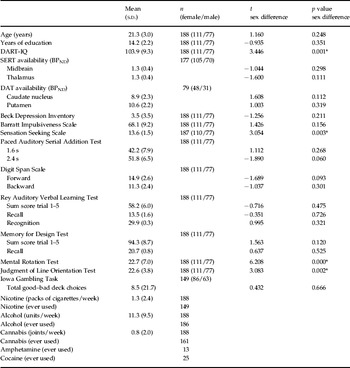
All 188 participants completed the mood questionnaire, 187 completed the personality questionnaires, and 184 completed all neuropsychological tests. The IGT was accomplished by 149 subjects. Only 177 SERT scans could be analyzed because 11 participants had to be excluded from analysis due to problems with scanning or matching. Of these 177 subjects, 80 also participated in DAT imaging, but one subject had to be excluded from analysis because of poor scan quality. Demographic data, data on SERT and DAT availability, neuropsychological measures (mean score and standard deviation), and substance use characteristics are presented in Table 1.
Subject characteristics: demographics, SERT and DAT availability, self-reported personality and mood measures, neuropsychological test scores and substance use

SERT, Serotonin transporter; DAT, dopamine transporter; DART, the Dutch Adult Reading Test; BPND, non-displaceable binding potential; s.d., standard deviation.
* Statistically significant with α=0.01 (uncorrected).
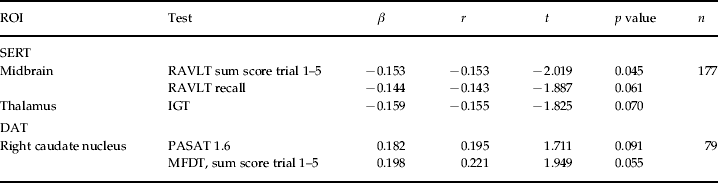
The results of the regression analysis on the SERT data revealed no significant associations between SERT availability in any of the selected brain regions and performance on any of the neuropsychological tests, personality scores or mood questionnaires. Although there were some trends for significance (Table 2; effects with p<0.1 are shown), no overall effect pattern could be observed. The only significant (p=0.045, uncorrected) predictor for SERT binding potential in the midbrain was performance on the RAVLT, sum trial 1–5. However, this association was no longer significant after Bonferroni correction. The regression analysis of the DAT data also revealed no significant associations between DAT availability in the striatum and neuropsychological test performance, personality questionnaire scores and mood ratings (Table 2).
Results of the regression analysis: SERT or DAT availability in different brain areas and performance on neuropsychological tests, mood and personality questionnaires. Results with p<0.1 are shown

SERT, Serotonin transporter; DAT, dopamine transporter; ROI, Region of interest; β, standardized beta; r, correlation coefficient; RAVLT, Rey Auditory Verbal Learning Test; IGT, Iowa Gambling Task; PASAT 1.6, Paced Auditory Serial Addition Test 1.6; MFDT, Memory for Design Test.
Supplementary Table S1 (available online) presents all correlations performed of DAT or SERT availability with neuropsychological test or questionnaire (age, gender and IQ as control variables).
Checking for potential sex differences within the sample (Table 1), men and women showed no differences in their SERT and DAT availability in the different brain areas. No differences between men and women were also found with respect to neuropsychological test performances, except for the Mental Rotation Test (p<0.001) and the JoLO test (p=0.006; no longer significant after Bonferroni correction). Men performed slightly better on these visuospatial functioning tests. Significant sex differences were also found for the Sensation Seeking Scale, with men scoring higher than women (p=0.003). Men (mean 106.6, s.d.=10.0) also had a significantly (p=0.001) higher estimated DART-IQ compared to women (mean 102.0, s.d.=8.3). We checked for a possible age-dependent decline in DAT or SERT availability but we did not find any effects of age in our sample.
The only possible substance-abuse confounder was the amount of alcoholic drinks per week (r=−0.18, p=0.017 for SERT availability in the thalamus; n=176). One subject was excluded from this analysis because of inconsistent reporting on alcohol consumption. When alcohol consumption was added to the regression analysis, only small and non-relevant changes were observed: midbrain and RAVLT sum trial 1–5 (β=−0.154, p=0.048), midbrain and RAVLT recall (β=−0.130, p=0.093); thalamus and IGT (β=−0.178, p=0.044); right caudate nucleus and PASAT 1.6 (β=0.222, p=0.041); right caudate nucleus and MFDT sum score trial 1–5 (β=0.194, p=0.065). None of these associations remained significant after correction for multiple testing.
Discussion
The purpose of this study was to assess the association of in vivo SERT and DAT availability with personality traits, mood state and neuropsychological abilities in a large group of healthy young adults. We could not replicate any of the previously reported associations between neuropsychological, mood or personality measures and SERT or DAT in healthy people. Even when taking trends for significance into account, no effect pattern, with, for example, one particular cognitive domain related to DAT or SERT, could be identified. The overall conclusion of our analyses is that no such association exists in our study sample.
In contrast to our findings, a few studies looking for an association between neurotransmitter systems and cognition or personality measurements in healthy subjects were able to demonstrate such a relationship, whereas others did not find such associations. These inconsistent results may have emerged from differences in study population, such as sex and age differences, or from other methodological issues such as the use of different, or too insensitive, tests and questionnaires and differences in the application of corrections for multiple testing. When we compare the results of these studies to the present one, a major difference is the sample size, with our sample being by far the largest to date. Whereas our study tested up to 177 SERT and 79 DAT subjects, the study with the largest sample size reporting a significant association is the one by Mozley et al. (Reference Mozley, Gur, Mozley and Gur2001), in which, using [99mTc]TRODAT-1 SPECT, 66 subjects were tested for possible associations between DATs and memory in healthy subjects. They used the Pennsylvania Verbal Learning Test, a variant of the RAVLT that we used. In contrast to our findings, they reported significant correlations between DATs and performance scores: r=0.43, p=0.02 in men (caudate nucleus) and r=0.40, p=0.02 in women (caudate nucleus, putamen). Methodological differences may be responsible for the differential findings. For example, Mozley et al. used a fixed-ROI template (i.e. without co-registration of individual MRIs) and images were acquired at 3 h p.i., whereas 4.5–5 h p.i. is probably a better time-point to analyze DATs with TRODAT SPECT (Acton et al. Reference Acton, Meyer, Mozley, Plossl and Kung2000). Moreover, a single [123I]β-CIT SPECT scan at 24 h p.i. is well validated to assess striatal DAT availability (Laruelle et al. Reference Laruelle, Wallace, Seibyl, Baldwin, Zea-Ponce, Zoghbi, Neumeyer, Charney, Hoffer and Innis1994) and considered superior to [99mTc]TRODAT-1 SPECT. Finally, Mozley et al. (Reference Mozley, Gur, Mozley and Gur2001) did not correct their findings for multiple testing, and therefore their reported associations between DAT availability and memory performance might be a false-positive (chance) finding.
Apart from the differences in sample size and radioligand use, there were differences with respect to tests used to investigate neuropsychological performance and personality traits. In their [11C]DASB PET study, Takano et al. (Reference Takano, Arakawa, Hayashi, Takahashi, Ito and Suhara2007) found that higher thalamic SERT binding correlated to higher levels of neuroticism and depressive feelings, measured with the NEO personality inventory. It should be noted that they were not able to find any association with NEO impulsivity, which is in agreement with our study finding of no association between impulsivity scores and SERT availability.
A recent [11C]DASB PET study (Kalbitzer et al. Reference Kalbitzer, Frokjaer, Erritzoe, Svarer, Cumming, Nielsen, Hashemi, Baare, Madsen, Hasselbalch, Kringelbach, Mortensen and Knudsen2009), testing 50 healthy subjects, found ‘openness to experience’, a subscale of the NEO, to be associated with lower SERT binding in the SERT-rich midbrain, putamen and thalamus. Notably, the authors do not mention associations with any of the other NEO subscales, such as the neuroticism facet, for which the study by Takano et al. (Reference Takano, Arakawa, Hayashi, Takahashi, Ito and Suhara2007) found significant associations. Takano et al. also did not report an association with the NEO openness to experience subscale.
Another [11C]DASB PET study (McCann et al. Reference McCann, Szabo, Vranesic, Palermo, Mathews, Ravert, Dannals and Ricaurte2008) investigated a group of 2-week abstinent MDMA users (n=16) and healthy controls (n=16). When all subjects were included for a correlational analysis, lower SERT-binding potentials in the dorsolateral prefrontal cortex and parietal cortex were associated with poorer performance on the Wechsler memory scale and the DSS. After splitting the group, and in contrast to what would be expected, this association remained strong only for the control group and not for the former MDMA users. We did not find any association between the DSS and SERT in our sample; however, we only assessed SERT in subcortical brain areas that express SERT intensively.
It might be thought that we failed to replicate previous findings because we used SPECT instead of PET. However, it should be noted that we were not able to replicate the positive [99mTc]TRODAT SPECT association with memory dysfunction (Mozley et al. Reference Mozley, Gur, Mozley and Gur2001) in our study even though we had a larger sample, used the radioligand [123I]β-CIT, and applied individually co-registered MR images, ensuring high reliability of quantification. The other three out of four studies reporting positive findings in healthy subjects used PET and the selective SERT radiotracer [11C]DASB (Takano et al. Reference Takano, Arakawa, Hayashi, Takahashi, Ito and Suhara2007; McCann et al. Reference McCann, Szabo, Vranesic, Palermo, Mathews, Ravert, Dannals and Ricaurte2008; Kalbitzer et al. Reference Kalbitzer, Frokjaer, Erritzoe, Svarer, Cumming, Nielsen, Hashemi, Baare, Madsen, Hasselbalch, Kringelbach, Mortensen and Knudsen2009). Although, the reliability of [123I]β-CIT SPECT in quantifying DAT and SERT is generally accepted (Seibyl et al. Reference Seibyl, Laruelle, van Dyck, Wallace, Baldwin, Zoghbi, Zea-Ponce, Neumeyer, Charney, Hoffer and Innis1996; Pirker et al. Reference Pirker, Asenbaum, Hauk, Kandlhofer, Tauscher, Willeit, Neumeister, Praschak-Rieder, Angelberger and Brucke2000; de Win et al. Reference de Win, Habraken, Reneman, van den Brink, den Heeten and Booij2005 a), the sensitivity and specificity of this technique (especially for measuring SERT in cortical areas) are lower compared to [11C]DASB PET, supporting the reported positive findings of the three [11C]DASB PET studies.
Another reason for the inconsistency of our findings with previous studies might be the variation within the samples. It might be that the variation in test scores or SERT/DAT binding values in this study were too small to find effects. Where possible, we checked whether our sample deviated from normal population scores (Feij et al. Reference Feij, Van Zuilen and Gazendam1982; Patton et al. Reference Patton, Stanford and Barratt1995; Zuckerman & Kuhlman, Reference Zuckerman and Kuhlman2000; Beck et al. Reference Beck, Steer, Brown and van der Does2002). Subjects from the present study scored within a normal range on measures of depression, impulsivity and sensation seeking. Moreover, variance and distribution of SERT and DAT availability values were comparable to that of healthy subjects of other studies (Maron et al. Reference Maron, Kuikka, Shlik, Vasar, Vanninen and Tiihonen2004; Joensuu et al. Reference Joensuu, Tolmunen, Saarinen, Tiihonen, Kuikka, Ahola, Vanninen and Lehtonen2007; Lehto et al. Reference Lehto, Tolmunen, Kuikka, Valkonen-Korhonen, Joensuu, Saarinen, Vanninen, Ahola, Tiihonen and Lehtonen2008 b; van der Wee et al. Reference van der Wee, van Veen, Stevens, van Vliet, van Rijk and Westenberg2008).
Another reason why the small studies with healthy subjects did find associations between neuropsychological measures and DAT or SERT could be that they did not rigorously correct for multiple testing. Only Takano et al. (Reference Takano, Arakawa, Hayashi, Takahashi, Ito and Suhara2007) reported a conservative p value (p<0.008), whereas others (Mozley et al. Reference Mozley, Gur, Mozley and Gur2001; Kalbitzer et al. Reference Kalbitzer, Frokjaer, Erritzoe, Svarer, Cumming, Nielsen, Hashemi, Baare, Madsen, Hasselbalch, Kringelbach, Mortensen and Knudsen2009) chose not to correct for multiple testing. In the present study, p values were considered statistically significant at a level of p<0.005 to correct for multiple testing for the 10 main tests and questionnaires. This correction might be regarded as too conservative. However, a less conservative correction contributes to the chance of false-positive findings.
Overall, we can say that the positive findings that have been reported on neuropsychological functioning and personality traits and SERT and DAT availability in healthy subjects are difficult to replicate in our present study. The main reasons are probably differences in assessment instruments (e.g. only a few cognitive assessments were computerized, and consequently were less precise than in previous studies), differences in the SERT and DAT availability measurements (PET versus SPECT) and the application of corrections for multiple testing.
Although our large sample size definitely contributed to statistical power, one weakness lies in a possibly biased study population. Subjects were selected on the basis of their relatively high probability of starting to use ecstasy in the future. This selection might pose a limitation to the external validity of the study, because the study subject population had higher levels of substance use than the general population. Using this selection criterion, we may have selected for individuals who had more self-control (and less impulsivity) because they were tempted, but had not tried, ecstasy. However, the impact of this selection was probably very small, because mean test scores and variances in outcome measures in the present study were highly comparable to other, less selective, healthy populations. Furthermore, statistical analysis showed that substance-abuse parameters did not affect DAT or SERT availability significantly. In the present sample of 188 subjects, substance use was fairly limited (1.3 packs of cigarettes/week, s.d.=2.4; and 0.8 joints/week, s.d.=2.0), and only a minority of participants had ever used amphetamines (n=13) or cocaine (n=25). None of the subjects met the criteria for drug abuse. Urine tests confirmed that none of the subjects had used drugs of abuse in the two weeks before they were scanned. The only identified potential confounder, with fairly small effects, was alcohol consumption (mean 11.1 units/week, s.d.=8.9). Overall, we cannot rule out any effect of substance abuse on this study, and consequently that our findings may not generalize to ‘healthy’ individuals, but we believe that this effect would be small.
In contrast to the few and partly inconsistent findings of studies with healthy subjects, many patient studies have replicated associations between personality traits, mood indicators or neuropsychological test results and DAT or SERT availability. For example, several studies found a lowered midbrain SERT concentration in depressed patients (Newberg et al. Reference Newberg, Amsterdam, Wintering, Ploessl, Swanson, Shults and Alavi2005; Parsey et al. Reference Parsey, Hastings, Oquendo, Huang, Simpson, Arcement, Huang, Ogden, Van Heertum, Arango and Mann2006; Joensuu et al. Reference Joensuu, Tolmunen, Saarinen, Tiihonen, Kuikka, Ahola, Vanninen and Lehtonen2007). In addition, it was demonstrated that psychotherapy could enhance SERT availability (Lehto et al. Reference Lehto, Tolmunen, Joensuu, Saarinen, Valkonen-Korhonen, Vanninen, Ahola, Tiihonen, Kuikka and Lehtonen2008 a), but to differentiate between subtypes of depression, SERT measurements as predictors were not sensitive enough (Lehto et al. Reference Lehto, Tolmunen, Kuikka, Valkonen-Korhonen, Joensuu, Saarinen, Vanninen, Ahola, Tiihonen and Lehtonen2008 b). Other studies report on dysfunctional impulsivity linked to SERT availability (Tiihonen et al. Reference Tiihonen, Kuikka, Bergstrom, Karhu, Viinamaki, Lehtonen, Hallikainen, Yang and Hakola1997; Lindström et al. Reference Lindström, Ryding, Bosson, Ahnlide, Rosén and Träskman-Bendz2004; Ryding et al. Reference Ryding, Ahnlide, Lindström, Rosén and Träskman-Bendz2006). Koch et al. (Reference Koch, Schaaff, Pöpperl, Mulert, Juckel, Reicherzer, Ehmer-von Geiso, Moeller, Hegerl, Tatsch and Pogarell2007) used the BIS and the BDI, as in our study, to investigate impulsivity and depression scores in relation to SERT in the hypothalamus and the midbrain, using [123I]ADAM SPECT. In a small sample of borderline personality patients (n=8) and controls (n=9), they were able to demonstrate a correlation between impulsivity and SERT binding when looking at the total sample. As in the present study, no association could be found for BDI measures, in either the patient or the control group.
Therefore, it might be thought that it is only the pathological condition that can be validly related to neurotransmitter system levels. However, normal personality traits, or extreme variants of them, are assumed to represent candidates for the role of ‘endophenotypes’ (Gottesman & Gould, Reference Gottesman and Gould2003) and there is some evidence for a continuum between normal personality traits, personality disorders and psychiatric illness. Consequently, personality disorders may represent extremes of normal personality traits. Mental illnesses, in turn, may be extreme variants of personality disorders. The results from the studies that did not include people with mental illnesses or extreme variants so far have shown only incidental and mainly inconsistent associations between personality traits and neuropsychological functioning and neurotransmitter system levels. Based on our results, we conclude that only in the case of pathological situations do underlying neurotransmitter systems seem to have a predictive value with respect to personality traits and neuropsychological functioning. In the case of normally functioning systems it is not yet possible to link the level of DAT or SERT expression directly to the level of behavior with the current techniques. In conclusion, the present study shows that predictions about behavioral data such as neuropsychological and personality measurements in young healthy people cannot be based on subcortical SERT or striatal DAT availabilities in the brain.
Note
Supplementary material accompanies this paper on the Journal's website (http://journals.cambridge.org/psm).
Declaration of Interest
None.