Introduction
Transoral robotic surgery (TORS) for obstructive sleep apnoea (OSA) is a minimally invasive technique utilising robotic systems to excise or reposition tissues obstructing the upper airway. The articulated robotic arms and high-magnification angled endoscopes afford enhanced visualisation and improved access to the confined operative space. Prior to TORS, surgical access to the tongue base was achieved via an open transcervical approach or a transoral endoscopic technique. The open approach was technically demanding with associated patient morbidity, whereas the transoral approach provided comparatively limited visualisation while utilising non-articulated instruments, hindering effective dissection within the confined surgical field.Reference Vicini, Montevecchi and Scott Magnuson1 These challenges prompted the pursuit of alternative techniques, culminating in the adoption of TORS.
Current surgical application of TORS in OSA include tongue base reduction, partial epiglottidectomy, supraglottoplasty and limited lateral pharyngectomy.Reference Vicini, Dallan, Canzi, Frassineti, La Pietra and Montevecchi2–Reference Thaler, Rassekh, Lee, Weinstein and BW4 Post-operative success defined by SherReference Sher, Schechtman and Piccirillo5 has been reported in 63.9 to 69 per cent of cases.Reference Miller, Nguyen, Ong and Gillespie6–Reference Lechien, Chiesa-Estomba, Fakhry, Saussez and Badr8 Patients also experience subjective improvement in daytime somnolence, with reductions in Epworth Sleepiness Scale (ESS) scores of up to 7.92 points.Reference Miller, Nguyen, Ong and Gillespie6, Reference Lechien, Chiesa-Estomba, Fakhry, Saussez and Badr8
TORS, however, may be associated with a steeper learning curve amongst less experienced surgeons and can result in complications with notable patient morbidity and, albeit rarely, mortality.Reference White, Frederick, Zimmerman, Carroll and Magnuson9, Reference Albergotti, Gooding, Kubik, Geltzeiler, Kim and Duvvuri10 This review, therefore, aims to provide an introductory overview of the application of TORS in the surgical management of OSA, including considerations for patient selection, practical surgical guidance, peri-operative care and management of post-operative complications.
Patient selection
Indications
The original patient selection criteria for TORS outlined by Vicini et al. included symptomatic OSA, defined as an ESS score greater than 11, and/or moderate to severe OSA, indicated by an Apnea-Hypopnea Index (AHI) exceeding 20.Reference Vicini, Dallan, Canzi, Frassineti, La Pietra and Montevecchi2 Additional criteria included intolerance of continuous positive airway pressure (CPAP) therapy, tongue base hypertrophy and adequate tongue base exposure during initial drug-induced sleep endoscopy (DISE).Reference Kezirian11
In their subsequent publication, Vicini et al. expanded their selection criteria to include patients with mild but symptomatic OSA exhibiting evidence of tongue base obstruction.Reference Vicini, Montevecchi, Gobbi, de Vito and Meccariello12 When evaluating for tongue base obstruction, Toh and Hsu advocated for DISE to assess features of tongue base collapse, lingual tonsillar hypertrophy, epiglottic collapse and supraglottic obstruction.Reference Toh and Hsu13 Notably, assessing for lingual tonsil hypertrophy is best done via awake endoscopy as described by Friedman et al., where multiple views of the tongue in various positions may be obtained.Reference Friedman, Salapatas and Bonzelaar14 Patients exhibiting grade 3 or higher hypertrophy may be considered suitable candidates for surgical intervention.Reference Lin and Friedman15
Relative contraindications
Not all patients are suitable for TORS. Anatomical considerations outlined by Rich et al. for endoscopic transoral surgeryReference Rich, Milov, JS, Thorstad, Adkins and Haughey16 are equally applicable to TORS (Table 1). For adequate surgical exposure, a minimum interincisive distance of 25 mm is required.Reference Vicini, Montevecchi, Gobbi, de Vito and Meccariello12 Additionally, patient positioning may be impeded by cervical spine immobility or instability.
Factors predicting poor outcomes for TORS

Abbreviations: AHI = Apnea–Hypopnea Index; BMI = body mass index.
Body mass index (BMI) has been shown to influence surgical outcomes, with higher success rates when BMI is under 30.Reference Vicini, Montevecchi, Gobbi, de Vito and Meccariello12 In obese patients, increased fat deposition within the tongue and parapharyngeal space is believed to limit the efficacy of surgery as these areas are not amenable to correction through TORS.
The presence of lateral pharyngeal wall collapse on DISE has also been associated with surgical failure,Reference Lin, Rowley, Folbe, Yoo, Badr and Chen17 possibly as TORS primarily enlarges the anteroposterior dimension of the airway without addressing lateral wall collapse. OSA severity also affects surgical outcomes, with lower success rates when AHI is above 60. In a series by Lin and Friedman, the most favourable outcomes were observed in patients with BMI under 30, AHI below 60, without lateral pharyngeal wall collapse.Reference Lin, Rowley, Folbe, Yoo, Badr and Chen17
Pre-operative patient counselling
Most centres employ a standardised consent form for pre-operative counselling, outlining TORS, its indications, alternatives and associated risks. Patients are counselled on surgical risks of injury to the oral cavity or jaw; wound infection; bleeding; tongue paraesthesia; post-operative pain; odynophagia and dysphagia; airway compromise; persistent snoring; and surgical failure.Reference Toh and Hsu13, Reference Hay, Migliacci, Karassawa, Boyle, Singh and Wong18, Reference Mouratidou and Chaidas19 Patients are anticipated to stay 2 to 3 days for isolated tongue base procedures and 6 to 7 days for multi-level surgeries. Strenuous physical activity should be avoided for at least two weeks post-operatively.
Practical tips
Intra-operative care
Intra-operative setup of the operation room
The surgical assistant is positioned at the patient’s head (Figure 1; central panel). A scrub nurse is usually situated to the assistant’s left, while the anaesthetist remains on the patient’s right to monitor the endotracheal tube and anaesthesiologic parameters throughout the procedure.
Intra-operative setup for transoral robotic surgery. (A) The robotic patient cart is positioned at a 30-degree angle to the left side of the operating table, allowing optimal access in limited space. (B) Robotic arms are centrally aligned with the patient’s oral cavity for precise instrument insertion. (C) The surgical assistant adjusts arm positioning under endoscopic visual guidance displayed on the vision cart monitor. (D) Final instrument positioning within the oral cavity, with the Maryland forceps and monopolar electrocautery carefully inserted to maintain a minimum 1 cm clearance from the patient’s teeth.

The robotic patient cart (e.g., the da Vinci system, Intuitive Surgical, Sunnyvale, CA) is generally positioned to the patient’s left, angled between 30° and 90° relative to the operating table. In settings with limited space, a 30° angle is often preferred,Reference Hassid, Putz, Lawson, Mayne, Delahaut and Bachy20 as this allows for convenient placement of the instrument table on the left without significantly interfering with the coordination between the assistant and nurse (Figure 1A). The robotic arms are then aligned centrally with the oral cavity (Figure 1B).
Once the robotic instruments are introduced into the oral cavity, the assistant should carefully guide their positioning while monitoring the visual feed from the endoscopic camera on the vision cart (Figure 1C). Surgical instruments, for example, Maryland forceps and monopolar electrocautery, should be inserted with a clearance of at least 1cm from the patient’s teeth to avoid dental injury (Figure 1D).
Creating good surgical exposure
Optimal surgical exposure is critical to ensure surgical safety and efficacy. The patient is positioned supine with neck flexed and head extended to facilitate access to the tongue base. Both nasotracheal and orotracheal intubation techniques have been described;Reference Mouratidou and Chaidas19, Reference Folk and D’Agostino21 however, nasotracheal intubation is often preferred as it provides an unobstructed view of the lingual tonsils and epiglottis, while reducing instrument collision during the procedure.
Stay sutures for tongue protraction are commonly applied to enhance visualisation and access to the tongue base.Reference Li, Lee and Kezirian22, Reference Li, Lee and Kezirian23 The Crowe–Davis gag is typically employed to suspend the tongue. Attaching suction to the gag aids in surgical smoke removal, ensuring intra-operative visibility.
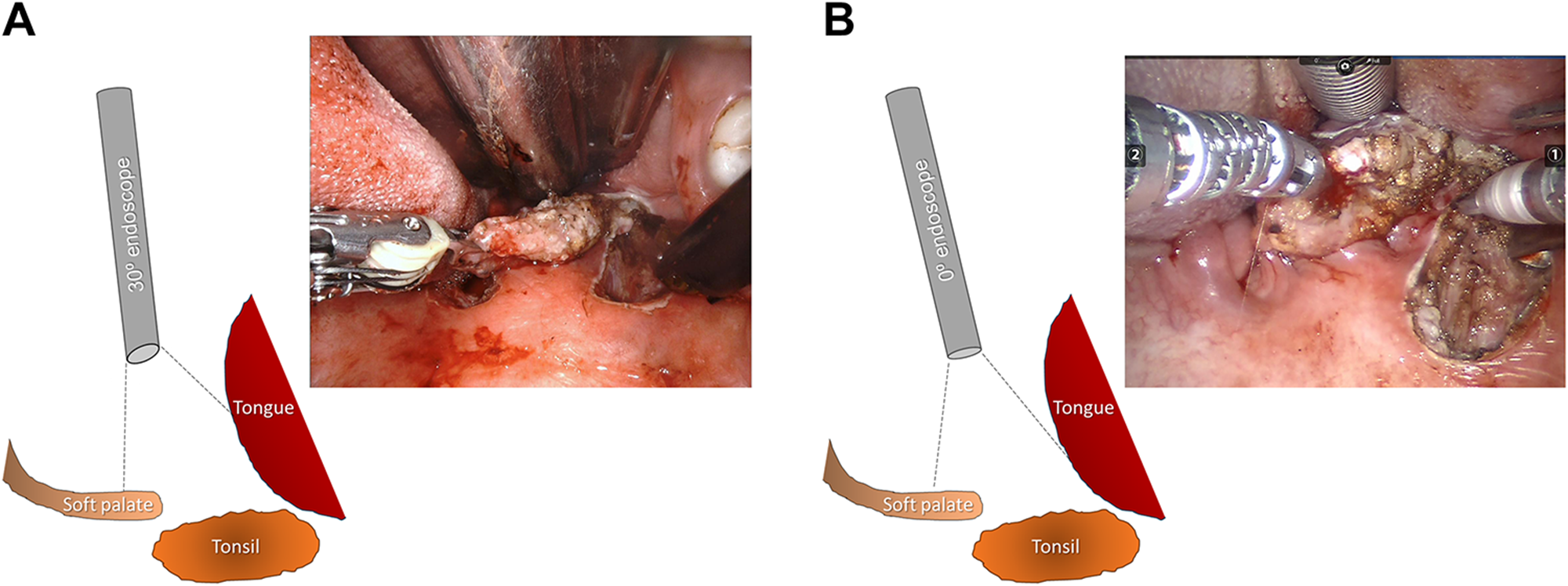
Use of the 30-degree endoscope offers significant advantages by reducing instrument collision between the endoscope and robotic arms. The angled view afforded by the 30-degree scope allows the camera to be positioned in a more vertical plane (Figure 2A) compared with the 0-degree endoscope (Figure 2B), while the robotic arms follow a more horizontal trajectory (Figure 1D). This separation of planes increases the working space within the surgical field.
Comparison of visual fields between 30-degree and 0-degree endoscopes in transoral robotic surgery. (A) The 30-degree endoscope provides a more vertical viewing plane, enhancing visualisation of the tongue base and the lower pole of the tonsil, while reducing instrument collision with the robotic arms. (B) The 0-degree endoscope aligns more closely with the horizontal trajectory of the robotic arms, offering improved visualisation of the soft palate but limited exposure of the tongue base and tonsillar lower pole.

Although the 30-degree endoscope provides improved visualisation of the tongue base, it affords comparatively limited visualisation of the soft palate (Figure 2). Despite this trade-off, the angled perspective is often favoured in tongue-base procedures where improved access and visibility are essential.
When manipulating the master controls, the surgeon is advised to minimise wrist movements and instead rely primarily on fine finger motions. This technique enhances precision at the wristed instrument tips while reducing gross movements of the robotic arms,Reference Mei, Yili, Bo and Xudong24 which are undesirable when operating within the constrained confines of the oropharyngeal surgical field.
In patients with limited cervical mobility, traditional supine positioning with head extension may not be feasible. Moore et al. described a novel approach in which TORS for oncological indications was performed with the patient in a seated position.Reference Moore, van Abel and Olsen25 In this setup, the authors reported enhanced surgical visualisation with increased operative space. Notably, sufficient tongue retraction was achieved using a 2-0 silk suture alone, eliminating the need for rigid oral retractors. Another adaptation, the modified Trendelenburg position, was described in a patient with severe thoracic kyphosis.Reference Lee, Manek, Hardman, Ghedia, Hariri and Lacey26 The patient’s upper body was slightly elevated, while the pelvis and lower limbs were positioned as in the conventional Trendelenburg position. This modification enabled a more favourable surgical angle while accommodating the patient’s spinal deformity. Although such innovative approaches have not yet been reported in the context of OSA, they hold promise for expanding patient eligibility amongst anatomically challenging cases.
Reduction and management of bleeding
Post-operative bleeding occurs in approximately 3.3 to 6.2 per cent of single-level tongue base reduction procedures.Reference Lechien, Chiesa-Estomba, Fakhry, Saussez and Badr8 When TORS is performed as part of multi-level surgery, bleeding risk may be higher although not necessarily attributable to the TORS site. In such instances, haemorrhage often originates from the tonsillar bed following concurrent pharyngoplasty.Reference Baptista, Diaz, Garaycochea, Alcalde, Moffa and Giorgi27, Reference Hwang, Kim, Kim, Lee, Kim and Yoon28
To minimise the risk of bleeding, a thorough understanding of the vascular anatomy of the tongue base is imperative. Major vessels are located laterally, whereas midline is relatively avascular and, thus, safer for dissection. It is important to note that tongue retraction during TORS significantly alters vascular anatomy. Cadaveric studies have shown that retraction decreases the distance between both lingual arteries, from 20 ± 7.5 mm to 13.4 ± 2.9 mm at the foramen caecum.Reference Cohen, Low, Melkane, Mutchnick, Waxman and Patel29 Additionally, computed tomography angiography has demonstrated a reduction in the depth of the lingual arteries with tongue retraction, from 27.9 ± 3.2 mm to 24 ± 2.7 mm at the foramen caecum and from 28.1 ± 3 mm to 24.5 ± 3.5 mm at 1 cm posterior to it.Reference Wu, Qin, Guo and Li30 Surgeons must remain cognisant of these anatomical changes to ensure safe dissection while achieving adequate tissue resection.
Intra-operative adjuncts have been explored to further minimise bleeding risk. For example, the use of intra-operative ultrasound has been reported to reduce operative time, decrease blood loss while achieving greater tongue base reduction volume.Reference Chang, Wu, Hsiao and Lin31 Although such technology can be beneficial when available, anatomical awareness remains critical throughout the procedure.
When dissection approaches the territory of the lingual artery, meticulous haemostasis is essential. Low-flow bleeding can often be controlled using monopolar or bipolar electrocautery. For larger vessels, vascular clips may be used.Reference Crawford, Bahgat, White and Magnuson32 Haemostatic agents, including fibrin sealants (e.g. Tisseel®, Baxter Healthcare Corporation, Fremont, CA) and haemostatic matrix sealants (e.g. Floseal®, Baxter Healthcare Corporation, Fremont, CA), are also widely employed in TORS. Although these adjuncts can reduce the frequency of minor bleeding events, their impact on preventing major haemorrhage appears limited.Reference Maza and Sharma33
In Taiwan, a polysaccharide-microencapsulated recombinant human epidermal growth factor (Newepi®, Goodcare-Biotech, Ltd., Taipei) has been developed. The senior author (L.L.A.) routinely applies Floseal® to the tongue base and epiglottic wounds for haemostasis, and Newepi® to the tonsillar wound bed to promote tissue regeneration and repair. Based on unpublished data from the senior author’s experience with 174 patients over seven years, the incorporation of these adjuncts reduced post-operative bleeding rates from 9.3 to 1.6 per cent.
In cases where post-operative bleeding does occur, most are minor, self-limiting episodes.Reference Vicini, Montevecchi, Campanini, Dallan, Hoff and Spector34 These may be managed conservatively with observation and administration of anti-fibrinolytic agents such as tranexamic acid. However, approximately 3.3 per cent of patients may experience bleeding severe enough to require surgical intervention.Reference Lechien, Chiesa-Estomba, Fakhry, Saussez and Badr8 In emergency scenarios, re-establishing the robotic setup may not be feasible due to time constraints and the need for specialised staff. Instead, traditional tonsillectomy instruments coupled with angled telescopes, can offer adequate visualisation for haemostasis with bipolar cautery or suction monopolar devices. In oncological TORS, more invasive options such as endovascular embolisation or transcervical ligation of the external carotid artery or its branches have been described,Reference Hay, Migliacci, Karassawa, Boyle, Singh and Wong35 although such measures have not, to our knowledge, been necessary in OSA patients.
Importantly, post-operative bleeding following TORS is considered a medical emergency due to its potential to rapidly compromise the airway, leading to anoxic brain injury or even death. All patients are provided with a written medical alert memo after surgery, advising them to seek immediate attention in the Emergency Department should bleeding occur. The memo instructs emergency staff to promptly transfer the patient to the resuscitation bay, initiate close airway monitoring and urgently alert the on-call otolaryngologist for prompt assessment and management.
Post-operative care
Dysphagia
Approximately 11.8 per cent of patients experience dysphagia following TORS.Reference Lechien, Chiesa-Estomba, Fakhry, Saussez and Badr8 In the immediate post-operative period, dysphagia is most commonly attributable to pain. However, oropharyngeal stenosis or post-operative scarring have also been reported as potential causes, occasionally necessitating revision surgery.Reference Lin, Rowley, Folbe, Yoo, Badr and Chen17, Reference Suh36 These complications may be more likely when TORS is performed in conjunction with oropharyngeal procedures, particularly if cautery is applied indiscriminately near the inferior tonsillar pole, lingual tonsils or tongue base.Reference Lin and Friedman15
Most centres report that dysphagia is transient, resolving spontaneously within three months.Reference Vicini, Montevecchi, Gobbi, de Vito and Meccariello12, Reference Lee, Weinstein, BW and Thaler37 However, Paker et al. reported possible long-term sequelae, with 32 per cent of patients experiencing subjective swallowing disturbances 18 months post-surgery.Reference Paker, Duek, Awwad, Benyamini, Meshyeev and Gil38 To mitigate this, it is advisable for surgeons to contour the tongue base resection with smooth, sloping edges rather than creating deep central depressions. This approach may help reduce vallecular residue and the risk of long-term dysphagia.
Dysgeusia and tongue paraesthesia
Post-operative dysgeusia and tongue paraesthesia have been reported in up to 14.8 per cent and 75.0 per cent of patients, respectively.Reference Lechien, Chiesa-Estomba, Fakhry, Saussez and Badr8 Dysgeusia may result from injury to taste receptors or sensory nerve branches, or from post-inflammatory changes during wound healing. Tongue paraesthesia is likely attributable to pressure or compression from tongue suspension sutures and prolonged retraction.Reference Lin, Hwang, Liao and Friedman39 When tonsillectomy is performed concurrently, damage to the lingual branch of the glossopharyngeal nerve may also contribute to taste disturbances.Reference Heiser, Landis, Giger, Cao, Guinand and Hörmann40
The surgeon may consider limiting the duration of tongue suspension, or ensure intermittent release of retraction to minimise the above. Symptoms are generally transient and expected to resolve after three months to one year.Reference Toh and Hsu13 Post-operative supplementation with zinc has been reported to be successful with eliminating dysgeusia in case reports,Reference Windfuhr, Cao Van and Landis41, Reference Janz, Momin, Patel, Daram, Szeremeta and Pine42 but further studies are required to confirm its efficacy.
Airway management
When TORS for OSA was first described, elective tracheostomy was routinely performed.Reference Vicini, Dallan, Canzi, Frassineti, La Pietra and Montevecchi2 Retrospective analysis revealed that none of the patients developed post-operative airway obstruction. Tracheostomy was primarily precautionary, potentially useful in the event of significant upper airway haemorrhage. In most cases, tracheostomy can be avoided, as its routine use has been associated with increased operative time, longer hospital stay, higher rates of post-operative aspiration and greater need for feeding tube support.Reference Chekkoury Idrissi, Lechien, Besnainou and Hans43
Approaches to post-operative airway management vary. Some surgeons elect to keep patients intubated post-operatively due to concerns over upper airway oedema;Reference Vicini, Montevecchi, Gobbi, de Vito and Meccariello12, Reference Lin, Rowley, Folbe, Yoo, Badr and Chen17 others advocate for immediate extubation following surgery.Reference Lin and Friedman15 For patients who are extubated, insertion of a nasopharyngeal airway (NPA) may be considered to maintain airway patency in the presence of tongue base oedema and pooled secretions. The NPA avoids stimulating the gag reflex in awake patients and is generally better tolerated than oropharyngeal devices.
Systemic corticosteroids are frequently administered peri-operatively in anticipation of oedema.Reference Ravesloot, de Raaff, van de Beek, Benoist, Beyers and Corso44 Patients are nursed in a head-elevated position to facilitate venous return and reduce tongue base swelling.Reference Li, Lee and Kezirian22, Reference Li, Lee and Kezirian23 Continuous pulse oximetry is employed to monitor oxygen saturation and detect early signs of airway compromise.
Pain management
Effective post-operative pain control is essential for patient comfort and to facilitate early resumption of oral intake. In recent years, there has been increasing emphasis on enhanced recovery after surgery (ERAS) protocols for patients undergoing TORS.Reference Ganti, Eggerstedt, Grudzinski, Ramirez, Vaughan and Revenaugh45, Reference Castellanos, Paoletti, Ulloa, Kim, Fong and Xepoleas46 Originally introduced in 2001 for colorectal procedures, ERAS protocols have since demonstrated benefits across various surgical disciplines, including improved post-operative pain management, shorter hospital stays and overall cost reductions.
A cornerstone of ERAS is the use of multi-modal analgesia, with an emphasis on minimising opioid use and its associated adverse effects.Reference Castellanos, Paoletti, Ulloa, Kim, Fong and Xepoleas46 Under this regimen, intra-venous lidocaine is administered at induction, followed by intra-venous ketamine for anaesthetic maintenance. Post-operatively, patients are prescribed non-opioid analgesics round-the-clock, including gabapentin, acetaminophen and celecoxib.
Implementation of such analgesic regimens have been associated with significantly lower pain scores and reduced opioid consumption post-operatively.Reference Castellanos, Paoletti, Ulloa, Kim, Fong and Xepoleas46 Such protocols not only enhance patient comfort and recovery, but also align with current efforts to mitigate opioid-related complications in surgical care.
Diet
Patients are generally commenced on a liquid diet from the first post-operative day, with dietary consistency advanced gradually based on individual tolerance. The reported mean time to resumption of oral intake ranges from 6 hours to 5.8 days.Reference Lechien, Chiesa-Estomba, Fakhry, Saussez and Badr8 Most patients are expected to return to their usual diet within two to three weeks following surgery.Reference Toh, Han, Tay and Kiong3, Reference Friedman, Hamilton, Samuelson, Kelley, Taylor and Pearson-Chauhan47 Enteral feeding support is rare, with feeding tubes required in fewer than 1 per cent of patients.Reference Glazer, Hoff and Spector48, Reference Hoff, D’Agostino and Thaler49 This low incidence reflects the typically favourable post-operative recovery and effectiveness of early oral intake protocols following TORS.
Length of hospital stay
The mean length of post-operative stay has been reported to be approximately 3.7 daysReference Lechien, Chiesa-Estomba, Fakhry, Saussez and Badr8 and is often influenced by the extent of surgical intervention, specifically, whether the patient undergoes single-level or multi-level surgery.
At the senior author’s centre (L.L.A.), patients typically remain hospitalised for 3 to 5 days following isolated tongue base surgery. Those undergoing multi-level procedures may require a longer stay, averaging between 5 and 7 days. This variation reflects the increased complexity, post-operative monitoring needs and recovery time associated with more extensive surgical interventions.
Long-term follow-up
A repeat sleep study is typically performed six months following surgery to assess treatment success. For patients who achieve a favourable outcome, it is important to highlight that a 10 per cent increase in body weight may result in a 30 per cent increase in AHI,Reference Peppard, Young, Palta, Dempsey and Skatrud50 underscoring the critical role of long-term weight management in maintaining therapeutic benefit.Reference Hudgel, Patel, Ahasic, Bartlett, Bessesen and Coaker51
It is essential to recognise that treatment success does not equate to cure. According to standard definitions, residual mild OSA (AHI < 15), or even moderate OSA (AHI 15–19), may still be present in patients deemed to have met criteria of treatment success. These individuals—along with those who did not achieve surgical success—should be counselled on the potential benefit of CPAP therapy. Notably, patients may find CPAP more tolerable following surgery, particularly if the required therapeutic pressures are reduced.Reference Chandrashekariah, Shaman and Auckley52
Staged surgical intervention may also be considered in select cases. DISE should be repeated to reassess the pattern and level of upper airway collapse. In retrognathic patients with persistent tongue base obstruction, procedures such as maxillomandibular advancement or hypoglossal nerve stimulation may be appropriate.Reference Iannella, Pace, Magliulo, Vicini, Lugo and Vanderveken53
It is important to acknowledge that the pathophysiology of OSA is multi-factorial, encompassing both anatomical and non-anatomical components. In patients with predominant non-anatomical traits—such as increased ventilatory control sensitivity, low arousal threshold or poor upper airway muscle responsiveness—additional surgical interventions are unlikely to be effective.Reference Owens, Edwards, Eckert, Jordan, Sands and Malhotra54
Surgical alternatives
Alternative techniques such as hypoglossal nerve stimulation (HGNS) and maxillomandibular advancement (MMA) have been described to address tongue base obstruction as well, with surgical success rates reported at up to 76.9 per centReference Costantino, Rinaldi, Moffa, Luccarelli, Bressi and Cassano55 and 86 per cent,Reference Holty and Guilleminault56 respectively. However, the choice of surgical technique should be individualised to patient phenotype. For instance, MMA is considered in patients with predominant lateral pharyngeal wall collapse on DISE or concomitant craniofacial skeletal restriction,Reference Holty and Guilleminault56 while those with lingual tonsil hypertrophy benefit from TORS.Reference Stringa, Vicini and Cammaroto57 At present, there is limited evidence on direct comparison across TORS, HGNS and MMA, likely as the surgical indications differ amongst the various techniques. These procedures are not mutually exclusive as well; patients may undergo a combination of techniques in a staged manner. Ultimately, the decision-making process in choosing a surgical technique should assume a patient-centred approach.
Conclusion
While TORS provides notable benefits in terms of visualisation, access and precision—particularly at the tongue base—it also presents specific challenges that require careful consideration. Successful TORS demands more than technical proficiency with robotic instrumentation; it requires the surgeon to be adept at navigating the entire continuum of care. This includes appropriate patient selection, comprehensive pre-operative counselling, meticulous intra-operative planning and execution, and attentive post-operative management. As the field of sleep surgery continues to evolve, ongoing refinement of surgical techniques, integration of adjunctive technologies and adoption of multi-disciplinary pathways such as ERAS protocols will be central to improving patient outcomes and expanding the scope of TORS in OSA management.
• Transoral robotic surgery (TORS) has emerged as a promising tool for surgical treatment of obstructive sleep apnoea (OSA) with documented efficacy
• The key advantage of TORS is the enhanced surgical access and intra-operative visualisation
• The associated steeper learning curve may give rise to significant morbidity amongst less experienced surgeons
• Successful surgery rests on appropriate patient selection, conscientious surgical planning, and the ability to anticipate, recognise and manage potential complications
• Adoption of multi-disciplinary pathways such as enhanced recovery after surgery (ERAS) protocols is crucial as the field of sleep surgery continues to develop
Competing interests
The authors declare none.