It is a mistake to try to reduce values to a single metric such as wealth, utility, well-being, or liberty… [T]he more nuanced language of values allows us to think more deeply about the scope of property rights and the nature and obligations of ownership.Footnote 1
Introduction
On July 31, 1944, Rikizo Yoneyama, a former resident of Haney, British Columbia, an agricultural area east of Vancouver, wrote to the Canadian Minister of Justice to protest the sale of his property. Two years earlier, when he and his family had packed their belongings for their forced expulsion from coastal British Columbia, they could take with them only what they could carry and, like other displaced people, they left much behind. “I realize that we are the victims of a war emergency and as such are quite willing to undergo … hardship … to help safeguard the shores of our homeland,” wrote Yoneyama, “however, I do urgently desire to return to my home … when the present emergency ends. May I plead your assistance in the sincere request for the return of that home?”Footnote 2 When letters like his did receive a response from the federal government (there is no record that he did so in this case) it came in the form of standard letter, acknowledging that “the disposal of … property will be a matter of personal concern” but informing Japanese Canadians that, in conformity with a new federal law, everything, including their homes, would be sold.Footnote 3
Along with Yoneyama, hundreds of Japanese Canadians immediately objected. This article analyzes 292 letters written by Japanese Canadians who protested the sale of their property between 1943 and 1947, a virtually unknown historical resource that provides an unprecedented window into the perspectives of property-owning Japanese Canadians articulating the value of their lands and belongings and the harms of the policies that dispossessed them. Hundreds of Japanese Canadians shared Yoneyama's assessment at the time: “It does not seem just” he wrote, “that as Canadians my family should be deprived of a home.”Footnote 4
Our goal in this article is straightforward. We draw from this rich archive to document, for the first time, the voices of those dispossessed. Buried among the hundreds of thousands of records that document the Canadian government's dispossession of people of Japanese ancestry, the letters of protest came to light as part of the research for Landscapes of Injustice, the first major scholarly inquiry into this topic. They allow a novel contribution to the scholarship on Japanese Canadians and the federal state in the 1940s. Although the policies of the Canadian government in this era have been detailed and debated in scholarship, the voices of ordinary property owners protesting their losses have scarcely been heard. To date, the scholarship on the federal policies directed at Japanese Canadians has largely taken as self-evident the injustice of property loss, analyzing the dispossession primarily through the prism of state racism.Footnote 5 This article adds to those analyses by attending carefully to the meanings that Japanese Canadians attached to property in the 1940s. Closer attention to the letters of protest allows us to place property—as a relationship among people and with the state—at the core of the dispossession. The protests of Japanese Canadians illuminate the specific and complex harms of property loss, even in the context of a larger injustice.Footnote 6 As Japanese Canadians articulated their attachments to property, they explained how its loss, in some senses above and beyond their uprooting and internment, threatened a permanent rupture in their sense of belonging and their faith in the state. As such, they reveal the fundamental injustices wrought by the policy, both in terms of the forcible taking and sale of their assets, and the subsequent response of the state. The injustice of the dispossession, the letters tell us, center on what was lost, how it was lost, and what that loss signified.
At the same time, the protests demonstrate that Japanese Canadians still sufficiently identified with their country to write to officials in condemnation of this act. Many believed that the state, on some level, could be reasoned with when it came to property. They clung to the notion that basic rules—especially rules about the value of property and about the terms of its exchange—might still hold fast, even for people ripped from their homes and interned on the basis of race. In making these claims to Canadian officials, despite the risks they entailed, Japanese Canadians gave lie to the notion (still pervasive in memory of these events) that they were silent or accepting of state policy.Footnote 7 The letters of protest convey the courage of Japanese Canadians in confronting their losses of home and property, losses that were specific within the larger injustices of the era and complex in their own right.Footnote 8
Internment and Dispossession
The dispossession of property came within the context of the massive disruptions of Japanese-Canadian lives after the declaration of war on Japan in the wake of its attack on Pearl Harbor. Canadian policies of the 1940s ran in concert with those in the United States, but also in some respects exceeded them in severity. Like those in the United States, they reflected long-standing racism that found new expression at a time of war. Although the large majority (75%) of Japanese Canadians were British subjects and more than 60% were born in Canada, Orders-in-Council (laws passed by federal cabinet under the authority of the War Measures Act) required that they carry special registration cards and obey curfews, face restricted mobility and communications, and live with the constant threat of arbitrary searches of their homes.Footnote 9 After the government declared Canada's west coast a “protected area” in January 1942, the 21,460 Japanese Canadians residing there (more than 90% of the Japanese-origin population in Canada) were uprooted. The internment resulted in the separation of families, forced labor for some, and, for others, incarceration in prisoner of war camps in northern Ontario. More than 12,000 Japanese Canadians were sent by train to live in hastily constructed shacks and abandoned buildings in various parts of the British Columbia interior. Approximately 4,000 were sent to grueling labor on sugar beet farms in Alberta and Manitoba. Slightly more than 1,000 who had sufficient funds established so-called self-supporting camps where they paid for the costs of their own internment. In a departure from the policies of the United States, Canada maintained the internment until 1949, when restrictions on Japanese Canadians were finally lifted. Before then, nearly 4,000 Japanese Canadians were involuntarily exiled to Japan; in constituting nearly 20% of the prewar coastal population, this group far exceeded the so-called “repatriates” from the United States. Finally, unlike any other jurisdiction, Canada undertook the forced sale of all property owned by people of Japanese origins in coastal British Columbia, including citizens, as a matter of federal policy.Footnote 10
Within the larger ordeal of Japanese Canadians in the 1940s, the forced sale of property is a distinctive chapter. In January and February of 1942, amidst mounting public and political pressure for the uprooting and internment of Japanese Canadians, property was initially overlooked. The first drafts of Order-in-Council 1665, specifying the administrative aspects of the uprooting, omitted entirely the question of property, and excluded the Custodian from the list of departments and agencies whose involvement was imagined necessary to the internment.Footnote 11 A last minute intervention by a leading administrator brought the question of property to the fore, and, in just one day, a property clause, indicating that the government would be vested with the property of Japanese Canadians “as a protective measure only,” had been hastily inserted into the proposed law.Footnote 12 Subject to immediate criticism, both within the federal government and the Japanese-Canadian community, for vagueness, the Order-in-Council was amended at the end of March 1942 to assure property owners that the Custodian of Enemy Property, a body of the federal government, would hold their land, homes, businesses, and belongings for the duration of the war, with “the purpose of protecting the interest of the owner” and would “release such property [back to its owners] upon being satisfied that [their] interests … will not be prejudiced thereby.”Footnote 13 The forced sale of property was not one of the measures undertaken to secure the coast in 1942; rather a protective trust was established.Footnote 14
Ten months later, however, once the Japanese-Canadian population had been successfully interned, the federal government reversed course. Acting on the basis of a new Order-in-Council (469) of January 1943, federal officials undertook the sale of everything that Japanese Canadians had left behind.Footnote 15 By this point, the furor over the alleged security threat posed by Japanese Canadians had long past. No one imagined that the farms or houses that they had left behind (largely occupied by tenants) or warehouses of their personal belongings posed a threat. Instead, the interests of other British Columbians in acquiring the property, a scheme to settle returning soldiers on their farms, the administrative difficulties of protecting the property of nearly 22,000 people, the mounting costs of the internment (which were to be defrayed by property sales), and the commitment of key British Columbia politicians to permanently exile Japanese Canadians from the province, encouraged a change in federal policy.Footnote 16 In the spring, officials began to solicit offers for hundreds of parcels of real estate and to organize auctions of personal belongings. Although Japanese Canadians were credited with the funds realized in the sale of their property, they had no role in setting the (often highly unfavorable) terms of the sales, and lost the autonomy to decide not to sell. Those in government camps were forced to use the funds to pay for their own sustenance.
The extent of the betrayal that Japanese Canadians felt can only be understood in the context of the lives that they had built over the previous decades. The first known Japanese immigrant to Canada arrived in the late 1870s and fished near the mouth of the Fraser River, where Steveston would become a center of Japanese-Canadian settlement and industry. By the mid 1880s, a small but steady stream of migrants from Japan arrived annually to Canada's west coast, where, in addition to fishing, they found employment in mining, lumber, and construction industries, in particular. In the face of persistent discrimination, including campaigns to reduce their access to fishing licenses, Japanese Canadians forged diverse lives and livelihoods. Permitted by law to own real property, they purchased and transformed Fraser Valley lands, long regarded as inarable, into thriving berry farms, established a hub of commercial activity on Vancouver's Powell Street, and found other niches in the economy and society of British Columbia. By the 1930s, Japanese Canadians farmed the Okanagan, fished the West Coast of Vancouver Island and the Northern stretches of the mainland coast, and owned (and worked) lumberyards in the Comox Valley. They labored in mines, cooked meals, ran groceries, gardened, shaved beards, and ran small businesses in locales throughout coastal British Columbia. In a province awash with newcomers (only one third of the general population growth came as a result of childbirths), Japanese Canadians stood out as particularly rooted in place.Footnote 17 Many of them immigrants of the first decade of the twentieth century (after which Japanese migration to Canada was severely curtailed) or the Canadian-born children of immigrants, Japanese Canadians had long since established themselves as British Columbians.Footnote 18 The forced sale of property meant that all of this would be undone in one cruel decade.
Informed of this injustice, Japanese Canadians wrote powerful letters, many of them conveying the individual experiences that link people to their belongings. Toyo Takahashi, for example, wrote to the Custodian in April 1944 to argue that the forced sale of her home at 42 Gorge Road in Victoria, was “against your promises, and my wishes, furthermore … utterly undeserved.” Working for more than a decade, she and her husband had painstakingly and lovingly cultivated a garden outside their home that was the site of rare and exotic plants and the recipient of a horticultural award. In 1937, it had merited royal recognition: “We treasure the memory of seeing Her Majesty turn her head to see our garden,” she wrote. “This property is our home,” she summarized near the end of her letter, “the reward for long years of toil and anticipation, a source of recreation, a stake in the future of Victoria, and an insurance for our later welfare.”Footnote 19
Takahashi's connection to property was expressed in a story that combined many different grounds for objecting to the government's policy. Other letters derived their power from simplicity. Tomio and Akira Yokoyama, for example, stated “enclosed [are] the two cheques which we are returning to you as we are not satisfied with the sale.”Footnote 20 Their letter conveys the futility of seeking to reason with an unreasonable federal state. In general, however, such letters were rare. Japanese Canadians sought to explain their objections to federal policy and they did so in complex and plural ways.
These letters have been read before, by federal officials. Frank Shears, who oversaw the daily operations of the Vancouver Office of the Custodian, instructed staffers to type and forward to him “all letters from Evacuees protesting to the sale of their properties,” which he filed together with carbon copies of official responses, largely form letters explaining that the property sales were made on the basis of appraised values and in accordance with federal law.Footnote 21 In February 1947, following a similar initiative in the United States, momentum built toward a federal inquiry into the dispossession of Japanese Canadians; therefore, Shears reviewed the letters for the legal representatives of the Custodian. He quoted twenty-three separate phrases that, in his view, gave “a fair representation” of the protests. Among them:
The price is ridiculously low … The qualified Appraisers must have been unfair … This is my formal protest against the sale … I am awaiting the judgment of the Court for the legality of the Orders-in-Council concerning the sale of real property …You must remember you are not dealing with animals … We have nothing to do with this war … To say that I am shocked is putting it mildly … I have receipts showing what this property was bought for which will show that you have gyped me … You have taken a step which is reminiscent of Nazi Germany … I think you are just like the Fascists confiscating people's property and chasing them out of their homes … I think the selling of property is unjust and a digression of Canadian fair play.Footnote 22
Some of the quotes, including references to Nazis, were rare among the letters. Shears may have selected them because they seemed to articulate the anger simmering in almost all of the protests. Other grounds of protest, including the contestation of the sale price and emphasis of consent, were common. Shears recognized in the letters not only monetary claims, but also sentiments that went beyond pecuniary disadvantage. “I think it can be said,” he summarized, “that all claims would fall broadly into two classes which perhaps might be called ‘Tangible’ and ‘Intangible.’” In response to plural property claims, he suggested, the Custodian's response “should lie strictly with the tangible and specific.”Footnote 23 Shear's distinction—between claims that could be assessed in monetary terms (tangible) and those that made broader claims of injustice or harm (intangible)—will be disputed in the pages that follow. Monetary losses in this case cannot be separated from the larger injustice of the uprooting; for Japanese Canadians, the harms to their livelihoods were inextricably tied to the broader assault on their lives. However, many officials would follow Shears in contemplating the loss of property from the narrow perspective of market value, notwithstanding their knowledge that losses went far beyond this calculus.
In the decades since, official discussion of the dispossession of Japanese Canadians has been significantly constrained by the conception of losses in terms of market value. In the immediate postwar years, determined representatives of Japanese-Canadian property-owners and cost-conscious federal officials debated the terms of reference for a Royal Commission that would ultimately investigate and inadequately compensate property losses.Footnote 24 Although the two sides held widely divergent views with significant material consequences, such as whether losses of income should be considered, whether or not the government was liable for deterioration of property prior to sale, and whether Japanese Canadians deserved compensation for losses due to theft and neglect, the terms of debate did not include the complex impacts of property and home loss that defy reduction to market value.Footnote 25 In the 1980s, when Japanese Canadians organized a campaign for federal redress, their presentation included a Price Waterhouse study commissioned by the National Association of Japanese Canadians.Footnote 26 The study expanded the formula for calculating losses by comparing sale prices to the likely value of the property in April 1949, when Japanese Canadians were permitted to return to the coast of British Columbia (a considerable conceptual advance that raised an important question: what would these properties have been worth if they had not been sold?).Footnote 27 However, perhaps understanding their audience, this presentation of Japanese-Canadian losses also focused on market values. Canada’s official acknowledgement of wrongdoing, which accompanied Prime Minister Brian Mulroney’s House of Commons apology on September 22, 1988, recognized the “confiscation and sale of private and community property” as a specific injustice and noted that “the proceeds of sale were used to pay” for the internment.Footnote 28 Shaped in collaboration with Japanese Canadians, it offered some hint of the deeper losses of the dispossession; however, the plurality of property values, and the range of grounds of protest articulated by Japanese Canadians in the 1940s, still lay largely outside the frame of discussion. The official response to the property losses of Japanese Canadians has thus conformed to a broader impasse in the legal domain. As Douglas Porteous wryly observes, “environmental intangibles” such as “attachment, grief, [and] loss” are “immeasurable” and “thus easy to ignore by the cost-benefit brigade.”Footnote 29 Not so by the people who lost everything that they owned.
A second narrative of Japanese-Canadian losses, more hinted at than explicitly specified, has persisted, haunting an official discussion focused primarily on market values. In 1948, Forrest Emmanuel La Violette, a sociologist at McGill University (who condoned the uprooting and internment of Japanese Canadians), judged the dispossession of property as “entirely racial and without concern for Canadian citizenship” and identified it as the “chief cause” of a “loss of faith in the Canadian government on the part of [Japanese Canadians].”Footnote 30 In the 1970s, Ken Adachi described the property sales as a cause of “simmering” anger and “deep rooted … outrage” among Japanese Canadians, and Toyo Takata, writing in the following decade, remembered the property disposals as a “disquieting jolt” that “revealed the government's true intention” to destroy Japanese-Canadian life in British Columbia.Footnote 31 Most recently, Mona Oikawa reflected that the dispossession was integral to the process “of creating a ‘placeless’ and hence ‘nationless’ people.”Footnote 32 Further, it ensured that property belonging to Japanese Canadians became the “antiques” and “inheritance” of others.Footnote 33 The losses suggested in such accounts—losses of citizenship and faith, losses of heritage and belonging—can be understood anew as we take seriously the property claims of Japanese Canadians in the context of their dispossession. As Japanese Canadians protested their losses, they explained the deeper meanings attached to ownership and home.
Property's Complexity and Pluralism
Shears's reductive account of the property loss experienced by Japanese Canadians, in which the dispossession and forced sale of chattels, land, and housing can be resolved through cash payments, echoes a wider tendency to regard property as a straightforward matter. As Gergory Alexander and Eduardo Peñalver note, a pervasive utilitarianism judges property arrangements in terms of the degree to which they advance maximal utility, which in contemporary scholarship tends to be understood in terms of preference satisfaction.Footnote 34 From this perspective, goods are always substitutable; the challenge lies in determining the proper rate of market exchange. In the context of the dispossession of Japanese Canadians, discussions of exchange rates can have significant material implications. As we assess the prices for which the state sold Japanese-Canadian-owned assets, should the benchmark be market value at the moment of the transactions? Should sale prices instead be juxtaposed against values in 1949, when Japanese Canadians were permitted to return to British Columbia? Could an argument be made for an exchange rate based on the values of property in British Columbia today? Such questions arise in a discussion of the dispossession that focuses primarily on the exchange value of property. The answers given—especially in a context of rapid increase in the value of property in postwar British Columbia—have significant consequences.
Nonetheless, any discussion based on exchange alone makes the erroneous assumption that the value that people attach to property can be reduced to its value in a market.Footnote 35 Psychologists and behavioral economists have long recognized that owners’ actual valuations of their possessions diverge from metrics that presume a uniform and rational market and have sought to explain such “anomalies” in psychological terms (finding “endowment effects”, “status quo biases,” and “aversions” to loss).Footnote 36 Although their experiments have largely explored cases of choice—comparing what people would choose to pay for a given good against what they would be willing to accept for its loss—the lessons they impart are crucial here as well: namely that people value property in the context of lived experiences that involve attachment over time, emotional meaning, and painful losses.
Legal theorists excavating the social and political foundations of property have arrived at similar conclusions. For Alexander and Peñalver, property “is simply too complex and heterogenous to be explicable by reference to a single, all-encompassing moral value.”Footnote 37 In a similar vein, Joseph Singer articulates the plural meanings of property: “Property gives us freedom and stability, provides a source of wealth and well-being, the bases for creating work and useful investment. Property provides a place to create a family life, to nurture friendships, to rest, and to have fun. Property allows us to be good neighbors and good citizens, and it promotes various human values, including privacy, the freedom to associate with others, religious liberty, tranquility, and peace of mind.”Footnote 38
Among many forms of ownership and exchange, property relations in land stand out as particularly complex because they serve as a basis for human sociability: “Each parcel of land … will be unique, in a sense, because of the relationship it bears to the web of human interactions within which it is situated.”Footnote 39 Also, land has “memory,” Peñalver points out, materializing ongoing human engagements and interactions. People foster a sense of identity that depends on memories of the past and expectations of the future. Memory, particularly in the case of the loss of property, is a powerful and “normatively ambiguous” phenomenon, extending beyond a monetary calculus to include questions of cultural identity, status, and intergenerational transmission.Footnote 40 Margaret Jane Radin draws from Hegel to ground the intricacy of property relations in core principles of human self-development.Footnote 41 To be a person requires some control over resources in the external environment. She argues that most people “possess certain objects they feel are almost part of themselves. Those objects are closely bound-up with personhood because they are part of the way we constitute ourselves as continuing personal entities in the world.”Footnote 42 Such forms of “personal” property, as she puts it, can be distinguished from “fungible” property (i.e., property that can be substituted). In this sense, people may experience and value some assets in ways that defy simple substitution. People form connections with particular pieces of property such that the property becomes inextricably bound up with their pursuit of the well-lived life.
Analysis of Letters
With these insights in mind, we return to the letters that Japanese Canadians wrote to protest the sales of their property. To do so, we must recognize their specificity. Federal authorities collected letters of protest beginning in 1943, when Japanese Canadians wrote to them, usually in response to letters notifying owners that their property had been sold and specifying the sale price. It is not surprising, therefore, that many focus on the sale itself, expressing surprise, anguish, and protest. As we would expect, questions of property value, financial or otherwise, are central to many responses. Further, the actions of the state in regard to property rights also figure centrally. Many Japanese-Canadian owners sought to contest the terms of sale or the very act itself. They pleaded, petitioned, cajoled, and threatened. As such, we can assume that they also sought to present their cases in terms that they imagined would resonate with the authorities. In part, therefore, we can understand the letters as strategic acts of claim making, generated for many by a sudden traumatic moment of state force and oppression. However, as time wore on, it was clear that their letters had little prospect of changing policy. Yet Japanese Canadians continued to write even after the government had been selling without consent for years, giving no indication that protest would halt the liquidation (including opposition in the form of a formal legal challenge that went to a federal court in the same period).Footnote 43 Japanese Canadians knew that this was the case (as one author, Risa Ono, wrote “Although my protest will have very little weight in the matter, I am informing you that it was very much against my wishes to have the property sold”).Footnote 44 Some still saw practical advantage, nonetheless, in writing to create an official record of their objections, in hopes that this might serve future legal utility. Some make explicit reference to the advice of lawyers, and a small number sent form letters that reflected legal advice. The vast majority, however, wrote in their own words, and their letters convey their feelings. The letters were strategic, but it is difficult to read them without concluding that owners also wrote to express the depth of their losses and to give heartfelt expression of the meanings of their property to them.
The 292 letters filed by the Vancouver Office of the Custodian as letters of protest convey the voices of 247 separate authors.Footnote 45 This number is considerable, given the very real insecurity of their positions during the 1940s; earlier Japanese-Canadian resistance to the uprooting, and to the break-up of families in its first months, had been punished with incarceration in prisoner-of-war camps in Ontario.Footnote 46 Further, federal responses to the letters deliberately offered no indication that they might change policy. In his tabulation of letters in 1947, Shears warned, “It must not be thought … that other Japanese [Canadians] are satisfied.” Rather, the Custodian's responses had been so discouraging that many others, he surmised, “thought it would be useless to complain knowing the type of answer they would be given.”Footnote 47 In the immediate postwar period, even though their internment had not yet ended, approximately 1,500 Japanese-Canadian property-owners presented claims to the Royal Commission investigating their losses.Footnote 48 This figure also surely under-represented the number who felt that there were grounds for protest, given that the appeal process cost money, held little promise of significant remuneration, and was conducted by a government still in the midst of undermining their citizenship. In voicing their dissent directly to a government in which they could place little trust, the protesters were unusual.
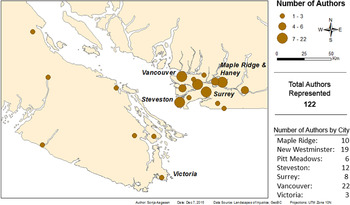
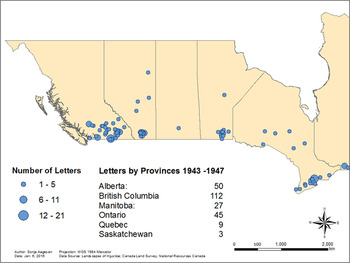
Nonetheless, the authors of protest letters constituted a reasonable cross-section of Japanese-Canadian society in the internment era. Most authors were men, but at least forty-three letters included a female signatory.Footnote 49 They originated from key sites of settlement, with the greatest numbers displaced from Vancouver, which housed the largest Japanese-Canadian urban neighborhood before the war, the fishing center of Steveston, and the rich agricultural areas of the lower mainland, where Japanese Canadians had built large multigenerational communities. Authors came also from the remote settlements—Ucluelet, Port Essington, Prince Rupert—where smaller numbers had made their lives before the internment (Figure 1). Between 1943 and 1947, the authors wrote from the varied sites of internment that housed Japanese Canadians during the war. The largest number, although less than a majority, wrote from the camps and ghost towns in British Columbia—Greenwood, Lemon Creek, New Denver, Slocan, Tashme—where Japanese Canadians were interned en masse. Fifty wrote from the small Alberta towns, such as Picture Butte and Raymond, where they labored. Forty-five wrote from Ontario, almost half of these from Toronto, which, especially after 1944, became a magnet for Japanese-Canadian resettlement. In all, the protests came from six provinces and almost 100 localities, reflecting the extent of Japanese-Canadian displacement and dispersal during the decade (Figure 2).Footnote 50
Origins of authors before their uprooting.

Locations of authors when they wrote in protest.

Sources as complex and multivocal as these invite a wide range of analytic approaches. Analysis might emphasize their heterogeneity, examining the role of gender, geography, or types of property (e.g., real estate vs. personal property, or urban vs. rural) in Japanese Canadians’ expressions of loss. Scholars might focus on only a few letters, linking them to other available sources to tell stories that unfold over longer chronologies, documenting Japanese-Canadian acquisitions of property, their experiences of loss in the 1940s, and then the remarkable achievements of so many in rebuilding their lives thereafter.Footnote 51 One colleague, an oral historian, has suggested pairing the letters with subsequent memories of these events to juxtapose the sheer outrage that these letters express against the often more guarded reflections of Japanese Canadians decades later.Footnote 52 Given the dissonance between property owners and officials over what kind of loss counted, it might also be tempting to isolate for analysis those types of harms—the emotional, personal, or even political—that government officials denied, but that Japanese Canadians asserted. The letters, overlooked for decades, are now (thanks to the Canadiana.ca project) freely available online; we hope that this article will encourage others to read these remarkable sources and to pursue some of these lines of inquiry.Footnote 53
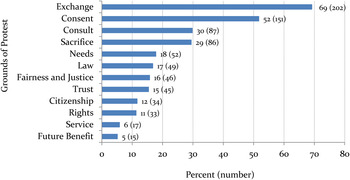
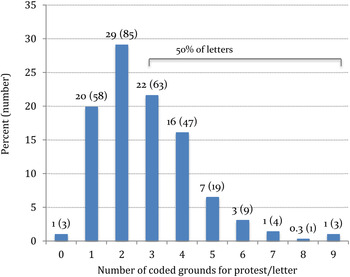
Our analysis aimed from the outset to understand the protests of Japanese Canadians in a comprehensive and inductive fashion. We found, in taking this approach, that it was also invocatory of key facets of property theory. Although the letters are powerful and individual (speaking to personal experiences that we do not intend to overlook in the reflections that follow), we seek to be comprehensive. That is, our analysis is guided by patterns of argument within the entire collection of letters. We situate individual claims within the context of hundreds that were written in protest. To achieve this kind of analysis, we first coded all 292 letters, identifying their most common argumentative themes.Footnote 54 Perhaps the most striking aspect of the collection is the plurality of grounds of protest expressed. Japanese Canadians contested market values ascribed by appraisers and described competing (and higher) offers for their lands and belongings (this was the most common ground for protest, which we represent in Figure 3 as “exchange”). They talked about the money, time, and labor that they had invested in improving their lands (“sacrifice”). They described their needs. They emphasized owners’ rights to consent, or at least to be consulted, in the sale of their property. They invoked law as well as justice, fairness, and trust. They spoke about the significance of citizenship, democracy, and rights. They appealed to the service they had given their country and described the benefits that they still hoped to reap from their possessions. Japanese Canadians, in short, articulated many grounds of protest.
Japanese Canadians expressed multiple grounds for protest.

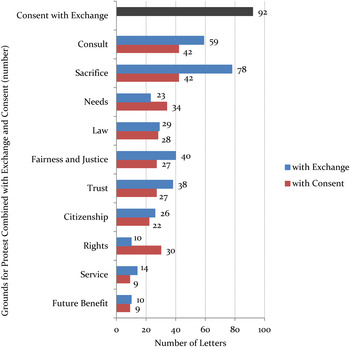
Our next analytic step was inductive. A regression analysis of the letters found that they clustered into two principal branches: protests tended to focus on (1) exchange or (2) consent. These were the most common grounds of protest in the letters, and, notably, they appeared together less frequently than we would have predicted (based on their overall frequencies). Further, they tended to cluster with different additional grounds for protest (Figure 4). Although ninety-two authors invoked both exchange and consent together (and these letters are also examined subsequently), the two arguments tended to combine somewhat differently with other grounds of protest: the letters, therefore, fell into two somewhat distinct groups, each expressing its own ways of conceiving of property and of the harms of property loss, or at least two different strategies for protesting policy. Whereas authors who focused on exchange values were also likely to describe their sacrifices for property (investments of time, money, and labor that owners put into their possessions), authors who expressed the principle of consent had no such tendency. By contrast, authors who invoked the principle of consent were disproportionately likely to also use the notion of rights (many of these in form letters, which will be discussed subsequently) and to speak about their needs for the material benefits of property ownership, concepts that tended not to be used by authors focused on exchange values (See Table 1).Footnote 55 By centering exchange and consent in our subsequent analysis, we follow the lead of the Japanese-Canadian letter writers themselves.
Japanese Canadians combined arguments about exchange and consent with all other grounds of protest.

We found, in conducting a comprehensive and inductive analysis, that our discussion echoed the observations of some property theorists. Alexander, for example, draws a distinction between a property's “commodity” function, in which property serves market-oriented ends, and its association with “propriety,” in which property arrangements are organized so as to shape and establish the proper social order. Footnote 56 From this latter perspective, personal security means not security against material losses, “but against political-ethical loss, that is, loss of the self-respect that is the basis for proper citizenship and, ultimately, the proper social order.”Footnote 57 Carol Rose also notes an important distinction between a “preference-satisfying” understanding of property, and a proprietarian conception, in which property serves to maintain appropriate relations in the commonwealth or body politic.Footnote 58 Such perspectives, over and above the distinctions they draw, are also useful in pointing to the pluralism of values that property serves.
Two patterns of protest, expressed in adjusted standardized residuals.

*Each of these associations (with the exception of consent-sacrifice) passed a standard statistical test of significance in cross tabulation.
In the two sections that follow, we unpack some of the meanings conveyed in letters in both clusters. Then, in a final section, we consider letters that address both exchange and consent. In the first two sections, we argue that exchange and consent are both internally complex and powerful grounds of protest and that they are in important ways conceptually distinct from one another. Further, we argue that exchange and consent are inextricably enmeshed with expressions of emotion, identity, dignity, and outrage; these very personal responses of Japanese Canadians to their losses cannot be separated from their appeals to conventionally articulable values or legal principles. In the final section of our analysis, we explore letters that integrate both exchange and consent to convey the multiple and tangled meanings of property loss.
Exchange Value
Almost 70% of authors explicitly contested the price for which their property sold. These letters—in which the authors used terms such as ridiculous, absurd, or shocking to describe the sale price; in which they cited a higher amount that should have been realized in the sale of their property; in which they described government appraisers as biased or unfair; in which they stated, plainly, that the price was too low—were classified as invoking “exchange.” These authors were concerned about monetary value. They felt that their property was worth more, sometimes far more, than the amount credited to them by federal officials. The sale of their property for less than its worth had material consequences for their economic well-being, but also, we will argue, protests about exchange were grounded in wide-ranging claims of injustice. If, in this sense, Japanese Canadians were similar to other groups that have lost property by force, their letters nonetheless convey in rich texture a historically specific experience of dispossession.
Although Japanese Canadians contested the prices for which their property sold, they did not do so by reference to an impersonal market of exchange. Owners did not appeal to prevailing real estate markets or price trends, they did not convey the worth of their lands and belongings by comparison with other sales. Rather, Japanese Canadians protested because their own, very personal investments—of money, time, labor, emotion—were not repaid in sales by the Custodian. In this regard, the letter writers anticipated Debbie Becher's observations about the multiple and deeply felt investments of owners in their property. Owners, she writes, “sacrifice” value of many kinds, such as “money, time, labor, love or relationships—in the hope of future benefits.”Footnote 59 “We know that people put all kinds of value into real property,” she explains:
They use money to buy, rent and improve their properties, and they also use time, skill and physical effort for improvements. They take advantage of social networks for support and advice about their properties, and they put furnishings and building materials into their properties. Finally, they put emotion into the decisions they make and into the time they spend with their properties. And as they sacrifice all these types of value, they expect to enjoy various types of value in the future.Footnote 60
Japanese Canadians protested the prices for which their properties sold on the basis of such plural and personal investments. The plurality of their claims can be verified numerically: only a small number of authors (14%) objected to the sale price without also invoking at least one additional ground for protest. The majority (55%) combined their indictment of exchange values with at least two other grounds (compare to combinations in all of the letters, Figure 5). However, the importance of their investments in their property, and the relationship of these investments to the injustice of forced property sales, can only be understood by attending more carefully to what Japanese Canadians actually wrote.
Japanese Canadians combined multiple arguments in their letters.

As they contested sale prices, Japanese Canadians sought to convey to officials how much of themselves they had put into their lands and belongings. A. Masuhara, for example, argued that his property in Vancouver was “sold by the Custodian at [a] price far below [its] actual worth.” Justifying this claim, he explains that when the family moved in, it was a “broken down small building … [T]he garden was stone and garbage and full of brush. After I bought the place had the whole place changed.” Masuhara offers significant detail: “floors, partitions, doors, walls, and [the] ceiling” were “renewed & painted.” New structures were built to accommodate both commercial and residential uses, and the back yard was “cleared … and made lovely garden with lovely many flowers and bulbs by gardener. I have spent lots lots of money for the place.” Labor, time, and monetary investments interwove to create Masuhara's sense of the value of his lands. He had invested thought and vision into remaking the property. The “absurdly low” figure for which the Custodian sold it was, in Masuhara's letter, measured against a very personal sense of property's real worth.Footnote 61
Similar investments are expressed in letter after letter in the collection. Sakae Takenaka, for example, protested the “unbelievably low price” ($1,020) for which the government sold her farm: property that her family had purchased years earlier for $1,800. In the intervening time, she argued, the value of the property had increased. “Every chicken house on the farm,” she wrote, “was built by us” and had been constructed with “flooring two inches thick instead of the usual one inch.” In addition to their labor, these improvements had cost the Takenakas $760 in cash. An independent valuation of the farm in 1942, she continued, had assessed its value at $5,000, a price that reflected the reality that “any chicken farmer would be able to make two or three thousand dollars a year” on the land.Footnote 62 The family's prior interaction with a “real estate valuator” suggests that they may have previously considered selling. Even so, the letter invoked not an impersonal market of exchange, but rather the very specific value of this very specific farm, value created by hand by the Takenakas themselves.
Many authors, like Takenaka, expected to see their labor in land repaid in the sale of their property. References to toil and time abound. One correspondent notes that “the labour in clearing that wild land, the trees planted … [and] buildings have entirely been overlooked,” with another protesting that “$200.00 is just giving the land free after all the time and labour I put in.”Footnote 63 Yoichi Okuma itemizes the multiple buildings he built on his farm, the labor entailed in clearing the bush, and the many crops that he planted: “You don't realize the hard labour, money and time it has taken me to build up to what I have. Thirty years of hard work and building up one by one has gone to ruins. What is the idea making such an unreasonable transaction?”Footnote 64
References to the labor invested are so widespread that they deserve more careful attention. These claims have a monetary basis: an investment of energy and time, they argue, should be recognized in the sale price. Market equity should match sweat equity. As Shig Kato complains: “Don't you think yourself that the selling price was but a mockery to all hard working people? Even more to a[n] old man who worked hard, put everything he had into his bit of land.”Footnote 65 When Yoichi Okuma wrote officials to protest the sale of his farm, he argued: “You are taking too much advantage of me. The price for which you made the sale is most disappointing.” “You don't realize,” he continued, “the hard labour, money and time it has taken to build up to what I have. Thirty years of hard work and building up one by one has gone to ruins.” Estimating the value of his house at $5,000, he nonetheless concluded his letter with a gesture to an unimaginable financial sum—“[t]his land is worth one million dollars.”Footnote 66 His letter thus simultaneously invokes a language of market valuation while also exploding its very applicability, given the depth of his investments in his land. Others contested price while also protesting the very notion that the market could repay their investments. Rokusaburo Taniguchi's letter states his dissatisfaction “with the amount for which you disposed of the property.” Valuing his farm at $8,000, Taniguchi had received “several good offers for the property,” contributing to his outrage at its sale for less than $3,000. This was, then, a transaction with serious economic repercussions for the family. But it was also more than that: “I had no desire to exchange my property, which represents more than thirty years of sweat and hard labour, and the place where I spent the best years of my life, for a small handful of paper money. Money can never buy my youthful days spent uselessly, now, on that wonderful farm.”Footnote 67
Toshiye Hoshiko similarly described investments that defied market valuation while simultaneously contesting a specific sale price: “It was my home for over twenty years. It was the work and hard work of two decades of toiling. It was where my children were born and raised. And now you tell me that the property was sold and that the balance of my credit at your office is only a mere $1340.11 and on top of that you subtract $50.00 for ‘legal expenses.’”Footnote 68
Such conceptions clearly speak to the financial value of an asset, but exceed it. Cash value needs to be recognized, the claimants note, but is also entangled in other values that monetization, at least in the form of the Custodian's sales, fails to capture.
Perhaps such accounts of the multiple investments associated with the improvement of property rely on a prevailing view, echoed by Locke, of property as a reward for useful labor. Not only do they itemize financial investments, they also serve to inscribe entitlement in the land. To sell my property below the price that I ascribe to it, some writers seem to say, is to efface the right I have in the land, marked not only in the formal title that I hold, but also through the manner in which I have performed ownership through my actions. If so, the authors articulate private property within a particular cultural register. Property can usefully be thought of as a series of enactments and practices.Footnote 69 Clearing land, growing gardens, “improving,” and making land productive are all means by which property can be performed. The sale of property below its value not only causes monetary harm but also undoes these important acts of ownership.
Following this thread, the Custodian’s sales can be understood as undermining important forms of communication. Their letters suggest that many Japanese Canadians believed that, through their many investments in property, they had communicated their status as good owners, as people committed to the places they lived, as people who belonged. Sales markedly below value served abrupt notice, even in the context of the larger uprooting, that such acts of communication, often performed over decades of hard work, were to be ignored. As Carol Rose notes, “persuasion … is what makes property available to action.”Footnote 70 Property—both in law and every day practice—relies on communicative acts, and compelling stories through which we persuade ourselves and others of our entitlements. As “persuasion tells a story,” so some Japanese Canadians narrated the extraction of their land from a state of “wilderness.”Footnote 71 C. Kobara notes, “I labored and cleared six acres in ten years to see the fruits of my work” and as such “I cannot bear to see it go at such a rediculous [sic] amount”Footnote 72 Similarly, Kisaku Nishimoto notes that land in Matsqui: “has been made productive in the highest degree from a wild, neglected land, where the water had covered most of the year making it only fit for hunting ducks, by networks of ditches, tons of fertilisers and patient and hard labours, taking ten years of hard and strenuous work. It was really … sweat and blood that had made this land a highly productive one.”Footnote 73
Given the meaning of these acts, the ownership that they ought to have communicated, Nishimoto was “simply appalled at seeing such insulting figures” for the sale of his farm.Footnote 74 Claimants frequently narrated their investment, documenting how they came to the land, improving it and investing in it. To sever that relationship was to destroy a personal history and geography. For H.K. Naruse, expressing a sentiment later echoed in scholarship by Radin, the entanglement between personhood and property is palpable: “How would you … like to be kicked out of your house which you have planned and built to your own specifications and satisfactions. Then soon after informed that your house and land has been sold. Yes, sold … and at a ridiculous amount. Perhaps you did not go through the pains and joys of building on your own property … after so many years of saving and planning.”Footnote 75
Ownership of the kind created through the investments of planning, labor, and time is, in this formulation, fuller than that which follows from a mere acquisition of title. Only some owners—and Naruse speculates perhaps not his correspondent at the Office of the Custodian—have performed and experienced this deeper and more personal kind of proprietorship.
Time is central to such investments, not only in terms of the time already spent, but also, crucially, in terms of a set of expectations regarding future benefits.Footnote 76 Masahiro Sakamoto wrote of his hopes of returning to his farm after the war ended. “It is here in this district,” he wrote,“that I grew up and had my schooling. The school that I went to from grade 1 to High School is only about a block away from the farm and I am hoping that my children will be able to go to it also. It was with this in mind that I bought that farm … If I may start once again in the district of my childhood I would be very happy.”Footnote 77
Another writer remembered his parents “both deceased” who had “worked so hard to leave something of Canada for us, their offsprings.” “Personally,” he continued, “I would consider disposing of my property, but when you state the sale price as a fair one, I can only say that it is adding insult to injury.”Footnote 78 Another author, who returned the check sent to him by the Custodian, explaining that it was “below my valuation,” noted that “it has always been my wish and intention that my son take over my property for his own use.”Footnote 79 Writing for the members of the South Fraser Farmer's Union, President T. Maruno implied similar plans for the future: “our children were born on, and loves [sic] these farms. I realize that you will understand that it will be hard for these second generations to trade their birthplace for money or any other thing.”Footnote 80
For others, land secured not only a future in terms of familial commitments, but also acted as a buffer against an uncertain world. C. Kobara notes that without the 6 acres cleared in 10 years of hard labor, he sees “no security or future ahead.”Footnote 81 Takahashi, on a similar theme, argues, “After all our efforts in good citizenship we do not deserve to have our retirement jeopardized by the liquidation of our properties.”Footnote 82 Overlapping themes of security and familial succession, Shig Kato evocatively refers to his property as land that he had “looked upon as a child who had at last grown up to a stage where it was ready to help.”Footnote 83
Japanese Canadians who contested the price for which their property sold argued that their plural and temporal investments failed to register in the state's narrow logic of valuation. They echoed Becher's observation that legitimate compensation for property loss is “an act of recognition—specifically, government's recognition of someone's investment.”Footnote 84 Thus Naruse, describing the “pains and joys” of building property, caustically rejects the Custodian's “‘qualified’ appraiser who was guilty of such a moronic valuation.”Footnote 85 For Kane Tanaka, whose home in Vancouver boasted a “beautiful and valuable landscaped garden,” the property valuation was an “obvious case of misfeasance attributable to unsympathetic and very careless handling … No Canadian property owner in his right mind would willingly consent to the sale of his property based on such a valuation standard.”Footnote 86 Such personalized investments cannot register in the dispassionate calculus of the state, notes another claimant: “After twenty (20) odd years of hardship I believe that others should have more consideration and figure out for themselves, the greater value of my properties.”Footnote 87 For Tsurukichi Mishima: “you will never no [sic] what energy and sweat I have put in it to make it produce as it does now … I am sure that any scale by which you have sold lands … will not be satisfactory for us.”Footnote 88 It is clear, then, that claimants did not evaluate the cash derived from forced sales as a dispassionate substitution of the assets. Judging by the letters, many responded with anger, disbelief, sadness, and surprise at the sale, the low valuation, and the failure to recognize the depth of their ties to property and the value of their investments.
Consent
Just over half of the authors invoked the principle of consent in contesting the sale of their property, making this the second most common ground for protest. Letters indicating that the owner did not wish to sell, did not give permission for the sale, or refused the sale were coded in this category. In these letters, the writers often also articulated their protests in terms of the relationship between the state and property owners, and concerns about price were significantly underrepresented.Footnote 89 For many authors, property's value turned less on its commodity form than on the manner in which it encoded a set of foundational political relations. Letters focusing on consent, in particular, reinforced Singer's observation that “the legal structure of property reflects norms and values that are not fully expressed by reference to the market value of property rights”; instead, property also must be understood as a “constitutional problem.”Footnote 90 Property rules organize and structure relationships according to a set of democratic principles predicated on respect and personal dignity; property “builds the floor on which we stand; it is the foundation that lets us live our lives in conditions of human decency.” As such, “property law defines things that we would like to take for granted; it does so by setting the boundaries of just social relationship.”Footnote 91
The taken-for-grantedness of property offers an explanation for the common and enduring conviction of many protestors that they retained the right to veto the sale of their property. Shichitaro Odagaki, on being informed that his property was to be sold, replied, “I have thought over this matter very seriously and come to the conclusion that I will not sell my property … I will appreciate very much if you would inform this buyer that my property is not for sale.”Footnote 92 He was joined in this sentiment by dozens of others who expressed the view that they had the power to deny the sales, for example: “I am thoroughly disgusted with the absurd transaction so cancel this sale immediately … I would like you to know that I will not sell my property no matter how many times you write… I am not selling the land…Please be informed that I definitely do not wish to have my property sold…please put our names on your list of people, who do not wish their property to be sold…I have no intention to sell my property, whatever the Government policy is.”Footnote 93
These letters assume and assert a view of property as a foundational relationship between owner and state. Taking for granted that an owner's intentions with his or her property should be enforced, these letters reaffirm foundational norms that the forced sales threatened to shatter. Owners will pay taxes, abide by government regulations, and generate and derive benefits from their property. Government will secure property and protect over time the diverse forms of value that owners hold in their property.Footnote 94 By refusing sales that they have been told will occur (or have occurred), Japanese Canadians repudiate state action that would allow their property to be taken away and transferred to others against their will. These letters imply a contract with the state that was violated by the dispossession.Footnote 95
Other protestors made property's place in the political order explicit in their frank outrage at the government policy. Tatsuo Onotera responded to a letter regarding the sale of his and his brother's property: “It was a shock and surprise as I had no previous notice or correspondence on the matter. I knew different properties were being sold of former coast Japanese, but I didn't think for a moment that such a thing was possible. I feel as a Canadian citizen born and raised here that I could have at least been notified[.] I have been brought up as any one of your other citizens believing this a fair and Democratic country, but the way we are being treated I have my doubts.”Footnote 96
If, as Singer argues, “[o]ur regulations … shape the house that we live in,” here it is both Onotera's house and a set of presumptions regarding the legal norms that make this house his that have been violated.Footnote 97 Rather than leaving these norms implied, many authors articulated their expectations of a political society that upheld property:
You have gone against our wishes, also without even consulting us, as any citizen of Canada would have the privilege of giving assent or refusal… I want to know from who did you get permission to sell my property…I thought the Custodian suppose [sic] to look after the land and responsible for everything, not sell it…I will, with all my efforts, let the Canadian Public know what form of injustice is carried on in spite of the true form of government and policy which Democracy stands for in Canada… To my thinking the Canadian Government should make some kind of restitution on properties … and help us get back on our own so that we may live as … true Canadian Citizens.Footnote 98
In affirming their Canadian citizenship, such writers both articulated the contractual implications of democratic governance, and pushed back against the widespread tendency in the 1940s for policy makers and the wider public to misconstrue them as foreigners. As Isamu Kai (quoted previously) wrote, “During the war I was forced to evacuate from New Westminster where I was born and classed as an enemy alien.”Footnote 99 The effort to be regarded as Canadian, nonetheless, was conjoined with an affirmation of the legal and normative meanings that should attach to political belonging.
A number of authors affirmed the notion of political contract by emphasizing their ongoing performance of the obligations of citizenship. Some did so by noting their efforts to remain financially self-sufficient despite the disruption of the uprooting and interment. Sajiro Wakita wrote, “I and my family are not dependent on the government maintenance, therefore, you should not need to sell my property which I altogether refuse in selling.”Footnote 100 Similarly, Chieno Kuroyama asked officials to recognize “how great my shock and disappointment would be, to be informed that my last remaining possession, my house, had been sold … Especially when you know that we have done our utmost not to be a burden on the Canadian Government by being self supporting.”Footnote 101 James Hasegawa objected to the sale of property belonging to his father (“a naturalized citizen of Canada since 1913”), in part on the grounds that “He has given us a liberal education by sending us to Universities so that we in turn could become useful citizens instead of a burden upon the government.”Footnote 102 Takeo Yoshida argued in 1946, almost 2 years after Japanese Canadians were given the opportunity to enlist in the Canadian military, that “many friend and persons of our minority have joined the services of Canada for right, justice, and fairness, for everything that the war stood for,” an effort that he described as “a dead cause when there is injustice of liquidating personal assets and belonging[s] without the approval of its rightful owners.”Footnote 103 Aya Suzuki wrote with a warning: “that property is one place I do not want to see sold as most of us were born there … Mother's heart & soul is in to get back to that house yet I am trying to wean her away from the re-location centre to go east for awhile. Yet you still insist it is Ottawa's Orders and take a dictatorial hand not a democratic way. Please do not try us any further.”Footnote 104
In her view, the cooperation of Japanese Canadians with federal directives, including their relocation to destinations east of British Columbia, was contingent on the government's fulfillment of its obligations. Violation of contract, she implied, could bring unforeseen and undesired consequences for governance.
In such cases, one may expect an individualized and rights-based defense of private property, given the prevailing view of property as a bulwark that protects the individual from the state. By seizing and forcibly liquidating assets, the state has violated the liberty and autonomy of the individual liberal subject. Claims about rights did cluster (in a statistically significant fashion) in letters that focused on consent; however, more striking in the letters is the limited use of such rights-based normative claims. Only thirty-three letters (10%) invoked rights explicitly, and almost half of these were form letters that accompanied the court challenge to the forced sales launched by Japanese Canadians in 1943. These letters were crafted to allow Japanese Canadians to accept funds realized in the disposition of their properties while at the same time registering their objection to the sales: “I wish to make it clear that [funds] are only being accepted under protest and without prejudice to any rights which I have or may have arising out of what I consider the wrongful sale and disposition of my property.”Footnote 105 In scattered other instances, Japanese Canadians “reserve the right to take legal action” or invoke the owner's “right to appeal for fair sale price” under conditions of expropriation, but such examples are notable for their scarcity.Footnote 106 Far more frequent are the appeals to broad norms of contractual citizenship, which themselves could sometimes be expressed in terms of rights, as for example, when Aya Suzuki wrote that “Canadian citizens” should be “free to exercise their rights and to contribute to the betterment of this land of our birth.”Footnote 107
The language of consent, rather than one of rights, is worth noting. Rather than an absolutist conception of property as a zone from which the state is excluded, by right, consent here implies a structured and predictable relationship between state and owner, ideally governed by norms of mutuality, equality, respect, and dignity. Although it presumptively privileges the interest of the owner, it does not rule out the interests of the state. As such, it rests on a set of relationships between owner and state, rather than a simple opposition.
Interweaving Exchange and Consent
Although the isolation of exchange from consent has conceptual advantages (allowing us to delve deeply into each theme) and follows a statistically significant trend within the collection of letters (whereby they were used in combination less often than we would have expected and tended to overlap with different supplementary themes), this division nonetheless overlooks another important aspect of Japanese-Canadian protests to the government policy: a large number of authors invoked both exchange and consent. Although statistically underrepresented, the majority (more than 60%) of writers who objected to the failure of the government to secure their consent also protested the monetary value of the exchanges. From the opposite perspective, among the 70% of writers who objected to the price for which their property was sold, almost half also mentioned the failure of the government to obtain their consent. Further, these letters exemplify the complexity and power of the entire collection and the reality that Japanese Canadians had many interwoven grounds to protest the forced sale of their property.
Among these is the letter of Rikizio Yoneyama, which gracefully and painfully expressed the layered significance of the ownership violated by the dispossession. Yoneyama wrote about monetary value: “During May of this year,” he explained, “I received notification that my property … had been sold for the sum of $1,406.98.” This amount fell far below his estimate of the worth of his estate: “My property there consisted of seventeen and a half acres of land and other household goods … which I valued at the total sum of $4,500.”Footnote 108 Like most Japanese-Canadian protesters, Yoneyama emphasized the exchange value of his property: the price for which the government had sold it was less than the property's rightful market value; however, Yoneyama wrote to protest much more than this.
He explained that after years of labor, he had transformed his land into a productive farm that played an essential role in his family's success in Canada. Years of “hard work,” he wrote, had built the farm “up to a point of security for my wife and my children.” An annual income of $3,500 (more than twice the sale price) had enabled him to “put two of my children through university as doctor and dentist respectively.” These lines could scarcely convey the remarkable personal journey that lay behind them. Born in 1887 in the Kanagawa Prefecture, southwest of Tokyo, Yoneyama traversed the Pacific at the age of 20. In the first decade after his immigration, during which he married and fathered two daughters, Yoneyama worked in a sawmill and then a pharmacy, saving enough money to purchase land, 7.5 acres in Haney, where he dug a well by hand so that he could raise chickens and pigs and cultivate berries, apples, pears, plums, and cherries as well as a variety of vegetables. There two more children were born. Supplementing the income of this farm with additional wage labor, Yoneyama was able in 1935 to purchase additional land, where he built a two-story chicken coop and an enlarged family home. As his letter indicated, by 1942, his children had already begun their entry into Canadian professional life; when his family packed their bags for Edmonton Alberta, they went to join his two oldest daughters, where they were training.Footnote 109 Yoneyama sought to convey to federal officials the extent to which his property was woven into the story of his personal and family history. The farm was invested with his labor and was a container of his memory; it was tied together with his identity as a father, husband, and provider.Footnote 110
In these respects, the farm was also essential to Yoneyama's aspirations for the future. He had planned, after the war, to return to Haney and to resume his work, so that his “two remaining children, who are dependent upon me, receive the same privilege as their two older sisters.” His third daughter, he hoped, might become an optometrist, whereas the youngest, “my only son” aspired to be an electrical engineer. “I am now fifty eight years and feel I cannot start again from the bottom,” he wrote “my health is failing … my desire after hostilities have terminated, was to return to my home at Haney and continue where I left off.”Footnote 111
Yoneyama's land was also part of the story of his citizenship, a status inseparable from the larger narrative of his family. “I came to Canada in 1907,” he wrote, “and was allowed the privilege of Canadian Citizenship on December 22, 1914.” “This was to me,” he wrote “the most gracious opportunity given by the country of my adoption. Through it, I realized an ambition I had desired since landing on this continent, that of being able to raise a family of Canadian sons and daughters.” The story of his migration and citizenship and that of his role as a father entangled with his property, “which to us meant more than just a home. It was to us, the foundation of security and freedom as Canadian citizens.”Footnote 112 Here Yoneyama seems to suggest, as Adachi would later argue, that Japanese-Canadian property ownership constituted a refuge from and a response to decades of racism and exclusion in British Columbia, providing the “economic and emotional security around which they organized their tightly-knit family and community life.”Footnote 113
It is in this context, then, that Yoneyama expressed indignation at the violation of his right to refuse the sale of his property: “The Custodian has not at any time requested my sanction [to] dispose of my property and had he done so, I would have been most reluctant to sell.” Yoneyama's protest extended beyond the $3,000 in losses that he estimated and beyond the future economic benefit that he had anticipated: irrespective of the price obtained or the value acknowledged, he should, on this view, have had the right to choose. Footnote 114 If conceptually distinct, these values were not separate in his experience. His investment in property over time was also a history of choices that he had made; the monetary losses that he suffered were also a violation of his ability to provide as a father and to act as a citizen.
Tsurukichi Takemoto's family was not consulted before the forced sale of their personal belongings, including “Japanese dishes, trays, etc,” which were important family heirlooms. “These things are very valuable to us” she wrote, they “are not what you think they are.” The use of this powerful phrase to describe personal property is a reminder that the investments of Japanese Canadians were not limited to real estate.Footnote 115 Among the letters, 118 specified personal property lost, often enumerating it in addition to the writers’ real estate and emphasizing its value. Many, like Takemoto, felt that officials badly underestimated the value of their moveable property. She wrote: “The total cost of the property we had in the premises,” which the government had sold for $325, “is about $3500.00. What do you think about that!” Her loss, she affirmed, was significant in monetary terms alone, but her words suggest something more; namely, that officials had no understanding of the meaning of these items, which were, as she writes, were “very valuable to us” (our emphasis). As Mihaly Csikszentmihalyi and Eugene Rochberg-Halton observe, cherished personal objects are valued not only for their craft and physical characteristics, but also for the ways in which they represent their owners’ senses of self and accomplishment, their relationships to kin and friends, their connection with wider communities, and their investments of time and memory.Footnote 116 The complex losses that they suffered were not merely the losses of the lands and buildings where Japanese Canadians had lived, but also of the countless objects that had constituted them as homes.
For Takemoto, this loss of investment, taken in the context of the wider policies directed at Japanese Canadians, signaled a profound rupture of the Canadian political order. “I did not answer [the government's notification of sale] until now,” she wrote, “because your letter just made me mad enough not to answer”: “Why did you sell without even consulting us. Isn't the method you're using like the Nazis? Do you think it is democratic? No! I certainly think you're just like the Fascists confiscating people's property, chasing them out of their homes, sending them out to a kind of a concentration camp, special registration cards, permits for travelling. Don't you think this is the method used in dictatorship countries. Democracy means no racial discrimination, or it the very opposite.”Footnote 117
Here, as in dozens of other cases, the full weight of the two main grounds of protest landed in forceful condemnation on Canadian policy. Like Yoneyama, Takemoto conveys the dispossession of property as materially significant: the sale of her family's treasured belongings at a fraction of their value was an emotional affront and a devastating economic blow. More broadly, the forced sales—along with neglect, theft, and vandalism—cost Japanese Canadians dearly. These acts significantly compromised their material well-being, and letter writers protested strenuously against this reality. At the same time, the forced sale was a political act, a violation of the basic rules of democratic society. These two dimensions of the forced sales can be analyzed separately (and many letter writers used them independently), but they were nonetheless knotted together. Here, no distinction between exchange and consent will hold. They were each of them complex and inseparably entangled.
Conclusions
The letters reveal the multiple injustices of the forced sale of Japanese-Canadian-owned property. With no plausible connection to the security of coastal British Columbia, the forced sales seemed to Japanese Canadians at the time, and ever since, to reflect a malice that extended beyond the exigencies of war. It reflected the desire, among some in British Columbia's racist political establishment, to see that Japanese Canadians never again returned to the province.Footnote 118 The dispossession of Japanese Canadians was part of the “politics of racism” of this era. This collection of letters demonstrates that Japanese Canadians immediately perceived the wrong of forced property loss and responded emphatically.
The dispossession was distinctive as a state act perpetrated against property owners. In their letters to the federal government, Japanese Canadians expressed the specific harms of this particular violation and conveyed what their property meant to them. Their protests confirm the pluralism and complexity of ownership. Japanese Canadians, like other owners, had made multiple and deeply felt investments in their homes, lands, businesses, and belongings. The harms of property dispossession had to do with monetary sacrifices and rewards, but also with much broader and deeper investments of time, labor, love, pride, and connection. The injustice of the dispossession, for Japanese-Canadian protestors, revolved around how much they lost, how they lost it, and what that loss signified. The loss of their property without their consent or even their knowledge, the violation of foundational norms of civic and social relations in a society of private property ownership, constituted a particular kind of injustice, which stood distinct from (even as it was connected with) the wider array of policies that overturned the lives of Japanese Canadians in the 1940s.
Violations of property are deceptively hard to repair. Attempts to redress the harms of Japanese-Canadian property losses—not only the Royal Commission created by the federal government in the immediate postwar era (a rather half-hearted attempt), but also initiatives of the Japanese-Canadian community (such as the Price Waterhouse estimation of material losses)—have taken their cue from the market. Because transactions of property do occur, wherein the complex investments that owners make in their property are reduced to a single exchange value, it has been repeatedly imagined that the harms of forced dispossession might be repaired by monetary compensation. The letters of Japanese Canadians do suggest that money needed to be part of any discussion of redress. However, they also suggest the extent to which any monetary resolution of these harms will always be inadequate.
Owners valued their land and assets in ways that could not always be compensated by cash payouts. Property was not an easily alienated commodity, but had become incorporated into life plans. Real and personal property materialized memory, recorded lives of hard work, and signaled security. Farms, businesses, and homes were entangled in local networks of meaning, belonging, and association, echoing Alexander and Peñalver's comments: “Once a person (or a community) has sufficiently incorporated a piece of land into her life plans, exchanging that land for some other good (even a good of very great economic value) or for some other piece of land can hinder, in some cases, irreparably, her ability to flourish. Losing the land can short-circuit long-term plans, deeply held commitments, and carefully constructed identities in ways that resist compensation.”Footnote 119
Such valuations of property's worth do not easily align with the state's calculations. First, the amount of the cash derived from forced sale is unlikely to adequately align with the multiple “investments” made by owners, in which the land is worth “a million dollars,” as one correspondent put it. Second, a cash payment is itself inherently constrained, squeezing the multiple and diverse attachments that people have with land and assets into a monetized calculus. Such assets are not simply substitutable, as the state presumed. To assume otherwise is to engage in an invidious form of reductivism.
Here, recent work on property loss and restoration in other contexts may be especially instructive.Footnote 120 Becher, on whom we have drawn previously, argues, that compensation for property losses should “recognize the years that owners and residents have spent with their property … [as well as] expectations of future benefits from properties” by supplementing market-based compensation with rules that take into account longevity of ownership and include “mechanisms for sharing the profits” derived from expropriate properties.Footnote 121 Introducing a recent collection of articles on property loss, Bernadette Atuahene similarly advocates remedies that “seek to provide dispossessed individuals and communities with material compensation through processes that affirm their humanity and reinforce their agency.”Footnote 122 Ndabe Zibuqu pushes toward a similar point, asking: “unless claims are settled in a manner which gives a real sense of redress to the claimant group and which takes into account loss of history, livelihood, dignity and time as well as a loss of a stake in the property market—can it really be called restitution?”Footnote 123
Today, Japanese Canadians are divided about the advisability of further negotiation that might directly, and more comprehensively, address property loss. For example, after a recent revelation that the City of Vancouver bore an important share of the responsibility for the dispossession of property, some members of the community saw this information as supporting a broad project of antiracist education, whereas others instead saw an opportunity to press for restitution by the city.Footnote 124 More generally, Japanese Canadians vary in their memories of and perspectives on their history with the Canadian state and its efforts at acknowledgement and repair.Footnote 125 It is not the purpose or the place of the present analysis to intervene in such discussions, which instead involve the Japanese-Canadian community and, at times, elected representatives. However, if a process of restitution were to be undertaken, it seems likely that the perspective advocated by Becher, with its emphasis on the complexity of investment, would be most likely to yield results that respond to the protests voiced decades ago by the Japanese Canadians who lost their homes and belongings.
The letters of Japanese Canadians to the Canadian state bring into sharp focus a historical reality of societies organized around private property. Although scholars have been right to critique private, individual proprietorship as only one form of ownership, and tenure in land as only one way of belonging in place, these have nonetheless been a tremendously powerful and motivating force. Japanese Canadians built lives around private property ownership; owning land, in particular, was a goal that had motivated the migration of first generation emigrants from Japan.Footnote 126 For Rikizio Yoneyama, among many others, property ownership was essential to a multigenerational plan, the core of a project that defined his life. Therefore, he could endure a temporary (although nonetheless unjustified) internment while he retained the promise of returning to his property and continuing where he left off. Deprived of this too, he despaired, but also tried to use his own story to fight back. In important respects, he failed. His property was never restored. In 2005, his son, Yutaka Harold Yoneyama, returned with his children and grandchildren to Haney, hoping to show them the farmhouse in which he had been born. “Unfortunately” he found, “the farmhouse was razed and the farmland has been developed into single family mansions and townhouses.”Footnote 127 All of the landmarks of his youth had been erased by redevelopment. Still, Rikizo's project had also succeeded. His son became an engineer and his youngest daughter became an optometrist. His letter of protest, and the hundreds of others written by Japanese Canadians, offer a powerful testament to the human importance of such aspirations, the harms of their forced compromise, and the courage of everyday people contesting injustice.