Introduction
Choice and consumerism have been identified as part of a fundamental, international shift in welfare service provision (Moffatt et al. Reference Moffatt, Higgs, Rummery and Jones2012). It can be argued that this international trend resonates with the process of globalisation, which has emphasised market rationality, and which has created global market values. Reflecting this trend, English and Japanese welfare reforms of long-term care for older people can be seen to have shared a change in policy direction, moving towards a consumer-focused strategy. There has been, in recent years, an increasing emphasis on choice for service users in both countries. Given this policy background, this article explores older people's exercising of choice in the context of long-term care, drawing on my PhD research, ‘Choice and care in England and Japan: a comparative study of older people's and key informants’ perspectives’ (Wada Reference Wada2012). Reflecting the definition of ‘long-term care’ as: ‘a set of health, personal care and social services delivered over a sustained period of time to persons who have lost or never acquired some degree of functional capacity’ (Kane and Kane Reference Kane and Kane1987: 4), this article explores both the informal and formal care contexts.
The other fundamental shift within consumerism has been decentralisation (Moffatt et al. Reference Moffatt, Higgs, Rummery and Jones2012). There have been local diversities in both policy making and service delivery within England and Japan. Therefore, with national considerations, the article presents the local context of Bristol in England and Kyoto in Japan. Bristol and Kyoto are not capital cities, but they are core cities in their respective countries. The two urban localities have large populations and a broad range of long-term care provision for older people. Both are known as historical cities but at the same time exhibit an innovative ethos. The article will begin with an examination of national and local long-term care policies. It will then present the research methods, followed by findings and discussions.
Personalisation in England and socialisation of care in Japan
In current long-term care policy in both countries, ‘choice’ is encouraging a new mode of care. In England, an emphasis on choice is present in ‘personalisation’ agendas, and in Japan, this emphasis is present in ‘socialising care’; the latter provides a support system for formal care services within the current public long-term care insurance (LTCI) system.
In England, the government's vision for the personalisation of adult social care is reflected in ‘Putting People First’:
[P]eople who use social care services and their families will increasingly shape and commission their own services. Personal Budgets will ensure people receiving public funding use available resources to choose their own support services – a right previously available only to self-funders. The state and statutory agencies will have a different not lesser role – more active and enabling, less controlling. (HM Government 2007: 2)
Personalisation agendas aim to increase people's choice and control over how their needs are met. However, in their evaluation of the Individual Budgets pilot programme, Glendinning et al. (Reference Glendinning, Challis, Fernández, Jacobs, Jones, Knapp, Manthorpe, Moran, Netten, Stevens and Wilberforce2008: 238) suggest that for older people, taking responsibility for their care arrangements is experienced as a burden rather than a form of control, and can induce in them a lower level of satisfaction than in other service user groups. Moreover, older people in ‘cash-for-care’ schemes have higher levels of psychological ill-health, and lower levels of wellbeing than older people in receipt of conventional services (Moran et al. Reference Moran, Glendinning, Wilberforce, Stevens, Netten, Jones, Manthorpe, Knapp, Fernández, Challis and Jacobs2013: 826). Lloyd emphasises that although policy tends to represent a highly instrumental view of social care, there is a need to address age-related issues and attentiveness to older people's needs (Reference Lloyd2010: 190, 193, original emphasis). Means, Richards and Smith (Reference Means, Richards and Smith2008: 196) point out that direct payments in personalisation agendas operate as ‘market mechanisms to achieve cost reductions’, ‘by shifting administrative costs to the service user’. Barnes suggests that personalisation is delivered through financial resources, and that the current discussion about personalisation agendas reflects ‘a radical shift in the relationship between citizens and government, mediated through the way in which people are able not only to use but also to choose and purchase the services they wish to receive’ (2011: 154–5).
The term ‘personalisation’ remains ambiguous in the practice of health and social care, being confused with ‘personalised care’ and ‘person-centred care’. It therefore, needs to be treated with caution. As a policy term, ‘personalisation agendas’ provide cash payment services aiming to increase choice and control. The term ‘person-centred care’ promotes independence and autonomy rather than control, and tends to be offered by those working within a collaborative, team philosophy (Innes, Macpherson and McCabe Reference Innes, Macpherson and McCabe2006: ix). The term ‘person-centred’ originates in the work of Carl Rogers (Reference Rogers1961) and client-centred psychotherapy (Brooker Reference Brooker2003: 215). As distinguished from ‘client-centred’ counselling, ‘person-centred’ counselling asserts the importance of seeing the person who seeks counselling as being the expert on themselves, and the therapist as a facilitator in their search for achieving self-actualisation (Brooker Reference Brooker2003: 215). Tom Kitwood (Reference Kitwood1997) first applied the term ‘person-centred approach’ to care. Kitwood's approach, usually known as ‘person-centred care’, is different from ‘personalised care’, which merely implies the need for individualised care. His approach is based on acknowledging the importance of the person with dementia rather than the disease process itself. In his ‘person-centred care’, people with dementia do not lose their personhood, but their personhood arises from communication and can be maintained through relationships with other people. Therefore, it is important to recognise the differences between the terms ‘personalisation’, ‘personalised care’ and ‘person-centred care’. Within the complexity of the way in which these terms are used, ‘personalisation’ can form a positive image, increasing individual responsibility.
Fine (Reference Fine2013: 422) observes that recent global trends reflect the individualisation of care (Fine Reference Fine2005; Yeatman et al. Reference Yeatman, Dowsett, Fine and Guransky2009). Regarding the meanings of ‘individualisation’, he argues that it is important to distinguish individualised care financial arrangements from the actual practice of care – where the recognition of individuality is based on those who receive assistance as well as those who provide it (2013: 422). Fine suggests that ‘[f]or individualisation to become meaningful it must be developed as a condition of recognition that is equally applicable to those who provide and those who depend on care’ (2013: 422). Empirical findings from English Individual Budget pilot projects (Moran et al. Reference Moran, Glendinning, Wilberforce, Stevens, Netten, Jones, Manthorpe, Knapp, Fernández, Challis and Jacobs2013) endorse this point – that cash-for-care schemes can be beneficial to older people where there are sufficient resources, as well as practical support, for older persons in managing their own budget and accessing information.
In Japan, the ‘choice’ agenda highlights ‘socialisation of care’, with the Japanese term Kaigo-no shakaika being the actual phrase used in the government's policy papers. The ‘socialisation of care’ implies a new mode of care in Japan with the intention that a support system of formal care services should help improve care for older people. Under the LTCI system, which was introduced in 2000, care provision is ‘no longer “expected” from the family or “allocated” by the state’, but based on consumer choice by service users (Izuhara Reference Izuhara2003: 395). The ‘socialisation of care’ embodies an attempt to reduce social pressure on the family to provide care for their older relatives; it represents the policy intention of redefining the role of the family from provider of physical care to supporter of emotional and psychological needs (Ministry of Health, Labour and Welfare (MHLW) 1994).
The report Constructing a New System for Long-term Care for Older People (MHLW 1994), which provided the foundation for the new long-term care system, emphasised supporting the independence of older people and their self-determination. It highlighted a significant change from the previous approach to long-term care in Japan. Japanese conventional care arrangements have rested on the cultural norms of filial piety. The term ‘filial piety’ means ‘the practice of respecting and caring for one's parents in old age, based on a moral obligation that children owe their parents’ (Hashimoto and Ikels Reference Hashimoto, Ikels, Johnson, Bengtson, Coleman and Kirkwood2005: 437). Filial piety in Japanese, kou (孝), refers to ‘an attitude of obedience, devotion, and care towards one's parents’ (Hashimoto and Ikels Reference Hashimoto, Ikels, Johnson, Bengtson, Coleman and Kirkwood2005: 437). The word kou has psychological and physical aspects: koushin (孝心) – filial affection, attitudes of mind, heart and spirit; and koukou (孝行) – filial conduct, action and behaviour. The ethic of piety has been an essential element in motivating people to provide care support for their older parents. However, this has entailed a different experience for men and women. Older people have traditionally relied on their son for financial support and on their daughter-in-law for care (Sodei Reference Sodei2009: 66); consequently, daughters-in-law providing care help for their parents-in-law has been a social norm. Therefore, ‘choice’ in recent long-term care policies in Japan is understood as being not only for older people, but also for their families – and for women, especially daughters-in-law, who have traditionally been the main source of care support.
Local policies in Bristol and Kyoto
Personalisation entails a significant transformation of adult social care in England. The Local Authority Circular of the Department of Health, which sets out information to support the transformation of social care, states:
Reforming social care to achieve personalisation for all will require a huge cultural transformational and transactional change in all parts of the system, not just in social care, but also for services across the whole of local government and the wider public sector. (Department of Health 2008: para. 21)
Every English Council was expected to change how social care was to be delivered to accommodate the new personalisation agenda. In Bristol, the ‘Putting People First in Bristol’ (PPFB) programme has been set up in order to address national government guidelines. The report Putting People First in Bristol (PPFB) Programme Brief sets out the vision statement of PPFB thus:
People who need care and support will have easy access to services, real choice in the help they receive and maximum control over the way they live their lives. They will be treated with dignity and respect. (Bristol City Council 2008: 5)
Reflecting the requirements of national guidelines, social care transformation in the Bristol programme adopted four elements of ‘Putting People First’:
-
1. Developing universal services (including information and advice) that help people maintain their independence.
-
2. Offering target early intervention and preventative services/opportunities that promote social inclusion, prevent needs escalating and avoid unnecessary use of intensive social care and health services.
-
3. Developing self directed support as the norm for people who have longer-term social care needs.
-
4. Developing the use of social capital including user-led organisations (ULOs) and volunteering, so that people can meet their needs with the least recourse to specialist services. (Bristol City Council 2010: 3–4)
The PPFB programme sets out its objective as ‘developing self directed support as the norm for people who have longer-term social care needs’ (Bristol City Council 2010). This carries the assumption that every older person can independently arrange what is good for them, and that they can solve their own problems. However, it can be argued that this assumption ignores older people's experience of impairment and their constrained circumstances. Barnes and Prior (Reference Barnes and Prior1995: 57) suggest that in welfare services, users are often in the situation in which they feel they ‘have to use services not through choice, but because they cannot deal with their difficulties on their own’. When they start using welfare services, service users are already in a disabled and disadvantageous situation.
In common with Bristol, policies in Kyoto City are developed and implemented by taking into consideration the guidance and suggestions of the national government as well as Kyoto Prefecture. In Japan, with a series of welfare restructuring programmes, the Decentralisation Law of 2000 set out role-sharing between central government and local government. Local government is required to take on the responsibilities of local policy planning. The Plan for Long and Healthy Life for Citizens of Kyoto (Kyoto Shimin Chojyu Sukoyaka Plan) has been set up based on the national guidelines. The Plan sets out its aim as:
to create a society where older persons are able to have a healthy life in their own community [as long as possible] through their own decision-making. (Kyoto City 2009: 6)
The policy objectives of the Plan have been identified as:
-
• Respect for dignity of older people; we will support older persons to maintain their decision-making despite any physical and mental conditions.
-
• Enhancing healthy living; we will promote healthy living and preventive care, recognising the different needs caused by their age and the level of physical and mental conditions.
-
• Creating safe communities; we will maintain health and social care services, social capital, and the community care network in order to meet the various levels of individual needs, so that older people are able to live safely and independently in their community.
-
• Recognising older people as valuable participants in society; we will promote older people's participation as important members of society and attempt to create a welfare society which is founded on partnership of citizens and government, and mutual support between generations. (Kyoto City 2009: 6)
In Japan, ‘the principle of self-determination and self-responsibility’, promoted by the national Decentralisation Law of 2000, now operates at all levels of local government, and care provision, and with care managers and individual users. Reflecting this, there is an emphasis on choice for older people and individual responsibility within the consumerist approach to long-term care. However, evidence from care practice in Japan alerts us to the danger of assuming older people's exercising of consumer choice within a market approach. An article in the newspaper Asahi Shinbun (28 May 2001, cited in the Central Social Security Council 2002: 92) reported the plight of an older couple who were isolated from the services they were entitled to, despite their needs and rights:
An old couple were found dead in a council house in T City in February 2001. The husband, aged 74, who was providing care for his 79-year-old wife suffering from senile dementia, died from ill-health, and a few days later his wife died of malnutrition. The husband was paying for LTCI, but did not apply for care services. The T municipality's comment on this incident was: ‘We have services. However, we cannot visit every older person to ask about their needs if they do not apply’.
Through the introduction of the LTCI, which is a public mandatory insurance system, all insured persons became entitled to use care services. This created new rights and promoted a system in which the responsibility for care is shared by society. However, as the above newspaper article highlights, it is crucially important to ensure the involving of older people in this process – who might well be too frail or isolated to otherwise access information about care services. The expansion of services itself does not necessarily bring about improvement in care systems and provision. A consumer-oriented approach assumes ‘active’ policy making, providers and user participation. However, it can easily ignore frail and isolated older people. There has been increasing emphasis on ‘inclusion’ in policy in the two countries. However, as Barnes suggests, if inclusion is for the sake of including ‘those who have traditionally been excluded’, then ‘there needs to be a broader conception of ways in which debate might take place’ (Reference Barnes2005: 249–50).
In Japan, with a rapidly ageing population and extending life expectancy, there is increasing so-called ‘old–old care’ (rou-rou kaigo) – that is, care for older people provided by those who are also aged 65 and over, such as their spouses, siblings and adult children. These older people might easily be isolated from the rest of society and from needed information. In England, there is an increasing concern about loneliness and social isolation in older people. Yang and Victor (Reference Yang and Victor2011: 1368) suggest that these two things are distinct, but related. They point out the close relationship between older people's use of health and care services, and their experience of feeling lonely and isolated. While older people who are not experiencing loneliness and/or social isolation tend to be less reliant on care services, older people who are experiencing such states can lose their independence, with a consequent use of care services (Yang and Victor Reference Yang and Victor2011: 1369). The above empirical evidence and debates suggest that current long-term care policies in the two countries, which assume consumer choice, may not address older people's lived experience in care practice.
Research methods
An individual interview method was chosen to involve vulnerable older people who were receiving care support. By ‘vulnerable older people’, the author means older people who are physically and/or mentally not fit, and consequently, might be at risk of having their voices ignored or unrecognised in research and the process of policy making. In research on long-term care, frail older adults with high care needs may have restricted or limited expression without the researchers’ due recognition and involvement. An individual interview method enabled the researcher to react ‘sensitively’ to the needs of frail older people in participating and communicating in the interviews (Cameron et al. Reference Cameron, Lloyd, Kent, Anderson, Smyth and Williamson2004; Heine and Browning Reference Heine and Browning2004). Interviews were also conducted with key informants – a range of key players, who had experiential knowledge of long-term care – in order to complement and build on the information obtained from written documents. Data collected from England and Japan were analysed using a comparative approach. The proposed study was submitted to the Ethics Committee at the School for Policy Studies at the University of Bristol, and the Research Governance Group in Adult Community Care, Bristol City Council, for approval.
Interview participants and procedure
Interviews with older people
In-depth semi-structured interviews with older people were conducted in Bristol and Kyoto between September 2008 and May 2009. The interviews aimed to elicit older people's subjective meanings, and what might be important for them. They also aimed to capture their living context so that situated knowledge could be produced.
The older interview participants were selected based on the following criteria, which were applied to both English and Japanese people: aged 65 and over; in the care system at home or in care homes; and not cognitively impaired and able to consent. The participants were 19 people in Bristol (nine living in care homes and ten in their own home) and 16 people in Kyoto (eight in care homes and eight in their own home). In Bristol, the participants were accessed through residential care homes which were run by Bristol City Council, an extra care home which was provided by the City Council in partnership with a housing association and day-care services run by charitable organisations. Older interview participants were also accessed through the Older People's Forum. In Kyoto, older interview participants were accessed through Japanese nursing homes (Tokubetsu yougo roujin homu), which have the same kind of care facilities as residential and nursing homes run by local authorities in England, but which, as non-profit private social welfare institutions, are run by themselves. Japanese older participants were also accessed through day-care services, short-stay services – that is, short-term respite care – and a care house in Kyoto City. A ‘care house’ in Japan is similar to sheltered housing in England, encouraging independent living, and not directly providing personal care.
The duration of each interview was about half an hour. Each interview was audio-taped or digitally recorded. The semi-structured interview method comprised open and closed questions, and used a topic guide in order to give flexibility of direction in the interview process, and to increase the comparability of interview data by defining topics. The names of participants were changed to ensure anonymity, and have remained anonymous in this article.
Interviews with key informants
Semi-structured interviews were conducted with the following key informants: managers in local councils who were involved in planning local long-term care policy programmes and care management; social workers/care managers; care providers; citizens’ groups; and academics in Bristol and Kyoto. There were ten participants in Bristol and 15 participants in Kyoto. In analysing the data, this diversity was taken into account, with an acknowledgement of the various ways in which official policy was interpreted on the issue of choice. Such reflection on key informants’ varying perspectives could contribute to highlighting gaps in the understanding of choice between actors involved in the system. Interviews took place between August 2008 and June 2009. A topic guide was used. The duration of each interview was about an hour and each was recorded.
Comparative data analysis
In international comparisons, a nation or country has generally been regarded as the unit of analysis. In existing comparative studies, there has been little emphasis on the qualitative approach, which considers the views and experiences of older people themselves. The author's study adopted the model of international comparative research (Grootings Reference Grootings1986); this involves a multi-level analysis, allowing for the exploration of the micro-dimension of older people's choice, as well as policy and cultural systems at a macro-societal level. ‘International comparative research’ is to be distinguished from ‘cross-national research’; while the latter treats micro- and macro-levels independently from each other, ‘international comparative research’ looks at the ‘micro–macro relationship’ as a unit of analysis (Grootings Reference Grootings1986: 286–7).
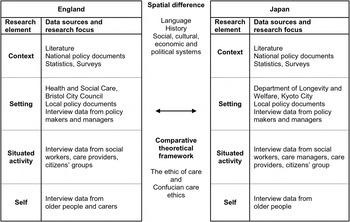
The various data utilised for analysis, and the overall analytical framework, are outlined in Figure 1. Four levels for analysis, ‘self’, ‘situated activity’, ‘setting’ and ‘context’ were identified, with reference to Layder's (Reference Layder1993) ‘research resource map’.
Analytical framework.

Comparative analysis was pursued through constant cross-contextual comparisons between data from England and Japan. Kennett (Reference Kennett2001) suggests that the principal focus of comparative research is not comparing, but explaining. In this research, explanations were based on the themes of how older people were understood to have choice; their views on how choices were made; and why a similar level of choice was not enjoyed by older people experiencing similar living arrangements in England and Japan. These explanatory accounts connected interview data on the older person as ‘the self’ to other data sources concerning ‘situated activity’, ‘setting’ and ‘context’ in the research map. This process entailed dovetailing micro-variables grounded in everyday activities, with macro-variables – for example, cultural traditions. Comparative explanations were developed by considering historical, social, economic and political differences between the two countries. For systematic comparative analysis, theoretical frameworks of the (Western) feminist ethic of care and Confucian ethics were used to elicit Western–Eastern contrasts, and cultural differences between England and Japan. (For a detailed theoretical comparison between the ethics of care and Confucian ethics, see Wada Reference Wada2014.)
The qualitative data collected involved written and spoken English and Japanese. In comparative research, language differences can be a barrier (Hantrais and Ager Reference Hantrais and Ager1985) because of the possible lack of cultural understanding of words sufficient to allow for equivalence of meaning (Iyengar Reference Iyengar, Bulmer and Warwick1993; Kennett Reference Kennett2001). As Tester (Reference Tester and Clasen1999) suggests, careful interpretation and understanding of the policy and cultural contexts, as well as terminology in different languages, is necessary. We should not understand language only as a medium for conveying concepts, but as discourse which is produced within and by a society (Hantrais Reference Hantrais, Hantrais and Mangen2007, Reference Hantrais2009; Hantrais and Mangen Reference Hantrais and Mangen1996; Lisle Reference Lisle1985; Mangen Reference Mangen, Hantrais and Mangen2007).
We could use capitalism as an example here. Sayer discusses that ‘social theory's traditional abstraction from context, which allows it to produce accounts of “normal” capitalism’, is usually based on characteristics of western systems’ (2000: 115). In other words, Sayer suggests what has been taken to be capitalism is a consequence of Western European and North American contexts. Japanese capitalism, however, involves a co-ordinated market economy, and fosters co-operative relationships in the private sector between firms and labour, between firms and banks, and between different firms. Morishima (Reference Morishima, Okimoto and Rohlen1988) observes that the Japanese economic system, based on these social relations, originated in Eastern capitalism, which developed within the social context of Confucianism. Recently, Japanese capitalism has been transforming towards the Western model, and some of these social relationships have not necessarily been desirable any longer. But there is still a Japanese system, trying to integrate a ‘new model of Japanese style capitalism’ (Iida Reference Iida2007: 36) within its history, culture and institutions. Therefore, ‘capital’ as an abstraction, which identifies its key constitutive elements, is common to all capitalisms; while ‘capitalism’ as a concrete social form differs according to geohistorically located space (Sayer Reference Sayer2000: 116).
As with the above example, ‘choice’ is widely understood within neoliberal consumerist discourse as involving the economic logic of an efficient and effective means of providing services, with individuals as consumers. Within this, the term ‘consumer’ in the marketplace carries the idea of an active, autonomous and self-conscious choice maker. However, the Japanese word ‘consumer’, shohi-sha, is made up of passive and rather negative meanings (Maclachlan Reference Maclachlan, Schwartz and Pharr2003: 218): the ideogram for sho has the meanings of ‘to extinguish’ and ‘to disappear’ and hi implies ‘to spend’ and ‘to waste’. In this study, comparative analysis was developed by taking on board the importance of context, and the word ‘choice’ was given particular consideration in terms of social and cultural contexts.
As will be discussed in a later section of this article, while all interviews in England were held in a quiet, independent room, where interviewees could talk freely, in Japan, some interviews were only possible in communal areas. The situation of the interviews in Japan might have influenced the extent to which older people could express their views. This could have affected the comparability of the data between the two countries, and thus, highlights a possible limitation of this empirical comparative research. However, the situations of interviewing in England and Japan themselves highlighted a cultural difference regarding what ‘care’ means, and this could in itself contribute to comparative research on care.
Findings and discussions
Whose choice?
An emphasis on choice in long-term care for older people has raised the question of ‘whose choice?’ For most younger adults, this question is unlikely to arise, since they are used to making decisions in their own best interests (Walker and Maltby Reference Walker and Maltby1997: 105), but in the field of care for older people, this issue is important.
In answer to the interview question, ‘Who is the best person to decide older people's care arrangements?’, all the English key informants commented that ‘choice’ in long-term care should be available to older people. However, decision-making in long-term care for older people often occurs in the context of family relationships, and this could entail a situation in which the views of older people and the views of their family differ. The findings from interviews with English key informants showed that when an older person's view and those of their family differed, they would look at that older person's best interests, whilst taking into account their mental capacity and risks. On the other hand, Japanese key informants tended to express the fact that when the views of older people and their families differed, they would leave the decisions to the family, and would not always support the views of the older person – thus emphasising the importance of considering family relationships. A chief care manager in a Comprehensive Community Support Centre in Kyoto City observed that the situation where the older person's view and their family's view differ often derives from their family relationships and history. To my question, ‘when the older person's and their family's views differ and the family's voice is louder than the older person's, do you try to add weight to the older person's view to balance the differing views?’, he answered:
I never thought of it like that; I mean, I always look at both sides objectively … Umm, we, as care managers, meet service users for the first time [when they need a care arrangement]. But the parent–child relationship will have lasted for 40 or 50 years, and they must have had a lot of experiences during that time. For example, an adult child who provides care to their parent might have been abused by the parent when they were young … my point is that if you look at only the current situation, you might think ‘oh, the older person is so poor [disadvantaged]’, but I assume that there must be something before in their relationship. We don't know what happened between them, so, I think we can't ignore the family's view. I don't blame anyone, but at the end of the day, the parent brought up the adult child [who behaves unsupportively to the parents]. I try to see the family as an outcome of the history of their relationship.
In Japan, older people's choice in combination with their family's, as a unit of decision-making, was highlighted in a comparison between the two countries.
The findings have highlighted comparative elements of the ethics of care and Confucian ethics. Reflecting the perspective of the ethics of care, for English participants, choice was about the means of meeting the needs of the older person, and balancing equality between care-givers and care-receivers. Tronto (Reference Tronto1993: 145) suggests that although contemporary moral theory tends to be based on the idea of human equality, in the realm of care, which involves inequality, we need to consider ‘how equality can emerge out of inequality’. Tronto argues that care needs to be democratic in its disposition. Illustrating this point, the views of English participants highlighted equality between individuals, whilst the views of Japanese participants reflected the theme of reciprocity in Confucian care ethics – rooted, as it is, in the symmetry of family relations. In Confucian care ethics, reciprocity involves a moral obligation on the part of the recipient to return good for good. Comments from Japanese participants highlighted the particular importance of family relationships. Within Confucianism, Tao (Reference Tao2000, Reference Tao and Kennett2004) suggests, the family is the cornerstone of ethical life in practice, because we first learn how to treat other persons with respect in family relationships. The family is thus the place of primary responsibility. The findings reflected this comparative element, with the different focuses on achieving equality in the ethics of care; and the reciprocity, but not equality, characteristic of Confucian ethics.
Interview findings from older people in both countries showed that their decision-making was influenced by professionals, as well as by family. Japanese older people were more likely to leave decision-making to their family, and they also often commented that they made a decision following advice from a care manager. Older English participants more often felt that professionals – for example, social workers and doctors – had an influence on the decision-making process than did older Japanese participants.
The significant influence of social workers on care decision-making in England can be explained by the current English social care model, which is linked to controls over expenditure. In England, public resources for long-term care derive from taxation and income-related National Insurance contributions (Glendinning Reference Glendinning2007: 411). The tax-based model is compatible with expenditure controls, because decisions on eligibility criteria and on how much of what service will be provided are made by local government (Campbell Reference Campbell, Conrad and Lützeler2002: 163). Within this model, care services are budget-constrained, holding the balance between increasing need and constrained resources (Lymbery Reference Lymbery2010). Social workers, as agents of local authorities, have a responsibility to monitor the use of public money, which directly relates to the constraint of individual choice (Moran et al. Reference Moran, Glendinning, Wilberforce, Stevens, Netten, Jones, Manthorpe, Knapp, Fernández, Challis and Jacobs2013: 829).
On the other hand, Japan has launched a programme of mandatory social insurance for long-term care. While tax revenues fluctuate with the economy, revenues from insurance premiums secure a stable source (Tsutsui and Muramatsu Reference Tsutsui and Muramatsu2005: 523). However, whilst the Japanese long-term care system operates mainly on social insurance principles, half of the revenue for the programme comes from general taxation – 25 per cent national and 12.5 per cent each from prefectures and municipalities. Another half of the revenue comes from premiums from people aged 65 and over, which make up 17 per cent of the funding; this is collected by the municipalities in the form of deductions from pensions, and also premiums from people between the ages of 40 and 64, which make up 33 per cent of the funding (Campbell and Ikegami Reference Campbell and Ikegami2000: 31; Webb Reference Webb2003: 41). At the point of service use, beneficiaries (older people and/or often their families) pay a 10 per cent co-payment. The main difference compared with the tax-based model is that social insurance-based funding works in conjunction with social entitlement models (King's Fund 2006: 234). By using explicit assessment criteria, once claimants are deemed entitled to benefits, all eligible people receive the same scale of benefits regardless of their means. Within this system, Japanese older people's access to public care services and to individual choice are less affected by professionals than that of English older people.
Decision-making: rational or relational?
‘Choice’ in long-term care policies in the two countries can be seen as a feature of ‘rational decision-making’, which is based on the assumption of detached self-interested individuals. However, as Barnes (e.g. Reference Barnes1997, Reference Barnes, Simmons, Powell and Greener2009, Reference Barnes2011, Reference Barnes2012) argues, this model, which assigns care receiver and care provider to separate, binary categories, leads to a failure to pay attention to the fluidity of the care process and the relationship between them. Within the process of care, choice will likely be exercised on both sides, as a result of negotiation (Barnes and Prior Reference Barnes and Prior1995: 58). Reflecting this perspective, the findings from care practice in England and Japan highlighted ‘relational decision-making’, which implies the joint decision-making of care receiver and care provider within the context of their relationship in the care process.
In interviews with older English participants, their views on the decisions about from whom to receive care and support were often expressed as ‘it just happened’. ‘It just happened’ can be seen as ‘drifting’ caring rather than the exercise of choice. However, as Finch argues, the notion of ‘drift’ might not be appropriate because ‘the commitment to care derives from a series of events which happen to the carer’ (Reference Finch1989: 204). Finch points out that:
A series of events such as these do not just ‘happen to’ the participants. Rather people make choices at one particular point in time, for reasons which they are aware of, with benefits accruing to both sides and with consequences of which they are at least partly conscious. (1989: 205)
From this point of view, older people's experience of ‘it just happened’ could be seen as a negotiation within their relationships, rather than a ‘drifting’. It could reflect a negotiated decision with benefits for both sides, arising through their relationships. In one interview, a comment from an older English participant who was the main carer for her husband, was:
Well, it just happens, doesn't it? If, if one of you can't do something. Yeah, I can't open the lids and he can; he opens, you know, jars with lids on. He does all the strong muscular things that I can't do so, we do what we can, and then we complement each other, you see, what he can't, I do … We make quite a good one between two of us.
Her comment shows her caring activity as arising through their relationship with a recognition of their needs, in their commitment to each other.
The findings showed Japanese older people tended to leave the decision-making to their family. They often commented that they were happy for their decisions to be made for them by their family members, especially their daughters. For example, one comment from an older participant who had to move from her care home in Nara Prefecture, which is situated next to Kyoto Prefecture, to her current residence in Kyoto City, revealed the decision about moving into a care home being made by her daughter:
I was living in a care home in Nara Prefecture, far away from here. Suddenly I was told about coming into this care home. I didn't know about my moving until the day I moved. As I was living far away from my daughter, it wasn't convenient for her, so I had to move to this place, closer to her. I felt, I just felt, ‘that's fine with me’ and thought only about my daughter's convenience.
She relied on her daughter's decision-making, thinking only about her daughter's convenience, rather than about herself and her choice. According to Hayakawa and Sugisawa (Reference Hayakawa and Sugisawa2008: 55), the acceptance that one does not have to make a decision oneself but will rely on someone else to do this is also regarded as a self-decision. This can be seen as ‘choosing not to choose’ and as ‘choosing to be dependent’. Japanese older people tended to maintain their relationship with the family by their dependence, leaving decision-making to them. From the Japanese perspective, Ogusu (Reference Ogusu2008: 404) argues that while the Western way of decision-making starts with autonomous individuals, the Japanese way of decision-making and choosing starts with relationships. From this perspective, accepting the family's decision is one kind of choice for older people, maintaining their important relationship. Japanese older people ensure their existence through depending on others. Rather than insisting on autonomy themselves, they tend to construct a relationship by being acknowledged by others through their dependence (Suzuki Reference Suzuki2007: 313). As with debates on caring relationships from the (Western) feminist ethic of care perspective, in Japan, as Morimura (Reference Morimura2000: 188) explains, there is an emphasis on ‘interdependence’ rather than a dichotomy of ‘dependence’ and ‘independence’. On the one hand, from the perspective of the feminist ethic of care (e.g. Sevenhuijsen Reference Sevenhuijsen1998; Tronto Reference Tronto1993), dependency is understood as being to do with vulnerability in a particular situation, focusing on needs in a care context. On the other hand, in Japan it is assumed that everyone – whether or not they are experiencing impairment or care – is dependent. It can be argued that this aligns with Buddhist thought, which assumes that all human beings are dependent, and therefore, we can be independent only through our dependence on each other – interdependence (Hasegawa Reference Hasegawa2000: 85). Morimura (Reference Morimura2000: 188) suggests that we need to recognise ‘others’ prior to the self. One can find the self only within a relationship with others – starting from the relationship and not from one's independence as an individual. Applying this to the care context, Hiroi (Reference Hiroi1997: 37) suggests that an individual does not create care, but is ‘created’ within a caring relationship. Thus, ‘independence’ requires ‘interdependence’ of ‘dependence’, and from this viewpoint, ‘dependence’ is not recognised as a negative, but as an important element in achieving the state of ‘interdependence’ (Hasegawa Reference Hasegawa2000: 85). The findings from Japan have emphasised older people's ‘relational self-determination’ (kankei-teki jiko-kettei) (Kimura Reference Kimura2000, cited in Hayakawa and Sugisawa Reference Hayakawa and Sugisawa2008: 55) within the context of their dependence.
Negotiation and conformity
Comments from older participants living in care homes highlighted their dilemma between group and individual interests, in exercising choice. There was a difference in the perspectives of older people on exercising choice between England and Japan; whereas English older participants referred to negotiation, Japanese older participants talked about conformity. Japanese older participants commonly thought that they should not express their own views when living with others. They believed that the conforming interests of the group, and the rule and norm of the care home, was more important than expressing their opinions or exercising choice. For example, Suzue, 82 years old, living in a care home in Kyoto, commented:
I think, if you live here … it's better not to do such a thing [exercise choice] since you live in a group. I have to think about the fact that I'm not the only one here.
As with Suzue, English participant Sandra, 71 years old, also describes living in the care home with the sentiment ‘I'm not the only one here’. However, whereas Suzue took the view that she is not the only one there, therefore, she should not express her views, Sandra thought, on the other hand, there needs to be discussion, as everyone has a different opinion. It was important for her to have discussions, to negotiate over different concerns. Mary, 83 years old, living in a care home in Bristol, felt that with negotiation, she had a good amount of freedom, and could exercise her choice at an adequate level. She observed:
Well, choice is limited anywhere, isn't it? When you live in a group choice has to be limited, doesn't it? Anywhere, any group, anywhere, doesn't it? So, let's put it another way, when you live in a group, there has to be certain rules and regulations, otherwise there would be chaos, wouldn't there? But there is, adequate freedom. I mean, somebody wants to go out, then they wouldn't necessarily be able to go out the day they want to, but people would make arrangements for them to go, you know, they have, everybody has, care workers, so…
The findings reflected cultural contrasts in the construction of social relationships between England and Japan, and this mirrors Western–Eastern contrasts as identified in early cross-cultural studies – for example, those of Kendig et al. (Reference Kendig, Koyano, Asakawa and Ando1999). The latter presented cultural differences in terms of social support in Australia and Japan. Similarly, Fiori, Antonucci and Akiyama (Reference Fiori, Antonucci and Akiyama2008: 205–6) have suggested the cultural differences in social relations between the United States of America (USA) and Japan: in Japan, relationships are considered as predetermined, while in the USA relationships tend to be seen as voluntary, and group ties are governed to a much lesser degree by group norms.
The findings from England and Japan in this study can also be seen through the lens of Confucian ethics and the ethics of care. In Confucian ethics, role-based categories determine how one should behave and care for others. The views of older interview participants in Japan tended to reflect the Confucian view of socialisation, emphasising formal standards and a deferential distance between the parties involved. By contrast, in the ethics of care, what is important is interaction and achieving a result through dialogue, with the voices and spontaneous expression ascribed to communicative morality. The views of older English people reflected the importance of paying attention to different perspectives, and not only following the requirements of particular roles. Almost all the older participants in Bristol care homes maintained the importance of having discussion to debate their differing views. However, one participant expressed in a fragile voice that it's ‘no good complaining, ahem, because I am not competent on my own, so…’. Feeling that she was not competent on her own, she seemed worried about whether she would be listened to or not, so would tend not to discuss things or complain. Her comment reflected that whereas having discussion could lead to a negotiated outcome, at the same time, there might be a risk of neglecting the quiet voice of some older people. The above response reflects the danger of possible neglect – the English equivalent of Confucianism in terms of cultural constraints on choice and care-giving.
I have applied the perspective of the ethics of care in order to explain empirical data from England (contrasting with Japanese data, which was explained with the perspective of Confucian ethics). Although there are various versions of the ethics of care, as Held (Reference Held2006) suggests, their common ground is the response to dominant, universalist and rationalist moral theories which can be interpreted as the foundation of the ethics of justice. The ethics of care, as relations-based moral theories, emphasise the importance of paying attention to particular contexts in practice. However, this does not mean that the ethics of care have been absorbed into practice – the degree to which this would occur would depend upon a carer's awareness of the ethical elements of care. Tronto (Reference Tronto1993) suggests four ethical elements of care: attentiveness, responsibility, competence and responsiveness, as being central in the commitment to overcoming a culture of oppression and neglect in the care process.
The psychological aspects of choice
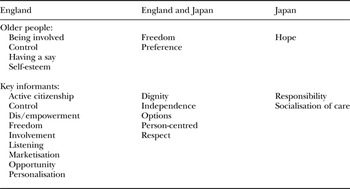
Key concepts of choice in the long-term care context for older people were identified from the findings, and these are shown in Table 1. In interviews with older people, choice was widely understood as the value of ‘freedom’ and an expression of ‘preference’, in both countries. Choice was seen as ‘being involved’ and having a sense of ‘self-esteem’, by older English participants, and as ‘hope’ by an older Japanese participant. The idea that choice was about ‘control’ was confirmed by English older participants and key informants alike – but was not cited by Japanese participants.
Concepts of choice: study findings

One of the findings to emerge from the interviews was the importance of the subjective and emotional aspects of choice. An example can be seen in the above comment of an older English participant living in a care home – when she was not happy with what she was provided with, she would not complain or discuss the matter. Another example can be seen in the experience of one Japanese older participant, who lived with her husband, son, daughter-in-law and three grandsons. She and her husband's preferences were overridden by those of the younger people in the family, but they did not complain, as they did not wish to seem ungrateful. She described:
My daughter-in-law prepares our meals everyday. But the meals tend to suit my three grandsons who are all teenagers. My husband and I often can't eat them and sometimes feel we wish we were asked what we would like to eat … We are grateful having meals but when we think about our health, we wouldn't like to eat a lot of oily food on a big plate.
Amongst older participants in both countries, choice was most frequently understood as the value of freedom. For example, an older English participant, living at home, commented:
…it [choice] means freedom or control, doesn't it? You can have control over things and you also have freedom from other people telling you what you got to do.
To the question, ‘What do you think when you hear the word “choice”?’, an older English participant, living in a care home, commented:
What do I think? Well, you can choose what you want, that's what it [choice] means, you can choose … if you want to go somewhere, or you don't want to go somewhere, … choose you don't want that to eat, or that … you know, they [care home staff] give you that choice, that you can … as I said, they don't just go ‘get on with it, eat it up’ like…
Older participants, particularly those living in care homes in both countries, were likely to describe choice as ‘to decide not to do’ rather than ‘to decide to do’ something. This reflects the concept of negative freedom – that is, absence of coercion – as opposed to the concept of positive freedom that is concerned with acting to fulfil one's own ability (Dasgupta Reference Dasgupta1986). While choice in long-term care policy is generally understood as deciding on things, or positive freedom, the findings have suggested that there is a need for embracing both positive and negative concepts of freedom.
The question ‘What do you think when you hear the word “choice”?’ was not easily understood by older participants in both countries. For older people, ‘choice’ might not be a familiar word in relation to care support. The question was therefore altered to: ‘What kind of image do you have about the word “choice”?’ To this question, an older Japanese participant answered with just one word: ‘Hope’.
This participant was living in a care home. In this home, it was only possible to undertake the interview in the presence of four other residents, as a group interview. During the interview, four or five care home staff were sitting behind them and listening to what the older people were saying. This interview situation could, potentially, have been psychologically oppressive to the participant, and might have affected her comments, limiting her in freely expressing her feelings. Some forms of power are implicit, and thus, it cannot be clearly stated that the situation was felt to be oppressive by the older participants, or that it influenced their expression. Nonetheless, the situation did at the very least affect the author's decisions about what could be discussed with the older people. In Japan, some interviews were held in communal areas. However, in one interview, which was held in a communal area in the other care home in Kyoto, the older participant and his younger carer were talking just like a father and daughter, rather than a care provider and a client. The locations of the interviews in Japan could have illuminated the importance of maintaining their relationship – including not only its positive aspects, but also its potentially psychologically oppressive practices. On the other hand, in England, all interviews were conducted individually, in a separate room. This could have led older English participants to speak more freely than older Japanese participants. Thus, in the process of researching the issue of ‘choice’, the locations of the interviews in England and Japan highlighted comparative notions of what ‘care’ involves.
‘Choice’ in current long-term care policies in both countries tends to be understood in terms of material selection; as we have seen in earlier sections of this article, ‘choice’ is present in ‘personalisation’ agendas in England, which are delivered through financial resources, and ‘socialising care’ in Japan, in the expansion of formal care services. However, the findings highlighted that the fundamental nature of ‘choice’ in care practice was more to do with ethical and psychological concerns. During the fieldwork, one Japanese key informant told me that in care practice, an ultimate question in offering choice to older people is ‘comfortable?’ or ‘uncomfortable?’ Faced with this question, very frail older people could ‘choose’ or ‘respond’; at the same time, asking was not only about providing them with options, but also about the involvement of older people, enabling them to express their feelings through their use of words, nodding, facial expressions or other elements of body language.
One of the main findings of the study was the importance of ‘the psychological aspects of choice’. The notion of the ‘psychological aspect’ derives from the ethic of care perspective: the main theme ‘underlying the ethic of care is a psychological logic of relationships, which contrasts with the formal logic of fairness’ (Gilligan Reference Gilligan1982: 73). According to Gilligan et al. (Reference Gilligan, Ward, Taylor and Bardige1988), in human relations, two fundamental, and universal, psychological themes are oppression and abandonment – oppression as a result of the denial of equality, and abandonment as a break of attachment or connection (Tronto Reference Tronto1993: 80). The experience of oppression can be seen as being about the denial of opportunity to have a say about decisions which affect one's life; so too can it be seen to be about experiences of domination by others (Barnes Reference Barnes2006: 140). The experience of abandonment can be seen as one of being ignored and neglected as a consequence of a break of personal ties or social relationships. When we consider ‘choice’ within the psychological logic of human relationship, in care practice, it can be an important value in involving older people in the process of care, and understanding the needs of older people, from their point of view.
Conclusion
This article has illustrated that older people's decision-making is relational, rather than their conforming to the rational model. The comparative findings from England and Japan highlighted older people's ‘negotiated decision-making’ between interrelated independent (relatively autonomous) individuals, in England; and older people's ‘relational self-determination’ from their relationships within the context of older people's dependence, in Japan. This finding draws attention to the fact that the consumerist approach to care provision, in which care is treated as a product and commodity and consumers as rational self-interested individual decision-makers, fails to acknowledge the human relationality and interdependency of the fluid care process. In global societies, liberal values, underpinned by market rationality, have become increasingly dominant. However, this article has emphasised, by looking at two distinctly different ‘global societies’, that despite the differences between them, in terms of their cultural and historical contexts, the notion of relationality is key to understanding care practice.
Empirical evidence and the literature discussed in this article have suggested that current long-term care policies have not addressed older people's needs and experiences in care practice. Those care policies have likely overlooked key points within those contexts, including their underpinning moral values. Importantly, older people's isolation and loneliness remain as significant social problems in both England and Japan. These, it is argued, are increasingly important contemporary themes. Furthermore, previous research in England has endorsed the fact that many older people receiving services through the personalisation agenda enjoy a lower level of satisfaction and wellbeing than older people in receipt of conventional services. Thus, developments intended to increase individual choice might have exacerbated isolation. This article has reflected on two relations-based moral theories – the ethics of care and Confucian ethics – which enshrine Western and Eastern moral values and reasonings. A comparative approach has offered advantages of developing insights into different kinds of human relationality. The findings from England and Japan have highlighted the comparative element, with different moral focuses, on equality in the ethic of care, and on the reciprocity characteristic of Confucian ethics.
The research has revealed that exploring the perspectives and experiences of older people in their living contexts is a crucial starting point for understanding choice for them. This awareness could be applied to further research on ‘wellbeing’, which is increasingly emphasised in policy in both countries, but still remains ambiguous in practice. When we try to understand older persons’ views from their point of view, a psychological explanation becomes important for knowledge creation in research. Study of these psychological and emotional aspects, particularly with consideration of the relational dimension and social psychology, could be an avenue of further research, providing an understanding of subjective feelings, as well as socio-cultural insights which link to perceptions of a ‘good life’ and ‘good care’ – essential components in examining the sense of wellbeing in receiving and providing care.
Acknowledgements
This paper is based on my PhD research, and this was submitted for approval to both the Ethics Committee at the School for Policy Studies at the University of Bristol, and the Research Governance Group in Adult Community Care, Bristol City Council.