INTRODUCTION
Statistically precise radiocarbon accelerator mass spectrometry (14C AMS) measurements require high count-rates of 14C from the cesium sputter anion source. One carbon is sputtered from solid carbon for every incident Cs of 8–10 keV (Yamamura and Tawara Reference Yamamura and Tawara1996). However, surface effects ionize less than 3% of these sputtered atoms (Litherland et al. Reference Litherland, Paul, Allenc and Gove1987). Creation of elemental anions through ion-pair production (IPP) during collisions of neutral sputtered products with neutral gaseous cesium (Cs) in ground or excited states is suggested to be much more efficient than surface ionization for Cs sputter ion sources (Vogel Reference Vandervorst, Janssens, Huyghebaert and Berghmans2013, Reference Vogel2015, Reference Vogel2016, Reference Vogel2018; Vogel et al. Reference Vogel, Giacomo and Dueker2013). Sputtered atoms come off a surface with a energy distribution maximizing at half their binding energy (BE) (Sigmund Reference Sigmund1969). The BE of fullerene carbon atoms is 8.8 eV (Porezag et al. Reference Porezag, Frauenheim, Köhler, Seifert and Kaschner1995) and that of Cs to Cs is 2.31 eV (Kudriatsev et al. Reference Kudriatsev, Villegas, Godines and Asomoza2005), predicting less than 4.4 eV C0 and 1.15 eV Cs0 in the ionizing collision. The sputter region is ≍ 500–700° K (above the bulk Cs sublimation at 300° K) yielding a larger evaporated fraction of Cs at 60 meV thermal energy. Thus, the maximum center of mass collision energy for C0-Cs0 is around 5 eV, a collision energy too low for well known ionization mechanisms (Middleton and Klein Reference Middleton and Klein1999).
Our search for a low-energy mechanism of electron transfer began with a collision-radiation model (CRM) of neutral Cs evaporated from a solid sample of carbon under the influence of secondary sputtered electrons (SSE) (Vogel Reference Vandervorst, Janssens, Huyghebaert and Berghmans2013). The CRM showed that SSE were indeed capable of exciting Cs to the 7d excited state and beyond, easily producing the 7p state which decays to the ground state, emitting the characteristic 455.7 and 459.4 nm blue light observed above the sample in intense Cs sputter ion sources (Middleton and Klein Reference Middleton and Klein1999) Andersson et al. (Reference Andersson, Martschini, Priller, Steier, Golser and Forstner2013) spectroscopically confirm that the plasma above C and Al samples emit these Cs(7p) lines. These 7p states of Cs have ionization potentials (IP) of 1.195 and 1.173 eV, close to the 1.263 eV electron affinity (EA) of carbon. The intense beams of C– that are noted when the blue plasma is present above a graphite sample were first thought to be related to a near resonant transfer of the excited electron to the anion (Vogel Reference Vogel2015). The search for a resonant process at this low energy, however, led to a rediscovery of the ion-pair process (IPP). IPP was discovered by Lee and Mahan (Reference Lee and Mahan1965) in an irradiated thermal Cs vapor causing a collision between a Cs atom and an excited Cs atom to produce negative ions: Cs+Cs*→Cs++Cs–. Beam collision instruments explored molecular negative ion production in alkali collisions through the 1970s (Baede et al. Reference Baede, Moutinho, De Vries and Los1969) and this chemical application continues to the present (Ciborowski et al. Reference Ciborowski, Liu, Graham, Buytendyk and Bowers2018). Physics was less interested in IPP, with only 2 explorations for elemental anions from collisions of excited atoms: Rb+Rb*→Rb++Rb– (Barbier et al. Reference Barbier, Djerad and Chéret1986) and Ca+Ne*→Ne++Ca– (Reicherts et al. Reference Reicherts, Roth, Gopalan, Ruf, Hotop, Desfrançois and Fabrikant1997).
IPP is a chemi-ionization in which the energy is supplied partly by chemical excitation in atoms or molecules, similar to Penning or Associative ionization. However, even recent articles about chemi-ionization refrain from describing IPP, emphasizing the other two processes (Klyucharev Reference Klyucharev1993; Mihajlov et al. Reference Mihajlov, Srećković, Ignjatović and Klyucharev2012). Working from a semi-classical description of the Ca on Ne* reaction by Buslov and Zon (Reference Buslov and Zon2012), we derived a description of IPP providing the optimal excitation for any electron donor element in collisions creating anions from any element having a positive electron affinity (Vogel Reference Vogel2018) While the electron transfer is nearly resonant between halogens and ground state alkalis explored in the 1970s, the reaction overall is endoergic, requiring a kinetic input up to 0.5 eV for making the oxygen anion, for example.
Our effort heretofore emphasized means of obtaining higher sputtered anion currents from solid samples while decreasing anions of isobar elements. Given the wide interest in increasing C– from CO2-fed ion sources evidenced at AMS-14 in Ottawa, our paper there was modified to consider the problematic overlap of the C and the O atoms obtaining their primary ionizations from the copious metastable Cs*(5d) state (Vogel Reference Vogel2018). An offered solution was to change the primary sputter ion to Rb+, which favors the C anion over the O anion, as seen in Figure 1. While there is evidence that this change of primary ion is not overly radical (Lachner et al. Reference Lachner, Kasberger, Martschini, Priller, Steier and Golser2015) few may be ready to turn their backs on decades of experience with Cs. In this paper, we consider the recent successes of CO2-fed sources in obtaining C– currents as high as 20 µA in light of the IPP theory (Xu et al. Reference Xu, Dougans, Freeman, Maden and Loger2007; Fahrni et al. Reference Fahrni, Wacker, Synal and Szidat2013; Stolz et al. Reference Stolz, Dewald, Heinze, Altenkirch, Hackenberg, Herb, Muller-Gatermann, Schiffer, Zitzer, Wotte, Rethemeyer and Dunai2017, Reference Stolz2018).
a. Excited states of cesium and rubidium are plotted versus their ionization energies, with their mean lives noted above or below their positions in µsec. The effective ionization potentials for anion creation of selected elements and molecules through IPP collisions are shown to the right, centered on carbon (Desfrançois Reference Desfrancois1995). b. Qualitative cross sections that we derived for C– and O– are shown as continuous variables with their relative magnitudes at excited states as circles (Cs) and triangles (Rb). Oxygen dominates at the metastable Cs*(5d) states. A shift to Rb+ primary ions gives that dominance to C, but without the advantage of metastable states.

CESIUM EXCITATION
Cesium has the most easily excited valence electron, with the first excited state (6p) only 1.4 eV above the ground state (6s). This 6s-6p pair constitute a resonance, such that at sufficient atomic density, the photon released by a decaying Cs(6p) is likely to collide with a Cs(6s), exciting it to a new Cs(6p). This stable resonance platform provides the basis for a decreasing step-wise ladder of _electron excitation energies to any higher state, including ionization. SSE from Cs+ sputtering of conductors and semiconductors produces one electron per primary ion with a maximum energy between 1 and 3 eV, well suited to provide such initial and subsequent electron excitations to Cs (Krebs Reference Krebs1983; Avilkina et al. Reference Avilkina, Andrianova, Borisov, Mashkova and Parikis2011). Electrons have a high elastic scattering cross section with Cs (≍150 Å2) below the excitation threshold at 1.39 eV (Zecca et al. Reference Zecca, Karwasz and Brusa1996) and scatter until absorbed by a Cs excitation or the well wall. Thus, the ionizing potential of excited Cs states in sputter sources for carbon depends on obtaining Cs0 gas densities that maintain a populated Cs(6p) state or on sufficient electron emissions at energies that excite the long lived Cs(5d) state at 1.8 eV.
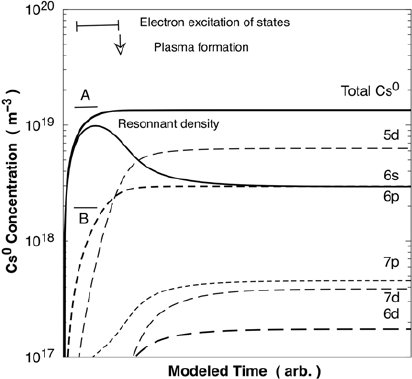
We used a CRM to explore excitation versus Cs0 densities (Vogel Reference Vandervorst, Janssens, Huyghebaert and Berghmans2013). The CRM was implemented in a linear differential equation solver (Berkeley Madonna, Berkeley CA) with constant electron and photon excitation rates derived from numerical integrals of cross sections against expected fluxes. Following presentation at a negative ion source meeting, this CRM structure was expanded in detail to investigate Cs0 excited states in RF ion sources for use in driving and probing ITER (Wünderlich et al. Reference Wünderlich, Wimmer and Friedl2014; Priti et al. Reference Priti, Gangwar and Srivastava2017). The Cs and electron densities in these are too low for useful comparisons. Our modeled physical process included accepting all primary Cs+ ions focused into a 1 mm × 1 mm cylindrical well in a metal sample holder with a solid sample at the bottom. The rate of primary ions sputtering the sample was taken from the current of the cathode potential set off from the ionizer, which was of the order of 1 mA, or 6.2 × 10¹⁵ ions/sec. Sputtered secondary atoms number 1 (C) to 10 (Cu) per primary (Yamamura and Tawara Reference Yamamura and Tawara1996). SSE also number one electron per Cs primary from conductive targets at typical sputter energies (8–12 keV) (Krebs Reference Krebs1983; Avilkina et al. Reference Avilkina, Andrianova, Borisov, Mashkova and Parikis2011), but are partially deflected from extraction by source-mounted magnets. Depending on source optical elements and power supplies, an electron current is read from the extraction supply to correct the cathode current for electron contributions. Of the embedded primary Cs+, ≍10% is re-sputtered by incoming Cs+ while >80% evaporate from the hot surface at less than 0.06 eV energy (Vandervorst et al. Reference Stolz2008). Less than 10% is retained in the sample. Cs0 at thermal energy exits a 1 mm well depth in ≍3 µsec rms time, leaving approximately 9 × 10⁹ Cs in the 0.78 × 10⁻⁹ m3 well, for a density of ≍1 × 10¹⁹ /m3, a density sufficient for resonance of 6s-6p states and shown in Figure 2 as a long line at the left marked “A”. The Cs0 gas continues as a semi-collimated beam at the sample well top, of course, while the CRM incorporates an abrupt halt of SSE excitation at the well edge (Vogel Reference Vogel2016).
Densities of the excited states of Cs versus modeled time for a chosen total input of C. The origin of the resonant pair around 1019 Cs/m3 leads to Cs(6p) equalling Cs(6s), with Cs(5d) dominant The Cs0 density for our modeled solid graphite sample (line A) is in this resonance. Line B represents the Cs density of the U. Köln CO2-fed ion source and is below resonance.

GAS-FED ION SOURCES
Electron excitation of the Cs0 states for IPP is not as certain for gas-fed sources as solid sample sources, given the more complex sputtering environment of C and O absorbed onto the Ti lattice and the presence of the helium carrier/buffer gas amid the sputtered products. Thus, the following ideas may be considered speculation that reveals experiments to be tried and models to be constructed. Once Middleton (Reference Middleton1984) revealed the gas-fed sputter source concept, development was slow, with only Oxford exploring the use in the 1980s (Bronk and Hedges Reference Bronk and Hedges1987), Ruff et al. (Reference Ruff, Wacker, Gäggler and Suter2007), Uhl et al. (Reference Uhl, Luppold, Rottenbach, Scharf and Kretschmer2007), Xu et al. (Reference Xu, Dougans, Freeman, Maden and Loger2007), and Stolz et al. (Reference Stolz, Dewald, Heinze, Altenkirch, Hackenberg, Herb, Muller-Gatermann, Schiffer, Zitzer, Wotte, Rethemeyer and Dunai2017), among others, have since developed the capability. The general assumption is that the C and the O are captured on/into the Ti lattice as TiC and TiO2, while He carrier gas flows through the sample area to vacuum. The Ti anvils take various forms, from bars to conical pits, but are recessed where the Cs gas excitation by SSE can occur. Uhl et al. (Reference Uhl, Kretschmer, Luppold and Scharf2004, Reference Uhl, Luppold, Rottenbach, Scharf and Kretschmer2007) and Xu et al. (Reference Xu, Dougans, Freeman, Maden and Loger2007) describe gas modifications of NEC ion sources, which do not easily allow visual inspection for blue Cs plasma at the sample. Xu et al. (Reference Xu, Dougans, Freeman, Maden and Loger2007) demonstrate robust C– with pure CO2 feed, but do not provide their Cs boiler temperatures or the measured ionizer-cathode current, so an estimate of Cs gas density in front of the sample anvil cannot be made.
Fahrni et al. (Reference Fahrni, Wacker, Synal and Szidat2013) describe an improved Cs sputter ion source used on the MICADAS™ instruments from IonPlus™ that uses 15 keV Cs+ primary from boilers at 150–185°C to attain –high currents. At a 1 mA Cs+ current, this source surely operates in the SSE-excited plasma mode, and the characteristic blue light is reportedly visible above the Ti anvil. The biggest difficulty in operating the source at high boiler temperatures is the rapid build-up of conductive Cs on source structures and the plugging of gas channels, as the authors note. Resonant density for electronic excitation of Cs is probably attained in the apparent small “well” shown in their Figure 4. The opening diameter of the Al holder is stated at 1.1 mm and the thickness of the Al holding the Ti anvil appears to be 1 mm thick, making the well similar in size to that modeled in our CRM.
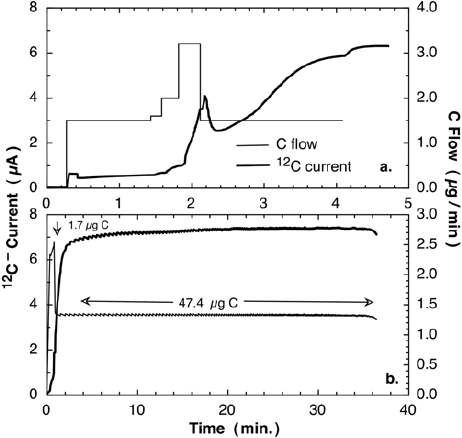
Data from the Köln AMS Laboratory recently showed that a SO-110B CO2-fed ion source from HVE produced 10% more carbon anions if the Cs0 vapor in front of the Ti anvil were exposed to 450 nm laser light, very weakly exciting the Cs*(7p3/2) state (Stolz et al. Reference Stolz2018). This replicated results from a graphite sputter source (Vogel and Giacomo Reference Vogel and Giacomo2016) and suggested that this gas fed source ionizes by IPP. This source also produces up to 400µA C– from fullerene graphite (Klein and Mous Reference Klein and Mous2017) which indicates that it normally ionizes solid samples by IPP, since that current is unavailable from surface ionization. The gas source exhibits 2 states of C– emission, however, one at the low 1–3 µA levels shown by many CO2-fed sources, and another at higher 6–12µA output, both occurring with ≍ 0.4 mA primary current. The lower output is assumed due to surface ionization of C captured on the Ti anvil. This flux is accompanied by O– at twice the C– current. The higher output, presumably by IPP from excited states of neutral Cs, is achieved in this source by a momentary doubling of the gas feed, as seen in Figure 3a. This “pulse” of sample gas uses a small fraction of the carbon sample, but the higher ion current continues for long periods, as seen in Figure 3b where the measured sample size totals 49.1 µg. The gas control is programmed to provide this igniting “squirt” for each sample, maintaining the increased gas flow until the rise in sample current is detected. The “ignition” occurs in tens of seconds using 1–2 µg of sample CO2, which is acceptable except for very small samples (≤3 µg). The mechanism for this change is mysterious. We have considered, without satisfaction, two possible causes: modification of the Ti anvil surface and an increase in electron density due to added gas among the neutral Cs.
a. The CO2-fed HVEE S011B has initial negative ion current of < 2 µA at carbon flow of 1.5 µg/min. Doubling flow for 20–60 seconds, triggers another mode in which the source outputs 6–12 µA. b. The high output continues for long periods. Doubling C flow requires only 1–2 µg C to attain increased anion current. A “sawtooth” pattern arises from the gas syringe for this pure CO2 sample (Stolz Reference Stolz, Dewald, Altenkirch, Herb, Heinze, Schiffer, Feuerstein, Muller-Gatermann, Wotte, Rethemeyer and Dunai2020).

Clean metal and semiconductor surfaces produce 0.5–1 sputtered electron per incident monatomic ion at 8–10 keV (Krebs Reference Krebs1983). Our CRM for solid graphite assumed production of 1 electron from carbon per ion, as found by others (Cernusca et al. Reference Cernusca, Fürsatz, Winter and Aumayr2005; Avilkina et al. Reference Avilkina, Andrianova, Borisov, Mashkova and Parikis2011). The oxides of Be and Al, both insulators, emit 5–7 SSE per 10 keV sputter ion (Dietz and Sheffield Reference Dietz and Sheffield1975), although Stein and White (Reference Stein and White1972) found only 3 SSE per 10 keV ion for Al2O3and for TiO2. Stein and White’s oxide layer on titanium was only the naturally occurring oxide found on cold-rolled, 99% pure Ti foil. No other directly applicable data was found, and we adopt an electron yield of 3 from the explicit measure of TiO2. Multiple gases getter on Ti (Stout and Gibbons Reference Stout and Gibbons1955), with CO and CO2 (but not CH4) dissociating on clean Ti surfaces (Carrillo et al. Reference Carrillo, Ramirez and Magaña2015). The same authors show through theoretical chemistry that CO2 dissociates to CO and O on clean Ti, but, surprisingly, the resultant CO remains stable since the nearby surface is oxidized rather than “clean.”
Electron excitation of Cs states comes from SSE that are emitted in a pseudo-Boltzmann distribution maximizing at 2–3 eV (Krebs Reference Krebs1983) from sputtered metals. Electrons emitted from insulators extend to higher energies, peaking above the Cs ionization energy at 4 eV, due to plasmon and Auger mechanisms (Ruano et al. Reference Ruano, Vidal, Ferron and Baraguiola2011). This means that the Cs0 cloud in front of the Ti anvil receives three times (and perhaps more) the electron flux as modeled for a solid graphite samples, including a higher fraction of ionizing electrons. Electrons from sputtered insulators require a new model structure, which we are initiating. Our CRM is no longer available due to changes in computer hardware. The cross sections for 2 eV secondary electrons on Cs0(6s) to Cs0(6p) and on Cs0(6p) to Cs0(5d) are 30 Å2 and 300 Å2, dominating the stepwise excitation in a solid ion source, while higher energy electrons promote Cs0(6s) to Cs0(5d) at 3 Å2 cross section (Priti et al. Reference Priti, Gangwar and Srivastava2017). Thus, paths to the Cs(5d) state that ionizes the C atom are probable at higher electron energies with the lower Cs densities of gas ion sources without involving the blue plasma from excitation to the Cs(7p) state. We suspect that the low output from the gas ion source results from lower Cs density and these less favorable excitations to the Cs(5d) state. The doubling of gas flow shown in Figure 3 may increase the oxygen flow to the Ti anvil, decreasing the time needed to build up a sufficient insulating TiO2 layer to sustain the electron emission. However, continued low-flow sample delivery should eventually provide equivalent oxide insulation and higher output, which is not seen.
Cesium has a density in the Köln sample well of ≍ 2 × 10¹⁸ Cs/m3. This density is below the 6s-6p resonance, as marked by the line B in Figure 2, preventing the step-wise excitation of higher states as seen in the solid sample model. Further, the Cs(7p) blue plasma is not seen in this source. SSE below the 1.4 eV inelastic threshold to Cs(6p) scatter from the Cs0 gas with a large elastic cross section of 150Å2 until loss or excitation between close states occurs. Elastic scatter off Cs affects only ≍0.9% of the electrons within the sample well, however. Dilution of the sample CO2 to 5% in helium gas is the normal mode of operation to conserve small samples. Helium also adds elastic electron scattering, with a 6 Å2 cross section below 10 eV (Zecca et al. Reference Zecca, Karwasz and Brusa1996), but the He adds only 0.8% elastic scatter to that of Cs. The data in Figure 3 came from 100% CO2 samples, demanding yet further investigation. One is tempted to assume that all of the CO2 interacts with the Ti anvil, but the complete detection efficiency of <7% shows otherwise. Thus, the sample well also contains CO2, CO, C, and O whose elastic scattering of 2–5 eV electrons are 10, 40, 10, and 8 Å2, respectively (Thomas and Nesbet Reference Thomas and Nesbet1975; Zecca at al. Reference Zecca, Karwasz and Brusa1996; Szmytkowski and Maciqg Reference Szmytkowski and Maciqg1996; Itikawa Reference Itikawa2002). The doubling of the gas flow could add to the electron densities exciting the Cs, but the contributions from each are 1% or lower. These contributions to the additional electron densities appear too low for significance, but a detailed collision-radiation-model for these interactions is needed for further inspiration.
This analysis is hypothetical, based on descriptions of the S011B ion source and a targeted literature search for means of exciting Cs(5d) at Cs densities below resonance. Experiments to test the hypotheses include modifications of the Ti surface, but they may be difficult since Ti oxidizes so rapidly in air. We will test a 460 nm laser to excite the Cs(7p) state which decays to provide significant long-lived Cs(5d) in the neutral gas at the top of the sample well. Such application of optical excitation is expected to be more efficient than hypothesized electron excitation.
CONCLUSION
We compared our CRM analysis of cesium sputter-source operation for solid carbon samples to examples of CO2-fed Cs sputter sources. In one case, increased C– is found for high concentrations of Cs input that are disruptive to reliable routine operations. Lower Cs boiler temperatures for the Köln gas fed source revealed other hypothetical paths to obtaining sufficiently excited Cs0 gas in front of the samples for ion-pair ionization to proceed. These divergent techniques present alternatives to our initial suggestion of using a Rb primary beam in CO2-fed sources (Vogel Reference Vogel2018), but still support the use of laser excitation of the Cs in a gas-fed ion source.