Introduction
The first thoroughly investigated, intrinsically conductive polymer (ICP), polyacetylene, was discovered in 1977.Reference Chiang, Fincher, Park, Heeger, Shirakawa, Louis, Gau and MacDiarmid1, Reference Shirakawa, Louis, MacDiarmid, Chiang and Heeger2 Due to the availability of free charge carriers in ICPs, they can conduct current in contrast to traditional polymers such as polyethylene or polypropylene.Reference Epstein3, Reference Conwell4 While polypropylene is an insulator and can be used as a cable coating to confine current to a metallic wire, ICPs have metallic properties and can be used to conduct current themselves. Furthermore, ICPs have the advantage of easy processing, such as printing and drying at low temperatures. However, the conductivity of ICPs is much lower than that of metals. Nonetheless, due to their specific properties as polymers, they have found a wide range of industrial applications within the last 30 years.
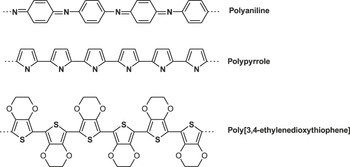
The specific properties of ICPs arise since these materials are conjugated polymers with alternating single and double bonds. Figure 1 shows some important ICPs in their neutral form.
Most prominent intrinsically conductive polymers.

Free charge carriers in ICPs can be introduced by oxidation or reduction. As a result, the electrical behavior of these materials changes from a typical semiconductor to a conductor. For example, when polyacetylene is oxidized by AsF5, the conductivity increases from 10–5 S/cm to 200 S/cm.Reference Heeger5 This process is often referred to as doping, and the resulting polymer is called a doped polymer. The conductivity is due to the mobility of free charge carriers (i.e., electrons and holes).
Polyacetylene has not penetrated into the marketplace, since the material is unstable under ambient conditions. However, other ICPs are very stable. For example, polypyrrole is used in polyelectrolyte capacitors, and polyaniline is used for antistatic coatings on plastic films. Poly(3,4-ethylenedioxythiophene) (PEDOT) is a highly stable ICP, and PEDOT films are exceptionally transparent and conductive. It was first discovered in 1988,Reference Jonas and Heywang6 and its first application was its use as an antistatic agent in photographic films. Since then, it has penetrated into other markets, including solid electrolyte capacitors, printed wiring boards, packaging films, and as hole transport layers in organic light-emitting diodes (OLEDs) and organic photovoltaics (OPV).Reference Elschner, Kirchmeyer, Lövenich, Merker and Reuter7–Reference Kirchmeyer and Reuter9 However, in this article, the focus is on the use of PEDOT as a transparent electrode. Therefore, the properties of the PEDOT dispersion, the physics of PEDOT films, and applications of PEDOT as a transparent electrode (e.g., in electroluminescent lamps, touch screens, or OLEDs) will be described. The availability of PEDOT in a solution processable form is a great advantage, and the way in which such a solution can be obtained is described in the following section.
Solution-processable PEDOT
When PEDOT was first discovered, it was obtained by the oxidation of ethylenedioxythiophene by iron salts.Reference Jonas and Heywang6 The resulting PEDOT forms a dark blue precipitate, which cannot be re-dissolved, re-dispersed, or used in any other way for transparent conductive coatings. However, if the reaction mixture is deposited onto a substrate and the polymerization takes place on the substrate, a transparent conductive film can be obtained. The disadvantages for this so called in situ PEDOT is the need for rinsing steps to remove the oxidation agent from the film and the resulting surface roughness.
In order to obtain a re-dispersable PEDOT powder, the monomer can be polymerized in the presence of surfactants.Reference Kudoh, Akami and Matsuya10 The resulting PEDOT particles are surrounded by surfactant shells that can be washed and re-dispersed. However, such PEDOT particles have limited film-forming properties and limited conductivity.
The most versatile form of PEDOT for processing and obtaining transparent conductive films is as a polyelectrolyte complex.Reference Karibyants, Dautzenberg and Cölfen11 A polyelectrolyte complex consists of polymeric cations such as PEDOT and polymeric anions and can be dispersed in solvents. In the literature, such systems are referred to as dispersions as well as solutions, and both terms are used synonymously in this article. The most effective anion or counter-ion for PEDOT is polystyrenesulfonic acid (PSS). PSS is easily soluble in water, is film forming, and transparent to visible light. Due to the ionic nature of the polyelectrolyte complex, water is the preferred solvent. PEDOT:PSS complexes typically contain a large excess of PSS with a weight ratio of PEDOT:PSS of 1:2.5. The complex can be obtained in the form of discreet swollen particles called gel particles. These particles have a size of 10–500 nm. The long loops and tails of PSS stabilize the particles against coagulation and precipitation.Reference Karibyants, Dautzenberg and Cölfen11 PEDOT:PSS dispersions based on such gel particles are stable at room temperature in air for many years. They can be processed using a wide range of processing methods and give the most transparent, conductive films that can be achieved for ICPs today.
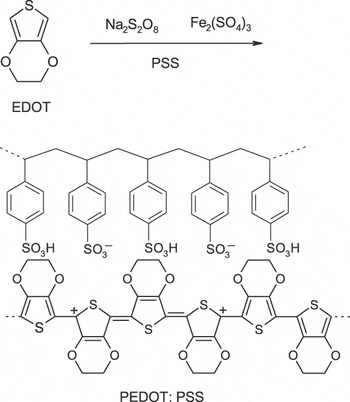
Figure 2 shows the chemical reaction that is used for the formation of the PEDOT/PSS polyelectrolyte complex. The oxidation of EDOT by persulfate and iron(III) is performed in the presence of PSS. The resulting PEDOT cation directly forms a complex with the dissolved PSS. The chain length of PEDOT is relatively short.Reference Kirchmeyer and Reuter9 Typically every third or fourth thiophene unit carries a positive charge. The Coulomb interactions between the positively charged PEDOT chains and the negatively charged PSS chains result in a high viscosity of the dispersion of up to 1 Pa·s even at a low solid content of 1%. Since the complex is present in the form of gel particles, the most suitable description is that of a dispersion rather than a solution. Nonetheless, both descriptions are found in the literature, and no distinction will be made within this article.
Chemical polymerization of ethylenedioxythiophene in the presence of polystyrenesulfonic acid.

The PEDOT:PSS dispersion can be deposited by a wide range of methods. Spin-coating allows for the deposition of very smooth layers in the range of 20–500 nm layer thickness of the dry film. Thicker layers of up to several μm can be deposited via silk screen printing. Fine lines can be printed by ink-jet printing. Slot-die coating allows the deposition of thin films in rectangular areas. Furthermore, the dispersion can be deposited by roll-to-roll printing techniques such as gravure printing or flexographic printing. The specific requirements for each printing method such as viscosity, solids content, adhesion, and drying speed can be obtained by a number of methods: Shearing of the dispersion leads to a decrease in particle size and viscosity. Concentration is feasible up to a solids content of 5% and increases the viscosity. Binders, surfactants, cross-linkers, and solvents can be used as additives in order to improve film deposition, drying speed, adhesion, and film hardness.
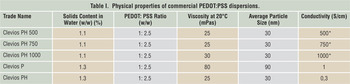
A very specific group of additives are the so-called conductivity enhancement agents. Amides, sulfoxides, glycols, and imides, as well as surfactants and salts, can increase the conductivity of PEDOT:PSS films by several orders of magnitude.Reference Ouyang, Xu, Chu, Yang, Li and Shinar12, Reference Xia and Ouyang13 For example, dimethylsulfoxide and ethylene glycol are two widely used conductivity enhancement agents. The effect of these materials is due to morphological changes in the film forming process. During the evaporation process, water evaporates first due to its lower boiling point. As a consequence, the additive becomes the predominant medium during the drying process, even if the initial concentration of such an additive is only a few percent. Its effect is similar to that of a plasticizer; it allows the rearrangement of PEDOT and PSS chains within the film.Reference Timpanaro, Kemerink, Touwslager, De Kok and Schrader14 In the dispersion, the gel particles predominantly show PSS chains on the outside, whereas PEDOT is mainly in the center of the gel particle. In the absence of a conductivity enhancement agent, the composition remains unchanged in the film forming process, and many barriers are formed due to the insulating properties of the PSS on the outside of each gel particle. The presence of such a conductivity enhancement agent allows a thermodynamically driven rearrangement in which larger domains of PEDOT-rich areas are formed, and the charge carriers can move more freely. Some of the conductivity enhancement agents can be evaporated at higher temperatures and leave the film. Others such as sorbitol remain in the film. PEDOT dispersion is commercially available from Heraeus under the trade name Clevios. The properties of today’s most conductive PEDOT dispersion as well as further widely used commercial PEDOT dispersions are shown in Table I.
Physical properties of commercial PEDOT:PSS dispersions.

Typical values for solids content, PEDOT:PSS ratio, viscosity, particle size, and conductivity. *Values for conductivities were measured in the presence of 5% (w/w) dimethylsulfoxide.
Physical properties of PEDOT:PSS films
The physical properties of solid PEDOT:PSS films are determined by various factors: First, the ratio of PEDOT to PSS within the dispersion determines the film’s conductivity and its optical absorption. Both properties will increase by increasing the volume fraction of PEDOT. The PEDOT concentration in dispersion is limited on the other hand to approximately 0.5 wt%, or the dispersion will become unstable. A PEDOT to PSS ratio of approximately 1:2.5 is found to be the best compromise between high conductivity of the finished film and sufficient stability of the dispersion. Second, the size distribution of water swollen gel particles in the dispersion affects conductivity and surface roughness. The mean value of size distribution can be shifted from 90 nm, for example in the PEDOT/PSS dispersion as in Clevios P, down to 30 nm, as in Clevios PH, by applying shear stress to the dispersion (see Table I). This size reduction decreases the film’s conductivity from 1 S/cm to 0.3 S/cm. Third, the addition of high boiling solvents, often referred to as secondary doping, will alter the film’s morphology within its drying process, since the high boiling solvent leaves the film at a high temperature and therefore allows the formation of a different and thermodynamically favored morphology. As pointed out previously, this will lead to lower energy barriers for charge carrier transport between the individual PEDOT:PSS clusters and higher conductivity. Other waterborne additives that can be added to the PEDOT:PSS dispersion, such as cross-linking polymers, film forming polymers, plasticizers, and stabilizers, allow for the modification of the film’s mechanical properties and its thermal stability. Fourth, the drying conditions will have an impact on the remaining water in the film and, consequently, the mechanical and electrical properties (e.g., the work function will be influenced). All of these factors define the material’s performance and allow tailoring of the material with respect to its designed application.
Some general features, however, are unique, as they are directly linked to the PEDOT component and should be discussed in more detail. PEDOT is not a high molecular weight polymer but forms large oligomers consisting of 10–30 monomer units. Owing to the interaction between the sulfur and the oxygen of neighboring thiophene units and the strong Π-Π interactions, the oligomer has a plain ridged structure. The doping of the thiophene oligomers is p-type and occurs accidently during the polymerization reaction as a consequence of the oxidizing agent. The doping density can be estimated by the quantity of consumed oxidant, which is approximately one net charge within three monomer units. The sulfonic groups within the PSS will dissociate in water and charge balance the cationic oligomers. Due to the coulombic force between PSS and PEDOT, a tight complex is formed that keeps PEDOT in solution and persists during film formation.
The charge transport in PEDOT:PSS is governed by electronic states formed by the cationic PEDOT oligomers. It is purely electronic and not ionic as in electrolytes. The mobility of p-type free charge carriers is calculated to be in the order of 20 cm2/Vs for the high-conducting Clevios PH1000, which exhibits a conductivity of 1000 S/cm and has an estimated hole density of 3 × 1020 cm–3. This calculated mobility is higher than for the best crystalline organic semiconductors. However, the mechanism of conductivity is still not considered to be purely metallic, as the conductivity is found to be thermally activated in contrast to metals where the conductivity decreases with temperature.
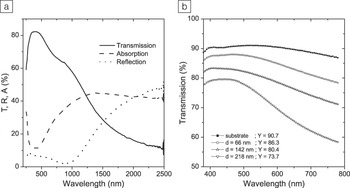
The optical properties of PEDOT:PSS make this material unique within the class of ICPs. PEDOT in its neutral form has a broad absorption band in the visible spectral range similar to other well-known semiconducting thiophene polymers (e.g., poly[3-hexylthiophene]). In its doped form, the absorption shifts to the infrared, and the material becomes transparent. By changing the redox state of PEDOT electrically, the film’s transmission can be altered by applying a bias, as demonstrated, for example, in electrochromic devices.Reference Heuer, Wehrmann and Kirchmeyer15 For transparent conductive electrodes, the uniformity of transmission within the whole visible spectral range and the ratio of conductivity to absorption are of utmost relevance. Figure 3 depicts the optical properties of highly conductive PEDOT:PSS.
(a) Optical spectra of a 190 nm thick film of Clevios PH1000. Transmission, absorption, and reflection spectra are normalized to 100% and labeled as T, A, and R on the y-axis, respectively. (b) Transmission spectra of Clevios PH1000 films on glass substrates deposited at different layer thickness. The luminous transmittance Y of each sample is denoted accordingly; for further properties of Clevios PH 1000, see Table I.

ICPs are often considered to suffer with respect to stability since organic molecules bear the inherent risk of degradation due to oxidation. Additionally, for some ICPs, the doping is reversible, and the loss of doping agent results in conductivity losses. In contrast, the neutral, low-bandgap polymer PEDOT is easily oxidized, and in the presence of acid, a stable complex is formed. This reaction is not reversible. Stability tests performed under accelerated outdoor conditions show only a minor increase in film resistance even when exposed for 1000 hours at 85°C/85% relative humidity.Reference Elschner, Kirchmeyer, Lövenich, Merker and Reuter7 No changes in sheet resistance are observed when the films are protected hermetically against air. It is important to note that the integral charge carried through the conducting films does not degrade the conductivity of the material.
Application of PEDOT as transparent conductive films
The development of PEDOT:PSS dispersions was triggered by the demand for a waterborne, transparent, conductive material to furnish photographic films with an antistatic coating. This was the first application of PEDOT:PSS and was accomplished in the early 1990s. For antistatic coatings, a sheet resistance covering a wide resistance range of 105–1011 Ω/sq is required. Even early PEDOT formulations easily fulfilled these requirements. The advantage of depositing the material by slot dye coating in a continuous process onto polymer foils and its high level of transparency make it the standard for ICPs in antistatic coatings. Such films are employed to protect items against electrical charging, such as integrated circuits stored in transparent plastic trays or against dust attraction (e.g., coated protection foils needed in the LCD production process). An additional advantage is that PEDOT:PSS-coatings are clean room compatible in contrast to polymers that contain conductive particles such as carbon black.
The first applications of PEDOT:PSS transparent conductive electrodes as an alternative to transparent conductive oxides (TCO) (e.g., ITO) were realized in thick film electroluminescent (EL) devices. These consist of several μm thick layers of ZnS-particles embedded in a polymer matrix typically sandwiched between a transparent electrode and a metal electrode. By applying an ac-bias of typically 80–200 V at a frequency of 100–500 Hz, the semiconducting particles are excited by the electrical field, and visible light is emitted. Owing to the fact that these EL-lamps are not direct-current driven devices, the sheet resistance of the transparent electrode only needs to be in the order of 500–5000 Ω/sq. This requirement can be accomplished by adding high boiling solvents to standard PEDOT:PSS. The possibility to silk screen print the transparent electrode in a structured manner is an additional advantage over TCOs.
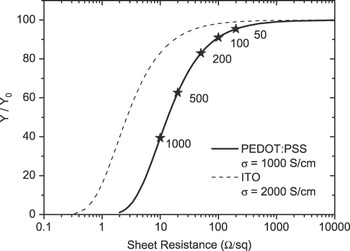
Within the last few years, the conductivity of PEDOT:PSS has continuously improved. With Clevios PH1000, a new dispersion has been made available exhibiting a conductivity of 1000 S/cm. New applications that require electrodes with a lower sheet resistance in the order of 100–300 Ω/sq at high transparency levels have become accessible. In Figure 4, the luminous transmission Y is depicted as a function of sheet resistance Ω/sq. The stars denote the correspondent layer thickness (e.g., a 100 nm thick layer has a sheet resistance of 100 Ω/sq and the luminous transmission Y is 91). For comparison, the same plot has been calculated for ITO on plastic substrates exhibiting a conductivity of 2000 S/cm.
Luminous transmittance of PEDOT:PSS and indium tin oxide (ITO) layers normalized to the substrate as a function of sheet resistance. The calculation of Y is based on the material’s spectral absorption and the layer thickness. Stars denote specific layer thickness of PEDOT:PSS films in nm.

Although the ratio of conductivity to absorption is larger for ITO, the properties of PEDOT:PSS are considered to be sufficient to meet the requirements of several applications, such as electrophoretic displays, touch screens, and transparent electrodes for OLEDs and organic solar cells (OSCs). All these applications face a strong demand to lower material and processing costs, especially for the transparent electrode. The deposition of the polymer from solution in a continuous roll-to-roll process opens new ways to solve this requirement other than in vacuum-deposited TCO layers. Besides lower cost, the polymer layers offer an additional feature that cannot be met by inorganic TCOs. Polymers are flexible and will not crack when being bent as compared to TCO layers, which crack because of their brittleness. This is an especially important property in touch-panel displays, as in the case of glass-free devices that are exposed to higher mechanical stress.
Transparent electrodes made of ICPs that have to transport high current densities need to be combined with metallic support lines, so called bus-bar lines, to avoid a voltage drop across the electrode. This can be achieved by depositing a wide mesh of thin metallic lines onto the substrate first to distribute the current uniformly, even on large areas. The transparent areas in between the lines are made conductive by coating a layer of PEDOT:PSS on top. This concept has proven to be reliable, as large aspect ratios of transparent to nontransparent areas could be realized (e.g., for OLED lamps or areal OSCs).Reference Fehse, Walzer, Leo, Lövenich and Elschner16, Reference Galagan, Rubingh, Andriessen, Fan, Blom, Veenstra and Kroon17
Another functionality of PEDOT:PSS films is exploited in OLEDs and OSCs. Here the material and Clevios formulations are used as buffer layers placed between the electrode and the organic semiconductor. The work function of these films can be tuned to the range of 4.8–6.0 eV to facilitate the injection or extraction of holes in OLEDs and OSCs, respectively. This hinders the formation of large energetic barriers that would lead to a voltage drop and reduce the device efficiency. Apart from this electrical functionality, PEDOT-based buffer layers offer another advantage related to the polymeric properties, especially in OLEDs. Even when deposited as a thin film, this layer smoothes the surface of the substrate. ITO-electrodes suffer from spikes due to their crystalline nature. These spikes stick out of the surface and cause electrical shorts in the finished device. By planarizing the ITO with a thin PEDOT layer, the number of electrical shorts can be significantly reduced, and consequently the number of functioning devices will increase. This is considered an important improvement in addition to reducing manufacturing costs.
Summary
The recently commercialized high conductivity and transparency versions of solution processable PEDOT:PSS have opened up completely new application areas, in particular those in current driven devices, such as displays, touch screens, and solar cells. PEDOT:PSS has become a competitor for transparent conductive oxide layers and offers advantages based on its polymeric structure. First, it is an aqueous dispersion, and various wet process deposition techniques can be applied, such as roll-to-roll coating, that help to reduce production costs. Second, it provides a high ductility that allows its deposition even on mechanically flexible substrates. Further expected improvements in conductivity will allow for the further penetration of these new markets.