In the past decade, scholars have used rigorous empirical studies to advance our understanding of how the college experience influences students’ political attitudes. Studies in political science and sociology conclude that concerns about political indoctrination in college are overstated because students show little change in their social and political attitudes over the course of their undergraduate education (Mariani and Hewitt Reference Mariani and Hewitt2008 Footnote 1; Rothman, Kelly-Woessner, and Woessner Reference Rothman, Kelly-Woessner and Woessner2011).
However, studies in student development have found that college leads to more liberal views on issues of abortion (Astin Reference Astin1993; Bolzendahl and Myers Reference Bolzendahl and Myers2004); civil liberties (Bobo and Licari Reference Bobo and Licari1989; Campbell and Horowitz Reference Campbell and Horowitz2016); and gender roles (Astin Reference Astin1993; Bolzendahl and Myers Reference Bolzendahl and Myers2004; Campbell and Horowitz Reference Campbell and Horowitz2016; Pascarella and Terenzini Reference Pascarella and Terenzini2005). One possible explanation for these differences is that interpretation of research findings has been motivated such that scholars find no evidence of attitude change when change is defined as “indoctrination” yet do find evidence of change when it is framed as positive social growth. We offer an alternative explanation, based on different measures of attitude change.
Studies that address the indoctrination claim tend to measure shifts in college students’ political party identification and ideological self-identification, whereas studies that focus on college student social and political development as a measure of educational success tend to find evidence of change in students’ issue positions. We argue that the two sets of findings are not incongruent. Rather, political party and ideology are forms of social identity, making them more resistant to change than issue positions. Therefore, it is reasonable and predictable that college students would move more on specific issues than on party affiliation or ideological identification.
Rather, political party and ideology are forms of social identity, making them more resistant to change than issue positions.
THE RESILIENCE OF POLITICAL IDENTITY AND IDEOLOGICAL SELF-IDENTIFICATION
Political scientists tend to fall into two primary schools of thought on the nature of party identification. Scholars from the first group, often referred to as the Michigan model, argue that party affiliation is a psychological attachment to a political party and is relatively stable over time (Campbell et al. Reference Campbell, Converse, Miller and Stokes1960; Miller Reference Miller, Budge, Crewe and Farlie1976; Reference Miller1991; Miller, Shanks, and Shapiro Reference Miller, Shanks and Shapiro1996). For example, in The American Voter, Campbell et al. (Reference Campbell, Converse, Miller and Stokes1960, 146) concluded that party attachments are formed early, often as the result of parental influence, and are characterized by a “persistent adherence and a resistance to contrary influences.”
The second school of thought, the revisionist school, emerged from Fiorina’s (Reference Fiorina1981) work, which argued that party identification is a retrospective analysis of political events and candidates that is subject to change over time (see also Brody and Rothenberg Reference Brody and Rothenberg1988; Franklin and Jackson Reference Franklin and Jackson1983; Jennings and Markus Reference Jennings and Markus1984).
More recently, researchers have returned to the original school of thought, arguing that party affiliation is an enduring psychological attachment, formed early in the socialization process. Bartels (Reference Bartels2002), for example, found that party identification is a “pervasive dynamic force” consistent with the Michigan-model view that “partisan loyalties are formed early in life, remain perfectly stable throughout adulthood, and serve as the unmoved movers of more specific political attitudes and behavior.” Green and colleagues argued that revisionist interpretations are the result of measurement error and that accounting for such error eliminates the effects of short-term forces on party identification (Green and Palmquist Reference Green and Palmquist1990; Reference Green and Palmquist1994; Schickler and Green Reference Schickler and Green1997). These findings support the conceptualization of party identification as a form of social identity (Green, Palmquist, and Schickler Reference Green, Palmquist and Schickler2002; Mason Reference Mason2015).
Compared to party identification, ideology is a more amorphous concept. Although scholars debate the meaning, definition, and measurement of ideology, most of the debate centers on what Ellis and Stimson (Reference Ellis and Stimson2012) classified as “operational” ideology. Operational ideology is a measure of actual issue positions, making ideological placement dependent on how we define political dimensions. “Symbolic” ideology, conversely, is a measure of self-identification or social identity.
In fact, Mason (Reference Mason2015) found that increased political polarization in recent years has created greater alignment between party identification and ideological identification, with people showing stronger attachments to both. Thus, party affiliation and ideological self-identification work together as a bias to shape political behaviors and interpretation of information.
The argument that symbolic ideology and operational ideology are separate constructs is supported by the fact that self-reported ideologies often are at odds with issue positions (Stimson Reference Stimson2004). This also is true in studies specifically of college students, who tend to express greater support for progressive policy positions than their self-reported ideological identifications would predict (Bailey and Williams Reference Bailey and Williams2016).
Self-reported ideology, as used on surveys of college students’ political attitudes, is therefore similar to party affiliation in that it has strong affective components, is a form of social identity, and is resistant to change. According to Jost, Federico, and Napier (Reference Jost, Federico and Napier2009), “peer and reference groups also exert a reasonably strong influence on left–right self-placement….[t]he resulting identifications tend to persist as long as one’s relational context does not change markedly.”
We argue, therefore, that students’ ideological identities are resistant to change, whereas their issue positions are more malleable. If this is the case, any “liberalizing” effect of college would appear first in students’ issue positions.
DATA AND METHODS
Our analysis was based on student surveys from the Higher Education Research Institute (HERI) at the University of California, Los Angeles, including the 2009 CIRP Freshman Survey (TFS) and the 2013 CIRP College Senior Survey (CSS). The combined TFS-CSS data include 17,667 students at 156 campuses who completed both the freshman and senior surveys at the same institution.
Both the TFS and CSS ask students about their demographic background, political attitudes, and college experiences (HERI 2018a; 2018b). Because the two surveys ask certain identical questions, we could measure shifts in students’ political attitudes over time on both specific issues and self-placement using a symbolic five-point ideological scale (i.e., “far left,” “liberal,” “centrist,” “conservative,” and “far right”). This ideology variable also allowed us to measure the mean student ideology for students at a particular campus. Finally, the data include institutional variables such as college ranking and Carnegie classification.
RESULTS
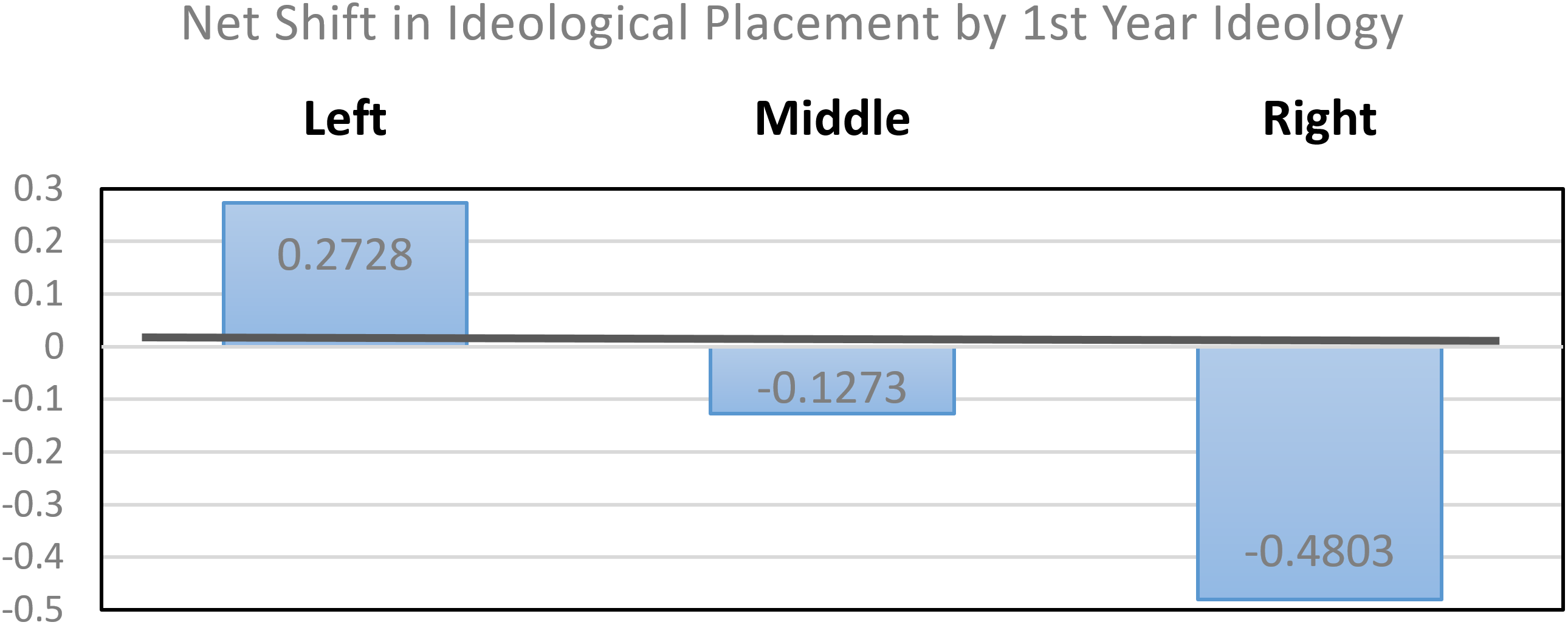
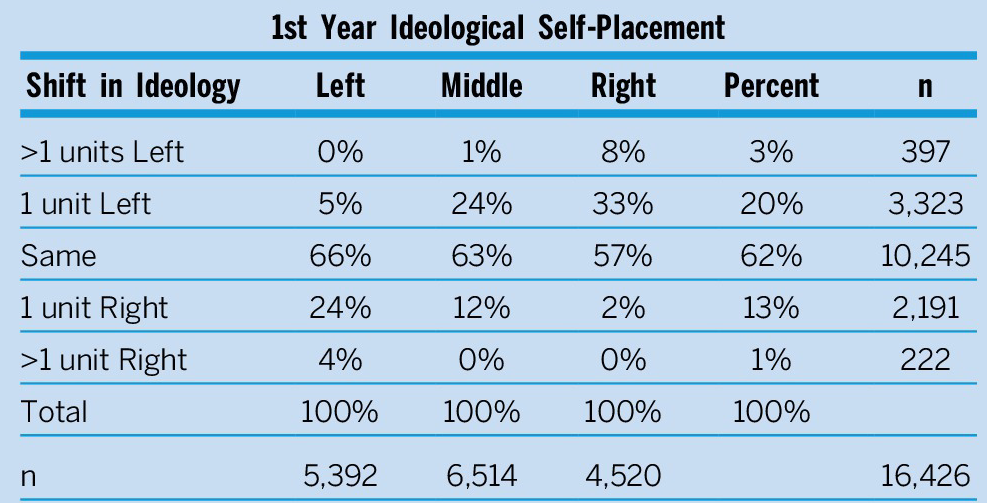
The results of the 2009–2013 panel study (figure 1; table 1) reveal that, consistent with previous studies (Mariani and Hewitt Reference Mariani and Hewitt2008; Rothman, Kelly-Woessner, and Woessner Reference Rothman, Kelly-Woessner and Woessner2011; Woessner and Kelly-Woessner Reference Woessner and Kelly-Woessner2009), students’ ideological self-placement is relatively stable, with changes tending to regress toward the mean. Most respondents reported exactly the same ideological identification in their first and fourth year of college. Ideological shifts, to the extent that they occur, typically are a single-unit change (e.g., moving from far left to liberal or from centrist to conservative). We also see evidence of a regression toward the mean. Students who identified as right-of-center (i.e., conservative or far right) moved to the left. However, figure 1 shows that among left-leaning students (i.e., liberal or far left) whose ideological views changed, a majority moved right rather than farther left.
Shift in Ideological Self-Placement* from the First to the Fourth Year

Shift in Ideological Self-Placement* from the First to the Fourth Year

* Note Pew Shows from 2007 to 2010 the public’s PID shifted slightly to the Republicans (http://www.people-press.org/2018/03/20/party-identification-trends-1992-2017/).
Although both sides regress toward the mean, the net effect is a slight overall shift to the left. Conservative students are more likely than liberal students to regress toward the mean. Students who start out as centrist are twice as likely to move left than right. The net impact of these shifts is shown in the bar chart to the right of the table in figure 1. Here and in the remaining bar charts in the article, a negative number shows the mean shift to the left over four years whereas a positive number shows the mean shift to the right. On ideological self-identification, a typical left-of-center student moves, on average, 0.27 units to the right in four years. A typical centrist student drifts 0.13 units to the left in four years. A typical right-leaning student moves 0.48 units to the left in four years.
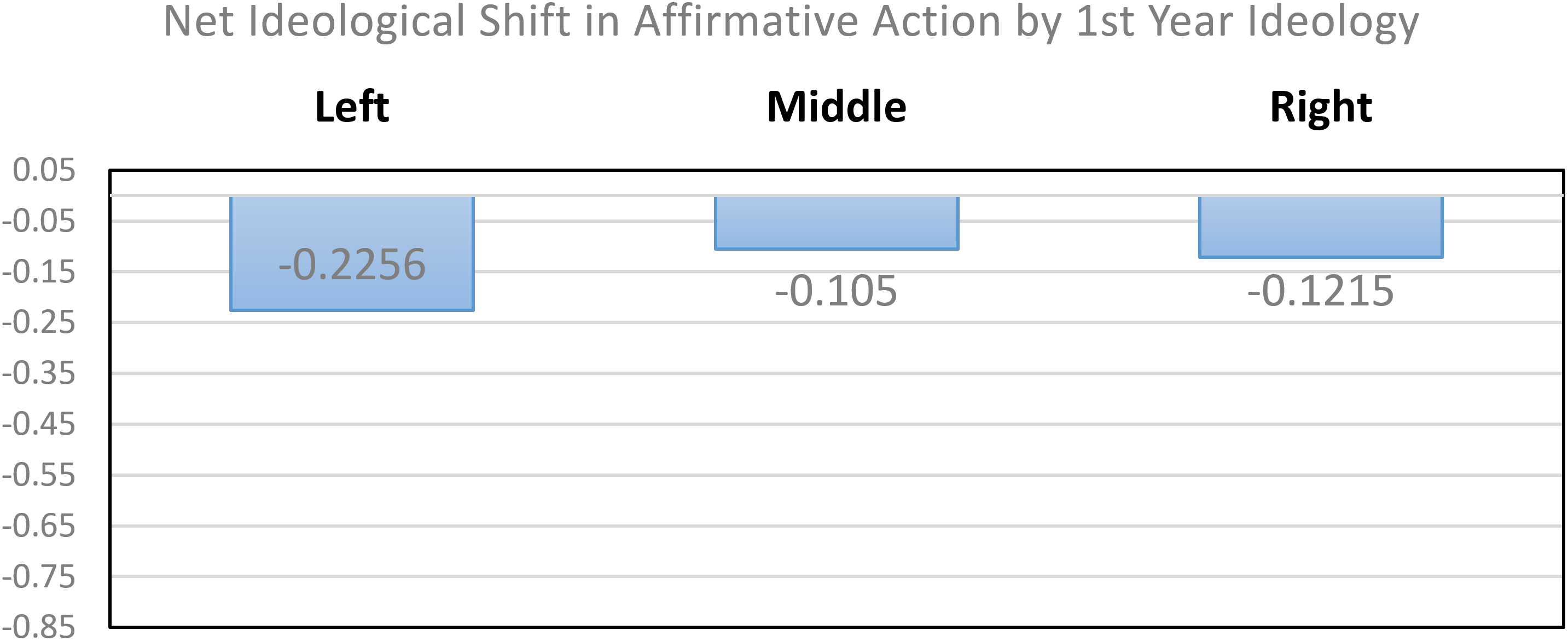
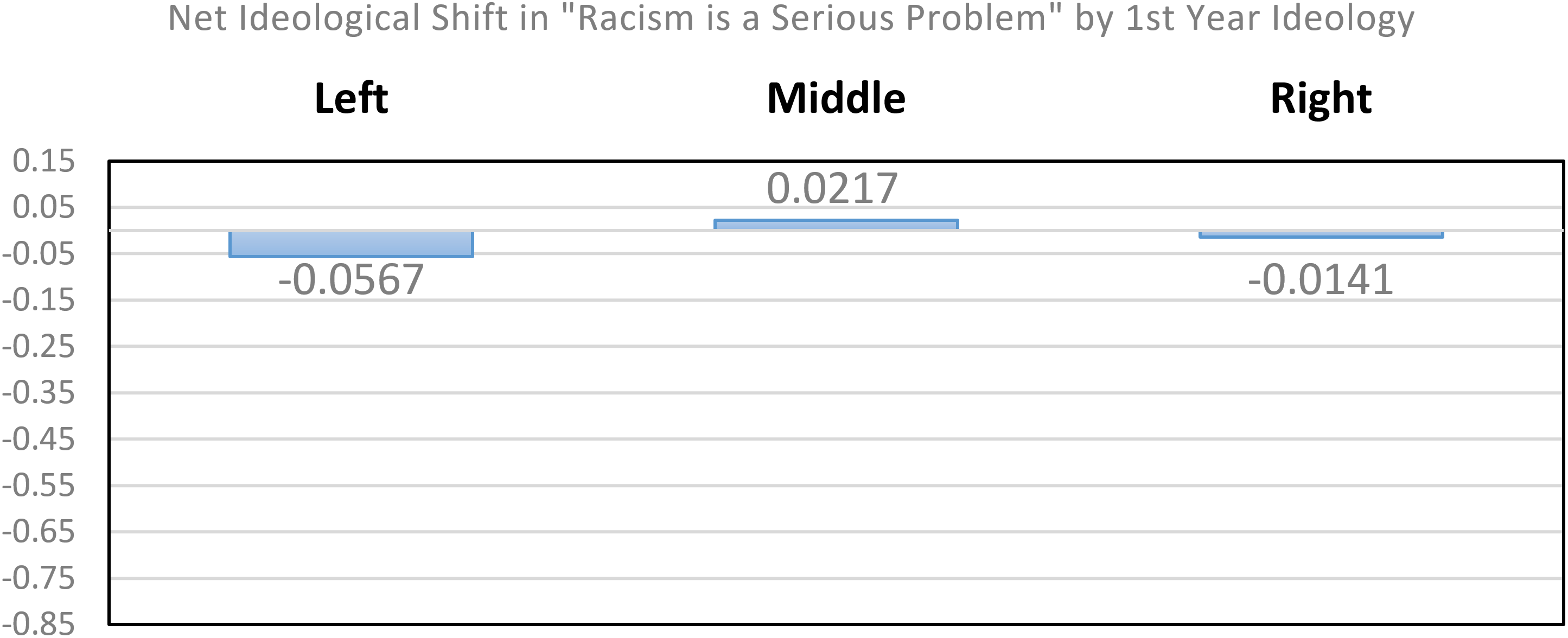
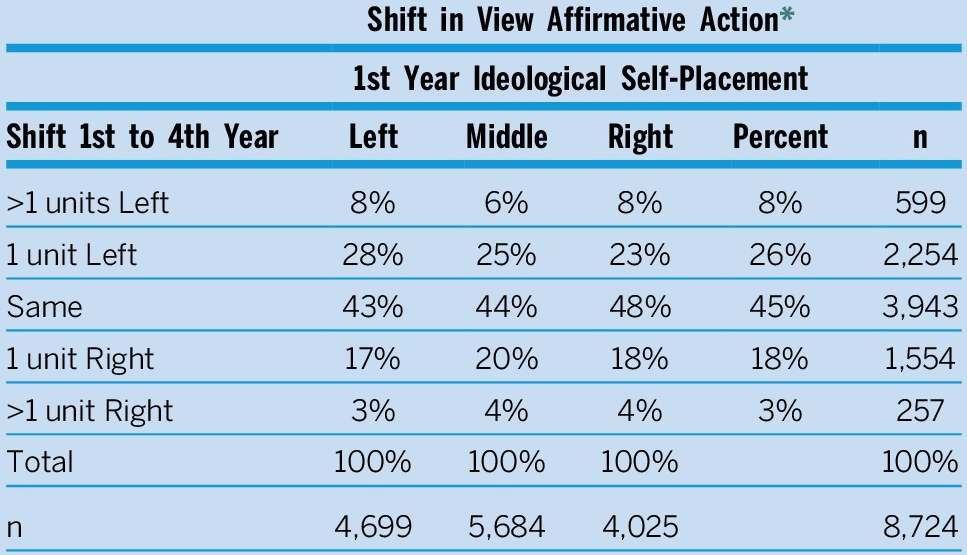
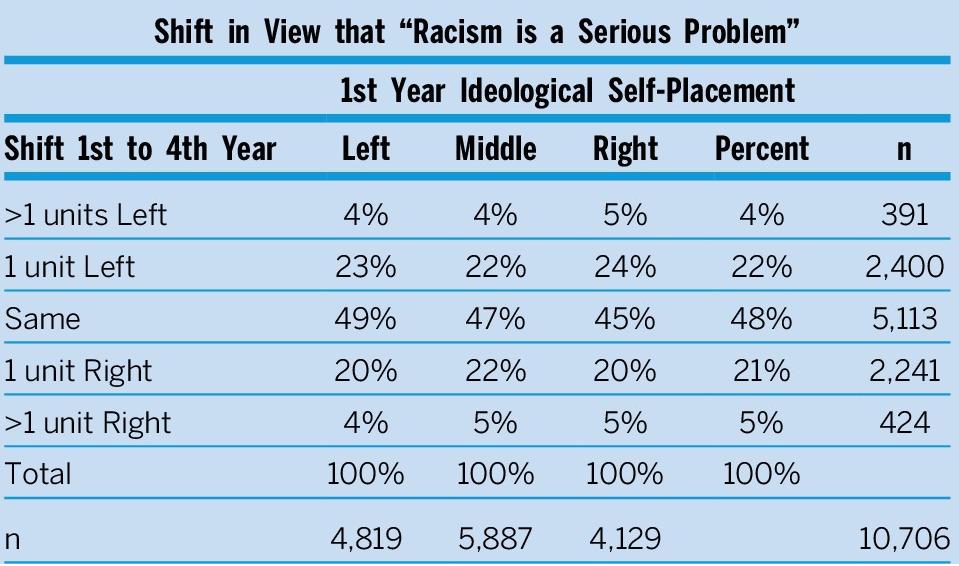
Whereas ideology tends to be stable over time, issue positions are more fluid. Figures 2 and 3 and tables 2 and 3 are overall breakdowns of two issue positions measured in both the first and second waves of the panel study. The top table shows the shift in students’ support for affirmative action—or “preferential treatment in college admissions”—over four years. The bottom table shows shifts in students’ assessment of whether “racism is a serious problem.” Whereas approximately 60% of students had consistent ideological self-identification from the first to the second wave of the panel study, slightly less than 50% had consistent answers to questions about race. Overall, students across the ideological spectrum moved to the left on the issue of affirmative action. They showed little net movement on the question of whether racism is a serious problem. Yet, on both questions, more than twice as many students reported significant changes in attitudes than on the question of ideology. Whereas only 4% of students moved more than one unit on the ideological scale, 9% moved more than one unit on racism and 11% moved more than one unit on affirmative action. What movement did occur was overwhelmingly to the left.
Shift in Student Views First to the Fourth Year by First Year Ideological Self-Placement: Affirmative Action

Shift in Student Views First to the Fourth Year by First Year Ideological Self-Placement: Racism

Shift in Student Views on Affirmative Action by First to Fourth Year by First-Year Ideological Self Placement

* Note Pew Shows from 2007 to 2010 the public’s views on Affirmative Action & Racism was static. http://www.people-press.org/2012/06/04/section-8-values-about-immigration-and-race/#affirmative-action.
Shift in Student View on Racism by First to Fourth Year by First-Year Ideological Self-placement

* Note Pew Shows from 2007 to 2010 the public’s views on Affirmative Action & Racism was static. http://www.people-press.org/2012/06/04/section-8-values-about-immigration-and-race/#affirmative-action.
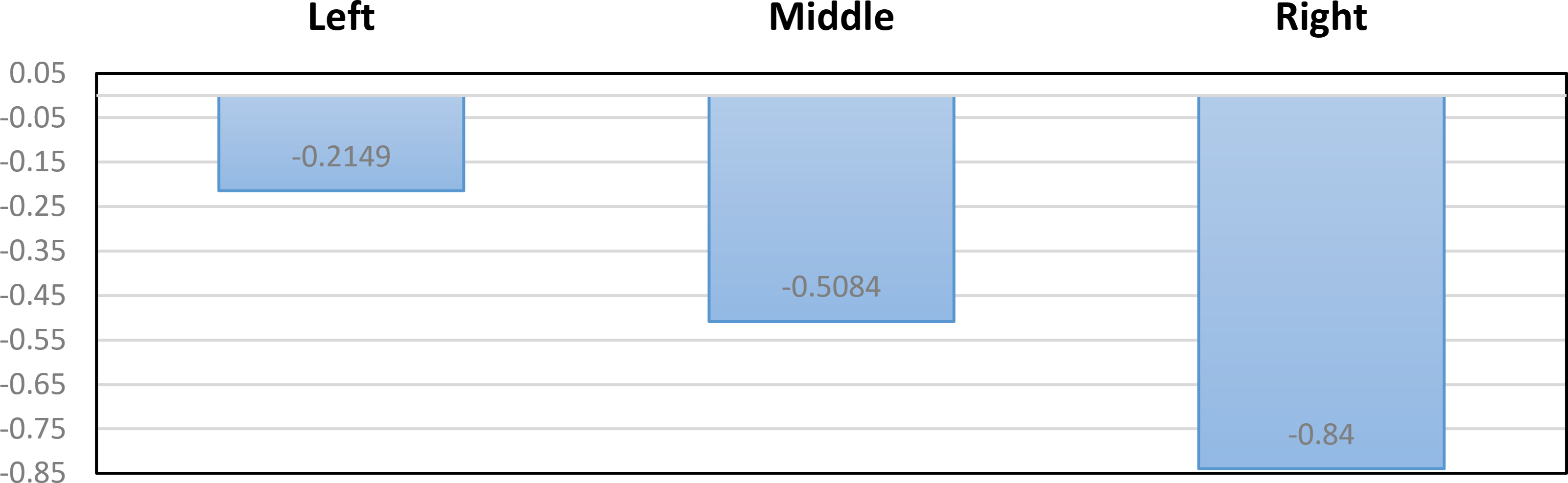
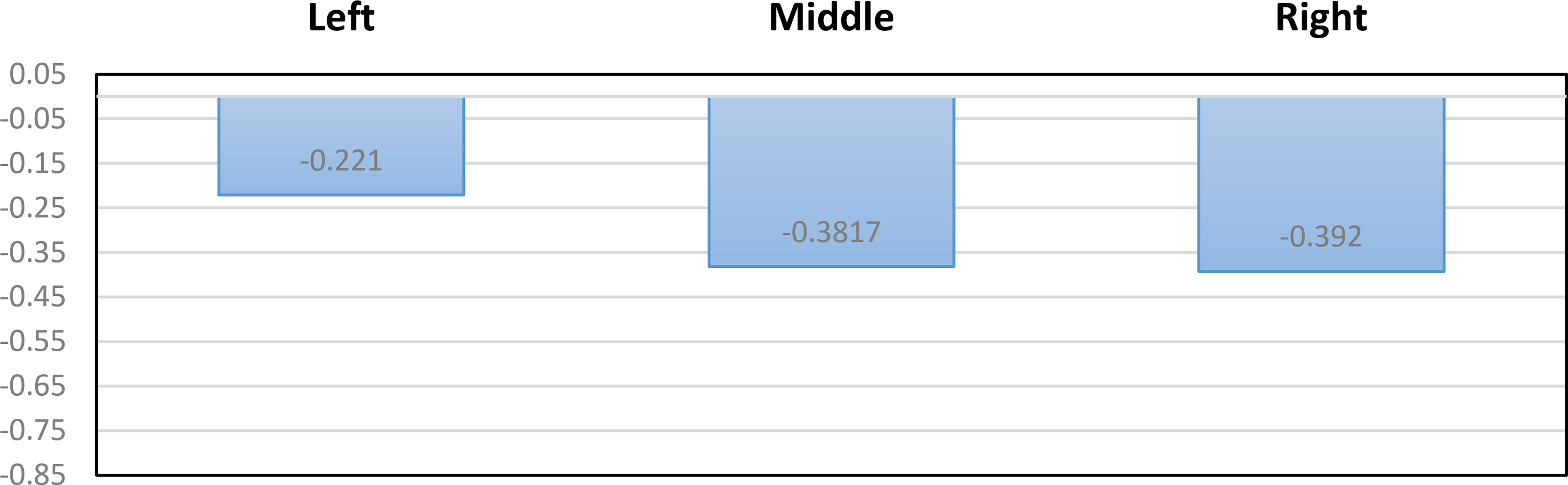
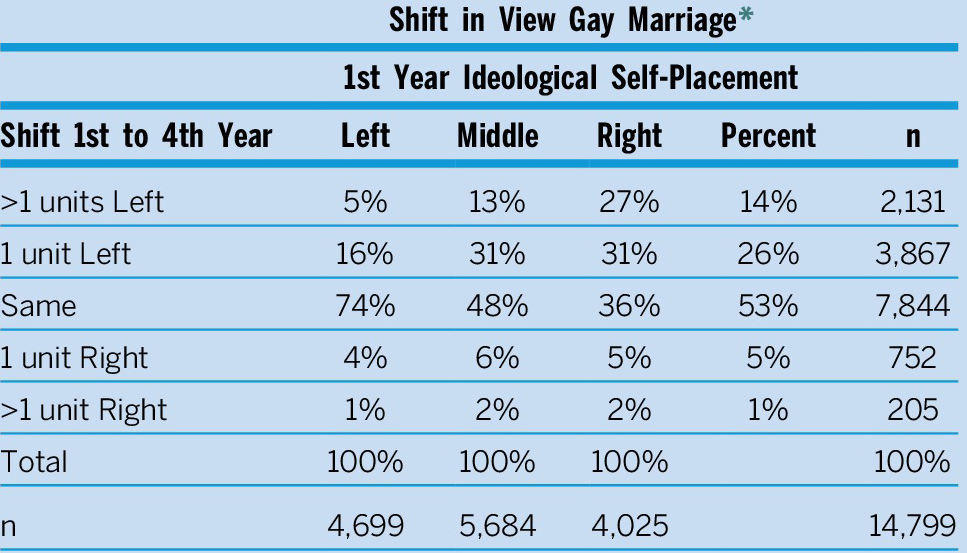
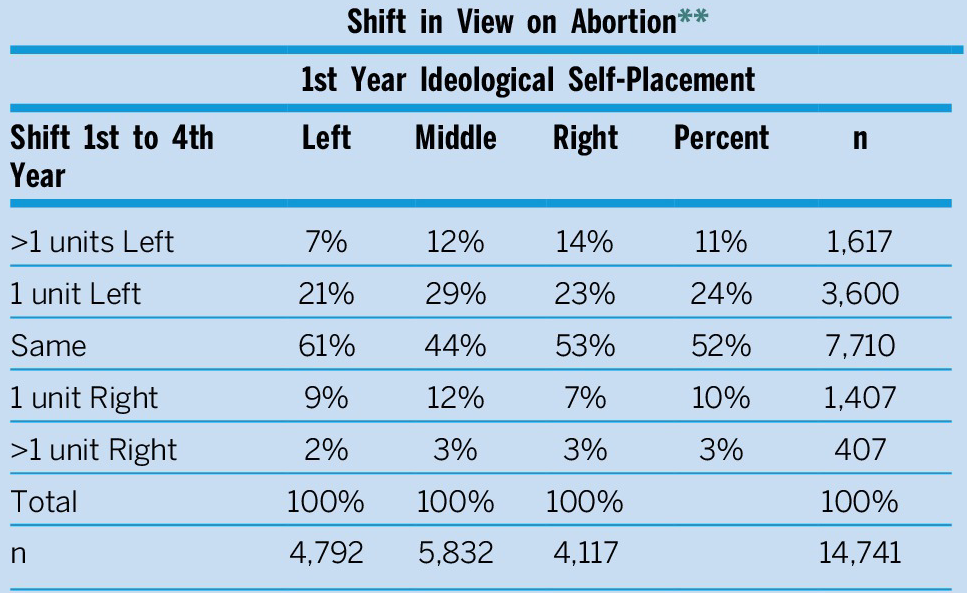
Figures 4 and 5 and tables 4 and 5 are overalls breakdowns of students’ agreement with the two statements: “same-sex couples should have the right to legal marital status” and “abortion should be legal.” As in figure 2, about half of the students did not change their view on gay marriage or abortion over time. Among students who altered their position, respondents tended to move consistently leftward, regardless of their initial ideological identification. On same-sex marriage, 40% of students moved to the left, with 14% moving more than one unit. On abortion, 35% of students moved to the left, with 11% moving more than one unit. Right-leaning students moved the most, shifting an average of 0.84 units left on same-sex marriage and 0.39 units left on abortion.
Net Ideological Shift in Gay Marriage by First Year Ideology

Net Ideological Shift in Abortion by 1st Year Ideology

Shift in Student Views of Gay Marriage by First to Fourth Year-Ideological Self-Placement

* Note Pew Shows from 2007 to 2010 the public’s PID shifted about 5% in favor of Gay Marriage (http://www.pewforum.org/fact-sheet/changing-attitudes-on-gay-marriage/)
Shift in Student Views on Abortion by First to Fourth Year by First-Year Ideological Self-Placement

** Note Pew Shows from 2007 to 2010 the public’s views on abortion did not meaningfully change. (See: http://www.pewforum.org/fact-sheet/public-opinion-on-abortion/)
The shifts in student views of gay marriage from 2009 to 2013 are hardly surprising; the public was undergoing a similar turnabout. The Pew Center polling shows a 5% shift in overall support for gay marriage in roughly the same period. However, the public’s overall views on abortion changed hardly at all.Footnote 2 Yet, we saw students moving left on abortion far more often than they drifted right. Thus, attitudes toward abortion are at least one example of how the college experience contributes to a substantive shift in political views over a relatively short period. This movement on abortion is consistent with Astin’s (Reference Astin1993) analysis 27 years earlier, which found abortion to be the issue on which students’ views changed the most.
Thus, attitudes toward abortion are at least one example of how the college experience contributes to a substantive shift in political views over a relatively short period.
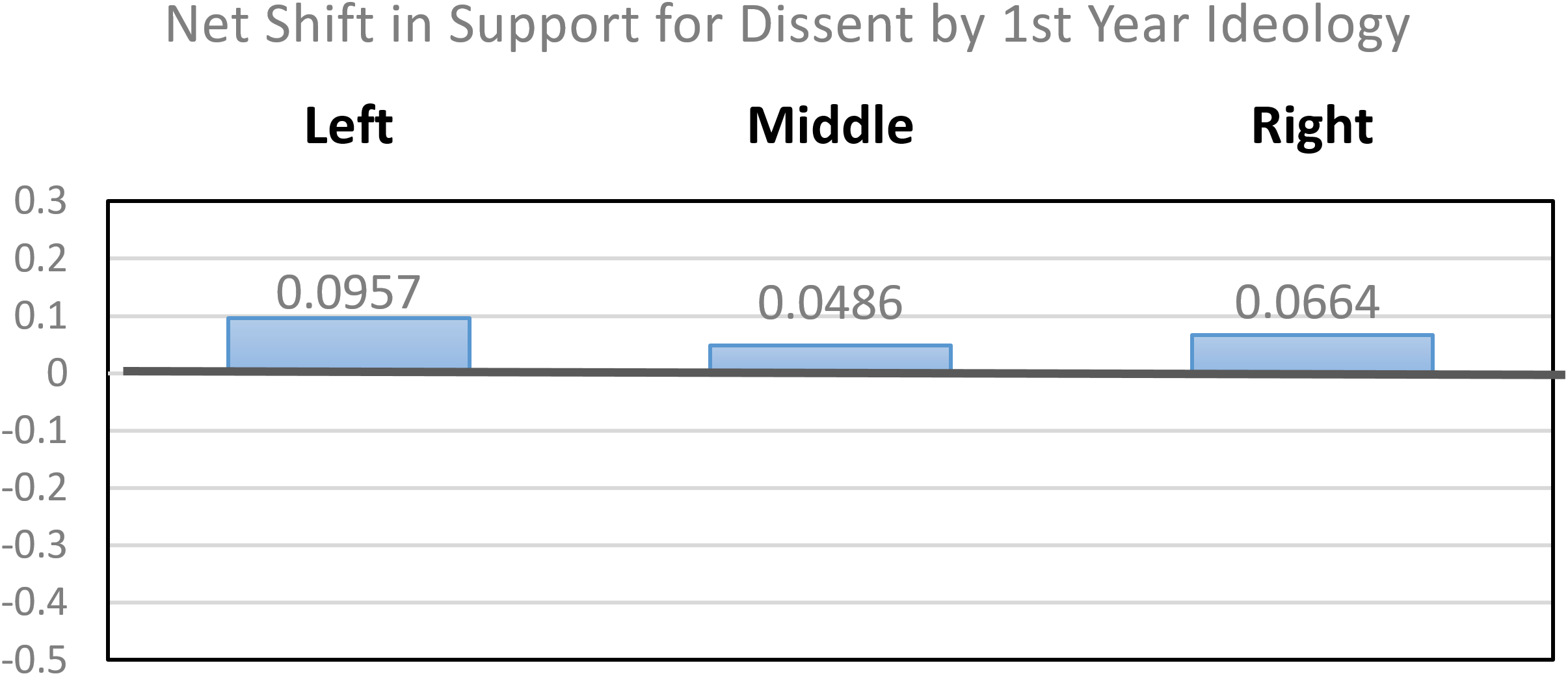
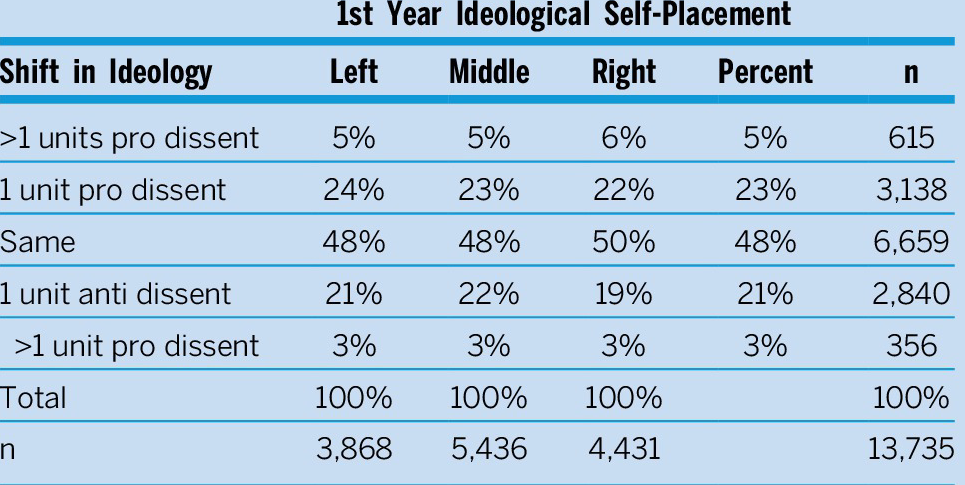
In addition to issue positions, we examined change in student attitudes on the question of whether “dissent is a critical component of the political process.” On this question (figure 6, table 6), students across all ideological groups gained in their appreciation for dissent, countering popular claims that colleges and universities make students less tolerant of opposing viewpoints. At least in principle, students appeared to gain an appreciation for the value of dissenting voices.
Shift in “Dissent Is a Critical Component of the Political Process” First to Fourth Year

Shift in “Dissent Is a Critical Component of the Political Process” First to Fourth Year

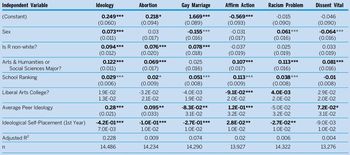
To access the factors that might contribute to leftward issue drift, we created a series of regression models (table 7) predicting students’ ideological change, issue-position change on the four policy questions, and changes in their belief that “dissent is a critical component of the political process.”
Regression Predicting Shifts in Student Views from the First to Fourth Years

Abortion −liberal +conser; Sex: M=1 f=2; Car 1=bac 3=research; Rank 1=low 3=high; Relig 0=no 1=yes; Expen
On the demographic variables, results are somewhat mixed. Women moved more to the left than men on general ideological identification and the view that racism is a serious problem. Men, however, moved more leftward than women on the issue of gay marriage. Men also shifted more than women toward the view that dissent is important to the political process. Nonwhite students moved more to the left in four years than white students on self-reported ideology, abortion, and gay marriage.
We hypothesized that leftward movement is related to students’ majors, with students in the arts, humanities, and social sciences moving farther to the left than those in professional majors and the hard sciences. We made this assumption for two reasons. First, debates about social policy are more likely to occur in the liberal arts than in the hard sciences and professional programs. Second, the greatest concentration of left-leaning faculty are in the humanities and social sciences (Rothman, Kelly-Woessner, and Woessner Reference Rothman, Kelly-Woessner and Woessner2011). The positive coefficients on ideological drift, abortion position, affirmative action, and racism point toward what we expected. Students in the arts and humanities drifted left more so than other students. Yet, they also showed greater gains than other students in appreciation for dissent.
Almost across the board, being at a highly ranked school was associated with more leftward movement of students over four years. It is especially noteworthy that this was true even when controlling for students’ ideological self-placement in their freshman year and the average ideological placement of peers at their institution. This suggests that there is an effect of elite education on political values that is independent of the political ideological views of students who attend the university. Whereas it may be the fact that faculty at these institutions are different and exert a stronger effect on students, Campbell and Horowitz (Reference Campbell and Horowitz2016) argued that there is a family effect for students: that is, wealthier families influence students’ politics to the left in their college years. Accordingly, university ranking may serve as a proxy for these family characteristics.
The relationship between liberal arts college classification and students’ drift to the left was confounded by peer ideology. When peer ideology was removed from our models, liberal arts colleges tended to produce more leftward movement on overall ideological identification (p<0.001). The addition of peer ideology eliminated the effect. This means that the leftward drift of students at liberal arts colleges is explained by the fact that their peers tend to be more liberal than those at other universities.
This means that the leftward drift of students at liberal arts colleges is explained by the fact that their peers tend to be more liberal than those at other universities.
Peers have an independent effect in several of the models. With the exception of gay marriage, the effect is positive; this means that students move more to the left—independent of their ideological self-placement—when their peers are more to the left. Students also learn to value dissent more when exposed to liberal versus conservative peers.
There is a significant difference in the explanatory power of the regression models for ideological drift compared to issue-position drift. Almost a quarter (22.8%) of the variation in ideological drift can be explained by the regression model. By contrast, the model explains only 7% of variation in views on gay marriage; 2% of the drift in views on affirmative action; and less than 1% of the drift in views on abortion, racism, and dissent. Whereas being an arts, humanities, or social science major tends to predict more leftward movement on issue positions, the majority of variance in students’ views is unexplained. This raises the possibility that the liberalizing effect of college is not tied to a student’s major but rather is a byproduct of the college experience common to all students. The common element could include the impact of the liberal arts core curriculum. Alternatively, it might be the result of nonacademic influences such as student-life organizations, which often deliberately promote the value of tolerance and diversity in a manner that overlaps with left–right ideological debates.
CONCLUSION
Our analysis supports the conclusion that students’ views on policy issues are more malleable than their political self-identification. Students’ ideological change over four years has a slight liberal drift, although the majority of movement can be summarized as a regression toward the mean effect. It is worth noting that few students actually change from the left side of the ideological scale to the right or from the right side to the left: only 4% change more than one unit on the scale.
However, on a number of social and political issues, we saw more uniform shifts over time and in the direction that is consistent with a “liberalizing” effect of higher education. On the issues of abortion, affirmative action, and same-sex marriage, students across the political spectrum appear to drift left from their first to fourth year in college. Moreover, these issue-position changes often are predicted by the average student views at the institution. Students with more liberal peers tend to move more to the left on ideological self-placement, abortion, and affirmative action when compared to students with more conservative peers. The evidence is consistent with research in political socialization that shows a significant peer effect on young people’s political values (Milem Reference Milem1998).
The fact that arts, humanities, and social science students move leftward faster than students in the hard sciences and professional majors certainly raises the possibility that left-leaning faculty—however unintentionally—transmit their beliefs to their students. Yet, it is also possible that the socializing influence of peers is more intense in majors in which fellow students are more liberal. Because our measurement for “average peer ideology” can capture the views of students only at the college rather than in the major, it is difficult to know if the arts, humanities, and social sciences variable denotes influence by the faculty or by peers in the major. We will explore this topic in future work.
Finally, although college does appear to have some impact on undergraduates’ political views, most students, overall, will complete their four-year degree with their ideological identity and views largely intact. Change in ideological identity appears to be a regression to the mean effect. On specific issues, students drift more uniformly to the left, suggesting that future studies of political change during the college years should focus first on shifts in issue positions.