1 Introduction
There exists a consensus in defining paraphrases as those language expressions different in form but expressing (approximately) the same meaning. Paraphrasing is a broad and multifaceted phenomenon displaying varied linguistic mechanisms. For example, in the paraphrase pair in (1), a synonymy substitution occurs (in italics); in (2), a syntactic reorganization can be observed; finally, the example in (3) shows a deeper change involving a complete rewording of the text.Footnote 1
- (1)
a. But Secretary of State Colin Powell brushed off this possibility
b. Secretary of State Colin Powell [. . .] ruled out a non-aggression treaty
- (2)
a. The company will offer songs for 99 cents and albums for $9.95
b. The songs are on offer for 99 cents each, or $9.99 for an album
- (3)
a. Michael Mitchell [. . .] did not answer his phone Wednesday afternoon
b. Michael Mitchell [. . .] was not available for comment
The omnipresence of paraphrase processes in the ordinary use of natural languages makes a knowledge of paraphrasing essential in many Natural Language Processing (NLP) applications. By way of illustration, in question-answering, the wording of a question may differ to its possible answers. In a canonical system, the question is straightforwardly transformed into an assertion with a variable; without the help of paraphrase knowledge, only the exact occurrence of this pattern would result in an answer. Herrera et al. (Reference Herrera, Peñas and Verdejo2007) show the variability of potential answers in this field. Other examples are summarization, where paraphrase knowledge is needed to avoid redundancy in the final summary, and editing, where paraphrases offer alternative expressions that fulfil certain communicative purposes.
Quoting Dolan and Brockett (Reference Dolan and Brockett2005), Burrows, Potthast, and Stein (Reference Burrows, Potthast and Stein2013) also pointed out that paraphrase corpora are essential, since they are necessary for evaluating and benchmarking the progress of researchers working on the foundations of paraphrasing, on new algorithms and on new tools. However, there exists a lack of paraphrase corpora. They are not created naturally or spontaneously as the Canadian Hansard corpusFootnote 2 for machine translation, which consists of parallel texts in English and Canadian French, drawn from official records of the proceedings of the Canadian Parliament. Moreover, automatically collecting paraphrases is not a straightforward task and neither is the validation of the acquired paraphrases. A more general problem is that paraphrase multifaceted nature prevents from the creation of general and comprehensive paraphrase corpora, that is, paraphrase corpora covering the phenomenon as a whole. Therefore, the field lacks a general data set that can serve as a standard against which algorithms can be trained and evaluated. Only corpora covering specific paraphrase types or facets, directly linked to the way paraphrases were obtained, may be created.
Considering all this, our objective has been building a new paraphrase corpus covering a concrete but productive paraphrase facet: relational paraphrases, that is, those paraphrases expressing the same type of relation between two entities. Examples (4) and (5), extracted from our corpus, illustrate this.Footnote 3 In the former, the authorship relation is expressed; the latter is an example of the person–place of birth relation. Relational paraphrasing sets our work in a manageable framework within the broadness of paraphrasing, where processes can be automatized and results evaluated in a straightforward and consistent way.
- (4)
a. author es conocido por su libro work
author is known for his book work
b. author es autor de los libros work
author is the author of the books work
- (5)
a. person was a native of place
b. person born in place
In this paper, we present the Wikipedia-based Relational Paraphrase Acquisition (WRPA) method and describe its implementation. The WRPA method extracts relational paraphrases from WikipediaFootnote 4 based on the distributional hypothesis (Harris Reference Harris1954) and taking advantage of Wikipedia-structured information. This method is subsequently used to build the WRPA paraphrase corpus, covering some examples of relations in different languages. Building the corpus constitutes an empirical test of the usefulness of the method to produce high-quality corpora and the corpus per se is a valuable resource for research in paraphrasing.
Several features show the value and productiveness of the WRPA corpus: (i) as the extraction method is based on the distributional hypothesis, paraphrases in WRPA do not necessarily show a formal mapping or correspondence, as in the case of (5). This type of paraphrase presents considerable computational challenges and requires further study. (ii) Currently, the corpus covers 16 different relations in two languages (English and Spanish). This suggests that the WRPA method is independent of the language and the relation addressed, and that the corpus may be extended to any language and relation present in Wikipedia. Moreover, not only a variety of relations are covered but a large number of paraphrase variants are comprised within each relation. (iii) The quality of the paraphrases is guaranteed by the reliance of our method on Wikipedia-structured and semantically labelled data. (iv) WRPA corpus subsets have already been used successfully in other tasks, namely paraphrase-type annotation (Vila et al. Reference Vila, Bertran, Martí and Rodríguez2013) and the Slot-Filling Task in the TAC KBP contest (Gonzàlez et al. Reference Gonzàlez, Rodríguez, Turmo, Comas, Naderi, Ageno, Sapena, Vila and Martí2012).
The rest of this paper is organized as follows. In Section 2, an overview of the WRPA method's main characteristics is set out. Section 3 presents relevant related work both in paraphrase extraction and paraphrase corpora. The process of learning the WRPA components is described in Section 4; the validation of the method is set out in Section 5; and its application, giving rise to the WRPA corpus, is presented in Section 6. In Section 4.1.1, the main features of the WRPA corpus are analysed. Finally, the conclusions and future work are presented in Section 8.
2 WRPA method outline
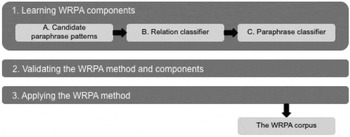
The WRPA method is divided into three blocks as shown in Figure 1: learning WRPA components, validating the WRPA method and components, and applying the method in order to obtain the WRPA corpus. The first block, in turn, is divided into three phases: acquiring the candidate paraphrase patterns, and learning the relation and paraphrase classifiers. In what follows, we present an overview of the whole process, organized according to the steps in Figure 1.
WRPA method outline.

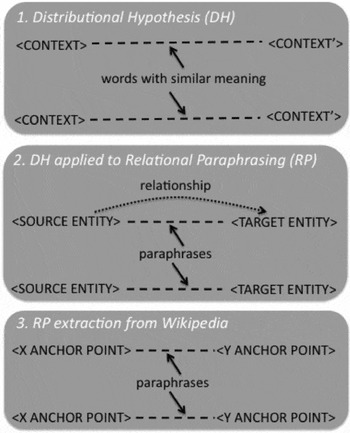
1A in Figure 1. We first learn a set of candidate paraphrase patterns expressing a concrete relation. Acquiring paraphrases implies ensuring sameness of meaning. In this sense, the distributional hypothesis (Harris Reference Harris1954), which states that words occurring in the same contexts tend to have similar meanings, makes up the basis of the methodology that many authors apply (1 in Figure 2). This methodology allows for the acquisition of a special type of paraphrases: those where a formal mapping is not necessarily observed.
Relational paraphrasing.

We apply this hypothesis to relational paraphrasing (2 in Figure 2). Relational paraphrases are those paraphrases in which the same type of relation is expressed in both members of the paraphrase pair. The relations we deal with are directional and binary between two entities: the source and the target (i). An example of such a relation is authorship, where the source corresponds to an author and the target corresponds to a work (ii). source and target are classes standing for sets of instances.
(i) Relation ⊂ source × target
source
 ${\xrightarrow {Relation}}$target
(ii) Authorship ⊂ author × work
author
$\xrightarrow {Authorship}$work


Pairs of source and target entities in a concrete relation stand for the ‘context’ (using distributional-hypothesis terms) of our paraphrase candidates. In concrete, our approach is based on the hypotheses that the meaning of the text around the source and target entities will be similar throughout their different occurrences, and that this meaning will hold the relation addressed in some way.
One of the main problems facing paraphrase acquisition is having an appropriate data source. Collecting paraphrases requires the availability of a corpus where different wordings for the same meaning coexist. The web is the biggest source of redundancy in existence, but it is also unstructured and unrestricted. We have therefore chosen Wikipedia. Its structure allows for an effective automatization of the task and its encyclopaedic nature allows for the acquisition of reliable and consistent examples. Imagine, for example, that we look for the Wikipedia page for ‘Paul Auster’. Once the page corresponding to the novelist is located (sometimes after a disambiguation procedure), we are reasonably sure that this page contains information about the author, and that mentions of ‘Paul’ or ‘Auster’ are likely to refer to him. The adequacy of mentions is notably less reliable when accessing web pages.
WRPA obtains pairs of source and target entities taking advantage of Wikipedia-structured information: source entities are extracted from the titles of Wikipedia pages, and target entities from infoboxes and itemized information embedded in these pages. Then, WRPA uses these entities as X and Y anchor points, respectively, for the extraction of paraphrase candidate fragments in the free text of the body of Wikipedia articles (3 in Figure 2).
In more detail, the extraction of the source and target entities is performed within the distant learning paradigm for relation extraction, initially proposed by Mintz et al. (Reference Mintz, Bills, Snow and Jurafsky2009), which uses supervised learning but with supervision not provided by manual annotation but obtained from the occurrence of positive training instances in a knowledge source or reference corpus. As we do not bootstrap the process, the distributional hypothesis is only used for obtaining snippets of text expressing a relation between two entities and is not applied to obtain new entities. It is important to point out that, although WRPA applies relation extraction techniques, our objectives are different: while relation extraction systems are geared towards obtaining the semantic relation held by pairs of entities in a corpus, relational paraphrasing focuses on the wording used to express those relations. Our objective is to build paraphrase corpora for specific relations, not to extract as many as possible relations occurring in a text.
Finding a large number of good ‘contexts’ is essential in our approach, since the quality and number of the obtained paraphrases depends in great measure on these contexts. The use of various Wikipedia structured sources allows for the obtention of a large number of source and target entities. Furthermore, we guarantee the correctness of these entities by extracting them directly from structured and semantically labelled data.
Once the set of source and target entities has been obtained, they are used as X and Y anchor points in the body of Wikipedia articles, the sentences where they appear are extracted and the snippets within X and Y are further processed. As reducing paraphrase expressions to sequences of words has a rather limited expressive power, our method generalizes these word sequences into regular expression patterns including words, lemmas and PoS tags using an A* approach (Nilsson Reference Nilsson1982). Finally, a set of candidate paraphrase patterns for a concrete relation is obtained.
As reflected in Figure 2, our pairs of entities are seen from multiple perspectives in this paper. Thus, several terms are used to allude to them: when we refer to the distributional hypothesis underlying our method, we talk about context; when we refer to relational paraphrasing, we say source and target entities; when we refer to the technique applied within the Wikipedia framework, we use the term anchor point. 1B and 1C in Figure 1. Two classifiers are built: the relation classifier checks whether a paraphrase candidate is an instance of the relation addressed, while the paraphrase classifier establishes whether two candidates are actual paraphrases. 2 in Figure 1. We carried out a series of experiments in order to validate the performance of the WRPA method and components. They were applied to several relations in two languages. More specifically, our experiments are divided into two blocks: person experiments, which include the person–date_of_birth, –date_of_death and –place_of_birth relations in the English Wikipedia; and the authorship experiment, which focuses on the author–work relation in the Spanish Wikipedia. Moreover, we performed a further validation applying our method to 13 more person relations. Therefore, the method was applied to 17 relations in total.Footnote 5
Person relations are simple relations. Authorship is complex in the sense that it includes several professional or artistic activities like painter–painting, director–film or inventor–invention. It should be noted that these relations are not treated separately, but embedded in a single complex one: authorship.Footnote 6
The person relations and the authorship one were chosen because they are frequent in biographies, for its high presence is Wikipedia-structured information and for their diverse nature.
These experiments suggest that the WRPA method is independent of the language and the relation addressed, and that the corpus may be extended to any language and relation present in Wikipedia.
3 in Figure 1. Finally, the application of the WRPA method resulted in the obtention of the WRPA corpus, which consists of WRPA-authorship and WRPA-person.
3 Related work
The omnipresence and complexity of paraphrasing have given rise to a great variety of approaches to the automatic treatment of this phenomenon in NLP. Although this task is far from being solved, interesting and useful methods have been set out.Footnote 7 These methods can be grouped in three basic paraphrase tasks as follows:
Paraphrase recognition. When faced with two snippets of text, deciding whether they are paraphrases or assigning a degree of paraphrasability to the pair.
Paraphrase generation. When faced with a snippet of text, generating a (ranked) set of paraphrases of the snippet.
Paraphrase extraction (or acquisition). When faced with a corpus, extracting from the corpus a (ranked) set of paraphrases.
It should be noted that these tasks are combined or embedded in larger systems on many occasions.
Moreover, some works are devoted to building paraphrase corpora, which are generally compiled using paraphrase extraction techniques. Existing paraphrase corpora are different in nature, which basically depends on the data source and method applied to acquire them.
In this section, we set out related work in paraphrase extraction (Section 3.1) and paraphrase corpora (Section 3.2), the fields in which the WRPA method and corpus are respectively embedded. Some works on corpus building in Section 3.2 can be linked to the corresponding paraphrase extraction systems in Section 3.1. As our final objective is building paraphrase corpora, more attention is paid to this field.
3.1 Paraphrase extraction
Paraphrase extraction systems acquire paraphrases using a variety of data sources, operating at different levels of language description and applying a wide range of techniques. We consider the type of data sources used for extraction to be a good way to organize these systems, as this selection has consequences on the methodology applied. There are five basic data sources used for paraphrase extraction: parallel, comparable, bilingual, single-monolingual and semi-structured corpora.
Parallel corpora can consist of multiple translations of the same text into the same target language. Barzilay and McKeown (Reference Barzilay and McKeown2001), for example, extract paraphrases from a collection of parallel English translations of novels.Footnote 8 They use an unsupervised learning algorithm that applies a co-training procedure to decision-list classifiers for two independent sets of features: one describing the paraphrase pair itself and the other corresponding to the contexts in which paraphrases occur. They rely on both lexical and syntactic features. Pang, Knight, and Marcu (Reference Pang, Knight and Marcu2003), in turn, exploit the Multiple-Translation Chinese (MTC) corpus, which consists of parallel English translations of Chinese news articles. They describe a syntax-based algorithm that builds Finite State Automata, which can be used to extract lexical and syntactic paraphrase pairs.
Comparable corpora consist of multiple texts containing approximately the same information. Barzilay and Lee (Reference Barzilay and Lee2003) extract paraphrases from articles talking about the same topic by two different news agencies. They apply multiple-sequence alignment to sentences in order to learn a set of paraphrasing patterns, which are represented by word lattice pairs. Dolan, Quirk, and Brockett (Reference Dolan, Quirk and Brockett2004), starting with temporarily and topically clustered news articles, follow two different approaches to extract paraphrases: string edit distance and a heuristic strategy that pairs initial sentences from different news stories.
Bilingual corpora contain texts reporting the same information in two languages. Bannard and Callison-Burch (Reference Bannard and Callison-Burch2005), using alignment techniques from phrase-based statistical machine translation, identify paraphrases in one language using a phrase in another language as a pivot. Going further in this line of research, Martzoukos and Monz (Reference Martzoukos and Monz2012) extract paraphrases for both the source and target languages.
Single monolingual corpora are those where no explicit parallelization exists. Lin and Pantel (Reference Lin and Pantel2001) extract paraphrases from newspapers based on the extended distributional hypothesis: if two paths in a dependency tree tend to occur in similar contexts, the meaning of the paths tends to be similar. Other systems, starting with a small set of manually collected high quality contexts (non-ambiguous pairs usually reduced to named entities), collect patterns of co-occurrence from this set and iterate this process. This bootstrapping approach has achieved notable success for simple and very specific relations such as author_title or person_birthdate (Brin Reference Brin, Atzeni, Mendelzon and Mecca1999; Ravichandran and Hovy Reference Ravichandran and Hovy2002).Footnote 9 The TEASE algorithm (Szpektor et al. Reference Szpektor, Tanev, Dagan and Coppola2004), in turn, consists of an unsupervised learning algorithm for web-based extraction of paraphrase relations. It takes as input a verb lexicon and for each verb searches the web for related syntactic entailment templates.Footnote 10
Semi-structured corpora are those that combine structured information and free text. Wikipedia is the paradigmatic example of this type. Methods extracting paraphrases using Wikipedia take advantage of its structure to extract paraphrases from the free text. Although there exists a significant number of NLP works on Wikipedia,Footnote 11 little research has been conducted on paraphrase extraction. In this line, Max and Wisniewski (Reference Max and Wisniewski2010) carry out a mining of Wikipedia's revision history focussing on local modifications made by human revisers and collecting paraphrases among other phenomena. Also, an earlier version of the work presented here can be found in Vila, Rodríguez, and Martí (Reference Vila, Rodríguez and Martí2010). Moving forward paraphrase boundaries, in Yatskar et al. (Reference Yatskar, Pang, Danescu-Niculescu-Mizil and Lee2010), edits from the Simple English Wikipedia are used to extract lexical simplifications, which overlap with paraphrasing on many occasions.
WRPA follows the line of those methods that rely on the Wikipedia semi-structured corpus. Also, our paraphrase patterns can be compared with those in other works performing pattern acquisition, such as Brin (Reference Brin, Atzeni, Mendelzon and Mecca1999) or Ravichandran and Hovy (Reference Ravichandran and Hovy2002) (see Section 5).
3.2 Paraphrase corpora
Although paraphrase corpora are rather few in number, this set is enlarged if we take into account corpora coming from paraphrase-related fields. We divide corpora presented in this section in two groups: those created within the paraphrase field and those coming from paraphrase-related fields. In the latter case, data collections are either actual paraphrase corpora or corpora that (partially) overlap with paraphrasing.Footnote 12
Within the first group, the Microsoft Research Paraphrase (MSRP) corpus (Dolan and Brockett Reference Dolan and Brockett2005)Footnote 13 contains 5,801 English sentence pairs from news articles hand-labelled with a binary judgement indicating whether human raters considered them to be paraphrases (67%) or not (33%). Chen and Dolan (Reference Chen and Dolan2011), in turn, present the Microsoft Research Video Description (MSRVD) corpus.Footnote 14 It was collected via the crowd-sourcing platform Mechanical Turk, where participants had to watch a short video clip and then summarize it in a single sentence. They used 2,089 videos and 41 descriptions were created per video on average. As users could use a language of their choice, both paraphrases and bilingual alternations exist in the different descriptions of the same video.
Cohn et al. (Reference Cohn, Burch and Lapata2008)Footnote 15 present a corpus of 900 paraphrase sentence pairs aligned at the word or phrase level. The pairs were compiled from three different corpora: (1) equivalent sentence pairs from the MSRP corpus, (2) the MTC corpus and (3) the monolingual parallel corpus used by Barzilay and McKeown (Reference Barzilay and McKeown2001). Max and Wisniewski (Reference Max and Wisniewski2010) built the Wikipedia Correction and Paraphrase Corpus (WiCoPaCo)Footnote 16 from Wikipedia revision history. Apart from paraphrases, the corpus includes spelling corrections and other local text transformations. In the paper, the authors set out a typology of these revisions and classify them as meaning-preserving or meaning-altering. Wubben, van den Bosch, and Krahmer (Reference Wubben, van den Bosch and Krahmer2010) present the ILK Headline Paraphrase Corpus.Footnote 17 It consists of 7,400,144 pairwise alignments of 1,025,605 unique headlines acquired automatically from Google News.
Still in the first group, we include works whose focus is an extraction or generation system, but which end up building a paraphrase collection. The work Barzilay and Lee (Reference Barzilay and Lee2003)Footnote 18 results in a corpus consisting of a set of 6,534 domain-dependent paraphrase pattern pairs in English. The patterns were then applied to the rewriting of new sentences. A sample of pattern pairs and sentences generated by them were manually evaluated with paraphrase judgements. Another example is the knowledge collection acquired by Lin and Pantel (Reference Lin and Pantel2001).Footnote 19 They extracted 7 million paths from parse trees (231,000 unique) from which paraphrases were acquired. Fujita and Inui (Reference Fujita and Inui2005) built a gold-standard corpus that is to be used to evaluate paraphrase generation models. It consists of 2,031 sentence pairs in Japanese with human judgement indicating whether the paraphrase is correct or not.
Moving to the second group, five NLP fields among others provide paraphrasing with useful data sources: plagiarism, text simplification, text compression, machine translation and textual entailment. Plagiarism. Paraphrasing is the linguistic phenomenon underlying most plagiarism acts. PAN-PC-10 (Potthast et al. Reference Potthast, Stein, Barrón-Cedeño and Rosso2010)Footnote 20 is a corpus containing cases of plagiarism, where 60% involve some kind of paraphrasing. Most of the paraphrase cases were generated automatically and 6% manually. From this 6%, the Paraphrase for Plagiarism (P4P) corpus (Barrón-Cedeño et al. Reference Barrón-Cedeño, Vila, Martí and Rosso2013)Footnote 21 was created. It is composed of 847 paraphrase-plagiarism cases manually annotated with the paraphrase phenomena they contain. The Webis Crowd Paraphrase Corpus 2011 (Webis-CPC-11) (Burrows et al. Reference Burrows, Potthast and Stein2013)Footnote 22 comprises 4,067 text samples and their corresponding paraphrases, created by human editors again via Mechanical Turk. Clough and Stevenson (Reference Clough and Stevenson2011), in turn, present the Corpus of Plagiarized Short Answers,Footnote 23 consisting of 95 answers (200–300 words) to computer science questions, in which plagiarism has been simulated taking five Wikipedia articles as source. Text simplification. Simplifications are a specific type of paraphrases where the complexity of the text is reduced. Coster and Kauchak (Reference Coster and Kauchak2011) set out 137K aligned sentences pairs extracted by pairing the Simple English Wikipedia with the English Wikipedia.Footnote 24 This data set contains simplification operations including rewording, reordering, insertion and deletion. Zhu, Bernhard, and Gurevych (Reference Zhu, Bernhard and Gurevych2010) present a similar resource, Parallel Wikipedia Corpus (PWKP),Footnote 25 which contains more than 108K pairs of aligned sentences again from Wikipedia and the Simple Wikipedia. Text compression. The objective of text compression is obtaining a summary paraphrase. Cohn and Lapata (Reference Cohn and Lapata2008) present the Abstractive Compression Corpus,Footnote 26 which consists of 575 pairs created by manually compressing sentences from newspaper articles. Rewriting operations as word deletion, insertion, substitution or reordering were used. Knight and Marcu (Reference Knight and Marcu2002)’s corpusFootnote 27 contains 1,067 pairs consisting of a sentence that occurred in a newspaper article and a manually compressed version of it. Contrary to Cohn and Lapata (Reference Cohn and Lapata2008), the pairs in this corpus show a single rewriting operation, namely word deletion. Machine translation. Paraphrase collections have been widely used in this field. Developed for machine translation evaluation, the MTC corpusFootnote 28 contains 105 news stories from journalistic Mandarin Chinese text translated into English by 11 translation agencies (human translations) and 6 machine translation systems. These parallel translations constitute a rich source of paraphrases. Buzek, Resnik, and Bederson (Reference Buzek, Resnik and Bederson2010), with the aim of obtaining paraphrases for the sentence snippets that are predicted to be problematic for a translation system, create 4,821 paraphrases of 1,780 phrases using Mechanical Turk. Textual entailment. Paraphrasing can be considered to be a bidirectional entailment. Training and test corpora in the recognizing textual entailment competitions are available.Footnote 29 These corpora contain both positive and negative examples of entailment pairs with a relatively high number of paraphrases. The problem in entailment corpora, as in others above, is that pure paraphrases are not distinguished from the whole entailment pair set.
The corpus presented in this paper is a corpus of relational paraphrases extracted from Wikipedia. Section 4.1.1 gives an overview of the WRPA corpus main features with comparisons to other paraphrase corpora.
4 Learning WRPA components
WRPA performance is based on the learning and application of a set of patterns associated with each relation addressed. In this section, we set out the learning process (1 in Figure 1). It is performed in three steps, grouped in two sections: learning the set of candidate paraphrase patterns (Section 4.1), and learning the relation and paraphrase classifiers (Section 4.2).
4.1 Learning the set of candidate paraphrase patterns
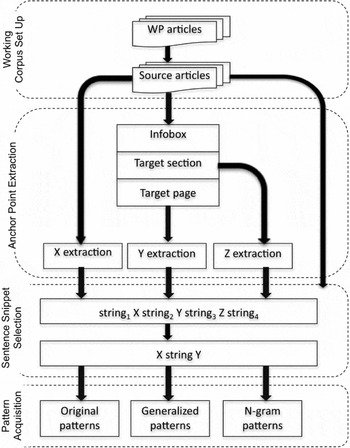
Learning the set of candidate paraphrase patterns (1A in Figure 1) proceeds in four steps, reflected in Figure 3. First, the working corpus is set up (Section 4.1.1). Second, collections of anchor points are extracted (Section 4.1.2). Anchor points are then used for sentence selection in the text, and relevant snippets are subsequently extracted from these sentences (Section 4.1.3). Finally, candidate paraphrase patterns are obtained from these snippets applying additional processes (generalization and ngram modelling) when needed (Section 4.1).
The process of learning the set of candidate paraphrase patterns.

4.1.1 Working corpus set-up
Our corpus consists of the Spanish Wikipedia and the English Wikipedia. We downloaded the versions of February 2009 into an MySQL database from Wikipedia dumps. We used the JWPL software (Zesch, Müller, and Gurevych Reference Zesch, Müller and Gurevych2008)Footnote 30 to access Wikipedia. Although the use of Wikipedia dumps prevents us from working on the latest version of Wikipedia, it allows us to perform the experiments on a static version, avoiding the problems arising from content instability.
WRPA extracts source–target pairs and, from them, our paraphrase candidates, taking advantage of the following Wikipedia components:
• Source pages. Wikipedia pages describing source entities.
• Redirection pages that point to source pages.
• Infoboxes that are present in the source pages containing attributes corresponding to target entities.
• Target sections. Itemized sections in the source pages containing target entities.
• Target pages. Pages linked to source pages containing an itemized list of target entities.
• Category-page links, which assign categories to articles, and the category graph.
For each relation addressed, the first step is to collect Wikipedia articles corresponding to the source (e.g. person and author). To do so, we first select Wikipedia categories that correspond to the source. This process can sometimes be done straightforwardly: when the source corresponds to an existing Wikipedia category (‘person’ in the English Wikipedia), this category, which we call top category, is selected. When such a correspondence does not exist (‘author’ in the Spanish Wikipedia), a manual inspection is needed in order to get top Wikipedia categories related to the source.Footnote 31 A set of top categories is selected in this case. From this top category or top category set, the category graph of Wikipedia is traversed top-down following the subcategory links. Once the set of relevant categories and subcategories for a source has been established, we collect the set of pages under them using the category-page links. These pages constitute the working corpus for each relation addressed. The working corpora are then cleaned and segmented into sentences.
The second step is to collect target-related infobox attributes (e.g. date_of_birth and work). Again, this task can sometimes be done straightforwardly and sometimes it requires further work. For the person experiments, we took advantage of the set of generic attributes and mappings to specific ones provided in the framework of the Slot-Filling Task in the TAC KBP contest.Footnote 32 Thus, we only had to select the generic attributes corresponding to our target entities. For the authorship experiment, we had to follow a less direct approach: we collected all the infoboxes with their attributes occurring in the working corpus and we manually selected the ones containing an attribute referring to works. Once the set of relevant infobox attributes was built, the pages in the working corpus containing any of these attributes were selected. They constituted what we call the learning corpus.
In our work, we talk about different partitions of the same corpus, namely Wikipedia: (1) the whole English Wikipedia and Spanish Wikipedia, our point of departure data sources; (2) the working corpus, which consists of the source pages; and (3) the learning corpus, which consists of the source pages containing a target entity in the structured information, i.e. infoboxes and/or target sections, and the target pages (see Section 4.1.2).
4.1.2 Anchor point extraction
In this step, the set of the source and target entities is extracted. These entities will be used as X and Y anchor points, respectively, in the candidate paraphrase extraction process.
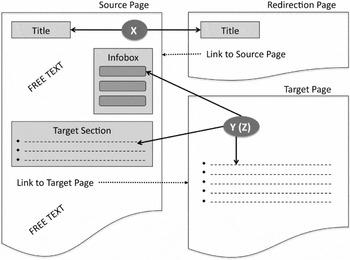
As shown in Figure 4, we extract X anchor points from the titles of source pages; Y anchor points, in turn, are extracted from infoboxes, target sections and target pages. We sometimes extract a third anchor, Z, which consists of additional information complementing Y. The relation holds between X and Y; Z simply makes Y more reliable. Z, when present, is extracted together with Y. In our experiments, Z is only obtained for authorship and corresponds to the work date.
Anchor point extraction from Wikipedia.

X extraction is simpler than Y extraction. Once the source pages have been selected (Section 4.1.1), X extraction simply consists in looking for it in the title of each of these pages. Name variants for X, when they exist, are also extracted from redirection pages linked to the source page and/or from infobox attributes such as ‘alternate names’ or ‘nicknames’.
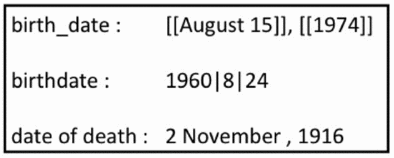
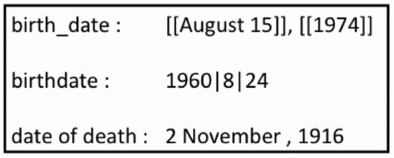
In the case of Y, a first set of anchor points is extracted from infoboxes. As information encoded in the attribute values shows variability (e.g. the variable format of the dates in Figure 5), we learned a set of grammars for extracting these values: date, date+place, place and work grammars in our experiments. Grammars were inferred using the ALERGIA system (Carrasco and Oncina Reference Carrasco, Oncina, Carrasco and Oncina1994), an efficient stochastic regular grammar inference engine that learns only with positive examples. Probabilities in ALERGIA-generated grammars were not taken into account.
Infobox attributes and their values.
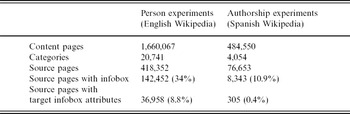
In the case of person experiments, information extracted from infoboxes is enough for Y anchor point extraction, because, as can be seen in Table 1, (i) the English Wikipedia is extensive enough, (ii) there is a relatively high number of person pages with an infobox, (iii) many of the target attributes appear in person infoboxes and (iv) attributes are univalued, allowing for an easier and more accurate extraction. However, in the authorship experiment, the coverage of Ys in infoboxes is low, because (i) the Spanish Wikipedia is smaller, (ii) few author pages have an infobox, (iii) few infoboxes have a work attribute and (iv) this attribute is multivalued consisting of an unconstrained string with possible noise.
Counts for relevant Wikipedia pages for authorship and person experiments

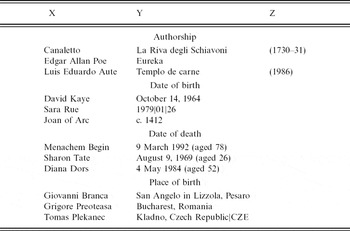
In order to improve the recall of the target entities in the authorship experiment, we take advantage of, when they exist, the target sections and the links to target pages. Target sections present the difficulty involved in obtaining the section limits (heading and ending), a lack of homogeneity in the format and the presence of complementary material which results in noise. By way of illustration of the productivity of target sections and pages, Paul Auster's infobox lacks the work attribute. In contrast, 33 works (25 were correct) were extracted from the target section and 18 (all correct) were added from the target page. Table 2 contains some anchor points extracted by WRPA.
Anchor point examples

4.1.3 Sentence snippet selection
Sentence snippet selection consists of first gathering the sentences that contain the anchor points in the body of the articles, and second selecting relevant snippets within these sentences.
Sentences are extracted from the free text of the same pages where the corresponding pair of anchor points has been extracted from the structured information. Sentences extracted by our method present the following structure:
 \begin{equation}
string_1\; X\; string_2\; Y\; string_3\; Z\; string_4
\end{equation}
Here, X, Y and Z stand for our entities or anchor points. They may occur in any order (what is shown in the above formula is the canonical order). Stringi stands for a snippet of text. Only the anchor Y is mandatory and it is looked for firstly. In case X occurs before or after Y, the string between these two anchors is string 2. In this case, string 1 is not used. If Z occurs, the string between Y and Z is string 3. In this case, string 4 is not used. In case X or Z are not present, the distinctions between string 1 and string 2, or string 3 and string 4, respectively, are no longer relevant. In these cases, the beginning and the end of the sentence are taken as limits. Table 3 shows frequency information for different orderings.
Sentence snippet counts for authorship. The underscore equals to a string of text. When no underscore appears, the text appears between the variables

In order to improve the recall, we look for all the variant forms in which X and Y can be expressed. In order to expand X, apart from using the variants obtained in the anchor point extraction step, we apply a person–name grammar (Arévalo, Civit, and Martí Reference Arévalo, Civit and Martí2004) to each entity. In order to expand Y, the grammars used for the extraction of infobox attribute values are also used for the generation of Y variants. One of WRPA's strengths for learning a large number of patterns is the use of anchor point variants instead of restricting the search to the original ones alone. By way of illustration, in the authorship experiment, the average number of variants for X is 5.2. Using only the initial anchor point instead of the whole set of variants obtains only 28% of the total of patterns.
Relevant sentence snippets are subsequently extracted. The criterion for selecting them depends on its frequency and the presence and order of X, Y and Z. In the following, we will concentrate on XY and XYZ snippets. We hypothesize that the most relevant information expressing the relation can be found between a source and a target in that order, as the former is likely to correspond to the subject of the sentence and the latter to the object, and the canonical sentence order is SVO. Also, this subset is common in our learning corpus, as can be seen in Table 3 for the authorship experiment. The set of snippets only containing Y is larger because subject (normally the X) elision is extremely frequent in Spanish. We decided not to work with this subset because the absence of X makes it much less reliable. Moreover, including YX patterns might result in a set of snippets different in nature from XY patterns; however, again, this would involve an increase of noise. We are leaving these issues for future work.
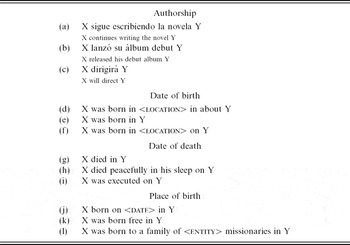
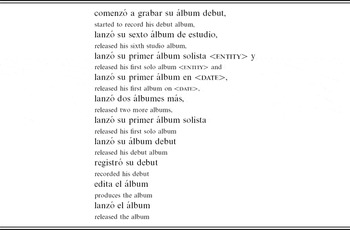
Table 4 shows examples of XY snippets extracted by our method. In the case of proper names, numbers and dates, we replaced specific words with their generic tags to reduce sparseness (e.g. < location > or < date >).
Sentence snippet examples

4.1.4 Pattern acquisition
Pattern acquisition consists of transforming sentence snippets into candidate paraphrase patterns. The process is more demanding in the case of complex relations such as authorship, due to the high variability of the sentence snippets and their low relative frequency. In simple relations such as date of birth, the sentence snippets are less variable and more frequent and, thus, the process is more straightforward.
For simple relations, the obtained snippets are simply transformed into regular expression patterns. For instance, the snippet in (f) in Table 4 is transformed into the regular expression X +was +born +in + < location > +on +(.+).*. The underlined group in the regular expression must be recognized by the grammar that corresponds to the target (in this example, the date grammar). This consistency check allows for the removal of many spurious candidates extracted by the pattern matching mechanism. For complex relations, the direct use of the snippets as patterns leads to severe overfitting and further work is therefore needed. We have developed two approaches: generalization and ngram modelling.
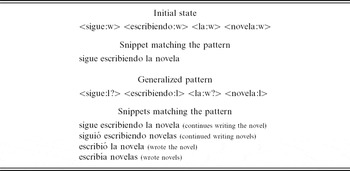
Generalization aims to extract patterns accounting for a larger number of texts from our initial sentence snippets. It implies going from a representation of the snippet as a sequence of words to its representation as a sequence of tokens with word forms, lemmas and PoS tags. Additionally, each token can be mandatory, skippable or omitted. The generalized pattern will be subsequently transformed into a regular expression formula.
In concrete, we first perform PoS tagging and named-entity recognition and classification on sentence snippets using the Freeling toolbox (Padró et al. Reference Padró, Collado, Reese, Lloberes and Castellón2010).Footnote 33 Then, we represent each token in the snippet as a < word, lemma, PoS, matching condition > tuple as shown in Table 5. Conditions state which part of the token has to be matched (w for word, l for lemma, or p for PoS) and its mandatory, skippable (?) or omitted (-) nature. Before generalization, all tokens fulfil the w condition. Snippets longer than 10 tokens are removed.
Generalization pre-process corresponding to (a) in Table 4

Then, generalization is performed using an A* approach (Nilsson Reference Nilsson1982). The search is controlled by three parameters: N, minimum number of matches with other snippets; M, maximum number of states to be traversed; and B, maximum number of generalized patterns to be returned.Footnote 34 The search proceeds until either of the following conditions is fulfilled: (i) a state matching at least N other snippets is reached or (ii) the number of traversed states reaches M. Once either of these stopping criteria is fulfilled, the B best scored patterns are returned. Note that the algorithm returns an optimum value only when the first halting criterion (N matches) holds, the second condition (M states) only prevents an expensive and unsuccessful search. In each state, snippets are represented as a sequence of <word, lemma, PoS, matching condition> tuples. The operators allow for moving from w to w?, from w? to l and so on. An example of the generalization process can be seen in Table 6.
Generalization process corresponding to Table 5

As the number of applicable operators in each state is huge, we perform a clustering of the candidates using an agglomerative approach with Levenstein distance as measure in order to reduce the search space. In this way, pattern generalization is carried out within each cluster and a set of generalized patterns is obtained from each cluster independently. Table 7 shows the contents of one of these clusters.
Cluster example

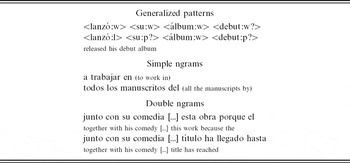
A final filtering sets the number of tokens fulfilling the w condition in a pattern from 1 to 4 (one of them being a common noun or a main verb) and the number of words fulfilling the p? condition from 0 to 4. The reason for establishing such restrictive constraints is that we are looking for patterns with lexical content. Not establishing these constraints would result in paraphrase candidates with no text between X and Y, or only functional words or punctuation marks between them, which are not relevant for our purpose of building paraphrase corpora. Examples of generalized patterns can be found in Table 8 (they are derived from the seventh example in Table 7).
Generalized pattern and ngram examples

The alternative approach to generalization is the use of ngram fragments between the involved anchor points. This can be considered to be an intermediate approach between generalization and a pure bag of words clustering, which is not appropriate for our purposes because word order is pertinent. In this approach, all word ngrams of any length are extracted from all the sentence snippets of the form XY[Z]. This set of ngrams is filtered to remove those not including any main verb or common noun. Moreover, a frequency threshold is used in order to discard infrequent ngrams. Finally, a regular expression is built for each remaining ngram, including the ngram within the anchor points and possibly a snippet of text (stringi) with a limited length (LL, in tokens) between both X and the ngram and between the ngram and Y (|stringi| ⩽ LL).
 \begin{equation}
X\; \{string_1\}\; ngram\; \{string_2\}\; Y
\end{equation}
We also build patterns including a pair of ngrams between X and Y:
 \begin{equation}
X\; \{string_1\}\; ngram_1\; \{string_2\}\; ngram_2\; \{string_3\}\; Y
\end{equation}
Examples of the so-called simple and double ngrams can be found in Table 8.
4.2 Learning the classifiers
The next steps in WRPA are learning a relation classifier, which classifies a specific pattern as an example or not of the relationship of interest (1B in Figure 1), and learning a paraphrase classifier, which decides, given a pair of patterns for a relation, whether or not they are paraphrases (1C in Figure 1). In both cases, we used a supervised approach for learning decision trees in the WEKA toolbox (Hall et al. Reference Hall, Frank, Holmes, Pfahringer, Reutemann and Witten2009).Footnote 35 In the experiments reported in this paper, we built these two classifiers for the authorship relation only. The simpler nature of person experiments made this process unnecessary.
4.2.1 Learning the relation classifier
In order to build the classifier, we first created a learning data collection. With this aim, the set of candidate paraphrase patterns was applied to the body of the articles in the learning corpus and 977 instances that matched different patterns were randomly selected. They were then manually annotated using the CoCo annotation tool (España-Bonet et al. Reference España-Bonet, Vila, Rodríguez and Martí2009).Footnote 36 The annotation consisted in deciding whether the pattern instances expressed an authorship relation or not. By way of illustration, the instance (a) in Table 9 is a positive example and (b) is a negative one.
Relationship annotation

The classifier was learned using a total of 5,231 features extracted from this set of instances. These features consisted of the most frequent nouns, verbs and their lemmas, the most frequent word ngrams (Section 4.1), and the most frequent subpatterns containing a verb or a noun. The relation classifier resulted in 32 rules corresponding to branches of the decision tree and 1,067 nodes. It has a depth of 87 and the average length of branches is 33.34. We finally applied this classifier to the whole set of candidate paraphrase patterns and selected the positive ones.
4.2.2 Learning the paraphrase classifier
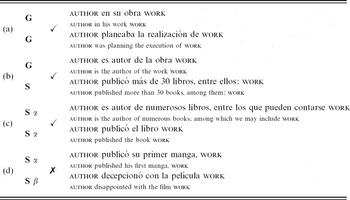
In order to create the learning data set, we collected the pairwise cross product of all the patterns considered as positive by the relation classifier. We then applied them to the learning corpus and 8,746 instance pairs that matched different patterns were randomly selected for manual annotation using the CoCo interface. The manual annotation consisted of determining whether the pairs were paraphrases or not. Our point of departure is that while what we call general authorship expressions can be applied to any type of authorship (e.g. is the author of can be applied to painting, writing, inventing, etc.), concrete authorship expressions can only be applied to one or some types (e.g. wrote can only be applied to writing). In the light of these ideas, the basic criteria were to annotate as paraphrases those pairs where both members expressed general authorship ((a) in Table 10) and those pairs where one member expressed general authorship and the other expressed concrete authorship (b). In the latter case, the meaning of the general case includes the meaning of concrete one. The specific–specific authorship relations were annotated as paraphrases only when they belonged to the same type(s) (c). When they did not belong to the same type(s), they were mutually exclusive and thus annotated as non-paraphrases (d).
Paraphrase annotation. G(eneral), S(pecific). α and β are authorship types

The classifier was learned using a total of 234 features measuring different types of overlapping, including the most frequent words, word ngrams, lemma ngrams and tree edit distance information calculated with the EDITS suite (Kouylekov and Negri Reference Kouylekov and Negri2010).Footnote 37 The paraphrase classifier resulted in 55 rules.
Although the classifiers are only built for authorship and for Spanish in this work, they can be built for other relations and languages as the features, i.e. the most frequent nouns, verbs, etc., are not fixed but extracted from the set of instances corresponding to the relation in question.
5 Validating the WRPA method and components
WRPA validation consists in evaluating the set of candidate paraphrase patterns and the two classifiers (2 in Figure 1). Candidate patterns are validated according to their ability to match a snippet of text ending in a correct Y. Following this approach, we applied the set of patterns to the body of the articles in the learning corpus: we looked for the occurrences of any variant of X in the sentences in the learning corpus (X is determined by the author in the title of the source page) and applied the pattern in order to obtain all possible Ys (corresponding to that X). We then computed their precision, recall and F1. The values for frequency, i.e. number of occurrences of each pattern, were also obtained.
In the case of precision, if the resulting Y is a variant or the original Y, the agreement is positive. For estimating recall, in the case of relations linked to univalued attributes, i.e. person experiment, we make the conservative assumption that all the pages contain at least a Y corresponding to each relation in the free text. Obviously, this is not always the case, because many pages lack these relations or some of them are simply not pertinent (e.g. a date of death is not adequate for living people). For each relation, recall is thus the ratio between the number of Ys recovered by the obtained patterns and the total number of pages in the learning corpus. In the case of multivalued attributes, i.e. the authorship experiment, it is not easy to hypothesize how many works occur in Wikipedia pages, so there are no clear ways to measure recall automatically. As an approximate alternative, we select the author pages containing links to their corresponding work pages and assume that all the works by an author can be obtained from these work pages. This resulted in 46 works per author on average. We then select from these works the ones appearing in the author page free text, which resulted in 13 works per author on average. We then compute the recall as the ratio between the number of Ys recovered by our patterns and the total number of Ys in the work pages occurring in the author pages. Thus, recall is only measured using author pages containing a link to a work page.
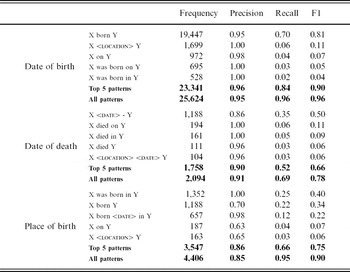
Table 11 presents the number of occurrences, precision, recall and F1 for the five most frequent patterns (individual and overall values) and the results for all the patterns in each person relation. As can be seen, the frequency is considerably higher in the first or first two patterns. Precision is very high in all cases, due to the relatively low variability of the patterns, and the fact that patterns have not undergone generalization or ngram processes. Date of birth resulted in a high recall, basically due to the high recall of the first and most frequent pattern. In the case of date of death, the recall is lower due to the conservative criteria used for defining it.
Person experiment results

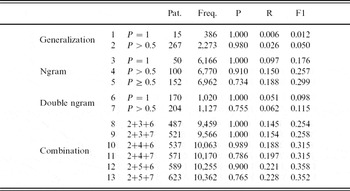
The results for authorship are shown in Table 12. We set out the results of the generalization, ngram and double-ngram approaches individually (rows 1–7). After removing the patterns showing a precision under 0.5, we split the remaining patterns in each approach into three groups: those having a precision of 1, those having a precision of between 0.5 and 1, and those having a precision of 0.5, respectively. Results are shown in a cumulative way in Table 12. The third group is empty for some sources. The evaluation of several combinations between the top sets is also presented (rows 8–13).
Authorship experiment results. Pat.=number of patterns; Freq.=frequency; P=precision; R=recall

Patterns coming from generalization are more precise than those obtained from ngrams and double ngrams, though the latter show better recall. As patterns within each approach are sorted decreasingly by precision, increasing the number of patterns results in an improvement in recall at a cost of a drop in precision. The results of the different combinations, in turn, are significant since they demonstrate that the generalization and ngram approaches are complementary for pattern building, which allows for the acquisition of non-overlapping data. As an illustrative example, the overlapping between the works extracted by the pattern subsets shown in rows 2 and 4 is only 6%. The relatively low recall in all cases is due to the greater difficulty of the task and the constraints we have imposed, namely that they must contain at least a common noun or a main verb. Limiting ourselves to XY patterns also contributes to a drop in recall.
As our objective is to build paraphrase corpora, our main interest is to obtain precise and linguistically rich paraphrases rather than a high recall. Actually, we observed that some patterns with a low recall are, in some sense, more interesting from a linguistic point of view. Patterns such as X escribi Y (‘X wrote Y’) show a high recall and the recall is lower in cases such as X haba por fin publicado Y (‘X finally published Y’). However, the second pattern is linguistically richer and therefore of greater interest for the analysis of the linguistic mechanisms underlying paraphrasing.
Regarding the classifiers, they were validated using 10-fold cross-validation. The relation classifier achieved an accuracy of 85% and the paraphrase classifier an accuracy of 76%.
A direct comparison of the whole task of relational paraphrase corpus building to related approaches is not possible because no comparable corpora exist. However, we can perform a partial comparison of the subtask of learning the set of candidate paraphrase patterns to works on pattern acquisition.
One of the relations used in this paper to illustrate our approach, namely, date of birth, is also explored by Ravichandran and Hovy (Reference Ravichandran and Hovy2002). Ravichandran and Hovy (Reference Ravichandran and Hovy2002)’s patterns differ from ours in four main aspects:
• They extract patterns from the web, while we extract them from Wikipedia.
• They accept XY and YX patterns, while we limit ourselves to the former.
• They extract patterns split into prefix, infix and suffix strings, while we limit ourselves to infixes.
• We apply a consistency check (grammar application) of the obtained Ys to ensure grammaticality, while they apply a simple matching procedure.
In their paper, a list of the 10 most precise patterns for this relation is presented. Three of them are comparable to ours (they consist of XY infixes) and also appear in the top positions in our set: X was born on Y, X was born in Y, X was born Y. In Ravichandran and Hovy (Reference Ravichandran and Hovy2002), these patterns have a precision of 0.85, 0.6 and 0.59, respectively. In our work, these patterns have a precision of 1.0 in all three cases (Table 11 shows the first two cases). Our better results in precision are due to the structured and more limited nature of our corpus, and the consistency check performed. Although no recall information is provided by Ravichandran and Hovy (Reference Ravichandran and Hovy2002), we assume that our recall is lower, due to our less expressive patterns (only infixes and XY patterns are extracted) and our smaller corpus.
Regarding authorship, a comparison to the DIPRE system (Brin Reference Brin, Atzeni, Mendelzon and Mecca1999) can be made, although DIPRE and WRPA differ in two main aspects: first, DIPRE is applied to English and WRPA to Spanish; second, DIPRE is only applied to the author–title (books) relation and WRPA to authorship in general. DIPRE patterns are again more expressive (YX patterns are accepted, as well as prefixes and suffixes) than ours and come from a greater but less reliable source (24 million web pages). Brin (Reference Brin, Atzeni, Mendelzon and Mecca1999) does not provide values for precision and he performs a qualitative analysis of the results instead. DIPRE acquires 3,972 occurrences of books after convergence. Even though this result does not correspond to the whole authorship relation, it is comparable to our snippet counts in Table 3 (4,338 for XY and 1,866 for YX).
6 Applying the WRPA method to build the WRPA corpus
The process of the construction of the WRPA corpus (3 in Figure 1) consists of candidate paraphrase pattern set application and filtering with the two classifiers. Contrary to the validation process, here the application of the patterns was performed on the free text of the whole working corpus, rather than on the learning one.
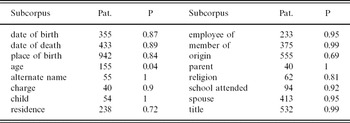
In the building of the WRPA-person corpus, the whole set of patterns was applied to the working corpus to obtain the number of occurrences. The patterns were then organized in three groups according to the relation involved. All patterns within each group are considered to be paraphrases of each other in the sense that they all express the same type of relation. This massive grouping is possible due to the low variability of person patterns. The WRPA-person corpus consists of 355 patterns with 27,581 occurrences for date of birth, 433 patterns with 3,261 occurrences for date of death and 942 patterns with 15,208 occurrences for place of birth.
For the building of the WRPA-authorship corpus, we selected the group of patterns with a higher F1 (row 12 in Table 12) and, from them, we selected the patterns accepted by the authorship classifier. Then, we obtained all the occurrences of these patterns from the working corpus, cross-paired them, computed the Levenstein distance between all pairs, sorted them by distance and discarded the most distant half. We finally applied the paraphrase classifier and collected the instance pairs accepted as paraphrases. The WRPA-authorship corpus consists of 81,101 pairs. The size of the WRPA-person and WRPA-authorship corpora is not comparable. The reason is, as already stated, that the person corpus is not expanded to all possible pairs, but presented as a single massive grouping.
In order to check the quality of the final WRPA-person and WRPA-authorship corpora, subsets for each were manually revised. WRPA-person validation consisted in manually revising 25% of the cases in each subcorpus to determine whether they were an expression of the corresponding relation. Besides using this revision for evaluation, the rejected patterns were removed from the corpus. Table 13 shows the final volume of each WRPA-person subcorpus and its precision. Moreover, a further validation was performed: the WRPA method was applied to 13 more person relationsFootnote 38 and the results were revised in the same way. The figures for these new relations can also be seen in Table 13. They constitute the WRPA-person-2 corpus.
WRPA-person and WRPA-person-2 validation. Pat.=number of patterns; P=precision

The precision for age shows a major decrease. Age, understood as a relation, is very unstable and it normally appears associated with concrete events in the life of a person in Wikipedia. This makes the value of the corresponding attribute in infoboxes highly variable. Due to its low precision, we decided not to include the age relation in the WRPA-person-2 corpus. The remaining relations show a high precision, only locations (place of birth, residence and origin) are slightly lower. A reason for that is that a same location may appear in a text expressing different relations. Also, locations sometimes do not appear in isolation, but combined in infoboxes (e.g. California, USA).
In the case of WRPA-authorship, the manual validation comprises two steps. The first step was previous to building the paraphrase pairs and consisted of a manual validation of 922 instances corresponding to different patterns. The objective was to reject those instances not expressing an authorship relation. The global precision obtained was 0.63. The second step was performed after building the paraphrase pairs and consisted in manually validating 1,000 of these pairs, stating whether they were paraphrases or not. The criterion used was the same as in Section 4.2.2. In this case, the precision obtained was 0.91.
7 WRPA corpus main features
The WRPA corpus consists of a collection of relational paraphrases extracted from Wikipedia.Footnote 39 In what follows, WRPA corpus main features are set out. In concrete, the nature of paraphrases in WRPA is discussed and compared with those in other paraphrase corpora. Also, we analyse the quantity, variety and quality of WRPA paraphrases. Then, some actual uses and applications of WRPA are presented. This section finishes with an analysis of the most common errors found in the corpus.
Paraphrase nature. Paraphrase multifaceted nature prevents from the creation of general and comprehensive paraphrase corpora, that is, paraphrase corpora covering the phenomenon as a whole. Only corpora covering specific paraphrase facets, directly linked to the way paraphrases were obtained, may be created. In this sense, some paraphrase corpora rely on the formal similarity between the paraphrase members in order to establish paraphrasability. Part of the MSRP, for example, was built using string edit distance. Other corpora apply transformations to one member of the pair in order to obtain the other. The P4P corpus was built in this way. Despite following different routes, both string similarity and transformation techniques generally cover paraphrases with some kind of formal mapping. In contrast, other corpora do not necessarily show formal similarity between the pairs. This absence of formal mapping may be the result of different gathering techniques. In the case of the MSRVD corpus, paraphrases are the result of using videos as stimulus. WRPA, in turn, follows the line of works that rely on the distributional hypothesis. In this case, as paraphrasability is established through context, what may be found in between is not predictable. By way of illustration, together with paraphrases with a high level of formal similarity (6), our corpus also contains paraphrases that are completely different in form (7).
- (6)
a. author realizó su primer álbum en solitario, work
author made his first solo album, work
b. author publicó su primer álbum en solitario, work
author released his first solo album, work
- (7)
a. author corresponden los títulos work
the titles work correspond to author
b. author es autor de los libros work
author is author of the books work
These ideas have been demonstrated in Vila et al. (Reference Vila, Bertran, Martí and Rodríguez2013), which presents the results of annotating 1,000 pairs of the WRPA-authorship corpus, together with the 856 pairs in P4P and 3,900 pairs of MSRP, with our typology of paraphrases (Barrón-Cedeño et al. Reference Barrón-Cedeño, Vila, Martí and Rosso2013), comprising 24 paraphrase types.Footnote 40 The same-polarity type, which includes cases of lexical-unit substitution, synonymy among them, is one of the most frequent types in the three corpora (25%–50% of the cases approximately). Addition–deletion is the other most frequent type in P4P and MSRP (12.91% and 25.94%, respectively); in contrast, the second most frequent type in WRPA is precisely semantic (16.22%), which includes those cases of semantic similarity where a formal mapping is not always possible.
The higher presence of semantic paraphrases in WRPA makes it a valuable resource in NLP, as this type of paraphrase presents considerable computational challenges and requires further study. Barrón-Cedeño et al. (Reference Barrón-Cedeño, Vila, Martí and Rosso2013) illustrate this in the field of automatic plagiarism detection: cases of plagiarism comprising semantic paraphrases are the most difficult to detect by plagiarism detection systems.
Next to the ideas that paraphrase multifaceted nature prevents from the creation of corpora covering the phenomenon as a whole and that only corpora covering specific paraphrase facets may be created, it is important to note that the presentation and organization required by these corpora can also be different: for example, the MSRP corpus is presented as a collection of sentence pairs; the WRPA corpus, in contrast, makes more adequate its presentation as a collection of patterns organized in sets/pairs for each relation.
Paraphrase quantity. The WRPA corpus currently covers 16 relations in two languages (English and Spanish). Moreover, it can be extended to any relation and language with sufficient coverage in Wikipedia by applying our acquisition method. Also, for each relation, a great number of paraphrases are provided. We consider that a total of 4,421 patterns for person and 81,101 pairs for authorship to be significant numbers. It is important to note that a direct numerical comparison between existing paraphrase corpora is not feasible due to their different nature.
Paraphrase variety. Through the variety of relations covered (simple and complex, and with univalued and multivalued targets), we observed that there is a spectrum between two extremes within relational paraphrasing. Very complex relations such as authorship show a high variability with respect to semantic content, that is why paraphrases cannot be combined in a single paraphrase grouping. Very simple relations such as date of birth show a low variability, so a single group is possible (Section 6). Between these two extremes there is a whole spectrum of possibilities. What all these relations share is the underlying paraphrase concept, which is wider than in corpora such as MSRP or P4P: in WRPA, paraphrases are those units expressing the same kind of relation, even though the semantic content is not always the same, as in example (8) for the alternate name relation.
- (8)
a. person also writes under the name person
b. person changed his name to person
Paraphrase quality. Taking advantage of Wikipedia-structured information and semantically labelled data to obtain our anchor points, as well as extracting our paraphrases from the body of the articles of the same encyclopaedia, allowed for the acquisition of reliable and consistent examples. The precision of the paraphrase pattern sets is good and their quality is further tested through the use of the two classifiers, whose accuracy is also reasonably high (Section 5). The same can be stated for the results of the manual validation of the corpus (Section 6).
Corpus applicability. WRPA is not fully accurate because it was automatically created without a final and complete human revision. Therefore, this corpus cannot be used as gold standard for evaluating paraphrase systems. However, it is useful in other NLP tasks. By way of illustration, patterns in WRPA-person were used in the Slot Filling Task in the TAC-KBP-2012 contest (Gonzàlez et al. Reference Gonzàlez, Rodríguez, Turmo, Comas, Naderi, Ageno, Sapena, Vila and Martí2012). Also, paraphrase corpora annotated with paraphrase types show a great potential for the study of the phenomenon of paraphrasing and the development of NLP tools involving paraphrasing. As already explained, a subset of WRPA-authorship was annotated with our paraphrase typology (Vila et al. Reference Vila, Bertran, Martí and Rodríguez2013).
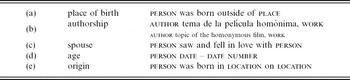
Due to the complexity of the task and the diversity of the paraphrase phenomenon, the method applied is not error free. In what follows, an analysis of the drawbacks present in the WRPA corpus is performed. According to Androutsopoulos and Malakasiotis (Reference Androutsopoulos and Malakasiotis2010) and Madnani and Dorr (Reference Madnani and Dorr2010), extraction methods based on the distributional hypothesis can produce pairs of templates that are not true paraphrase pairs, even though they share the same context. In fact, pairs involving antonyms are frequent. Lin and Pantel (Reference Lin and Pantel2001) find X solves Y to be very similar to X worsens Y, and the same problem has been reported by Bhagat and Ravichandran (Reference Bhagat and Ravichandran2008). WRPA is not different in this regard. It extracted cases of antonymy, such as (a) in Table 14 for place of birth; cases that do not express the relation in question, such as (b) for authorship; cases in which the relation does not necessarily hold, such as (c) for spouse; cases in which it is difficult to determine the adequacy of the pattern, such as (d) for age; and cases where there exists a confusion with other relations, such as (e) for origin, where the preposition on clearly introduces a date. These errors have been removed from the final corpus when detected in our manual revisions.Footnote 41
Patterns not expressing the expected relation

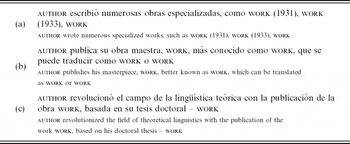
Other issues causing error in WRPA, specially regarding the authorship classifier, can be seen in Table 15. The example in (a) ends by a list of Ys instead of a single Y. The example in (b) introduces a series of alternatives to the name of the work (better known as or which can be translated as). In (c), a large amount of complementary information appears (revolutionized the field of theoretical linguistics and based on his doctoral thesis). These cases make the task more difficult.
Troubling instances

8 Conclusions and future work
In this paper, we set out the WRPA method and corpus: a method to build paraphrase corpora and a new corpus created accordingly. The WRPA method extracts relational paraphrases, that is, paraphrases expressing a relation between two entities, from Wikipedia. In concrete, it extracts entity pairs from structured information in Wikipedia applying distant learning and, based on the distributional hypothesis, uses them as anchor points for candidate paraphrase extraction from the free text in the body of Wikipedia articles. Some of the extracted paraphrases are then generalized following two complementary approaches, namely generalization and ngram processes. Also, two classifiers that take the candidate paraphrases as input were built: a relation and a paraphrase classifier. Due to the vastness and diversity of paraphrasing, the evaluation of such a task is a challenging issue in NLP. Focussing on the relational paraphrase framework and the use of Wikipedia-structured information allowed for a direct and straightforward evaluation of the results.
Paraphrase multifaceted nature prevents from the creation of general and comprehensive paraphrase corpora and only corpora covering specific paraphrase types or facets may be created. In this sense, the WRPA corpus is one more piece in the paraphrase puzzle, a piece that unveils paraphrase features not present in other types of corpora, making the words by Fillmore (Reference Fillmore and Svartvik1992) true: ‘every corpus I have had the chance to examine, however small, has taught me facts I couldnt imagine finding out any other way’. Contrary to corpora that rely on string similarity or transformation operations, WRPA relies on coincident anchor points. The form of the obtained paraphrases is the result of the free use of language and not the result of operations of transformation and reformulation.
The fact that the corpus currently covers both simple and complex relations, and two languages suggest that the WRPA method is independent of the language and relation addressed and that the corpus may be enlarged to new languages and relations. The only requisites are that there exist both Wikipedia and shallow linguistic tools (PoS tagging, lemmatizing, and named-entity recognition and classification) for that particular language, and that the relation appears in Wikipedia-structured information.Footnote 42
Also, finding numerous good entities, i.e. our source and target entities, is essential in our approach, since the quality and number of the obtained paraphrases depends in great measure on these entities. First, we guarantee their correctness by extracting them directly from structured and semantically labelled data. Second, the target entity is not only extracted from infoboxes but also from itemized information in or outside the source page. Also, several entity variant generation mechanisms are used both for the source and the target. Thus, this method allows for the acquisition of a large number of quality paraphrase variants, which makes the application of bootstrapping techniques unnecessary, thereby avoiding data degradation.
Finally, the usefulness of the corpus has also been discussed: WRPA corpus subsets have already been used successfully in paraphrase-type annotation (Vila et al. Reference Vila, Bertran, Martí and Rodríguez2013) and the Slot-Filling Task in the TAC KBP contest (Gonzàlez et al. Reference Gonzàlez, Rodríguez, Turmo, Comas, Naderi, Ageno, Sapena, Vila and Martí2012).
Potential lines for future work are (i) applying our method to other types of sentence snippets, such as < Y string X > or < string Y >, and to other relations and languages, (ii) evaluation on non-Wikipedia texts and (iii) studying the dependence between paraphrase extraction performance and the number of available Wikipedia pages, infoboxes and filled attribute values.