Introduction
Taxonomic investigations of the genus Bacidia s. lat. (Lecanoromycetes, lichenized Ascomycota) have a long tradition. Despite some recent studies, including classical taxonomic treatments and revisions (Ekman Reference Ekman1996, Reference Ekman, Nash, Ryan, Diederich, Gries and Bungartz2004; Dolnik Reference Dolnik2005; Czarnota & Coppins Reference Czarnota and Coppins2007; Llop & Ekman Reference Llop and Ekman2007; Brand et al. Reference Brand, Coppins, van den Boom and Sérusiaux2009; Llop & van den Boom Reference Llop and van den Boom2009) as well as a preliminary molecular phylogeny of Bacidiaceae (Ekman Reference Ekman2001), many problems remain unresolved. With the exception of the widely accepted genera Bilimbia and Mycobilimbia separated from the Bacidia s. lat., other related species with biatorine apothecia, transversely septate, acicular, bacilliform or fusiform ascospores, asci with a K/I+ dark blue apical dome with a pale, mostly conical apical cushion and more or less distinct ocular chamber were often included within this large genus (Coppins & Aptroot Reference Coppins, Aptroot, Smith, Aptroot, Coppins, Fletcher, Gilbert, James and Wolseley2009). The single locus (ITS) phylogenetic study by Ekman (Reference Ekman2001) showed, however, that Bacidia is not monophyletic, and many species described under this name are distantly related to the ‘core’ group, which includes B. rosella (Pers.) De Not., the type of the genus. Further, the ‘Bacidina group’ is regarded as representing a separate genus by several lichenologists (e.g. Vězda Reference Vězda1990; Wirth Reference Wirth1995; Ekman Reference Ekman1996, Reference Ekman, Nash, Ryan, Diederich, Gries and Bungartz2004; Hauck & Wirth Reference Hauck and Wirth2010) and rejected by others (e.g. Coppins & van den Boom Reference Coppins and van den Boom2002; Sparrius & Aptroot Reference Sparrius and Aptroot2003; Czarnota & Coppins Reference Czarnota and Coppins2006; Brand et al. Reference Brand, Coppins, van den Boom and Sérusiaux2009; Coppins & Aptroot Reference Coppins, Aptroot, Smith, Aptroot, Coppins, Fletcher, Gilbert, James and Wolseley2009). Indeed, the molecular affinity of Bacidia phacodes Körb. (chosen as the type of the genus by Vězda Reference Vězda1990) with other members of the ‘Bacidina’ group is ambiguous (Ekman Reference Ekman2001). Recent studies by Sérusiaux et al. (Reference Sérusiaux, Brand, Motiejunaite, Orange and Coppins2010) based on mtSSU data further confirmed that B. phacodes may belong to a different lineage.
It is obvious that further large-scale studies on Bacidia s. lat., including more representatives of ‘Bacidina’ and detailed analysis of the relationships between phenotypic and multilocus molecular characters, are needed to resolve the nomenclatural and taxonomic problems. This paper addresses two objectives: 1) to compare the use of a single phenotypic character, recently used for the delimitation of Bacidina arnoldiana (Körb.) V. Wirth & Vězda and B. sulphurella (Samp.) M. Hauck & V. Wirth (Brand et al. Reference Brand, Coppins, van den Boom and Sérusiaux2009; as Bacidia sulphurella Samp.), with molecular data; and 2) describe a new species in the genus Bacidina, known from a single saxicolous collection in the Czech Republic.
Materials and Methods
Taxon sampling
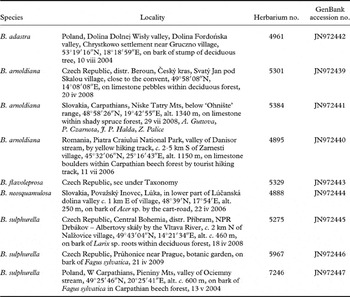
Newly generated ITS sequences of Bacidina spp., together with published sequences of many representatives of former Bacidiaceae (see Ekman Reference Ekman2001) downloaded from GenBank, (Ekman Reference Ekman2001; Schmull et al. Reference Schmull, Miądlikowska, Pelzer, Stocker-Wörgötter, Hofstetter, Fraker, Hodkinson, Reeb, Kukwa and Lumbsch2011) were used for the analyses. Detailed descriptions of the newly sequenced materials together with their GenBank accession numbers are presented in Table 1, and GenBank accession numbers of all sequences used are given in Figs 1 & 2 after the species name.
List of newly sequenced specimens of Bacidina with location, reference collection details and GenBank accession numbers of their ITS rDNA sequences generated for the current study. All specimens were collected by P. Czarnota, unless otherwise stated and are deposited in GPN

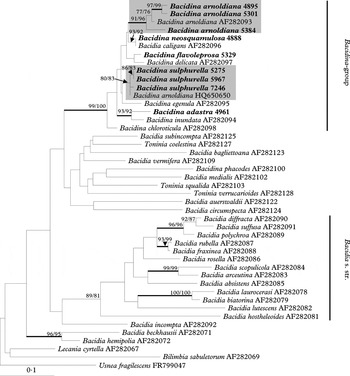
The most likely tree generated by phylogenetic analysis of ITS1 and ITS2 regions and 5.8S gene in PhyML 3.0 using TN93 model. Bootstrap supports ≥70 for ML (first value) and MP (second value) methods are indicated near branches. Branches with both bootstrap supports ≥90 are in bold. Names of the newly sequenced species are followed with their herbarium collection numbers and are marked in bold. Other species names are followed with their GenBank accession numbers. Usnea fragilescens was used as an outgroup. Bacidina arnoldiana and B. sulphurella clades are in grey boxes. Bacidina and Bacidia s. str. clades are marked on the right side of the tree. The Bacidina arnoldiana obtained from GenBank (HQ650650), in fact, represents B. sulphurella as suggested by its ecology (see text).

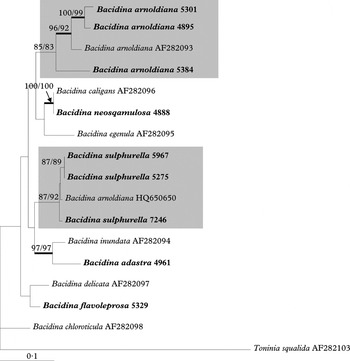
The most likely tree of selected Bacidina taxa generated by phylogenetic analysis of ITS1 and ITS2 regions and 5.8S gene in PhyML 3.0 using TN93 model. Bootstrap supports ≥70 for ML (first value) and MP (second value) methods are indicated near branches. Branches with both bootstrap supports ≥90 are in bold. Names of the newly sequenced species are followed with their herbarium collection numbers and are marked in bold. Other species names are followed with their GenBank accession numbers. Toninia squalida was used as an outgroup. Bacidina arnoldiana and B. sulphurella clades are in grey boxes. The Bacidina arnoldiana obtained from GenBank (HQ650650), in fact, represents B. sulphurella as suggested by its ecology (see text).

DNA extraction, PCR amplification and DNA sequencing
Fragments of thalli were used for total genomic DNA extraction using a modified CTAB method according to Guzow-Krzemińska & Węgrzyn (Reference Guzow-Krzemińska and Węgrzyn2000). DNA was resuspended in sterile distilled water. PCR amplifications were performed using Mastercycler (Eppendorf). PCR reactions of 50 µl volume were prepared using 5 µl of 10× Taq polymerase reaction buffer, 4 µl of MgCl2, 1 unit of Taq polymerase (Fermentas), 0·2 mM of each of the four dNTPs, 0·5 µM of each primer and 10–50 ng of DNA.
ITS rDNA region was amplified with ITS1F (Gardes & Bruns Reference Gardes and Bruns1993) and ITS4 primers (White et al. Reference White, Bruns, Lee, Taylor, Innes, Gelfand, Sninsky and White1990). The following conditions were used for PCR: initial denaturation at 95°C for 5 min followed by 35 cycles at 95°C for 40 s, 54°C for 45 s and 72°C for 1 min, and a final elongation step at 72°C for 10 min. PCR products were resolved on agarose gels in order to determine DNA fragment lengths. The residual oligonucleotides and dNTP's were then eliminated from the 20 µl of PCR products using 10 units of Exonuclease I (Fermentas) and 2 units of Shrimp Alkaline Phosphatase (Fermentas), starting with the incubation at 37°C for 35 min and followed by enzyme inactivation at 80°C for 20 min. DNA sequencing was performed by Macrogen®. The newly determined sequences (Table 1) were compared to the sequences available in GenBank using a BLAST search (Altschul et al. Reference Altschul, Gish, Miller, Myers and Lipman1990) to confirm their identity.
Sequence alignment and phylogenetic analysis
The new sequences were aligned with sequences of selected representatives of the genus Bacidia s. lat. and representatives of Ramalinaceae downloaded from GenBank, together with Usnea fragilescens as an outgroup. The Muscle algorithm as implemented in MEGA5 (Tamura et al. Reference Tamura, Peterson, Peterson, Stecher, Nei and Kumar2011) was used for the alignment, and eventually optimized by eye. Portions of the alignment with ambiguous positions were eliminated from the dataset; out of 585 characters in the alignment only 451 were subjected to analysis. As the number of characters eliminated was high, we performed additional analyses with a second dataset comprising only the Bacidina group, excluding B. phacodes, with Toninia squalida as an outgroup.
The phylogenetic analyses were performed using PAUP* 4.0b10 (Swofford Reference Swofford2001) with maximum parsimony (MP) as the optimality criterion. Heuristic searches were performed with 1000 random sequence additions and TBR branch-swapping; gaps were treated as missing data. Support for the branches was tested with the bootstrap method and 1000 pseudoreplicates.
We used ModelTest 3.8 (Posada Reference Posada2006) to infer the best-fit model of evolution to our datasets. The TN93 (Tamura & Nei Reference Tamura and Nei1993) model was selected based on the Hierarchical Likelihood Ratio Test for both datasets. ML analyses were performed with the fast likelihood software PhyML 3.0 (Guindon & Gascuel Reference Guindon and Gascuel2003; Guindon et al. Reference Guindon, Lethiec, Duroux and Gascuel2005), starting with a BioNJ tree. Using the same program, non-parametric bootstrap analyses were performed with 1000 bootstrap pseudoreplicates. The phylogenetic trees were visualized using TreeView (Page Reference Page1996) and TreeGraph 2 (Stöver & Müller Reference Stöver and Müller2010). Bootstrap supports ≥70% are given near the branches, but only clades that received bootstrap support ≥90% in both analyses (MP and PhyML) were considered as strongly supported and are marked in bold (Figs 1 & 2).
Hypothesis testing
To test whether our ITS rDNA data were consistent with a hypothesis of monophyly of the genus Bacidina, we performed the Shimodaira-Hasegawa (SH) test (Shimodaira & Hasegawa Reference Shimodaira and Hasegawa1999) under the likelihood method and TN93 model using the first dataset. An alternative topology tree constraining the monophyly of the Bacidina genus was generated and compared with the unconstrained most likely tree, employing the SH test using RELL bootstraps with 100 pseudoreplicates in PAUP* 4.0b10 (Swofford Reference Swofford2001).
We also tested if our data can reject an alternative topology for a monophyletic Bacidina arnoldiana group using the second dataset. We constructed a constraint topology with all accessions of B. arnoldiana and B. sulphurella in a single clade. We applied this constraint to searches under likelihood method and TN93 model as the unconstrained ML search. We employed the SH test using RELL bootstraps with 1000 pseudoreplicates in PAUP* 4.0b10 (Swofford Reference Swofford2001).
Haplotype network analysis
In order to provide insights into the variation of the Bacidina clade, a haplotype network was constructed using TCS 1.21 software (Clement et al. Reference Clement, Posada and Crandall2000). Alignment of ITS rDNA sequences was trimmed to 510 positions in order to make the sequences equal in length and the network was constructed using statistical parsimony (Templeton et al. Reference Templeton, Crandall and Sing1992) with a connection limit fixed to 25 steps and gaps treated as missing data.
Morphology and chemistry
All specimens were morphologically and anatomically studied under a Carl Zeiss Stemi DV4 stereomicroscope and a Carl Zeiss Axiostar plus light microscope. For measurements of algal cells, conidia, ascospores and apothecial structure dimensions, hand-cut preparations mounted in water were prepared. The size range of each apothecial character of the new Bacidina flavoleprosa was established based on at least 20 measurements. Drops of 10% KOH were used to separate excipular hyphae and other internal structures from an apothecial gel-matrix. Chemical analyses were carried out using thin-layer chromatography (TLC) with solvent C, according to Orange et al. (Reference Orange, James and White2001).
Results
Nine new ITS sequences from Bacidina spp. were obtained, including three for both B. arnoldiana and B. sulphurella and one for the new species B. flavoleprosa. ITS sequences from B. adastra (Sparrius & Aptroot) M. Hauck & V. Wirth and B. neosquamulosa (Aptroot & Herk) S. Ekman (Table 1) were also generated. In the first dataset, 45 ITS rDNA sequences were analyzed: of 451 characters, 222 were constant and 168 were parsimony-informative. Three most parsimonious trees of 976 steps were generated and a majority rule consensus tree was created (data not shown). A tree of a similar topology, except for a position of Bacidina phacodes, was generated using the maximum likelihood method that is presented in Fig. 1. However, the position of B. phacodes was not supported in both trees, thus its position remains uncertain.
Sixteen ITS sequences of Bacidina spp., together with Toninia squalida as an outgroup, were included in the second analysis: of 512 characters, 387 were constant and 58 were parsimony-informative. Ten most parsimonious trees of 222 steps were generated and a majority rule consensus tree was created (data not shown). A tree of a similar topology was created using the maximum likelihood method (Fig. 2).
Species belonging to Bacidina, including B. flavoleprosa sp. nov. described here, form a monophyletic clade that is strongly supported by bootstrap values (99 and 100 in ML and MP methods respectively) (Fig. 1). All representatives of the genus are resolved in this clade, except for B. phacodes that was found to be related to Bacidia medialis in the ML tree but without support and unrelated to this species in the MP tree (data not shown). Although it is the type species of the genus, it is not closely related to the Bacidina clade in any of our analyses. However, the SH test did not reject the monophyly of the Bacidina genus including B. phacodes (P=0·408).
The newly described B. flavoleprosa is nested within the Bacidina group with strong support and is related to Bacidina delicata (Larbal. ex Leight.) V. Wirth & Vězda, but without support. Further, the newly sequenced B. neosquamulosa (Aptroot & Herk) S. Ekman is resolved with strong support as closely related to B. caligans (Nyl.) Llop & Hladun: bootstrap values of 93 in ML and 92 in the MP method (Fig. 1), and 100 for both methods in our analysis of the Bacidina dataset (Fig. 2). The closest relative of B. adastra is B. inundata (Fr.) Vězda (Figs 1 & 2) and their relationship is highly supported in both optimization methods.
Within the Bacidina-group clade, newly available sequences of B. arnoldiana, together with that obtained from GenBank (AF282093), form a sub-clade that is highly supported (Figs 1 & 2). Our phylogenetic analyses also showed that all accessions of B. sulphurella form another sub-clade with bootstrap support of 93 in ML and 83 in the MP method (Fig. 1). However, a sequence obtained from GenBank (HQ650650) and labelled as B. arnoldiana is also resolved within this sub-clade. As this specimen was collected on the bark of Sambucus nigra in 2005 (AFTOL ID 1845), we strongly suggest that after recent taxonomic changes made by Brand et al. (Reference Brand, Coppins, van den Boom and Sérusiaux2009) it should be treated as B. sulphurella.
Moreover, the SH test rejected the null hypothesis with the topology constrained to force the monophyly of Bacidina arnoldiana and B. sulphurella at P<0·05, showing that the constrained tree is significantly worse than the ML tree. We can thus conclude that our molecular data support the distinction of those species.
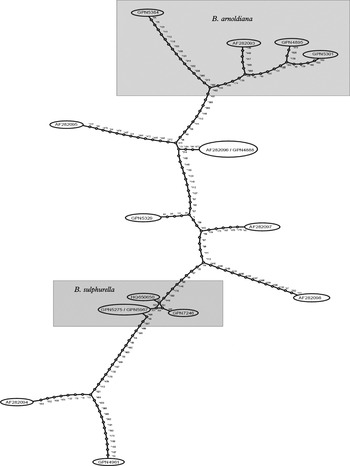
Further, a haplotype network was also constructed for the Bacidina group. The haplotypes that represent B. arnoldiana and B. sulphurella are in shaded boxes (Fig. 3). The ITS rDNA sequences obtained from specimens of B. arnoldiana are quite variable. The highest similarity (c. 98% of sequence identity) has been found between the samples from the Czech Republic (GPN5301) and Romania (GPN4895). These two haplotypes differ by 8 sites (Fig. 3). Other B. arnoldiana haplotypes (i.e. AF282093 and GPN5384) differ significantly from each other. Specimens of B. sulphurella are not as variable in the ITS rDNA region as those of B. arnoldiana. Three haplotypes were identified and one of them was found to occur in two specimens (GPN5275 and GPN5967), both collected in the Czech Republic. The Polish specimen of B. sulphurella (GPN7246) differs from samples collected in the Czech Republic in three nucleotide positions, in a similar way to the sequence obtained from GenBank (HQ650650) and labelled there as B. arnoldiana. The haplotype network analysis (Fig. 3) and phylogenetic trees (Figs 1 & 2) show its very close affinity to other specimens of B. sulphurella. Based on these data, as well as the information from the herbarium label of the corresponding specimen (AFTOL ID 1845), we suggest that this specimen should be referred to B. sulphurella. Moreover, the haplotype that represents Bacidina neosquamulosa (GPN4888) was found to be identical with the sequence obtained from B. caligans (AF282096) downloaded from GenBank.
Haplotype network constructed from ITS rDNA sequences of Bacidina clade using TCS 1.21 software with a connection limit fixed to 25 steps and gaps treated as missing data. Each line connecting circles is one mutational difference. Each haplotype is represented by a single individual, except for two B. sulphurella specimens (GPN5275 and GPN 5967) and B. caligans (AF282097) and B. neosquamulosa (GPN 4888). Haplotypes representing B. arnoldiana and B. sulphurella are in shaded boxes that correspond to B. arnoldiana and B. sulphurella sub-clades in Figs 1 & 2.

Phylogenetic affinities within Bacidia s. str., and positions of B. beckhausii Körb. and B. hemipolia (Nyl.) Malme outside the clades of Bacidia s. str. and Bacidina, agree with the results presented by Ekman (Reference Ekman2001).
Discussion
The genus Bacidina (sensu Ekman Reference Ekman1996, Reference Ekman, Nash, Ryan, Diederich, Gries and Bungartz2004) is variable and its monophyly was questioned by Ekman (Reference Ekman2001), who showed that B. arnoldiana, B. caligans, B. chloroticula (Nyl.) Vězda & Poelt, B. delicata, B. egenula (Nyl.) Vězda and B. inundata form a well-supported monophyletic group, with B. phacodes being resolved outside that clade and close to Lecania naegelii (Hepp) Diederich & van den Boom. Recent studies by Sérusiaux et al. (Reference Sérusiaux, Brand, Motiejunaite, Orange and Coppins2010) based on another DNA locus (mtSSU) rejected such a close relationship of the latter two species as they are nested in different lineages. We could obtain sequences of further species, including Bacidina adastra, B. flavoleprosa sp. nov., B. neosquamulosa and B. sulphurella, and additional specimens of B. arnoldiana. All those species are resolved within a highly supported monophyletic clade of Bacidina, except for B. phacodes that remains excluded from this group. However, we were not able to reject the monophyly of the genus Bacidina with the SH test (P=0·408) when including B. phacodes. Further sequences of the type species must therefore be generated, as well as from many other species that can be phenotypically referred to this group, to resolve the circumscription of the genus Bacidina.
Separation of the two very similar species B. arnoldiana and B. sulphurella, based on morphological and ecological characters, has recently been made (Brand et al. Reference Brand, Coppins, van den Boom and Sérusiaux2009). Molecular data analysis presented here showed that these two taxa are nested within the ‘Bacidina group’ as expected, and belong to two closely related but independent sub-clades within our phylogenetic tree (Figs 1 & 2), both being well supported in ML and MP analyses. Moreover, the SH test rejected the monophyly of a clade formed by Bacidina arnoldiana and B. sulphurella at P<0·05 and thus provided support for the delimitation of these two taxa. Additionally, haplotype network analysis showed that Bacidina sulphurella is represented by very similar haplotypes, whereas B. arnoldiana is much more variable (Fig. 3).
As summarized by Crespo & Pérez-Ortega (Reference Crespo and Pérez-Ortega2009), detection of a phylogenetic signal, together with biogeographical or ecological patterns, but in the absence of other easily recognizable morphological or anatomical characters, lead to the presence of the so-called cryptic species. The case of Bacidina arnoldiana and B. sulphurella shows that, beside subtle morphological characters such as the shape of conidia, ecological data are very important features for recognition of the new taxa, as previously shown by other authors, such as occurrence of Parmelia serrana A. Crespo, M. C. Molina & D. Hawksw. on bark and P. saxatilis (L.) Ach. on rock (Molina et al. Reference Molina, Crespo, Blanco, Lumbsch and Hawksworth2004) or taxa within the Caloplaca citrina group (Vondrák et al. Reference Vondrák, Říha, Arup and Søchting2009). In our paper, a correlation between ecology as well as the shape of conidia, regarded as a diagnostic character for the separation of Bacidina arnoldiana and B. sulphurella, and variation in their ITS sequences has been confirmed. This suggests that the shape of conidia could be an important feature in the taxonomy of lichenized fungi. It has a particular meaning for the correct identification of Bacidia s. lat., since the members of Bacidina with long, filiform conidia differ from Bacidia s. str. producing small bacilliform or shorter and thinner filiform conidia (Vězda Reference Vězda1990). Within Bacidina there are several very similar species, sometimes lacking typical apothecial pigmentation, for which the length and shape of conidia are crucial for their recognition, especially as they often occur in an anamorphic stage.
The newly described species B. flavoleprosa is also nested within the ‘Bacidina group’ (Fig. 1). The molecular analysis of ITS data, as well as its sorediate thallus composed of goniocysts, and acicular ascospores, support its description within the genus Bacidina (sensu Ekman Reference Ekman, Nash, Ryan, Diederich, Gries and Bungartz2004). Although the thallus of B. flavoleprosa resembles B. adastra, and its apothecial structure and pigmentation are similar to B. brandii (Coppins & van den Boom) M. Hauck & V. Wirth, our molecular inferences point to a close relationship with B. delicata (Figs 1 & 2).
Taxonomy
Bacidina flavoleprosa Czarnota & Guzow-Krzemińska sp. nov.
MycoBank No.: MB 800631
Bacidinae brandii similis sed thallo sorediato differt.
Typus: Czech Republic, Central Bohemia, Středočeská pahorkatina foothills, c. 0·3 km W of Líchovy village by the road between Sedlčany and Přibram towns, 49°40′31″N, 14°18′59″E, alt. 350 m, vertical walls of siliceous rocks, 20 April 2008, P. Czarnota 5329 (GPN—holotypus).
(Fig. 4)
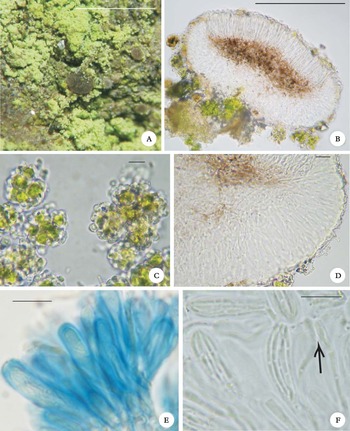
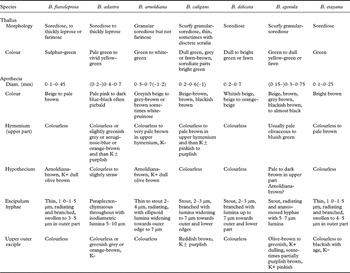
Bacidina flavoleprosa [Czarnota 5329 (GPN—holotype)]. A, habit; B, apothecial section; C, goniocysts surrounded by protuberant hyphae; D, excipular hyphae; E, asci; F, ascospores and paraphyses (arrow). Scales: A=1 mm; B=100 µm; C–F=10 µm. In colour online.

Thallus sulphur-green, almost completely sorediate and forming large cracked patches of goniocysts, or sometimes thinner aggregations resembling punctiform soralia; goniocysts surrounded by protuberant hyphae; sometimes portions of the thallus close to apothecia ±crustaceous to minutely granular, thin, olive tinged. Photobiont chlorococcoid, cells 5–12 (–15) µm diam.
Apothecia rather rare, simple or often forming small groups, 0·10–0·45 mm diam., beige to pale brown, at first constricted at the base with shallow, darker pigmented disc and a thick, distinctly paler, whitish beige margin; mature apothecia slightly convex with a margin pale, thin, almost invisible, but in cross-section remaining well-developed. Hymenium colourless throughout, 30–40 µm tall. Asci clavate to cylindrical, 25–35×5–7 µm; apical dome amyloid, K/I+ blue, apical cushion and ocular chamber invisible, or sometimes ocular chamber wide as in Ekman (Reference Ekman1996, fig. 5R). Ascospores acicular, ±straight, 25–30×1·0–1·5 µm, 1–3-septate. Paraphyses numerous, simple or forked above, hyaline throughout, 1·5–2·5 µm wide, apices slightly swollen to 3·5 µm. Hypothecium brown, at least in upper part, pigment Arnoldiana-brown, K+ dulling (Meyer & Printzen Reference Meyer and Printzen2000). Excipulum well-developed, colourless throughout, composed of thin, 1·0–1·5 µm wide radiating and branched hyphae, swollen to 3–5(–7) µm towards the outermost edge, bound in a gel-matrix that swells in K; the swollen cells much more visible in young apothecia.
Pycnidia unknown.
Chemistry. No substances detected by TLC.
Etymology. ‘Flavoleprosa’ from the sulphur-green, leprose thallus which is often the only phenetic feature of this lichen.
Remarks. The sterile, leprose thallus of Bacidina flavoleprosa most resembles the thalli of B. adastra and B. etayana (van den Boom & Vězda) M. Hauck & V. Wirth; both species, however, are not found on rocks (van den Boom & Vezda Reference van den Boom and Vezda1996; Dolnik Reference Dolnik2005; Coppins & Aptroot Reference Coppins, Aptroot, Smith, Aptroot, Coppins, Fletcher, Gilbert, James and Wolseley2009), while the new Bacidina is known only as a saxicolous species. The thallus of B. etayana is composed of small goniocysts surrounded by rather smooth hyphae, in contrast to the goniocysts of B. adastra (Dolnik Reference Dolnik2005) and B. flavoleprosa which are covered by protuberant hyphae (Fig. 4C). Differences between these species are distinct when they are fertile, since B. flavoleprosa has a hypothecium at least partially dark pigmented (Arnoldiana-brown, K+ olive-brown), and apothecial sections of B. adastra and B. etayana are hyaline throughout or sometimes aeruginose-blue in upper parts of the hymenium and upper outer edge of the excipulum (Dolnik Reference Dolnik2005; Coppins & Aptroot Reference Coppins, Aptroot, Smith, Aptroot, Coppins, Fletcher, Gilbert, James and Wolseley2009). Additionally, B. adastra forms a paraplectenchymatous exciple, while in B. flavoleprosa excipular hyphae are radiating, branched and only sometimes more swollen at their apices.
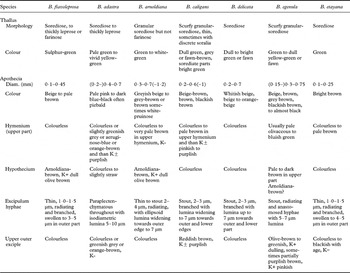
In terms of hypothecial pigmentation, B. flavoleprosa could be mistaken for B. arnoldiana and B. sulphurella, as well as B. brandii and B. egenula; all these species share the same Arnoldiana-brown pigmented hypothecium, at least in its upper part, but their thalli are never sulphur-green. Bacidina egenula does not form a leprose, almost mealy, thick and cracked thallus, but is usually thin and only slightly sorediose, olive to green coloured, and moreover has an olive-green epithecium and often an additional K± pinkish to purplish pigment in its upper outer exciple. The pale to dark brown apothecia of B. brandii are surrounded by a paler margin, and the size of asci, ascospores and hymenium resemble those found in B. flavoleprosa, but both species differ in their excipular hyphae: in B. brandii cell lumina reach up to 6–10 µm, while in B. flavoleprosa the hyphae are not, or only slightly, swollen at the apices up to 5(–7) µm. Bacidina brandii also has a granular-areolate, never sorediose thallus (Coppins & van den Boom Reference Coppins and van den Boom2002). Bacidina arnoldiana and B. sulphurella, in addition to the ±green, more coarsely granular thallus, the larger apothecia, the taller hymenium, longer ascospores and presence of pycnidia, differ from B. flavoleprosa ecologically. Saxicolous B. arnoldiana grows on calcareous substrata (Brand et al. Reference Brand, Coppins, van den Boom and Sérusiaux2009; Coppins & Aptroot Reference Coppins, Aptroot, Smith, Aptroot, Coppins, Fletcher, Gilbert, James and Wolseley2009) and B. sulphurella is an epiphyte. The main diagnostic features for B. flavoleprosa and other similar sorediose members of the genus Bacidina are presented in Table 2.
Main diagnostic features for Bacidina flavoleprosa and similar sorediose European representatives of the genus.
The phylogenetic trees presented here (Figs 1 & 2), based on ITS sequences, show a closer relationship of Bacidina flavoleprosa with B. delicata, that has a colourless hypothecium (Coppins & Aptroot Reference Coppins, Aptroot, Smith, Aptroot, Coppins, Fletcher, Gilbert, James and Wolseley2009), than to other representatives of the genus containing the characteristic hypothecial Arnoldiana-brown pigment and granular thallus. However, the support of this affinity is not strong. Further studies are necessary to resolve their relationships and the position of B. flavoleprosa, including more members of the Bacidina group with pigmented apothecia (e.g. B. brandii and others, perhaps not yet discovered). Indeed, B. delicata has a similar sorediate thallus to B. flavoleprosa, but it is never mealy and distinctly sulphur-green. Sorediate thalli also develop in several other European and North American Bacidina species, as well as in several foliicolous taxa (Spribille et al. Reference Spribille, Björk, Ekman, Elix, Goward, Printzen, Tønsberg and Wheeler2009); they most probably belong to the same taxonomic group. They differ from B. flavoleprosa as their thalli are never sulphur-green and their apothecia have an unpigmented hypothecium.
Distribution and habitat. The new Bacidina species is known only from locus classicus in the Czech Republic, where it was found on exposed, but not well-lit, N-facing vertical walls of granite boulders, close to a public road; the microhabitat was rather humid. A single lichen species, Arthonia muscigena, was detected nearby.
Martyna Zawiślak is acknowledged for technical assistance. A part of this study was financially supported by the University of Gdansk task grant no. DS/140-4-0114-10. Beata Guzow-Krzemińska also acknowledges the support of the Marie Curie European Reintegration Grant within the 7th European Community Framework Programme project no. 239343. We are grateful to anonymous reviewers for their valuable comments that improved the manuscript.